Best enterprise SEO tools in 2026, compared across crawl, rank and AI visibility
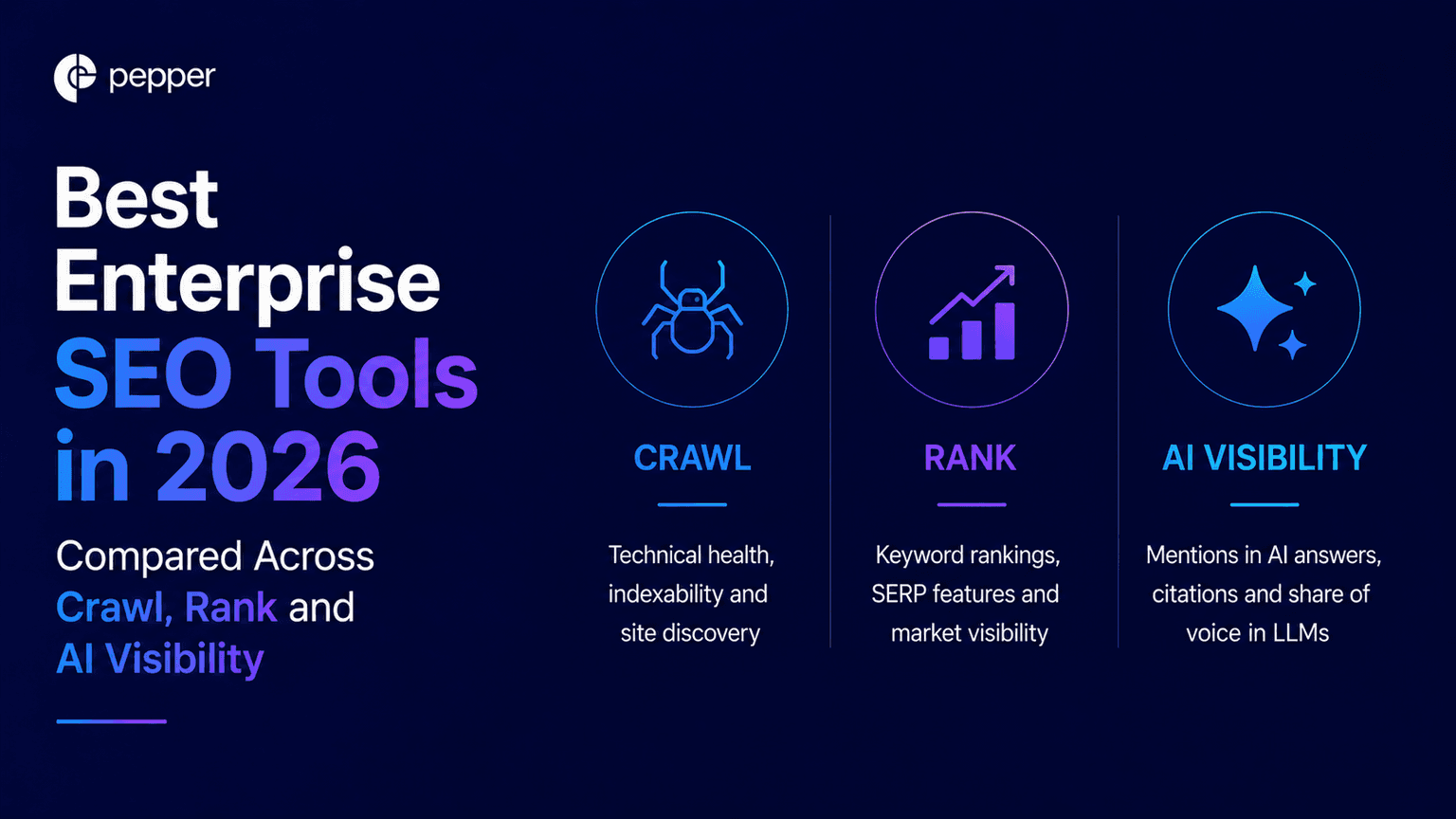
Enterprise SEO tools used to do two jobs. Crawl a large site properly, and track rankings at scale. In 2026 there is a third, and the way vendors have added it tells you a lot about how mature it is.
AI visibility is frequently sold as a paid add-on rather than included. seoClarity’s ArcAI is an optional extra on top of plans starting at $2,500 a month. SE Ranking’s AI Search tracking costs $71.20 a month on top of a base plan. Ahrefs sells Brand Radar AI as a separate product from $199. None of that is hidden, and all of it makes headline pricing misleading.
We have run organic for more than 250 enterprises across eight years, so we buy and operate these platforms rather than only reviewing them.
How we compared them
We did not run a lab test, and it is worth saying so directly, because several articles on this SERP claim months of hands-on testing without describing a reproducible method.
What we did instead is checkable. Every price, plan name, capability claim and AI feature below was verified at that vendor’s own site on 24 August 2026. Then we weighted the comparison by what actually decides outcomes on a large site.
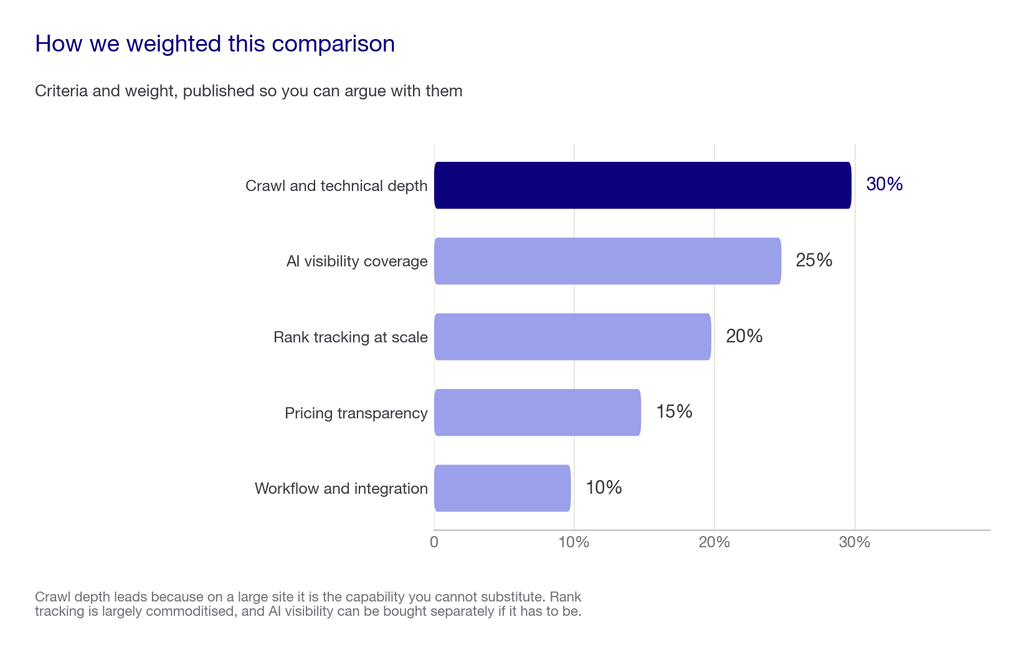
Crawl depth carries the most weight because on a large site it is the capability you cannot substitute. Rank tracking is largely commoditised, and AI visibility, while newer, can be bought separately. A platform that cannot crawl your site properly cannot be fixed by adding modules.
The three jobs, and who does which
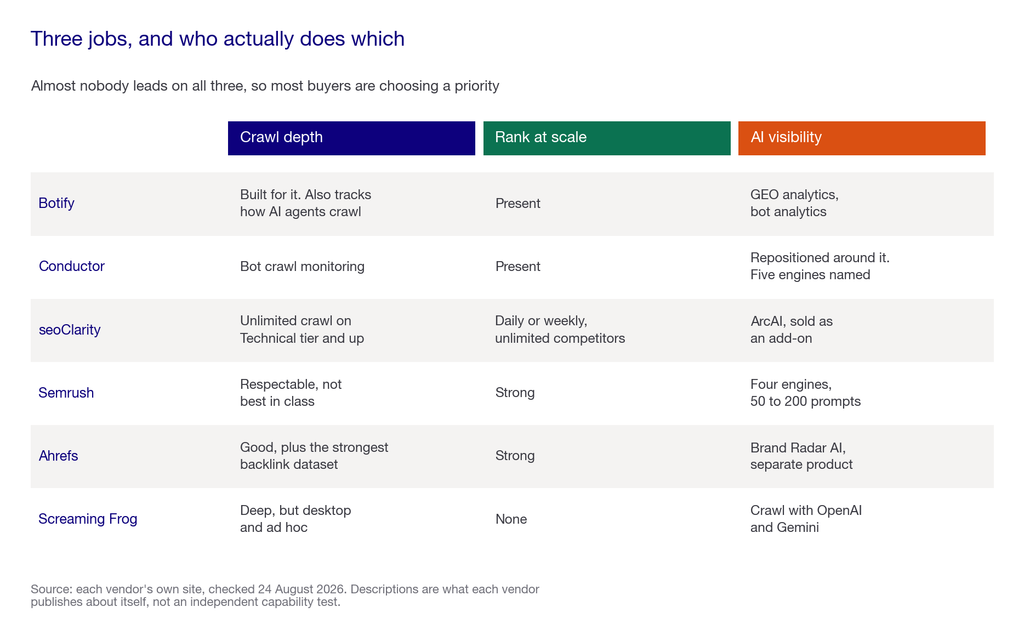
Most buyers assume a single platform can carry all three. In practice you are usually choosing which one to prioritise, then filling the gaps.
The platforms, in detail
1. Pepper
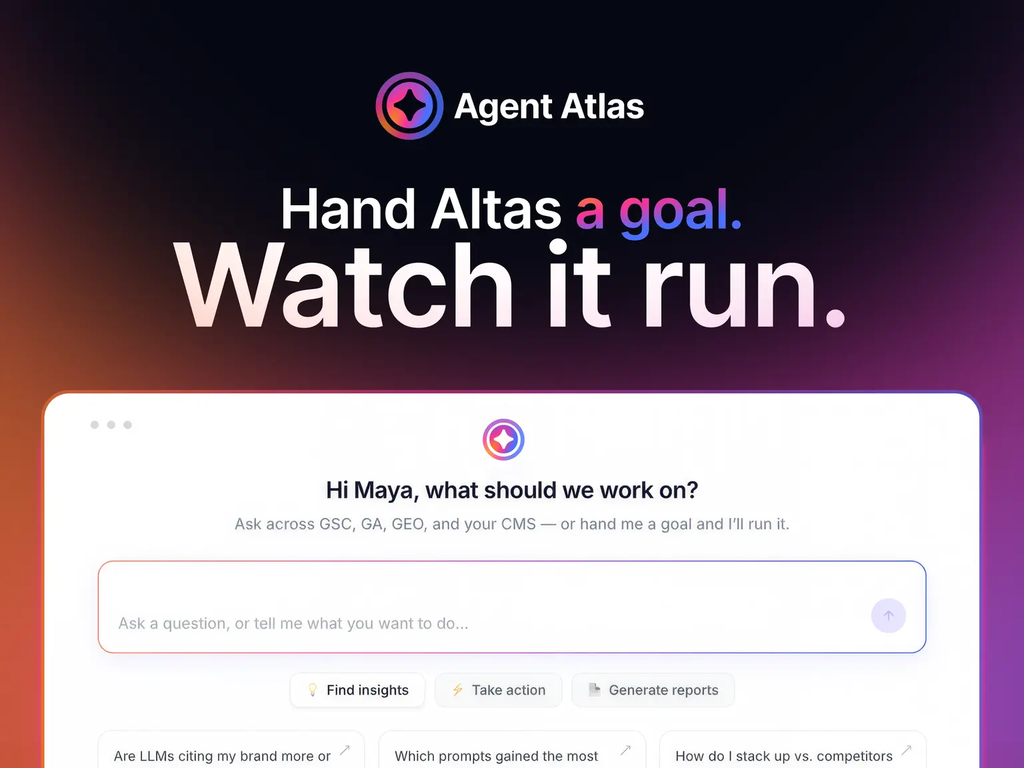
The product is genuinely two things at once. Customers log in and run it themselves, setting up a workspace, defining brand profile, competitors and personas, connecting GA4 and Search Console, managing themes and prompts, reading GEO analytics, and building and running their own agents in the Agent Atlas. Alongside that, a growth team is attached to the account and does the work with them. Agents for scale, experts for judgement, one team on the hook for the number.
On the AI visibility side we track Brand Visibility, meaning how often engines name your brand, Domain Prompt Presence, meaning how often they cite a page from your domain, and Share of Voice across ChatGPT, Perplexity, Gemini, Claude and Google AI Overviews. The gap between the first two is the diagnostic most platforms cannot give you, because it separates an awareness problem from a citability one, and those have different owners and different fixes.
We suit organisations that want organic run as a continuous function rather than assembled from a crawler, a rank tracker and a content agency. We have run organic for more than 250 enterprises across eight years, so the growth team is the product as much as the platform is.
2. Botify
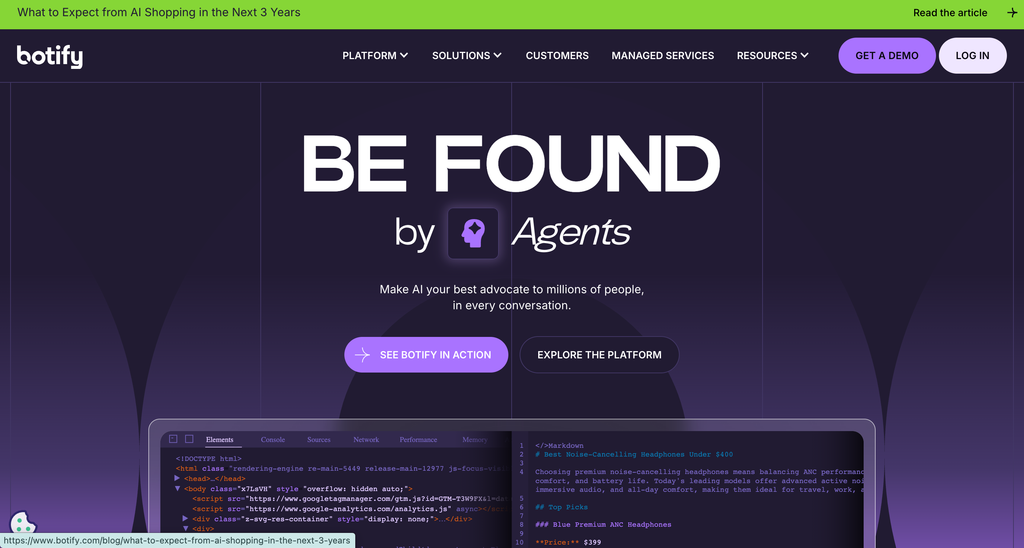
Botify now positions as “an AI search optimization platform”. They describe themselves as “the infrastructure AI needs to recommend you to millions of people.” That is a notable shift for a company built on crawl and log analysis.
The capability that matters most is AI agent and bot analytics, tracking how OpenAI and other agents crawl your site. Retrieval is where AI answers break. So knowing which bots reach which pages is genuinely useful, and few platforms offer it. They also provide GEO analytics and content automation. Clients include Farfetch, Etsy, Under Armour, Ralph Lauren and Macy’s.
They suit large ecommerce and retail sites where crawl and indexation are the binding constraint. Where they fall short: no published pricing, so budget discovery means a demo. Their claimed results, including a 5x ROI within three years, are company-reported. That caveat applies to every vendor here.
3. Conductor
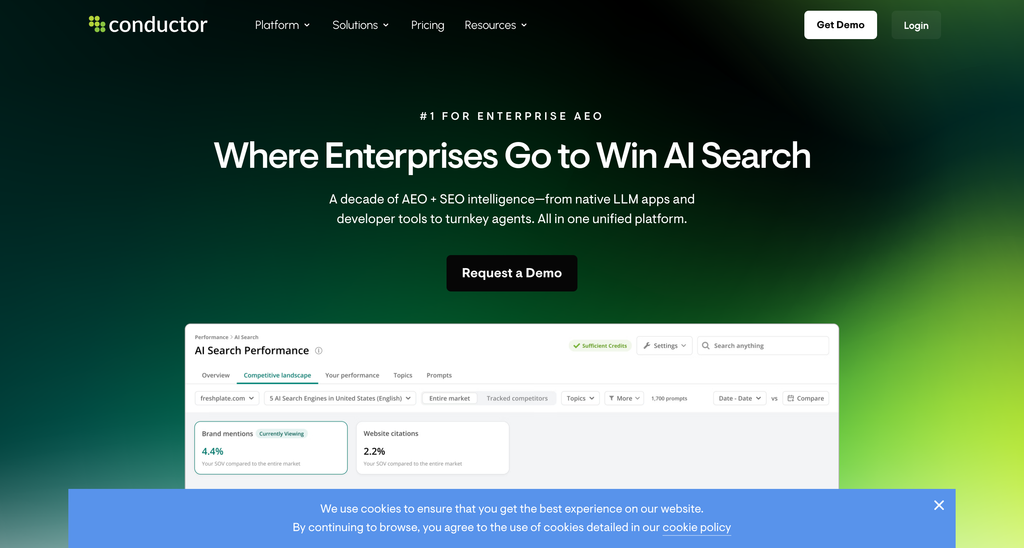
Conductor has repositioned hardest of anyone here. They now call themselves “the only all-in-one enterprise AEO platform” and “#1 for Enterprise AEO.” The platform splits into four parts: Intelligence for visibility tracking, Creator for content, Monitoring for bot crawl activity, and AgentStack for workflow automation.
Coverage spans ChatGPT, Gemini, Copilot, Claude and traditional search. The 24/7 bot crawl monitoring pairs well with the visibility tracking. There is a free AI Visibility Report if you want to test the data before committing.
They suit content-led enterprise programmes where AI visibility is the priority rather than an addition. Where they fall short: no published pricing, and no named clients, only unattributed logos. So if reference customers matter to procurement, ask early.
4. seoClarity
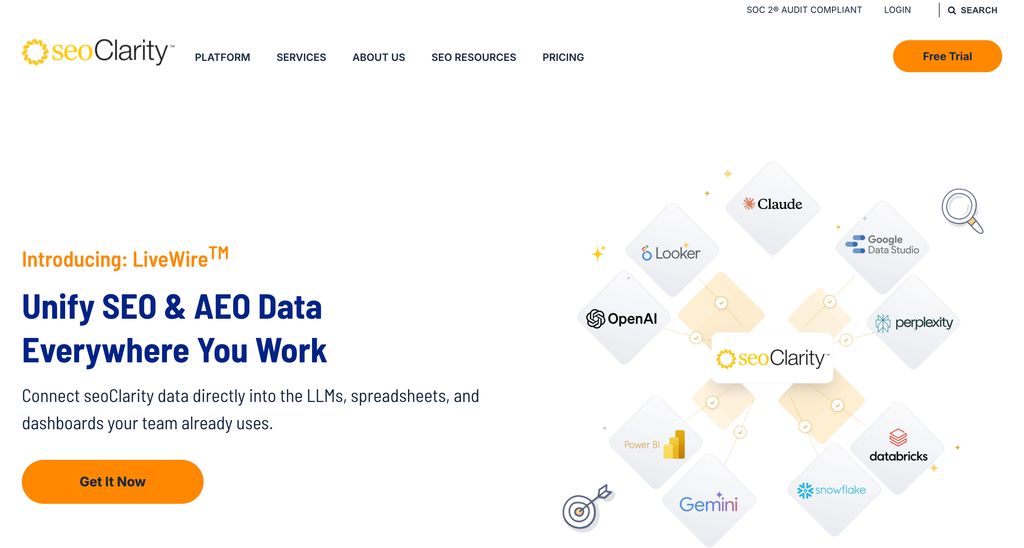
seoClarity publishes the clearest enterprise pricing in this group, which is unusual enough to reward with attention. Research and Content starts at $2,500 a month, Technical SEO at $3,200, and Enterprise at $4,500. All plans scale with domains and keywords tracked.
Technical SEO tiers and above include unlimited crawl pages and projects. Rank tracking runs daily or weekly with unlimited competitors. AI search capability comes through Clarity ArcAI, covering brand mentions, content optimisation, sentiment analysis, bot activity detection and hallucination monitoring.
They suit enterprises that want published pricing and unlimited crawling. Where they fall short: ArcAI is an optional add-on, so the AI capability is not in those headline figures. Ask for the all-in number.
5. Semrush
Semrush remains the most complete single subscription. Plans run from $117.33 a month for SEO, through Starter at $165.17, Pro+ at $248.17 and Advanced at $455.67, billed annually. AI prompt tracking scales with tier, from 50 daily on Starter to 200 on Advanced, covering Google, ChatGPT, Perplexity and Gemini.
They suit teams wanting one contract and one reporting layer rather than three tools stitched together. Where they fall short: crawl depth is respectable rather than best in class, so a site with serious technical debt may still need a dedicated crawler alongside it.
6. Ahrefs
Ahrefs holds the strongest backlink and authority dataset here. That matters more for AI visibility than it once did, since citation behaviour tracks authority signals. Plans run Lite at $129, Standard at $249, Advanced at $449 and Enterprise at $1,499 monthly, with an annual commitment. Brand Radar is included from Lite, while Brand Radar AI is a separate product from $199 with access to a database of 271 million organic prompts.
They suit teams whose constraint is authority diagnosis rather than crawl. Where they fall short: full AI prompt tracking sits in that separate product, so the real cost of complete coverage is higher than the headline tier.
7. SE Ranking
SE Ranking is the value option at enterprise scale. Core runs $103.20 a month and Growth $223.20, billed annually. The AI Search add-on costs $71.20 monthly on top, covering AI Overviews, AI Mode, Perplexity and ChatGPT. Prompt limits are 200 daily on Core and 450 on Growth.
Notably, this is one of the few platforms naming Google AI Mode explicitly. They suit mid-market and lower enterprise teams who need real coverage without a four-figure commitment. Where they fall short: crawl capability is not at the level of a dedicated enterprise crawler, and the AI tracking is an add-on rather than included.
8. Screaming Frog
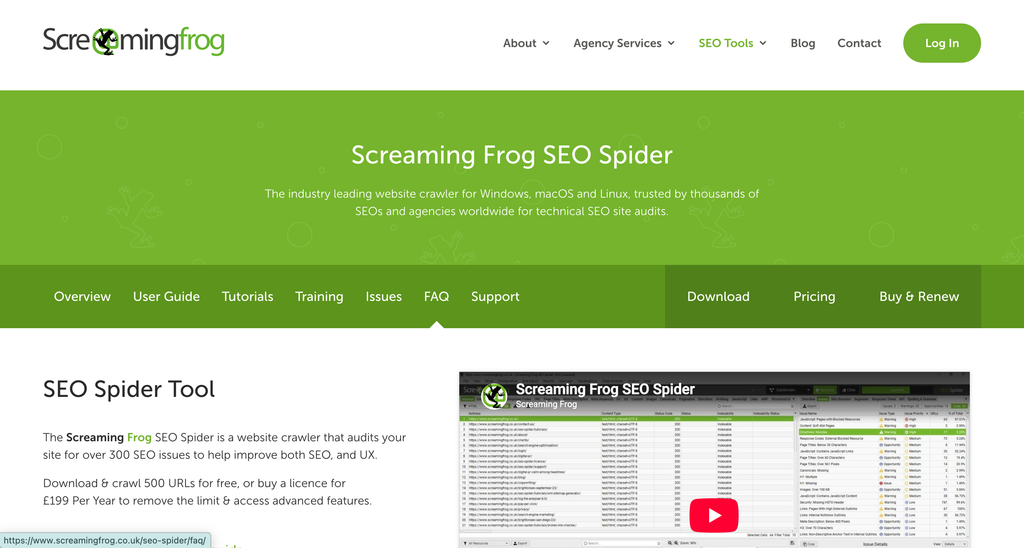
Screaming Frog belongs on this list despite not being an enterprise platform, because almost every enterprise team runs it alongside one.
At £199 per year per user, it is the cheapest serious capability here by an order of magnitude. Bulk discounts fall to £169 for twenty or more licences. The free version handles 500 URLs. Both versions now include crawling with OpenAI and Gemini.
It suits ad hoc technical diagnosis rather than continuous monitoring. Where it falls short: it is a desktop crawler, so you get no ongoing tracking, dashboards or team workflow. Nobody should run an enterprise programme on it alone, and nobody should run one without it either.
What this actually costs
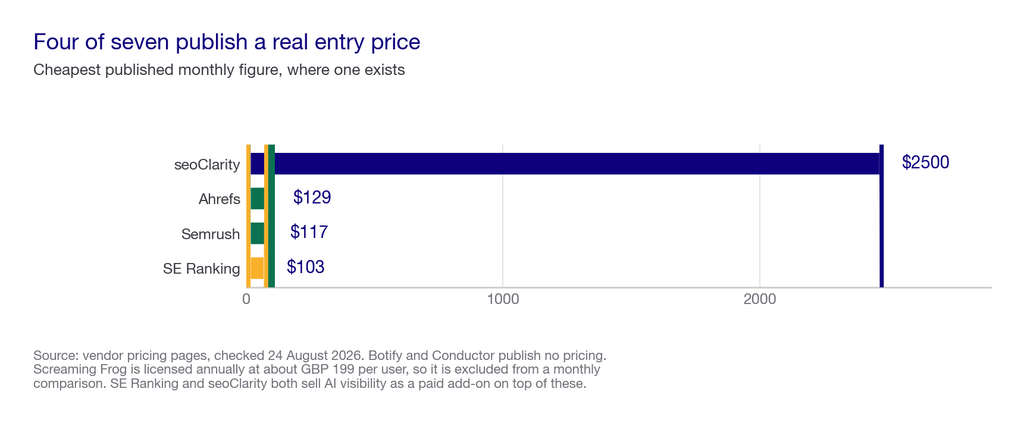
Four of the seven publish real numbers, which is better than this category managed a year ago. Screaming Frog sits at roughly £199 a year. SE Ranking starts at $103.20 a month before the AI add-on. Semrush starts at $117.33. Ahrefs starts at $129. seoClarity starts at $2,500. Botify and Conductor publish nothing.
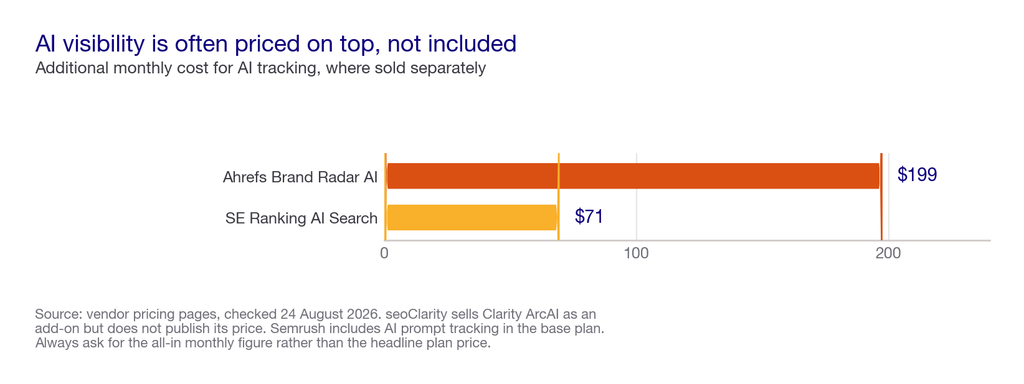
Three things move the number more than the plan you pick. Site size and keyword volume come first, since most enterprise pricing scales on both. Whether AI visibility is included or added comes second, and it is the least visible variable. Third is whether you need a dedicated crawler alongside the platform. On a large or messy site, you usually do.
The cost nobody quotes is the analyst time to make any of it useful. A platform surfacing two hundred issues nobody can action has added a backlog rather than a capability.
How to choose
Start by naming which of the three jobs is your binding constraint, because that decides the shortlist faster than any feature comparison.
If crawl and indexation are the problem, meaning a large site, a messy migration or JavaScript rendering issues, prioritise Botify or seoClarity’s Technical tier. Then run Screaming Frog alongside whatever you choose.
If AI visibility is the priority, Conductor has repositioned entirely around it, and SE Ranking offers the cheapest credible multi-engine coverage including AI Mode.
If you want one subscription covering most things, Semrush is the most complete, with the caveat that crawl depth is not its strength.
If authority diagnosis is your gap, Ahrefs, with Brand Radar AI budgeted as a separate line.
Then ask four questions of any vendor. Is AI visibility included or an add-on, and what is the all-in figure? How many prompts, refreshed how often? Does the crawler handle JavaScript rendering at our page count? And can we see raw AI answers and cited URLs, not just a score?
That last question filters more platforms than the other three combined.
Want to know which constraint you actually have before you shortlist? Book a growth audit and we will run your prompt set and check what crawlers are reaching.
What nobody should promise you
Guaranteed rankings or AI citations. Google explicitly advises against providers who promise rankings, because third parties cannot access internal ranking systems.
A single platform that does all three jobs excellently. Every vendor here leads on one or two. Anyone claiming parity across crawl, rank and AI visibility is describing a roadmap.
A composite score that means something. Blended visibility numbers hide the gap between being mentioned and being cited.
Complete AI engine coverage at entry tier. Coverage varies by tier and changes monthly. Verify at the tier you are buying.
That the platform will fix anything. Measurement is not execution, and every tool here reports rather than acts.
Frequently asked questions
What are enterprise SEO tools?
Enterprise SEO tools manage organic search across large, complex sites. They cover three jobs. Crawling and technical diagnosis at scale, rank tracking across large keyword sets, and increasingly AI visibility across ChatGPT, Perplexity, AI Overviews and other engines.
How much do enterprise SEO tools cost?
Published entry pricing ranges from about £199 a year for Screaming Frog to $2,500 a month for seoClarity. Semrush starts at $117.33 monthly and Ahrefs at $129. Botify and Conductor publish no pricing and quote on request.
Which enterprise SEO tool is best for AI visibility?
Conductor has repositioned entirely around enterprise AEO, tracking ChatGPT, Gemini, Copilot and Claude alongside bot crawl monitoring. SE Ranking offers cheaper multi-engine coverage and names Google AI Mode explicitly, albeit as a paid add-on.
Do enterprise SEO platforms include AI visibility tracking?
Often not by default. seoClarity sells ArcAI as an add-on, SE Ranking charges $71.20 monthly extra, and Ahrefs sells Brand Radar AI separately from $199. Always ask for the all-in figure rather than the headline plan price.
Is Screaming Frog enough for an enterprise site?
No, and it is not meant to be. At £199 per year it is a desktop crawler for ad hoc diagnosis, without continuous monitoring or team workflow. Most enterprise teams run it alongside a platform rather than instead of one.
Which tool handles the largest sites?
Botify and seoClarity are built for crawl at scale. seoClarity offers unlimited crawl pages on Technical tiers and above. Botify also tracks how AI agents crawl your site, which few platforms currently do.
Do I need a separate crawler alongside my platform?
On a large or messy site, usually yes. Platform crawlers are built for monitoring rather than deep diagnosis, so most teams keep a dedicated crawler for migrations, audits and one-off investigations.
How do I compare AI visibility features across platforms?
Ask which engines are covered at your specific tier, how many prompts are tracked, how often they refresh, and whether you can inspect raw answers and cited URLs. Marketing pages describe top-tier coverage, not what you are buying.
Where to go next
Before you book demos, establish which of the three jobs is your constraint. Pull your log files and see what crawlers actually reach. Then run 20 to 30 real commercial prompts to see where you appear in AI answers. Those two exercises take an afternoon and will eliminate most of the shortlist.
Then ask every remaining vendor for the all-in monthly figure including AI visibility, because that is where the comparison usually changes.
For the broader context, our enterprise SEO guide covers the governance and template questions that decide whether tooling gets used, and crawl budget for AI bots covers what changes when the crawler is not Googlebot. For measurement theory, what actually matters in AI search measurement covers which numbers to report.
To see where you stand across engines, see where you show up in ChatGPT, Perplexity, Gemini, Claude and AI Overviews. Customers run this themselves in the platform, with a growth team attached to do the work alongside them. Our Acceldata case study documents 6X organic traffic growth and top-three keywords rising from 85 to more than 300.
One honest exit. If nobody on your team has capacity to act on what a platform surfaces, buying a bigger platform will not help. Fix the capacity problem first, and run Screaming Frog in the meantime.
Sources
All pricing, plan names, capabilities and AI features were verified at each vendor’s own site on 24 August 2026. This category reprices frequently, so re-check before quoting. Vendor claims about their own results are company-reported and not independently audited.
- Botify, Conductor, seoClarity pricing, Semrush pricing, Ahrefs pricing, SE Ranking pricing, Screaming Frog pricing.
- Google Search Central, AI features and your website, 15 May 2026, including the advice against providers guaranteeing rankings.
- Suzgun et al., Evaluating Commercial AI Chatbots as News Intermediaries, arXiv, 21 May 2026, on retrieval failures causing more than 70% of chatbot errors.
Latest Blogs
Most advice on this is inference dressed as fact. OpenAI documents exactly one thing clearly, which is access. Here is what is documented, what is inferred, and how to verify the rest for yourself.
Being named in an AI answer and having your page used as its source are different outcomes with different causes and different fixes. The gap between them is the most useful diagnostic in AI search, and most reporting collapses it into one number.
Every platform reports share of voice and almost none of them define it the same way. Here is the definition worth using, the three choices that change the number, and how to measure it yourself without buying anything.
Get your hands on the latest news!
Similar Posts
Artificial Intelligence
11 mins read
What is anchor text, and does it still matter in 2026?
SEO
11 mins read
What is internal linking? Meaning, and what changed for AI search
SEO
15 mins read