Primary and secondary keywords in 2026: what they were always for, and what changes now
The short answer
Primary and secondary keywords were never a ranking mechanism. They were a planning device, and confusing the two is why the advice around them has aged so badly.
Google’s own SEO Starter Guide, last updated on 10 December 2025, mentions keywords exactly three times, and all three are things that do not work: the keywords meta tag is unused, keyword stuffing breaks the spam policies, and keywords in a domain or URL have hardly any effect. The guide never mentions a primary keyword at all.
What it does say is the sentence that settles this: “Google’s language matching systems are sophisticated and can understand how your page relates to many queries, even if you don’t explicitly use the exact terms in them.”
So the exact-phrase ritual is over, and it has been for years. The planning job the hierarchy was doing is not. You still need one idea per page, a way to tell whether the page worked, and a way to stop two pages doing the same job. That is what a primary keyword was always for.
Key takeaways
- A primary keyword is a statement of what a page is for, not an instruction to repeat a phrase. Keep the discipline, drop the placement checklist.
- Secondary keywords are a coverage test, not a sprinkle list. Use them to check whether the page answers the questions around the topic, then stop.
- LSI keywords do not exist. Google has said so repeatedly, and the page you are reading used to recommend them.
- Cannibalisation was never about sharing a word. It is two pages doing the same job. Engines quoting passages make that clearer, not murkier.
- Keywords and prompts are different units and neither replaces the other. Keywords size demand. Prompts describe the questions. Pepper’s GEO platform tracks the second, and we still build keyword maps.
A note on where this comes from. We run organic for more than 250 enterprises and track more than 10 million prompts across every major engine. The Google quotations are Google’s, dated and linked. The judgement about which parts of the keyword model survive is ours, shaped by the content plans we inherit and rebuild in client reviews most weeks.
Book a growth audit if you want to know which of your pages are competing with each other before you plan another one.
What are primary and secondary keywords, and do they still matter?
A primary keyword is the one phrase that best describes what a page is about. A secondary keyword is a related phrase covering a sub-topic the page should also address.
That definition is unchanged. What has changed is what you are supposed to do with them.
The old instruction set was placement: put the primary in the H1, the meta description, the first hundred words and the URL. Then add three to five secondaries for what people used to call semantic signals.
Google’s documentation supports almost none of that. It says its language matching systems understand how a page relates to many queries without the exact terms. It warns that repeating the same words, “even in variations”, is tiring for users and against the spam policies. It notes that keywords in a URL have hardly any effect beyond breadcrumbs.
But the planning job is real and nothing has replaced it, which is why Pepper still builds keyword maps. When a writer asks “what is this page for”, the answer is a primary keyword whether or not you call it that. When an editor asks “have we covered enough”, the answer is a list of secondaries. Those questions survive because they are about editorial discipline rather than about how a ranking system works.
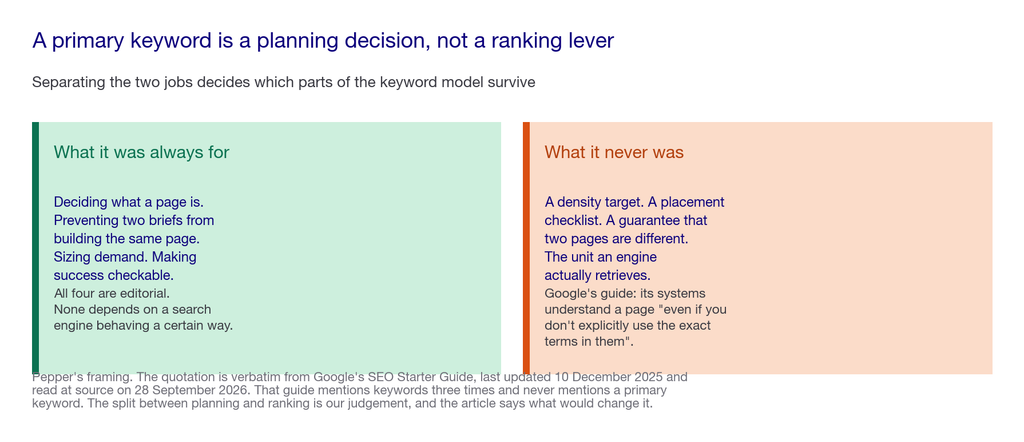
What a primary keyword was always for, and what it never was
What it is genuinely for.
- Deciding what a page is. One page, one job. This is the single most useful constraint in content planning and it has nothing to do with search engines.
- Preventing duplication. If two briefs have the same primary, you are about to build the same page twice.
- Sizing demand before you commit. Volume is an imperfect proxy for how many people care, and an imperfect proxy is better than a hunch.
- Making success checkable. A page with a stated job can be judged. A page without one cannot fail, which is why nobody ever retires it.
What it never was.
- A density target. There is no correct number of repetitions and never was.
- A placement checklist. Putting the phrase in four specific locations is not what makes a page relevant.
- A guarantee of separation. Two pages can target different phrases and still do the same job, which is the cannibalisation that actually costs you.
- The unit an engine retrieves. Engines match meaning, and answer engines quote passages. Neither matches strings.
Secondary keywords are a coverage test
The useful version of a secondary keyword list is a checklist you run once, before writing, and once after.
Before writing, and this is the version Pepper briefs: does this set of sub-topics describe everything a reader would reasonably expect on this page? If a phrase in the list belongs to a different job, it is a different page.
After writing: did we actually answer each of them, properly, in a place a reader can find? If a sub-topic got one sentence, either expand it or drop it from the list honestly.
What we would not do. Add three to five phrases to a page because a rule says so, or vary a term across a page to hit synonyms. Google’s guidance calls repetition “even in variations” tiring for users. A checklist that makes the page worse has stopped being a checklist.
And the specific thing to stop doing: LSI keywords. Latent semantic indexing is a technique from the 1980s that Google never used for this. Google’s John Mueller has said so publicly more than once, in 2019 and again in 2023, most bluntly as “there’s no such thing as LSI keywords”. We read those quotations in Search Engine Roundtable’s reporting rather than in Google documentation, because the originals were social posts, and we flag that rather than presenting it as a citable Google document.
The hierarchy that replaced it
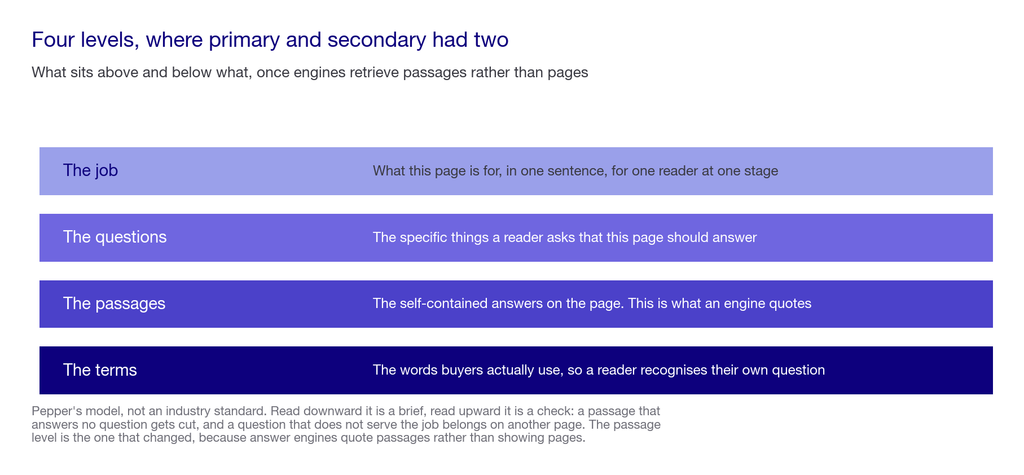
Primary and secondary is a two-level model. The thing it was approximating has four levels, and naming them makes the planning easier.
- The job. What this page is for, in one sentence, for one reader at one stage. This is what a primary keyword was standing in for.
- The questions. The specific things a reader asks that this page should answer. Some are searched, some are asked of an assistant, most are both.
- The passages. The self-contained answers on the page. This is the unit an answer engine quotes, which is why how you write each passage matters more than where you put a phrase.
- The terms. The words people actually use, which tell you how to phrase headings so a reader recognises their own question.
Read it downward and it is a brief. Read it upward and it is a check. If a passage does not answer one of the questions, cut it. If a question does not serve the job, it belongs to another page.
Keywords and prompts are different units
This is the confusion we spend most time unpicking, and neither unit replaces the other.
| Keywords | Prompts | |
|---|---|---|
| What it is | A phrase somebody types into a search box | A question somebody asks an assistant, in their own words |
| Where it comes from | Search data, with volume attached | Sales calls, support tickets and buyer language |
| What it sizes | Demand, imperfectly but measurably | Nothing. There is no volume figure for a prompt |
| What it tells you | How many people are looking | What they actually want to know |
| What it cannot do | Tell you how a buyer phrases a question to an assistant | Tell you whether anyone else asks it |
| Still needed in 2026 | Yes, for planning and sizing | Yes, for measurement and coverage |
The practical answer is to keep both and use each for what it is good at. Keywords tell you a topic is worth a page. Prompts tell you what that page has to answer and let you measure whether it worked. For building and maintaining the prompt side properly, our [guide to prompt tracking](https://www.pepper.inc/blog/prompt-tracking/) covers where to harvest prompts and how to freeze a set.
Cannibalisation was never about sharing a word
The classic fear is two pages targeting the same phrase. The real problem is two pages doing the same job, and those are not the same thing.
- Two pages, same phrase, different jobs. A definition page and a buyer’s comparison can both contain the same term and serve different readers. This is usually fine.
- Two pages, different phrases, same job. This is the expensive one. Both answer the same questions for the same reader, and neither becomes the definitive version.
- How answer engines change it. An engine quoting a passage does not care which page it came from. If two pages carry the same answer, one of them is doing no work.
The test Pepper uses: can you say, in one sentence each, what the two pages are for, and are those sentences different? If you cannot, merge them.
What to do with the keyword map you already have
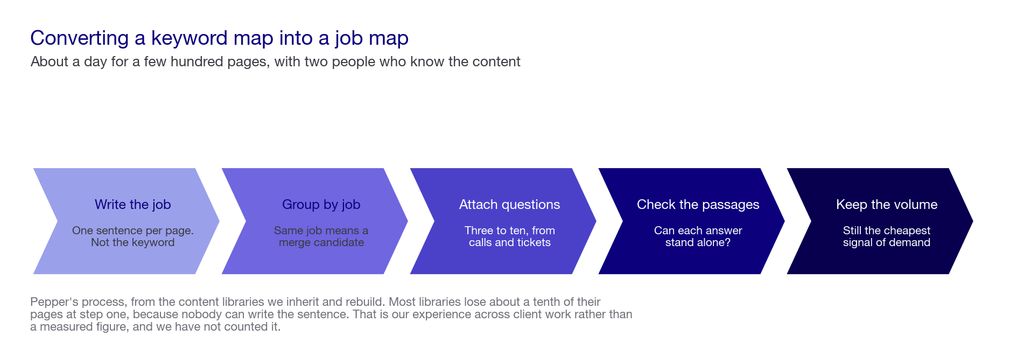
You do not need to throw it away. Pepper does this to the libraries we inherit: add a column, then act on it.
- Write the job for every page, in one sentence. Not the keyword. What it is for, and for whom. Most libraries lose a tenth of their pages at this step because nobody can write the sentence.
- Group by job, not by phrase. Two rows with the same job are a merge candidate regardless of what they target.
- Attach real questions to each job. Three to ten, taken from sales calls and support tickets rather than a keyword tool.
- Check each page answers them in self-contained passages. This is the part that decides whether an engine can quote you.
- Keep the volume column. It is still the cheapest available signal of whether anyone cares, and nothing has replaced it.
Our methodology: what earns a page its own existence
| Criterion | Weight | Why it carries that weight |
|---|---|---|
| It has a job nobody else has | 35 | The whole point of a primary keyword, stated properly. If another page has the same job, you have a merge rather than a brief. |
| Real questions attach to it | 25 | Questions taken from buyers rather than a tool. A job with no questions under it is a topic somebody wanted to write about. |
| Demand exists at some level | 20 | Volume is an imperfect proxy and still the cheapest one. Low volume is a reason to size the effort, not always to skip it. |
| The answers can stand alone | 15 | Passages are what engines quote. A page whose answers only make sense in sequence will be read and not cited. |
| Somebody will maintain it | 5 | Pages nobody owns drift out of date and become the reason a library needs an audit. |
Weights sum to 100. Job distinctiveness and real questions carry 60 between them. That is Pepper’s judgement rather than a fact, and it is the judgement this page rests on.
What would change these weights. On a small site, demand matters more, because you cannot afford a page nobody is looking for. On a large library, job distinctiveness outranks everything, because duplication is already the problem.
Keyword practices at a glance
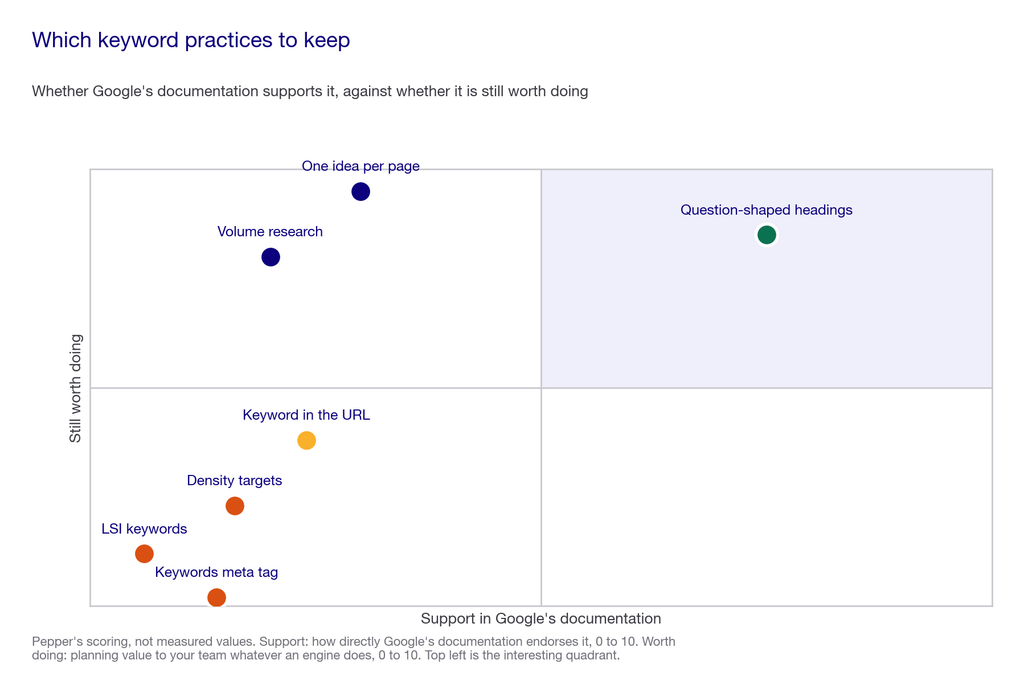
The top-left quadrant is the useful one: practices Google never mentions that are still worth keeping, because they are planning tools rather than ranking levers.
| Practice | Does Google’s documentation support it | Still worth doing | What to do instead | Cost of getting it wrong |
|---|---|---|---|---|
| One primary idea per page | Not mentioned as a ranking factor | Yes, as planning | Write the job in a sentence | Low. It is an internal discipline |
| Primary keyword in the H1 | Not stated. Headings are endorsed for structure | Usually, for readers | Phrase the heading as the question | Low. Readers benefit either way |
| Primary keyword in the URL | “Hardly any effect beyond breadcrumbs” | Low priority | Readable slugs, and do not rename live URLs for this | High if you rename a live URL for it |
| Keywords meta tag | “Google Search doesn’t use the keywords meta tag” | No | Delete it | None. Deleting it is free |
| Keyword density targets | Not stated. Stuffing is against spam policies | No | Write the passage once, properly | Medium. Stuffing risks a spam penalty |
| 3 to 5 secondary keywords per page | Not stated anywhere | As a coverage check only | Turn them into questions and answer them | Low, unless it crowds out real answers |
| LSI keywords | Google says they do not exist | No | Cover the sub-topics because readers need them | Medium. It wastes brief and review time |
| Exact-match phrasing | “even if you don’t explicitly use the exact terms” | No | Use the words your buyers use | Medium. It makes the writing worse |
| Volume research | Not Google’s business | Yes | Keep it for sizing, not for phrasing | High. Skipping it means building pages nobody wants |
What this costs
- Converting a keyword map into a job map: about a day for a few hundred pages, with two people who know the content.
- The merges it surfaces: longer. Deciding which of two pages survives is an editorial argument, not an exercise.
- Harvesting real questions: an afternoon per cluster, from sales calls and tickets you already have.
- What it does not cost: tooling. Nothing in this page needs a purchase. If a supplier quotes a project to make your keyword strategy AI-ready, ask which of the practices in the table above they are changing.
Where Pepper fits
We are an agentic organic growth engine, and on this page the relevant part is that we still build keyword maps, which surprises people who expect us to say keywords are dead.
- An organic growth partner. A growth team is attached to your account, a senior strategist plus always-on agents, accountable for the number rather than for a keyword list.
- Our GEO platform. Genuinely self-serve and included rather than billed as a separate licence. You log in and set up a workspace. Define your brand profile, competitors and personas, connect GA4 and Search Console, then manage your own themes, prompts and analytics across six engines including ChatGPT, Perplexity, Gemini, Claude and Google AI Overviews.
- The Agent Atlas. Your team builds, versions and runs its own agents, and keeps them.
Themes and prompts in the platform are the job-and-questions layers made operational, which is why the model on this page is not a framework we wrote for an article. For what it produces, the Acceldata case study records 6X organic traffic and top-three keywords rising from 85 to more than 300, mostly through B2B SaaS programmes.
Where it falls short: we cannot give you a volume figure for a prompt, because none exists, so the sizing half of planning still depends on conventional keyword data we do not provide. Merging a library is editorial work that we can advise on and cannot do for you. And this page corrects one of our own, which is the clearest evidence that our published work needs the same maintenance we are recommending.
How to choose what to keep from your keyword process
I will write this in the first person, because a recommendation nobody will defend is worth nothing.
Start by separating the two things a keyword was doing. One was planning: deciding what to build and whether it already exists. The other was optimisation: placing a phrase to influence a ranking system. The first half is as useful as it ever was. The second half stopped working before most of the advice about it was written.
So my order is: keep the planning, drop the placement, then add the questions layer. Here is the scorecard I would use on any practice still in your process, on a 100 point scale.
| Area | Weight | What a practice worth keeping demonstrates |
|---|---|---|
| It helps somebody decide something | 35 | A writer, an editor or a planner acts differently because of it. Placement rules fail this immediately. |
| Documentation supports it, or it is honestly editorial | 25 | Either Google says it matters, or you can say plainly that you do it for readers and planning rather than for rankings. |
| It survives the passage test | 20 | The practice still makes sense when an engine quotes two sentences from the page rather than showing the page. |
| It is cheap to apply | 15 | A rule a writer can hold in their head beats a checklist nobody completes under deadline. |
| It does not make the page worse | 5 | Anything that degrades the reading experience to serve a machine will be reversed, usually by a complaint. |
Five questions I would ask about your current keyword process, in this order.
- “Can we write the job of each page in one sentence?” A stronger library can. A weaker one has rows of phrases with no statement of purpose behind them, and that is where duplication hides.
- “Which two pages have the same job?” Ask the question directly. Everyone on the team usually knows the answer already.
- “Where did these secondary keywords come from?” If the answer is a tool’s related-terms panel, they are a coverage checklist at best.
- “Are we still doing anything Google says does not work?” The meta keywords tag, density targets and LSI are the three we find most often.
- “Do we have the questions, or only the phrases?” Phrases tell you a topic is wanted. Questions tell you what to write.
Red flags, each one something that appears in real briefs. A keyword density target. A required count of secondary keywords. “LSI keywords” as a section in a template. Instructions to rename live URLs to include a phrase, which risks real traffic for an effect Google calls hardly any. And a brief with a primary keyword and no statement of what the page is for.
Before rebuilding anything, test the questions side. Write 25 real commercial questions your buyers would type. Run each of those 25 prompts three times across every engine you care about, because engines are probabilistic and one run is an anecdote. Then give any fix 90 days before you judge it. Four worked examples for a mid-market B2B software company:
- “best data observability platform for enterprise”
- “how do I monitor data quality across Snowflake and Databricks”
- “what should I look for in a data observability vendor”
- “who competes with Monte Carlo in data observability”
Compare those questions against your keyword map. The gap between how your buyers phrase things and how your map does is the most useful hour of work in this whole article. Checking whether your brand appears in AI search walks through the running part.
And the answer that loses Pepper the sale: if your keyword map already states the job of each page and you have no duplicate jobs, you do not need to rebuild anything and you do not need us for this. Add the questions layer yourself and spend the money on earned media instead.
It comes down to one principle: keep the keyword as a statement of purpose, and stop treating it as a string to place. We have published the other version ourselves, ours included, on the page this one replaces. That is the most honest argument we can make for reading your own library with the same scepticism, and it cost us a page we had promoted.
What nobody should promise you
- A keyword density that works. There is no correct number and there never was.
- That LSI keywords help. Google has said repeatedly that they do not exist.
- That exact-match phrasing is required. Google’s own guide says its systems understand a page’s relationship to queries without the exact terms.
- That keywords are dead. They are still the cheapest way to size demand, and Google’s position is that optimising for generative AI search is still SEO.
- A volume figure for a prompt. None exists. Anyone quoting one has invented it.
Frequently asked questions
What is the difference between primary and secondary keywords?
A primary keyword states what a page is for. Secondary keywords describe sub-topics it should also cover. Treat the primary as a planning decision about the page’s job, and the secondaries as a coverage checklist you run before and after writing.
Do primary and secondary keywords still matter in 2026?
As planning tools, yes. As placement rules, no. Google’s SEO Starter Guide mentions keywords three times and all three are things that do not work, and it states that its systems understand a page without the exact terms appearing in it.
How many secondary keywords should a page have?
There is no correct number and no documentation supports one. Use however many sub-topics a reader would expect the page to cover, turn each into a question, and answer it properly. A count taken from a template is not a reason.
Are LSI keywords real?
No. Latent semantic indexing is a technique from the 1980s that Google never used for this purpose, and John Mueller of Google has said publicly more than once that there is no such thing as an LSI keyword. Cover sub-topics because readers need them.
What is keyword cannibalisation, really?
Two pages doing the same job, rather than two pages containing the same phrase. Pages can share a term and serve different readers perfectly well. The expensive version is two pages answering the same questions, where neither becomes definitive.
Should I still put the keyword in my URL?
It is low priority. Google’s documentation says keywords in a domain or URL path have hardly any effect beyond appearing in breadcrumbs. Write readable slugs, and do not rename a live URL for this, because the redirect risk outweighs the gain.
Are keywords and prompts the same thing?
No. A keyword is a phrase typed into a search box, with volume attached. A prompt is a question asked of an assistant, in the buyer’s own words, with no volume figure available. Keywords size demand, prompts tell you what to answer.
Does keyword research still work for AI search?
Partly. It still tells you a topic is worth a page, which is the sizing job nothing else does. It does not tell you how a buyer phrases a question to an assistant, so pair it with questions harvested from sales calls and support tickets.
Where to go next
Once the job and the questions are settled, the writing decides whether anything gets quoted. the passage craft guide covers how to write an answer that survives being lifted, and the page structure and FAQ playbook covers the container.
For the questions layer specifically, prompt tracking explains where to harvest prompts and how to freeze a set. To measure any of it, the GEO measurement stack sets out which KPIs mean anything.
Sources and further reading
- Google Search Central, “SEO Starter Guide”, last updated 10 December 2025, read at source on 28 September 2026. It mentions keywords three times. “Google Search doesn’t use the keywords meta tag.” “Excessively repeating the same words over and over (even in variations) is tiring for users, and keyword stuffing is against Google’s spam policies.” “Keywords in the name of the domain (or URL path) alone have hardly any effect beyond appearing in breadcrumbs.” And, on exact terms: “Google’s language matching systems are sophisticated and can understand how your page relates to many queries, even if you don’t explicitly use the exact terms in them.” The guide never mentions a primary keyword.
- Google Search Central, “Optimizing your website for generative AI features on Google Search”, last updated 10 July 2026. The position that optimizing for generative AI search is still SEO, which is why keyword research has not retired.
- On LSI keywords. Google’s John Mueller has stated publicly more than once, in 2019 and again in 2023, that there is no such thing as an LSI keyword. We read these quotations in Search Engine Roundtable’s reporting, not in Google documentation, because the originals were social posts. We say so rather than presenting them as a citable Google document, and we would apply the same test to anyone quoting them at us.
- Muck Rack, “What Is AI Reading?”, May 2026 edition. Earned media accounted for 84% of AI citations across more than 25 million cited links from ChatGPT, Claude and Gemini in 17 industries. This is the study the previous version of this page quoted without attribution. Muck Rack sells PR software and benefits if the result is true. Not hyperlinked, per our policy on vendor links.
Further reading on Pepper, each checked live on 28 September 2026:
- How to structure content for answer engines, the passage craft that decides what gets quoted.
- Prompt tracking, where prompts come from and how to freeze a set.
- The GEO measurement stack, which KPIs mean anything.
- AEO page structure, H1s and FAQ strategy, the container.
Latest Blogs
Most advice on this is inference dressed as fact. OpenAI documents exactly one thing clearly, which is access. Here is what is documented, what is inferred, and how to verify the rest for yourself.
Being named in an AI answer and having your page used as its source are different outcomes with different causes and different fixes. The gap between them is the most useful diagnostic in AI search, and most reporting collapses it into one number.
Every platform reports share of voice and almost none of them define it the same way. Here is the definition worth using, the three choices that change the number, and how to measure it yourself without buying anything.
Get your hands on the latest news!

Similar Posts
Artificial Intelligence
11 mins read
What is anchor text, and does it still matter in 2026?
SEO
11 mins read
What is internal linking? Meaning, and what changed for AI search
Content Creation
11 mins read