How to Evaluate a GEO Agency: 8-Point Scorecard for Marketers
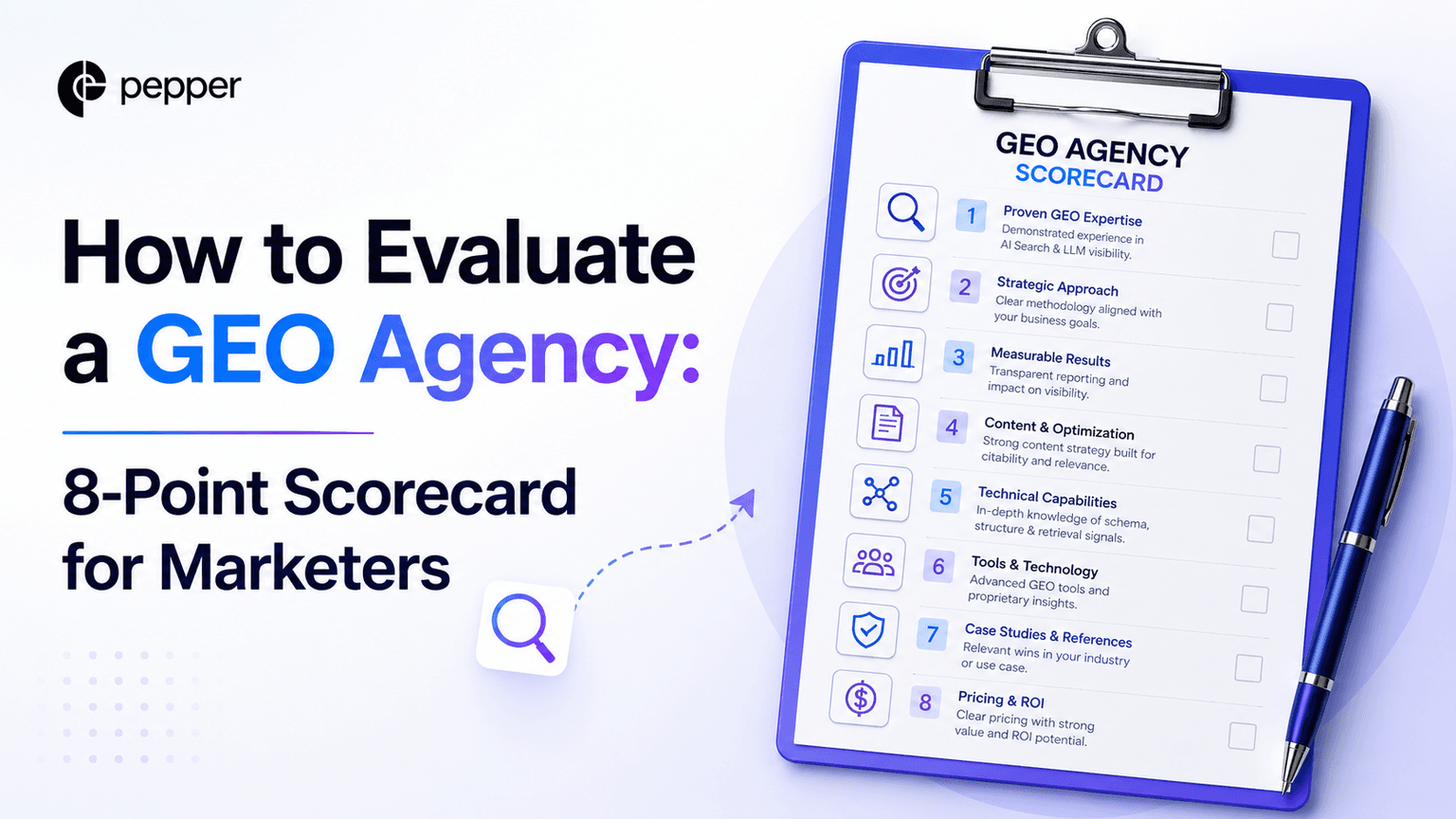
TL;DR: Google’s own John Mueller has warned that urgency and jargon from an AI-search vendor are themselves a red flag. Before signing a GEO agency, score them on 8 concrete points: proof of their own AI visibility, a defined tracking methodology, whether they treat GEO as separate from SEO, real multi-engine reporting, technical depth, reference checks on what they didn’t deliver, citation-based contract terms, and whether they guarantee outcomes no one can actually guarantee.
A GEO pitch deck is easy to make convincing. Acronyms, a chart trending up and to the right, a client logo wall. What’s harder to fake is a defined methodology, a real reporting sample, and a straight answer to a technical question. Google’s own John Mueller put it bluntly: “the higher the urgency, and the stronger the push of new acronyms, the more likely they’re just making spam and scamming.”
That’s the filter worth applying before any contract gets signed. Here’s exactly how to evaluate a GEO agency in 8 concrete points.
Where to Jump In
- Why This Category Attracts Weak Pitches
- How to Evaluate a GEO Agency: The 8-Point Scorecard
- How to Evaluate a GEO Agency in Practice, Not Just on Paper
- FAQ
Why This Category Attracts Weak Pitches
GEO is new enough, and the terminology confusing enough, that a vendor can sound sophisticated without doing anything a client could actually verify, which is exactly why a scorecard matters more here than in an established category. The specific traps repeat across weak pitches: guaranteed citations or rankings, vague methodology dressed up in acronyms, weak or absent reporting, and a framing that treats GEO as something entirely separate from SEO rather than an extension of the same fundamentals.
None of that is unique to any one vendor. It’s a pattern common enough that Google’s own search advocate has warned about it publicly, which is a strong signal the industry itself sees the problem.
Takeaway: the burden of proof belongs on the agency, not on your ability to intuit whether the pitch feels credible.
How to Evaluate a GEO Agency: The 8-Point Scorecard
1. Do they show up in AI answers themselves?
An agency selling AI visibility should be able to demonstrate its own. Have them prove it, and independently verify their claim across major AI engines yourself before the call.
2. Do they have a defined method for tracking LLM mentions?
Not a general description of “monitoring AI search.” A specific method: which engines, what cadence, how a mention is distinguished from a citation.
3. Do they treat GEO as separate from SEO, or as an extension of it?
A credible answer explains how technical health, authority, and strong commercial pages support AI discoverability. An answer that positions GEO as a wholly separate discipline with its own disconnected tactics is a structural red flag.
4. Can they show real reporting, not just claims?
Ask for a live demo showing a brand tracked across ChatGPT, Perplexity, and Google AI Overviews in a single report. If what you get instead is a static slide with numbers you can’t trace to a source, treat that as an answer.
5. Do they have real technical depth?
A basic technical question, such as the difference between keyword-based and semantic retrieval, or how an engine decides which sources to cite, should get a real answer. A GEO consultant who can’t engage with the mechanics at all hasn’t kept up with what they’re selling.
6. What do their references say they didn’t deliver?
Call references and ask specifically what fell short, not just what went well. Confirm the person who pitched you is the person who’ll actually do the work, not a senior seller handing you off to a junior team after signing.
7. Does the contract measure success in citation terms?
A contract that measures success in traffic or ranking terms alone hasn’t actually committed to GEO outcomes. Citation rate, Share of Voice, and domain presence are the metrics that should appear in the success criteria.
8. Do they guarantee anything they don’t control?
No agency controls what an AI engine decides to cite. A guaranteed citation count or a promised ranking is, per Mueller’s warning above, close to a tell on its own.
Takeaway: a real agency can survive all eight without flinching. A weak one will dodge at least two or three, usually numbers 2, 4, and 8.
How to Evaluate a GEO Agency in Practice, Not Just on Paper
- Run it before the first sales call, not after. Check the agency’s own AI visibility yourself; you’ll already know something before they’ve said a word.
- Ask the technical question early. It filters out a surprising number of pitches fast, before you’ve invested real time in the relationship.
- Insist on a live report walkthrough, not a deck. A deck can say anything. A live tool showing real client data can’t hide much.
- Get the reference call before the contract, not after. What a past client says fell short tells you more than what the agency claims went well.
- Read the success-metrics clause line by line. If it’s vague enough to cover any outcome as a win, it will.
FAQ
What’s the single biggest red flag when evaluating a GEO agency?
A guaranteed citation count or promised AI ranking. No agency controls what an AI engine decides to cite, and Google’s own John Mueller has warned that urgency and guaranteed outcomes from AI-search vendors are themselves a warning sign.
How do I know if a GEO agency’s methodology is real?
Ask for a specific answer: which engines they track, how often, and how they distinguish a mention from an actual citation. A vague description of “AI monitoring” without those specifics usually means there’s no defined method behind it.
Should a GEO agency treat GEO as separate from SEO?
No. A credible agency explains how technical SEO health, authority, and strong commercial content support AI discoverability together. An agency pitching GEO as a wholly separate, disconnected discipline is a structural warning sign.
What should a GEO agency contract actually measure?
Citation rate, Share of Voice, and domain or brand presence across AI engines, not traffic or traditional ranking alone. A contract that only measures traffic hasn’t actually committed to a GEO outcome.
How technical should a GEO agency’s team actually be?
Technical enough to explain, in plain terms, how an AI engine decides which sources to cite and how retrieval differs from traditional keyword ranking. An agency that can’t engage with that at all likely hasn’t kept pace with how the category actually works.
See How Pepper Can Help
Every point on this scorecard is meant to survive scrutiny, including applied to Pepper itself. If you’re evaluating a program that pairs a platform with real execution, see how Pepper’s platform, agents, and growth team work, and hold it to the same eight points. Browse Pepper’s case studies for the reporting and results this scorecard asks any agency to show.
Latest Blogs
Most advice on this is inference dressed as fact. OpenAI documents exactly one thing clearly, which is access. Here is what is documented, what is inferred, and how to verify the rest for yourself.
Being named in an AI answer and having your page used as its source are different outcomes with different causes and different fixes. The gap between them is the most useful diagnostic in AI search, and most reporting collapses it into one number.
Every platform reports share of voice and almost none of them define it the same way. Here is the definition worth using, the three choices that change the number, and how to measure it yourself without buying anything.
Get your hands on the latest news!