What is anchor text, and does it still matter in 2026?
The short answer
Anchor text is the visible, clickable words in a link.
It still matters, and we should be straight about the evidence. No published study has measured anchor text’s effect on AI citation directly. What exists is adjacent, and it points one way.
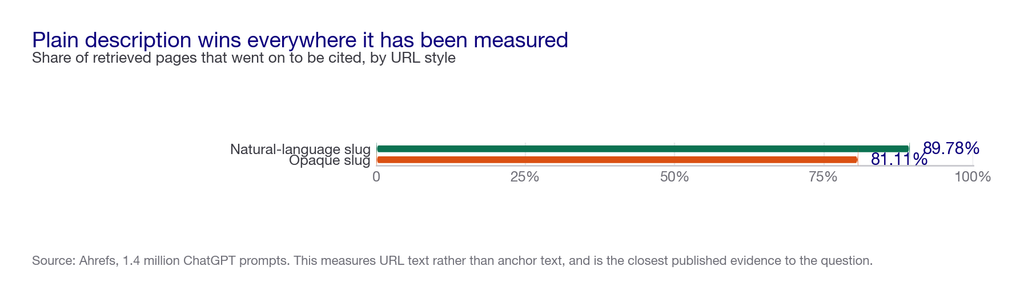
Across 1.4 million ChatGPT prompts, pages with natural-language URL slugs were cited 89.78 percent of the time against 81.11 percent for opaque ones. That is URL text rather than anchor text. It is still the clearest signal we have that describing a destination in plain words helps a machine use it.
Key takeaways
- Anchor text is the words, not the link. The URL is the destination. The anchor is what you say about it.
- Nobody has measured anchor text against AI citation. Anyone quoting a figure for that is extrapolating.
- Descriptive text demonstrably helps machines elsewhere. Readable slugs beat opaque ones by nearly nine points.
- “Click here” wastes the one place you describe a target. That is the practical cost, and it is free to fix.
- Over-optimised anchors are a real risk. Exact-match anchors at scale have been a spam signal for over a decade.
Where this comes from. We run organic for more than 250 enterprises at Pepper and track over 10 million prompts across every major engine. We read a lot of link profiles, and the same two faults recur. That work shapes the view here, along with the client reviews we sit in and the talks we have at the events we run.
What is anchor text?
Anchor text is the clickable text a reader sees in a hyperlink. In HTML it is the text between the opening and closing tags of the link.
It does two jobs at once, and they rarely conflict.
The two jobs
- It tells a reader where they are going. Good anchor text sets an expectation the destination then meets.
- It tells a machine what the target is about. The anchor is one of very few places you make a direct statement about another page, which matters more now that agents traverse links to gather context.
That second job is why this is worth any attention at all. A crawler reading your page sees the anchor before it sees the destination, and the anchor is your description of it. Crawler access decides whether it gets that far.
The types you will hear named
- Exact match. The anchor is the target’s keyword precisely. “Anchor text” pointing at a page about anchor text.
- Partial match. A variation. “Our guide to anchor text”.
- Branded. A company name. “Pepper”.
- Naked URL. The address itself, shown as text.
- Generic. “Click here”, “read more”, “this page”. The ones that say nothing.
See where you show up. Pepper’s GEO platform tracks Brand Visibility, Domain Prompt Presence and Share of Voice across ChatGPT, Perplexity, Gemini, Claude and Google AI Overviews. Your team can log in, connect Search Console and GA4, manage the prompt set and run your own agents in the Agent Atlas. A growth team works the same account alongside you. Book a growth audit or see where you show up.
What the evidence actually supports
This section exists because most articles on this subject assert more than anyone has measured.
What has not been measured
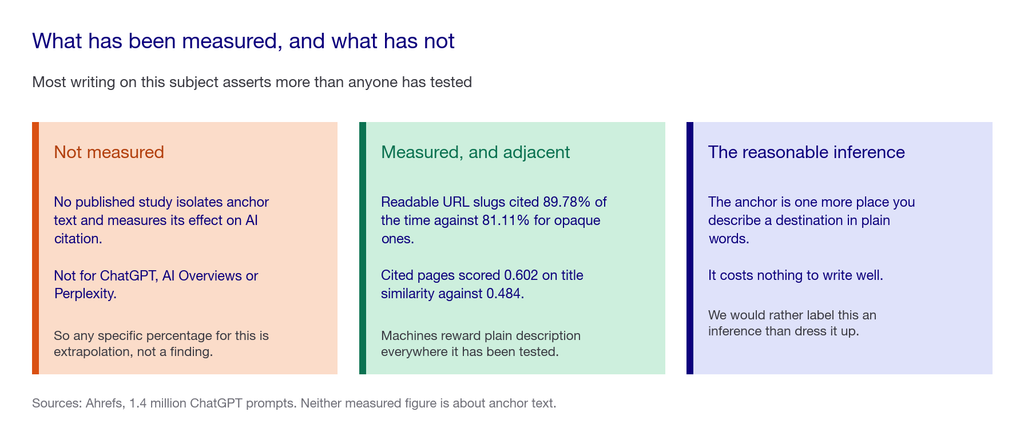
No published study we can find isolates anchor text and measures its effect on whether an AI engine cites a page. Not for ChatGPT, not for AI Overviews, not for Perplexity.
So if you read a specific percentage for “anchor text improves AI citation by X”, treat it as extrapolation rather than a finding.
What has been measured
Three adjacent results, all of which point the same way.
- Readable URLs get cited more. Across 1.4 million ChatGPT prompts, pages with natural-language slugs were cited 89.78 percent of the time against 81.11 percent for opaque ones.
- Descriptive titles matter most of all. Cited pages scored 0.602 on semantic similarity to the prompt, against 0.484 for pages retrieved and never cited.
- Link structure affects retrieval. A controlled 2026 study found an entity page format with rich interlinking improved retrieval accuracy by 29.6 percent over plain HTML.
What that adds up to
Machines reward plain description in every place it has been measured. The anchor is one more such place, and it costs nothing to write well.
That is an inference, and we would rather label it as one than dress it up. The full citation evidence sits in our analysis of 1.4 million prompts.
The two faults we see most
Both are common, and they fail in opposite directions.
Anchors that say nothing
“Click here”, “read more”, “this article”, “learn more”. These describe the action, not the destination.
Every one of them wastes the single place on the page where you state what another page covers. The fix takes seconds and needs no approval.
Anchors that say the same thing too often
The opposite failure. Hundreds of links using the identical exact-match phrase reads as manufactured, because it usually is.
Exact-match anchor patterns at scale have been treated as a manipulation signal for well over a decade. The risk is real and it has not gone away. Earned authority covers the off-site half, where the same caution applies.
The middle, which is just writing
Vary them naturally. Describe the destination the way you would in conversation. If the same page is linked five times, five slightly different descriptions is normal and healthy.
How to write good anchor text
Five rules. All of them are editing.
- Describe the destination, not the action. “The 2026 crawler table” rather than “click here”.
- Make it readable out of context. If the anchor makes no sense on its own, it will not help a machine either.
- Keep it short. A few words. A whole sentence as a link reads as noise, and it competes with the passage itself for attention.
- Vary it. Different links to one page should read differently.
- Never promise what the target does not deliver. The anchor sets an expectation, and a broken one costs trust. Content chunking covers making the destination worth the click.
The read-it-alone test
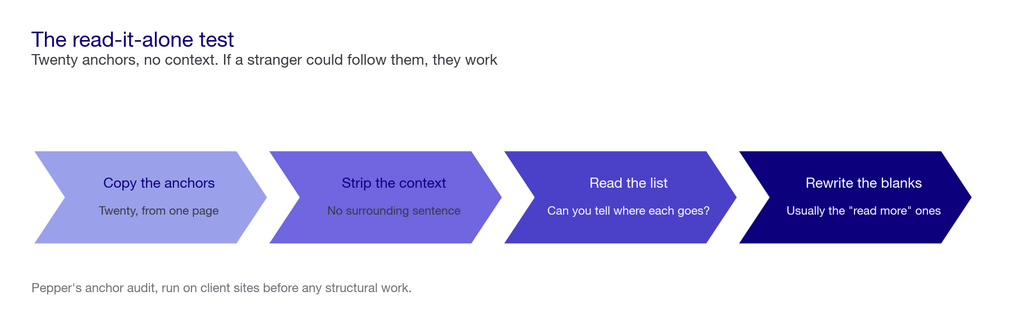
Copy twenty anchors off a page into a list, with nothing around them.
If a stranger could guess what each one points at, your anchors are doing their job. If the list is mostly “read more”, you have found an afternoon of free improvement. The structural side of this sits in internal linking.
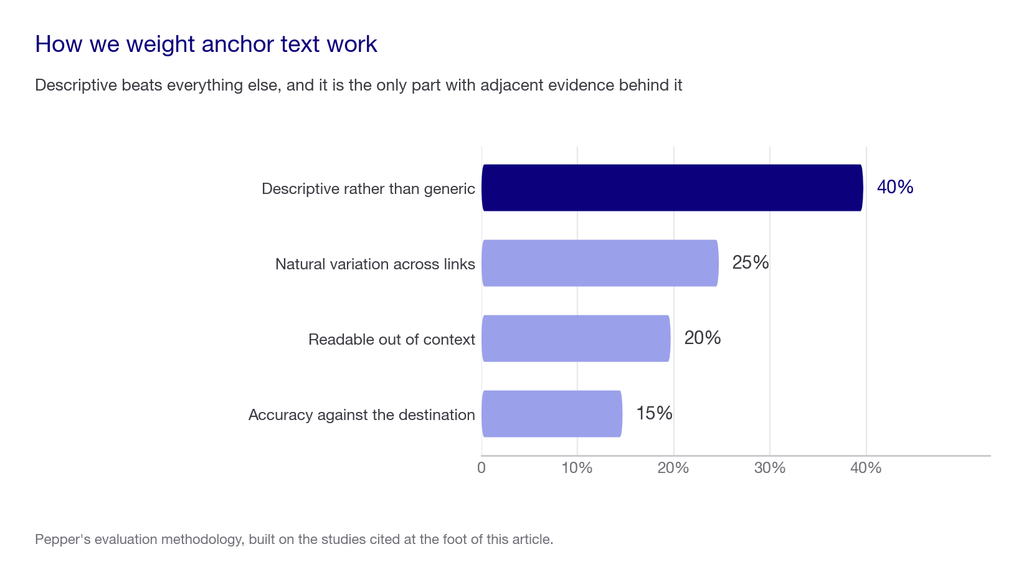
Our methodology: how we weight anchor text work
| Factor | Weight | Why it carries this much |
|---|---|---|
| Descriptive rather than generic | 40% | The only part with adjacent measured evidence behind it, and the cheapest to fix |
| Natural variation across links | 25% | Exact-match patterns at scale remain a long-standing manipulation signal |
| Readable out of context | 20% | Machines and skim-readers both encounter anchors without the sentence |
| Accuracy against the destination | 15% | A promise the target does not keep costs more than a weak anchor |
Anchor types at a glance
| Type | Example | Where it works | Typical cost to fix | Risk | Where it falls short |
|---|---|---|---|---|---|
| Descriptive | “the 2026 crawler table” | Almost everywhere | Seconds per link | None | Needs a writer to think for a moment |
| Partial match | “our guide to anchor text” | Body content, naturally | Seconds per link | Low | Vaguer than a direct description |
| Branded | “Pepper” | Citations and references | Free | None | Says nothing about the destination topic |
| Exact match | “anchor text” | Sparingly, where it reads naturally | Free | Moderate at scale | A manipulation signal if repeated at scale |
| Naked URL | the full address | References and citations | Free | None | Describes nothing, and reads badly in prose |
| Generic | “click here” | Nowhere useful | Seconds per link | None | Wastes the one place you describe a target |
| Image link with no alt | an image with no alt text | Nowhere | A developer hour | High | Invisible to machines entirely |
How to choose what to fix
Anchors are cheap to improve, so the question is where to start rather than whether to bother.
The scorecard
Score a page out of 100.
| Factor | Weight | How to score it honestly |
|---|---|---|
| No generic anchors on key pages | 30% | You have read the anchors on your twenty most valuable pages, rather than assuming |
| Anchors describe the destination | 25% | A stranger reading the anchor alone could guess where it goes |
| Natural variation | 20% | Links to the same page read differently from each other |
| Image links carry alt text | 15% | Checked in the source, since a CMS will often omit it silently |
| Anchors match what the target delivers | 10% | Somebody has followed ten of them and confirmed |
The live test, over 90 days
Anchor changes are slow to show up, so pair them with a measurement you can read.
Fix 30 prompts in your buyers’ words and run them monthly across Google, ChatGPT and Perplexity for 90 days. Real ones, such as “what is anchor text”, “best data observability tool for a small team”, “how much does sales enablement software cost” and “how should I structure internal links”.
Record whether you were named and whether a page of yours was cited. Three readings is the shortest honest window. One is a snapshot, two could be noise, three shows direction. Keep the set fixed, because changing it resets the comparison.
Watch the specific pages whose inbound anchors you rewrote. If those pages start getting cited while the rest hold flat, you have a signal worth acting on. The free method sits in how to measure AI search visibility without expensive tools.
Weak approach versus strong approach
The weaker approach: pick a target keyword, use it as the anchor on every internal link to that page, and treat the count as progress. That is the exact pattern search engines have treated as manipulation for over a decade.
The stronger approach: write each anchor to describe the destination in the words that fit the sentence, and let them vary naturally.
One optimises for a keyword. The other optimises for a reader, which is also what the measured evidence rewards everywhere it has been tested.
One caution on sequencing. Anchor work is a tidy-up rather than a strategy. Do it after the page is retrievable and worth citing, because a perfect anchor pointing at a thin page simply gets a reader there faster.
Red flags
- A recommended anchor ratio. The percentage mixes in circulation trace to no published research.
- A figure for anchor text’s effect on AI citation. Nobody has isolated and measured it.
- Identical exact-match anchors at scale. A long-standing manipulation signal, and still risky.
- “Click here” on a money page. Free to fix and nobody has.
- Image links with no alt text. Invisible to machines entirely.
- Guaranteed ranking gains from anchor changes. Nobody controls generated output, and Google warns against guaranteed rankings.
Five questions worth asking
- “Could a stranger guess where this anchor points?” The fastest quality test available.
- “How many of our anchors say ‘read more’?” A find-and-count answers it.
- “Do links to the same page vary?” If not, the pattern is doing you no favours.
- “Do our image links have alt text?” Check the source rather than the CMS.
- “What evidence is this rule based on?” For anchor ratios, the answer is usually none.
Reduced to one principle: write the anchor as a description a stranger could follow.
One closing note that costs us something. This is an afternoon of editing on pages you already own, it needs no tool, and it is a poor fit for a retainer, ours included. Do it yourself and spend the budget on something slower.
What does this cost?
| What you are buying | Typical 2026 cost | What it covers |
|---|---|---|
| Reading your own anchors | Free, an afternoon | Which ones say nothing, on the pages that matter |
| Rewriting generic anchors | Minutes per page | The cheapest meaningful change available here |
| Adding alt text to image links | A developer hour | Making image links visible to machines at all |
| A crawl to find the pattern | Free to low | Exact-match repetition across the whole site |
| Ongoing discipline | Seconds per new link | Keeping it from degrading again |
| Platform plus a growth team | Custom | Pepper: tracking, plus the people and agents doing the work |
The first row is free, and on most sites it finds more than a tool would.
What nobody should promise you
A measured effect of anchor text on AI citation. No published study isolates it, and anyone quoting a figure is extrapolating.
An optimal anchor text ratio. The percentage mixes in circulation trace to no research anybody can produce.
Ranking gains from anchor changes alone. Anchors describe a destination. They do not make the destination worth visiting.
Guaranteed results. Nobody controls generated output, and Google warns against providers guaranteeing rankings.
When anchor text is not your problem
The answer that costs us the sale. If your pages are not indexed, or your anchors are already descriptive, you do not need anchor text work and we would tell you not to buy it.
Anchor text is a small lever pulled free. It will not rescue a page nothing retrieves, and it will not make a thin page worth citing. Check crawler access first, then whether the page answers something, and come back to anchors as a tidy-up rather than a strategy.
Frequently asked questions
What is anchor text?
The visible, clickable words in a hyperlink. It tells a reader where a link goes, and it gives a machine one of very few direct statements about what the destination page covers.
Does anchor text still matter in 2026?
Yes, though the honest answer is that nobody has measured its effect on AI citation directly. Adjacent evidence is consistent: readable URL slugs were cited 89.78 percent of the time against 81.11 percent for opaque ones.
What is the best type of anchor text?
Descriptive, in the words that fit the sentence. “The 2026 crawler table” tells a reader and a machine what sits on the other side, while “click here” describes only the action.
Is exact-match anchor text dangerous?
Occasionally, no. At scale, yes. Hundreds of links carrying the identical exact-match phrase has been treated as a manipulation signal for well over a decade, and that has not changed.
What is the ideal anchor text ratio?
There isn’t one you can source. The percentage mixes recommended across SEO blogs do not trace to published research, so we do not use them and would not advise anyone else to.
Does anchor text affect AI citations?
Probably, though no study isolates it. What is measured is that machines reward plain description elsewhere, including in URL slugs and page titles, so the inference is reasonable and should be labelled as an inference.
What about links on images?
An image link with no alt text is invisible to machines, since the alt text is the anchor in that case. Content management systems omit it silently, so check the page source rather than trusting the interface.
How do I audit my anchor text?
Copy twenty anchors from a page into a list with no surrounding context. If a stranger could guess what each points at, they work. If the list is mostly “read more”, you have found free improvement.
Where to go next
Open your most important page and copy every anchor into a list.
Read the list with nothing around it. If you cannot tell where the links go, neither can a machine, and that is an afternoon of free improvement sitting on a page you already own.
Internal linking · What AI engines cite · Book a growth audit
Sources and further reading
Primary studies
- Ahrefs. Study of 1.4 million ChatGPT prompts, covering roughly 23.4 million cited and 23.4 million non-cited URLs. Pages with natural-language URL slugs were cited 89.78 percent of the time against 81.11 percent for opaque ones. Cited pages scored 0.602 on semantic similarity to the prompt against 0.484 for non-cited pages. The authors caution that non-cited URLs are 67.8 percent Reddit, which creates compositional artefacts in aggregate comparisons. Neither figure measures anchor text, and both are used here as adjacent evidence that plain description helps machines. Link
- Volpini, Raad, Gamba and Riccitelli. “Structured Linked Data as a Memory Layer for Agent-Orchestrated Retrieval”, submitted 11 March 2026. An entity page format with rich interlinking improved retrieval accuracy by 29.6 percent over plain HTML in standard retrieval. A controlled experiment rather than a measurement of production search engines. Link
Further reading
- Google Search Central. AI search optimisation guidance, 15 May 2026. Warns against providers guaranteeing rankings.
- Pepper. Internal linking for the structural half, and what AI engines actually cite for the page-level evidence.
- Deliberately excluded: any figure for anchor text’s effect on AI citation, since no published study isolates it. Also excluded, the recommended percentage mixes for exact-match, branded and generic anchors, which circulate widely and trace to no research we could open.
Latest Blogs
Most advice on this is inference dressed as fact. OpenAI documents exactly one thing clearly, which is access. Here is what is documented, what is inferred, and how to verify the rest for yourself.
Being named in an AI answer and having your page used as its source are different outcomes with different causes and different fixes. The gap between them is the most useful diagnostic in AI search, and most reporting collapses it into one number.
Every platform reports share of voice and almost none of them define it the same way. Here is the definition worth using, the three choices that change the number, and how to measure it yourself without buying anything.
Get your hands on the latest news!

Similar Posts
GEO / AI Search
10 mins read
How to get cited by ChatGPT
GEO / AI Search
10 mins read
Mentioned vs cited: the difference that decides AI visibility
GEO / AI Search
13 mins read