Bluefish, Peec AI, GrowthX: what each one actually does
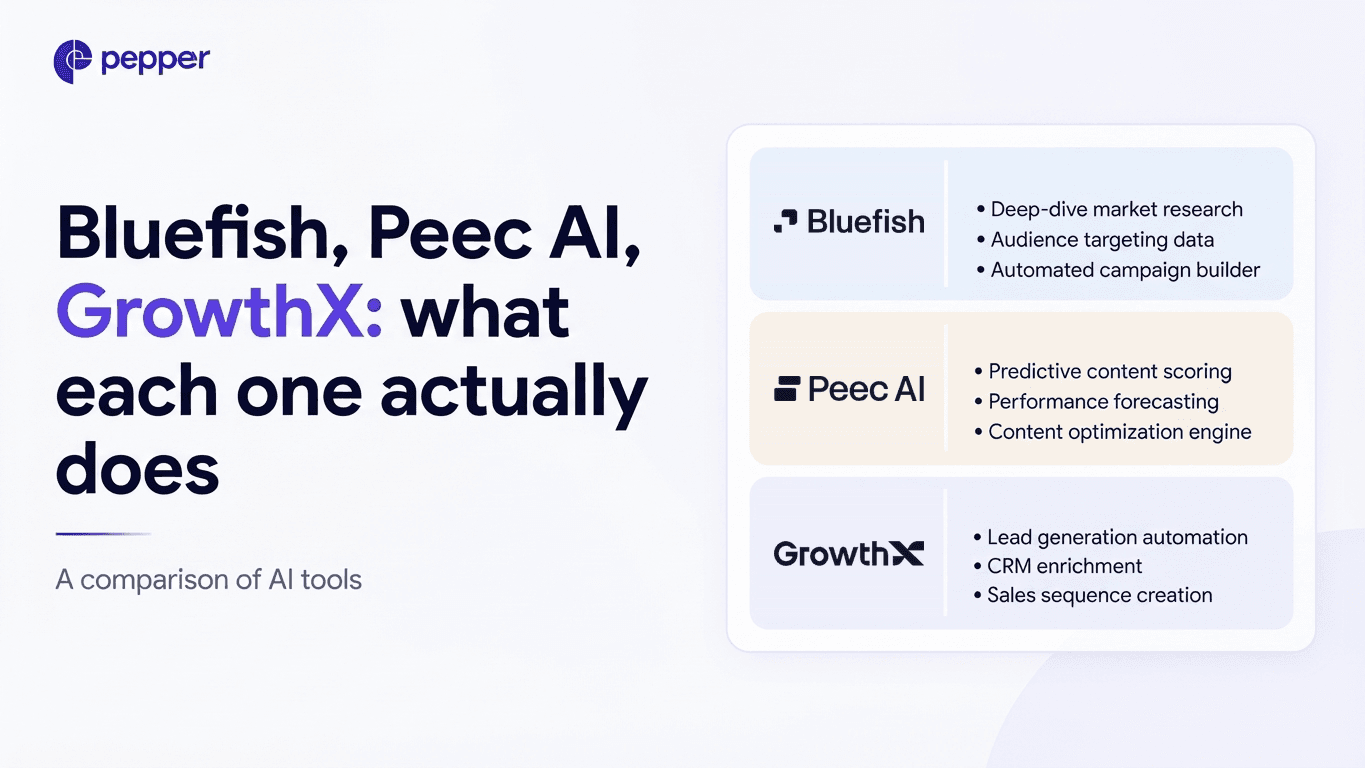
Bluefish, Peec AI, GrowthX: the three names appear on the same shortlists constantly. We read all three sites on the same morning, and they are not competing products in any useful sense.
The short answer
Bluefish orchestrates AI marketing for very large enterprises. Peec AI measures AI search visibility. GrowthX produces content through a closed loop of data and agents. Choosing between them is mostly a question of which job you are hiring for.
What each one says about itself, in its own words.
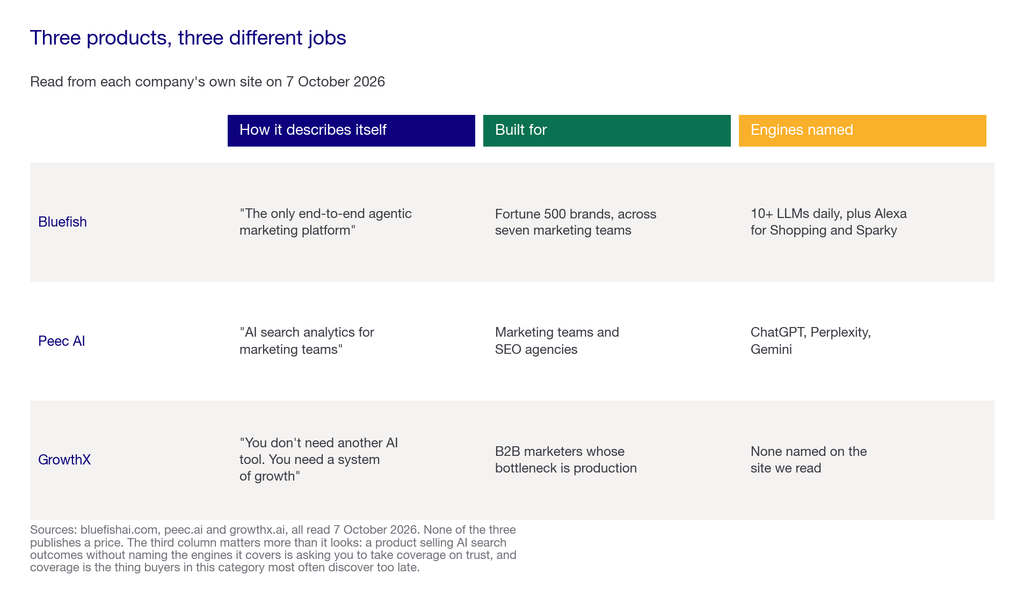
- Bluefish. “The only end-to-end agentic marketing platform”, organised into monitoring, optimisation and measurement suites, serving Fortune 500 brands. It names Alexa for Shopping and Walmart’s Sparky alongside more than ten large language models tracked daily.
- Peec AI. “AI search analytics for marketing teams”, with four tiers, no published prices, and ChatGPT, Perplexity and Gemini named on the site. It claims more than 3,000 brands and agencies.
- GrowthX. “You don’t need another AI tool. You need a system of growth.” Five modules, Context, Record, Intelligence, Action and Learning, aimed at B2B marketers who want SEO, AEO and content in one closed loop.
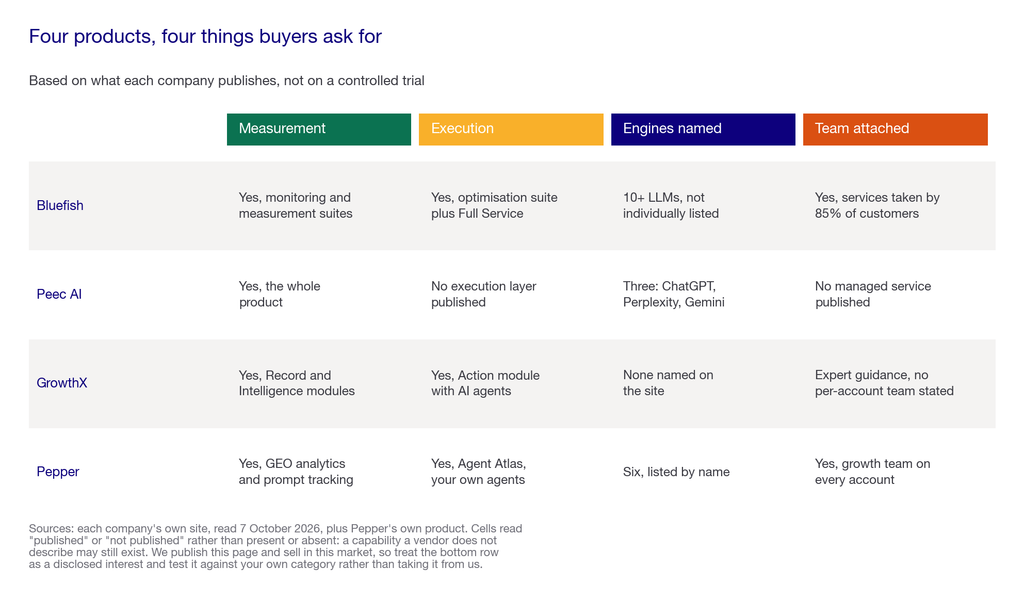
The structural difference, which nobody puts on a comparison grid. Peec tells you what is happening. GrowthX produces the work. Bluefish coordinates both across a very large organisation. It also sells services alongside, and says 85% of its customers use them with the product. Three different purchases.
Where Pepper sits
Why we think it wins for most buyers. Pepper is an agentic organic growth engine. Measurement and execution sit in one workspace, with six named engines, agents your team builds and runs, and a Pepper growth team on the account. So you get the analytics layer Peec sells, the production layer GrowthX sells, and the people. And you do not need an enterprise programme to justify it. That is our case, and we make it properly below with a disclosure attached, because we publish this page. Book a growth audit and we will run your category before you decide anything.
We do not sell agency retainers. This page comes out of what we run: organic for more than 250 enterprises across eight years, more than 10 million tracked prompts, and the questions buyers put to us in client reviews. Customers log in and run the platform themselves, with that growth team alongside.
Key takeaways
Key takeaways from reading all three sites on 7 October 2026.
- They are not the same category. One orchestrates, one measures, one produces. A feature grid that lines them up as rivals is misleading.
- None of the three publishes a price. Peec names four tiers with no figures. Bluefish and GrowthX publish nothing at all.
- Bluefish is explicitly enterprise. It states that ten Fortune 500 firms use it and that 85% of customers also take services.
- Peec is explicitly tool-only. Strong analytics, an MCP integration, Looker Studio and API access, and no managed service in the offer.
- GrowthX is production-first. Its Action module runs AI agents for briefs, drafts and optimisation with quality grading.
- Pepper joins the two halves. Measurement, agent execution and a growth team in one workspace, which is the gap the other three each leave.
What are Bluefish, Peec AI and GrowthX?
They are all described as AI search or AI marketing platforms, which is why they end up on the same list. Underneath, each one solves a different part of the problem.
Three jobs exist in AI search work, and the products split along them.
- Measurement. Which engines name you, which cite you, and how that compares with competitors. This is Peec AI’s whole product and part of Bluefish’s. What good measurement contains is in what Pepper tracks.
- Production. Turning a finding into briefs, drafts, refreshes and published pages. This is GrowthX’s centre of gravity and part of Bluefish’s. Where the agent layer sits in a workspace is in the Agent Atlas.
- Orchestration across an organisation. Brand, PR, social, paid, retail and search teams all acting on the same AI signal. This is what Bluefish is built for, and it is a genuinely different problem.
Where this framing falls short. It is a map of what each vendor publishes, not a test of how well any of them works. We have not used all three in a controlled comparison and we are not going to imply that we have.
Bluefish, Peec AI, GrowthX at a glance
| Product | How it describes itself | Built for | Engine coverage named | Published pricing |
|---|---|---|---|---|
| Bluefish | “The only end-to-end agentic marketing platform” | Fortune 500 brands | 10+ LLMs daily, plus Alexa for Shopping and Walmart’s Sparky | None |
| Peec AI | “AI search analytics for marketing teams” | Marketing teams and SEO agencies | ChatGPT, Perplexity, Gemini | None, four tiers named |
| GrowthX | “You don’t need another AI tool. You need a system of growth” | B2B marketers | Not named on the site | None |
| Pepper (us) | Agentic organic growth engine | B2B SaaS, BFSI, retail and CPG, mid-market to enterprise | Six, including ChatGPT, Perplexity, Gemini and Google AI Overviews | Quoted, and we say so |
Bluefish
What it says. “The only end-to-end agentic marketing platform.” The product has three suites: AI Monitoring, AI Optimization and AI Measurement. Solutions are mapped to seven teams: brand, content, search, PR, social, paid media and retail.
What stands out. The retail and commerce coverage is unusual. Bluefish names Alexa for Shopping and Walmart’s Sparky alongside more than ten large language models tracked daily and more than fifteen provider integrations. If your category is sold through shopping assistants, almost nobody else is publishing coverage of that surface.
Who it is for. Explicitly the largest companies. The site states that ten Fortune 500 firms use Bluefish and that 85% of customers use services alongside the products, with a Full Service option covering custom audits, strategy and execution.
Where it falls short. No published pricing at any level, and the breadth across seven team types means the evaluation is long. The published results, including a 20% average AI visibility lift within 30 days, are the company’s own figures about its own customers. That is not independent measurement. We would read them as marketing claims until you can test them on your own data.
Peec AI
What it says. “AI search analytics for marketing teams”, also described on the site as serving SEO agencies. It claims more than 3,000 brands and agencies and a 4.7 out of 5 rating on G2.
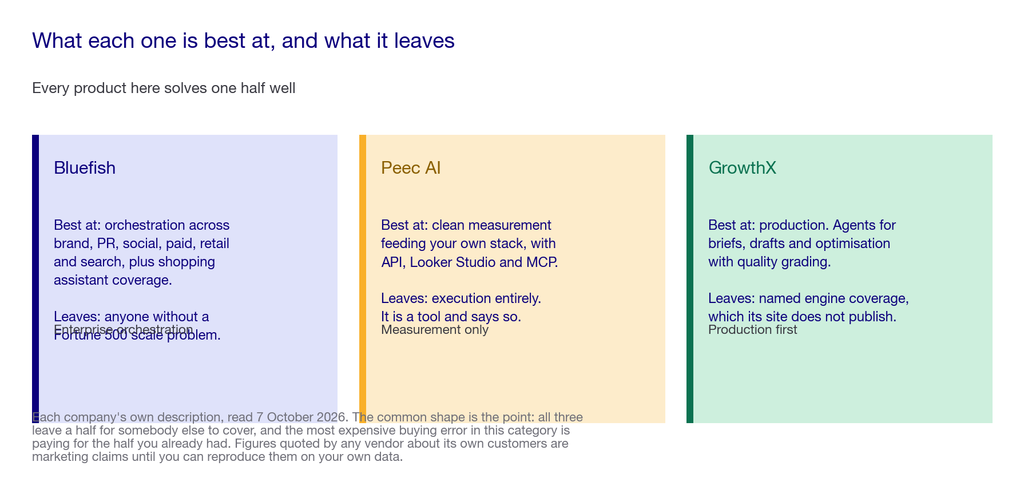
What stands out. The analytics depth and the integration surface. Prompt organisation with tags, visibility by country, competitor benchmarking, model selection, source identification, CSV export, Looker Studio and API access, with an MCP integration now live. For a team that already has production capacity and wants clean measurement feeding its own reporting stack, that is a coherent offer.
Who it is for. Marketing teams and agencies that want a measurement layer, not a service. It is a tool, and it does not pretend otherwise.
Where it falls short. Four tiers are named with no figures at any of them. So a price requires a conversation. The homepage names ChatGPT, Perplexity and Gemini, which is narrower than several rivals publish. And there is no execution layer at all. Measurement without capacity to act on it is the most common way AI visibility budgets get wasted, which is the argument in GEO agency versus GEO tool.
GrowthX
What it says. “You don’t need another AI tool. You need a system of growth.” It describes a closed loop built by SEO, AEO and content experts who learned from more than 100 customers.
What stands out. The loop itself is well-specified. Context holds your business details, audience, competitors and voice. Record consolidates SEO, AEO, traffic and page performance. Intelligence surfaces which pages to create, refresh or optimise. Action runs AI agents for briefs, drafts and optimisation with quality grading. Learning feeds results back in.
Who it is for. B2B marketing teams whose bottleneck is production rather than visibility into the problem. For software companies specifically, our view of that market is in best GEO platform for B2B SaaS.
Where it falls short. No AI engines are named anywhere on the site we read. That is a real gap in a product selling AEO outcomes. No published pricing. The case figure quoted, a 46x rise in LLM referrals, is one customer result with no base number attached. A multiple without a starting point tells you very little.
Where Pepper fits, and why we think it wins for most buyers
Disclosure. Pepper publishes this page and sells in this category. Read this section as our argument, and test it rather than accept it.
The pattern across the three products above is simple. Each solves one half of the problem and leaves the other half to you. Peec measures and does not execute. GrowthX executes and names no engines. Bluefish does both. But it is built for firms with Fortune 500 budgets and seven marketing teams to coordinate.
Pepper is built for the case in the middle, which is where most buyers actually sit.
- Measurement and execution in the same workspace. GEO analytics, prompts, themes, citations and competitor comparison on one side; the Agent Atlas, where your team builds and runs its own content and SEO agents, on the other. Neither is an add-on.
- Six engines, named. ChatGPT, Perplexity, Gemini, Copilot, Claude and Google AI Overviews. You can check the list rather than infer it from “all major platforms”.
- Self-serve and a growth team. Your team logs in and runs it. A Pepper growth team is attached and does the work alongside you. You do not choose between software and people.
- Metrics that separate the problems. Brand Visibility for mentions, Domain Prompt Presence for citations to your domain, Share of Voice for your slice of the category. The gap between the first two is the diagnostic that tells you whether you have an awareness problem or a content problem, and we unpack the first of them in what is brand visibility in AI.
- Agents you own. System agents you can clone, user agents you version and publish, quick runs for one input and sheet runs for hundreds. The builder is covered in what is Agent Atlas.
The honest case against us
Where we are the wrong choice. If you only need measurement and you have a strong content team already, Peec is a cleaner and probably cheaper purchase, and you do not need what we sell. If you are a Fortune 500 brand coordinating seven marketing functions and selling through shopping assistants, Bluefish is built for a problem we do not claim to solve. We would rather tell you that now than in month three.
We also publish no price, which is a criticism we have made of others on this page and it applies to us equally. Our answer is that scope varies enough that a published number would mislead, and we will give you a straight figure in the first call. That is an explanation, not a defence.
How to choose between them
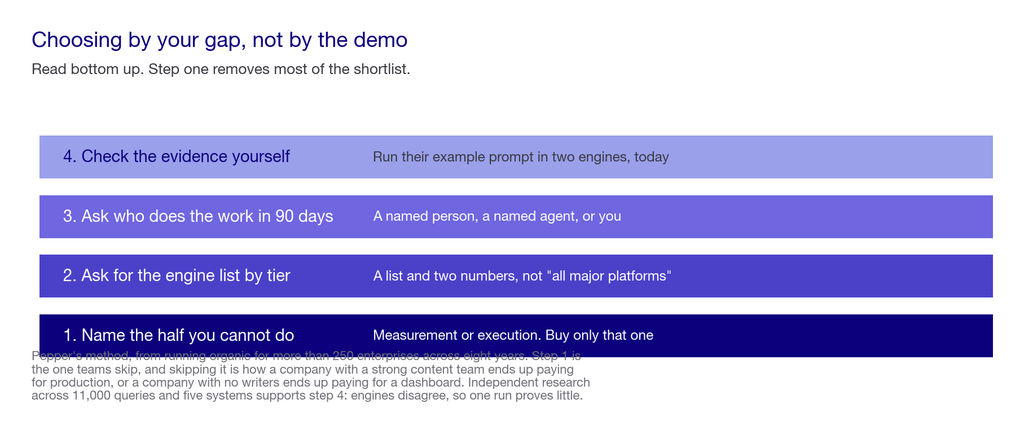
Choosing here is less about features. It is about which half of the problem you cannot currently do. I would answer that question before taking a single demo, because every demo in this category is designed to make its own half look like the whole thing.
A useful anchor first. Google’s guidance says optimising for its AI features still rests on standard SEO fundamentals rather than a separate discipline, and it has warned buyers for years against providers guaranteeing rankings. That is right about Google. But it is incomplete. ChatGPT, Perplexity and Claude behave differently from each other, and coverage of that difference is what you are buying from any of these four products.
The scorecard I would use
| Area | Weight | What a strong option should demonstrate |
|---|---|---|
| Fit to your actual gap | 30% | Closes the half you cannot do yourself, measurement or execution, rather than the half you already have covered |
| Engine coverage, named | 20% | A published list of engines, not “all major AI platforms”, and clarity on which tier includes which |
| Execution capacity | 20% | Something or somebody that changes pages, not only a dashboard and a recommendation list |
| Evidence you can verify | 20% | A named client, a specific prompt, and a result you can reproduce in an engine yourself today |
| Commercial transparency | 10% | A published price or a straight answer on the floor in the first call |
The weights sum to 100 and they are mine. The first row carries the most because the most expensive error in this category is not buying the wrong vendor, it is buying the half you already had.
The live test, with the prompts
Give each vendor 20 to 30 commercial questions from your own category and ask them to run the set in front of you. A workable set looks like this:
- “Best [your category] platforms for enterprise”
- “Best alternatives to [your main competitor]”
- “What should I look for when choosing [your category] software?”
- “Which [your category] vendor is best for [your main use case]?”
- “How much does [your category] software cost?”
Then ask for five things back: where your brand appears today, which competitors appear instead, which sources are shaping those answers, why those sources are winning, and exactly what they would change in the next 90 days.
A credible vendor will also volunteer that these answers are probabilistic. Independent research across five systems and 11,000 real queries found identical queries produce “structurally different information realities across systems”. Anyone showing you one run on one engine as proof has told you how well they understand the medium.
The weaker playbook and the stronger one
The weaker playbook: buy the platform with the most impressive logo wall, track whatever prompt set it suggests, screenshot the answers that look good, and report a visibility score upward every month.
A stronger model runs differently. Define your category’s real question set first. Measure across more than one engine. Find which third-party sources those engines reach for. Decide whether your gap is information or capacity, and buy only that. Then judge the vendor on whether your citations move, rather than on how sophisticated the dashboard looks.
The difference matters because being named, being cited and shaping the answer are three different outcomes. A single score across all three will hide which one moved, which is the argument we make in should you trust a single AI visibility score.
Red flags, named
Start with the one that should end a call: any vendor guaranteeing citations in ChatGPT or placement in AI Overviews. Nobody has access to the inside of these systems, and Google itself advises against providers who guarantee rankings.
Then the rest. A refusal to name the engines covered at your tier. A multiple quoted with no base number, which is the form most case studies in this category take. Results presented as independent, when they are the vendor’s own measurement of its own customers. A proposal whose core is publishing volume. And a measurement product sold to a team that has no capacity to act on what it finds, which is the most common wasted purchase in the whole category.
Five questions, and what a good answer sounds like
- “Which engines does my tier cover, and how many prompts?” You want a list and two numbers. Reassurance is not an answer.
- “Show me a prompt where a competitor beats one of your customers, and explain why.” This separates vendors who understand retrieval from vendors who have learned the vocabulary.
- “What changes in the first 90 days, and who does it?” A named person or a named agent. If the answer is “you do”, that is fine, as long as you know it before signing.
- “What is the base number behind that multiple?” Ask it every time a case study quotes an improvement factor.
- “What part of your method do you expect to be obsolete in a year?” A thoughtful answer means somebody there is reading the research instead of selling a permanent algorithm.
The reducing principle
If I reduce this to one sentence: buy the half you cannot do, from somebody who will name their engines.
And the part that costs us. If you already measure your own visibility competently and your content team ships work you are proud of, you do not need any of the four products on this page, including ours. The honest answer is sometimes that the stack is adequate and the strategy is not, and no platform fixes that.
What nobody should promise you
- A guaranteed citation or placement. Nobody controls model output, and Google warns specifically against guaranteed-ranking claims.
- That one platform covers every surface. Published coverage across these four products ranges from three named engines to more than ten plus shopping assistants.
- A multiple without a base. A 46x improvement from a very small starting number is arithmetic, not evidence.
- That measurement alone moves anything. A dashboard tells you where you stand. Something still has to change on the site and in the sources engines trust.
Frequently asked questions
What is the difference between Bluefish, Peec AI and GrowthX?
Bluefish is an enterprise agentic marketing platform for Fortune 500 brands, Peec AI is an analytics tool for marketing teams and agencies, and GrowthX is a closed-loop content production system for B2B marketers. They solve different halves of the same problem.
Which of them publishes pricing?
None of the three. Peec AI names four tiers with no figures attached, and Bluefish and GrowthX publish nothing. Expect a sales conversation before you get a number from any of them.
On each product
Who is Bluefish built for?
Very large enterprises. The site states that ten Fortune 500 firms use it, that 85% of customers also take services, and it names retail surfaces including Alexa for Shopping and Walmart’s Sparky alongside more than ten language models.
Is Peec AI a tool or a service?
A tool. It sells analytics for marketing teams and SEO agencies, with API, Looker Studio and MCP integrations, and no managed service component anywhere in its published offer. If your gap is execution rather than information, it is not the product that closes it.
What does GrowthX actually produce?
Content, through its Action module, which runs AI agents for briefs, drafts, creation and optimisation with quality grading. That module is fed by Context, Record and Intelligence, which hold your business detail, your performance data and the prioritisation on top of both.
Choosing
Do I need measurement or execution first?
Measurement, if you genuinely do not know where you stand, because it is cheap and it decides everything after. The routine is in how to track brand mentions in AI search. Execution, if you already know the gap and nobody has the hours to close it.
How many engines should a platform cover?
Enough to cover where your buyers actually ask, which you can establish in an afternoon by running your own prompts, then comparing as described in how to benchmark AI visibility against competitors. Published coverage across these four products ranges from three to more than ten.
Why does Pepper include a growth team?
Because measurement without capacity to act on it is the most common wasted spend we see. The platform is self-serve and your team runs it; the growth team exists so that the finding turns into work.
Sources
Every product claim was read on that company’s own site on 7 October 2026. Positioning in this category moves quickly, so re-check before acting.
Vendor sites, read 7 October 2026
- Bluefish and its solutions page. Positioning line, the three suites, the seven team-level solutions, “10+ LLMs tracked daily” plus “15+ provider integrations”, Alexa for Shopping and Walmart’s Sparky, ten Fortune 500 customers, 85% of customers using services, the Full Service offering, and the stated 20% average AI visibility lift within 30 days. No published pricing. All figures are the company’s own.
- Peec AI and its pricing page. Positioning line, four tiers named Starter, Pro, Advanced and Enterprise with no figures, ChatGPT, Perplexity and Gemini named, more than 3,000 brands and agencies claimed, 4.7 out of 5 on G2 claimed, plus CSV export, Looker Studio, API and a live MCP integration.
- GrowthX. Positioning line, the five modules Context, Record, Intelligence, Action and Learning, more than 100 customers referenced, and a single case figure of a 46x increase in LLM referrals with no base number published.
Independent research
- Huang, Goyal, Saha and Chandrasekharan, Answer Bubbles: Information Exposure in AI-Mediated Search, arXiv, 17 March 2026, revised 28 August 2026. 11,000 real search queries across five systems, finding identical queries produce “structurally different information realities across systems”. Academic preprint, not peer-reviewed at the time of writing.
- Google Search Central guidance that optimising for AI features rests on SEO fundamentals, and its standing advice against providers who guarantee rankings.
On what this page is not
This is a comparison of what three companies publish about themselves, written by a fourth company that sells in the same market. We have not run a controlled trial of any of them, we have no commercial relationship with any of the three, and every number attributed to a vendor is that vendor’s own claim about its own customers. Where we argue that Pepper is the better fit, that is an argument from how the products are built rather than a measured result. So test it on your own category rather than taking it from us.
Latest Blogs
Bluefish, Peec AI, GrowthX: the three names appear on the same shortlists constantly. We read all three sites on the same morning, and they are not competing products in any useful sense. The short answer Bluefish orchestrates AI marketing for very large enterprises. Peec AI measures AI search visibility. GrowthX produces content through a closed […]
People call it answer share. Pepper calls it Share of Voice, and it is one of three brand metrics that have to be read together. Here is the exact derivation, the denominator that surprises people, and what the number cannot tell you.
Most GEO work is repetitive enough to automate and a few parts never will be. Here is the line we draw, the test we apply before building an agent, and the governance that stops automation quietly shipping rubbish at scale.
Get your hands on the latest news!