Best GEO platform for B2B SaaS in 2026: why the enterprise answer is wrong for you

The short answer
The best GEO platform for B2B SaaS is usually not the one that tops enterprise rankings, because three things about your situation are different.
- Your prompt set is small and it is about the category, not you. An enterprise tracks brand prompts across many product lines. You need maybe forty to eighty prompts, and most of them are phrased “best X software for Y” by someone who has never heard of you.
- One person signs. There is no procurement committee, so published pricing and genuine self-serve matter far more than SSO and SOC 2 at your stage.
- Sample depth beats prompt allowance. Fifty prompts refreshed daily gives you thirty times the observations of fifty prompts refreshed monthly, at the same headline number.
That last point is the one that reorders the shortlist. On published figures, the cheapest self-serve tier that runs a SaaS-sized prompt set daily across eight engines is $100 a month. The most expensive per prompt is not the most expensive plan.
Pepper sits in this market and we will be plain about that. We are an agentic organic growth engine, not an SEO agency. This page comes out of what we run: organic for more than 250 enterprises across eight years, more than 10 million tracked prompts, and the questions buyers put to us in client reviews. Customers log in and run the platform themselves, with a Pepper growth team attached to the account. Book a growth audit and we will show you what five engines say about your category before you buy anything.
Key takeaways
Key takeaways from an afternoon on vendor pricing pages, checked 17 and 21 September 2026.
- Cost per tracked prompt ranges from $0.71 to $2.00 across the self-serve tiers that publish both a price and a prompt count.
- The cheapest plan is the most expensive per prompt. Trakkr’s $100 Growth tier works out at $2.00 per prompt. Scrunch’s $500 Growth tier is $0.71.
- Refresh frequency is the number nobody compares. Trakkr states daily refresh on all tiers. A monthly refresh at the same prompt count gives you a thirtieth of the data.
- The enterprise favourite withdrew its pricing. Profound now publishes only a free trial and a custom quote, which makes it hard to evaluate without a sales call.
- Your buyer does not search your brand. B2B SaaS discovery prompts are category-shaped, so Domain Prompt Presence matters more than Brand Visibility early on.
- Do not buy seats you will not fill. Several tiers price on brands or user licences, which suits agencies and holding companies rather than a single product company.
What is a GEO platform, and what does a B2B SaaS company need from one?
A GEO platform runs a set of prompts across AI engines on a schedule and reports what came back: whether you were mentioned, whether a page of yours was cited, and who was named instead.
Naturally, every platform does that. The differences that matter to you are narrower than the feature lists suggest.
- Engine coverage, meaning which engines are actually included at the tier you will buy rather than at enterprise.
- Prompt allowance, meaning how many distinct questions you can track.
- Refresh frequency, meaning how often each prompt is re-run. This is the sample size and it is the most commonly omitted figure.
- Raw answer access, meaning whether you can read what the engine actually said, or only a score.
If you want the general market view rather than the SaaS cut, we compare fourteen platforms on data reliability in top AI visibility platforms, and the enterprise segment separately in best AI visibility platforms for enterprise.
So why does the enterprise answer not transfer?

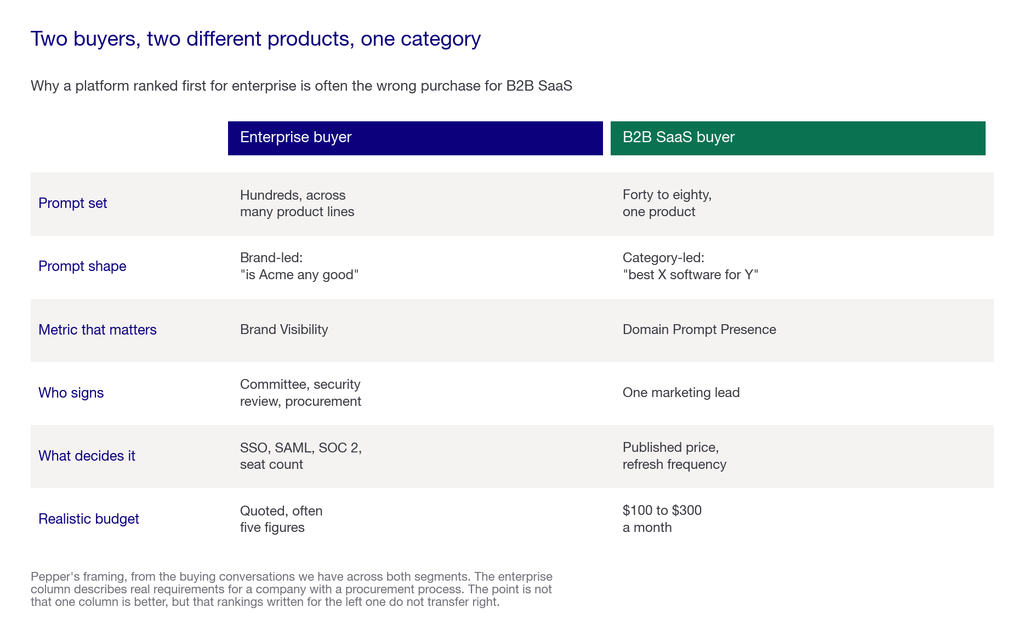
However, the enterprise rankings optimise for things you may not need yet: SSO and SAML, nine or more engines, unlimited seats, procurement-friendly contracts, and a denominator large enough to satisfy an analytics team. Those are real requirements for a company with a security review and a committee.
Meanwhile, at a fifty-person SaaS company, none of that is the constraint. Your constraint is that one person has to run this alongside three other jobs, and they need to see, this week, whether ChatGPT recommends you when someone asks for software in your category.
What B2B SaaS discovery prompts actually look like
This is the part that changes the metric you should watch.
An enterprise brand is already known, so its prompts are often brand-shaped: “is Acme any good”, “Acme vs Globex”. A B2B SaaS buyer usually does not know you exist. Their prompts are category-shaped.
- “Best invoicing software for freelancers”
- “What tool should I use for SOC 2 compliance automation”
- “Cheapest alternative to Zendesk for a small support team”
- “Project management software that integrates with Linear”
Because of that, you will not appear in those answers on brand recognition. Instead, you appear because a page of yours, or a third party writing about you, is the source the engine reaches for. That makes Domain Prompt Presence the number to watch early, not Brand Visibility, and the gap between the two is the citability problem. Our framework for acting on it is Visibility, Citability and Retrievability.
Where the citations come from
A note on what we could not verify. Independent academic work across 11,000 queries found third-party and reference sources overrepresented in AI answers, which matches what we see: review sites, comparison pages and community threads carry a lot of weight in software categories. You will also find widely quoted figures claiming specific citation shares for G2, Reddit and YouTube in B2B SaaS. We went looking for those at source. The two studies behind them are published by agencies selling services in this category, and both returned errors when we tried to read them. So we are not quoting a number we could not check.
Do this instead, and it takes twenty minutes. So take your ten most valuable category prompts, run them in ChatGPT and Perplexity, and write down every source cited. That list is your actual authority target, it is specific to your category, and it beats anyone’s published average including ours.
The best GEO platform for B2B SaaS, at a glance
Disclosure: Pepper appears here. We are not ranking ourselves against these tools. We lead the table because we are the publisher, in a separate category, with the same columns filled so you can judge fit yourself.
Note that these are the self-serve tiers a single SaaS product company would actually buy, rather than enterprise quotes.
| Platform | Entry tier a SaaS buyer would use | Prompts | Engines | Cost per prompt |
|---|---|---|---|---|
| Pepper | Not published, quoted on scope | Scoped | 5 named | Not published |
| Trakkr Growth | $100 a month | 50 per brand | 8 | $2.00 |
| Otterly Standard | $189 a month | 100 | 4, more as add-ons | $1.89 |
| AthenaHQ Starter | $295 a month | 3,600 credits | 11 models | Credits, not prompts |
| Scrunch Starter | $300 a month | 350 custom | Multiple, not itemised | $0.86 |
| Peec AI | Not published | Not published | Not published | Cannot be calculated |
| Profound | Enterprise only, no published tier | 10 on free trial | 1 on trial, 9 on Enterprise | Cannot be calculated |
Checked at each vendor’s own pricing page on 17 and 21 September 2026. Cost per prompt is our arithmetic: published monthly price divided by published prompt allowance. AthenaHQ prices in credits, where one credit is one AI response, so it is not directly comparable.
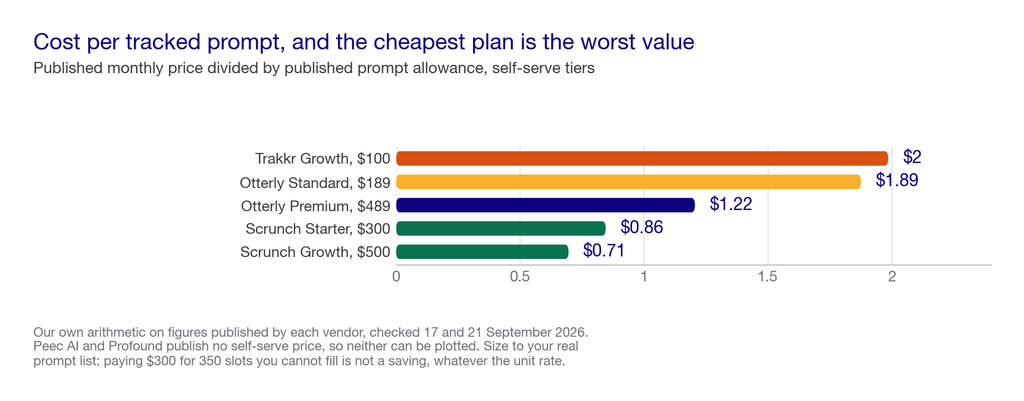
So read that chart against your prompt count, rather than against the headline price. If you genuinely have fifty buying prompts, the $100 plan is the right purchase even though it is the worst value per prompt. Paying $300 for 350 slots you will not fill is not a saving.
Trakkr
- Published price: first, $100 a month Growth, then $500 Scale, and Enterprise from $950. Annual billing takes 17 percent off.
- What Growth includes: 1 brand, 50 prompts, 8 engines, 3 seats, 25 article credits a month.
- Refresh: daily on all tiers, and it is stated plainly on the pricing page. That is the most useful disclosure here.
- Engines named: ChatGPT, Claude, Gemini, Perplexity, Google AI Overviews, Grok, DeepSeek and Meta AI.
- Trial: 14 days, all plans.
- Where it falls short: however, 50 prompts is a real ceiling if your category is broad, and Scale at $500 is priced for ten brands, so a single-product company pays for nine it will not use.
Otterly
- Published price: $29 Lite, $189 Standard, $489 Premium. Enterprise from around $1,000. Annual billing takes 15 percent off.
- Prompts: 15, 100 and 400 respectively. Extra bundles are $99 per 100.
- Engines: four included, with Claude, Google AI Mode and Gemini as paid add-ons.
- Where it falls short: however, the add-on model means the headline price understates coverage. Price the engines you actually need before comparing it with anything else.
AthenaHQ
- Published price: free Essential tier with 300 credits, Starter at $295 a month with 3,600 credits, Enterprise custom.
- Model coverage: five models on Essential, eleven on Starter.
- The unit: stated plainly as “1 credit = 1 AI response,” which is the clearest unit definition we have found in this category.
- Where it falls short: because credits are not prompts, comparison takes arithmetic. One prompt across eleven models consumes eleven credits, which turns 3,600 credits into roughly 327 full prompt runs a month.
Scrunch
- Published price: $300 Starter, $500 Growth, Enterprise custom. Annual billing takes 17 percent off.
- What Starter includes: 350 custom prompts, 1,000 industry prompts, 3 user licences, 3 personas, 5 page audits.
- Trial: 7 days on Starter, no card required.
- Where it falls short: the best cost per prompt here, but only if you can fill 350 slots. Also, it does not publish a refresh frequency, which is the number that decides whether the prompt count means anything.
Peec AI
- Published price: none. Four named tiers, Starter through Enterprise, with no figures.
- Where it falls short: so you cannot evaluate it without a call, which for a single budget holder with an afternoon to spend is a real cost. The product may be excellent. The buying process is not built for you.
Profound
- Published price: none any more. A free trial covering 10 prompts on ChatGPT as a one-time run, then Enterprise at a custom quote.
- What changed: earlier in 2026 it published a $99 Starter and a $399 Growth tier with stated monthly response volumes. Those are gone, and so are the response figures that made its percentages checkable.
- Where it falls short: so for a B2B SaaS buyer this is now an enterprise product with an enterprise sales motion. A 10-prompt trial run once will not tell you whether the sampling is deep enough to trust.
The arithmetic nobody does: prompts times refresh
Here, then, is the calculation that should decide your shortlist, and almost no comparison runs it.
First, a platform advertising 50 prompts and one advertising 350 prompts look seven times apart. They are not, if one refreshes daily and the other monthly.
- 50 prompts refreshed daily produces roughly 1,500 observations a month.
- 350 prompts refreshed monthly produces 350.
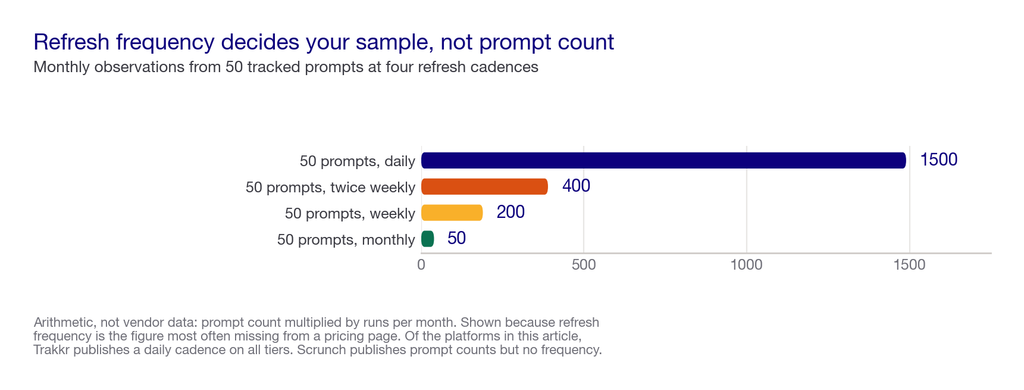
In other words, the smaller allowance gives you four times the data. And data volume is what makes a percentage mean something: a share-of-voice figure built on 350 observations moves visibly on noise, while the same figure on 1,500 starts to reflect reality.
So ask two questions of every vendor, in this order. How many prompts, and how often is each one run? If the second answer is missing from the pricing page, ask for it in writing before you buy. Of the platforms above, Trakkr is the one that publishes it.
What this costs, and what to expect to pay
For a single B2B SaaS product with a realistic prompt set, the self-serve market sits between $100 and $300 a month.
- Under $100 a month. Otterly Lite at $29 tracks 15 prompts. That is a baseline check, not a measurement programme, and it is a perfectly sensible first purchase.
- $100 to $300 a month. Where most single-product SaaS companies land. Trakkr Growth, Otterly Standard, AthenaHQ Starter, Scrunch Starter.
- Above $300. You are buying either more brands, more seats, or enterprise features. Check which, because for one product company the first two are waste.
- Free tiers exist. AthenaHQ’s Essential tier is free with 300 credits, and several vendors run trials. Start there before you spend anything.
We do not publish a rate card either, and it would be poor form to criticise anyone else for that. What we do is give you the number on the first call rather than after three meetings. The wider picture across agencies, platforms and tools sits in SEO, AEO and GEO pricing benchmarks.
How to choose a GEO platform for B2B SaaS
This is the part worth slowing down for. Here is the sequence we would run if we were buying rather than selling.
Step one: write your prompt list before you look at any vendor
First, open a document and write the questions a buyer types when they do not know you exist. Category phrasing, not brand phrasing. Include the competitor comparisons you already lose.
Most B2B SaaS companies land between forty and eighty. If you are also choosing who runs the work, should you buy a GEO platform or hire a team covers that split. That number is your entire buying criterion for prompt allowance, and having it in hand stops a salesperson sizing you into a tier you do not need.
Step two: score the shortlist on a 100-point scale
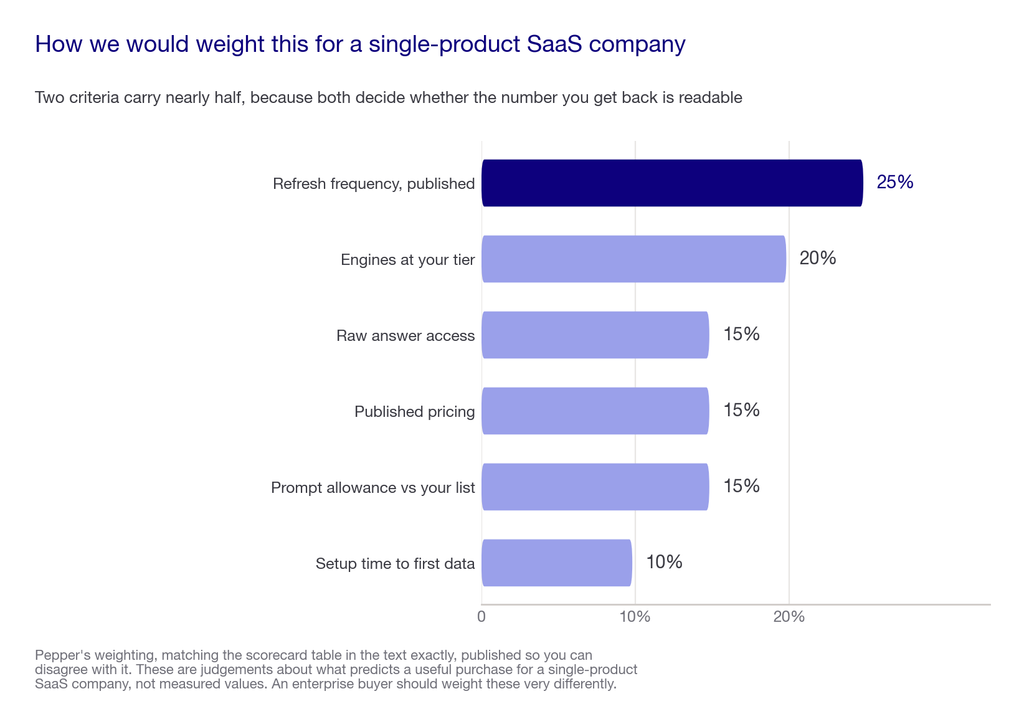
Rebuild this for your own situation, from each vendor’s own pricing page rather than from a ranking.
| Criterion | Weight | What earns full marks |
|---|---|---|
| Refresh frequency, published | 25 | A stated cadence on the pricing page, ideally daily |
| Engines included at your tier | 20 | The engines you care about, at the price you will pay |
| Raw answer access | 15 | You can read what the engine said, not only a score |
| Published pricing | 15 | A number on the page, no call required |
| Prompt allowance against your list | 15 | Covers your forty to eighty without a jump to enterprise |
| Setup time to first data | 10 | Hours, not a scheduled onboarding |
Total 100. Refresh frequency and engine coverage carry nearly half between them, because those two decide whether the number you get back is worth reading. Our weights for the wider category sit in the GEO agency ranking methodology.
Step three: ask the five questions that separate them
- “How often is each prompt re-run?” The single most useful question in this category, and the one most often unanswered on a pricing page.
- “Which engines are included at the tier I am buying, not at enterprise?” Tier-gating is standard. The advertised engine count is usually the ceiling.
- “Can I export the raw answers and the cited URLs?” Without this you cannot tell whether a citation was your page or a third party’s, which is the whole diagnosis.
- “What happens when I exceed my prompt allowance?” Add-on bundles, a forced upgrade, or silent truncation. All three exist.
- “What would you tell us not to buy?” A vendor with a view answers immediately. This is the question that most reliably separates practitioners from sales teams.
Step four: run a real test on the trial, not a demo
Most of these offer a trial of 7 to 14 days. Use it properly.
First, load your twenty highest-value category prompts, rather than the vendor’s suggested ones. Then check three things. Does it report which page was cited, or only that you were mentioned? Does the answer it captured match what you see when you run the prompt yourself? And can you get the raw text out?
A weaker tool gives you a score and a trend line. A stronger one gives you the answer text, the cited URLs, and the competitor named in your place. The second kind tells you what to write next week. The first kind tells you to worry.
Then give the winner 90 days before you judge it. Load the same 25 prompts on day one, take a baseline, and leave it alone. Organic movement in AI answers is slow, so a fortnight of data tells you whether the tool works and nothing at all about whether your visibility is improving. Judge the tool in two weeks. Judge the programme at 90 days.
Step five: watch for these red flags
- No published refresh frequency. The prompt count is meaningless without it.
- A single visibility score with no published components. Ask what it is made of.
- Pricing by brand or seat when you have one brand and two people who will log in.
- Engine counts quoted from the enterprise tier in a conversation about a $200 plan.
- No raw answer export. You are buying a dashboard, not a diagnosis.
- A guaranteed citation in an AI answer. Nobody controls model output, and we will not promise it either.
Step six: decide whether you need a platform at all yet
And here is the answer that loses us the sale. If you have fewer than about twenty real category prompts and nobody who will read the output weekly, do not buy anything. Run your ten most valuable prompts by hand in ChatGPT and Perplexity once a month, keep the citations in a spreadsheet, and spend the budget on the pages and third-party coverage the engines are already citing.
After all, a tool tells you that you are not cited. It does not fix it. The fix is the content and authority work in our GEO best practices playbook, and that work is free to start.
It comes down to one principle: buy the smallest thing that gives you a trustworthy number, then spend the difference on being worth citing. For most B2B SaaS companies, that is a $100 to $300 subscription and the rest into earned coverage. Our own work in this segment, including Algolia and Acceldata, followed that order.
What nobody should promise you
- A guaranteed citation in an AI answer. Nobody controls what a model outputs, at any price.
- A single GEO score that means something. One number collapsing several engines and dozens of prompts hides the variance you are paying to see.
- That a bigger prompt allowance is better. Fifty prompts refreshed daily beat 350 refreshed monthly, four to one on observations.
- Enterprise engine coverage at a self-serve price. Tier-gating is the norm. Check the tier you are buying.
- That last year’s published price still holds. One vendor withdrew its entire published ladder inside this year. Check on the day you buy.
Frequently asked questions
What is the best GEO platform for B2B SaaS?
There is no single answer, because it depends on your prompt count and whether the vendor publishes a refresh frequency. For a single product with forty to eighty category prompts, the self-serve tiers between $100 and $300 a month are the right shelf to shop on.
How many prompts should a B2B SaaS company track?
Most land between forty and eighty. Write the list before you talk to a vendor, using the category phrasing a buyer uses when they do not know your brand, and let that number choose your tier rather than the other way round.
Cost and sizing
How much does a GEO platform cost for a SaaS company?
Published self-serve tiers run from $29 a month for 15 prompts to $500 for 700. Most single-product companies land between $100 and $300. Free tiers and trials exist, so start there before spending.
Is a cheaper plan worse value?
Often the opposite, per prompt. The cheapest published tier we checked works out at $2.00 per prompt and the most expensive at $0.71. But paying for slots you cannot fill is not value, so size to your actual list.
Why do some platforms not publish pricing?
Scope varies and a published floor becomes an anchor in negotiation. For an enterprise buyer that is tolerable. For a single SaaS budget holder it adds a sales call to what should be an afternoon’s decision.
Metrics and testing
Should I track Brand Visibility or Domain Prompt Presence?
Domain Prompt Presence, early on. Your buyer does not search your brand, so what matters is whether a page from your domain gets cited when they ask a category question. The gap between the two numbers is your citability problem.
How do I test a GEO platform before buying?
Use the trial with your own twenty highest-value category prompts, not the vendor’s samples. Check whether it names the cited page, whether its captured answer matches what you see yourself, and whether you can export the raw text.
Do I need a platform if I already do SEO?
Not immediately. If you have fewer than twenty category prompts and nobody to read the output weekly, run them by hand monthly and spend the budget on content and third-party coverage instead.
Sources
Every price and specification below was read off the vendor’s own pricing page on the date stated. Prices in this category move, so check before you buy.
Vendor pricing pages
- Trakkr pricing, checked 21 September 2026. Growth $100 monthly, 1 brand, 50 prompts, 8 engines, 3 seats, 25 article credits. Scale $500, 10 brands. Enterprise from $950. Daily refresh on all tiers, 14-day trial, 17 percent annual discount. Engines named: ChatGPT, Claude, Gemini, Perplexity, Google AI Overviews, Grok, DeepSeek, Meta AI.
- Scrunch pricing, checked 21 September 2026. Starter $300 monthly with 350 custom prompts, 1,000 industry prompts, 3 user licences, 3 personas, 5 page audits. Growth $500 with 700 custom prompts. 7-day Starter trial, 17 percent annual discount. No refresh frequency published.
- Otterly pricing, checked 17 September 2026. Lite $29 for 15 prompts, Standard $189 for 100, Premium $489 for 400, four engines included with others as add-ons. Enterprise from around $1,000. Extra prompts $99 per 100. 15 percent annual discount.
- AthenaHQ pricing, checked 17 September 2026. Free Essential tier with 300 credits and five models, Starter $295 monthly with 3,600 credits and eleven models, Enterprise custom. States “1 credit = 1 AI response.”
- Peec AI pricing, checked 17 September 2026. Four named tiers, no figures published.
- Profound pricing, checked twice on 17 September 2026. A free Trial covering 10 prompts on ChatGPT as a one-time run, and Enterprise at “Custom” covering nine engines with SSO, SAML and SOC 2. No monthly figures published. Earlier in 2026 the same page listed a $99 Starter and a $399 Growth tier with stated monthly response volumes.
All cost-per-prompt figures in this article are our own arithmetic on those published numbers: monthly price divided by published prompt allowance.
Research
- Huang, Goyal, Saha and Chandrasekharan, Answer Bubbles: Information Exposure in AI-Mediated Search, arXiv, 17 March 2026. 11,000 real search queries across five systems. Finds Wikipedia and longer third-party sources cited far more often than their share of the web would suggest. Academic and independent.
Latest Blogs
Most advice on this is inference dressed as fact. OpenAI documents exactly one thing clearly, which is access. Here is what is documented, what is inferred, and how to verify the rest for yourself.
Being named in an AI answer and having your page used as its source are different outcomes with different causes and different fixes. The gap between them is the most useful diagnostic in AI search, and most reporting collapses it into one number.
Every platform reports share of voice and almost none of them define it the same way. Here is the definition worth using, the three choices that change the number, and how to measure it yourself without buying anything.
Get your hands on the latest news!
