SEO agency cost in 2026: benchmarks for agencies, platforms and AI visibility tools
The short answer
SEO agency cost in 2026 runs from roughly $1,600 to $25,000 a month for published figures, and most firms publish nothing at all. AI visibility tools sit an order of magnitude below that, starting at $29 a month.
The reason is that the three layers are not priced on the same thing.
- Agencies price time. Hourly rates, retainers, minimum project sizes.
- AI visibility tools price volume. Prompts tracked, or credits, where one vendor states plainly that “1 credit = 1 AI response.”
- The enterprise tier increasingly prices nothing. One vendor that published a clear ladder earlier in 2026 has withdrawn it. Its page now shows a free trial and a custom enterprise quote.
Every number below was read off the vendor’s or agency’s own page in September 2026. Where a figure is not published, we say so rather than estimating.
We have a stake in this. Pepper is an agentic organic growth engine, not an SEO agency, and we do not publish a rate card either. What we do is give you the number on the first call rather than after three meetings. This page comes out of what we run: organic for more than 250 enterprises across eight years, more than 10 million tracked prompts, and the pricing questions buyers put to us in client reviews. Customers log in and run the platform themselves, with a Pepper growth team attached to the account, running the agents in Agent Atlas. Book a growth audit and you will get a scoped number, not a range.
Key takeaways
Key takeaways from a day spent reading pricing pages rather than pricing guides.
- Published agency figures run $1,600 to $25,000 per month. SeoProfy starts from $1,600. WebFX starts at $3,000. uSERP publishes a $5,000 to $25,000-plus band.
- Published tool figures start at $29 per month. Otterly lists $29, $189 and $489 tiers. AthenaHQ has a free tier and a $295 tier.
- The marginal prompt is cheaper than the base prompt. Otterly’s entry tier works out at about $1.93 per tracked prompt per month. Its top published tier is about $1.22, and extra prompt bundles are $0.99.
- One vendor withdrew its published ladder. Profound’s pricing page now shows a free trial and a custom enterprise quote, with no monthly figures. Earlier in 2026 it published named monthly tiers.
- Hourly rates cluster far more tightly than minimums. In one city listing, rates spanned $100 to $300 while minimum project sizes spanned $1,000 to $25,000.
- Your existing agency probably can do GEO. Google places this work inside SEO. What you are really negotiating is price, and we settle that below.
What is included in SEO agency cost, and what is priced separately?
A retainer usually bundles four things, and the bundling is why comparing two quotes is so hard.
- Technical and structural work. Crawl health, architecture, speed, indexation, schema. Mostly front-loaded, done once for the estate, then maintained.
- Content production. Priced per piece or per month, and the single largest variable between two otherwise similar quotes.
- Earned authority. Links, citations, digital PR. The slowest and most expensive line, and the one where published unit prices actually exist. uSERP states that “if you are paying notably less than $900 per link placement, you are most likely receiving a worthless or even harmful link.”
- Reporting and account management. Rarely itemised, always present, and typically where an agency’s margin lives. What good reporting contains is set out in the Visibility, Citability and Retrievability framework.
Priced separately, more often than not: tooling. Which brings us to the interesting part.
Three layers, three incompatible pricing logics
Put every published figure on one axis and the shape of the market is obvious.
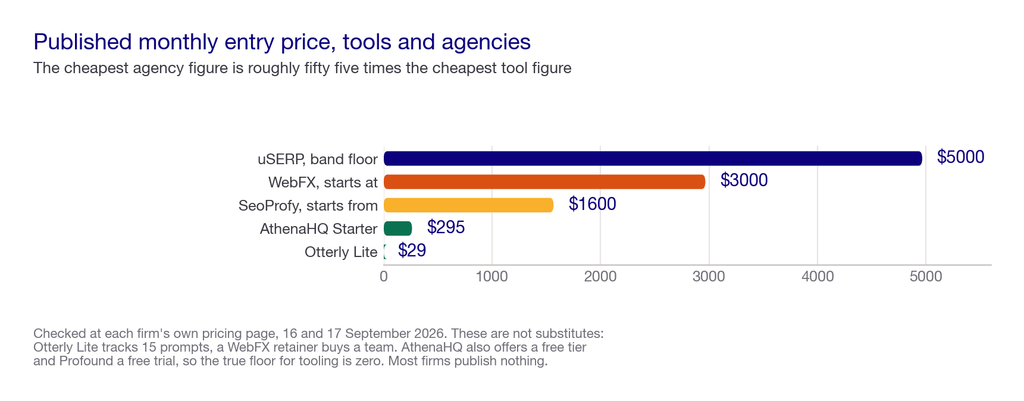
The tools and the agencies are not really competing on price, because they are not selling the same unit. A $29 subscription tracks 15 prompts. A $3,000 retainer buys a team’s attention. Comparing them directly is a category error, and vendors on both sides are happy to let you make it. We laid out how the two models differ at scale in our guide to enterprise SEO agencies.
What the chart does show is the size of the gap. The cheapest agency figure we found is roughly fifty five times the cheapest tool figure. That gap is the space where the question at the bottom of this page lives.
Why so few firms publish anything
Across the agencies and tools we checked this month, a minority publish a number. The reasons are ordinary rather than sinister: scope genuinely varies, and a published floor becomes an anchor in every negotiation that follows.
The effect on buyers is still real. With no public reference points, a first quote has nothing to be compared against, and the published figures below end up carrying more weight than their sample size deserves. Treat them as anchors, not averages.
What agencies actually charge
Three agencies publish enough to be useful, and one publishes a full rate card.
- SeoProfy. States services “start from $1,600 per month,” noting that exact pricing depends on goals and market competition. It also claims delivery in 45-plus countries and 15-plus languages. Where it falls short: a floor is not a ladder, so you still cannot tell what your scope lands at.
- WebFX. The only full ladder we found. SEO services start at $3,000 per month, with four named tiers that split an initial two-month investment from a lower ongoing monthly fee across a six-month commitment. Where it falls short: the tiers describe deliverable volume rather than outcomes, so two buyers on Gold can get very different value.
- uSERP. Publishes a band of $5,000 to $25,000-plus per month, plus the $900 per link floor quoted above. Where it falls short: a fivefold band is wide enough that it prices nothing, and the figure sits in an FAQ rather than on a pricing page.
- Delante. No rate card, but its contact form asks buyers to choose a band: €1,500 to €2,500, €2,500 to €5,000, or above €5,000. Where it falls short: asking your budget before quoting is the oldest anchoring move in the category.
Reading the one full rate card
The WebFX structure is worth looking at closely, because it makes explicit something most quotes hide.
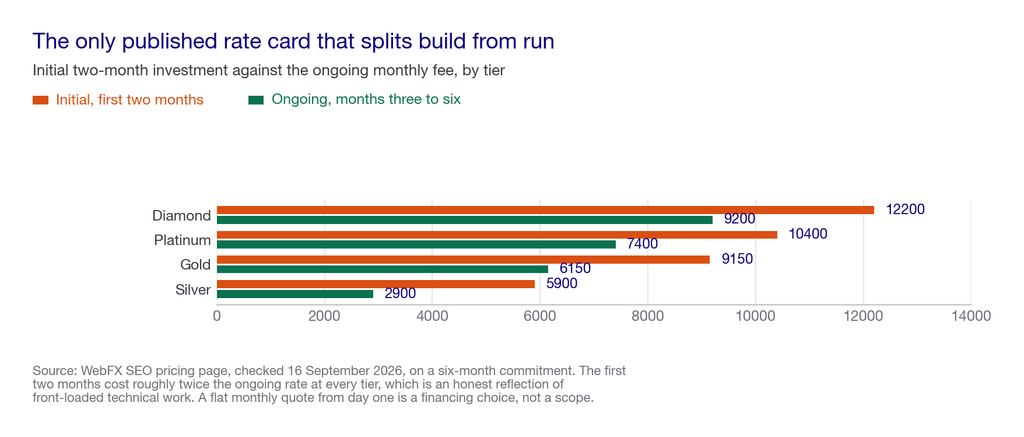
- Silver. Costs $5,900 up front, then $2,900 a month.
- Gold. Starts at $9,150, dropping to $6,150 a month.
- Platinum. Opens at $10,400, then $7,400 a month.
- Diamond. Runs $12,200 first, then $9,200 a month.
Why this matters more than the absolute numbers. The first two months cost roughly twice the ongoing rate at every tier. That is an honest reflection of how the work actually lands: technical fixes, architecture and templates are front-loaded, and maintenance is not. If a proposal you are reading is one flat monthly figure from day one, ask what happens in month one versus month five. The work is not flat, so a flat price is a financing decision rather than a scope description.
Hourly rates, and why the minimum tells you more
City directory listings publish hourly rates and minimum project sizes, and the two behave very differently.
In one New York listing checked this month, published hourly rates ran from $100 to $300, roughly a threefold spread. Minimum project sizes in the same listing ran from $1,000 to $25,000, a twenty five times spread.
Read that gap carefully. The rate tells you roughly where a firm places itself. The minimum tells you who it is actually built to serve, and it is the faster filter by a wide margin. That pattern holds wherever directories publish the numbers, and we walk through one city listing in detail in our piece on banking and financial SEO agencies.
What AI visibility tools actually charge
The tool layer is where published pricing still survives, and where the unit is prompts rather than hours.
- Otterly. Lite at $29 per month for 15 prompts, Standard at $189 for 100 prompts, Premium at $489 for 400 prompts, all covering four engines with more as add-ons. Enterprise starts around $1,000. Annual billing takes 15 percent off. Extra prompts are $99 per 100.
- AthenaHQ. A free Essential tier with 300 credits covering five models, Starter at $295 per month with 3,600 credits and 11 models, then custom enterprise. It states the unit plainly: “1 credit = 1 AI response.”
- Peec AI. Four named tiers, Starter through Enterprise, with no figures published on the pricing page.
- Profound. A free trial and a custom enterprise quote, covered in the next section.
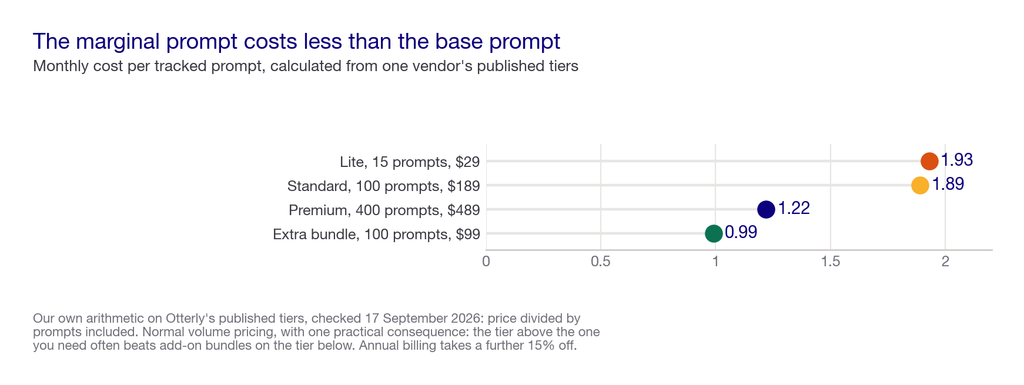
The marginal prompt is cheaper than the base prompt. Divide Otterly’s published tiers by their published prompt counts and the entry tier is the most expensive per unit, at roughly $1.93. Premium works out near $1.22, and the add-on bundle is $0.99 per prompt. That is normal volume pricing, and it has a practical consequence: buying the tier above the one you think you need is often cheaper per prompt than buying add-ons onto the tier below it.
Credits are not prompts
Watch the unit. AthenaHQ’s “1 credit = 1 AI response” is the clearest statement of the unit we found anywhere in this category. One prompt run against five engines consumes five responses. Before comparing any two tools, convert both to responses per month, or you will compare a number against a different number. We compared the tools themselves in alternatives to Profound.
The tier that stopped publishing a price
Here is the change worth recording, because it happened inside this year.
Profound’s pricing page, checked on 17 September 2026, shows two things: a free Trial and an Enterprise tier at “Custom.” The trial covers 10 prompts, ChatGPT only, as a one-time run. The enterprise tier covers nine engines with SSO, SAML and SOC 2, and is described as “Tailored packages for companies operationalizing AI Search insights and running marketing agents at scale.” An FAQ mentions an “Agency Growth plan” with 400 credits per client workspace, and gives no price for it.
Earlier in 2026, the same page published named monthly tiers with figures. Those figures are gone.
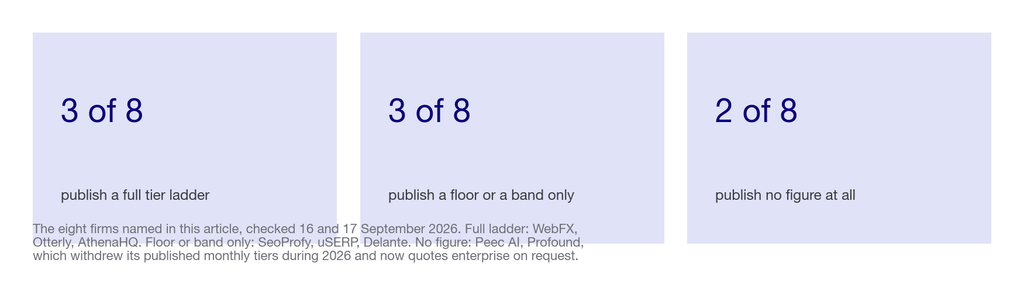
We are flagging this rather than criticising it. Moving to quote-on-request is a normal commercial decision as a product moves upmarket, and the free trial is still there. But it does two things to buyers. It removes the clearest public reference point in the GEO tool category, and it means any article quoting those old tiers, including several of ours, is now out of date. We are correcting ours.
The practical instruction: check the pricing page yourself on the day you are buying. Who owns that checking habit internally is a question we answer in the AI search team ownership model. In this category, figures published six months ago are not reliable, and that includes figures published by us.
Can my existing SEO agency do GEO?
This is the question underneath the pricing question, so let us answer it directly.
Technically, yes, and Google says so. Its May 2026 guidance places AEO and GEO inside SEO rather than beside it. There is no separate discipline your agency is locked out of. The skills that earn a citation in an AI answer are the skills that earn a link and a ranking: clear pages, real authority, and content an engine can actually retrieve. We set the practices out in our GEO best practices playbook.
Three scenarios, and how to tell them apart
Commercially, the answer is a pricing question. Three scenarios, and you can tell which one you are in with two questions.
- They are doing the work and measuring it. They can name the engines, the prompt set and the reporting frequency. This is the good case and it is worth paying for.
- They are reselling a tool. A $189 per month subscription appearing inside a $5,000 per month retainer as “AI search optimization” is not fraud, and the analysis on top may be worth real money. It is worth knowing, because you can buy that subscription yourself in ten minutes.
- They renamed the service. The scope did not change, the invoice did. Our case studies show what a real change of scope looks like in the numbers. This is the case to catch, and the question that catches it is below.
The two questions that settle it
Two questions that settle it. First: “which engines do you measure, how often, and can I see last month’s raw answers?” Second: “which tool are you using, and what does it cost you?” A partner doing real work answers both without discomfort. We wrote up where the line sits between agency, tool and platform in AEO, GEO, AIO and LLMO explained, and the tooling market itself in best AEO platforms.
What this means for the budget
Where this leaves the budget. If your agency is doing it properly, the marginal cost of GEO on top of SEO should be modest, because the underlying work overlaps heavily. If the quote doubles, the scope should visibly double too. Ask to see what the second half buys.
And here is the answer that loses us the sale. If you are tracking fewer than about fifty prompts and you have somebody in house who will read the output weekly, you do not need us or any platform at this price point. Buy a $29 or $189 subscription, run it yourself for two quarters, and find out whether anyone acts on it. If nobody does, a bigger tool will not fix that, and neither will we. Come back when the volume or the number of markets makes it a real job.
What nobody should promise you
- A fixed market rate. There is not one. Published figures span $29 to $25,000 a month across two different products, and most firms publish nothing.
- That a cheaper tool is a cheaper answer. A $29 subscription tracking 15 prompts and a $3,000 retainer are not substitutes, and anyone framing them as such is selling one of them.
- A guaranteed ranking, in exchange for any budget. Google advises against providers who guarantee rankings, because third parties cannot access internal ranking systems.
- A guaranteed citation in an AI answer. Nobody controls what a model outputs. We will not promise it either, at any price.
- A single AI visibility score. One number collapsing five engines and dozens of prompts is a marketing device. Ask what it is made of.
- That last year’s published price still holds. One vendor withdrew its entire published ladder inside this year. Check on the day.
Frequently asked questions
How much does an SEO agency cost in 2026?
Published figures run from about $1,600 to $25,000 per month, and most agencies publish nothing. WebFX is the only firm we found with a full rate card, starting at $3,000 per month with a separate higher initial two-month investment.
Why do so few SEO agencies publish pricing?
Scope genuinely varies, and a published floor becomes an anchor in every later negotiation. The effect is that buyers have almost no public reference points, so the handful of published figures carry more weight than their sample size really supports.
Tools, credits and prompts
How much do AI visibility tools cost?
Published tiers start at $29 per month for 15 tracked prompts, rising to $489 for 400 prompts at one vendor. Another offers a free tier and a $295 tier. Enterprise pricing at both is custom and unpublished.
What is the difference between a prompt and a credit?
A prompt is a question you track. A credit is usually one engine response to it, and one vendor states that “1 credit = 1 AI response.” Running one prompt across five engines consumes five credits, so convert both tools to responses per month before comparing.
Is a bigger tool tier cheaper per prompt?
Yes, at every vendor we checked. One vendor’s entry tier works out near $1.93 per prompt per month against roughly $1.22 at its top published tier. Buying the tier above what you need often beats adding prompt bundles to the tier below.
Agencies, GEO and scope
Can my existing SEO agency do GEO?
Usually yes. Google’s May 2026 guidance places AEO and GEO inside SEO rather than beside it, so no separate discipline exists. Ask which engines they measure, how often, and whether you can see last month’s raw answers.
Should GEO cost extra on top of my SEO retainer?
Some extra is fair, because measurement and analysis are real work. A doubling is not, unless the scope visibly doubles. If AI search appears as a separate line item, ask which tool sits behind it and what that tool costs.
How do I compare two SEO quotes fairly?
Separate build from run, because front-loaded technical work is not the same as ongoing maintenance. Then ask each firm for its minimum project size, which sorts the market faster than any hourly rate does.
Latest Blogs
Most 90-day AI plans are sequenced by how hard the work feels rather than by how long it takes to land. So they spend week one on an llms.txt file that Google states it does not use, and they schedule earned media for phase three, which guarantees no result inside the quarter. This plan inverts that. It orders the work by lead time, starts the slowest thing on day one, and cuts four tactics Google explicitly says are unnecessary.
We priced this category nine days ago. Today we went back to the same four pricing pages to check the numbers before publishing. Three of the four had changed, and two had stopped publishing prices altogether. That is the real answer to what AEO costs in 2026: not a number, but a meter that moves, measured in prompts and responses and engines that are billed separately. Here is how each pricing model works, what unit it charges you for, and which incentive that unit creates.
Ask what AI search traffic is worth and you will be handed a multiplier. The ones in circulation right now run from 13% worse than organic search to 23 times better, a spread of roughly twenty-six fold on the single input your whole business case depends on. They disagree because they are measuring the same behaviour under different attribution models. So this is not a guide to finding the right multiplier. It is a guide to building a model whose assumptions are visible, and to being honest about the half you cannot prove.
Get your hands on the latest news!

Similar Posts

SEO
12 mins read
How to find the topics AI engines actually answer

SEO
15 mins read
What are the best SEO agencies in 2026?

Artificial Intelligence
12 mins read