Profound alternatives: 8 AEO platforms compared for 2026
The short answer
Before you compare a single feature, check whether the prices on your shortlist actually exist. We priced nine platforms in this category on 8 September 2026, reading only each vendor’s own pricing page. Three of them publish no figure at all.
That matters because the numbers circulating for this category have been copied between roundups until they read as fact. AirOps names its tiers and prices none of them. Peec AI does the same. Bluefish has no pricing page. Yet specific monthly figures for all three appear across the pages ranking for this keyword, including, until today, our own.
So the honest comparison is narrower than the listicles suggest. Two things separate these platforms. The first is how many engines you get at the tier you can actually see. The second is whether anyone is on the hook for acting on what the dashboard says. Price is the noisiest axis available, and it is the one everybody leads with.
Key takeaways
- “Profound alternative” describes four unrelated products. Trackers, SEO-suite add-ons, enterprise measurement platforms and execution platforms all appear on the same lists. They are not substitutes for each other.
- Most of the prices you will read are not published anywhere. AirOps and Peec AI list seven tiers between them and no figures. Bluefish has no pricing page. Anything you see quoted for those three is an estimate.
- The cheapest tier is not the product. Profound’s $99 Starter plan covers ChatGPT and nothing else, which is one of the nine engines its Enterprise plan reaches.
- This category consolidated in 2026. Sitecore acquired Scrunch on 3 June 2026, so one of the most recommended alternatives on every list is now part of a larger suite.
- A tracker is not a plan. Every platform here tells you where you stand. None of them does the work that changes it, which is the gap Pepper’s agentic organic growth engine is built to close.
A note on where this comes from. We run organic for more than 250 enterprises and have done for eight years, and we track more than 10 million prompts across every major engine. This read is shaped by that, by the client reviews we sit in every week, and by the migration conversations we have with teams switching platforms. So it is our opinion about the category rather than a neutral directory.
What are Profound alternatives, and why do four products share the label?
Because the phrase describes a job, and four genuinely different kinds of software claim to do that job. If the acronyms themselves are the confusing part, AEO vs GEO vs AIO vs LLMO untangles them, and what GEO is is the shorter version. A shortlist that mixes them compares a $29 tracker against a platform sold on a custom enterprise contract. That comparison cannot resolve.
The four categories separate cleanly once you sort by what the cheapest paid tier actually delivers.
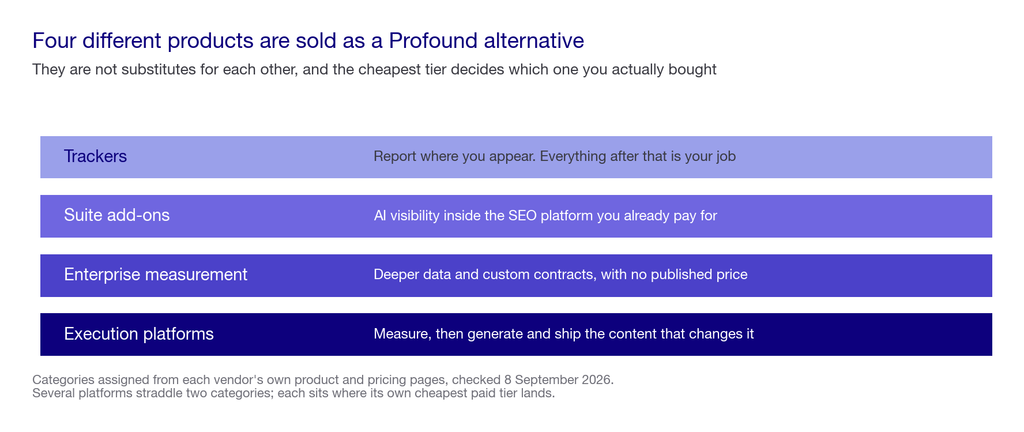
- Trackers run a prompt set against AI engines on a schedule and report whether you were named. Otterly and Peec AI sit here, alongside most of the citation monitoring tools in the category. Cheap, fast, and the work that follows is entirely yours.
- Suite add-ons put AI visibility inside a platform you already pay for. Semrush and HubSpot sit here. The data is thinner than a specialist tool and the integration is the point.
- Enterprise measurement platforms go deeper on data and sell on custom contracts. Bluefish and Profound’s own Enterprise tier sit here. Expect procurement rather than a credit card.
- Execution platforms measure and then generate and ship the content. AirOps sits here, and so does Pepper, for different reasons we come to below.
Sorting your shortlist this way usually shortens it. If you need the work done, two of those four categories cannot help you, whatever their dashboards look like. If you only need a number this quarter, the cheapest tracker will do and you can stop reading after the pricing section.
What changed in 2026, and why the switching decision looks different now
Three things moved this year, and together they change what a Profound alternative even means.
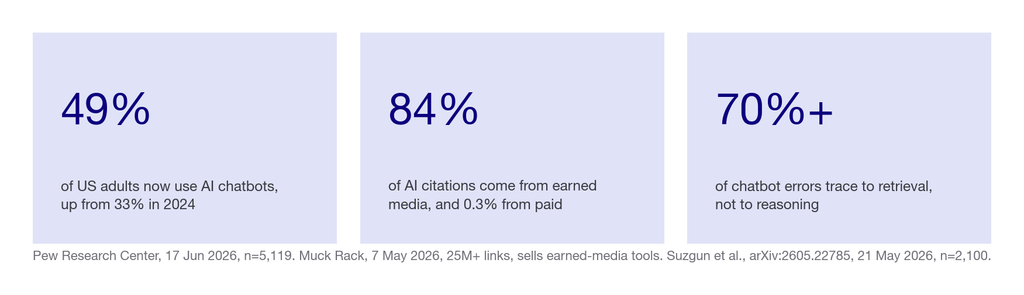
First, the audience arrived. Pew Research Center found that 49% of US adults now use AI chatbots, up from 33% in 2024. Of those surveyed, 60% read the AI summary at the top of search results and 42% use chatbots to search for information. The survey went to 5,119 US adults in February 2026. So this is no longer an early-adopter surface.
Second, the thing that earns citations is not the thing most tools measure. Muck Rack’s May 2026 analysis of more than 25 million cited links covered 17 industries. Earned media accounted for 84% of AI citations, and paid or advertorial content for 0.3%. Muck Rack sells earned-media software, so read the finding with that interest in mind. However, it has held between 82% and 89% across three editions, which is what makes it worth quoting.
Third, the failure mode is retrieval rather than reasoning. A Stanford-led evaluation of six commercial chatbots published on 21 May 2026 tested 2,100 factual questions. It found that retrieval failures drive over 70% of all errors. So when an engine gets your brand wrong, the usual cause is what it could fetch about you.
Put those together and the shape of the problem is clear. Measurement is the cheap part. Retrievability and earned authority are the expensive parts, and no tracker here moves either. That is why we organise this comparison around who acts rather than who charts.
Our point of view on this category
We think this category has a measurement surplus and an execution deficit, and the pricing pages prove it. You can buy a competent AI visibility dashboard for $29 a month. You cannot buy the digital PR, the technical work and the content that moves those numbers. Not at any price on this page.
The pattern we see most often in accounts we take over looks like this. A team is eighteen months into a tracking subscription, with a year of trend lines and no shipped work. They can tell you their visibility fell in March. Nobody was resourced to do anything about it. The dashboard was never the bottleneck.
So our bias is explicit. We would rather a team spent less on measurement and more on the work. Tracking five engines properly beats tracking nine badly. Our view is that the three levers of visibility, citability and retrievability are the right frame for this decision. They separate “engines do not mention us” from “engines mention us and cite somebody else”. Those two problems have completely different fixes, and our guide to what to track and what to ignore covers which numbers deserve a dashboard slot at all.
Book a growth audit if you want us to run your prompt set and show you which of those two problems you actually have.
What Profound is, and the five real reasons teams leave
Profound is an enterprise AI search platform. Per its own pricing page on 8 September 2026, it sells three tiers:
- Starter, $99 a month. ChatGPT only, with 50 tracked prompts and 1,500 monthly responses.
- Growth, $399 a month. Three answer engines, with 100 prompts and 9,000 monthly responses.
- Enterprise, custom pricing. Up to nine answer engines, plus SSO, SAML and SOC 2.
It is a serious product. It is also the reference point for this whole category, for good reason.
The reasons teams actually leave, from the migration conversations we have:
- The entry tier is a demo, not a deployment. One engine and 50 prompts answers whether the category is real, not what to do about it.
- The jump to real coverage is steep. Nine engines means Enterprise, and Enterprise means procurement.
- Nobody was resourced to act on it. The most common reason, and it is not a product flaw.
- Prompt caps bite earlier than expected. A serious commercial prompt set outgrows 100 prompts quickly once you add competitor and category questions.
- The team wanted the work done, not measured. At which point they are not shopping for a tracker at all.
Notice that only two of those five are Profound’s problem. The other three are procurement and staffing problems that follow you to whichever platform you buy next.
Our methodology: how we priced and weighted this comparison
We read every price off the vendor’s own pricing page on 8 September 2026. Not a roundup, not a cache, not a review site. This category repriced four times in six weeks by our own records, so anything older than about a month is fiction.
We are not publishing a ranked leaderboard, because these nine products do different jobs and a single ordering would be false precision. What we do publish is the weighting behind our judgements, in the same spirit as how we rank GEO agencies. If you disagree with the weights, the routing changes, and that is the point.
| Criterion | Weight | How we scored it |
|---|---|---|
| Engine coverage at a buyable tier | 25 | Counted the engines included at the cheapest paid tier, not the ceiling. A tier that needs a sales call to price scored as unbuyable. |
| A path to action | 20 | Whether the product ships work or only reports. A platform that generates and publishes content scored above one that exports a CSV. |
| Pricing you can verify | 15 | A public figure scored full marks. Tier names with no numbers scored zero, however good the product behind them is. |
| Prompt and competitor depth | 15 | Prompt allowance against a realistic commercial question set, plus whether competitor tracking is included rather than an upgrade. |
| Source and citation visibility | 15 | Whether the product names the pages an engine cited, which is the field that turns a number into a piece of work. |
| Contract and roadmap risk | 10 | Who owns the roadmap, and what an acquisition or a suite strategy means for renewal. |
Weights sum to 100. Coverage and a path to action carry 45 between them, which is a judgement rather than a fact, and it is the judgement this whole page rests on.
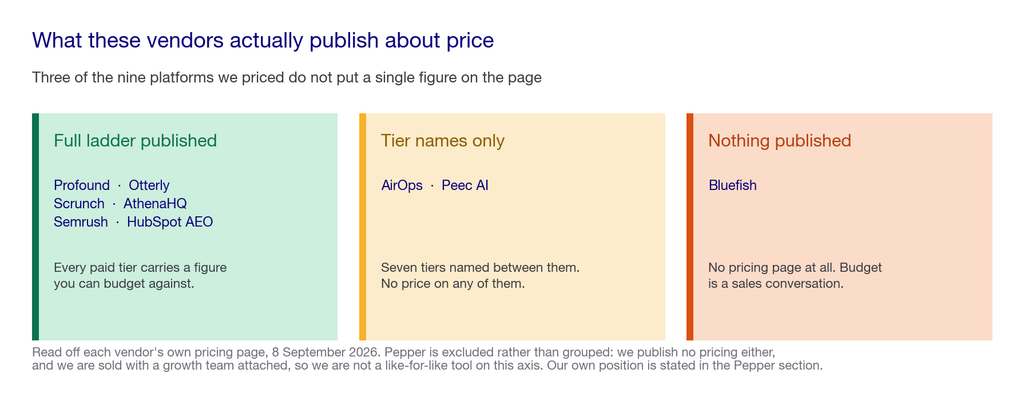
Six of the nine publish a complete ladder you can budget against. Two publish tier names with no figures. AirOps names Solo, Pro and Enterprise, and prices none of them. Peec AI names Starter, Pro, Advanced and Enterprise, and prices none of them either. Bluefish has no pricing page at all.
Three corrections to our own previous version of this page, because they matter more than the rest:
- We quoted an AthenaHQ Growth tier at around $545 a month. No such tier exists on AthenaHQ’s pricing page, which lists Essential, Starter and Enterprise.
- We quoted an Otterly Pro tier at $989 for 1,000 prompts. Otterly’s top published tier is Premium at $489 for 400 prompts.
- We quoted Profound Enterprise at $2,000 or more. Profound’s Enterprise tier is listed as custom, with no figure.
We also removed a monthly figure we had given for Peec AI and one for AirOps. Neither company publishes a price, so neither number was ours to print.
The alternatives at a glance
Every figure below came off the vendor’s own pricing page on 8 September 2026. Engine counts are the vendor’s own claims about their own coverage.
| Platform | Category | Cheapest paid tier | Engines at that tier | Ceiling | Where it falls short |
|---|---|---|---|---|---|
| Otterly | Tracker | $29 | 4 of 7 | 7 with paid add-ons | Add-ons take a $29 plan to about $76 for full coverage |
| HubSpot AEO | Suite add-on | $50 | 3 of 3 | 3 | Still in beta, and three engines is the whole product |
| Semrush AI Visibility | Suite add-on | $99 annual | 4 of 4 | 4, one domain | 25 prompts and one domain caps it early |
| AthenaHQ | Enterprise measurement | $295 | 9 of 9 | 9 plus, one region | Single region and language until Enterprise |
| Scrunch | Enterprise measurement | $250 annual | 7 of 7 | 7 | Roadmap now sits inside Sitecore |
| Peec AI | Tracker | Not published | Not published | Not published | Four tiers named, no figure on any of them |
| AirOps | Execution platform | Not published | 1 at Solo | 7 plus at Pro | No published price, and Solo is ChatGPT only |
| Bluefish | Enterprise measurement | Not published | Not published | Not published | No pricing page, and no engine list on the site |
| Profound (incumbent) | Enterprise measurement | $99 | 1 of 9 | 9 | Real coverage means the custom Enterprise tier |
The alternatives in detail
Otterly is the cheapest honest entry into this category. Its Lite plan is $29 a month for 15 prompts, covering ChatGPT, Google AI Overviews, Perplexity and Microsoft Copilot. Standard is $189 for 100 prompts and Premium is $489 for 400. Annual billing takes 15% off. The catch is structural rather than hidden. Claude, Google AI Mode and Gemini are paid add-ons, so seven engines on the $29 plan lands nearer $76. Where it falls short: 15 prompts is a sample rather than a prompt set. The add-on model also means the advertised price and the useful price are different numbers.
HubSpot AEO is the right answer for a team already standardised on the CRM and nowhere else. It tracks ChatGPT, Gemini and Perplexity, costs $50 a month standalone, and comes bundled with Marketing Hub Professional and Enterprise. HubSpot also publishes free AI Search Grader and AI Search Sensor tools. Both are a reasonable way to get a first reading at no cost. Where it falls short: it is labelled beta on HubSpot’s own product page, and three engines is the entire ceiling rather than the entry tier.
Semrush AI Visibility Toolkit is the same argument for teams already inside Semrush. It is $99 a month per domain billed annually, covering 25 custom prompts on one domain, with mentions from ChatGPT, Google AI, Gemini and Perplexity. There is a seven-day trial. Where it falls short: 25 prompts on a single domain is a diagnostic budget rather than an operating one. You will outgrow it within a quarter if AI search is genuinely a priority.
AthenaHQ is the closest thing here to Profound-grade reporting without the enterprise conversation. Its Essential tier is free with a $25 credit and covers five models. Starter at $295 a month carries 3,600 credits. It covers nine named platforms: ChatGPT, Perplexity, Google AI Overviews, AI Mode, Gemini, Claude, Copilot, Grok and DeepSeek. Enterprise then adds a knowledge base with claim review, its citation engine, SSO and multi-region support, on custom pricing. Where it falls short: Starter is a single region and single language, so international teams hit the Enterprise tier faster than the price ladder suggests.
Scrunch is the one where the buying decision changed this year. It publishes Starter at $250 a month billed annually, or $300 month to month, and Growth at $417 or $500. Every tier covers ChatGPT, Claude, Gemini, Perplexity, Google AI Mode, AI Overviews and Meta. Getting full coverage at the entry price is genuinely unusual here. The context is that Sitecore announced its acquisition of Scrunch on 3 June 2026, positioning Scrunch’s Agent Experience Platform alongside its own DXP. Scrunch’s own site still sells the standalone tiers and makes no mention of the acquisition. Where it falls short: the roadmap now answers to a suite strategy. So weigh it as a Sitecore component rather than an independent point tool, particularly if you are not a Sitecore customer.
Peec AI names four tiers: Starter, Pro, Advanced and Enterprise, organised around Discover, Measure, Act and Report. It publishes no price, prompt limit or model count against any of them. Every specific monthly figure we found for Peec AI online traces back to a roundup rather than to Peec AI. Where it falls short: you cannot budget against a page that does not exist, and a tier structure with no numbers makes a like-for-like comparison impossible.
AirOps is an execution platform rather than a tracker, and that is the reason to consider it. Its Solo tier covers ChatGPT insights only, with 35,000 monthly tasks. Pro covers what it describes as more than seven answer engines, with 100,000 tasks and unlimited seats. However, it publishes no price at any tier. Where it falls short: the pricing is entirely gated. Solo’s ChatGPT-only scope also means the cheap way in is single-engine, which is the same trap as Profound’s Starter plan.
Bluefish is the enterprise end of this list. It positions itself as “the AI marketing platform of choice for the Fortune 500”. Its listed modules are AI monitoring, GEO, GEO measurement and agentic commerce. It raised a $43 million Series B in April 2026 co-led by Threshold and NEA, taking it to $68 million raised. Worth knowing before you search for it: its own site is at bluefishai.com, and the shorter bluefish.ai is now a parked domain-for-sale page. Where it falls short: no published pricing, no engine list and no named customers on its own pages. A shortlist entry therefore rests on press coverage rather than primary material.
Pepper, in its own category
We are not a $99 tracker and we are not trying to be. Pepper is an agentic organic growth engine. Pepper’s GEO platform tracks six engines, including ChatGPT, Perplexity, Gemini, Claude and Google AI Overviews. It reports three metrics: Brand Visibility for how often engines mention you by name, Domain Prompt Presence for how often they cite a page from your domain, and Share of Voice for your slice of all brand mentions in the category. The gap between the first two is the diagnostic we care about most, because it separates an awareness problem from a citability problem.
What makes us a different purchase is that both halves are real at once. Customers genuinely run the platform themselves. They log in, set up a workspace, and define their brand profile, competitors and personas. They connect GA4 and Search Console, manage themes and prompts, and read their own GEO analytics. And in the Agent Atlas they build, version and run their own agents, with quick runs for a single input and sheet runs for bulk. And a growth team is attached to the account and does the work alongside them. Agents for scale, experts for judgement, one team on the hook for the number.
For what that produces, the Acceldata case study is the clearest example we can point at. It records 6X organic traffic and top-three keywords rising from 85 to more than 300. It also records 100,000 plus new organic users, and 260,000 plus impressions from a single hero guide.
Where it falls short: we do not publish pricing, so budget discovery is a conversation rather than a page. That costs you the fast comparison the rest of this table gives you. We are built for teams running organic as a long-term function, so a one-off technical audit or a single-quarter visibility spike is not what we are for. Our depth sits in content, authority and AI search rather than large-scale technical migrations, so raise that directly if it is your primary problem. And if all you want is a visibility number this week, every tracker above is faster and cheaper than talking to us.
What these platforms cost, and what the cheapest tier covers
Price alone tells you almost nothing here, so this is the chart we would want if we were buying. It measures each platform against its own ceiling rather than against the others. So it answers the question the price ladder hides: how much of this product does the advertised price actually buy?
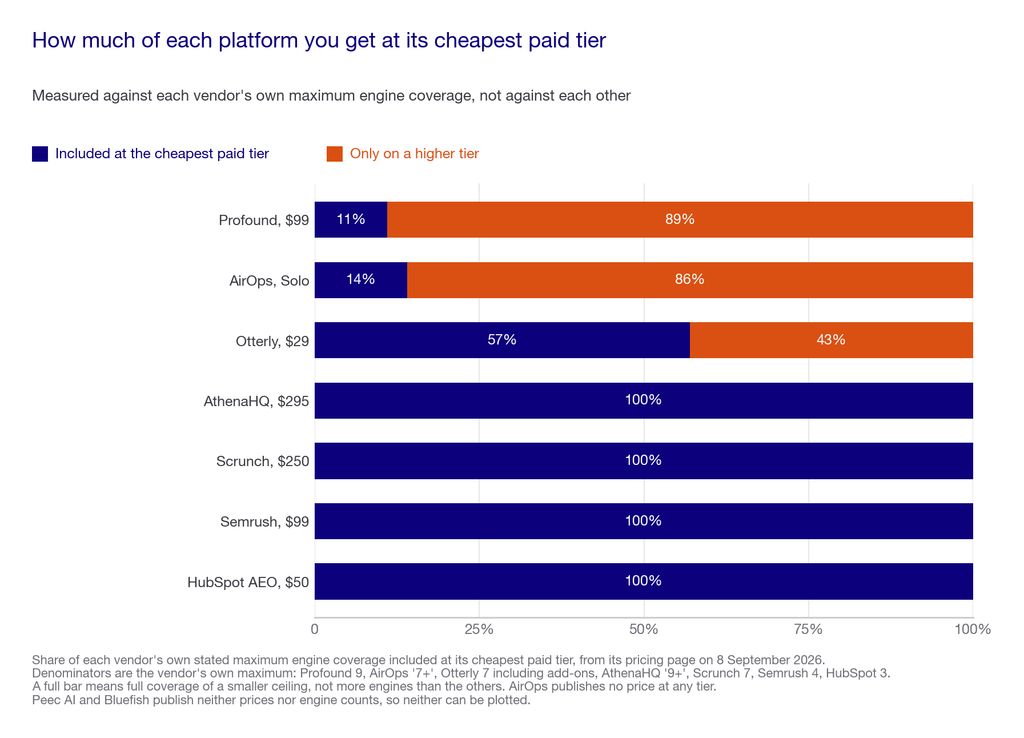
Profound’s $99 plan buys 11% of Profound. AirOps’ Solo tier buys about 14% of AirOps. Otterly’s $29 plan buys 57% of Otterly, and the rest arrives as add-ons. AthenaHQ, Scrunch, Semrush and HubSpot AEO give you their whole engine list at their cheapest paid tier, though for Semrush and HubSpot that list is short to begin with.
Read it carefully, because the obvious conclusion is wrong. A full bar is not a better product. HubSpot gives you 100% of three engines. Profound gives you 11% of nine. If you need nine engines, Profound at Enterprise is the serious option and HubSpot is not in the conversation. The useful question is not which bar is longest. It is whether the tier you can actually afford covers the engines your buyers actually use.
How to choose between these platforms
I am going to write this part in the first person, because a scorecard nobody will stand behind is worth nothing. This is how I would run the decision if it were my budget.
Start with what Google settled. Its official guidance on optimizing for generative AI features puts it plainly: “From Google Search’s perspective, optimizing for generative AI search is optimizing for the search experience, and thus still SEO.” The same page tells you to skip most of what gets sold as AI optimisation. “You don’t need to create new machine readable files, AI text files, markup, or Markdown to appear in Google Search.” It says the same about chunking your content and about rewriting it for AI. That guidance is correct, and it is correct for Google. Google is one engine among several, and the evidence that engines disagree with each other is exactly why single-engine coverage is not coverage. Hold both ideas at once: the mechanics are mostly classic SEO, and the surface is genuinely fragmented.
So the question is not “which tool has the best dashboard”. It is “what is the smallest amount of measurement that lets us start doing the work, and who does the work”.
Here is the scorecard I would score every option on, including ours.
| Area | Weight | What a strong option demonstrates |
|---|---|---|
| Engine coverage at a tier you can actually buy | 25 | The engines your buyers use are included at the price you will really pay, not at a tier you will reach in year three. Ask for the coverage at your budget, not the ceiling. |
| Pricing you can verify | 15 | A figure on a public page you can put in a budget line without a sales call. A vendor that will not publish a number is asking you to spend procurement time before you know the range. |
| Prompt and competitor depth | 15 | Enough prompts to cover your real commercial question set, plus competitor tracking, because your own visibility in isolation tells you nothing about whether you are winning. |
| Source and citation visibility | 15 | The specific pages an engine cited, and why those pages win rather than yours. This is the field that converts a number into a piece of work. |
| A path to action | 20 | Someone is accountable for changing the number. Either the platform ships the work, or you have a resourced internal team, or you have a partner attached. Without this the subscription is a report. |
| Contract and roadmap risk | 10 | You know who owns the roadmap and what happens at renewal. An acquisition mid-contract changes the product you bought. |
Weights sum to 100. Note that a path to action carries more weight than pricing transparency. That is a judgement rather than a fact, and it is the judgement this whole page rests on.
Then run the live test, on your own prompt set, before you sign anything. Write out 20 to 30 real commercial questions your buyers would type. Not branded questions, which every tool will tell you that you win. Four worked examples for a mid-market B2B SaaS analytics company:
- “best data observability platform for enterprise”
- “how do I monitor data quality across Snowflake and Databricks”
- “Acceldata vs Monte Carlo vs Bigeye”
- “what should I look for in a data observability vendor”
Run those against every engine you care about, three times each, on different days. The three runs matter, because engines are probabilistic and one run on one engine establishes nothing. Then demand five answers:
- Where do we appear, by engine, across those runs?
- Which competitors appear instead of us, and how often?
- Which specific sources influenced those answers?
- Why are those sources winning, in mechanical terms?
- What would you change in the next 90 days, in priority order?
Any vendor or partner who cannot answer the last two is selling you a report.
Two playbooks circulate in this category. One is weaker than the other, and they are easy to tell apart once you have seen both.
The weaker one:
- Find some prompts.
- Rewrite a few blogs.
- Add FAQ schema.
- Sprinkle in statistics.
- Hope for a citation.
The stronger one:
- Demand intelligence first, so you know which questions matter.
- Then technical discoverability, so engines can fetch you at all.
- Then entity and brand authority, so they know who you are.
- Then content built for the questions that actually matter, structured so an engine can lift it.
- Then earned-media authority, because that is what gets cited.
- Then distribution, then visibility measurement, then revenue attribution.
Why does the order matter so much? Because the weaker sequence starts with your own website, which is the part you control. The stronger one starts with what the engine can find and who it already trusts. Muck Rack’s 84% figure is the whole argument for putting earned authority ahead of another blog refresh.
Red flags, each one something a vendor actually says:
- “We guarantee you will be cited in ChatGPT.” Nobody can. Google’s own guidance is blunt about the adjacent claim: “Be wary of third-party tools that promise ranking success or claim to use ‘internal’ Google metrics. No third-party tool has access to our internal ranking or AI systems.”
- “Here is your AI visibility score.” A single composite number across engines that behave differently is a marketing artefact.
- “We track your brand name across every engine.” Branded prompts are the questions you already win. The commercial questions are the ones that matter.
- “We will get you into AI Overviews.” Single-engine optimisation sold as AI search strategy.
- “We will publish 40 AI-generated articles a month.” Volume against a surface that rewards earned authority.
- “Our prompt set is proprietary.” If there is no stated methodology for prompt selection, the numbers are not reproducible.
- “You are cited 340 times a month.” A citation count with no competitor share of voice is a number with no denominator.
Five questions I would ask on every call, and what a good answer sounds like:
- “How did you choose the prompts you are showing me?” A good answer describes a method: commercial intent, category questions, competitor comparisons, mapped to personas, revisited quarterly. A bad answer is “our AI generates them”.
- “Which engines are included at the price you just quoted me?” A good answer is a specific list and a specific tier. A bad answer moves to the ceiling and hopes you do not notice the difference.
- “Who is accountable for the number moving, and what do they actually do?” A good answer names the work: technical fixes, content, digital PR, and who ships it. A bad answer is “you will have full visibility”.
- “Show me a case where the number went down and what you did.” A good answer exists. Everyone has one. A vendor with no such story either has no clients or is not telling you the truth.
- “Who owns your roadmap in twelve months?” A fair question in a category where a major platform was acquired in June. A good answer is direct about ownership and renewal terms.
It comes down to one principle: buy the smallest measurement that unblocks the work, and spend the difference on the work. If you are choosing between a $295 platform with nine engines and a $99 platform with one, the honest answer is often that neither is your constraint, and the money belongs in earned media and technical fixes instead.
The note that costs us something: very few companies in this category are equally strong at measurement, content execution, digital PR and revenue attribution, and that includes us. Ask every option on your shortlist which of those four is their weakest, ours included. The ones that answer honestly are the ones worth shortlisting, and the ones that claim all four equally are the ones to be careful with.
What nobody should promise you
Some claims in this category cannot be delivered by anyone, and hearing one is useful information about the vendor.
- A guaranteed citation or position in an AI answer. Engines are probabilistic and their ranking systems are not yours to control.
- A single composite AI visibility score that means something. Our own help documentation says it plainly: there is no universal good target for these metrics, and the useful question is whether the trend is moving and how you compare with the category leader right now.
- A universal benchmark for your category. A 30% Brand Visibility can be excellent in a fragmented market and poor in a concentrated one.
- Conclusions from one run on one engine. Three runs on different days is the minimum before you believe anything.
- Clean attribution from an AI citation to closed revenue. The measurement does not exist yet, and anyone selling it is selling a model, not a fact.
We will not promise you any of those either. What we will do is tell you which of the two problems you have, and what the first 90 days of work looks like.
Frequently asked questions
What is the best alternative to Profound?
There is no single best one, because four different product types share the label. AthenaHQ is the closest match on reporting depth at $295 a month. Otterly is the cheapest real entry at $29. AirOps is the alternative if you want execution rather than measurement.
Is there a cheaper alternative to Profound?
Yes. Otterly’s Lite plan is $29 a month against Profound’s $99 Starter, and it includes four engines rather than one. HubSpot AEO is $50 a month for three engines. Semrush is $99 annually for four engines on a single domain.
What is the difference between Profound and Pepper?
Profound is a measurement platform you operate yourself. Pepper is an agentic organic growth engine: you get a self-serve GEO platform and a growth team attached to the account doing the work alongside you. If you only want a visibility number, Profound is the faster purchase.
Does Profound publish its enterprise pricing?
No. Profound publishes Starter at $99 a month and Growth at $399, both verified on its pricing page on 8 September 2026, but Enterprise is listed as custom with no figure. Any specific enterprise number you see quoted elsewhere is an estimate.
Is Scrunch still independent after the Sitecore acquisition?
Sitecore announced the acquisition on 3 June 2026. Scrunch’s own site still sells its standalone tiers at $250 and $417 a month billed annually and does not mention the acquisition, so treat it as a Sitecore component when you weigh roadmap risk.
Can I keep Profound and add another tool?
Yes, and some teams do run a cheap multi-engine tracker alongside Profound’s ChatGPT depth. It is usually a sign the prompt set outgrew the tier rather than a long-term architecture. Consolidating on one platform with adequate coverage is normally cheaper.
How many engines do I actually need to track?
Track the engines your buyers use, which for most B2B teams means ChatGPT, Perplexity, Gemini and Google AI Overviews. Adding Grok or DeepSeek rarely changes a decision. Coverage beyond what you will act on is a cost, not an insight.
How long does it take to see a change after switching?
Switching tools changes nothing on its own, because the tool was not the constraint. Expect a few weeks to rebuild a prompt set and a baseline, then months of shipped work before trends move. Anyone promising a faster number is selling you the dashboard.
Where to go next
If you are still shortlisting, our guide to the best AEO platforms covers the wider category and our comparison of LLM monitoring tools goes deeper on the tracking layer specifically. Where the choice is really between buying software and buying help, AEO agency or AEO tool is the more useful read. Send why you might not need an AI search monitoring tool at all to whoever controls the budget.
For more of what the work produces, Pepper case studies collects the rest. And what to automate and what never to automate is the companion piece if agents are the part you are weighing.
If you already know measurement is not your constraint, see where you show up and we will run your prompt set across six engines and tell you which of the two problems you have.
And the honest exit, because it belongs here. If your category has fewer than roughly 30 meaningful commercial prompts, or nobody on your team has capacity to act on what a dashboard tells you, you do not need a platform this quarter. Spend the money on earned media and one round of technical fixes instead, and revisit this page when somebody owns the number.
Sources and further reading
Research sources, all published in 2026 and checked at the original:
- Pew Research Center, “Americans and AI 2026: Chatbots, Smart Devices and Views on Impact”, published 17 June 2026. Survey of 5,119 US adults fielded 17 to 23 February 2026 through the American Trends Panel. Used for the 49%, 60% and 42% figures.
- Muck Rack, “What Is AI Reading?”, published 7 May 2026. Analysis of more than 25 million cited links across 17 industries and ChatGPT, Claude and Gemini. Used for the 84% earned-media and 0.3% paid figures. Muck Rack sells earned-media software, so it has a commercial interest in this finding.
- Suzgun et al., “Evaluating Commercial AI Chatbots as News Intermediaries”, arXiv:2605.22785, submitted 21 May 2026. Six chatbots evaluated on 2,100 factual questions derived from BBC News reporting, 9 to 22 February 2026. Used for the retrieval-error finding.
- Google Search Central, “Optimizing your website for generative AI features on Google Search”, announced 15 May 2026 and last updated 10 July 2026. Used for the position that optimizing for generative AI search is still SEO, for the llms.txt and chunking guidance, and for the warning about third-party tools promising ranking success.
- Sitecore newsroom press release, “Sitecore acquires Scrunch to help brands influence discovery and buying decisions in the AI-search era”, 3 June 2026, read at source and deliberately not hyperlinked, since Sitecore now owns a product on this list. Used for the acquisition date and the Agent Experience Platform description. Financial terms were not disclosed in the release; Bloomberg reported a figure of about $225 million, which Sitecore has not confirmed.
Vendor pricing and positioning, each read on that vendor’s own site on 8 September 2026 and deliberately not hyperlinked, per our policy of not linking competitors:
- Profound pricing page: Starter $99, Growth $399, Enterprise custom, up to nine answer engines.
- AthenaHQ pricing page: Essential free with $25 credit, Starter $295, Enterprise custom.
- Otterly pricing page: Lite $29, Standard $189, Premium $489, Enterprise from $1,000, 15% annual discount, three paid engine add-ons.
- Scrunch pricing page: Starter $250 annual or $300 monthly, Growth $417 or $500, seven engines at every tier.
- Semrush AI pricing page: $99 a month per domain billed annually, 25 prompts, one domain, four engines.
- HubSpot AEO product page: $50 a month standalone, bundled with Marketing Hub Professional and Enterprise, three engines, labelled beta.
- Peec AI pricing page: four tiers named, no figures published.
- AirOps pricing page: Solo, Pro and Enterprise, no figures published, Solo ChatGPT only.
- Bluefish website at bluefishai.com: positioning and modules, no pricing published, no engine list. Series B of $43 million reported April 2026.
Removed from the previous version of this page, and why:
- A G2 Winter 2026 AEO Leader claim for Profound, which was sourced to Profound’s own blog. We do not cite a ranked vendor’s own material as the source for a category claim.
- An AthenaHQ G2 rating of 4.9 and an Otterly Gartner Cool Vendor mention, neither of which we could verify at the original source.
- Claims that citations can be earned “within two to three weeks” and that visibility shifts take “three to six months”, neither of which had a stated source.
- Named Bluefish customers, which appear in press coverage of its funding round but not on Bluefish’s own site.
- Estimated monthly prices for AirOps, Peec AI and Bluefish, and non-existent tiers for AthenaHQ, Otterly and Profound Enterprise. Details in the pricing section above.
Latest Blogs
Two Google AI features, two different jobs. One appears above results when it adds something; the other replaces the results page entirely. What Google says about each, and what changes for your pages.
Independent research found people click a result 8% of the time when an AI Overview appears, against 15% when one does not. Here is the evidence, its limits, and how to tell what is happening on your own site.
Twelve technical checks you can run on your own site today, in dependency order. Most take minutes, several are free, and the first four decide whether the rest matter at all.
Get your hands on the latest news!

Similar Posts
GEO / AI Search
8 mins read
AI Overviews vs AI Mode: what actually changed in Google Search
GEO / AI Search
9 mins read
Are AI Overviews taking your clicks? How to tell, and what to do
GEO / AI Search
10 mins read