Banking and financial SEO agencies in 2026: 10 compared on what they actually publish
The short answer
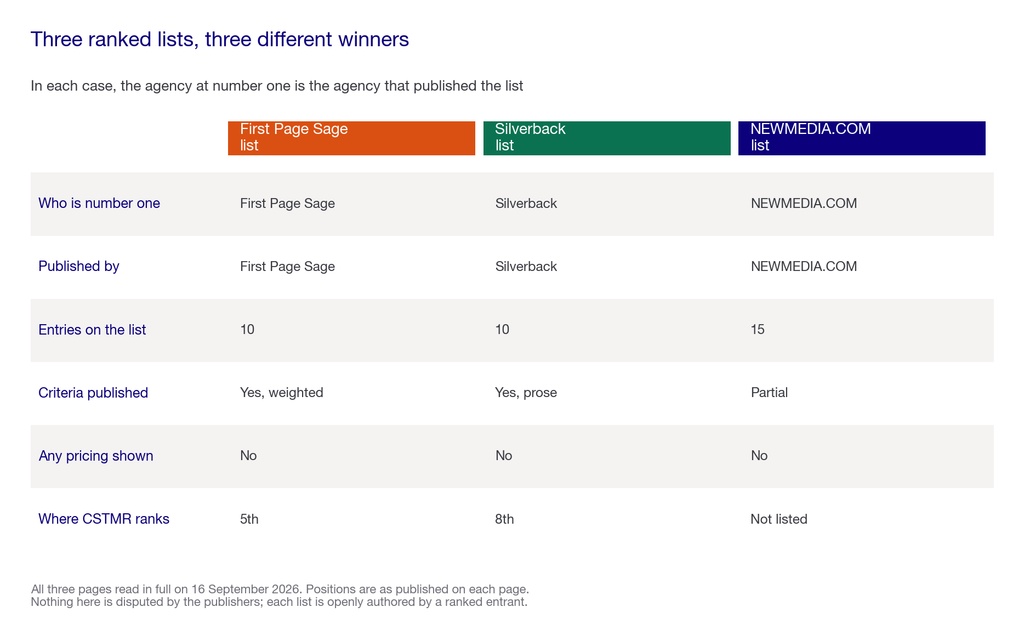
Rank order in this field is authored by the agency sitting at number one. We read three ranked lists end to end on 16 September 2026. All three were published by agencies. All three placed themselves first.
So compare specs, not positions. Below we set out ten banking and financial SEO agencies against five things you can check yourself in a browser: whether the firm names a financial vertical on its own site, whether it publishes a price, what it calls its AI search work, which financial clients it names, and what we could not verify.
If you want the work run rather than researched, that is what we do. Pepper is an agentic organic growth engine, and it is not an SEO agency. This page comes out of what we run: organic for more than 250 enterprises across eight years, more than 10 million tracked prompts, and the questions buyers put to us in client reviews. Customers log in and run the platform themselves, with a Pepper growth team attached to the account doing the work alongside them.
Start at the BFSI practice page if banking is your category, or book a growth audit and we will run the five-column check on your own shortlist with you.
Key takeaways
Key takeaways from a morning spent in the agencies’ own websites rather than in the rankings.
- Every ranked list we read placed its own publisher first. Three out of three. First Page Sage, Silverback Strategies and NEWMEDIA.COM each rank themselves at number one on their own page.
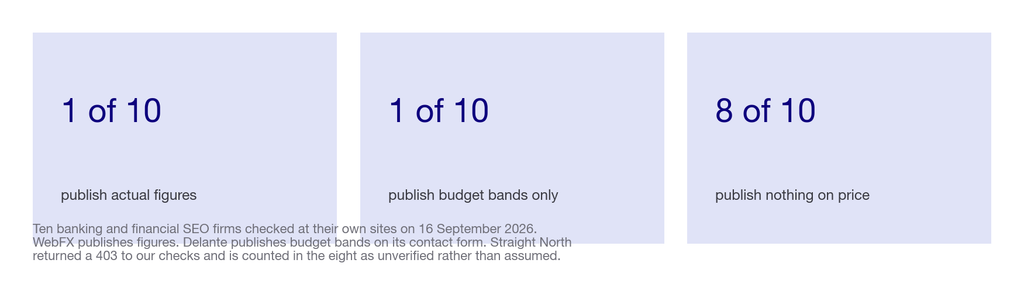
- One agency in ten publishes a price. WebFX lists figures. The other nine quote on request.
- The same agency appears at two different ranks on two lists. CSTMR is fifth on one and eighth on another.
- Two agencies are credited with a financial vertical they do not claim. Ignite Visibility and Delante are both described as finance specialists on aggregator pages. Neither names financial services as a vertical on its own homepage.
- There are four different names for AI search work across these ten firms. GEO, AEO, AISO and “discovery optimization”. None of them is wrong. All of them make a side by side comparison harder than it needs to be.
- Google’s own guidance says financial content is held to a higher bar. That part is real, and it is the reason this category costs what it costs.
Why every “top 10” list has a different number one
Start with the mechanic, because once you see it you cannot unsee it.
A ranked list of agencies is a lead generation asset. It ranks for a buying query. The publisher is an agency. The agency is eligible for its own list. You can guess the rest.
We are not accusing anyone of bad faith. Placing yourself first on your own list is not deception. It is marketing, and it is disclosed by context. The problem is what happens downstream. A reader treats rank order as a finding. It is a byline.
What we checked, and how you can repeat it
- First Page Sage, “The Top Financial Services SEO Agencies: 2026”. Ten entries. First Page Sage is number one. The page states its team “analyzed 75+ agencies to select the top financial services SEO providers of 2026.”
- Silverback Strategies, “Best SEO Agencies for Financial Services”. Ten entries. Silverback is number one.
- NEWMEDIA.COM, “15 Best SEO Companies for Financial Services”. Fifteen entries. NEWMEDIA.COM is number one.
- The overlap test. CSTMR sits at five on the First Page Sage list and eight on the Silverback list. Same agency, same month, three places apart. Nothing about CSTMR changed. The publisher did.
- The vertical test. Aggregator pages credit Delante with fintech focus and Ignite Visibility with finance focus. We opened both homepages. Delante lists automotive, beauty, software, travel and gardening. It does not list financial services. Ignite Visibility mentions finance in passing and gives it no vertical page.
The one list that shows its working
First Page Sage does something the others do not. It publishes weights. That deserves credit, and it also deserves reading closely, because the weights tell you what the ranking measures.
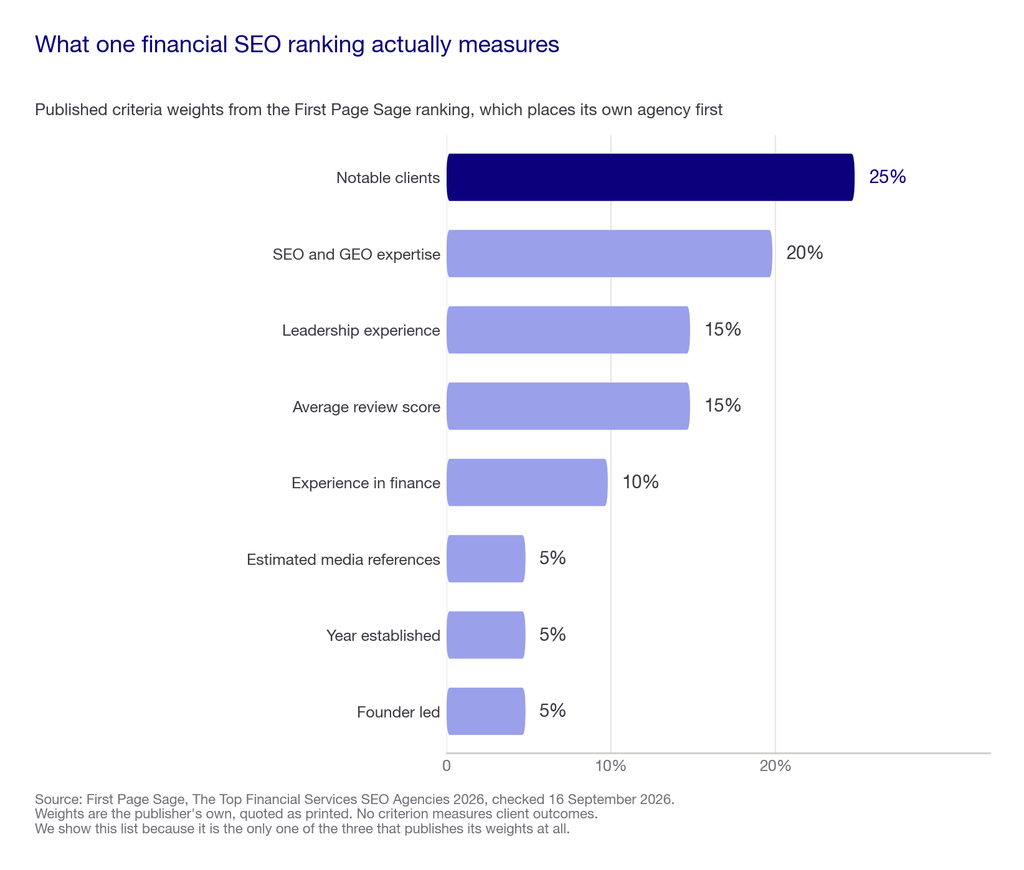
Notable clients carry 25 percent. That is the heaviest single input, and it favours whoever has the biggest logos rather than whoever moved the most pipeline. Year established and founder led carry five percent each, which are facts about a company rather than facts about its work. Add them up and roughly a third of the score is structural. None of it is outcome data.
We publish our own weights too, and for the same reason: a ranking you cannot audit is an opinion with a table around it. Ours are in the GEO agency ranking methodology.
What is a banking and financial SEO agency, and what does it actually do?
Strip the category language and the work has four parts. Any agency worth a retainer does all four. Most decks lead with the second.
- Technical and structural work. Crawl health, site architecture, page speed, indexation, schema. In banking this gets harder fast, because rate tables, branch locators and product pages are usually generated by a core system nobody in marketing controls.
- Content built to the trust bar. Not volume. Financial content is judged on who wrote it, what they are qualified to say, and whether the page shows it. Author credentials, review dates, named reviewers and citations are ranking inputs here in a way they are not in most categories.
- Earned authority. Links and citations from places a regulator, a journalist or a model would treat as credible. This is the slowest part and the one most commonly under-resourced.
- Compliance-aware production. Every page passes a review your risk team signs off. A good agency builds that review into the calendar rather than discovering it at publish time.
Why the bar is genuinely higher here
This part is not vendor talk. It comes from Google’s own published guidance.
Google gives “even more weight to content that aligns with strong E-E-A-T” for topics that “could significantly impact the health, financial stability, or safety of people.” It adds that “of these aspects, trust is most important.” Banking and lending content sits inside that definition. So the same brief costs more to execute here than it does for a software company, and an agency that quotes you a general-purpose rate has probably not priced the review cycle.
The same guidance places AI search work inside SEO rather than beside it. We have written up what that means for a bank or a lender in GEO for fintech. If an agency sells you GEO as a separate line item with a separate scope, ask why. We wrote up the terminology in AEO, GEO, AIO and LLMO explained.
Ten banking and financial SEO agencies at a glance
Read this table as a specification sheet, not a league table. We have not ordered it by quality, because we have no outcome data on these firms and neither does anyone else publishing a list.
| Firm | Financial vertical on own site | Published pricing | Term for AI search | Named financial clients |
|---|---|---|---|---|
| Pepper | Yes, BFSI practice page | Not published | GEO | Case studies published, none in BFSI |
| First Page Sage | Yes | Not published | GEO | US Bank, U.S. Bancorp |
| Silverback Strategies | Yes, dedicated page | Not published | AI Search Optimization | Not published |
| CSTMR | Yes, exclusive focus | Not published | Discovery Optimization | AccessOne, Pursuit Lending, Athena Advisory |
| Victorious | Yes, Finance vertical | Not published | AEO | SoFi |
| WebFX | Yes, finance industry page | Yes, figures published | SEO plus AI | Not published |
| Sure Oak | Yes, financial services | Not published | AISO, AEO/GEO | Not published |
| Banktastic | Yes, banks and credit unions only | Not published | None mentioned | Not published |
| Delante | No | Not published, budget bands on form | AI Search Optimization | Not published |
| Ignite Visibility | No dedicated vertical | Not published | Generative Engine Optimization | Not published |
| Straight North | Could not verify | Could not verify | Could not verify | Could not verify |
Checked at each company’s own site on 16 September 2026. “Not published” means we looked and found nothing. Straight North’s site returned a 403 to our checks, so every cell is marked unverified rather than guessed.
1. Pepper
- What it is: an agentic organic growth engine, not an agency. The distinction matters for this decision, so we are stating it rather than blurring it.
- How it runs: you hold the logins. You set up the workspace, connect GA4 and Search Console, manage themes and prompts, and read the analytics yourself. A Pepper growth team is attached to the account and does the work alongside you.
- Engines tracked: ChatGPT, Perplexity, Gemini, Claude and Google AI Overviews.
- Metrics you get: Brand Visibility, Domain Prompt Presence and Share of Voice. The gap between the first two is the citability problem, and naming it is how you fix it.
- Financial vertical: yes, a BFSI practice with published strategy work on AI search for regulated financial services.
- Credentials: eight years, 250-plus enterprises, more than 10 million tracked prompts.
- Published pricing: no. We quote on scope like everyone else in this table, and we will tell you the number on the first call.
- Where we are a fit and where we are not: our published case studies cover B2B software, healthcare, manufacturing and consumer. Acceldata is the closest reference for a complex, technical buying cycle. If a named banking logo is your deciding factor, say so early and we will tell you plainly what we can reference.
2. First Page Sage
- Own positioning: “Get Qualified Leads Through SEO & AI”.
- Financial vertical: yes, and the strongest named client set in this table for banking specifically.
- Named clients: US Bank and U.S. Bancorp, alongside Salesforce, Logitech and Verizon.
- Term for AI search: GEO, offered as a service line beside SEO.
- Published pricing: none.
- Where it falls short: publishes weighted ranking criteria, which almost nobody else does, and then places itself first under those criteria. Read the ranking as marketing and the criteria as useful.
3. Silverback Strategies
- Own positioning: “The Marketing Agency Your CFO Will Brag About”.
- Financial vertical: yes, with a dedicated financial services page.
- Services: paid search, paid social, programmatic, SEO, AI search, content, media mix modelling, incrementality testing and CRO. Broader than search alone.
- Term for AI search: AI Search Optimization.
- Published pricing: none.
- Where it falls short: names no financial client anywhere we could find, despite a dedicated vertical page. The media mix modelling and incrementality lines suggest a real measurement culture. Ask to see a readout before you assume it.
4. CSTMR
- Own positioning: “Where fintech and financial companies grow into captivating brands”.
- Financial vertical: exclusive. They serve “banking, payments, lending, investing” and nothing else.
- Named clients: AccessOne, Pursuit Lending, Athena Advisory.
- Term for AI search: “Discovery Optimization (AI/SEO)”, which is their own coinage.
- Published pricing: none.
- Where it falls short: the exclusive focus is a constraint as well as an edge. If you also need non-financial work, this is not one supplier. The private coinage for AI search also makes proposals harder to compare.
5. Victorious
- Own positioning: “Strategies engineered for AI visibility” and “Built for the next generation of search.”
- Financial vertical: yes, Finance sits under “Who We Serve”.
- Named clients: SoFi, plus Salesforce, Delta Dental, Wayfair and GE Digital.
- Term for AI search: AEO, covering ChatGPT, Perplexity, Google AI Overviews, Gemini, Copilot and Claude.
- Published pricing: none.
- Where it falls short: finance sits alongside many other verticals rather than defining the firm, and SoFi is the only financial logo named. The published engine list is the widest here, so ask about Copilot specifically.
6. WebFX
- Own positioning: leads on scale, citing “$10,085,355,239+ revenue driven for clients”.
- Financial vertical: yes, a finance industry page covering banks, credit unions, CPA firms and accountants.
- Published pricing: yes, and it is the only one. SEO services start at $3,000 per month. Its published plan ladder runs from Silver to Diamond with separate initial and ongoing figures.
- Named financial clients: none on the finance page.
- Where it falls short: names no financial client on its finance page, so the vertical proof is thin. Publishing a rate card is still a genuine service to buyers, and it gives the field a reference point it otherwise lacks.
7. Sure Oak
- Own positioning: “Build Authority. Drive More Leads.”
- Financial vertical: yes, financial services listed with fintech called out, plus financial SEO case studies.
- Term for AI search: AISO, described as AEO/GEO.
- Published pricing: none.
- Where it falls short: the strongest third-party signal on offer is a directory award, which is more than most entries here carry and is still a directory award. No financial client is named.
8. Banktastic
- Own positioning: “We build outcomes-based programs that help banks, credit unions and other financial organizations build love, loyalty and profit.”
- Financial vertical: banks and credit unions only.
- Services: research, brand strategy, video, advertising and social alongside marketing programmes.
- Term for AI search: none. We found no AI search, GEO or AEO language on the site.
- Published pricing: none.
- Where it falls short: the only firm here with no stated AI search offer at all. For a community bank brand rebuild that may not matter. For an AI visibility brief it matters a great deal.
9. Delante
- Own positioning: “Hands-On SEO • SEM & AI Agency For Predictable Growth”.
- Financial vertical: no. Listed industries are automotive, beauty, software, travel and gardening.
- Term for AI search: AI Search Optimization, covering ChatGPT, Gemini and Perplexity.
- Published pricing: no figures, but the contact form offers budget bands of €1,500 to €2,500, €2,500 to €5,000, and €5,000 plus. That is the second-best cost signal in this table.
- Where it falls short: credited as a fintech specialist on at least one aggregator list, while its own site names no financial vertical. Ask them directly rather than trusting the list.
10. Ignite Visibility
- Own positioning: “Your Trusted Digital Marketing Agency for More Traffic, Leads & Revenue”.
- Financial vertical: no dedicated page. Finance is mentioned in a list alongside healthcare and home services.
- Services: a full earned, paid and owned stack.
- Term for AI search: Generative Engine Optimization, grouped under earned media, which is a sensible place for it.
- Published pricing: none.
- Where it falls short: broad generalist strength rather than financial depth, despite how aggregator lists describe them. No dedicated finance page and no named financial client.
11. Straight North
- Status: could not verify. The site returned a 403 to our checks on 16 September 2026.
- Why it is still listed: it appears on multiple ranked lists, so leaving it out would be its own distortion. We would rather show you an empty row than fill it from a secondary source.
- What to do: open it yourself and apply the same five columns.
Four names for the same work
Look back at the table’s third column. Ten firms, and among them GEO, AEO, AISO, AI Search Optimization, Generative Engine Optimization and “Discovery Optimization”.
This is not pedantry. It has a direct cost. Send the same RFP to five of these agencies and you will get five scopes that look different and may be identical, or look identical and differ on which engines are actually tracked. Our own read on the firms doing this work in financial services is in GEO agencies for fintech.
Fix it in one line. Before comparing proposals, send every shortlisted agency the same question: which engines do you measure, how often, and what do you report back? Ask for engine names. The answers will suddenly be comparable.
We use GEO, and we mean five named engines: ChatGPT, Perplexity, Gemini, Claude and Google AI Overviews. Our framework for what to do about the results is Visibility, Citability and Retrievability.
What financial SEO costs
Here is the awkward part of this category. Nine of the ten firms above publish no price at all.
That leaves one public anchor, and it is worth using.
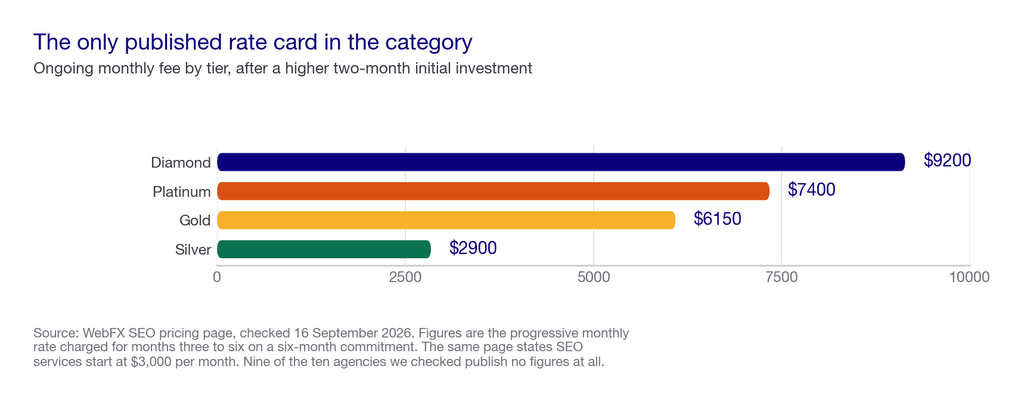
WebFX publishes a two-part structure. An initial campaign investment covers the first two months. A lower progressive monthly figure runs for the following four, on a six-month commitment.
- Silver. Costs $5,900 up front, then $2,900 a month.
- Gold. Starts at $9,150, dropping to $6,150 a month.
- Platinum. Opens at $10,400, then $7,400 a month.
- Diamond. Runs $12,200 first, then $9,200 a month.
- Entry point. The same page states SEO services start at $3,000 per month.
- Enterprise. Custom, no figure given.
Delante gives the second signal, indirectly. Its contact form asks buyers to pick a band: €1,500 to €2,500, €2,500 to €5,000, or above €5,000. Those bands tell you where its work sits even though no rate card exists.
How to read a quote when almost nobody publishes one
- Anchor low, then adjust for the review cycle. $3,000 a month is a published floor for general SEO. Financial work carries a compliance review that general work does not. Expect the real number to sit above the floor and ask the agency to show you where the difference goes.
- Separate build from run. WebFX’s structure is honest about something most quotes hide: the first two months cost more because that is when the technical and structural work happens. If a proposal is one flat monthly figure from day one, ask what happens in month one versus month five.
- Price the review, not the page. In banking, the slowest and most expensive part of publishing is usually the approval, not the draft. An agency that has not asked about your review process has not priced your account.
- Check the commitment. Six months is the published term in the one rate card we have. Anything shorter rarely shows organic results. Anything longer without a break clause is worth negotiating.
- Watch for scope stacking. AI search work quoted as a separate retainer on top of SEO is a pricing decision, not a technical necessity. Google’s own guidance places it inside SEO.
If you want to see the number our side, we quote on scope and we say it on the first call. The platform and the growth team come together rather than as separate line items, and the agents that run the work sit in Agent Atlas.
How to choose a banking and financial SEO partner
This is the part worth slowing down on, because the shortlist you build here decides the next eighteen months. What follows is the sequence we would run if we were buying rather than selling.
Step one: decide which of three things you are actually buying
Three different purchases hide under the phrase “SEO agency”. They have different economics, and conflating them is how retainers quietly inflate.
Execution capacity. You know what to do and lack the hands. You are buying throughput: pages produced, technical tickets closed, links earned. Judge on delivery volume, turnaround and how they handle your review cycle.
Strategic direction. You do not yet know which of thirty possible priorities matters. You are buying judgement. Judge on the diagnosis they give you before you sign, not the case studies they show after. An agency that arrives with a plan before it has seen your Search Console is selling a template.
Visibility infrastructure. You need to see what AI engines say about you, continuously, and act on it. That is a platform purchase with a service layer, and it is the category we sit in. Judge on engine coverage, metric definitions, and whether you get raw answers or a summary.
Most banks need two of the three. Almost nobody needs all three from one supplier.
Step two: score the shortlist on a 100-point scale
Rebuild the five-column table above for your own shortlist, from the agencies’ own websites. It takes about twenty minutes. Then weight it, so the scoring survives contact with a good sales call. These are the weights we would use for a regulated brand, and the reasoning matters more than the exact numbers.
| Criterion | Weight | What earns full marks |
|---|---|---|
| Regulated-vertical evidence | 25 | A named financial client you can call, not a logo wall |
| Compliance-cycle fluency | 20 | They ask about your review process before you raise it |
| Engine coverage, named | 15 | Named engines and a stated reporting frequency |
| Data and login ownership | 15 | You keep GA4, Search Console and platform access |
| Cost transparency | 10 | A number on the first call, and a build-versus-run split |
| Technical depth | 10 | They found something in your site before the pitch |
| Reporting you can audit | 5 | Raw answers attached, not only a chart |
Total 100. Two of those criteria carry half the score between them, and both are about whether the firm has done regulated work before. That is deliberate. In this vertical, the compliance cycle is the constraint, not the writing.
Step three: ask the five questions that separate them
- “Which engines do you measure, and how often?” You want engine names and a frequency. Vague answers here predict vague reporting later.
- “Who owns the logins and the data?” If they run everything and send a monthly deck, you are buying a report rather than a capability, and when the contract ends you keep nothing. Ask specifically about GA4, Search Console and any visibility platform.
- “Show me a page you wrote that a compliance team rejected, and what you did next.” The best answer is a real story about a rewrite. An agency that has never been rejected has never worked in your category.
- “What does month one look like against month five?” This surfaces whether the retainer is front-loaded build work or flat-rate maintenance. Both are legitimate. Not knowing which you bought is not.
- “What would you tell us not to do?” A partner with a view answers immediately. This is the question that most reliably separates practitioners from sales teams.
A sixth is worth keeping in reserve. Any time AI visibility work is pitched as a compliance obligation, ask which rule requires it. We went looking and found no published regulator rule requiring a firm to monitor what third-party AI says about it. The commercial reasons are good enough on their own. The full check is in AI search, fintech compliance and where the real exposure sits.
Step four: run a live test before the full retainer
Paper evaluations reward whoever writes the best deck. Run a real one instead.
Give each finalist the same 25 prompts your customers would actually type, and 90 days. Prompts like “best business bank account for a startup”, “is my money safe in a credit union”, or “compare fixed rate mortgage vs tracker”. Ask for a baseline in week one and a movement report at the end.
A weaker agency will report rankings, traffic and a list of pages shipped. A stronger one will report which prompts you now appear in, which pages the engines actually cited, and which of the two numbers moved. The gap between Brand Visibility and Domain Prompt Presence is the tell: high mentions with low domain citations means engines are describing you using someone else’s pages. That is a citability problem with a specific fix, set out in our Visibility, Citability and Retrievability framework.
Step five: watch for these red flags
- A guaranteed position. Covered below, and it ends the conversation.
- A single AI visibility score with no published components. Ask what it is made of. It usually dissolves.
- A named bank they will not name. “A top five US bank” is not a reference you can check.
- No question about your compliance process. The clearest sign a firm has not run a regulated account.
- AI search quoted as a separate retainer with no explanation of why it cannot sit in the main scope.
- A rank on their own list used as a credential. Now you know how those are made.
Step six: define the in-house line, and be willing to walk away
Compliance sign-off stays inside. Product and rate accuracy stays inside. Relationships with your own subject matter experts should stay inside. An agency offering to own those is over-reaching. An agency refusing to work around them has not done banking. Our view on where that line sits is in the AI search team ownership model.
And here is the answer that loses us the sale. If you have fewer than thirty indexable product and guidance pages, you do not need an agency yet, ours included. Fix the pages you have, get author credentials and review dates onto them, and come back in two quarters. Retaining anybody before that spends budget on distribution for content that is not ready to be distributed.
All of it comes down to one principle: buy the constraint, not the capability. In banking the constraint is almost always the review cycle, so the firm that has argued with a compliance team before is worth more than the firm with the longer service list.
What nobody should promise you
- A guaranteed ranking. Google’s own guidance advises against providers who guarantee rankings, on the grounds that third parties cannot access internal ranking systems. If a proposal contains a guaranteed position, that is a complete answer about the proposal.
- A guaranteed placement in an AI answer. Nobody controls what a model outputs. We will not promise it either.
- A single AI visibility score. One number that collapses five engines, dozens of prompts and citation quality into a figure is a marketing device. Ask what it is made of and it usually dissolves.
- Results in thirty days. The published commitment in the only rate card in this category is six months. Treat shorter promises accordingly.
- A named bank logo they cannot name. “A top five US bank” is not a reference. If they cannot name it, you cannot check it.
Frequently asked questions
Which is the best SEO agency for financial services?
There is no verifiable answer, and any page claiming one is usually written by the winner. Three ranked lists we checked each placed their own publisher first. Compare agencies on published specifications, named financial clients and engine coverage instead of on rank order.
How much does financial services SEO cost?
Only one of ten agencies we checked publishes figures. WebFX lists SEO from $3,000 per month, with tiers running from $2,900 to $9,200 in ongoing monthly fees after a higher initial two-month investment. Treat that as a floor, because financial review cycles add real cost.
Why is SEO harder for banks than for other industries?
Google gives more weight to strong E-E-A-T for content that could significantly impact financial stability, and states that trust matters most. Banking pages are judged on author credentials, review dates and citations, and every page also has to pass an internal compliance review before it ships.
Do I need a separate GEO or AEO agency?
Usually not. Google’s May 2026 guidance places AI search work inside SEO rather than beside it. If an agency quotes AI search as a separate retainer, ask which engines it covers and why that scope cannot sit inside the main engagement you are already paying for.
Cost, timing and what to ask
What should I ask an agency before signing?
Ask which engines they measure and how often, who owns the logins and the data, what month one looks like against month five, and what they would tell you not to do. Then ask for a page a compliance team rejected, and what they did next.
How long before financial SEO shows results?
The only published commitment in this category is six months, from the one agency that publishes a rate card. Organic work in a regulated vertical is slower than in most, because the compliance review sits between the draft and the live page every single time.
Choosing between them
Should a bank hire a specialist or a generalist agency?
A specialist usually clears review cycles faster because it has argued with a compliance team before. A generalist usually brings more technical depth and a bigger bench. Decide by which of those two is currently your bottleneck, then check the claim on the firm’s own site.
Can an agency guarantee my bank will rank first?
No, and Google advises against providers who make that promise, because third parties cannot access internal ranking systems. The same applies to guaranteed placement in an AI answer. Treat a guarantee in a proposal as a finding about the proposal.
Sources
Agency details come from each company’s own website, checked 16 September 2026. Ranked lists were read in full on the same date. Where we could not verify something, we have said so rather than filling it in.
Ranked lists we read
- First Page Sage, The Top Financial Services SEO Agencies: 2026, checked 16 September 2026. Ten entries, First Page Sage at number one. Publishes eight weighted criteria and states its team “analyzed 75+ agencies to select the top financial services SEO providers of 2026.”
- Silverback Strategies, Best SEO Agencies for Financial Services, checked 16 September 2026. Ten entries, Silverback at number one.
- NEWMEDIA.COM, 15 Best SEO Companies for Financial Services, checked 16 September 2026. Fifteen entries, NEWMEDIA.COM at number one.
Agency sites
- First Page Sage, Silverback Strategies, CSTMR, Victorious, Sure Oak, Banktastic, Delante and Ignite Visibility, all checked 16 September 2026.
- WebFX SEO pricing, checked 16 September 2026. Source of every dollar figure quoted above.
- Straight North returned HTTP 403 to our checks on 16 September 2026, so no cell in its row is filled.
Google guidance
- Google Search Central, Creating helpful, reliable, people-first content, checked 16 September 2026. Gives “even more weight to content that aligns with strong E-E-A-T” for topics that “could significantly impact the health, financial stability, or safety of people,” and states “of these aspects, trust is most important.”
- Google Search Central, AI features and your website, 15 May 2026. Places AEO and GEO inside SEO, and advises against providers guaranteeing rankings.
On what we did not do
We did not rank these agencies. We have no outcome data on any of them, and neither does any page currently ranking for this query. If an agency publishes audited performance data, send it to us and we will add it here with attribution.
Latest Blogs
Six stages, in order, with the template at the end. The new part is not a separate AI workstream bolted on the side. It is two extra columns in the plan you were already building, and one capability most teams do not have.
No regulator requires you to monitor what ChatGPT says about your products. Vendors imply otherwise. Here is what the rules actually cover, what the real risk is, and which tools stand up to a buying review.
Every ranked list of financial SEO agencies puts its own author first. We checked three of them. Here are ten agencies compared on what they publish, what financial SEO costs, and the questions that sort a real partner from a good deck.
Get your hands on the latest news!

Similar Posts

SEO
15 mins read
What are the best SEO agencies in 2026?

Artificial Intelligence
12 mins read
How to check whether your brand appears in AI search

Digital Marketing
15 mins read