GEO for Fintech: How to Get Your Brand Cited in AI Financial Queries
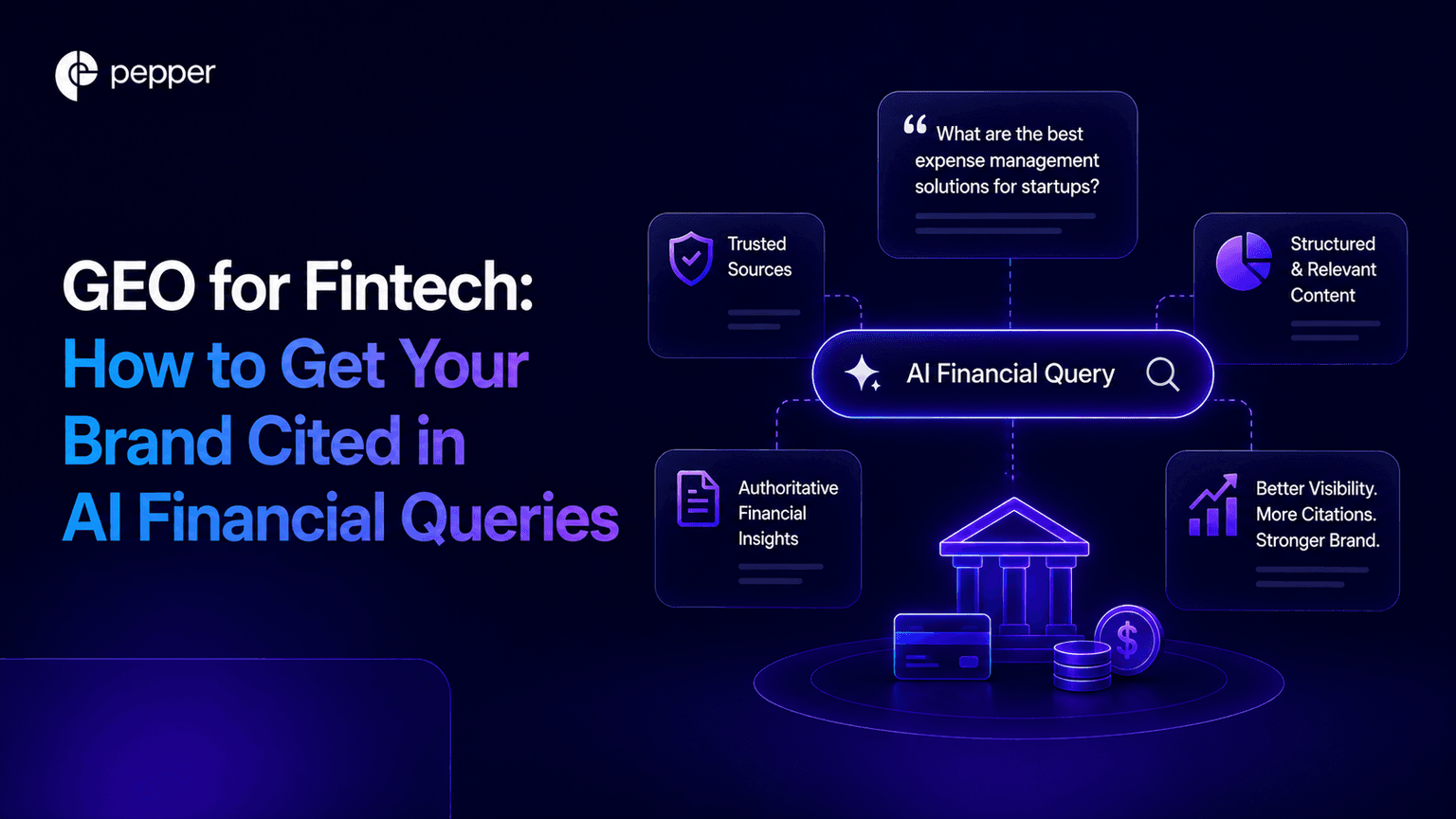
| TL;DR When someone asks ChatGPT ‘the best payment gateway for startups’ or ‘how does BNPL work,’ the brands named in that answer win the consideration set before a website visit ever happens. But fintech faces a harder version of the AI-search problem than any other category: because money questions are ‘Your Money or Your Life’ (YMYL), LLMs apply extra caution, citing fewer sources and leaning heavily on trusted, authoritative ones. That makes citations harder to earn and far more valuable to hold. This guide covers what makes financial content citation-worthy (E-E-A-T, regulatory accuracy, expert-backed content, structured data), the trust barriers fintechs must clear, and the playbook to earn AI citations. The stakes: in a category built on trust, absence from AI answers reads as a red flag. |
What This Guide Covers
- Why Fintech Is AI Search’s Hardest Category
- How the AI Answer Became the New Consideration Set
- What Makes Financial Content Citation-Worthy for LLMs
- The Trust Barriers Fintechs Have to Clear
- The Playbook: How to Earn AI Citations in Fintech
- Industry Updates
- YouTube Script
- FAQ
Why Fintech Is AI Search’s Hardest Category
Every brand now competes to be named inside AI answers instead of ranked on a results page. For fintech, that competition runs on hard mode.
The reason is a category Google calls YMYL, Your Money or Your Life: content that can affect a person’s health, safety, finances, or well-being. Financial topics sit squarely inside it, and AI engines apply markedly stricter source-quality filters to YMYL queries than to ordinary product questions. The bar to get cited is higher, and the bar to get refused or hedged is lower. An LLM that will happily name five project-management tools will name far fewer savings accounts, and only ones it trusts.
This caution is rational. When an AI quotes an interest rate that was correct eighteen months ago, describes a business credit card as a consumer product, or omits the regulator that would make a deposit trustworthy, the consequences are immediate and real. So the models hedge, and they lean on sources they consider authoritative. The result is a paradox that defines fintech GEO: citations are harder to earn, and precisely because they are harder, they are far more valuable once you hold them.
| DEFINITION: GEO for Fintech |
| GEO (Generative Engine Optimization) for fintech is the practice of structuring a financial brand’s content, entity, and third-party presence so that AI engines like ChatGPT, Gemini, Perplexity, Claude, and Google AI Overviews cite it when users ask money questions. It differs from GEO in other categories because financial topics are YMYL: AI assistants apply stricter source-quality filters, cite fewer sources, and refuse or hedge more readily, so the citation bar is higher and trust signals matter more. |
How the AI Answer Became the New Consideration Set
Think about how financial decisions now start. A founder asks an AI assistant ‘the best payment gateway for startups.’ A shopper asks ‘how does BNPL work, and which providers are safest?’ A saver asks ‘which neobank is best for international transfers?’ In each case, the model returns a confident, synthesized answer that names a handful of brands, often before the person visits a single website.
That is the whole game. Research into consumer AI-assistant behavior in 2026 found that a growing share of customers form a view and a shortlist before, or entirely without, visiting a brand’s site. The AI answer is where consideration now happens. And because LLMs cite only a small handful of sources per answer, far fewer than the ten blue links of old search, the competition for a citation slot is more intense than ranking ever was. You are named, or you are not.
For fintech, this reshuffles categories fast. Marketing leaders describe organic traffic to established brands falling sharply as AI absorbs the research phase. At Pepper’s Index ’26 summit, an investor on our panel noted that among the Fortune 500, organic traffic from Google dropped roughly 30 to 40% on average in recent years, and for some companies 70 to 80%. In a trust-driven category, the brands that get cited early are compounding an advantage while incumbents watch their old funnel quietly drain.
| For 25 years the game was clear: show up on Google, get ranked, get bought. Now buyers ask ChatGPT, Gemini, and other LLMs, and that answer either has your name in it or it does not. It’s happening before they land on your website, before they fill out a form, before they speak to sales. (Anirudh Singla, Co-founder & CEO, Pepper, Index ’26 keynote) |
What Makes Financial Content Citation-Worthy for LLMs
If YMYL caution is the barrier, trust is the key that opens it. Four signals do most of the work in deciding whether an AI engine will put its name behind your financial content:
- Experience, Expertise, Authoritativeness, and Trustworthiness carry extra weight for financial topics, and Google calls Trust the most important of the four. Named expert authors with real credentials, clear organizational identity, and verifiable claims are what let a model treat your page as safe to cite.E-E-A-T signals.
- Get the rate, the fee, the product classification, and the jurisdiction right, and keep them current. Precise, conservative, attributable claims get cited; vague superlatives like ‘the best account for everyone’ get skipped. In fintech, accuracy is not just quality, it is a citation signal.Regulatory accuracy.
- AI engines favor content that shows a real human with relevant expertise stands behind it. Bylines from credentialed authors, expert quotes with attribution, and original analysis outperform anonymous, generic explainers, especially on money topics where the model is looking for a reason to trust you.Expert-backed content.
- Schema (FAQPage, HowTo, Organization, Product), clean headings, comparison tables, and answer-first passages let a model retrieve and quote your content without ambiguity. Facts hidden in PDFs, gated pages, or walls of prose are effectively invisible to retrieval.Structured data.
One nuance from our own research that matters enormously for fintech: different engines weight different sources. As Kishan Panpalia showed at Index ’26, ChatGPT weights authoritative-list mentions heavily (around 41%), while Claude draws roughly 68% of its signals from traditional directories, the Bloombergs, Hoover’s, and New York Times of the world. For a fintech, that means a mention in a trusted financial publication or directory is not a nice-to-have. It is often the difference between being citable and being invisible.
| When AI processes your website, it doesn’t care how flowery the writing is. It extracts structured facts. What matters is explicitness, repetition, and hard facts. One fact per section. If you have two important facts, put them in different sections. (Kishan Panpalia, Pepper founding team, Index ’26) |
The Trust Barriers Fintechs Have to Clear
Across the enterprise brands we have audited through Atlas, the same barriers keep fintechs out of AI answers. They map cleanly to our V-C-R framework, Visibility, Citability, Retrievability, which asks three questions: can LLMs see your content, can they trust it, and can they reuse it?
| Layer | The Barrier | What It Looks Like in Fintech |
| Visibility | Over-indexed on branded SEO, absent from non-branded and third-party queries | You rank for your own name but never appear for ‘best business account’ or in analyst and media roundups |
| Citability | Key facts buried, unstructured, no definitional authority | Rates and terms locked in PDFs or gated calculators; no clear ‘what is BNPL’ answer a model can lift |
| Retrievability | Fragmented architecture, single-source presence, published too late | Content scattered across microsites; no third-party redundancy; competitors already cited on the topic |
The through-line is trust redundancy. A fintech can have an excellent website and still be uncitable if the model cannot corroborate its claims anywhere else. Financial answers demand cross-source agreement, and a brand that appears only on its own domain gives the model nothing to verify against. In a category where the model is already inclined to hedge, thin trust signals are fatal.
The Playbook: How to Earn AI Citations in Fintech
You do not win fintech GEO with a clever trick. You win it by systematically becoming the source an AI engine trusts on your core topics. Four moves, in order:
1. Build Topical Authority on Core Financial Concepts
Start with the concepts your buyers ask about, not your product. Publish clear, accurate, expert-backed explainers on the foundational questions in your space: how BNPL works, what a payment gateway does, how business credit differs from consumer credit. Cover a topic comprehensively rather than publishing one thin page, because AI engines reward depth and consistency across a cluster. This is also where a subtle mechanic helps you: AI recommendations correlate with reciprocal rank fusion, meaning a brand that ranks consistently across many related queries outperforms one that ranks first on only a few. Broad, consistent topical coverage beats a single hero page.
2. Engineer Content for Retrieval and Accuracy
Structure every page so a cautious model can lift a clean, verifiable passage. Lead each section with a direct answer, keep to one key fact per section, add schema, and present rates, fees, and comparisons in tables rather than prose. Keep every regulatory detail current and precise, and state the jurisdiction and protections plainly. In fintech, accuracy and structure are not separate from citability; they are citability.
3. Earn Mentions on the Third-Party Sources LLMs Already Trust
This is the highest-impact move for fintech, and the one most brands underinvest in. Because financial answers demand corroboration, and because engines like Claude lean heavily on traditional directories and publications, you have to exist in the sources the models trust. Earn coverage in reputable financial media, get listed and reviewed on the comparison and directory sites your category lives on, contribute expert commentary, and build genuine presence in the communities where these topics are discussed. Earned, third-party validation is what moves you from ‘published’ to ‘citable.’
4. Lock Your Entity and Prove Your Legitimacy
Make your brand resolvable and verifiable. Keep your description, regulatory status, and key facts consistent across your site, LinkedIn, Crunchbase, and Wikidata, and make your credentials and compliance posture easy to find. For a fintech, clear signals of legitimacy (who you are regulated by, where deposits are protected, who stands behind the content) are exactly what a trust-seeking model looks for before it will name you.
| Building your brand in LLMs also means answering the questions your customer has that aren’t about your product. Think about the persona’s job to be done, and be the answer to all their questions, not just the ones about you. (Cindy Sloan, former CMO of G2, Index ’26 CMO panel) |
This is why PR and distribution now behave like growth functions in fintech. As our founding team put it at Index ’26, digital PR directly drives AI citations, and consistent monthly distribution beats one-time annual campaigns. In a trust category, the brand that shows up authoritatively, everywhere the model looks, wins.
Industry Updates: AI Search and Fintech in 2026
The SEO-to-AI Overlap Has Collapsed
Analyses from Ahrefs and BrightEdge reported that the overlap between top-10 Google rankings and AI Overview citations fell from roughly 75% to between 17% and 38% by early 2026, with most AI citations now coming from pages outside Google’s top 10. For fintechs that spent a decade building Google rankings, the implication is direct: strong SEO no longer guarantees AI visibility, and the citation game has to be played on its own terms.
Earned Media Dominates AI Citations
Muck Rack reported in late 2025 that earned media accounts for a large majority of AI citations, roughly 82%. AI engines look for third-party validation before citing a brand, so coverage in trusted publications carries more weight than anything a brand publishes about itself. For fintech, where corroboration is a precondition for citation, this makes PR one of the highest-impact GEO investments available.
YMYL Scrutiny Is Expanding
Google’s 2025 updates broadened the YMYL definition beyond health and money to include content affecting civic trust and societal well-being, and both algorithms and human raters now apply the highest level of scrutiny to it. For fintech content, this reinforces the direction of travel: expect the citation bar to rise, not fall, and treat regulatory accuracy and demonstrable expertise as permanent requirements.
Citations Reward Consistency, Not Just Rank
A recurring theme at Index ’26 was that AI systems use reciprocal rank fusion, so a brand ranking fourth or fifth consistently across many related queries can outperform one ranking first on only a few. For fintechs, this validates a topical-authority strategy over a handful of hero pages: broad, consistent coverage of a concept space is what compounds into AI citations.
Boards Are Starting to Ask
Investors and boards are beginning to ask CMOs where their brand ranks in ChatGPT, Perplexity, and Gemini, and many marketing leaders cannot yet answer. In fintech especially, where trust is the product, being unable to report your AI visibility is becoming a board-level gap, not just a marketing one.
Latest Blogs
Most advice on this is inference dressed as fact. OpenAI documents exactly one thing clearly, which is access. Here is what is documented, what is inferred, and how to verify the rest for yourself.
Being named in an AI answer and having your page used as its source are different outcomes with different causes and different fixes. The gap between them is the most useful diagnostic in AI search, and most reporting collapses it into one number.
Every platform reports share of voice and almost none of them define it the same way. Here is the definition worth using, the three choices that change the number, and how to measure it yourself without buying anything.
Get your hands on the latest news!

Similar Posts
GEO / AI Search
10 mins read
How to get cited by ChatGPT
GEO / AI Search
10 mins read
Mentioned vs cited: the difference that decides AI visibility
GEO / AI Search
13 mins read