AI visibility tools for fintech: compliance-safe GEO for regulated brands
The short answer
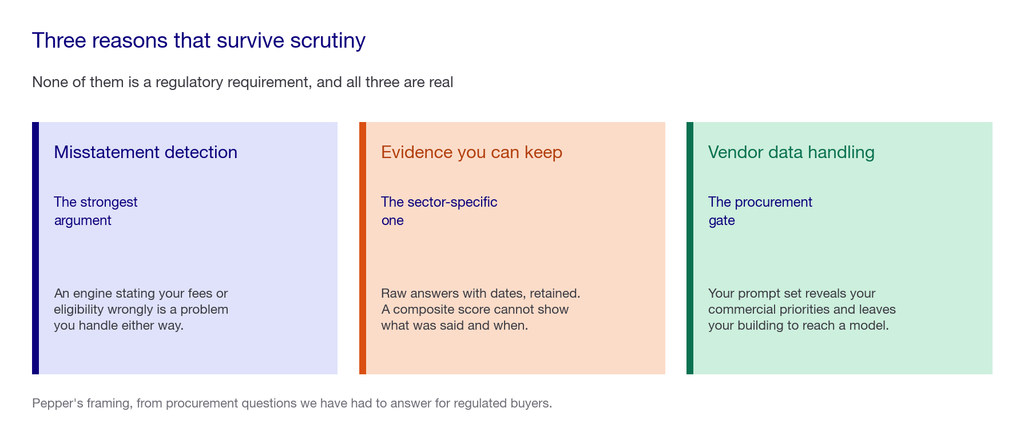
Buy on three things, none of which is a regulatory rule. Misstatement detection, because an engine describing your rates wrongly is a commercial and reputational problem you will handle either way. Evidence you can keep, meaning exportable raw answers with dates. Vendor data handling, because your prompt set and your brand data leave your building.
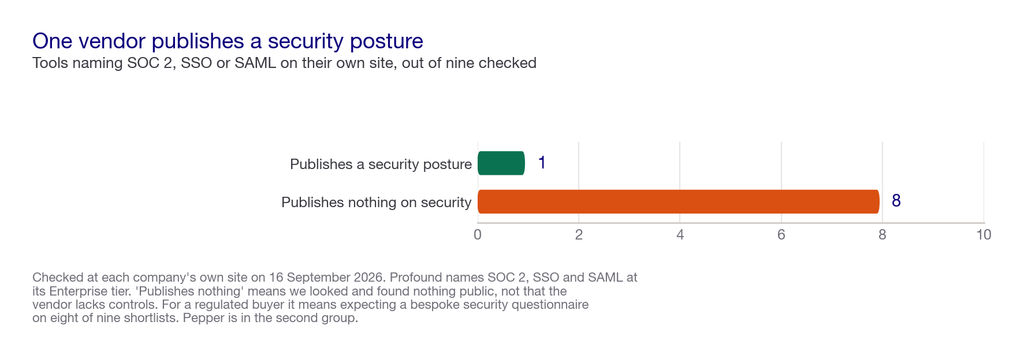
On published evidence, Profound is the only tool here naming SOC 2, SSO and SAML on its pricing page, which matters more in a buying review than any feature.
Key takeaways
- No rule requires third-party AI tracking. FINRA’s rules are technology neutral and cover a firm’s own use of GenAI.
- The real risk is misstatement, not non-compliance. If an engine states your terms wrongly, customers act on it.
- Only one vendor publishes a security posture. Profound names SOC 2, SSO and SAML. The rest say nothing publicly.
- Exportable raw answers matter more here than elsewhere. A composite score is not evidence of anything.
- Google’s YMYL bar is the part that is real. Financial content sits in it, and Google says trust is the most important factor.
A note on where this comes from. We run organic for more than 250 enterprises and track over 10 million prompts across every major engine. What follows is shaped by that, by the client reviews we sit in weekly, and by buying questions we have had to answer for regulated buyers.
What is an AI visibility tool, and what does compliance actually change?
An AI visibility tool runs a set of prompts across AI engines on a schedule and reports what came back: whether your brand was named, whether your pages were cited, which competitors appeared instead, and which outside sources fed the answer.
For a regulated brand, three things change and two do not.
What changes. Where your data goes matters, because your prompt set reveals your commercial priorities. Evidence retention matters, because you may need to show what an engine said on a given date. And accuracy tracking matters more than share of voice, because a wrong number about your product is a different class of problem from a missing mention.
What does not change. The tool still only measures. And the underlying work is the same as any other field: access, extractable structure, evidence, and sources you do not own.
The part of the regulation that really bears on this is Google’s YMYL standard, not FINRA. Google gives “even more weight to content that aligns with strong E-E-A-T” for topics that “could significantly impact the health, financial stability, or safety of people.” It adds that “of these aspects, trust is most important.” Financial content sits squarely there, which raises the bar on what gets cited.
Our fintech compliance and GEO piece covers why compliance-first content maps well to what engines reward, and AI search for financial services covers the wider strategy.
What the rules actually say, and what they do not
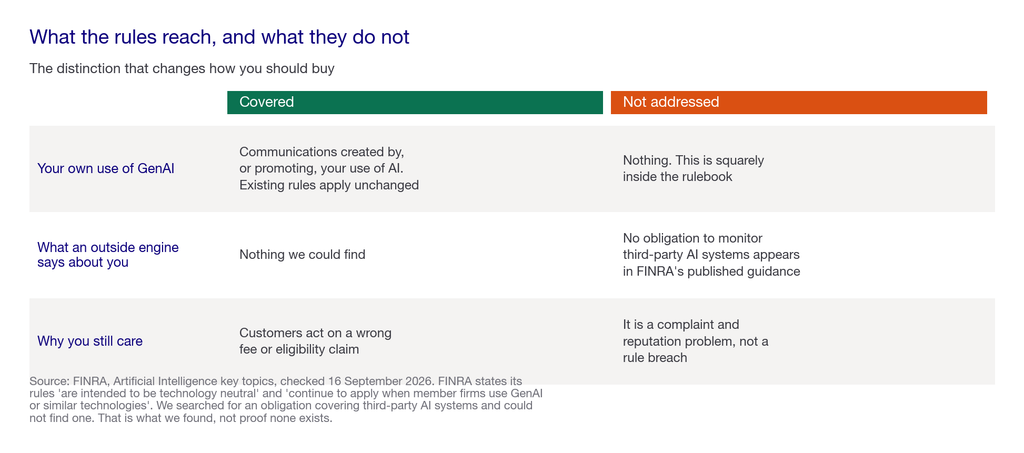
Covered: your own use of GenAI. FINRA states its rules “are intended to be technology neutral”. They “continue to apply when member firms use GenAI or similar technologies.” Its AI guidance sits under communications with the public. It covers “communications that are created by, or promote a firm’s use of, AI.” Use a model to draft customer-facing material and the existing rules apply unchanged.
What no rule addresses
What an outside engine says about you. FINRA’s published material does not create an duty to monitor third-party AI systems. We could find no rule requiring it.
Why it still matters
If ChatGPT states your fee structure wrongly and a customer acts on it, you deal with it. Whose model produced it does not matter. That is a complaint and reputation problem rather than a rule breach. It is real enough to justify tracking on its own terms.
Say this in the buying call. If a vendor says their tool is required for compliance, ask which rule. You will get a gesture at FINRA, not a citation. That tells you plenty about the rest of their claims.
AI visibility tools for fintech at a glance
| Tool | Entry pricing | Engines | Published security posture | Raw answers exportable |
|---|---|---|---|---|
| Pepper | Not published | 6 | Not published; raised in onboarding | Yes, you hold the logins |
| Profound | $99 Starter, $399 Growth | 1, then 3, up to 9 | SOC 2, SSO, SAML at Enterprise | Yes |
| AthenaHQ | Free Essential, $295 Starter | 5 free, 10 on Starter | Not published | Not stated |
| Scrunch | $300 Starter, $500 Growth | 7 at every tier | Not published | Not stated |
| Peec AI | Not published | 5 at every tier | Not published | Not stated |
| Evertune | Not published | 7 | Not published | Not stated |
| Conductor | Not published | 6 | Not published | Not stated |
| Otterly | $29 Lite | 4 included, 3 add-ons | Not published | Not stated |
| AirOps | Free Solo | 1 free, 4 on Pro | Not published | Not stated |
Checked at each company’s own site on 16 September 2026. “Not published” means we looked and found nothing, which for a regulated buyer is itself the finding: expect to raise every one of these in a call.
Reading that table as a buyer
Two columns decide your shortlist before any feature does. Published security posture narrows nine vendors to one. Exportable raw answers decides whether you can evidence anything later. Everything else is negotiable.
How we weighted this for a regulated buyer
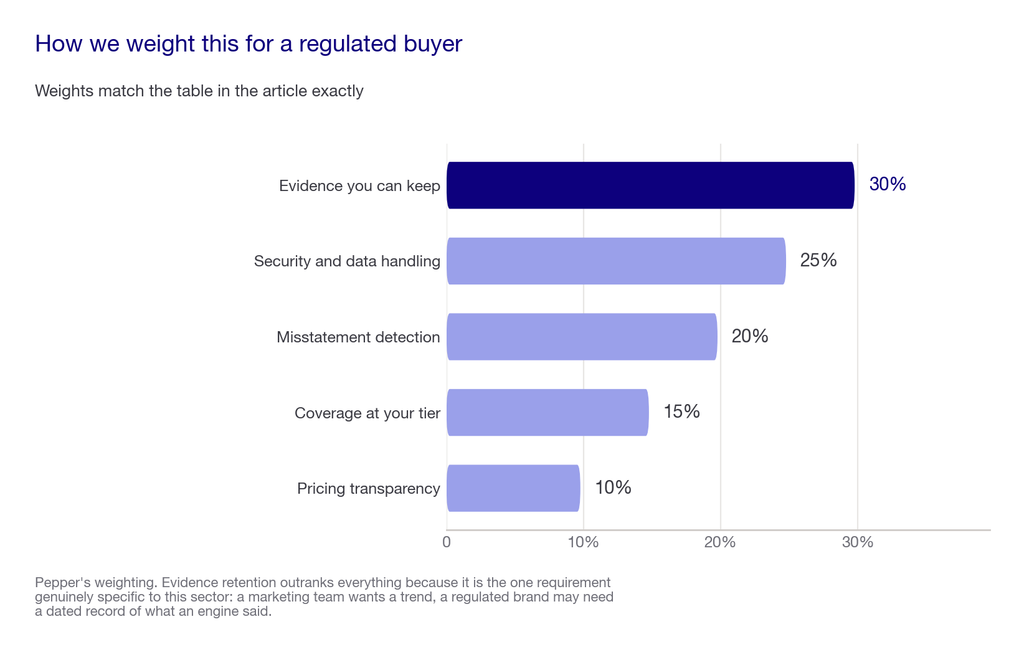
| Area | Weight | What decides the score |
|---|---|---|
| Evidence you can keep | 30 | Whether raw answer text and cited URLs export with dates, so you can show what an engine said and when |
| Security and data handling | 25 | Whether the vendor publishes a security posture, and can say where your prompt set and brand data are processed |
| Misstatement detection | 20 | Whether the tool surfaces what engines claim about your products, not only whether you were mentioned |
| Coverage at your tier | 15 | Which engines the purchasable tier returns, since a gap looks identical to absence |
| Pricing transparency | 10 | Whether you can build a business case before buying gets involved |
Evidence retention outranks everything because it is the one rule really specific to this sector. A marketing team wants a trend. A regulated brand may need to show a dated record. Our [GEO agency ranking methodology](https://www.pepper.inc/blog/geo-agency-ranking-methodology/) explains how we build weightings like this.
If you want the diagnostic run against your own products before buying starts, book a growth audit and we will show you what engines currently say about your rates and terms.
The tools
Pepper
Pepper leads in its own field per the disclosure, because it pairs the measuring layer with people who act on it.
- Pricing: Not published. Scope set with the account rather than by tier
- Engines: 6, including ChatGPT, Perplexity, Gemini and Google AI Overviews
- Evidence: you log in and read raw answers and cited URLs directly. Records stay yours rather than arriving in a deck
- What you log into: workspace setup, brand profile, competitors and personas. GA4 and Search Console connected. Themes and prompts managed, GEO analytics read directly, and your own agents built and run in the Agent Atlas
- And a growth team is attached to the account, doing the work alongside your people
- Misstatement detection: answer text is visible per prompt, so a wrong claim about your product surfaces as text rather than as a score movement
- Best for: regulated teams who need the findings acted on, not only recorded
- Where it falls short: we publish no security posture on the site, so raise it in onboarding. We publish no pricing either. And we have no live financial case study to show you right now. That is a fair thing to hold against us here
Profound
Profound is the clearest fit if buying is your gate.
- Pricing: $99 Starter, $399 Growth, Enterprise quoted
- Engines: 1 on Starter, 3 on Growth, up to 9 on Enterprise
- Security: SOC 2, SSO and SAML named at Enterprise, plus dedicated Slack support. The only tool here publishing this
- Evidence: 1,500 monthly responses on Starter, 9,000 on Growth, with raw answers available
- Best for: regulated buyers who need to clear a security review without a bespoke questionnaire
- Where it falls short: coverage is heavily tier-gated, so the $99 tier watches one engine
AthenaHQ
AthenaHQ covers the most engines at a published price.
- Pricing: Free Essential with $25 credit, $295 Starter, Enterprise quoted
- Engines: 5 free, 10 on Starter
- Security: Not published
- Best for: breadth of tracking at a visible price, useful when you need wide coverage of product claims
- Where it falls short: credit-based with no stated run volume, so the sample behind a percentage is unclear, and nothing published on security
Scrunch
Scrunch covers seven engines at every tier with no gating.
- Pricing: $300 Starter, $500 Growth, Enterprise quoted
- Engines: 7 at every tier
- Also included: GA4 integration for AI referral traffic
- Best for: teams who want consistent coverage and attribution into existing analytics
- Where it falls short: highest entry price here, nothing published on security, and no stated sampling volume
Peec AI
Peec AI does not gate engines by tier.
- Pricing: Not published at any of four tiers
- Engines: 5 at every tier, tracked daily
- Best for: consistent coverage regardless of spend
- Where it falls short: no published figures at all, which makes a business case difficult before buying
Evertune
Evertune publishes the deepest sampling statement in the field.
- Pricing: Not published
- Engines: 7
- Sampling: each prompt sampled up to 100 times per model, the most specific disclosure anyone makes
- Best for: defensible accuracy work, which suits a regulated brand needing confidence in a claim
- Where it falls short: no published pricing or security posture, and the depth suits periodic studies more than daily tracking
Conductor
Conductor is scoped for enterprise.
- Pricing: Not published
- Engines: 6, plus traditional search
- Best for: enterprises consolidating SEO and AI search into one contract
- Where it falls short: nothing published on pricing or security, so expect a long buying cycle
Otterly
Otterly has the lowest published entry.
- Pricing: $29 Lite, $189 Standard, $489 Premium
- Engines: 4 included; AI Mode, Gemini and Claude are paid add-ons
- Seats: unlimited on every plan, which suits a large compliance and marketing group
- Where it falls short: three of seven engines cost extra, and nothing published on security
AirOps
AirOps has the most generous free tier.
- Pricing: Free Solo tier, paid tiers quoted
- Engines: 1 free, 4 on Pro
- Best for: establishing whether engines discuss your products at all, before buying is involved
- Where it falls short: single-engine free tier and nothing published on security
What this costs, and the line nobody quotes
Published entry pricing runs from free to $300 monthly. That is not the cost.
For a regulated brand, the review is the real cost. A security questionnaire, a data processing agreement and a legal read on where prompt data goes will eat more elapsed time than the subscription costs in a year. That is the argument for shortlisting on published security posture first, which currently narrows this list to one.
The second cost is acting on findings. A tool surfacing a misstatement does not correct it. Correction means updating your own pages, getting cited on sources the engines trust, and sometimes contacting a publisher. Our cost breakdown of platforms against hiring models that line.
What nobody should promise you
That any tool is required for compliance. No rule we could find requires tracking third-party AI answers. Ask which rule, and expect a gesture rather than a citation.
That tracking prevents misstatement. It detects it. Correction is separate work, and mostly happens off your own site.
Guaranteed citations. Google advises against providers guaranteeing rankings, because third parties cannot access internal ranking systems.
A composite score as an audit record. If you may need to show what an engine said on a date, you need the answer text, not a number derived from it.
How to choose an AI visibility tool for a regulated brand
I would start by removing the compliance framing from the conversation entirely, because it distorts the evaluation.
Google’s May 2026 guidance places AEO and GEO inside SEO, and its helpful content guidance sets the YMYL bar: more weight on strong E-E-A-T for anything affecting financial stability, with trust the most important factor. That is the standard really shaping whether you get cited. FINRA’s rules, meanwhile, are technology neutral and govern your own use of GenAI. Hold both, and notice that neither creates a tracking duty.
Score what actually matters here
| Area | Weight | What a strong vendor demonstrates |
|---|---|---|
| Evidence you can keep | 30 | Raw answer text and cited URLs exportable with timestamps, retained long enough to be useful in a dispute |
| Security and data handling | 25 | A published security posture, and a straight answer on where prompt and brand data are processed |
| Misstatement detection | 20 | Surfaces what engines claim about your products, not only whether you appeared |
| Coverage at your tier | 15 | The tier row lists your buyers’ engines, and add-ons are named without being asked |
| Pricing transparency | 10 | Enough published to size the purchase before buying is involved |
Those weights sum to 100. Score your own risk first: if nobody would act on a detected misstatement, tracking is documentation rather than protection.
The live test
Take 30 real questions a customer would ask about your products, in their words. Four worked examples: “what are the fees on this account”, “is my money protected if this company fails”, “which provider has the lowest rate for a small business loan”, “is this platform regulated”. Run each across ChatGPT, Perplexity and Google AI Mode, more than once, because engines are probabilistic and one run establishes nothing.
Then check three things that matter more here than in any other sector. Is anything stated about your product actually wrong. Which outside sources are being used to describe you. What would change in the next 90 days, and who does it.
That exercise costs a day and usually finds at least one factual error about pricing or terms, which is the strongest internal argument for doing anything at all.
The weak evaluation against the strong one
The weaker version starts from a compliance mandate nobody wrote, shortlists on feature grids, and buys the tool with the most engines. It produces a dashboard, a security review nobody scheduled, and no view on whether anything said about you is true.
The stronger version runs the free diagnostic first, finds the actual misstatements, shortlists on published security posture and exportable evidence, and only then compares price. It usually ends in a shorter list, because published security posture alone removes most of the market.
Red flags you will really hear
“This is required for compliance”, with no rule named. “Our AI visibility score keeps you audit-ready”, which is a score, not a record. “We’re SOC 2 ready”, which is not SOC 2. “We track all major engines”, quoted from a marketing page when the tier row says one. “Your data never leaves our platform”, offered without saying which models process the prompts. And the quiet one: a vendor who cannot say where prompt data is processed.
Five questions for the first call
- Which rule requires this? A good answer concedes none does and sells on misstatement risk instead.
- Can we export raw answers with timestamps, and for how long are they retained? A good answer is a format and a period.
- Where is our prompt data processed, and which models see it? A good answer is specific about sub-processors.
- Do you publish a security posture, and can you share the report? A good answer is yes or a clear no.
- When the tool finds a wrong claim about our product, what happens? A good answer describes correction work. A weak one describes an alert.
It all comes down to one principle: buy this to find out what engines are saying wrongly about your products, not to satisfy an duty nobody has written. The first reason survives scrutiny and the second will not.
One closing note that costs us something. Very few providers are equally strong across measuring, execution, earned authority and attribution. Ours included. And we currently have no live financial services case study to show you, which is a fair objection in this vertical and one you should press us on.
Frequently asked questions
What the rules cover
Do regulations require tracking what AI says about my company?
We could find no rule requiring it. FINRA states its rules are technology neutral and apply when firms use GenAI themselves. Its published guidance does not address what third-party AI systems say about a firm.
What do FINRA’s AI rules actually cover?
A firm’s own use of generative AI, including communications created by or promoting the use of AI, under existing communications and supervision standards. Using GenAI does not change those duties.
Is YMYL relevant to AI search for fintech?
Yes, and it is the part that really bites. Google gives more weight to strong E-E-A-T for topics affecting financial stability, and states trust is the most important of those factors.
What is the real risk if an engine describes my product wrongly?
Customers act on it. That is a complaint-handling and reputation risk rather than a rule breach, and it is reason enough to monitor without inventing a regulatory mandate.
Choosing a tool
Which AI visibility tool is best for a regulated brand?
On published evidence, Profound, because it is the only one naming SOC 2, SSO and SAML on its pricing page. That clears a security review faster than any feature comparison.
What should I ask about data handling?
Where prompt data is processed, which models see it, who the sub-processors are, and how long records are retained. Expect to raise all four, since almost nobody publishes them.
Are free tiers usable in a regulated environment?
For a one-off diagnostic, often yes, but check the terms on data use before loading a real prompt set. A free tier is a good way to find misstatements before buying gets involved.
Do I need raw answer exports?
More than a marketing team does. A composite score cannot show what an engine said on a given date, and that record is the thing most likely to matter later.
Where to go next
Run 30 customer questions about your own products this week and read the answers rather than the scores. In our experience at least one factual error about pricing, eligibility or protection turns up, and that single finding does more to unlock budget than any vendor deck.
Then shortlist on published security posture before features, because it removes most of the market and saves a buying cycle.
Our our GEO guide for regulated brands covers why compliance-first content suits these engines, and the best answer engine optimization tools covers the wider market without the regulated lens.
For the mechanics, how to run a GEO audit covers the five-stage diagnostic and 18 GEO best practices covers what the research says gets cited. Our BFSI industry page covers how we work with financial brands, and how to read an SEO report covers which numbers belong in the monthly review.
The honest exit. If nobody in your organisation would act on a detected misstatement, do not buy a tool. Run the manual check quarterly, and spend the budget on fixing what it finds.
Sources
Regulatory statements are quoted from the the regulator’s own pages, checked 16 September 2026. Vendor details come from each company’s own site on the same date. Where we could not find something, we have said so rather than supplying it.
Regulatory and primary sources
- FINRA, Artificial Intelligence key topics, checked 16 September 2026. States FINRA’s rules “are intended to be technology neutral” and “continue to apply when member firms use GenAI or similar technologies.” Its published material on this page does not address third-party AI systems making statements about a firm.
- Google Search Central, Creating helpful, reliable, people-first content, checked 16 September 2026. Gives “even more weight to content that aligns with strong E-E-A-T” for topics that “could significantly impact the health, financial stability, or safety of people,” and states “of these aspects, trust is most important.”
- Google Search Central, AI features and your website, 15 May 2026. States AEO and GEO are part of SEO, and advises against providers guaranteeing rankings.
Vendor pages
- Profound pricing: $99 Starter, $399 Growth, Enterprise quoted up to nine engines, with SOC 2, SSO and SAML named.
- AthenaHQ pricing, Scrunch pricing, Peec AI pricing, Otterly pricing, AirOps pricing, Evertune and Conductor, all checked 16 September 2026.
Research
- Zhang Kai, He Xinyue and Yao Jingang, From Citation Selection to Citation Absorption, arXiv, 28 April 2026. Academic and independent.
- Muck Rack, Earned media still drives 84% of AI citations, 7 May 2026. Muck Rack sells PR software, so read it as an interested party with a large dataset.
On the absence of a rule
A note on what we searched for: we searched FINRA’s published guidance for an duty to monitor third-party AI systems and could not find one. That is a statement about what we found, not proof none exists. If a reader can point us at one, we will update this page and say so.
Latest Blogs
Six stages, in order, with the template at the end. The new part is not a separate AI workstream bolted on the side. It is two extra columns in the plan you were already building, and one capability most teams do not have.
No regulator requires you to monitor what ChatGPT says about your products. Vendors imply otherwise. Here is what the rules actually cover, what the real risk is, and which tools stand up to a buying review.
Every ranked list of financial SEO agencies puts its own author first. We checked three of them. Here are ten agencies compared on what they publish, what financial SEO costs, and the questions that sort a real partner from a good deck.
Get your hands on the latest news!