AI Search and Fintech: Why Your Compliance-First Content is a GEO Advantage
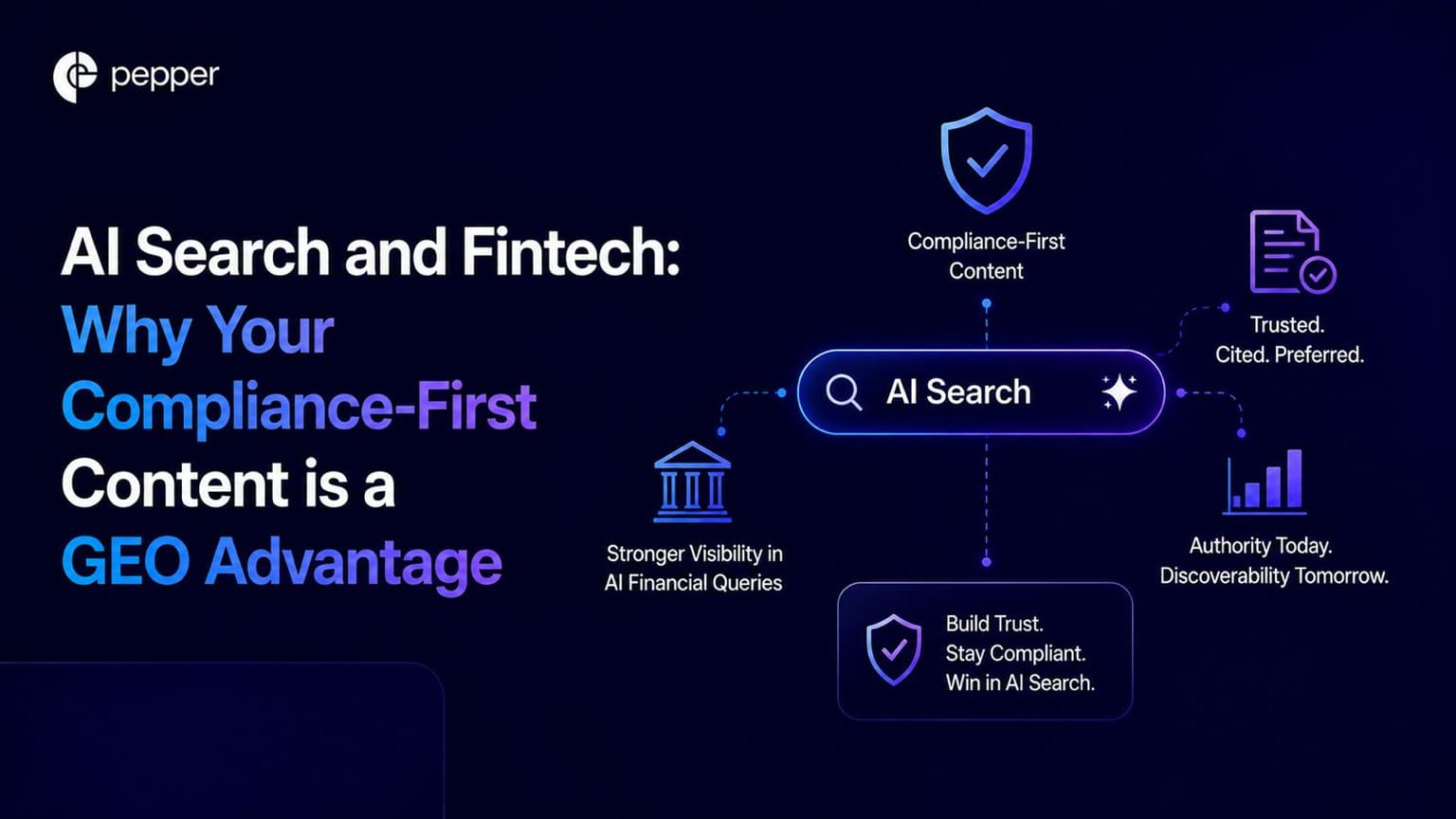
TL;DR: Financial content needs 45 to 70 percent more trust signals than general business content to earn equivalent AI citation rates, and AI models still hallucinate on 15 to 30 percent of financial questions in peer-reviewed testing. Right now, ChatGPT’s finance answers actually over-index on Reddit discussion over financial experts, while Google AI Mode already favors established, compliant sources like Bankrate and NerdWallet. That split points to where this is heading: the documentation compliance already forces fintechs to produce, sourced, dated, disclosed claims, is exactly the substrate AI engines will need more of as scrutiny increases.
Most fintech marketing teams treat compliance review as a tax on content: a delay, a rewrite, a legal sign-off that slows everything down. The data on AI search visibility suggests the opposite framing is closer to true. Financial content faces one of the highest trust bars of any category in AI search. The specific things compliance already forces into fintech content, source attribution, dated claims, disclosed limitations, are exactly the signals AI engines are short on in this category.
That advantage isn’t automatic yet. Here’s what the data on AI search and fintech actually shows, including where the current reality doesn’t match the theory.
Where to Jump In
- AI Search and Fintech: Why Fintech Faces a Higher Bar
- The Gap Between Theory and Current Reality
- AI Search and Fintech: Why Compliance Content Maps to What Engines Need
- How Pepper Approaches This
- FAQ
AI Search and Fintech: Why Fintech Faces a Higher Bar
Financial content sits in Google’s YMYL category (Your Money or Your Life), and AI engines apply meaningfully stricter trust filtering to it than to general business content. Semrush’s YMYL research found financial services content needs 45 to 70 percent more trust signals than general business content to earn an equivalent AI citation rate, a wide, structural gap rather than a marginal one.
The accuracy stakes explain why. Peer-reviewed testing on financial and economic questions found ChatGPT-4o hallucinated on roughly 20 percent of financial-literature references, with earlier model versions exceeding 30 percent on similar tasks. A hallucinated fact in a general-interest article is embarrassing. A hallucinated fact in a financial answer is a compliance incident waiting to happen, for the AI provider and for any brand it names.
Takeaway: AI search and fintech intersect at exactly this point. Fintech doesn’t get to treat AI search visibility the way a consumer brand does; the trust bar is real, measured, and roughly half again as high as most other categories face.
The Gap Between Theory and Current Reality
Here’s the part that complicates a clean “compliance wins” narrative: it isn’t winning yet, at least not uniformly. Semrush’s AI visibility research found that when ChatGPT answers finance questions, it currently favors community discussion over dedicated financial expertise. Reddit shows up in ChatGPT’s finance answers more often than any single financial-expert source, cited nearly twice per prompt on average. The researchers describe this as AI models prioritizing “collective wisdom over polished marketing messages.”
Google AI Mode tells a different story on the same category. It favors established, compliant financial comparison sites directly: Bankrate appears in 86.61 percent of the queries tested, NerdWallet in 75.07 percent. Wikipedia sits second across finance overall.
That split matters. It means the “compliance content wins” case isn’t a description of today’s ChatGPT results. It’s a bet on where the trust bar goes as scrutiny increases, and on which engines already reward it. FINRA’s 2026 Annual Regulatory Oversight Report explicitly flags generative AI governance and hallucination control as a growing supervisory priority for financial firms. That’s the kind of regulatory pressure that tends to push AI providers toward stricter sourcing over time, not looser.
Takeaway: compliance-first content isn’t a guaranteed citation win across every engine today. It’s a defensible position for where financial AI search is headed, and it already works on at least one major engine.
AI Search and Fintech: Why Compliance Content Maps to What Engines Need
Set aside the current Reddit-versus-experts split for a moment and look at what AI engines actually need to trust and cite anything: content that’s extractable, clearly structured, authoritative, and current. Those four qualities have a name in a regulated industry. They’re what compliance review already forces into fintech content before it can publish at all.
- Source attribution. A compliance-reviewed claim about a rate, a fee, or a regulatory requirement carries a citation almost by definition. That’s the same signal Princeton’s foundational GEO research found boosts AI visibility by up to 41 percent when a claim states its source explicitly.
- Dated, current claims. Regulatory content has to reflect the rules as they currently stand, which means it gets updated on a real cadence rather than sitting stale for years. Freshness is one of the four trust pillars AI engines weight directly.
- Disclosed limitations. A compliant fintech page says what a product doesn’t do, who it isn’t for, what the risks are. That kind of honest, bounded claim reads as more credible to a model trained to be skeptical of unqualified promotional language.
- Structured disclosure. Terms, rates, and risk disclosures are typically already organized into scannable, structured formats, close to what schema markup and FAQ structuring ask content to look like anyway.
None of this happens automatically. A compliance-approved PDF sitting behind a login isn’t citable content. The advantage only materializes when that same rigor gets published as accessible, structured, on-site content instead of staying locked in a document only a lawyer reads.
Takeaway: compliance doesn’t need to become marketing. It needs to become visible. The accuracy is already there; the citability usually isn’t, yet.
How Pepper Approaches This
Pepper’s platform runs Citation Analysis against a fintech brand’s actual category. It shows exactly which domains AI engines are pulling from right now, including whether community platforms like Reddit are currently outranking a brand’s own compliant, expert content the way Semrush’s research found for the category broadly. That’s the specific, fixable gap: knowing whether the problem is content quality or content visibility.
Pepper’s CRED case study shows a conversion-optimized content engine built for a fintech brand serving 7.5 million-plus members, content that has to be accurate at scale for a regulated audience. A more direct proof point sits in the Piramal case study. The explicit challenge there was simplifying complex, YMYL-grade financial information without sacrificing accuracy, and the program delivered 45 percent monthly organic growth doing exactly that.
Pepper’s agents then handle turning compliance-reviewed source material into the structured, dated, source-cited content AI engines are shown to reward. Human review stays built into the workflow so accuracy never gets traded for speed. From there, Pepper’s growth team owns getting that content in front of the right engines and prompts, rather than leaving a fintech marketing team to reverse-engineer each engine’s current preferences alone.
FAQ
What is the connection between AI search and fintech compliance content?
The underlying qualities, source attribution, dated claims, disclosed limitations, structured disclosure, map directly to what AI engines are shown to reward. It isn’t automatic: Semrush’s research found ChatGPT’s finance answers currently favor community platforms like Reddit over expert sources. The advantage exists but requires actively publishing that compliance rigor as citable, structured content.
Why does financial content need more trust signals than other categories?
Financial content falls under Google’s YMYL classification, and AI engines apply stricter accuracy filtering because a wrong financial answer carries real consequences. Semrush’s research found financial content needs 45 to 70 percent more trust signals than general business content to earn an equivalent citation rate.
How often do AI models get financial information wrong?
Peer-reviewed testing found ChatGPT-4o hallucinated on roughly 20 percent of financial-literature references, with earlier GPT versions exceeding 30 percent on similar tasks, underscoring why accuracy-focused, compliance-backed content has real room to differentiate.
Does Reddit really outrank financial experts in AI search?
Based on Semrush’s research, yes, currently on ChatGPT specifically. Reddit appears in ChatGPT’s finance answers more often than any single financial-expert source. Google AI Mode shows the opposite pattern, favoring established compliant sources like Bankrate and NerdWallet, so the picture varies meaningfully by engine.
What’s the fastest way for a fintech brand to turn compliance content into AI citations?
Publish the source attribution, dated claims, and disclosures compliance already requires as accessible, structured, on-site content rather than locked-away documentation. Then add explicit source citations and current dates, the two techniques Princeton’s GEO research found produce the largest visibility gains.
See How Pepper Can Help
The accuracy your compliance team already enforces is a real asset in AI search. Most fintechs just haven’t turned it into content an AI engine can find and cite. See how Pepper’s platform works, or browse Pepper’s case studies to see how the platform, Pepper’s agents, and Pepper’s growth team have done this for regulated fintech brands already.
Latest Blogs
Most advice on this is inference dressed as fact. OpenAI documents exactly one thing clearly, which is access. Here is what is documented, what is inferred, and how to verify the rest for yourself.
Being named in an AI answer and having your page used as its source are different outcomes with different causes and different fixes. The gap between them is the most useful diagnostic in AI search, and most reporting collapses it into one number.
Every platform reports share of voice and almost none of them define it the same way. Here is the definition worth using, the three choices that change the number, and how to measure it yourself without buying anything.
Get your hands on the latest news!