
The short answer
Fintech GEO is a compliance problem as much as a content problem. When an AI answer states a wrong number about your product, the exposure is regulatory rather than editorial.
Key takeaways
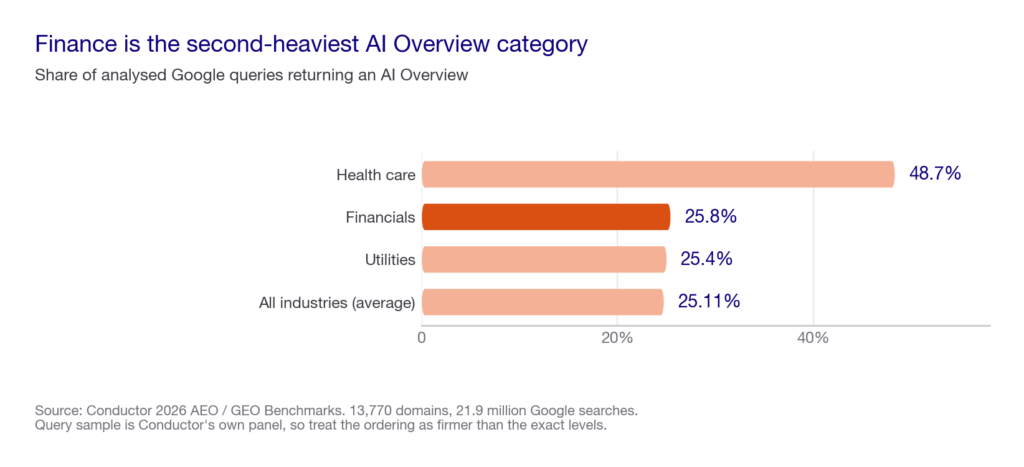
- AI Overviews appear on 25.8 percent of analysed queries in the financials industry, second only to healthcare (Conductor, 2026 benchmarks, 21.9 million searches).
- The large majority of AI citations point at earned media rather than brand-owned domains. For regulated finance, where independent corroboration carries extra weight, that gap is the whole game.
- Shortlist on regulated-sector proof, not fintech logos. Ask who signs off content before it ships.
- Most fintech GEO providers quote custom. Nobody on this list publishes rates.
- Be careful with the AI conversion statistics circulating in fintech pitches. The most-quoted figure comes from a sample of IT services firms, not financial companies. Details below.
A note on where this comes from. In addition, we run organic for more than 250 enterprises and track over 10 million prompts across every major engine. And the view below is shaped by that, by the client reviews we sit in every week. Also, by the conversations we have with buyers and operators at the events we run. As a result, this is our read on the category, not a neutral directory.
What is a fintech GEO agency?
A fintech GEO agency gets a regulated financial brand named and cited in AI answers, working inside the compliance process rather than around it. The GEO mechanics are shared with other categories. The constraints, YMYL scrutiny and legal sign-off, are what make it a different job.
Why fintech GEO is different
Four things change once money and regulation are involved, and each one changes what you should buy.
YMYL scrutiny is real and it is asymmetric. Financial content sits in the “your money or your life” category, where engines apply heavier weight to source credibility. The upside is that genuine authority compounds faster here than in unregulated categories. The downside is that thin content gets filtered out rather than simply ranking lower.
Accuracy carries liability, not just embarrassment. If an AI answer states a wrong APR, an outdated fee or a product availability that does not apply in a given market, the exposure is regulatory. So this is the argument for structured data and feed accuracy that most fintech teams underweight: you are not optimising, you are controlling what a machine is able to say about you.
Your compliance process is a publishing constraint. Content that needs legal sign-off ships slower. And a agency whose model depends on publishing velocity will either stall or route around your process. That means ask how they have handled sign-off elsewhere before you sign.
The answer is decided on sources you do not own. Independent studies consistently find the overwhelming majority of AI citations point at earned media rather than brand-owned domains. In finance that skews harder still, toward regulators, established outlets and comparison sites. In practice, our fintech compliance as a GEO advantage piece covers why the constraint is also the moat.
What the data actually says
Three figures matter, and it is worth being precise about all three, because fintech GEO pitches recycle them loosely.
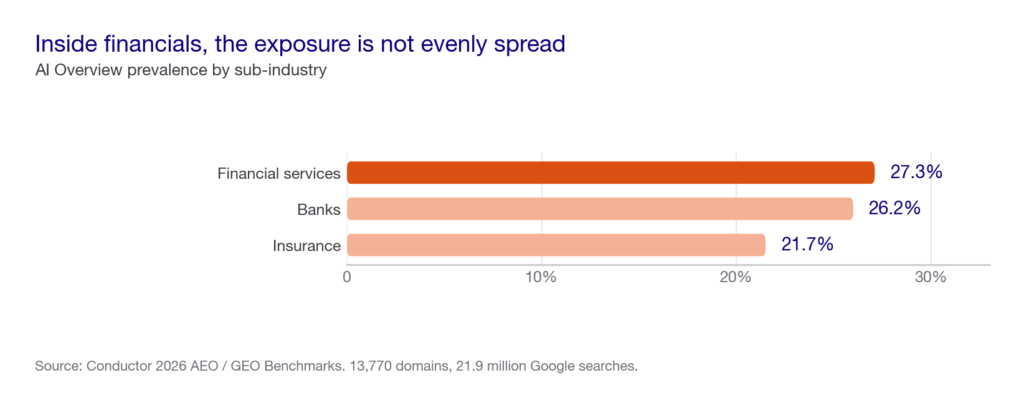
AI Overview prevalence. Conductor’s 2026 AEO/GEO benchmarks analysed 13,770 domains across 21.9 million Google searches. AI Overviews appeared on 25.8 percent of financials queries, against 25.11 percent across all industries and 48.7 percent in healthcare. Within financials, the split was financial services 27.3 percent, banks 26.2 percent and insurance 21.7 percent (Conductor, 2026).
Earned media dominance. Muck Rack’s May 2026 edition of What Is AI Reading, built on more than 25 million cited links across ChatGPT, Claude and Gemini, found earned media accounts for 84 percent of AI citations, with paid and advertorial content at 0.3 percent and journalism alone at 27 percent (Muck Rack, May 2026). Across three editions since July 2025 the earned share has held between 82 and 89 percent. So treat the direction as settled and the exact figure as edition-dependent.
AI traffic conversion, handled honestly. You will see “AI traffic converts at 14.2 percent against 2.8 percent for organic” in a lot of fintech decks. For that reason, that figure comes from vendor research by Opollo and RankScience. What is more, the Opollo sample was 312 IT and technology services firms, ranging from regional managed service providers to cybersecurity consultancies. And it is not fintech data. Cross-study consensus puts AI-referred conversion somewhere in the 4 to 5 times range against standard organic. Equally, adobe’s independent retail measurement found a 42 percent lift rather than a 5x one. And no credible fintech-specific measurement is public. Anyone quoting a precise fintech conversion multiple is extrapolating.
That last point is worth holding onto when you evaluate proposals. At the same time, a provider who cites a number without knowing whose data it is will do the same with yours.
See where you show up. Pepper’s GEO platform tracks Brand Visibility, Domain Prompt Presence and Share of Voice across ChatGPT, Perplexity, Gemini, Claude and Google AI Overviews. And a growth team works the account with you. Book a growth audit or see where you show up.
Our methodology: how we evaluated these agencies
Applied to publicly verifiable information: agency sites, published case studies and client reviews. Full weighting model in our GEO agency ranking methodology.
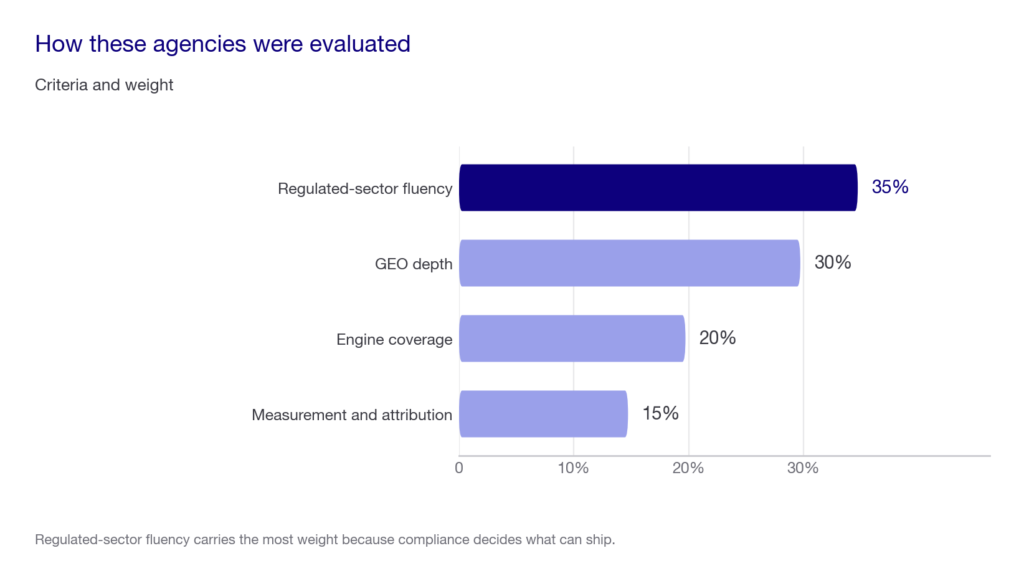
| Factor | Weight | What we looked for |
|---|---|---|
| Regulated-sector fluency | 35% | Evidence of working inside compliance review, not around it |
| GEO depth | 30% | Entity work, citation strategy, off-site authority |
| Engine coverage | 20% | Beyond ChatGPT, including AI Overviews where finance queries concentrate |
| Measurement and attribution | 15% | Citation-level tracking tied to something downstream |
What we excluded. SEO agencies offering GEO as a line item with no citation tracking. Providers with no regulated-industry experience.
What we could not verify. Pricing. Beyond that, every provider here quotes custom. And we have not estimated.
At a glance
| Provider | Best for | Regulated experience | Engines | Pricing |
|---|---|---|---|---|
| Pepper | Teams wanting the whole function run and owned | BFSI practice | ChatGPT, Perplexity, Gemini, Claude, AI Overviews | Custom, annual |
| Omnius | Technical GEO for fintech and SaaS | Fintech-exclusive focus | ChatGPT, Perplexity, Gemini, Claude | Not disclosed |
| First Page Sage | Enterprise and complex verticals | Strong, incl. financial | ChatGPT, Perplexity, Claude, Gemini | Not disclosed |
| Intero Digital | Multi-channel regulated programmes | Cybersecurity, healthcare, fintech | ChatGPT, Gemini, Perplexity, AI Overviews | Not disclosed |
| Minuttia | Established SaaS and fintech above 10M ARR | Moderate | ChatGPT, Perplexity, Gemini, AI Overviews | Not disclosed |
| Omniscient Digital | Content tied to pipeline | Moderate | ChatGPT, Perplexity, AI Overviews | Not disclosed |
| TripleDart | Full-funnel B2B fintech marketing | Moderate | ChatGPT, Gemini, Perplexity, AI Overviews | Not disclosed |
| AnswerManiac | Citation-focused AEO execution | Emerging | Multi-engine | Not disclosed |
The shortlist
1. Omnius
What they do. A specialised SEO and LLMO agency focused on B2B SaaS and fintech, operating from a European base, with emphasis on crawlability, entity work and citation tracking rather than content volume.
Best for. Technically mature fintech teams that already produce decent content and need the entity, schema and retrievability layer built properly.
Where they fall short. Technical emphasis means less editorial firepower. If your bottleneck is producing compliant content at all, this is the wrong starting point. European focus may matter for US-specific regulatory nuance.
2. First Page Sage
What they do. Describes itself as an SEO and GEO agency, selling both as named services. Its published client list is enterprise and mid-market and includes US Bank, which is the closest thing to financial-sector proof it makes public.
Best for. Enterprise financial brands with long sales cycles where accuracy outranks publishing cadence.
Where they fall short. It names no fintech or regulated-sector specialism on its own site, and publishes no engagement model or pricing. So compliance-workflow experience has to be established in a call rather than assumed.
3. Intero Digital
What they do. Formalises AI search work as a proprietary GRO framework, with notable depth in regulated industries including cybersecurity, healthcare and fintech, integrated across channels.
Best for. Mid-market and enterprise fintech wanting GEO integrated with paid, PR and the wider mix.
Where they fall short. Multi-channel breadth means organic is one priority among several. Public case studies often skew toward broader SEO wins rather than engine-specific citation gains.
4. Minuttia
What they do. SaaS and tech specific, built for companies past roughly 10 million in ARR, strategy-first with integrated content and AEO. Strong retention.
Best for. Established fintech wanting a senior strategic partner rather than an execution vendor.
Where they fall short. Boutique capacity limits scale. Less regulated-sector depth than the specialists above, so probe the compliance workflow specifically.
5. Omniscient Digital
What they do. B2B organic growth tying content to pipeline rather than traffic, with GEO built into core SEO.
Best for. Fintech teams that want organic measured against pipeline from the outset.
Where they fall short. Managed service only, no platform layer, so visibility depends on their reporting cadence. Generalist B2B rather than regulated-sector specialist.
6. TripleDart
What they do. B2B tech exclusive, running GEO through its proprietary Slate platform, with attention to how vendor shortlists form inside conversational AI.
Best for. Fintech companies wanting full-funnel marketing where GEO sits alongside paid and lifecycle.
Where they fall short. Full-funnel by design, so organic is diluted across priorities. In practice, compliance workflow experience is less evidenced than the regulated specialists.
7. AnswerManiac
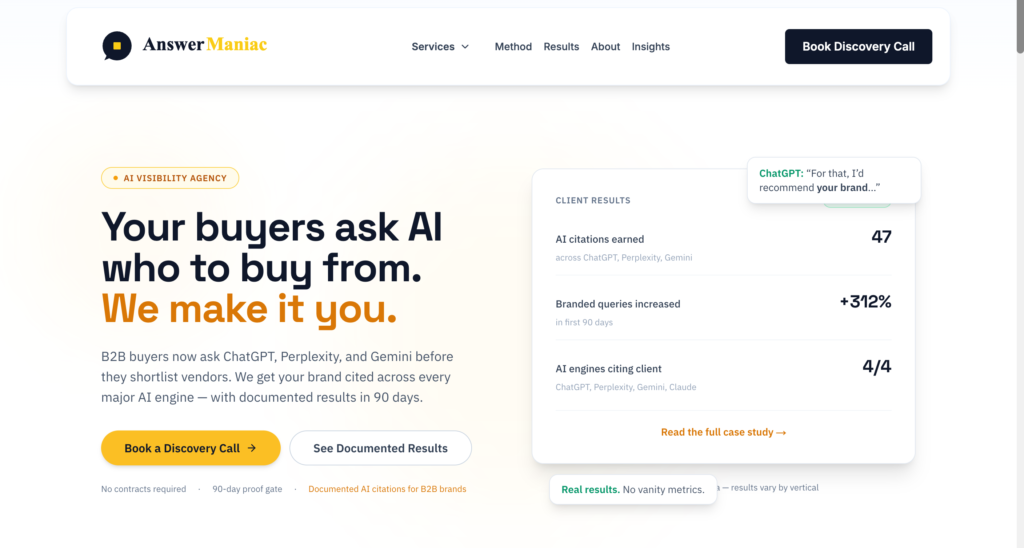
What they do. AEO execution with a citation-first orientation, focused on getting brands surfaced in AI answers.
Best for. Teams that have content handled and want focused citation work.
Where they fall short. Smaller and less established than others here, with a thinner public track record in regulated finance specifically. So ask for named references in your sub-sector.
8. Pepper
What it is. Pepper is an agentic organic growth engine: a senior growth team backed by always-on AI agents, running the whole organic function across search and AI. Atlas is the engine underneath. In practice, our BFSI practice covers banking, financial services and insurance.
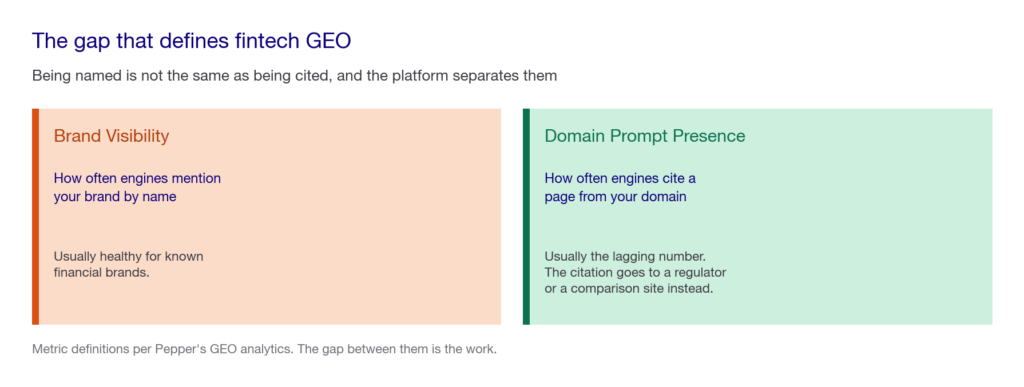
How the fintech work is structured. Around three levers: Visibility, Citability and Retrievability. In regulated finance the binding constraint is almost always citability: Brand Visibility is healthy while Domain Prompt Presence lags. Because the citation goes to a regulator, a comparison site or an established outlet. Closing that lives in PR and partnerships as much as in the CMS. In practice, you get the platform and a growth team on the account. Your team can log in, connect Search Console and GA4, manage the prompt set, read the analytics. In addition, build and run agents in the Agent Atlas. In practice, our growth team works the same account alongside you, so the work still happens when your week fills up. More than 10 million tracked prompts across every major engine sit behind the strategy. Eight years, 250 plus enterprises.
Where it falls short. Custom annual pricing on an outcome-pegged model. So it suits companies treating organic as core rather than teams wanting a cheap monthly tool. Organic only: if you want one partner across paid and lifecycle, this is the wrong shape. And if your compliance process is the real bottleneck, no external partner fixes that for you.
What fintech GEO costs
Nobody on this list publishes rates, which is normal for regulated-sector work where scope varies enormously with compliance overhead.
| Engagement type | Typical range | Notes |
|---|---|---|
| Tracking platform only | 800 to 1,500 USD per month | You act on the findings |
| Boutique or specialist GEO | 3,000 to 8,000 USD per month | Common for mid-market fintech |
| Regulated enterprise programme | Custom, usually annual | Compliance review adds real cost |
Why regulated work costs more. Legal sign-off cycles, jurisdiction-specific content variants, and the slower cadence that comes with both. Also, a provider quoting regulated work at unregulated rates has either not done it before or is planning to route around your review process. Neither is good.
How to choose a fintech GEO partner
Fintech narrows the field fast, because most of the shortlist cannot work inside a compliance process. Consequently, that is the filter we would apply first, before anything about engines or dashboards.
In May 2026 Google published its first official guidance on optimising for its AI features and filed it under SEO fundamentals. In practice, its position: AEO and GEO are part of SEO for Google, AI Overviews and AI Mode run on the core Search ranking systems. And there is no separate AI index. It also mythbusts several things GEO vendors sell hard, including llms.txt, content chunking and AI-specific rewrites. So for regulated finance we would add one thing to that: Google’s emphasis on genuinely useful, non-commodity content is not just quality advice here. Financial content sits under YMYL scrutiny. As a result, thin content is filtered rather than merely outranked, and the cost of a factual error is regulatory rather than editorial.
The scorecard we would use
Score each shortlisted partner out of 100 using the weights below, before the pricing conversation rather than after it. What is more, a partner who scores well on measurement and badly on execution is a research vendor, whatever the deck says.
| Area | Weight | What a strong partner demonstrates |
|---|---|---|
| Regulated-sector fluency | 25% | Has shipped inside a legal review cycle, not around it, and can describe the workflow |
| AI visibility measurement | 20% | Brand mentions, cited URLs, competitors and share of voice across a real prompt set |
| Off-site authority | 20% | A route into the regulators, comparison sites and established outlets that finance answers lean on |
| Content and technical execution | 15% | Can change architecture, entity clarity, schema and structure, not just recommend it |
| Multi-engine capability | 10% | Covers AI Overviews, where financial queries concentrate, alongside the rest |
| Business attribution | 10% | Connects visibility to qualified demand rather than stopping at citations |
Compliance fluency outranks measurement here, which is unusual. And it is also the thing we see go wrong most often: a capable GEO team that cannot get anything approved produces nothing at all.
Ask them to prove it before you sign
Hand each shortlisted partner 20 to 30 real commercial questions from your category. Not branded. Things like “best business bank account for startups”, “alternatives to [competitor]”, “is [product type] regulated in [market]”.
Then ask for five answers:
- Where do we appear across these prompts?
- Which competitors or third parties appear instead?
- Which sources are influencing those answers?
- Why are those sources winning?
- What would you change in the first 90 days, and what would need legal sign-off?
That fifth clause is the fintech-specific one, and it is revealing. Equally, a partner who has genuinely worked in regulated categories will answer it without prompting, because sign-off is the constraint that shapes their plan. One who has not will treat it as an obstacle you have introduced.
Expect them to acknowledge that answers vary between runs and between engines. Research across generative engines finds low overlap in cited sources, so a single screenshot is not evidence.
The distinction that decides it: weak playbook against strong
The weaker playbook in this category runs: find prompts, rewrite blogs, add FAQs, add statistics, hope the engines cite you. And it is cheap to sell and it plateaus in about a quarter.
The stronger model, and the one we run, sequences it: demand intelligence, then technical discoverability, then entity and brand authority, then content, then earned-media authority, then distribution, then visibility measurement, then revenue attribution.
That difference matters because generative engines synthesise an answer from several sources rather than ranking one page. Being retrieved, being cited, and actually influencing the answer are three different things worth measuring separately.
Red flags
- “We guarantee citations.” Nobody controls the output, and in a regulated category an overpromise is a governance problem as well as a commercial one.
- A precise fintech conversion multiple. As covered above, the most-quoted figure comes from IT services research. Anyone quoting it as fintech data has not checked their own numbers.
- No named compliance workflow. Ask who reviews, at what stage, and what happens when legal rejects a piece.
- Volume-based content plans. Under YMYL scrutiny this actively harms you.
- Branded prompts only, or ChatGPT only. Financial queries concentrate in AI Overviews. A single-engine plan misses where your category actually lives.
- Citation counts with no competitor share of voice.
The five questions we would spend the meeting on
- Walk me through a piece of content from brief to publication in a regulated client. Listen for the review gates.
- Take one query where a regulator or comparison site outranks us and explain why.
- What would you change that does not need legal approval? A good partner has a real answer here, because it is where the first 60 days go.
- How do you handle jurisdictional variation? A product available in one market and not another is a factual accuracy problem an engine will get wrong unless someone owns it.
- What are you accountable for if the number does not move?
Reduced to one principle: in fintech, hire for the ability to ship accurate work through your review process, then for GEO skill. The reverse order produces a good strategy nobody can publish.
One honest closing note. Very few firms are equally strong across measurement, execution, earned authority and attribution, ours included. The good ones will tell you which is their weakest without being asked. If a partner claims to be excellent at all four, you have learned something about how they answer questions.
What nobody should promise you
A guaranteed position in an AI answer, and any precise fintech conversion multiple. As covered above, the numbers circulating come from other industries. So ask where a figure is from before you let it into your business case. In practice, our note on AI visibility scores covers why a one-shot score is a coin flip.
Frequently asked questions
What does a fintech GEO agency actually do?
It builds third-party citations in the sources AI engines trust for finance, makes your pages accurate and retrievable. At the same time, tracks which URLs get cited for which buyer prompts. Compliance-aware content production runs through all of it.
How is fintech GEO different from regular GEO?
Financial content faces heavier source-credibility filtering, factual errors carry regulatory exposure rather than just embarrassment, and content moves through legal review. The authority work is similar; the constraints around it are not.
How much do fintech GEO agencies charge?
None publish rates. Specialist engagements commonly run 3,000 to 8,000 US dollars a month, with regulated enterprise programmes priced custom and higher. Because compliance review adds genuine cost.
Do AI engines treat financial content differently?
Yes. Finance falls under YMYL, where engines weight source credibility more heavily. Conductor found AI Overviews on 25.8 percent of financials queries, second only to healthcare, so the surface area is large.
Can a regular SEO agency handle fintech GEO?
Some can, though many simply relabel existing SEO work. The distinguishing capabilities are entity optimisation, off-site citation building, and a workable relationship with your compliance and legal review process.
How long until fintech GEO shows results?
Structural fixes can move within four to eight weeks. Earned authority in financial sources compounds over three to six months and often longer, because the publications that matter have their own editorial standards.
Does AI-referred traffic convert better for fintech?
Probably, but no credible fintech-specific measurement is public. The widely quoted 14.2 percent figure comes from a sample of IT services firms. That means treat the direction as reliable and any precise multiple as unproven.
What should we fix before hiring anyone?
Accuracy of product facts across your site, structured data on key pages, crawler access for AI user agents. And a written set of the 50 to 100 prompts your buyers actually ask. So those cost engineering time, not licence fees.
You may not be ready for a partner yet
The answer that costs us the sale. If your compliance process cannot currently get a blog post approved inside a month, you do not need a GEO partner yet. Beyond that, no partner fixes that for you, and paying one to wait is expensive. For that reason, fix the review workflow first, or start with the work that needs no sign-off: schema, entity clarity, crawler access and product-fact accuracy. Then bring a partner in.
Where to go next
The useful first step is a baseline: which prompts your buyers ask, which sources get cited when they ask them. And whether the citations landing in your category point at you, a competitor, or a regulator.
For most fintech brands the answer is a regulator or a comparison site. So that tells you the work is off your domain, and it tells you what to buy.
Related reading: GEO for fintech, AI search for financial services and GEO agencies for insurance.
See where you show up · Book a growth audit
Sources and further reading
- Conductor, “Financials Industry: 2026 AEO / GEO Benchmarks.” 13,770 domains, 21.9 million searches. Link
- Muck Rack, “What Is AI Reading?”, May 2026 edition. 25 million-plus cited links: earned media 84 percent, paid and advertorial 0.3 percent, journalism 27 percent. Link
- Removed in the 2026 sourcing pass: the University of Toronto earned-media experiment and the Opollo and RankScience conversion studies, none of which has a 2026 edition. The conversion claim is described in the text with its sampling limits rather than quoted as fintech data.
- Opollo and RankScience conversion studies, noted above with their sampling limits.
- Agency sites and case studies, checked 11 August 2026.
Latest Blogs
The research pulls in two directions. Fan-out rewards covering many adjacent questions; absorption research finds longer pages get used. The resolution is that the passage competes, not the page.
Seven documented changes, not seven predictions. Google switched two rich results off, shipped two new AI reports, and added a channel to Analytics. Here is what actually moved and what it means.
Content chunking is the process of splitting a page into smaller pieces so a machine can retrieve one of them. Here is the part most articles get wrong: chunking is something engines do to your page, not something you do to it. You do not choose the chunk size.
Get your hands on the latest news!

Similar Posts
Affiliate Marketing
3 mins read
Anchor Text Semantics: Why Your Link Words Matter More Than You Think
Affiliate Marketing
3 mins read
Crawlability for AI: Can Robots Actually See Your Website?
Affiliate Marketing
3 mins read