Best GEO agencies for developer tools in 2026

The short answer
Developers were the first audience to stop reading marketing content, and the first to start asking a model instead. For a devtools company that changes what a content partner has to be good at: your documentation is now the asset. In addition, technical accuracy is the ranking factor.
Key takeaways
- Your docs, tutorials and reference pages are what models retrieve. Your blog is a distant second, and your landing pages barely register.
- Accuracy is binary here. A deprecated API call or an outdated code sample does more damage than publishing nothing, because it burns credibility with the reader and the model at once.
- Shortlist on who writes it. A partner without engineers on the byline will produce content your buyers can smell, and so will the models trained on what those buyers wrote about it.
- Two firms publish pricing: Draft.dev from $9,000 a month, and GrowthX at $6,000. Everyone else quotes custom.
- We have a real developer-tools client and we name it below, along with what it did and did not prove.
A note on where this comes from. We run organic for more than 250 enterprises at Pepper and track over 10 million prompts across every major engine. In addition, this is shaped by that, by weekly client reviews, and by conversations with devtools marketers at the events we run. So it is our read, not a directory. Where we think the category oversells, we say so.
What is a developer tools GEO agency?
A developer tools GEO agency gets your product named and cited when an engineer asks a model which library, database or platform to use. The work looks different from generic B2B GEO in one specific way: the content that earns the citation is usually technical documentation rather than marketing content. As a result, the partner has to be able to produce and structure that credibly.
That sounds like a small distinction. In practice it decides which agencies can do this at all. Because most B2B content teams cannot write a working code sample and will not admit it until month three.
Why developer tools is a different problem
Three things change, and each one changes what you should buy.
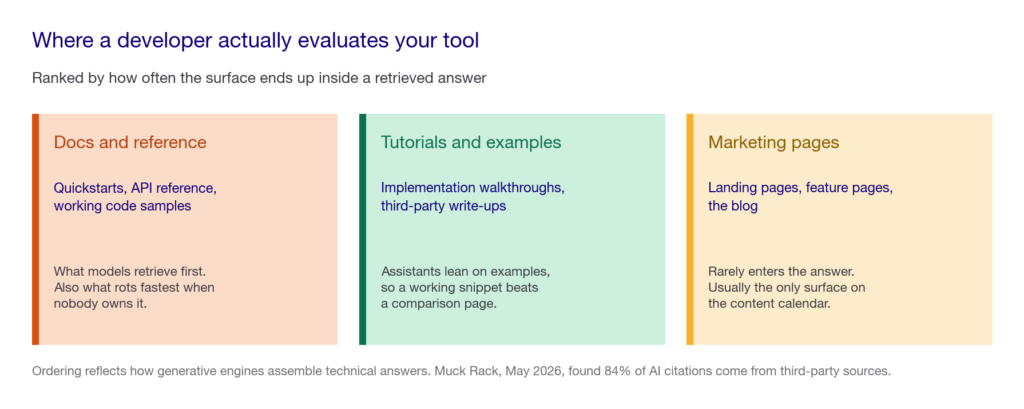
Documentation is the asset, not the blog. When an engineer asks a model how to implement something, the retrieved answer is assembled from reference docs, tutorials and code examples. Marketing pages rarely make it in. So a partner whose entire plan is a content calendar of blog posts is optimising the surface your buyers use least. Our guide on how to structure content for AI citation covers the shape that gets lifted.
Accuracy is binary and unforgiving. In most categories, slightly out-of-date content is a minor cost. In devtools, a deprecated API call or a code sample that no longer runs actively destroys trust. In addition, it does so twice: once with the developer who tries it, and again with the model that learned from it. Freshness is not a ranking nicety here, it is a correctness requirement.
Coding agents are a new surface. Engineers increasingly evaluate tools inside the assistants they already code in. Those assistants lean on examples. As a result, a well-structured tutorial with a working snippet does more for you than a comparison page ever will. This surface barely existed two years ago and most agency proposals still do not mention it.
See where you show up. Pepper’s GEO platform tracks Brand Visibility, Domain Prompt Presence and Share of Voice across ChatGPT, Perplexity, Gemini, Claude and Google AI Overviews. In addition, a growth team works the account with you. Book a growth audit or see where you show up.
Where the answer actually gets decided
Muck Rack’s May 2026 study of more than 25 million cited links across ChatGPT, Claude and Gemini found earned media accounts for 84 percent of AI citations, with paid and advertorial at 0.3 percent (Muck Rack, May 2026).
For devtools, “earned” means something specific. It is not press coverage. It is your presence in the places engineers actually congregate. That is what getting cited in LLMs actually depends on: community forums, developer publishing platforms, newsletters, and the technical write-ups other people publish about your product.
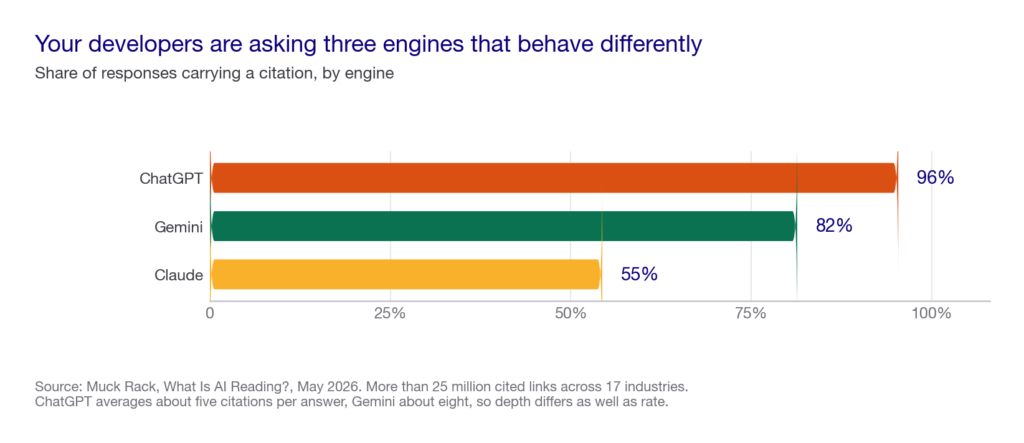
The same study found the engines cite at very different rates and depths. ChatGPT carries a citation in 96 percent of responses but averages about five citations per answer. Gemini cites in 82 percent of responses and averages around eight. Claude cites in just 55 percent.
That spread matters more for devtools than most categories. Because your buyer is likely using several assistants in a week and will notice if you are absent from one.
What we have actually shipped
Most vertical roundups imply proof they do not have, so here is ours, stated exactly.
Algolia is a developer tools company and it is our clearest evidence in this category. Algolia sells AI search and agentic retrieval to engineers. In addition, the brief was hard in the way devtools briefs usually are: explain cutting-edge retrieval capability to a deeply technical and sceptical audience, while the company evolved its story from AI search to a broader retrieval platform.
What we did is the part worth copying rather than the metric. We deployed category-matched writers fluent in ranking, retrieval and search architecture, then paired them with Algolia’s own subject matter experts. That pairing is the whole trick: it lets you produce genuinely expert content without consuming the engineering time you cannot spare. We ran the pipeline end to end, sourcing writers, interviewing SMEs, structuring, drafting, editing and quality control. In addition, kept AI as an assistive layer rather than the author.
Scroll depth on most pieces landed between 65 and 87 percent. That for long technical assets is the number that matters more than sessions. Tariq Z. Khan, Algolia’s Director of Content Marketing, described the value as acting like a thought partner rather than a writing supplier, bringing an audience lens into the process.
What Algolia does not prove: it is a content-depth engagement, not a citation-tracking one. For that, the honest reference is SalesHood, which is B2B SaaS rather than devtools. There we ran GEO work in Atlas across ChatGPT, Gemini and Claude alongside SEO and technical fixes. Blog impressions went from 200,000 to 417,000, AI Overview visibility from 14 keywords to 97. In addition, rich results grew 291 percent in five months while clicks rose 20 percent against an industry-wide decline.
Two different clients, two halves of the same argument. We will not pretend one is the other.
How we evaluated these agencies
Applied to what each firm publishes on its own site, checked on 19 August 2026, rather than to another roundup.
| Factor | Weight | What we looked for |
|---|---|---|
| Technical credibility | 35% | Who actually writes it, and whether engineers review it before it ships |
| GEO depth | 30% | Entity work, citation strategy and off-site presence, not a renamed SEO deck |
| Documentation and reference capability | 20% | Can they work on docs and tutorials, or only blog posts |
| Measurement | 15% | Citation-level tracking per engine that reaches something downstream |
What we could not verify. Pricing, for most of this list. Draft.dev and GrowthX publish rates. The rest quote custom, and we have said so rather than estimating.
The shortlist at a glance
| Agency | Developer positioning | Who writes | Engines named publicly | Pricing |
|---|---|---|---|---|
| Draft.dev | Devtools and platforms only | 300+ vetted engineer-writers | Not specified | From $9,000/mo, 3-month minimum |
| Omnius | B2B SaaS and fintech, technical GEO | Boutique team | ChatGPT, Perplexity, Gemini, Claude | Not published |
| TripleDart | B2B tech, incl. dev tools | Agency team | ChatGPT, Gemini, Perplexity, AI Overviews | Not published |
| Animalz | B2B SaaS, editorial-led | Editorial team | Multi-engine | Not published |
| Omniscient Digital | B2B software, pipeline-focused | Agency team | ChatGPT, Perplexity, AI Overviews | Not published |
| Minuttia | SaaS and tech above $10M ARR | Boutique, strategy-first | ChatGPT, Perplexity, Gemini, AI Overviews | Not published |
| First Page Sage | No vertical named on its own site | Agency team | Not specified | Not published |
| GrowthX | Generalist B2B, platform model | Platform plus your team | Google, ChatGPT, Claude, Perplexity | $6,000/mo, published |
| Pepper | Technical B2B, Algolia in devtools | Category-matched writers with your SMEs | ChatGPT, Perplexity, Gemini, Claude, AI Overviews | Custom, annual |
The shortlist
Draft.dev
Draft.dev is the only firm here built exclusively for developer tools and platforms. In addition, it shows in the model: a network of more than 300 vetted engineer-writers, with work reviewed by subject matter experts and professional technical editors. Published clients include Docker, Cloudflare, Supabase, JetBrains and Auth0. It uses AI to speed research and first drafts, with review by real developers before anything ships. In addition, it publishes an AEO and GEO guide for devtools, so the AI search question is not an afterthought.
It also publishes pricing, which almost nobody in this category does: from $9,000 a month with a three-month minimum.
Where it gets thin: the output is content. In addition, the site does not name which AI engines it tracks or how citation measurement works. If you need per-engine visibility reporting rather than a content engine, that is a separate purchase.
Omnius
Omnius is a boutique focused on B2B SaaS and fintech, built around technical GEO and LLMO, with its own tracker called Atomic. The emphasis is crawlability, entity clarity and citation tracking rather than volume. That is a good match for a devtools team that already produces solid technical content and needs the retrievability layer built properly.
The mismatch is editorial firepower. If your problem is that nobody internally can write the tutorial, a technical GEO specialist will not solve it. Devtools is also not a named vertical for them, so you are buying technical competence rather than category fluency.
TripleDart
TripleDart works exclusively with B2B tech and names dev tools among its focus areas alongside fintech, HR tech and security. It runs GEO through Slate, its own platform, covering content structuring, schema and prompt testing across buying scenarios.
The trade is that TripleDart sells full-funnel B2B marketing, so organic is one priority among several. It publishes no pricing.
Animalz
Animalz describes itself as a content marketing and SEO agency for leading B2B SaaS brands, sells Answer Engine Optimization as a named service. In addition, has a content refresh tool called Revive. Published clients include Airtable, Amplitude and Intercom. The editorial standard is the highest on this list.
For devtools specifically, the question is whether editorial quality is your gap. If your docs are the weak point, or your tutorials no longer run, an editorial agency is solving a different problem at a premium price.
Omniscient Digital
Founded in 2019 and based in Austin, Omniscient originated the Barbell Content Strategy, pairing high-intent conversion content with long-form thought leadership. In addition, ties content to pipeline rather than traffic. That pipeline orientation suits devtools, where signups are a poor proxy for revenue.
It is a managed service with no platform layer. As a result, visibility into the work depends on their reporting rather than a system you can query, and it is a generalist across B2B software rather than a devtools specialist.
Minuttia
Minuttia is SaaS and tech specific, built for companies past roughly $10 million in ARR, working strategy-first with integrated content and AEO. Good fit for an established devtools company that wants a senior partner rather than an execution vendor.
Boutique capacity limits how fast it scales, and the ARR threshold rules out earlier-stage teams.
First Page Sage
First Page Sage describes itself as an SEO and GEO agency, selling both as named services. Its published client list is enterprise and mid-market, including Salesforce, Verizon and US Bank.
It publishes no engagement model, no volume expectation and no pricing, names no vertical specialism. In addition, does not say which AI engines it covers. For a devtools buyer that is a lot to establish in a call.
GrowthX
GrowthX now sells GrowthOS, a subscription platform rather than a content service, built around treating your own site as the source AI answers draw on. It covers visibility planning, tracking and citation monitoring across Google, ChatGPT, Claude and Perplexity. In addition, publishes pricing at $6,000 a month.
The limitation for devtools is the premise. Your own site matters, but a meaningful share of what a model says about your library was learned from other people’s write-ups. It is also a platform, so someone internally still has to drive it.
Pepper
We are on this list and we published it, so read this with that in mind.
Pepper is an agentic organic growth engine. Atlas is the platform underneath. In addition, it works two ways: your team can log in, connect Search Console and GA4, define competitors and personas, manage the prompt set and build and run your own agents in the Agent Atlas, while a Pepper growth team works the same account alongside you. For a devtools team where the bottleneck is usually engineering time rather than intent, that combination is the point.
Our full case study library is public. Our devtools evidence is Algolia, described above: category-matched writers paired with client SMEs to produce expert technical content without consuming engineering capacity. We work the three levers of Visibility, Citability and Retrievability and report Brand Visibility, Domain Prompt Presence and Share of Voice across ChatGPT, Perplexity, Gemini, Claude and Google AI Overviews.
Eight years, 250 plus enterprises, more than 10 million tracked prompts.
Where we are not the answer: we sell organic only. As a result, if you want one partner across paid and lifecycle, this is the wrong shape. Engagements are annual and outcome-pegged. That suits a team treating organic as a long-term function and suits nobody running a one-quarter test. And our devtools proof is a content-depth engagement rather than a published citation-tracking result in this vertical. That is a real gap and we would rather say it than blur it.
What this costs
Two firms publish rates here, which is unusually transparent for the category.
| Shape of engagement | Typical range | What it usually buys |
|---|---|---|
| Tracking platform only | $99 to $1,500 a month | You read the data and act yourself |
| Platform with published pricing | $6,000 a month, per GrowthX | A system to run, internal capacity assumed |
| Devtools content engine | From $9,000 a month, per Draft.dev | Engineer-written content at volume, 3-month minimum |
| Organic run as a function | Custom, usually annual | Strategy, execution and accountability for the number |
Technical content costs more than general B2B content for an unavoidable reason: the people who can write it credibly are engineers. In addition, engineers are expensive. A quote well below these ranges usually means the writing is being done by someone who has not used your product.
How to choose a developer tools GEO partner
Most devtools shortlists get decided on portfolio quality, which is the wrong test. A beautiful tutorial for someone else’s product tells you the agency can write. It does not tell you whether they can write about yours without a week of your senior engineer’s time.
Start with the context that reframes it. In May 2026 Google published its first official guidance on optimising for AI features and filed it under SEO fundamentals: AEO and GEO are part of SEO, AI Overviews and AI Mode run on core Search ranking systems. In addition, there is no separate AI index. It also names llms.txt, content chunking and AI-specific rewrites as things to stop doing.
Correct, for Google. And Google is one engine, and your developers are asking three. Fundamentals are the floor, and the engines diverge above it.
The scorecard I would use
Score each partner out of 100 before the pricing conversation.
| Area | Weight | What a strong partner should demonstrate |
|---|---|---|
| Who writes it | 25% | Named engineer-writers or a credible SME pairing model, with a real answer on how technical review works before publication |
| Documentation capability | 20% | Will work on docs, tutorials and reference pages, not only the blog, and can say how they keep code samples current |
| AI visibility measurement | 20% | Shows cited URLs, competitors and share of voice per engine rather than one blended number |
| Off-site presence | 15% | Has a route into the communities and publications developers actually read, and can name them for your category |
| Technical execution | 10% | Will change entity clarity, schema, structure and crawler access themselves |
| Engineering time required | 10% | Can state honestly how many SME hours a month the model needs, because every model needs some |
That last row is the one devtools teams forget to ask about, and it is the reason most engagements stall.
Make them prove it on your product
Give each shortlisted partner 20 to 30 real questions your users ask. Not your brand name. Things like “best vector database for a small team”, “how do I handle rate limiting with this kind of API”, “alternatives to the tool we currently use” and “which framework should I pick for this use case”.
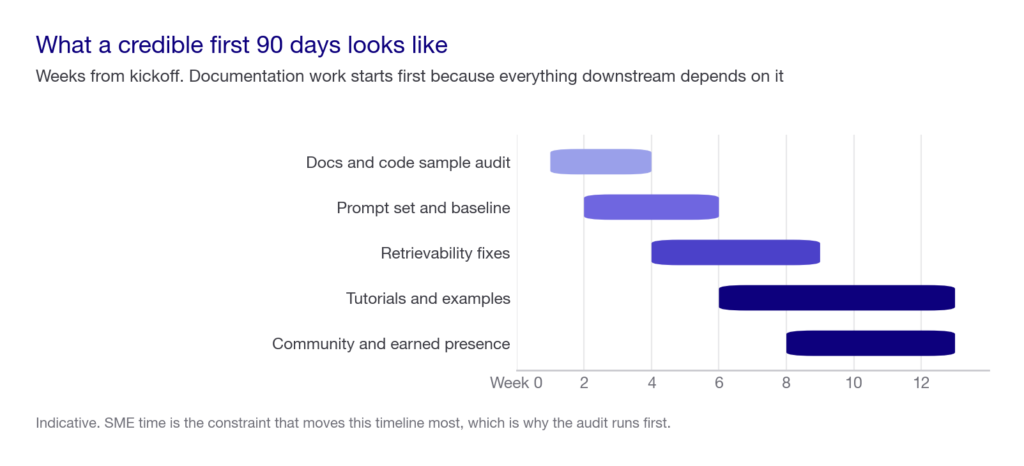
Then ask for five answers: where do we appear across those prompts. That competitors appear instead, which sources are influencing those answers, why are those sources winning, and what would you change in the first 90 days.
Then add one devtools-specific test. Ask them to review a page of your existing documentation and tell you what is wrong with it. A partner who can do that has engineers. A partner who returns generic structural feedback does not.
Run the prompt set twice on different days. Engines are probabilistic, so one run on one engine establishes nothing.
The weak playbook against the strong one
The weaker sequence, still sold widely: pick keywords, commission blog posts, add an FAQ block, hope for a citation. In devtools it plateaus faster than anywhere. Because the surfaces that decide the answer are docs and community write-ups, and neither is on the content calendar.
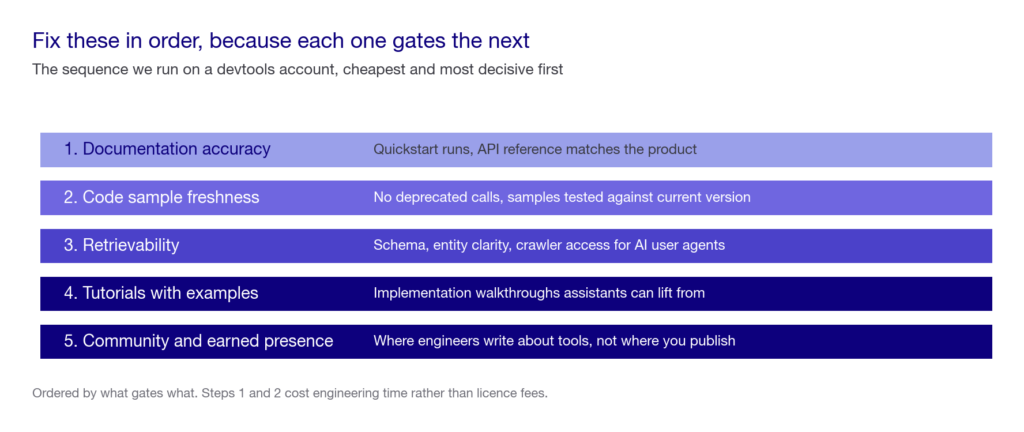
The stronger sequence, and the one we run: demand intelligence. Then technical discoverability, then documentation and reference quality, then tutorials with working examples, then community and earned presence, then measurement, then attribution.
The difference matters because generative engines assemble an answer from several sources. Being retrieved, being cited and actually influencing the answer are three different things. In addition, in devtools they often happen on three different surfaces.
Red flags
- “We guarantee citations.” Nobody controls a generative engine’s output, and Google gives the same warning about guaranteed rankings.
- No engineers anywhere in the process. Ask who writes and who reviews. If both answers are “our content team”, your developers will notice before the model does.
- A content calendar with no documentation work. That is optimising the surface your buyers use least.
- No answer on code sample maintenance. Tutorials rot. A partner without a refresh mechanism is building you a liability.
- “You need llms.txt.” Google’s 2026 guidance says otherwise for its AI features.
- One engine. Your developers use several in a week.
- Citation counts with no competitor share of voice. Your number rising while a competitor rises faster is a loss reported as a win.
The five questions I would spend the meeting on
- “Who writes it, and who reviews it technically?” Names and process, not a capability slide. This one question eliminates most of the field.
- “Review a page of our docs and tell me what is wrong.” The fastest competence test available, and it costs them an hour.
- “How many hours a month of our engineers’ time does your model need?” Every model needs some. A partner claiming zero has either not done this or is planning to publish without review.
- “Take one query where a competitor is cited and explain why.” Separates people who understand retrieval from people reselling a dashboard.
- “Which part of your methodology do you expect to be obsolete in a year?” A thoughtful answer beats a confident one.
Reduced to one principle: hire the partner who can be wrong in front of your engineers and recover. Technical credibility is not a tone, it is a willingness to be corrected in public.
One honest closing note. Very few firms are equally strong across technical writing, documentation, earned presence and measurement, ours included. The good ones will tell you which is their weakest without being asked.
What nobody should promise you
A guaranteed citation or position in an AI answer. Nobody controls the output, and Google says the same about guaranteed rankings.
A single composite AI visibility score presented as a ranking. Ask a model the same question repeatedly and the answers move. Brand Visibility, Domain Prompt Presence and Share of Voice across a fixed prompt set over time are real numbers. One screenshot is not.
Zero engineering involvement. Any partner promising expert technical content with no SME time is either publishing unreviewed work or has not started yet.
You may not need an agency yet
The answer that costs us the sale. If your documentation is out of date, your quickstart no longer runs, or your API reference has drifted from the product, you do not need a GEO agency yet. Fix the docs first. That work costs engineering time rather than a retainer. In addition, it is the single highest-return thing a devtools company can do for AI visibility, because docs are what models retrieve. Commissioning blog posts on top of broken documentation is paying to amplify a problem.
Frequently asked questions
What does a developer tools GEO agency do?
It gets your product cited when engineers ask a model which tool to use. The work spans documentation and tutorial quality, entity and schema clarity, presence in developer communities. In addition, citation tracking across engines rather than blog production alone.
Why is GEO different for developer tools?
Because the retrieved content is usually documentation rather than marketing pages, and technical accuracy is binary. A deprecated code sample damages credibility with the developer and the model at once. That is not true in most other categories.
How much do developer tools content agencies charge?
Draft.dev publishes rates from $9,000 a month with a three-month minimum, and GrowthX publishes $6,000 monthly. Most others quote custom. Technical content costs more because credible writers are engineers.
Should our docs or our blog be the priority?
Docs, almost always. When an engineer asks a model how to implement something, reference pages, tutorials and code examples are what get retrieved. Marketing pages rarely enter the answer at all.
How much engineering time will this take?
Every credible model needs some subject matter expert input. The useful question is how a partner minimises it, usually by pairing technical writers with your engineers rather than interviewing them repeatedly for every piece.
Can a general B2B agency handle developer tools?
Some can, if they have engineer-writers or a working SME pairing model. Without one, the output reads as marketing to your buyers, and developers are unusually quick to detect and dismiss it.
Which AI engines matter for developer audiences?
Track them separately. Muck Rack found ChatGPT carries a citation in 96 percent of responses averaging five sources, Gemini 82 percent averaging eight. In addition, claude 55 percent, so coverage differs sharply by engine.
What should we fix before hiring anyone?
Documentation accuracy, working code samples, structured data on reference pages, crawler access for AI user agents. In addition, a written list of the 50 to 100 questions your users actually ask. All internal time rather than licence fees.
Where to go next
Ask a model fifteen questions your users would genuinely ask, and read the citations. If the sources being cited are other people’s tutorials and community threads rather than your own docs, you have a documentation and presence problem rather than a content-volume problem.
That is worth knowing before you sign anything, and it costs an afternoon.
Book a growth audit · See where you show up
Sources and further reading
- Muck Rack. “What Is AI Reading?” May 2026 edition. More than 25 million cited links across ChatGPT, Claude and Gemini, 17 industries. Link
- Google Search Central. First official AI search optimisation guidance, published 15 May 2026, filed under SEO fundamentals.
- Pepper. Algolia case study and SalesHood case study. Metrics as published on each page.
- Agency claims taken from each firm’s own website, checked 19 August 2026, including Draft.dev’s published pricing and engineer-writer network.
Latest Blogs
The research pulls in two directions. Fan-out rewards covering many adjacent questions; absorption research finds longer pages get used. The resolution is that the passage competes, not the page.
Seven documented changes, not seven predictions. Google switched two rich results off, shipped two new AI reports, and added a channel to Analytics. Here is what actually moved and what it means.
Content chunking is the process of splitting a page into smaller pieces so a machine can retrieve one of them. Here is the part most articles get wrong: chunking is something engines do to your page, not something you do to it. You do not choose the chunk size.
Get your hands on the latest news!