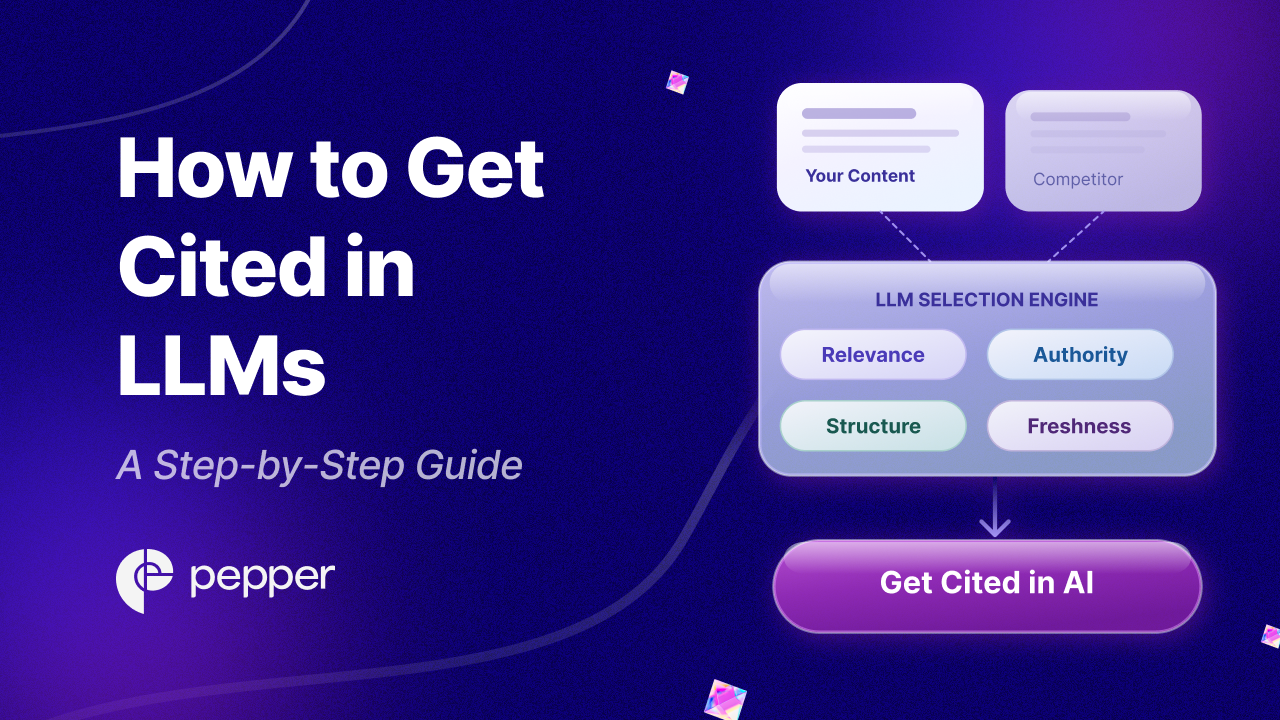
How to Get Cited in LLMs: A Step-by-Step Guide
By Anirudh Singla | Pepper Inc. | April 2026
| ⚡ TL;DR — Key Takeaways → 94% of B2B buyers now use LLMs during the buying journey – your brand either appears in the answer or it doesn’t. → Getting cited isn’t luck. It’s a function of entity clarity, content structure, schema markup, and platform presence. → The full workflow has 6 steps: entity mapping → content structuring → schema → citations platforms → publishing cadence → measurement. → Pepper’s Visibility → Citability → Retrievability framework is the operating model behind everything in this guide. |
The Answer Either Has Your Name in It – Or It Doesn’t
Your buyer opens ChatGPT and types: ‘What’s the best content marketing platform for enterprise?’ Ten seconds later, they have a confident, sourced answer. Your name is either in it, or it isn’t.
That’s not a future scenario. It’s happening right now, before your buyer visits your website,before they fill out a form, before they speak to anyone on your sales team.
58%. That’s how much click-through rates drop for the #1 Google ranking when an AIOverview appears above it (Ahrefs, February 2026). Meanwhile, 94% of B2B buyers reported using generative AI in their 2025 purchasing process (6sense/Forrester). The first
moment of buyer intent has moved inside the LLM and most brands haven’t followed it.
The gap between brands winning AI answers and brands missing them isn’t budget; it’s structure. This guide walks you through the exact workflow to close that gap.
| Definition: LLM Citability LLM citability is the degree to which an AI language model will retrieve, quote, and attribute your content when generating an answer to a relevant user query. It is determined by three factors: whether LLMs know you exist (Visibility), whether your content is structured for extraction (Citability), and whether your pages are technically findable by AI crawlers (Retrievability). – Pepper Inc., 2026 |
Step 1: Entity Mapping – Make LLMs Know You Exist
LLMs don’t think in keywords. They think in entities. An entity is any unique, identifiable thing, a brand, a person, a concept, a product. Before an AI can cite you, it needs to know what you are.
As Kishan Panpalia, GEO Lead at Pepper, put it at Index ’26: “AI thinks in entities, not keywords. In SEO, the fundamental unit was a keyword. In AI search, the fundamental unit is an entity. LLMs build knowledge graphs, they ask: What is this thing? What category does it belong to? What relationships connect it to other entities?”
The 4 steps to entity mapping are:
- Designate your Entity Home, your About or Company page, as the authoritative source of record for your brand. Every fact an LLM might surface about you should be verifiable here.
- Create or claim a Wikidata item with a QID. Add properties: instance of (company), official website, founded (date), and country. The sameAs property is your identity glue, link it to LinkedIn, Crunchbase, GitHub, YouTube, and X.
- Ensure your Wikipedia entry exists if you qualify. If you don’t yet, build it via Wikidata first. LLMs treat Wikipedia as the single highest-trust source, it accounts for 11.22% of all citations across ChatGPT, Gemini, Claude, and Perplexity (Goodie, 2025).
- Run every piece of content through an entity checker before publishing. One core fact per section, explicitly stated. If you have two important facts to tell, put them in two different sections.
| “AI doesn’t care how flowery your content is. It extracts structured facts. What matters is explicitness, repetition, and one fact per section.” – Kishan Panpalia, GEO Lead, Pepper – Index ’26 |
Takeaway: If an LLM can’t find a consistent, corroborated entity record for your brand, it won’t cite you – even if your content is excellent.
Step 2: Structure Content for RAG Retrieval
Every major AI search engine, ChatGPT, Perplexity, Gemini, Copilot, uses Retrieval-Augmented Generation (RAG). The model embeds your query, retrieves 5–20 relevant content chunks from an index, and generates a grounded answer. Your content either lands in that retrieved set or it doesn’t.
The Princeton/Georgia Tech GEO study (arXiv:2311.09735) tested nine content rewrite strategies on a 10,000-query benchmark. The result: adding citations, statistics, and expert quotations each produced 30–40% improvements in AI visibility. Keyword stuffing, the old SEO default, performed negatively.
Structure your content using these rules:
• Open every article and every H2 with a 15–25-word standalone answer. LLMs are optimizing for the fastest possible answer, give it to them in the first sentence of every section.
• One fact per block. If you have two important claims, put them in two separate paragraphs with two separate headings. Machines chunk content, if two facts share one block, one of them will likely be lost.
• Keep paragraphs to 40–80 words. Atomic blocks are ideal for passage retrieval.
• Phrase H2s as natural-language questions. 78.4% of question-heading citations come from the paragraph immediately following the heading (Indig, 2025).
• Lead with a TL;DR block. Include a numbered or bulleted summary at the top that states your key claims. This is the most liftable unit in your article.
• Use definition blocks, labeled tables, and short bullet lists. These are the primary extraction units for Perplexity and ChatGPT.
| 44.2% of LLM citations come from the first 30% of page text (Kevin Indig, 2025). Front-load your best content. |
Step 3: Schema Markup – Give LLMs a Machine-Readable Map
Schema markup is how LLMs understand entity relationships. Fabrice Canel, Microsoft’s Principal PM for Bing, confirmed at SMX Munich (March 2025) that Bing uses schema specifically to help Copilot’s LLMs interpret content. The right schema types open up direct extraction into AI answers.
Here are the 8 schema types that matter most for LLM citability:
| Schema Type | Apply To | LLM Impact |
| Organization | Homepage | Registers your brand as a known entity |
| Article + Person | Every blog post | Author credibility + content dating for freshness |
| FAQPage | Content with Q&A blocks | Enables direct extraction into LLM answers |
| HowTo | Step-by-step guides | Maps procedural content for task-based queries |
| DefinedTerm | Glossary/definition pages | Positions you as the authority on a term |
| SoftwareApplication | Product pages | Registers your tool as LLM-recommendable |
| CaseStudy / Article | Client success pages | Structured proof points LLMs cite as evidence |
| Person | Author bios | Links human expertise to your domain |
Three critical rules when implementing schema:
1. Put JSON-LD in the <head>, not inline in the body.
2. Every schema property must have a visible on-page corollary. A schema without corroboration is distrusted.
3. Add datePublished and dateModified to every Article schema. Freshness is a top-3 citation factor.
Takeaway: Schema is the cheapest lift with the clearest return. Implement Organization schema today. FAQPage tomorrow. Everything else in week one.
Step 4: Build Your Citation Platform Presence
LLMs don’t only read your website. They read the entire web, and they weight some platforms far above others. This is the most underestimated lever in AI search optimization.
Based on citation data across 10M+ LLM responses (Goodie, Semrush, BrightEdge, 2025–2026), the platforms that drive the most citations are:
• YouTube: Cited 200× more than any other video platform (BrightEdge). Now the #1 social citation source with 9.51% share across all major LLMs. Titles must match exact search queries. Include detailed descriptions and chapter markers, LLMs read transcripts, not videos.
• LinkedIn: The #2 most-cited domain on ChatGPT Search at 14.3% of responses. Publish long-form LinkedIn articles from named experts (not brand handles). These are being cited more than traditional blog posts.
• G2 / Review Platforms: G2 is the #1 cited B2B source across all major LLMs. A 10% increase in G2 reviews correlates with a 2% increase in AI citations (Indig, 2025). Target 50+ reviews at 4.3+ before pursuing other review platforms.
• Reddit: Still cited in ~10% of AI responses. Authentic participation in relevant subreddits with aged, high-karma accounts, not promotional posts, builds citation equity.
• Wikipedia: Accounts for 11.22% of all citations. Pursue it only if you are independently notable. If not, focus on Wikidata and being cited on Wikipedia via third-party sources.
“AEO-GEO is much more complex than most people think. It is a team effort, and it should be a CMO top priority right now – because that’s where our buyers are.”
– Sydney Sloan, Executive in Residence, Scale Ventures – Index ’26
Step 5: Publishing Cadence & Freshness Signals
Freshness is load-bearing for LLM citation. Perplexity cites content updated within the last 30 days at an 82% rate, versus 37% for content older than 180 days (Onely, 2025). 76.4% of highly-cited pages were updated within the last month.
The recommended publishing cadence is:
1. Competitive ‘best-of’ pages (tools, platforms, vendors): refresh every 2–4 weeks. Add a new stat, update a ranking, or revise a pricing detail.
2. Evergreen how-to guides: update quarterly with new data, expert quotes, and a revised examples section.
3. Annual benchmarks and research reports: update yearly with a new dataset. Add a ‘What changed this year’ section to signal substantive refresh.
4. News-reactive content: publish within 4 hours of a relevant industry announcement. This is the highest-velocity citation opportunity in the entire workflow.
Technical freshness signals that LLM crawlers read:
• datePublished and dateModified in JSON-LD Article schema
• article:modified_time in Open Graph metadata
• A visible ‘Last updated: [date]’ timestamp on the page
• Submitting updates via IndexNow (Perplexity’s crawler rediscovers URLs within hours)
One rule: don’t fake freshness. Cosmetic date changes without substantive updates hurt E-E-A-T signals. Update a statistic, revise a section, or add a real example.
Takeaway: Freshness isn’t about posting more. It’s about maintaining the pages that already rank, and giving LLMs a reason to re-index them.
Step 6: Measure Your Share of Answer
You can’t optimize what you can’t measure. Share of Answer, also called Share of Model, AI Share of Voice, or Mention Rate, is the new marketing KPI for the LLM era.
| Definition: Share of AnswerShare of Answer is the percentage of AI-generated responses to a defined prompt set in which your brand is mentioned, relative to total responses in your category. It is measured by repeatedly sampling LLM outputs across ChatGPT, Perplexity, Gemini, Claude, and Copilot for the specific queries your buyers type. Coined by Pepper Inc. as a category-defining metric for Generative Engine Optimization. |
The measurement stack includes: Pepper’s Atlas platform, Jellyfish Share of Model, BrightEdge AI Catalyst, Semrush AI Toolkit, Ahrefs Brand Radar, and SE Ranking.
Track these metrics monthly:
• Mention Rate, percentage of responses that include your brand name
• Citation Share, percentage of citations linking to your domain
• Top-3 Recommendation Rate, how often your brand appears as a primary recommendation
• Sentiment Drift, is AI framing shifting positively or negatively over time
• Message Pull-Through, is AI repeating your actual positioning language
| “The window to build an advantage is open right now. And it won’t stay open forever.”— Anirudh Singla, CEO, Pepper Inc. — Index ’26 |
Industry Updates: What Just Changed in AI Search
🔔 Google AI Mode is live: Google’s full AI Mode (successor to AI Overviews) now delivers AI-first answers across nearly all informational queries. Organic CTR for position one has fallen 58% on affected queries — but brands cited inside AI Mode see 35% higher residual organic CTR. Being in the answer is now more valuable than ranking.
🔔 YouTube overtakes Reddit as #1 social citation source: Per Adweek/Bluefish AI (February 2026), YouTube now appears in 16% of LLM answers versus Reddit’s 10%. BrightEdge confirms YouTube is cited 200× more than any other video platform. If you haven’t started a YouTube channel with keyword-optimized transcripts, this is your clearest citation gap.
🔔 LinkedIn Pulse articles are accelerating in citations: Semrush’s 325,000-prompt study (January–February 2026) confirmed LinkedIn is the #2 most-cited domain overall at 11% of responses, and #1 on ChatGPT Search at 14.3%. Long-form articles by named executives – not brand pages – are what’s driving this.
🔔 Profound raises $96M at $1B valuation: Profound (the AI search visibility platform) closed a $96M Series C in February 2026 (Lightspeed, Sequoia, Kleiner Perkins), cementing institutional validation of Share of Answer as a category. Competitors Atlas, Jellyfish Share of Model, and Semrush AI Toolkit are all expanding rapidly.
🔔 G2’s AI citation dominance is expanding: G2 now has 100,000+ verified LLM citations growing weekly (Mohammad Farooq, G2, October 2025). In B2B BOFU queries, G2 is the #1 cited source across all major LLMs. Getting listed and actively reviewed on G2 is now a prerequisite for AI visibility in software categories.
Myth vs. Reality: What Most Brands Get Wrong
| ❌ MYTH | ✅ REALITY |
| If I rank #1 on Google, I’ll get cited by LLMs. | 80% of LLM citations come from pages outside Google’s top 100. Ranking and citability are increasingly separate problems. |
| Publishing more content is the answer. | One well-structured, entity-rich, freshly-updated page beats ten walls of undifferentiated text. Quality of structure matters more than volume. |
| llms.txt tells LLMs what to index. | Google’s John Mueller confirmed no major AI system currently reads llms.txt. Focus on schema, entity records, and passage-level structure instead. |
| Social media presence doesn’t affect AI citations. | YouTube, LinkedIn, and Reddit are the top-3 most-cited social platforms in LLM responses. Social presence is now a direct citation channel. |
| GEO is just SEO with a new name. | SEO optimizes for keyword ranking. GEO optimizes for entity recognition, passage retrievability, and third-party platform corroboration. The mechanics are fundamentally different. |
FAQs
How do I get my brand cited in ChatGPT?
There are 5 steps: (1) Create a Wikidata entity for your brand and link it to all major platforms. (2) Publish expert-attributed, statistic-rich content with one fact per section. (3) Implement Organization, Article, FAQPage, and Person schema markup. (4) Build active presences on G2, LinkedIn, YouTube, and Reddit — the top-cited platforms across ChatGPT. (5) Track your Share of Answer using tools like Pepper’s Atlas or Profound, and refresh your highest-traffic pages monthly.
What is the difference between GEO, AEO, and LLMO?
GEO (Generative Engine Optimization) is the broad practice of optimizing content to appear in AI-generated answers across ChatGPT, Perplexity, Gemini, and Copilot. AEO (Answer Engine Optimization) specifically targets featured snippets and AI Overviews in Google. LLMO (LLM Optimization) refers to the technical practice of building entity recognition into training-data-adjacent sources like Wikipedia and Wikidata. GEO is the umbrella; AEO and LLMO are sub-disciplines within it.
How do I measure my Share of Answer?
Share of Answer is measured by repeatedly sampling LLM outputs across your target platforms (ChatGPT, Perplexity, Gemini, Copilot, Claude) for the exact prompts your buyers use. Calculate the percentage of responses in which your brand is mentioned. Tools that automate this include Pepper’s Atlas, Profound, Jellyfish Share of Model, BrightEdge AI Catalyst, and Semrush’s AI Toolkit. Track mention rate, citation share, top-3 recommendation rate, and sentiment drift monthly.
How does schema markup help with LLM citability?
Schema markup provides LLMs with a machine-readable map of your content’s meaning. Organization schema registers your brand as a known entity. Article schema with dateModified signals freshness. FAQPage schema enables direct extraction of Q&A content into AI answers. HowTo schema maps procedural content for task-based queries. According to Microsoft’s Fabrice Canel, Bing uses schema specifically to help Copilot interpret content – making it one of the clearest technical signals you can send to AI crawlers.
Does blog publishing frequency affect LLM citations?
Frequency matters less than freshness and structure. Publishing one well-structured, expert-attributed, schema-marked blog post per week beats publishing five undifferentiated posts. More important than raw frequency is updating your existing high-traffic content: refresh competitive ‘best-of’ pages every 2–4 weeks, evergreen guides quarterly, and benchmark reports annually. Perplexity cites content updated in the last 30 days at an 82% rate versus 37% for content older than 180 days.
Start With One Prompt
You now have the full workflow: entity mapping, content structure, schema markup, citation platforms, publishing cadence, and measurement.
The fastest way to start? Type your most important buyer query into ChatGPT, Perplexity, and Gemini – right now. See if your brand appears. If it doesn’t, you’ve just found your first Share of Answer gap.
Pepper’s Atlas platform tracks exactly this – your brand’s share of AI answers across all major LLMs, compared to your competitors, in real time. If you want a custom AI search audit for your brand, reach out to the team at pepper.inc.
| “Once in a generation, technology doesn’t just improve – it changes the very way we see the world. That’s what’s happening to search right now.”– Anirudh Singla, CEO, Pepper Inc. |
Latest Blogs
Most advice on this is inference dressed as fact. OpenAI documents exactly one thing clearly, which is access. Here is what is documented, what is inferred, and how to verify the rest for yourself.
Being named in an AI answer and having your page used as its source are different outcomes with different causes and different fixes. The gap between them is the most useful diagnostic in AI search, and most reporting collapses it into one number.
Every platform reports share of voice and almost none of them define it the same way. Here is the definition worth using, the three choices that change the number, and how to measure it yourself without buying anything.
Get your hands on the latest news!

Similar Posts
GEO / AI Search
10 mins read
How to get cited by ChatGPT
GEO / AI Search
10 mins read
Mentioned vs cited: the difference that decides AI visibility
GEO / AI Search
13 mins read