Llms.txt: The Map That Helps Robot Readers Find Your Best Stuff

You know how libraries have those little cards that tell you where to find the best books? Well, llms.txt is kind of like that, but for robot brains reading your website.
What is llms.txt? (The Simple Version)
Think about your toy box. You have a hundred toys, but only five are your absolute favorites. Now imagine a new friend comes over and asks, “What should I play with?” You could let them dig through everything, or you could point to your five best toys.
That’s exactly what llms.txt does for websites. When AI systems (those smart robot readers like ChatGPT) visit your website, this little file sits at the front door and says, “Hey! If you want the good stuff, check out these pages.” Created by AI researcher Jeremy Howard, it lives at your website’s main address (like yoursite.com/llms.txt) and uses simple Markdown formatting that both humans and robots can read easily.
How Does llms.txt Work?
Here’s the fun part: it works just like robots.txt, which you might have heard of. But instead of telling search engines what NOT to crawl, llms.txt tells AI systems what they SHOULD pay attention to.
Picture a bakery with 50 different cookies. The owner puts up a sign saying, “Our chocolate chip and oatmeal raisin are award-winners!” That sign is llms.txt. When robot readers show up, they can still taste all 50 cookies if they want, but the sign helps them find the best ones first.
You write the file in Markdown (super simple text formatting), drop it at your website’s root directory, and list the pages you want AI systems to notice. Maybe your API documentation, your best tutorials, or your official company policies. The robots read it and say, “Cool, these are the important pages here.”
Why Does llms.txt Matter?
Right now, AI systems randomly crawl websites, sometimes grabbing outdated pages, draft content, or less important stuff. With an llms.txt file, you get to say, “No, THIS page is my current, correct information.”
This matters because when someone asks ChatGPT a question about your product, you want it referencing your real documentation, not that old blog post from 2019. It’s still early days-not every AI system uses these files yet-but websites creating them now get an advantage. They’re teaching robots where the treasure is buried instead of making them dig everywhere.
llms.txt at a Glance
| Feature | Details |
| File Location | Root directory at domain.com/llms.txt |
| Format | Simple Markdown text |
| Created By | AI researcher Jeremy Howard |
| Adoption Status | Emerging convention, growing but not universal |
| Purpose | Guides LLM crawlers to authoritative content |
| Enforcement | Optional-a helpful guide, not a strict rule |
Real-World Examples
A software company might use llms.txt to point AI systems toward their stable API reference docs and away from experimental beta pages. When developers ask ChatGPT how to use their API, the AI cites the right version.
Documentation sites for programming libraries can list their versioned endpoints, REST references, and official tutorials. This helps AI assistants give accurate code examples instead of mixing old and new syntax.
Even a recipe blog could use it to highlight tested, finalized recipes over draft posts, ensuring AI systems share the perfected version of grandma’s cookie recipe, not the experimental one that burned.
FAQs
Q1: Do AI systems like ChatGPT actually read llms.txt files?
Some do, some don’t yet. This is still an emerging standard, not something every AI crawler follows automatically. But early adopters are helping establish the convention, and more systems are expected to honor it as awareness grows.
Q2: Is llms.txt mandatory for my website?
Nope, completely optional. Your website will work fine without it. Think of it as a bonus communication tool for sites that want more control over how AI systems understand their content.
Q3: How do I create one for my site?
Super easy. Make a text file, write it in Markdown, list your important page URLs with brief descriptions, and upload it to your root directory. No coding skills needed-just plain text formatting.
Q4: How is this different from robots.txt or schema markup?
robots.txt tells search crawlers what to skip. Schema markup adds structured data to individual pages. llms.txt is simpler-it just points AI readers toward your best pages using an easy-to-read file at your site’s root.
Wrapping Up
llms.txt is your chance to introduce your website to robot readers the right way. You’re handing them a map to your treasure instead of hoping they stumble onto it. Simple, optional, and potentially smart for anyone who cares how AI systems understand their content.
Latest Blogs
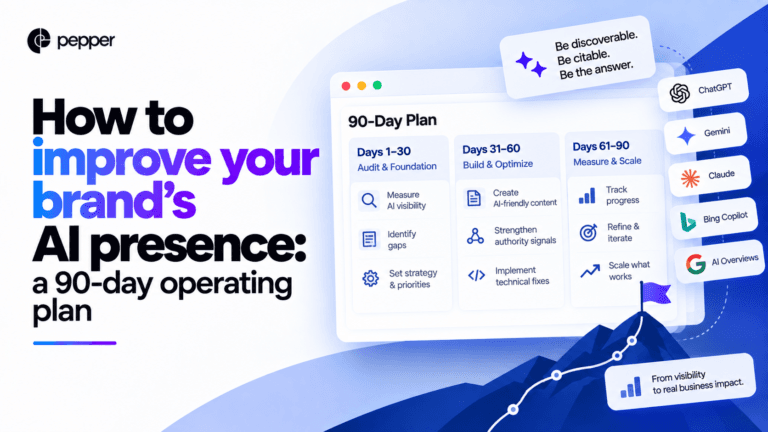
Most 90-day AI plans are sequenced by how hard the work feels rather than by how long it takes to land. So they spend week one on an llms.txt file that Google states it does not use, and they schedule earned media for phase three, which guarantees no result inside the quarter. This plan inverts that. It orders the work by lead time, starts the slowest thing on day one, and cuts four tactics Google explicitly says are unnecessary.
We priced this category nine days ago. Today we went back to the same four pricing pages to check the numbers before publishing. Three of the four had changed, and two had stopped publishing prices altogether. That is the real answer to what AEO costs in 2026: not a number, but a meter that moves, measured in prompts and responses and engines that are billed separately. Here is how each pricing model works, what unit it charges you for, and which incentive that unit creates.
Ask what AI search traffic is worth and you will be handed a multiplier. The ones in circulation right now run from 13% worse than organic search to 23 times better, a spread of roughly twenty-six fold on the single input your whole business case depends on. They disagree because they are measuring the same behaviour under different attribution models. So this is not a guide to finding the right multiplier. It is a guide to building a model whose assumptions are visible, and to being honest about the half you cannot prove.
Get your hands on the latest news!

Similar Posts
Artificial Intelligence
16 mins read
How to improve your brand’s AI presence: a 90-day operating plan

Artificial Intelligence
16 mins read
What does AEO cost in 2026? Pricing models explained

Artificial Intelligence
17 mins read