
The short answer
Six agencies, checked on their own websites this week. All six now sell AI search, GEO or answer engine optimisation. Two publish anything you could call a price. None publishes a client result we could verify.
That first number is the one that matters. It is why “which agency is best at AI search” has stopped being a useful question. Everyone says yes now. The question worth asking is simpler. Did the delivery model change, or did a service page get added to the same retainer?
Key takeaways
- Selling AI search is now table stakes. Six of six offer it. The differentiator is no longer whether, it is how much of the business changed to deliver it.
- Two agencies publish usable budget guidance. Omniscient Digital states full-service engagements start at $10,000 a month. Victorious recommends budgeting at least $6,000 a month and committing to twelve months.
- Nobody publishes verifiable client results. Every agency shows case studies. None of the six publishes a figure we could independently check at source.
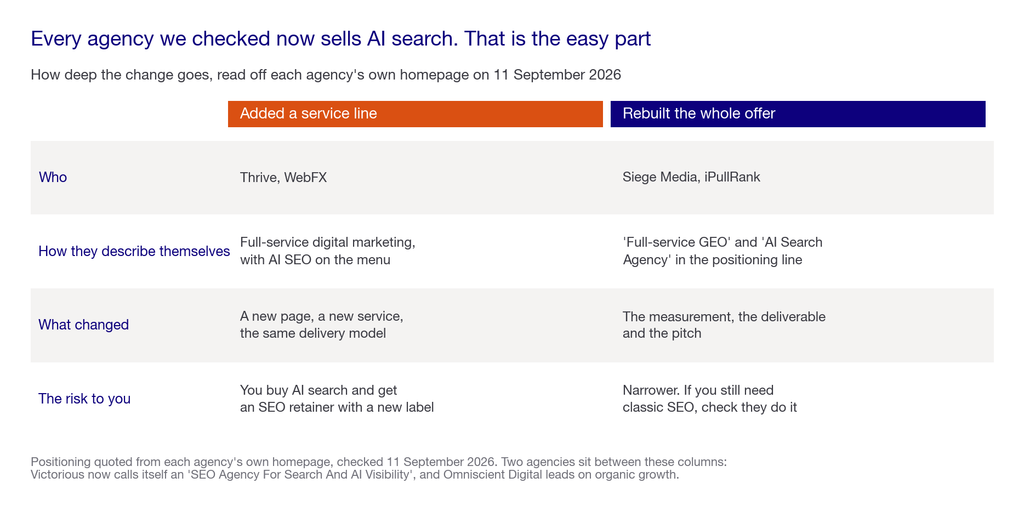
- Watch for the label swap. The most common pattern is a full-service agency adding an AI SEO page while the retainer, the deliverables and the reporting stay exactly as they were.
- The gaps between good agencies are small. Our scores cluster between 75 and 82 for four of the six. Any list implying a decisive winner is selling you certainty it does not have.
A note on where this comes from. We run organic for more than 250 enterprises and track more than 10 million prompts across every major engine. We also compete with several of the agencies below. That shapes this, along with the client reviews we sit in weekly and the pitches we lose. It is our opinion, not a neutral directory, and we have published the weighting so you can disagree with it precisely.
What is an SEO agency in 2026, and is that still the right thing to buy?
An SEO agency is a firm you pay to make your pages easier to find through search. Traditionally that meant technical fixes, content and links. That definition held for fifteen years. It is now incomplete, because a meaningful share of the answers your buyers see are assembled rather than ranked.
Google’s own position is that this is still SEO. Its official guidance on optimizing for generative AI features says so directly. “From Google Search’s perspective, optimizing for generative AI search is optimizing for the search experience, and thus still SEO.”
We agree, and it has an awkward consequence for this page. If it is all still SEO, an agency claiming AI search expertise is claiming to be good at what it always claimed. So we stopped scoring the claim and started scoring what changed underneath it.
What we found when we checked
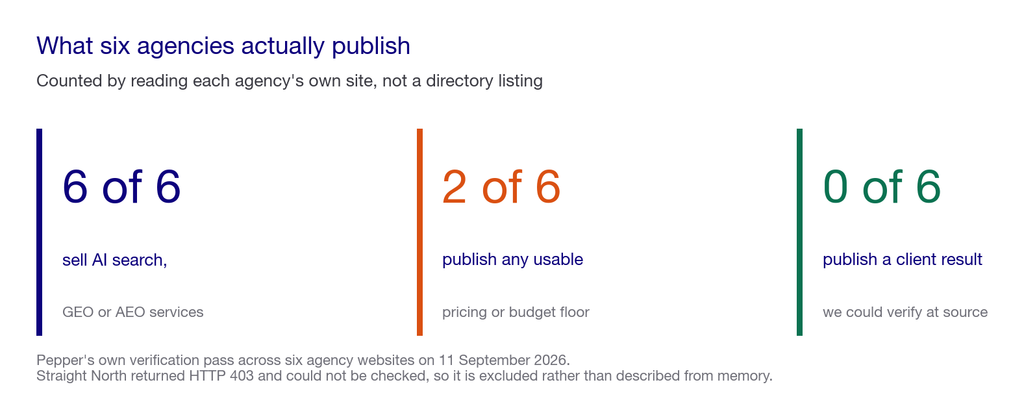
- Six of six sell AI search. Thrive describes itself as a “Generative Engine Optimization Company for AI Visibility”. Siege Media leads with “Full-service GEO”. iPullRank calls itself a “Pioneering Enterprise and Mid-Market AI Search Agency”. Victorious is now an “SEO Agency For Search And AI Visibility”. WebFX and Omniscient Digital both list GEO among their services.
- Two of six publish usable pricing. Omniscient Digital publishes a $10,000 monthly floor. Victorious publishes budget guidance rather than a price. The other four publish nothing you could put in a budget line.
- Zero of six publish a verifiable client result. All six show case studies. None gave us a figure we could check at source, which is the same standard we hold ourselves to below.
One more pattern worth naming: the language has converged. Several agencies now describe their work in near-identical terms, including phrases we use ourselves. That is not dishonesty. It is a category settling on vocabulary faster than it settles on method, which is precisely why a positioning line is weak evidence.
Our point of view
We think the agency question is being asked backwards, and it costs buyers a year.
The usual process is to shortlist on category expertise, then check whether they do AI search, then negotiate. What we see in the accounts we take over is that the expertise was real and the model was wrong. The team was paid for deliverables and reported on rankings. It had no mechanism for earning the third-party coverage that now decides whether an engine cites you.
So our bias is explicit. Ask what the agency is accountable for, rather than what it is expert in. An agency accountable for published pages will produce published pages. If your problem is that engines do not trust you, that is a different contract.
Book a growth audit if you want to know which of those two problems you have before you brief anyone.
Our methodology: how we weighted this ranking
| Criterion | Weight | How we scored it |
|---|---|---|
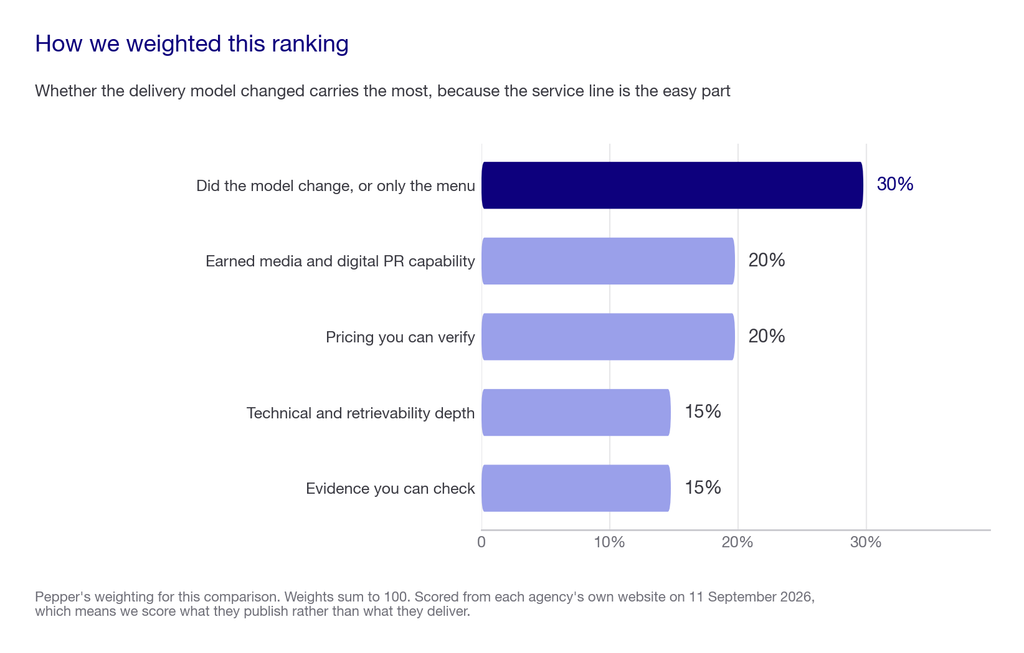
| Did the model change, or only the menu | 30 | Whether the deliverable, the measurement and the pitch changed, or whether an AI page was added to an unchanged retainer. Scored from how the agency describes its own work. |
| Earned media and digital PR capability | 20 | Whether they can get a client written about by somebody else. Most AI citations come from third parties, and this is the hardest capability to bolt on. |
| Pricing you can verify | 20 | A published figure or budget floor scored full marks. Contact-us scored zero, however good the agency behind it. |
| Technical and retrievability depth | 15 | Whether they can diagnose rendering, crawlability and entity consistency rather than briefing somebody else to. |
| Evidence you can check | 15 | Case studies with figures traceable to a source. Self-reported percentages with no methodology scored low. |
Weights sum to 100. The first two carry half of it, which is a judgement rather than a fact, and it is the judgement this page rests on.
The honest limitation of this method: we scored what these agencies publish, not what they deliver. A great agency with a quiet website scores badly here. Treat the scores as a guide to who is easy to evaluate, not to who is best at the work.
The scores
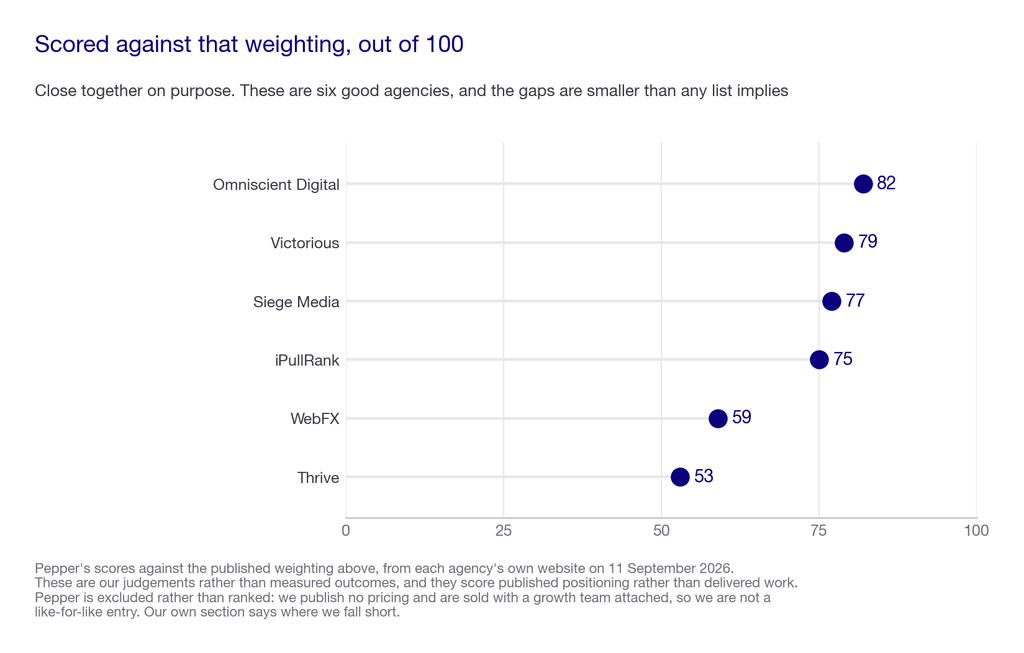
Four of the six land between 75 and 82. That closeness is the finding. These are all capable firms, and anyone presenting a decisive ranking of them is adding precision that the evidence does not support.
The best SEO agencies, one by one
1. Omniscient Digital
Omniscient Digital describes itself as an “Organic Growth Agency for B2B Software Companies”. It is the only agency here that publishes a real number.
- Services: SEO strategy, generative engine optimisation, programmatic and technical SEO, link building, digital PR, content production, analytics.
- Pricing: “Full-service engagements start at $10,000 a month.” Published on their own site.
- AI search: GEO offered explicitly, described as appearing in AI search and LLM outputs.
Best for: B2B software companies that want one firm covering content, technical and digital PR. Where it falls short: the focus is narrow by design. If you are not B2B software you are not their centre of gravity, and the $10,000 floor prices out smaller teams.
2. Victorious
Victorious rebranded from victoriousseo.com and now positions as an “SEO Agency For Search And AI Visibility”. It is unusual in publishing budget guidance rather than hiding it.
- Services: on-page, technical, off-page and link building, plus a distinct AEO service covering ChatGPT, Perplexity, Google AI Overviews, Gemini, Copilot and Claude.
- Pricing: recommends “budgeting at least $6,000 a month for SEO optimization services and committing to a 12-month campaign to start.”
- AI search: AEO and GEO are named service lines, framed around improving AI retrievability with structured content, entity signals and schema.
Best for: teams that want classic SEO depth with a credible AI search practice attached. Where it falls short: the twelve-month commitment is a real constraint if you are testing an agency rather than committing to one.
3. Siege Media
Siege Media has gone furthest in repositioning. Its homepage leads with “Full-service GEO. We make brands the answer in search.”
- Services: GEO, content strategy, content marketing and creation, digital PR, affiliate partnerships, Reddit marketing, design.
- Pricing: not published.
- AI search: the entire identity. They describe tearing through prompt and citation data to find AI mentions.
Best for: brands whose main gap is earned coverage and content that gets cited, especially where digital PR matters. Where it falls short: the repositioning is thorough. If you still need heavy classic technical SEO, confirm it is in scope before you sign.
4. iPullRank
iPullRank positions as a “Pioneering Enterprise and Mid-Market AI Search Agency”. It has built its own vocabulary around the work, including what it calls relevance engineering.
- Services: relevance engineering, GEO, AI search strategy, technical SEO, content engineering, content marketing.
- Pricing: not published.
- AI search: central. They describe GEO programmes across strategy, content, technical optimisation and measurement.
Best for: enterprise and mid-market teams that want a technically deep partner and are comfortable with a consultative engagement. Where it falls short: no published pricing, and the enterprise framing suggests a procurement process rather than a quick start.
5. WebFX
WebFX is the largest firm here, positioned as “Digital Marketing That Drives Revenue” with its own reporting platform.
- Services: SEO, PPC, social advertising, content marketing, CRO, local SEO, email, plus their RevenueCloudFX platform.
- Pricing: not published.
- AI search: AI search optimisation is offered, with AI visibility tracking built into their platform.
Best for: organisations that want many channels under one roof with consolidated reporting. Where it falls short: the AI search offer reads as an addition to a broad menu rather than a change in method. The scale that makes them capable also makes them less specialised.
6. Thrive Internet Marketing Agency
Thrive is a large full-service agency positioning on “RELATIONSHIPS & RESULTS”, with a wide services menu and month-to-month contracts.
- Services: SEO, web design, PPC, social, content, video, reputation management, CRO, Amazon, email and many local variants.
- Pricing: not published. The site says “affordable pricing for any size budget” and advertises month-to-month contracts.
- AI search: offered, including AI Overviews visibility, ChatGPT and Gemini search optimisation.
Best for: smaller teams that value flexibility and want one supplier across many channels without a long lock-in. Where it falls short: the breadth is the trade. The AI search line sits on a very large menu, and the traffic claims we found on the site are self-reported without a stated methodology.
Pepper, in its own category
We are not on the list above, and we should not be. Scoring us against agencies on a published-positioning rubric would flatter us in some rows and be meaningless in others.
What we do have is the one thing none of the six offers. The platform and the people sit in the same contract, with a single team accountable for the number rather than a deliverable count.
We are an agentic organic growth engine, which is three things working together.
- An organic growth partner. A growth team is attached to your account, a senior strategist plus always-on agents, accountable for the number itself. That accountability is exactly what this page argues you should be buying, and it is genuinely rare.
- Pepper’s GEO platform. Genuinely self-serve. You log in, set up a workspace, define brand profile, competitors and personas, connect GA4 and Search Console, and manage your own themes and prompts. It tracks six engines, including ChatGPT, Perplexity, Gemini, Claude and Google AI Overviews.
- The Agent Atlas. Your team builds, versions and runs its own agents, with quick runs for one input and sheet runs for bulk. Not one agency above gives you the tooling as well as the work, and that is the clearest difference on this page.
Held to the same evidence standard. The Acceldata case study publishes 6X organic traffic, and top-three keywords rising from 85 to more than 300. SalesHood publishes AI Overview keywords moving from 14 to 82 between August 2025 and February 2026. Both are on our own site, which is exactly the caveat we applied to everyone else.
Where it falls short: we do not publish pricing, so we score zero on our own transparency criterion and budget discovery is a conversation. We are built for teams treating organic as a long-term function, so a one-off project is not what we are for. Our depth sits in content, authority and AI search rather than large technical migrations. If you need a replatform, one of the technical specialists above is the better call. And if you want a single supplier across paid, social and video too, we are not that either.
What the best SEO agencies cost, at a glance
Published figures are rare, so here is what can actually be verified.
| Agency | Published price | What it buys |
|---|---|---|
| Omniscient Digital | $10,000 a month floor | Full-service engagement, B2B software focus |
| Victorious | $6,000 a month recommended, 12-month commitment | Their own guidance rather than a rate card |
| Siege Media | Not published | Contact required |
| iPullRank | Not published | Contact required |
| WebFX | Not published | Contact required |
| Thrive | Not published | “Affordable pricing”, month-to-month contracts |
| Pepper | Not published | Contact required. We score zero here too |
For context, the mid-market range we see in competitive pitches runs from roughly $5,000 to $25,000 a month, depending on scope. Digital PR is usually the line item that moves it. That is our observation from pitches rather than published data, and you should treat it as such.
How to choose an SEO agency
I will write this in the first person, because a recommendation nobody will defend is worth nothing.
Start from the framing. If Google is right that this is all still SEO, then every agency claiming AI search expertise is claiming competence at something they already claimed. So I would stop scoring the claim and start scoring accountability and capability.
| Area | Weight | What a strong agency demonstrates |
|---|---|---|
| What they are accountable for | 30 | A number, not a deliverable count. Ask what happens to the contract if rankings hold and citations do not. A good answer exists before you ask. |
| Can they earn coverage | 25 | Named placements they secured, in your category, in the last year. Most AI citations come from third parties, and this is the capability that cannot be faked in a pitch. |
| Will they diagnose first | 20 | They run your prompt set and tell you which problem you have before proposing scope. A proposal that arrives before a diagnosis is a template. |
| Technical depth in-house | 15 | They can diagnose rendering and crawlability themselves rather than handing your engineers a list to interpret. |
| Will they tell you no | 10 | They can name work they would not do, or a quarter where you should not hire them. Rare, and the strongest signal on this list. |
Weights sum to 100. Accountability and earned media carry over half, which is the judgement this whole page rests on.
Before you brief anyone, run the free check yourself. Write 20 to 30 real commercial questions your buyers would type. Run them three times each across every engine you care about, and give any fix 90 days before judging it. Four worked examples for a mid-market B2B SaaS analytics company:
- “best data observability platform for enterprise”
- “how do I monitor data quality across Snowflake and Databricks”
- “Acceldata vs Monte Carlo vs Bigeye”
- “what should I look for in a data observability vendor”
What comes back tells you what to brief. Absent everywhere means you need earned media, so weight that capability. Named but never cited means content and structure. Wrong facts mean technical.
Red flags, each one something an agency actually says:
- “We guarantee first page rankings.” Google’s own guidance warns to be wary of third parties promising ranking success or claiming to use internal Google metrics.
- “We are an AI search agency.” Six of six say a version of this. It is now table stakes, so treat it as a starting point rather than a differentiator.
- “Here is your AI visibility score.” One composite number across engines that behave differently hides the diagnosis.
- “We will publish 20 articles a month.” A deliverable count dressed as a strategy.
- “Our proprietary process.” If they will not describe the method, you cannot evaluate it and neither can your successor.
- “Pricing depends on scope.” True, and it should still come with a floor. Four of the six here will not give you one.
Five questions I would ask on every call, and what a good answer sounds like:
- “What are you accountable for, in a number?” A good answer names it and explains how it is measured. A weak one describes deliverables.
- “Show me a placement you earned in our category this year.” A good answer names publications. A weak one describes a process.
- “What did you change about how you work when AI search arrived?” A good answer is specific and sounds slightly painful. A weak one says they added a service.
- “What is your minimum engagement?” A good answer is a number. Hesitation here predicts hesitation later.
- “When would you tell us not to hire you?” A good answer exists.
It comes down to one principle: buy accountability, not expertise. The weaker shortlist ranks agencies by what they claim to know. The stronger one ranks them by what they will put their name against, and by whether they can get somebody else to write about you.
The note that costs us something. Very few firms are equally strong at technical work, content, digital PR and measurement, ours included. On this page’s own transparency criterion we score zero. Ask everyone on your shortlist which of those four is their weakest. Ask us too, and if the honest answer for your situation is one of the six above, hire them.
What nobody should promise you
- Guaranteed rankings or AI citations. Engines are probabilistic and no agency controls their ranking systems.
- A single composite AI visibility score that means something. There is no universal good target for these metrics.
- Results in weeks from earned authority. It is the slowest lever and the one that cannot be compressed.
- A definitive ranking of agencies. Including this one. Our top four sit within seven points of each other.
- Clean attribution from a citation to closed revenue. That measurement does not exist yet.
Frequently asked questions
What are the best SEO agencies?
It depends on what you are buying. Of six we checked at source, Omniscient Digital, Victorious, Siege Media and iPullRank scored highest against our published weighting, and the gaps between them were small enough that fit matters more than rank.
How much does an SEO agency cost?
Only two of six publish anything. Omniscient Digital states a $10,000 monthly floor. Victorious recommends at least $6,000 a month with a twelve-month commitment. The rest require a conversation, which makes budgeting harder than it should be.
Do SEO agencies handle AI search and GEO now?
Yes, all six we checked sell AI search, GEO or answer engine optimisation. That makes it table stakes rather than a differentiator, so the useful question is whether their delivery model changed or a service page was added.
What is the difference between an SEO agency and a GEO agency?
Increasingly little in what they claim. Google states that optimizing for generative AI search is still SEO. In practice, firms calling themselves GEO agencies have usually rebuilt measurement and deliverables around citations rather than rankings.
Should I hire an agency or build in-house?
Build the accountable owner in-house and buy the capability you lack, which for most teams is digital PR. If you can fund a senior internal owner, do that first, because you will need outside help less over time.
How do I check an agency’s claims before signing?
Ask for a named placement they earned in your category this year, a client number they are accountable for, and their minimum engagement. Then run your own prompt set first, so you can judge their diagnosis against what you already found.
Why does this page not rank ten agencies?
Because we could only verify six at source on the day we checked. Straight North returned an HTTP 403 and could not be read, so it was excluded rather than described from memory, and we would rather publish six checked than ten half-known.
Is Pepper ranked on this list?
No, deliberately. We publish no pricing and are sold with a growth team attached, so scoring us on a published-positioning rubric would be misleading. We have a separate section that includes where we fall short.
Where to go next
If the choice is really between buying software and buying help, AEO agency or AEO tool is the more useful read. For the methodology behind how we rank firms, how we rank GEO agencies sets it out.
If your category is specific, we have deeper lists for GEO agencies in fintech, healthcare and software companies. Before you brief anyone, check whether your brand appears in AI search so you can judge their diagnosis against your own.
If you would rather see the work before the pitch, see where you show up and we will run your prompt set across six engines.
And the honest exit. If you have nobody internally who can brief an agency, you do not need one yet. Hold the budget. The most expensive failure we see is a good agency reporting into a company with no owner, producing work nobody integrates. Hire the owner first, even part-time. The agency will be worth more when you do.
Sources and further reading
Agency positioning and pricing, each read on that company’s own website on 11 September 2026 and deliberately not hyperlinked, per our policy of not linking competitors:
- Omniscient Digital: “Organic Growth Agency for B2B Software Companies”, full-service engagements start at $10,000 a month, GEO offered.
- Victorious (formerly victoriousseo.com, now redirecting to victorious.com): “SEO Agency For Search And AI Visibility”, recommends at least $6,000 a month and a 12-month commitment, AEO service across six named engines.
- Siege Media: “Full-service GEO. We make brands the answer in search.” No pricing published.
- iPullRank: “Pioneering Enterprise and Mid-Market AI Search Agency”, relevance engineering and GEO. No pricing published.
- WebFX: “Digital Marketing That Drives Revenue”, AI search optimisation and AI visibility tracking in its own platform. No pricing published.
- Thrive Internet Marketing Agency: “Digital Marketing Agency driven by RELATIONSHIPS & RESULTS”, GEO and AI SEO services, month-to-month contracts. No pricing published.
- Straight North could not be verified. The site returned HTTP 403 to our check, so it is excluded from this page rather than described from an older source.
Research sources, checked at the original on 11 September 2026:
- Google Search Central, “Optimizing your website for generative AI features on Google Search”, announced 15 May 2026 and last updated 10 July 2026. Both quoted phrases appear verbatim.
Client results, read at source:
- Acceldata case study and SalesHood case study, both published on our own site, which is the same limitation we applied to every agency above.
Removed from the previous version of this page, and why:
- Pepper ranked first out of ten. Ranking ourselves above competitors on a page we publish breaks our own editorial rule, and it is the single biggest correction here.
- The entire 2024 list of ten agencies, which carried no methodology, no pricing, no FAQs and no per-agency limitations.
- An unsourced claim that “over 80% of customers start their journey online when searching for financial solutions”.
- The “Team Pepper” byline, replaced with a named author and reviewer.
Latest Blogs
Choosing a GEO agency for mid-market B2B used to be a shortlisting problem. It is now a procurement problem, because the published prices have largely gone. Of four agencies publishing a GEO-specific figure in September 2026, two had withdrawn their pricing pages by early October and one had moved domains. Exactly one still publishes a number a mid-market buyer can act on. So the useful question is no longer which agency is best in the abstract, but how to compare three quotes when only one of them arrived with a method attached.
Third-party sources and AI citations are tightly linked, and the link stops short of where most plans assume. Off-page work decides whether an engine retrieves and cites you. It does not decide whether the answer names you, and 61.7% of brand appearances are citations with no name attached. The two largest 2026 datasets also disagree about how much of the citation surface is third-party at all, one saying 84% and the other putting the brand bucket above half. That disagreement is definitional rather than factual, and it decides where a budget goes.
Why is my competitor showing up in ChatGPT and not me? Before accepting the premise, check it. Across 3,981 brand appearances studied in 2026, 61.7% were citations with no brand name in the answer and only 13.2% produced both. So there are three states that look identical from where you are sitting: genuinely absent, present as an unnamed source, and named less often than a rival. Each has a different cause and a different fix, and working on the wrong one is the most common way this gets expensive.
Get your hands on the latest news!

Similar Posts
Artificial Intelligence
11 mins read
What is anchor text, and does it still matter in 2026?
SEO
11 mins read
What is internal linking? Meaning, and what changed for AI search
SEO
15 mins read