Best GEO Agencies for B2B SaaS: The 2026 Shortlist
Disclosure: Pepper published this list, and Pepper appears on it. We have put ourselves in a separate category rather than ranking ourselves first against agencies we are not, and every entry carries a “where they fall short” line, including ours. Judge the criteria in the methodology section, then judge the list.
The short answer
A GEO agency gets your product named and cited inside AI answers: ChatGPT, Perplexity, Gemini, Claude and Google AI Overviews. So for B2B SaaS, the ones that understand the buying committee beat the ones that simply publish more.
Key takeaways
- The best GEO agencies for B2B SaaS in 2026 are Graphite, Animalz, GrowthX, First Page Sage, Omniscient Digital, Intero Digital, Minuttia, TripleDart and Omnius. Pepper sits in a separate category: an agentic organic growth engine rather than an agency.
- Weight B2B SaaS fit and genuine GEO depth above logo counts. A rebranded SEO deck is the most common thing sold as GEO right now.
- Specialist GEO engagements generally start around 3,000 to 8,000 US dollars a month, though most providers quote custom. Very few publish rates.
- Agency versus in-house is the wrong axis. What you are choosing is how much execution to delegate, and who stays accountable for the number.
- Be careful with anyone selling a single AI visibility score. Ask the same question of a model a thousand times and the answers vary. Brand Visibility and Share of Voice, tracked over time, are the honest metrics.
A note on where this comes from. And we run organic for more than 250 enterprises and track over 10 million prompts across every major engine. And the view below is shaped by that, by the client reviews we sit in every week. And by the conversations we have with buyers and operators at the events we run. So this is our read on the category, not a neutral directory.
What is a GEO agency?
A GEO agency is a marketing partner that structures your content, entities and third-party authority so that generative engines cite your brand when buyers ask about your category. Generative Engine Optimization, or GEO, is the practice of earning those citations. The term comes from a 2023 academic paper and has since become the working label for the discipline.
The work splits into three jobs:
- On-site. Schema, entity clarity, answer-led structure, retrievable formatting, technical crawlability for AI user agents.
- Off-site. The reviews, roundups, communities and publications that a model reads when it decides who to name. This is the part most teams underinvest in, and it is where the answer is usually decided.
- Measurement. Tracking which prompts surface your brand, which sources get cited alongside you, and whether any of it reaches pipeline.
An agency that only does the first job is doing technical SEO with a new label.
GEO vs AEO vs AI SEO vs LLMO: the terms, settled
These get used interchangeably in sales decks. They are not identical, and knowing the difference helps you read a proposal properly.
| Term | What it means | What it optimises for |
|---|---|---|
| GEO (Generative Engine Optimization) | Getting cited and named inside AI-generated answers | Citations and brand mentions in ChatGPT, Perplexity, Gemini, Claude, AI Overviews |
| AEO (Answer Engine Optimization) | Winning the direct answer to a question | Featured snippets, People Also Ask, voice and AI answers |
| LLMO (Large Language Model Optimization) | Influencing how models represent your brand | Model understanding and description of your entity |
| AI SEO | Loose umbrella term, often marketing shorthand | Varies by who is selling it |
We unpack the distinctions in AEO vs GEO vs AIO vs LLMO. In practice GEO and AEO overlap heavily, and both converge with modern SEO. The structural properties that make a page citable by a model are largely the same ones that made it rank: clean heading hierarchy, answer-led openings, extractable tables, sourced data. GEO and SEO are converging, not competing. So treat any provider who tells you SEO is dead with caution: they are usually selling the replacement.
What separates a real GEO partner from a rebranded SEO shop
This is the single most useful filter when reading proposals, because the relabelling is widespread and the pitch decks look similar. In practice, the shows up in what the scope covers, not in what the deck is called.
| A real GEO partner | A rebranded SEO shop | |
|---|---|---|
| Unit of work | The prompt a buyer asks | The keyword a buyer types |
| Off-site scope | Reviews, roundups, communities, category publications | Backlinks, measured by domain rating |
| Entity work | Explicit: schema, consistent descriptions, disambiguation | Absent, or a schema plugin |
| Measurement | Brand Visibility, Domain Prompt Presence and Share of Voice across a tracked prompt set, over time | Rankings and traffic, with an AI screenshot appended |
| Handling of variance | Explained, accounted for in reporting | Not mentioned |
| Definition of done | Cited in the answer | Published on the calendar |
If a proposal cannot tell you which prompts it is targeting, it is a content plan with a new cover page.
The three levers: a diagnostic to run before you hire anyone
Before comparing providers, work out which problem you actually have. In practice, most teams buy the wrong service because they never separated these three, and each one fails differently.
| Lever | The question it answers | What a failure looks like | What fixes it |
|---|---|---|---|
| Visibility | Does AI name us at all in our category? | You are absent from answers where competitors appear | More of your own strong content, and category presence |
| Citability | Does AI trust our pages enough to cite them as the source? | High Brand Visibility, low Domain Prompt Presence: you are mentioned, but the citation goes elsewhere | Off-site authority, PR and partnerships as much as the CMS |
| Retrievability | Do we surface however the question is phrased? | You win one phrasing and vanish on the next | Entity clarity, schema, answer-led structure, coverage of prompt variants |
The diagnosis matters because the remedies are not interchangeable. And a citability problem is the one most often misdiagnosed as a content problem: the brand is mentioned everywhere and cited nowhere. So the team commissions more blog posts, and nothing moves, because the answer was being decided on sources they never touched.
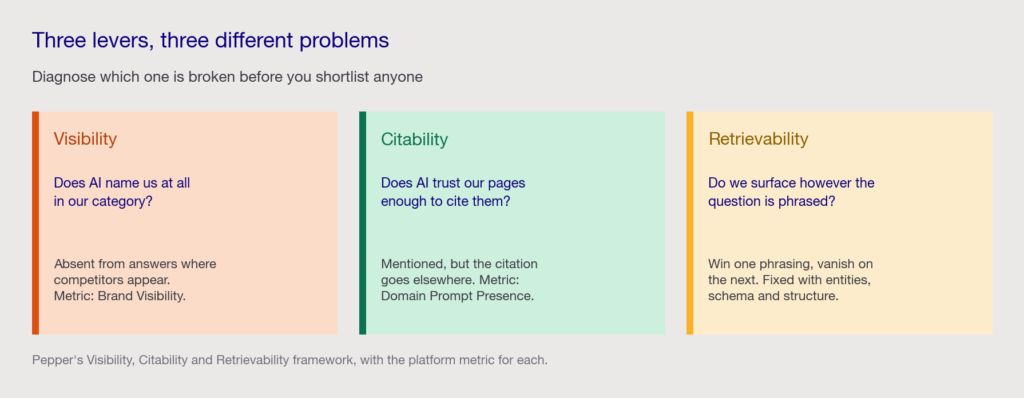
Being mentioned everywhere and cited nowhere is the most common shape of a stalled GEO programme. Know which lever you are pulling before you sign anything.
Why B2B SaaS needs GEO specifically
Your buyers build their shortlist before they reach your site. They ask an AI tool which products fit their use case, narrow the field. And arrive at a demo already leaning toward whoever the model named.
The data supports a more measured version of that story than most vendors tell, and the measured version is more useful.
Buyers use AI, and they do not trust it blindly. The same Forrester research found 36 percent felt more confident in their decision because they used generative AI, while 20 percent felt less confident after hitting unreliable or inaccurate information (Forrester, January 2026). Read those together and the job is not to game one engine. And it is to be described consistently enough across sources that the answer holds up when a buyer checks it.
Read that carefully, because it points at the actual work. If a buyer consults seven sources and cross-checks the AI answer with a human, then winning is not about gaming one engine. And it is about the sources agreeing with each other about what you do. Consensus across the sources a category trusts is the asset. So that is slower to build than a content sprint, and considerably harder for a competitor to buy past.
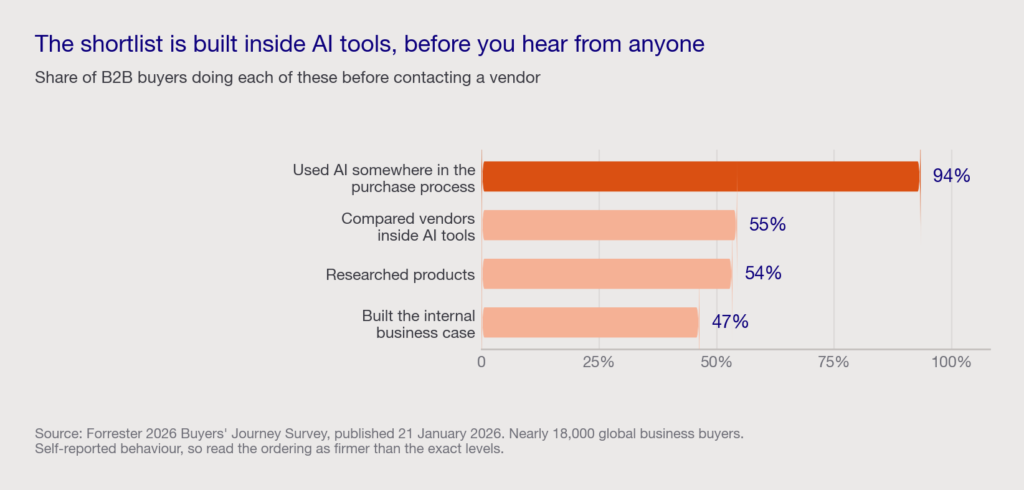
The decision is largely made before you hear from anyone. Forrester’s 2026 Buyers’ Journey Survey, published in January 2026 and covering nearly 18,000 global business buyers, found 94 percent used AI somewhere in their most recent purchase. More usefully, it split what they did with it: 55 percent compared vendors inside AI tools, 54 percent researched products. And 47 percent built the internal business case, all before contacting a vendor (Forrester, January 2026). Your rankings can hold while none of that touches your site. Being the cited source in the answer is increasingly the only version of visibility that pays.
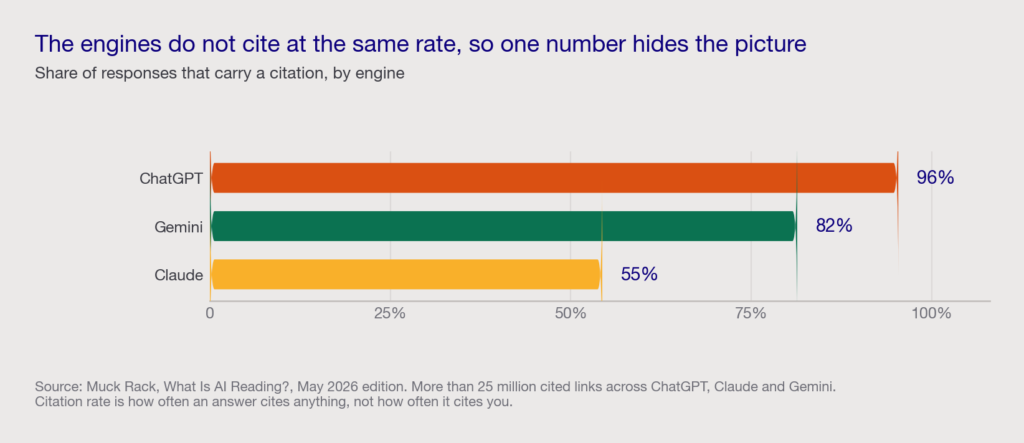
And the engines do not behave alike. Muck Rack’s May 2026 edition of What Is AI Reading, built on more than 25 million cited links across ChatGPT, Claude and Gemini, found ChatGPT carries a citation in 96 percent of responses, Gemini in 82 percent and Claude in just 55 percent (Muck Rack, May 2026). So that gap matters for how you measure: a single blended visibility number averages three engines that cite at very different rates. Two caveats worth holding:
40 percent is the upper bound rather than an average. And the test environment was a single simulated engine, not the live multi-engine landscape you actually sell into. And it is directional evidence that structure matters, not a guarantee of a number.
See where you show up. Pepper’s GEO platform tracks Brand Visibility, Domain Prompt Presence and Share of Voice across ChatGPT, Perplexity, Gemini, Claude and Google AI Overviews. And a growth team works the account with you. Book a growth audit or see where you show up.
How we evaluated these GEO agencies
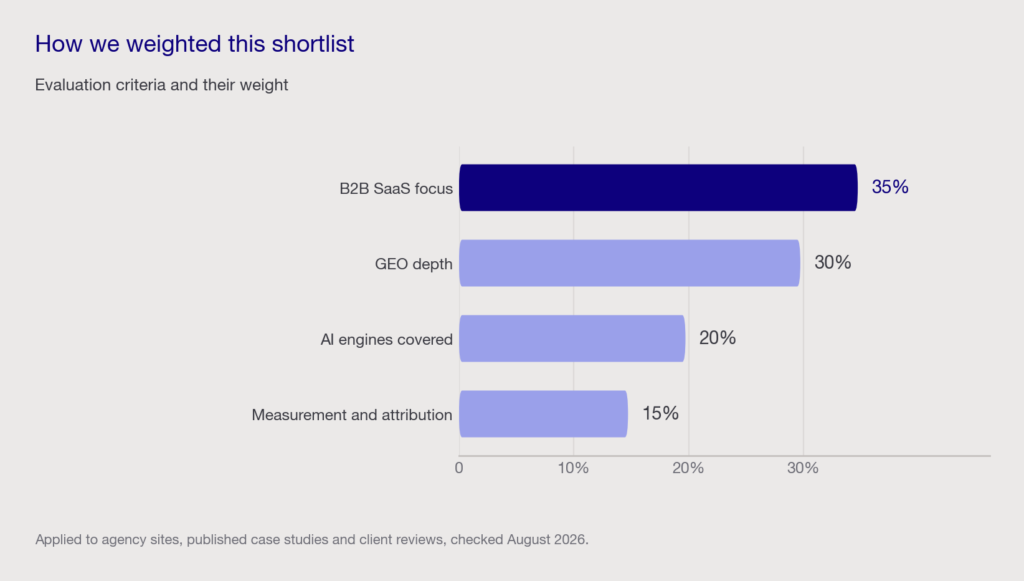
Four weighted factors, applied to publicly verifiable information. The full model is set out in our GEO agency ranking methodology: agency websites, published case studies, client reviews and the engines each provider states it tracks.
| Factor | Weight | What we looked for |
|---|---|---|
| B2B SaaS focus | 35% | Named SaaS clients, understanding of buying committees and multi-stakeholder deals, not generalist logo counts |
| GEO depth | 30% | A distinct methodology beyond rebranded SEO: entity work, citation strategy, off-site authority |
| AI engines covered | 20% | Which engines are actually tracked, and whether tracking extends past ChatGPT |
| Measurement and attribution | 15% | Whether outcomes tie to pipeline rather than visibility screenshots |
What we excluded. Traditional SEO shops offering GEO as a line item with no citation tracking or entity work. Providers with no demonstrable B2B software experience.

What we could not verify. Pricing, for most of this list. GEO providers overwhelmingly quote custom. Where a provider publishes rates we have said so; where they do not, we have written “not publicly disclosed” rather than guessing. So treat any listicle that prints confident price tags for a dozen agencies with suspicion.
Best GEO agencies for B2B SaaS in 2026, at a glance
| Provider | Best for | Model | Engines tracked | Pricing |
|---|---|---|---|---|
| Pepper | Teams wanting the whole organic function run and owned | Platform plus growth team | ChatGPT, Perplexity, Gemini, Claude, AI Overviews | Custom, annual |
| Graphite | Editorial clarity and intent-driven content | Agency, AEO plus SEO plus growth | ChatGPT, AI Overviews | Not publicly disclosed |
| Animalz | Premium thought leadership | Agency, dedicated AEO practice | ChatGPT, Perplexity, Gemini, AI Overviews | Not publicly disclosed |
| GrowthX | Seed to Series B velocity | Content and GTM subscription | ChatGPT, Perplexity, AI Overviews | Not publicly disclosed |
| First Page Sage | Enterprise and complex verticals | Agency, content-led GEO | ChatGPT, Perplexity, Claude, Gemini | Not publicly disclosed |
| Omniscient Digital | Content tied to pipeline | Managed service only | ChatGPT, Perplexity, AI Overviews | Not publicly disclosed |
| Intero Digital | Regulated and multi-channel programmes | Agency, proprietary GRO framework | ChatGPT, Gemini, Perplexity, AI Overviews | Not publicly disclosed |
| Minuttia | SaaS above 10M ARR wanting strategy first | Boutique agency | ChatGPT, Perplexity, Gemini, AI Overviews | Not publicly disclosed |
| TripleDart | Full-funnel B2B tech marketing | Agency plus Slate platform | ChatGPT, Gemini, Perplexity, AI Overviews | Not publicly disclosed |
| Omnius | Technical GEO for SaaS and fintech | Boutique, Atomic tracker | ChatGPT, Perplexity, Gemini, Claude | Not publicly disclosed |
The 2026 shortlist
1. Pepper
What it is. Pepper is an agentic organic growth engine: a senior growth team backed by always-on AI agents, running the whole organic function across search and AI. And it is not an agency, and that distinction is the point rather than a euphemism. Agencies bill for effort. In practice, Pepper signs annual, outcome-pegged contracts with KPIs written in.
Best for. Mid-market and enterprise SaaS teams that treat organic as core, have an internal team to work alongside. And want one partner accountable for the number instead of four vendors accountable for their slice.
How the GEO work is structured. Around three levers, set out in full in our Visibility, Citability and Retrievability framework: Visibility (does AI name you at all), Citability (does AI trust your pages enough to cite them), Retrievability (do you surface however the question is phrased). Winning one phrasing and vanishing on the next is winning by luck. The platform tracks more than 10 million prompts across every major engine, which is the dataset the strategy is built on.
Proof and credentials. Eight years operating, 250 plus enterprises served, with a dedicated B2B SaaS practice. In practice, our work with Acceldata grew organic traffic sixfold and took top-three keywords from 85 to more than 300.
Where it falls short. Pepper only sells organic. So if you want one partner running paid, lifecycle and organic together, this is the wrong shape. The commercial model is annual and outcome-pegged, which suits companies committing to organic as a channel and suits nobody looking for a one-quarter experiment. And if you want a cheap monitoring tool with no strategic engagement attached, this is more than you need.
2. Graphite
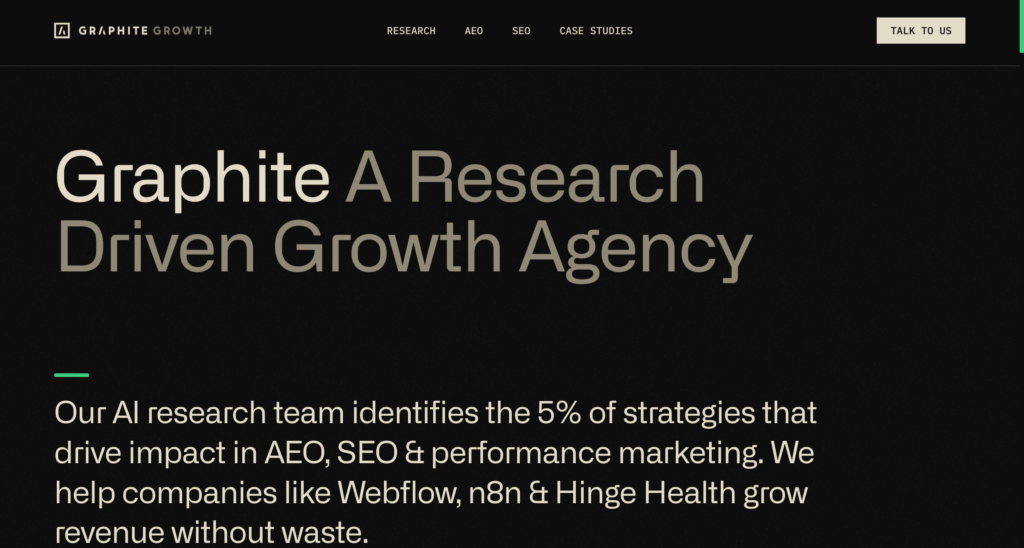
What they do. Graphite pairs answer engine optimisation with SEO and performance marketing, built on intent-driven content and persona mapping. Its own positioning is about finding the small share of tactics that move the number rather than publishing more.
Best for. Teams that value editorial clarity and want content decisions justified by intent data rather than volume targets.
Where they fall short. Engine coverage skews to ChatGPT and Google AI Overviews. So if Perplexity or Claude matter to your category you will want to ask how those are tracked. Generalist across B2B rather than SaaS-only.
3. Animalz
What they do. Animalz built its reputation on editorial quality in B2B SaaS thought leadership and has since stood up a dedicated AEO practice, with proprietary tooling for identifying and refreshing decaying content.
Best for. Companies whose category is won on ideas, where a genuinely original point of view is the differentiator.
Where they fall short. Premium positioning and premium cost. The model is content-led, so if your gap is technical retrievability or off-site authority rather than content quality, you may be buying the wrong strength.
4. GrowthX
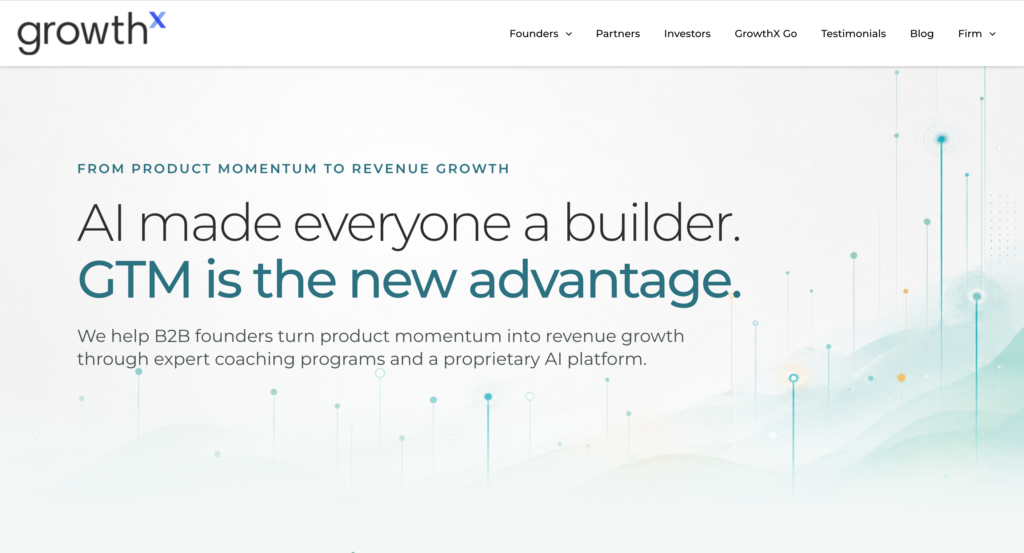
What they do. A content-and-GTM subscription built for startup velocity, covering a broad tech remit with AEO folded into the content engine.
Best for. Seed to Series B companies that need volume and speed with a light management overhead.
Where they fall short. Breadth across tech rather than depth in SaaS. The subscription model favours throughput, which is the right instinct early and the wrong one once you need entity strategy and third-party authority rather than more posts.
5. First Page Sage
What they do. One of the earliest agencies to formalise GEO as a category, working with enterprise and complex verticals including SaaS, medtech and manufacturing. Content-heavy, deliberately low-volume engagements.
Best for. Enterprise and regulated categories with long sales cycles, where accuracy and depth matter more than publishing cadence.
Where they fall short. Low-volume by design. So growth teams wanting rapid coverage across a wide keyword and prompt set may find the pace slow. Broad vertical remit rather than SaaS specialisation.
6. Omniscient Digital
What they do. An organic growth agency founded in 2019, based in Austin, known for a barbell content strategy that pairs high-intent conversion content with long-form thought leadership. Ties content to pipeline rather than traffic, with GEO built into core SEO work.
Best for. SaaS teams that want organic measured against pipeline from the outset and are prepared to run a longer programme.
Where they fall short. Managed service only, with no platform layer. So measurement and visibility into the work depend on their reporting cadence rather than a system you can query yourself.
7. Intero Digital
What they do. Founded in 1996, Intero formalises its AI search work as a proprietary GRO framework and integrates GEO across multiple channels. Notable depth in cybersecurity, healthcare and fintech.
Best for. Mid-market and enterprise teams in regulated industries that want GEO integrated with paid, PR and the rest of the mix.
Where they fall short. Multi-channel breadth means organic is one of several priorities rather than the whole focus. And specialists tend to win the answer in a given category. And a large agency footprint can also mean more layers between you and the people doing the work.
8. Minuttia
What they do. SaaS and tech specific, built for companies past roughly 10 million in ARR, with an integrated content and AEO model and a strategy-first engagement style. Strong client retention.
Best for. Established SaaS companies that want a senior strategic partner rather than an execution vendor.
Where they fall short. Boutique capacity limits how many accounts they take and how fast they scale. The stated ARR threshold rules out earlier-stage companies.
9. TripleDart
What they do. B2B tech exclusive, running GEO through its proprietary Slate platform, with particular attention to how SaaS vendor shortlists get formed inside conversational AI.
Best for. B2B tech companies wanting full-funnel marketing where GEO sits alongside paid, lifecycle and web.
Where they fall short. Full-funnel by design, spanning paid, social and email as well as organic. So that is genuinely useful if you want one agency for everything. And a dilution if you want the organic specialist who wins the answer in your category.
10. Omnius
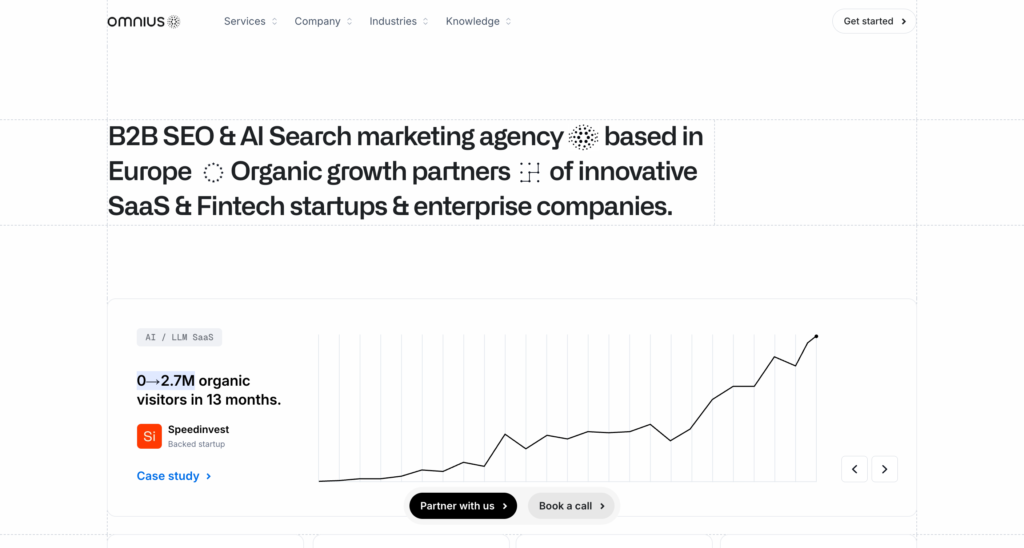
What they do. B2B SaaS, fintech and AI exclusively, with a technical GEO and LLMO focus, using a proprietary Atomic tracker. Emphasis on crawlability and entity work rather than content volume.
Best for. Technically mature teams that already produce good content and need the entity, schema and retrievability layer built properly.
Where they fall short. Technical emphasis means less editorial firepower. If your content itself is the weak link, this is the wrong starting point.
What does a GEO agency cost in 2026?
Most GEO providers quote custom, which makes honest benchmarking hard. Here is what is publicly established.
| Engagement type | Typical range | Notes |
|---|---|---|
| Platform or tool only | 800 to 1,500 USD per month | Self-serve tracking. You run the work. |
| Boutique or specialist GEO | 3,000 to 8,000 USD per month | The most common shape for mid-market SaaS |
| Full organic function, owned | Custom, usually annual | Strategy, execution and accountability for the number |
| Enterprise multi-channel | Substantially higher | GEO integrated with PR, paid and lifecycle |
Two providers publish rates: VisibilityStack lists tiers from 800 to 5,000 US dollars a month. And derivateX is reported at 3,500 US dollars and up for SaaS between 5 and 50 million ARR. Everyone else on this list quotes custom.
How to read a GEO quote. The number matters less than what it buys. So ask whether the fee covers off-site authority work or only on-site content. Because off-site is where the answer is usually decided and it is the line item most commonly missing. So ask what happens in month seven, when the easy structural wins are done and the compounding work begins. And ask what the provider is accountable for if the number does not move.
What a good first 90 days looks like
Proposals rarely spell out the sequence, which makes them hard to compare. So this is the shape a serious engagement takes, and it doubles as a checklist for reading anyone’s plan.
Weeks 1 to 3: baseline and prompt universe. Establish which prompts your buyers actually ask, not which keywords you rank for. So those two sets overlap less than most teams expect. Then measure where you appear across those prompts today, and which sources get cited alongside you. Without this, every later claim of improvement is unfalsifiable.
Weeks 2 to 5: entity and retrievability fixes. Schema, consistent descriptions of what you do, disambiguation from similarly named products, crawlability for AI user agents. So this is the least glamorous work and it produces the earliest movement, because it removes reasons for a model to skip you.
Weeks 4 to 10: the citation core. Identify the ten to twenty sources that decide your category: the reviews, roundups, communities and publications that keep appearing in answers. In practice, most brands cannot name one of them. Then make sure those sources describe you accurately and consistently. So this is the slowest part and the part that compounds.
Weeks 6 to 12: answer-led content and coverage. Build or rebuild the pages that map to your highest-value prompts, structured so a model can lift the answer cleanly. Cover the phrasings, not just the canonical query.
From week 8: measurement that survives scrutiny. Brand Visibility, Domain Prompt Presence and Share of Voice across the fixed prompt set, tracked over time. Then watch for branded search lift, which is the leading indicator that the work is reaching buyers rather than dashboards.
Expect first citations somewhere in the four to eight week range, and expect the meaningful compounding between months three and six. Anyone promising a step change in week two is describing a lucky prompt, not a programme.
GEO agency, in-house team, or platform plus team?
The framing of agency versus in-house is the wrong axis, as we argue in tool vs agency vs platform. What you are really deciding is how much execution to delegate, and who carries the outcome when it does not move.
| In-house | Agency | Platform plus team | |
|---|---|---|---|
| Speed to start | Slow, hiring dependent | Fast | Fast |
| Category context | Deepest | Learned over time | Learned, retained in the system |
| Cost shape | Fixed headcount | Retainer, scales with hours | Contract, scales with outcome |
| Off-site authority | Hard without relationships | Varies widely | Core to the model |
| Who owns the number | You | You | Shared, written into the contract |
| Fails when | One person plays every position | Nobody is accountable past delivery | You want to run it yourself |
Done properly, organic now takes five specialists working as one function: a content strategist writing for buyers and machines, a PR and authority lead earning mentions in the sources AI trusts, a technical SEO and GEO specialist owning indexing and retrievability, a social and community specialist building presence where models actually read. And a conversion specialist turning visits into pipeline.
Most companies lose organic by asking one person to play every position. Silos are the real enemy: a content team optimising the one surface that does not decide the answer, while the third-party sources that do decide it go untouched.
How to choose the right GEO partner
Choosing a GEO partner is less about finding someone who knows a few retrieval tricks and more about finding someone who can systematically move visibility, citations, authority and eventually pipeline. In practice, most of the shortlists we get pulled into are decided on the wrong criteria: deck quality, logo walls. And whoever demoed the prettiest dashboard.
Start with a piece of context that reframes the whole evaluation. In May 2026 Google published its first official guidance on optimising for its AI features, and filed it under SEO fundamentals. Its position is blunt: AEO and GEO are part of SEO for Google, AI Overviews and AI Mode run on the core Search ranking systems. And there is no separate AI index or AI ranking algorithm. The same guidance mythbusts several tactics sold hard by GEO vendors, including llms.txt files, content chunking and AI-specific rewrites.
We think that guidance is correct, and incomplete. And it is correct about Google. Google is one engine, and our tracked prompt set shows the same page performing very differently on Perplexity, which cites heavily, than on AI Overviews, which summarises. So the honest reading is: strong SEO fundamentals are the floor, not the ceiling. And any partner whose pitch contradicts Google’s published guidance owes you an explanation.
The scorecard we would use
Score each shortlisted partner out of 100 using the weights below, before the pricing conversation rather than after it. And a partner who scores well on measurement and badly on execution is a research vendor, whatever the deck says.
This is the weighting we apply when we audit a category, adapted into something you can score a partner against.
| Area | Weight | What a strong partner demonstrates |
|---|---|---|
| AI visibility measurement | 25% | Tracks brand mentions, citations, cited URLs, competitors and share of voice across a meaningful prompt set. Not screenshots |
| Query and demand intelligence | 20% | Knows what your ICP asks from awareness to purchase, and can show where you are absent |
| Content and technical execution | 20% | Can actually change site architecture, crawlability, entity clarity, structure, evidence, schema and internal linking. Not just hand over recommendations |
| Off-site authority | 15% | Understands that engines retrieve from the wider web: publications, comparison sites, communities, reviews, expert content |
| Multi-engine capability | 10% | Measures the engines your buyers actually use, rather than claiming one universal GEO algorithm exists |
| Business attribution | 10% | Connects visibility to traffic to pipeline, instead of stopping at citation counts |
Measurement carries the heaviest weight because it is the fastest way to separate a serious operator from a marketing story. And it is also getting easier to check independently. Bing shipped an AI Performance report in Webmaster Tools in February 2026 showing which URLs get cited and which queries trigger those citations. And openAI runs distinct crawlers, OAI-SearchBot, ChatGPT-User and GPTBot, with distinct jobs. And a partner who cannot discuss first-party sources like these is working from vendor dashboards alone.
Ask them to prove it before you sign
The single most useful thing you can do costs nothing. Give each shortlisted partner 20 to 30 real commercial questions your buyers ask. Not branded ones. Questions like “best enterprise content marketing platforms”, “best alternatives to [your competitor]”, “which platform should I use for [use case]”.
Then ask them to come back with five answers:
- Where does our brand currently appear across those prompts?
- Which competitors appear instead of us?
- Which sources are influencing those answers?
- Why are those sources winning?
- What exactly would you change in the first 90 days?
That conversation tells you more than a fifty-slide capabilities deck. It also exposes the most common gap in this category, which is that plenty of providers can produce question four’s data and almost none can answer question five with anything beyond “publish more”.
A good partner will also tell you, unprompted, that AI answers are probabilistic. Research across generative engines finds substantial variation between them and relatively low overlap in the sources they cite. So one query run on one engine establishes nothing. If they present a single screenshot as evidence, they either do not know that or are hoping you do not.
The distinction that matters most: GEO is not content optimisation
The weaker playbook in this category runs: find prompts, rewrite blogs, add FAQs, add statistics, hope you get cited.
The model we run looks like this: demand intelligence, then technical discoverability, then entity and brand authority, then content, then earned-media authority, then distribution, then visibility measurement, then revenue attribution.
The difference matters because generative engines synthesise an answer from several sources rather than ranking one page. Being retrieved, being cited, and actually influencing the answer are three different things, and they are worth measuring separately. Google’s own advice points the same way: make genuinely useful, non-commodity content rather than manufacturing content for machines.
The distinction that decides it: weak playbook against strong
The weaker playbook in this category runs: find prompts, rewrite blogs, add FAQs, add statistics, hope the engines cite you. And it is cheap to sell and it plateaus in about a quarter.
The stronger model, and the one we run, sequences it: demand intelligence, then technical discoverability, then entity and brand authority, then content, then earned-media authority, then distribution, then visibility measurement, then revenue attribution.
That difference matters because generative engines synthesise an answer from several sources rather than ranking one page. Being retrieved, being cited, and actually influencing the answer are three different things worth measuring separately.
Red flags
We would walk away from any of these.
- “We guarantee ChatGPT citations.” Nobody controls a generative engine’s output. Google gives the same advice about SEO providers guaranteeing rankings, for the same reason.
- The whole proposition is a dashboard. A dashboard is the start of the work, not the work.
- They track branded prompts only. Your brand name surfaces your brand. That is not the test.
- They optimise for ChatGPT alone. Winning one engine and vanishing on the next is winning by luck.
- Hundreds of AI-generated articles as the plan. This is the tactic Google’s guidance explicitly warns against, and it is expensive to unwind.
- No methodology for prompt selection. If they cannot say how the tracked set was chosen, the reporting is arbitrary.
- Citation counts with no competitor share of voice. Your number going up while a competitor’s goes up faster is a loss reported as a win.
- No technical, digital PR or execution capability. Then they are a research vendor, whatever the deck says.
The five questions we would spend the meeting on
- Show me exactly how you measure GEO visibility. They should show real prompts, competitors, citations, URLs, engines and movement over time.
- Take one query where a competitor beats us and explain why. This separates people who understand retrieval and source authority from people reselling software.
- What will you actually change? Look for an answer spanning technical work, owned content and earned authority. If it is only blog production, half the job is missing.
- How will you prove this reached the business? Their measurement should travel through branded demand, qualified referral traffic and pipeline, not stop at “AI visibility up 34 percent”.
- Which part of your methodology do you expect to be obsolete in twelve months? The field is moving fast. A thoughtful answer is a better signal than a confident one.
If we had to reduce the whole selection process to one principle: choose the partner that treats GEO as a measurable growth system, not a new name for content services.
For a B2B SaaS company, the winning partner usually has to combine five things: GEO software, SEO intelligence, content execution, digital PR and authority building. And analytics. Very few are strong across all five. So that is exactly where we would concentrate the evaluation. And it is worth asking any partner which of the five they are weakest at. The ones worth hiring answer that question straight.
One honest closing note. Very few firms are equally strong across measurement, execution, earned authority and attribution, ours included. The good ones will tell you which is their weakest without being asked. If a partner claims to be excellent at all four, you have learned something about how they answer questions.
What nobody should promise you
Be wary of a single AI visibility score presented as a ranking position. Run the same prompt repeatedly with randomness enabled and the answers vary considerably. Anyone selling you one position in an AI answer is selling a coin flip.
Share of Voice is different: measured across a tracked set of buyer prompts, over time, so it moves and can be held to. In practice, Pepper reports this as three numbers: Brand Visibility (how often engines mention you by name), Domain Prompt Presence (how often they cite a page from your domain) and Share of Voice (your slice of all brand mentions in the category). Visibility rising while Share of Voice falls means competitors rose faster. The chain worth measuring runs: authority built, then consensus across trusted sources, then Share of Voice up, then branded search lift, then organic demand and pipeline. And every link in that chain is observable. And a screenshot is not.
Frequently asked questions
What does a GEO agency actually do?
A GEO agency structures your content, entities and third-party authority so AI engines cite your brand. The work spans on-site schema and answer-led formatting, off-site authority in the sources models trust, and tracking across multiple engines.
How much do GEO agencies charge for B2B SaaS?
Most quote custom. Publicly, platform-only tools start near 800 to 1,500 US dollars a month. And specialist GEO engagements commonly run 3,000 to 8,000 US dollars a month. Enterprise programmes integrating PR and paid run substantially higher.
Can a traditional SEO agency handle GEO?
Some can. In practice, most relabel existing SEO work. Genuine GEO adds entity optimisation, citation-ready structure and third-party authority building. So ask what their GEO methodology does that their SEO methodology does not.
How long does GEO take to work?
Most providers report first citations within four to eight weeks, with compounding visibility at three to six months. Timelines depend heavily on your existing authority and how contested your category is.
Is GEO different from AEO?
They overlap. GEO targets citations inside AI-generated answers across engines. AEO targets the direct answer to a question, including featured snippets and People Also Ask. And both converge with modern SEO rather than replacing it.
Should I hire a GEO agency or build in-house?
Build in-house if you have the five specialist roles and the patience to hire them. Partner if you need speed, off-site relationships, or one accountable owner. The deciding factor is how much execution you want to delegate.
Which AI engines should B2B SaaS prioritise?
ChatGPT and Google AI Overviews carry the most volume. Perplexity matters for research-heavy categories, and Claude increasingly appears in technical evaluation. Coverage beyond ChatGPT alone is the useful filter when comparing providers.
How do I know if my GEO programme is working?
Track Brand Visibility, Domain Prompt Presence and Share of Voice across a fixed prompt set over time, not a one-off score. Then look for branded search lift and organic pipeline. If visibility rises and nothing downstream moves, the prompts being tracked are probably not the ones your buyers ask.
You may not need any of them yet
The answer that costs us the sale, because it is true often enough to say out loud. If your category has fewer than roughly 30 meaningful monthly buyer prompts, or nobody on your team has capacity to act on what a partner finds, you do not need a GEO agency yet. Spend the money on earned media and on fixing your own product pages instead, and revisit this in two quarters. Hiring a partner to generate findings nobody can action is the most expensive way to learn that lesson.
Where to go next
You cannot fix what you cannot see. The useful first step is a baseline rather than a proposal: which prompts your buyers actually ask, which sources get cited when they ask them. And where your brand sits in those answers today.
That baseline is worth having whether you hire anyone on this list or none of them.
See where you show up · Book a growth audit
Sources and further reading
- Forrester. “Forrester’s 2026 Buyer Insights.” Published 21 January 2026. Nearly 18,000 global business buyers. Link
- Muck Rack. “What Is AI Reading?” May 2026 edition. More than 25 million cited links across ChatGPT, Claude and Gemini. Link
- Removed in the 2026 sourcing pass: the Pew click-through study (July 2025) and the original GEO paper (KDD 2024). Both predate 2026 and have no direct 2026 equivalent, so the claims they supported were replaced rather than restated.
Latest Blogs
Our own benchmark of 30 published prices already answers what GEO costs. This answers the different question, which is what you should budget and where it should go. Two numbers decide it. A study of more than 25 million cited links found earned media drives 84% of AI citations while paid and advertorial content drives 0.3%. And the Gartner CMO survey of 401 CMOs puts marketing at 7.8% of revenue with SEO the largest single line inside owned and earned digital. Put those together and the answer is that GEO is not a new budget line at all. It is a reallocation, and most teams are making it in the wrong direction.
Yes, and it will not show up in your pipeline report. Those two statements are not in tension, they are the same fact stated twice. A survey of more than 1,000 B2B software buyers found 82% had sourced software recommendations from an AI chatbot in the last two years, and about half said AI mattered most when they were narrowing and comparing options. That is precisely the stage that produces no click. Meanwhile the conversion multiples circulating for AI traffic run from 22% better than organic to five times better, and the only peer-reviewed study says worse. Here is how to tell which is true for you.
Agent Atlas is the chat-first layer of Pepper’s platform: you ask in plain language, it reasons across your connected sources, and it runs the work. Here is exactly what it does, and what V1 does not.
Get your hands on the latest news!