Tool vs Agency vs Platform for AEO: The CMO’s Honest Decision Framework
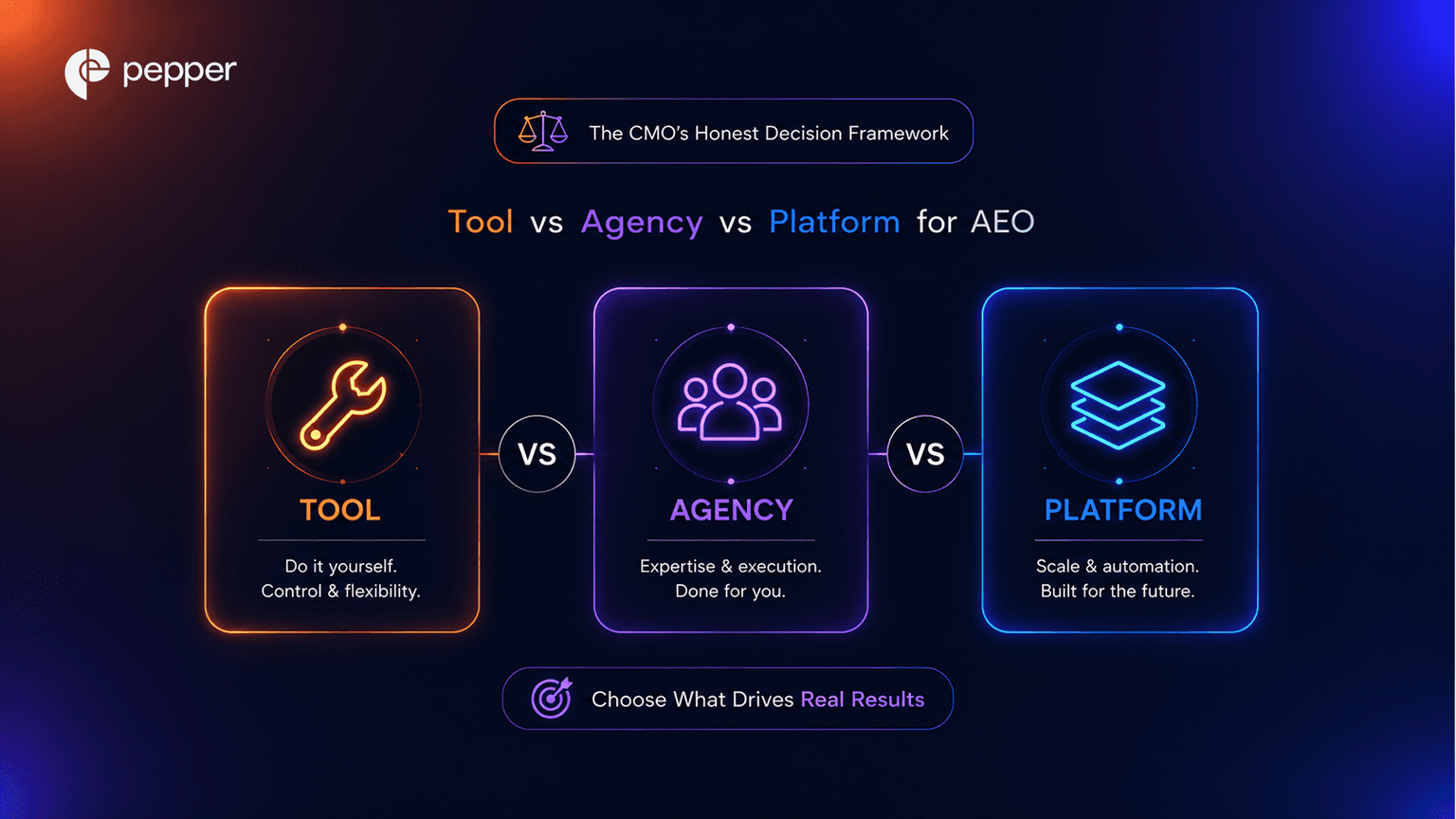
Every CMO in 2026 has had some version of the same meeting. AI search is eating into your organic traffic, your CEO has read one article about ChatGPT shopping, and now there is a line item to defend. The question on the table is deceptively simple: do we buy a tool, hire an agency, or commit to a platform?
The honest answer is that all three can be right, and all three can be expensive mistakes, depending on who you are. The people selling you each option will not tell you that, because each of them sells exactly one of the three. A tool vendor thinks you need a tool. An agency thinks you need an agency. This page is an attempt to be the thing that is missing from the category: a framework that tells you when each path actually fits, written by a company that will admit when its own answer is the wrong one for you.
| Plot your route → The three paths, defined (tool · agency · platform) → The decision framework: 7 questions to ask yourself → When a tool is the right call → When an agency is the right call → When a platform is the right call → The hybrid model: where Pepper sits → Cost comparison: four paths over 12 months |
Here is the short version, so you can leave early if you want to. A tool gives you data and hands the work back to you. An agency gives you people and hands the control away from you. A platform tries to give you both, with software doing the scale work and humans owning the judgment. Which one wins comes down to seven questions about your team, your timeline, and your tolerance for either doing the work or letting go of it.
Let us define the three paths precisely, then build the framework.
The three paths, defined
The category is noisy because the words are used loosely. A vendor calls itself a platform when it is a tool. An agency calls itself a platform when it has a dashboard. So let us be strict about what each one actually is.
Path 1: The tool
A tool is software you operate yourself. In AEO, that usually means a visibility tracker: it tells you where your brand shows up across ChatGPT, Perplexity, Google AI Overviews, Gemini, and the rest, which prompts you are winning or losing, and which sources the models cite instead of you. The best of them, like Profound, go deep. Profound tracks 10 or more engines, surfaces prompt-volume data that shows how often a topic is actually being asked, and ties visibility to traffic. It added a content layer called Agents in late 2025.
What a tool does not do is the work. It tells you that you are invisible for “best data observability platform.” It does not write the page, earn the citations, fix the schema, or publish anything. That part is yours. A tool is a very good pair of glasses. It is still your job to walk.
Example: Profound (tool). Deep visibility intelligence, self-serve to enterprise, monitoring-first. You bring the team that acts on it.
Path 2: The agency
An agency is people you hire to do the work for you. In AEO, a strong agency builds the strategy, produces the content, handles the technical SEO, and chases the citations, then reports on what moved. Graphite is a clean example: an AI-powered growth agency working with the likes of Webflow, Notion, and Adobe, organized around the thesis that most SEO work is wasted and only a small fraction drives impact. Its team runs editorial, technical, programmatic, and AEO as a service, either full-service or strategy-only.
What an agency does not give you is control or institutional memory. The expertise lives in their building, not yours. When the engagement ends, so does the capability. You move at their cadence, you wait in their queue behind other clients, and the premium you pay is for their people’s time, which is the most expensive thing money can buy.
Example: Graphite (agency). Done-for-you strategy and execution, senior expertise, results without you building the muscle. You rent the capability rather than own it.
Path 3: The platform
A platform is software and people fused into one system, where AI agents do the repeatable scale work and humans own strategy and quality. The promise is that you get the speed and cost structure of a tool with the judgment and execution of an agency, inside a single workflow that you have visibility into. Pepper is built on this model: 400 or more custom AI agents handling research, drafting, and optimization, a network of top-1% human experts owning editorial quality, AI-search optimization through its Atlas platform, and technical SEO, all in one place.
What a platform asks of you is commitment. This is not a $29-a-month experiment you cancel next Tuesday. It is an operating system for your content and AI-search function, which means it pays off when you have real scale and real stakes, and it is overkill when you do not.
Example: Pepper (platform). Content production, AEO tracking, and technical SEO in one engine, AI for scale and humans for judgment. You get execution without surrendering control.
A quick gut check before the framework: if you only ever needed to know where you stand, you would buy a tool and be done. The reason this decision is hard is that knowing is the easy 10 percent. The hard 90 percent is doing something about it, repeatedly, at quality, for months. Keep that in mind as you answer the seven questions.
The decision framework: 7 questions to ask yourself
This is the part to actually fill out. For each question, note which path your honest answer points toward. Tally them at the end. There is a working version of this as an interactive quiz further down the page if you would rather click than read.
1. How big is your team?
Team size is the bluntest predictor of all. A one-to-three-person marketing team cannot operate a deep platform or absorb an agency relationship well, so a focused tool is usually the move. A four-to-ten-person team has enough hands to act on tool data but rarely enough specialist depth, which pushes toward an agency or platform. A team of ten-plus with dedicated content and SEO roles can run almost anything, so the question becomes one of leverage rather than capacity.
→ Tiny team: tool. Mid-size team: agency or platform. Large team: platform.
2. Do you have AEO expertise in-house?
A tool assumes you already know what to do with what it shows you. If nobody on your team can read a citation gap and turn it into a content brief, schema fix, and publishing plan, a tool will become an expensive dashboard nobody opens. An agency supplies the missing expertise wholesale. A platform supplies it as embedded experts plus AI, so you build some internal muscle while the work still gets done.
→ Deep in-house expertise: tool. None: agency. Some, and you want more: platform.
3. How fast do you need results?
Tools produce data immediately and results whenever your team gets to it, which can be never. Agencies have a ramp, often a month or more of onboarding, then a steady cadence. Platforms that pair AI with humans tend to move fastest on production volume, because the drafting is automated and only the review is human-paced.
→ “We needed this last quarter”: platform or agency. “We are exploring”: tool.
4. What is your real budget?
Be honest about the all-in number, not the sticker price. A tool looks cheap until you count the salaries of the people who operate it. An agency looks expensive because the cost is all visible and front-loaded. A platform sits in between on a custom basis and usually replaces several line items at once. The cost section below does the 12-month math on all of this.
→ Under a few thousand a year: tool. Five to six figures with people to spare: agency. A consolidated budget you want to spend once: platform.
5. How much content, across how many markets?
Scale breaks tools and bankrupts agencies. If you need a handful of pages a month in one language, a tool plus your existing writer is plenty. If you need hundreds of pages across multiple regions and languages, agency pricing climbs with every deliverable and your queue gets longer, while a platform’s AI layer is built precisely for that volume.
→ Low volume, one market: tool. High volume, many markets: platform.
6. How complex is your product or category?
Complexity is where AI-only approaches quietly fail. A regulated fintech product, a deep technical category, or a brand with strong editorial standards needs human judgment in the loop, which rules out a bare tool and a thin AI content generator. An agency brings senior humans. A platform brings senior humans plus AI scale, with checkpoints designed to catch what models miss.
→ Simple, commoditized: tool. Highly complex or regulated: agency or platform.
7. How much control do you want to keep?
This is the emotional question, and it matters more than people admit. Some teams want to own the work, the data, and the institutional knowledge, and they will trade speed for that. A tool maximizes control. An agency minimizes it because the capability lives outside your walls. A platform is the middle path: you keep visibility and direction while offloading execution, and the knowledge accrues inside a system you operate.
→ Control is everything: tool. Happy to delegate fully: agency. Want direction without the grunt work: platform.
Tally your seven answers. A clear lean toward one path is your answer. A split usually means the hybrid model is worth a serious look, which is the whole reason it exists.
When a tool is the right call
Buy a tool, and only a tool, when these things are true. You have a capable in-house team with real AEO or SEO chops. You publish at low-to-moderate volume in one or two markets. Your category is straightforward enough that good content plus good structure gets you cited. And control matters to you more than speed.
In that world, a tool is the highest-leverage dollar you can spend. Use Otterly at around $29 a month to start tracking visibility, or HubSpot’s AEO tooling from around $50 a month if you live in HubSpot already and want AI visibility tied to your CRM. Step up to Profound at roughly $399 a month for serious multi-engine intelligence and prompt-volume data when AEO is a named channel with a dedicated owner.
The trap to avoid: buying a tool to create a capability you do not have. Software does not do the work. If you cannot point to the person who will turn the tool’s output into published, optimized content every week, you are about to buy a very informative dashboard that changes nothing.
When an agency is the right call
Hire an agency when you need senior expertise you do not have and cannot quickly build, when you want the work done for you rather than alongside you, and when your budget can absorb five to six figures a year without flinching. Agencies shine for brands that need a credible strategy fast, that value having accountable humans on call, and that would rather pay a premium than carry the hiring and management overhead of an in-house team.
The honest trade-offs. You will pay for people’s time, which is expensive and scales linearly with output, so volume gets costly fast. You will move at their pace and wait in their queue. And when the contract ends, the capability walks out the door with them, because it never lived in your building. For many brands, that is a perfectly rational deal. Just go in knowing you are renting, not owning.
When a platform is the right call
Commit to a platform when you have scale, stakes, and a desire to stop stitching tools and vendors together. The fit is strongest for mid-market and enterprise brands that need real content volume, often across markets, that have stopped treating AI search as an experiment, and that want one system instead of a tool for tracking, a different tool for content, a freelancer for editing, and an agency for strategy.
The platform model earns its keep through consolidation. Instead of paying for a visibility tracker, a content generator, an SEO suite, and an editorial layer that do not talk to each other, you run production, optimization, and tracking in one feedback loop, where what the tracking finds flows directly into what the content engine produces. The cost of the stack you would otherwise assemble is usually higher than the platform that replaces it, and the operational drag of four disconnected tools is higher still.
The honest trade-off: this is a commitment, not a trial. If you are not yet at the scale where consolidation pays off, a focused tool will serve you better and cheaper. A platform is for the team that has outgrown the patchwork.
The hybrid model: where Pepper sits
The reason this decision feels like a trilemma is that the three classic paths each force a sacrifice. The tool sacrifices execution. The agency sacrifices control and ownership. The pure in-house build sacrifices speed and specialist depth. For years, those were your only options, so CMOs picked the least-bad one and lived with the gap.
The hybrid model exists to refuse the sacrifice. The thesis is straightforward: let AI do what AI is genuinely good at, which is scale, speed, research, and first drafts, and let humans do what only humans do well, which is judgment, taste, accountability, and the nuance that keeps a regulated or technical brand out of trouble. Put both inside one platform that you direct, and you get agency-grade execution at tool-grade economics, with the control and institutional memory of an in-house team.
This is Pepper’s positioning, and it is worth being concrete about what it means in practice. Pepper runs 400 or more custom AI agents through an agentic system that handles research, drafting, and optimization at volume. A network of top-1% human experts owns editorial quality through structured review checkpoints, so output arrives closer to publish-ready rather than handing the editing problem back to your team.
Atlas, Pepper’s AI-search platform, optimizes that content to be cited across ChatGPT, Perplexity, and AI Overviews, and ties it back to your broader search strategy. Technical SEO lives in the same place. The whole thing is built for enterprise, with governance, permissions, and audit trails, so your content, SEO, brand, and growth teams work from one source of truth.
The point is not that the hybrid model is always right. It is that it dissolves the specific false choice between “buy software and do it yourself” and “hire humans and lose control.” For a brand at scale, that is often the most rational answer available.
Acceldata, an enterprise data-observability company, is a clean example of the model working. A lean marketing team, a technically demanding category, and a competitor with an eight-year head start to outrank. They did not want to choose between a tool they would have to staff and an agency they would have to manage. They wanted quality and velocity from one partner. Inside 12 months, the engine delivered 6X organic traffic growth, more than 300 keywords in the top three positions, and a single hero article that pulled in over 260,000 impressions, all while holding the technical depth a data-infrastructure audience demands.
“Their ability to hone in on a specific topic that really resonates and draw people in was absolutely critical for us.”
-Mahesh Kumar, CMO, Acceldata
Cost comparison: four paths over 12 months
Sticker price is the wrong number. The right number is the total cost to actually get the job done for a year, including the people each path requires. The table below uses illustrative ranges to show the shape of the decision. Your real figures will vary by market, volume, and vendor, so treat this as a model, not a quote.
| Path | Typical monthly cost | 12-month software/fees | What you still pay for | Best when |
| DIY + free/cheap tool | $0 to $300 | $0 to $3,600 | Salaries and the hours of your existing team | You have skilled people and time to spare |
| Tool(s) | $400 to $2,000 | $4,800 to $24,000 | The people who act on the data, plus a separate content workflow | You have in-house expertise and want control |
| Agency | $5,000 to $15,000+ | $60,000 to $180,000+ | Oversight, and living with their queue and cadence | You need senior execution and can fund it |
| Platform (hybrid) | Custom | [Insert Pepper range] | Less: production, tracking, and SEO are bundled | You have scale and want one system, not four |
The lesson the table teaches is not “platform is cheapest” or “tool is cheapest.” It is that the cheap-looking options carry hidden costs and the expensive-looking ones carry hidden savings. A tool at $400 a month is not a $4,800 decision once you count the salaried hours required to act on it. An agency at $10,000 a month is honest about its cost because all of it is on the invoice. A platform’s value is in what it lets you stop paying for elsewhere, which is why the comparison only makes sense at the all-in level.
The decision tree
If you want the whole framework at a glance, the decision tree graphic maps the seven questions to a recommended path. Start at the top, follow the branches that match your team, and land on a tool, agency, platform, or the hybrid that combines them.
The tree is deliberately opinionated. It sends small, expert, control-loving teams to tools, it sends teams that need senior help fast and have a budget to agencies, and it sends scaled teams that want execution without losing control to the platform path. Where your answers conflict, every branch eventually routes through the same honest question: are you trying to know, to delegate, or to operate?
Take the quiz
Reading a framework is one thing. Answering for your own team is another. The interactive version asks the same seven questions, weights your answers across the three paths, and gives you a recommendation in under two minutes, along with a tailored next step.
Frequently asked questions
Should I use a tool or hire an agency for AEO?
Use a tool if you have in-house AEO expertise, publish at modest volume, and want to keep control. Hire an agency if you lack the expertise, need senior execution fast, and can fund five to six figures a year. If you have scale and want both execution and control, a hybrid platform is usually the better fit than either alone.
Can I do AEO myself with a tool, or do I need a partner?
You can, if and only if you have someone who will turn the tool’s data into published, optimized content every week. A tool shows you the gap. It does not close it. If no one on your team owns that closing work, you need a partner, whether an agency or a platform.
What is the difference between an AEO tool and an AEO agency?
A tool is software you use to measure and diagnose your AI search visibility. An agency is a team of people you hire to do the strategy, content, and technical work for you. The tool gives you data and keeps the work on your side. The agency takes on the work and keeps the expertise to itself.
Do I need a tool, an agency, or an in-house team for GEO?
GEO and AEO describe the same discipline, so the same framework applies. Small expert teams do well with a tool. Teams without expertise do well with an agency. Scaled teams that want to own the capability while still moving fast do well with an in-house team augmented by a platform.
Is there a platform that does both AEO tracking and execution?
Yes. The platform category pairs visibility tracking with content production and technical SEO in one system. Pepper is built this way, combining AI agents for scale with human experts for quality, plus AEO tracking through its Atlas platform.
Can one company handle AEO tracking, content, and technical SEO together?
Yes, and consolidating them is usually cheaper and faster than running separate vendors for each, because the tracking insights feed directly into content and technical work in one loop. That single-loop model is the core argument for a platform over a stitched-together stack.
Is there an all-in-one platform for AEO?
There is. An all-in-one AEO platform handles tracking, content creation, and technical SEO in one place rather than asking you to assemble a tool, a writer, and an agency separately. Pepper is one such platform, designed for mid-market and enterprise teams that have outgrown the patchwork approach.
Pricing and feature details reflect publicly available information as of mid-2026 and change frequently. Confirm current numbers with each vendor before purchasing. Cost ranges in this article are illustrative models, not quotes.
Latest Blogs
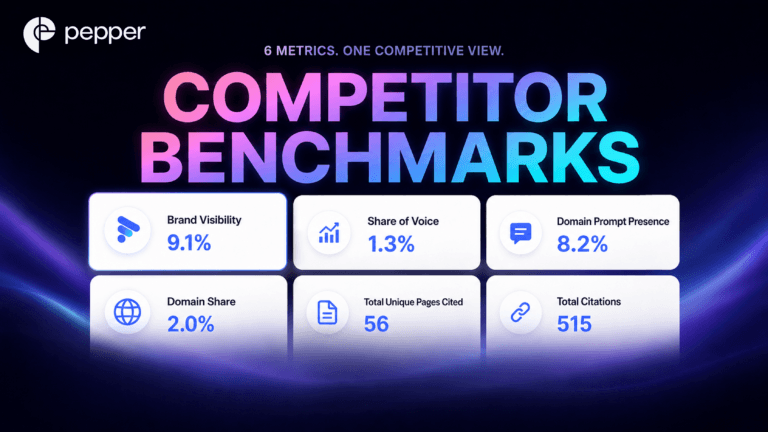
TL;DR: Leadership does not want to hear that AI search feels different this quarter. They want the number. Competitor Benchmarks in Pepper’s GEO platform puts six core GEO metrics in one view, your brand against your entire competitive set, tracked daily. You can slice it by engine, competitor, theme, or date range, zoom any single […]
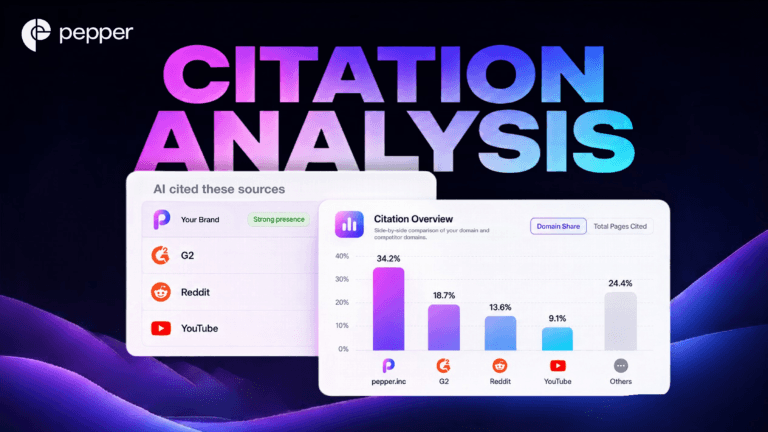
TL;DR: AI engines do not read your website the way a person does. They build an answer from sources they already trust, which means the pages deciding your category are usually not yours at all. Citation Analysis, inside Pepper’s GEO platform, ranks every domain AI cites in your category, splits them into your pages, your […]
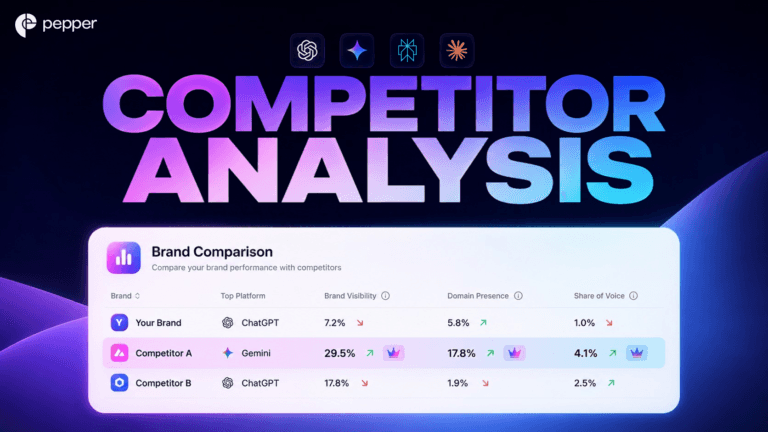
TL;DR If a competitor is beating you in AI search, staring at the gap accomplishes nothing. The only useful move is to focus on that one competitor and work out exactly how they win. Here is how you do it with Pepper’s GEO platform: start at the leaderboard, find the conversations they control, drill into […]
Get your hands on the latest news!
Similar Posts
GEO / AI Search
6 mins read
Competitor Benchmarks: Show Your Board Exactly Where You Stand
GEO / AI Search
6 mins read
Citation Analysis: See the Sources Deciding Who AI Believes
GEO / AI Search
5 mins read