Best GEO agencies for healthcare brands in 2026
The short answer
Healthcare is the single heaviest AI Overview category on the internet. Also, it is also the one where getting a fact wrong is a clinical problem rather than a marketing one. That combination is why generic GEO agencies struggle here.
Key takeaways
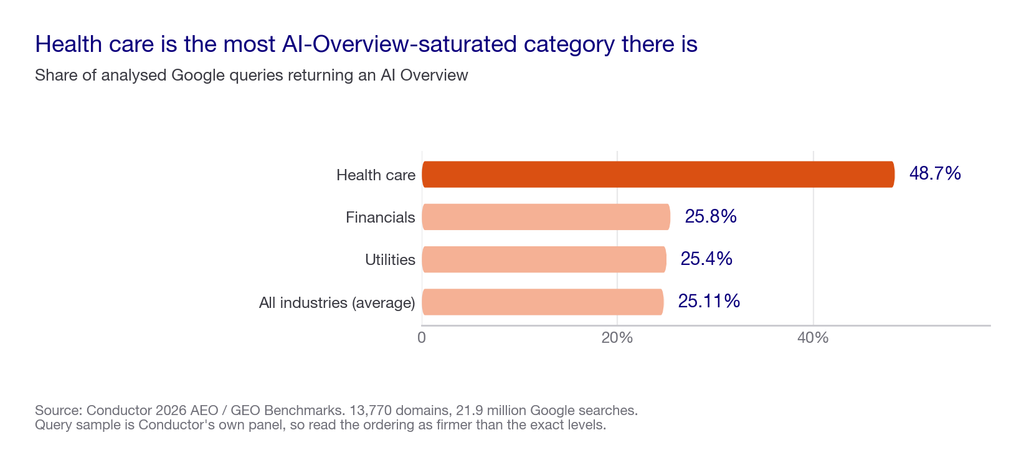
- AI Overviews appear on 48.7 percent of health care queries, nearly double the all-industry average of 25.11 percent. No other sector has this much exposure.
- The differentiator is not medical vocabulary, which is learnable. It is whether a partner can work through clinical review and produce content a doctor will put their name to.
- Author identity is the lever. In a category where engines filter hard on credibility, named clinicians on the byline do more than any schema change.
- We have a healthcare case study and we go through it in detail below, including the numbers and the part that is specific to India.
- Almost nobody in this category publishes pricing. We say so rather than guessing.
A note on where this comes from. We run organic for more than 250 enterprises at Pepper and track over 10 million prompts across every major engine. In addition, this is shaped by that, by weekly client reviews, and by conversations with healthcare marketers at the events we run. So this is our read, not a directory. Where we think the category oversells, we say so.
What is a healthcare GEO agency?
A healthcare GEO agency gets a medical brand named and cited in AI answers, working inside clinical and regulatory review rather than around it. The mechanics are shared with GEO everywhere: entity clarity, retrievable structure, and authority in the sources engines trust. What changes is that every substantive claim needs someone qualified behind it. What is more, that the cost of an inaccurate answer is measured in patient harm rather than lost sessions.
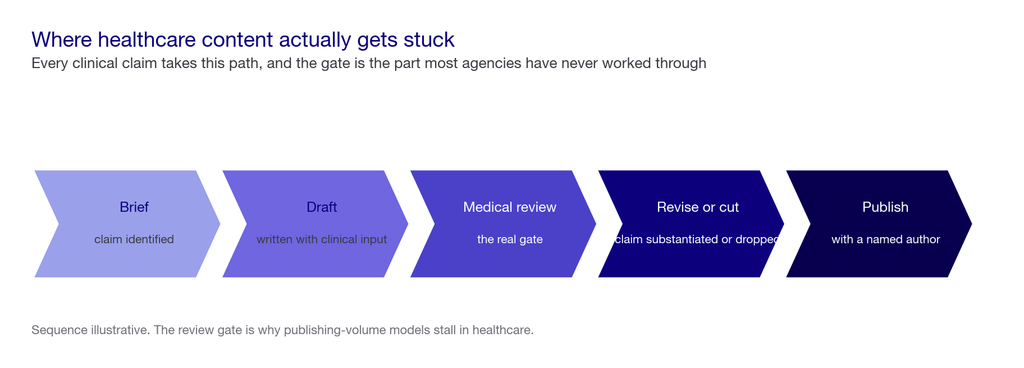
Most agencies can learn the vocabulary in a fortnight. Very few have shipped content through a medical reviewer who has veto power and uses it.
Why healthcare is the hardest GEO category
Three things separate it, and each changes what you should buy.
The exposure is extreme. Conductor’s 2026 AEO and GEO benchmarks analysed 13,770 domains across 21.9 million Google searches and found AI Overviews on 48.7 percent of health care queries, against 25.11 percent across all industries and 25.8 percent in financials (Conductor, 2026). Almost half of health searches now return a generated answer before a single result. If you are not in it, you are not in the consideration set.
Credibility filtering is heavier than anywhere. Health sits squarely in the “your money or your life” category. As a result, engines weight source authority hard and thin content is filtered rather than merely outranked. The practical consequence is that publishing volume, which works in unregulated categories, actively fails here.
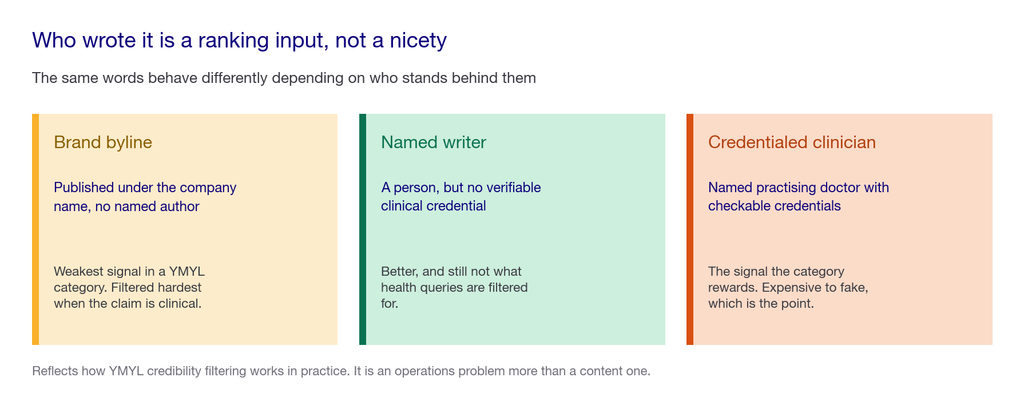
Author identity carries the weight. This is the part most GEO advice misses. In health, who wrote it is a ranking input, not a nicety. A page attributed to a named practising clinician, with credentials that can be checked, behaves differently from the same words published under a brand byline. That is not a schema trick, it is a sourcing and operations problem, and it is expensive to fake.
The upside is that all three are moats. A category where accuracy is costly to counterfeit rewards whoever can actually prove things.
Where the answer gets decided
Muck Rack’s May 2026 study of more than 25 million cited links across ChatGPT, Claude and Gemini found earned media accounts for 84 percent of AI citations, with paid and advertorial at 0.3 percent and journalism alone at 27 percent (Muck Rack, May 2026).
In healthcare, that maps onto a specific and hard-to-enter set: medical publications, institutional sources, professional bodies and clinician-authored material. Very little of it sits on your domain. In addition, almost none of it can be bought, which is what getting cited in LLMs actually depends on.
The same study found the engines differ sharply. ChatGPT carries a citation in 96 percent of responses, Gemini in 82 percent, Claude in just 55 percent. So one blended visibility number tells a healthcare team very little.
See where you show up. Pepper’s GEO platform tracks Brand Visibility, Domain Prompt Presence and Share of Voice across ChatGPT, Perplexity, Gemini, Claude and Google AI Overviews. Equally, a growth team works the account alongside you. Book a growth audit or see where you show up.
What we have actually shipped in healthcare
We have a healthcare case study. That is more than most of this list can say, and it is worth going through properly rather than as a logo.
Apollo 24/7 is the digital arm of one of India’s largest healthcare groups. When we started, the content strategy was essentially blogs and social, against a potential audience of 33 million monthly visitors. In addition, the company was trying to become a full digital health ecosystem covering the whole patient lifecycle.
The interesting part is what the work actually consisted of. Because it is not what a generic GEO proposal looks like.
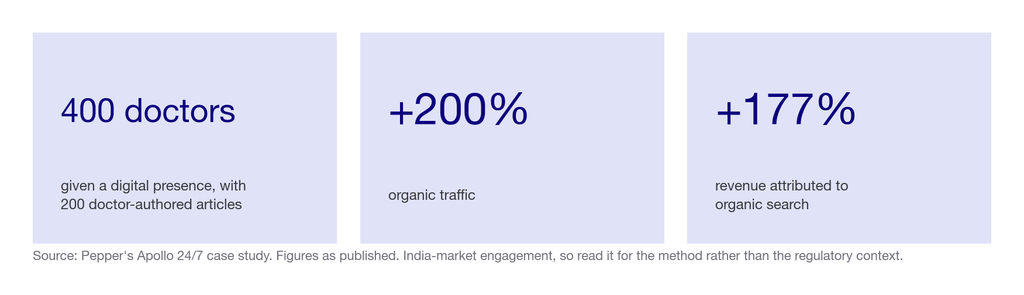
We scanned more than 50,000 pages for gaps, repurposing opportunities and outdated material. Then we built digital presence for 400 Apollo doctors, and produced 400 thought leadership blogs, 200 doctor-authored articles, hundreds of YouTube videos and 4,000 Google Business Profile posts, running an on-demand network of over 100 healthcare content and creative specialists to do it.
That doctor-authored number is the one worth staring at. Two hundred articles with a named practising clinician behind them is an E-E-A-T asset that a competitor cannot replicate by writing faster. Beyond that, it is exactly the signal a YMYL category rewards.
The results, as published: organic traffic up 200 percent, 2.5 times more new users, 15 percent average month-on-month revenue growth, 77 percent growth in organic revenue within a year. In addition, 177 percent increase in revenue attributed to organic search. Video content saw a 23-fold increase in impressions and 16-fold in reach.

Himanshu Sirohi, Apollo 24/7’s Head of Digital Marketing, described the operational side rather than the metrics: the platform brought the whole team together, everyone had access. On top of that, everyone could see exactly what content was being created. That is the self-serve half of how we work. In addition, in an organisation coordinating 400 clinicians it matters more than any dashboard feature.
What Apollo does not prove. It is an India-market engagement, so the regulatory environment is not the FDA or MHRA. It is also predominantly an SEO and content programme whose structural properties, topical authority, author credibility and retrievability, are the same ones that drive AI citation. Rather than a controlled GEO experiment. If your question is specifically about US medical device or pharma promotional compliance, ask us about that directly rather than reading it into this.
For a case study where the GEO measurement is explicit, the honest reference is SalesHood, which is B2B SaaS: AI Overview visibility went from 14 keywords to 97, blog impressions from 200,000 to 417,000. Similarly, rich results grew 291 percent in five months.
How we evaluated these agencies
Applied to what each firm publishes on its own site, checked on 24 August 2026, rather than to another roundup.
| Factor | Weight | What we looked for |
|---|---|---|
| Clinical review capability | 35% | Evidence of shipping through medical review, and access to credentialed authors |
| GEO depth | 30% | Entity work, citation strategy and off-site authority rather than a renamed SEO deck |
| Engine coverage | 20% | What is tracked at the tier you would actually buy |
| Measurement and attribution | 15% | Citation-level tracking that reaches something downstream |
**What we could not verify.** Pricing, for most of this list. WebFX publishes a starting rate of $3,000 a month; the rest quote custom. Where a firm names no healthcare specialism on its own site, we say that rather than inferring one.
The shortlist at a glance
| Agency | Healthcare positioning | Model | Engines named publicly | Pricing |
|---|---|---|---|---|
| First Page Sage | Enterprise clients incl. Dignity Health | Agency, SEO plus GEO | Not specified | Not published |
| Intero Digital | Names healthcare, fintech, cybersecurity | Agency, GRO framework | ChatGPT, Gemini, Perplexity, AI Overviews | Not published |
| WebFX | Positions itself as a healthcare specialist | Agency, OmniSEO platform | Google AI Overviews, ChatGPT, Gemini, Perplexity | From $3,000/mo |
| Omniscient Digital | Generalist B2B software | Managed service | ChatGPT, Perplexity, AI Overviews | Not published |
| Animalz | Generalist B2B SaaS, editorial-led | Agency, AEO practice | Multi-engine | Not published |
| TripleDart | B2B tech, healthcare not named | Agency plus Slate platform | ChatGPT, Gemini, Perplexity, AI Overviews | Not published |
| Minuttia | SaaS and tech above $10M ARR | Boutique, strategy-first | ChatGPT, Perplexity, Gemini, AI Overviews | Not published |
| Pepper | Apollo 24/7, 200 doctor-authored articles | Platform plus growth team | ChatGPT, Perplexity, Gemini, Claude, AI Overviews | Custom, annual |
—
The shortlist
1. Pepper
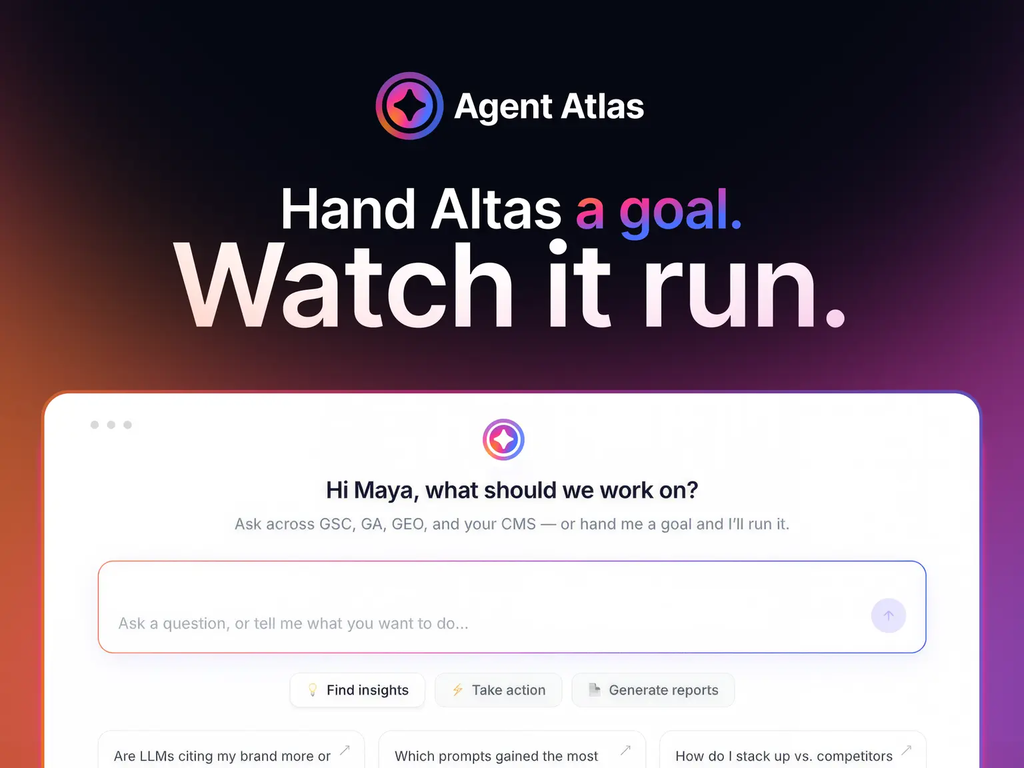
Pepper is an agentic organic growth engine. Atlas is the platform underneath. Beyond that, it works two ways: your team logs in, connects Search Console and GA4, defines competitors and personas, manages the prompt set and builds and runs your own agents in the Agent Atlas, while a Pepper growth team works the same account alongside you. In healthcare that shared visibility does real work. Because content usually has to move between marketers, clinicians and compliance, and the usual failure is that nobody can see where a piece is stuck.
Our healthcare practice and the Apollo 24/7 work above are the evidence. In addition, the full case study library is public, including the part we cannot claim: it is an India-market engagement rather than a US regulatory one. We work the three levers of Visibility, Citability and Retrievability and report Brand Visibility, Domain Prompt Presence and Share of Voice across five engines. In healthcare the gap between the first two is usually stark: the brand is named constantly and cited rarely. Because the citation went to a medical institution.
Eight years, 250 plus enterprises, more than 10 million tracked prompts.
2. First Page Sage
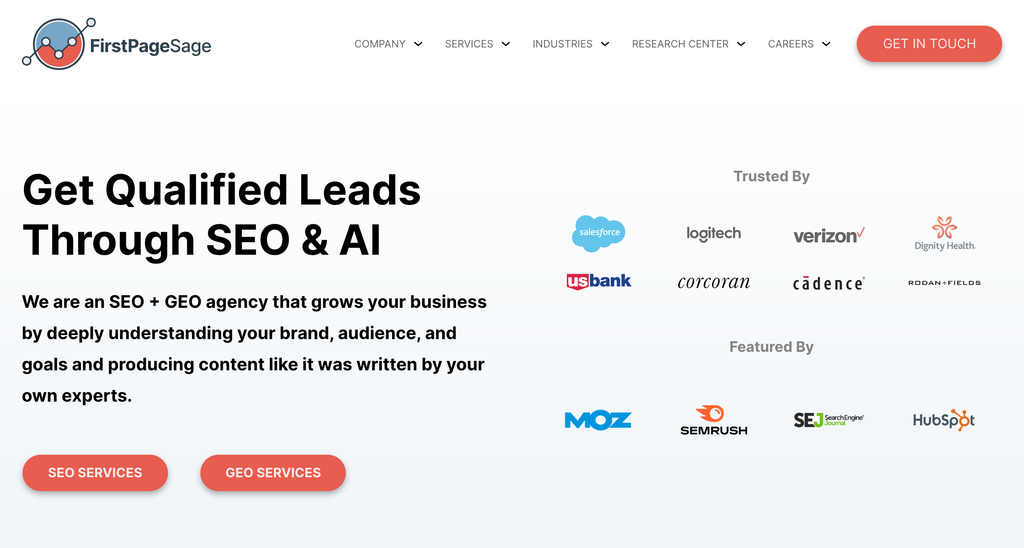
First Page Sage describes itself as an SEO and GEO agency, selling both as named services rather than treating GEO as an add-on. In addition, its published client list is enterprise and mid-market including Dignity Health. That healthcare logo is the closest thing to sector proof it makes public. Also, in a category this hard, one named health system counts for something.
The gap is everything it does not publish. No engagement model, no volume expectation, no pricing, and no statement of which AI engines it covers. It also names no vertical specialism. As a result, the healthcare experience has to be established in a call rather than inferred from the site.
3. Intero Digital
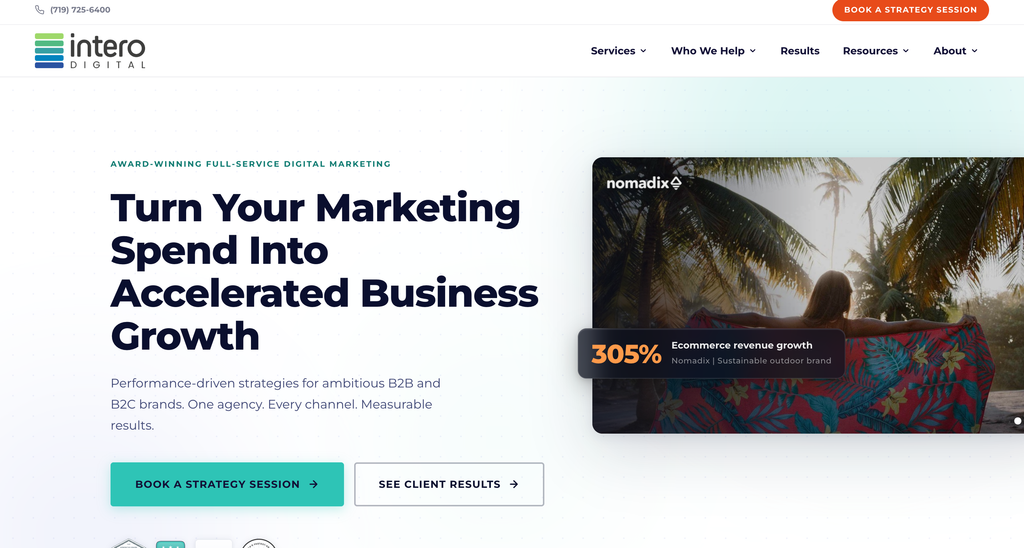
Founded in 1996, Intero formalises its AI search work as Intero GRO, its own Generative Response Optimization framework. In addition, runs it across channels rather than as an isolated content programme. It names healthcare explicitly alongside fintech and cybersecurity, putting it in the small group claiming regulated-sector depth rather than learning it on your account.
What to probe: its public case studies lean toward broader SEO wins rather than engine-level citation gains. As a result, ask for healthcare-specific evidence. Being a large multi-channel agency also means organic competes internally with paid and PR.
4. WebFX
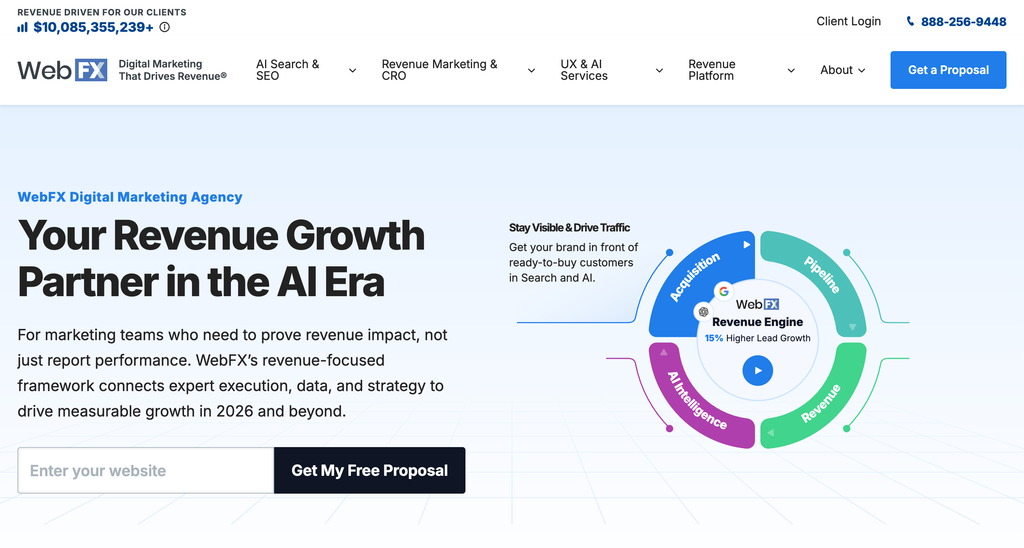
WebFX is a 750-person agency based in Harrisburg, Pennsylvania, and it positions itself explicitly as a healthcare specialist rather than a generalist with a health page. It runs GEO through OmniSEO, its own visibility tracking platform, covering Google AI Overviews, ChatGPT, Gemini and Perplexity. It also publishes a starting rate of $3,000 a month, which almost nobody else in this category does.
Where it gets thin: at 750 people it is a very large full-service agency. As a result, the question is not capability but who is actually on your account. Ask for the named team and their healthcare experience specifically. Worth noting too that the healthcare GEO roundup WebFX publishes ranks itself best overall, which is the same conflict this article has.
5. Omniscient Digital
Founded in 2019 and based in Austin, Omniscient originated the Barbell Content Strategy, pairing high-intent conversion content with long-form thought leadership. What is more, ties content to pipeline rather than traffic. That orientation suits healthcare, where session counts are a particularly poor proxy for value.
It is a managed service with no platform layer. As a result, visibility depends on their reporting rather than a system you can query, and it is a generalist across B2B software with no healthcare specialism named.
6. Animalz
Animalz describes itself as a content marketing and SEO agency for leading B2B SaaS brands, sells Answer Engine Optimization as a named service. In addition, has a content refresh tool called Revive. The editorial standard is the highest here.
The mismatch for healthcare is structural rather than about quality. This is a B2B SaaS editorial model. Equally, healthcare’s binding constraint is credentialed authorship and clinical review, which is an operations problem rather than a writing one.
7. TripleDart
TripleDart works exclusively with B2B tech, running GEO through Slate, its own platform, covering content structuring, schema and prompt testing. Strong if your healthcare product is sold as B2B software to providers or payers.
It does not name healthcare among its focus areas, which are dev tools, fintech, HR tech and security. So for a clinical or patient-facing brand this is a harder fit, and it publishes no pricing.
8. Minuttia
Minuttia is SaaS and tech specific, built for companies past roughly $10 million in ARR, working strategy-first with integrated content and AEO. A good fit for health tech sold as software rather than care.
Boutique capacity limits how fast it scales, the ARR threshold rules out earlier-stage teams. In addition, it names no healthcare or regulated specialism, so probe the review workflow directly.
What healthcare GEO costs
Nobody on this list publishes rates, which is worth noting in itself.
| Shape of engagement | Typical range | What it usually buys |
|---|---|---|
| Tracking platform only | $99 to $1,500 a month | You read the data and act yourself |
| Boutique or specialist GEO | $3,000 to $8,000 a month | The common shape for mid-market health brands |
| Clinician-authored programmes | Higher, and quoted custom | Credentialed authors cost more than writers, unavoidably |
| Organic run as a function | Custom, usually annual | Strategy, execution and accountability for the number |
Healthcare costs more than general B2B for a reason you cannot design around: medical review takes time. On top of that, credentialed authors are expensive. A quote at general-B2B rates usually means the content is being written by someone with no clinical background and reviewed by nobody.
How to choose a healthcare GEO partner
Most healthcare shortlists are decided on how well the agency understood the condition or product in the first call. That tests their preparation, not whether they can move your visibility or survive your review process.
Start with the context that reframes it. In May 2026 Google published its first official guidance on optimising for AI features, filed under SEO fundamentals: AEO and GEO are part of SEO, AI Overviews and AI Mode run on core Search ranking systems. In addition, there is no separate AI index. It also names llms.txt, content chunking and AI-specific rewrites as things to stop doing.
Correct, for Google. And Google is one engine, and Conductor’s data says health care is the most AI-Overview-saturated category there is. So fundamentals are the floor, and the exposure above that floor is larger for you than for anyone else.
The scorecard I would use
Score each partner out of 100 before the pricing conversation.
| Area | Weight | What a strong partner should demonstrate |
|---|---|---|
| Clinical review workflow | 25% | Can describe, unprompted, how content moved through medical review at a named client, including what got rejected and what happened next |
| Credentialed authorship | 20% | Has a route to named clinicians who will put their name on work, or a model for using yours without exhausting them |
| AI visibility measurement | 20% | Shows cited URLs, competitors and share of voice per engine rather than one blended number |
| Off-site authority | 15% | Can name the medical and institutional sources that decide your category, and has a route into them |
| Technical execution | 10% | Will change entity clarity, schema, structure and crawler access themselves |
| Business attribution | 10% | Reaches appointments, enquiries or pipeline rather than stopping at citations |
Give each shortlisted partner 20 to 30 real questions patients or clinicians ask. Not your brand name. Things like “what are the treatment options for this condition”, “is this procedure covered”, “what should I ask before starting this medication” and “which clinic near me does this”.
Then ask for five answers: where do we appear. That competitors or institutions appear instead, which sources are influencing those answers, why are those sources winning, and what exactly would you change in the first 90 days.
Then add the healthcare-specific test. Ask what they would do if an AI answer stated something clinically wrong about your service. A partner who has worked in this category has a process. One who has not will offer sympathy.
Run the set twice on different days. Engines are probabilistic, so a single run establishes nothing.
The weak playbook against the strong one
The weaker sequence, still widely sold: find keywords, publish condition pages, add an FAQ block, hope for a citation. In healthcare it fails faster than anywhere, because unattributed condition content is exactly what YMYL filtering is designed to suppress.
The stronger sequence, and the one we ran at Apollo: audit what exists, establish credentialed authorship. Then technical discoverability, then depth on the conditions you can genuinely own, then institutional and earned presence, then measurement, then attribution.
The difference matters because generative engines assemble an answer from several sources. Being retrieved, being cited and influencing the answer are three separate things. Similarly, in a category where a medical institution outranks everyone, they need measuring separately.
Red flags
- “We guarantee citations.” Nobody controls a generative engine’s output, and Google gives the same warning about guaranteed rankings.
- No named clinical reviewer. Ask who signs off medically. If the answer is the content team, walk.
- “We will publish 50 condition pages a month.” In YMYL this actively harms you.
- Ghostwritten clinician bylines with no involvement. Beyond the ethics, engines increasingly cross-check author identity, and getting caught is worse than never trying.
- A dashboard as the whole proposition. It shows the gap. Someone still has to close it.
- One engine. Health queries surface across all of them.
- No answer on handling a wrong AI answer. In this category that is the question, not a detail.
The five questions I would spend the meeting on
- “Walk me through a piece of content from brief to publication at a healthcare client.” Listen for named review gates and something being rejected.
- “How do you get credentialed authors, and how much of their time does it take?” This is the operational constraint that decides whether the programme runs at all.
- “Take one query where a medical institution outranks us and explain why.” Separates people who understand source authority from people reselling software.
- “What would you change that does not need clinical sign-off?” A good partner has a real answer, because that is where the first 60 days go.
- “Which part of your methodology do you expect to be obsolete in a year?” A thoughtful answer beats a confident one.
Reduced to one principle: hire for the ability to get a qualified human to stand behind the work. Then for GEO skill. Everything else in healthcare follows from that.
One honest closing note. Very few firms are equally strong across clinical operations, measurement, earned authority and attribution, ours included. The good ones will tell you which is their weakest without being asked.
What nobody should promise you
A guaranteed citation or position in an AI answer. Nobody controls the output, and Google says the same about guaranteed rankings.
A single composite AI visibility score presented as a ranking. Ask a model the same question repeatedly and the answers move. Brand Visibility, Domain Prompt Presence and Share of Voice across a fixed prompt set are real numbers. One screenshot is not.
And nobody should promise medical accuracy on your behalf. An agency can build the process, produce the drafts and manage the workflow. The clinical responsibility stays with you. In addition, any partner willing to take it off your hands is telling you something about how they work.
You may not be ready for an agency yet
The answer that costs us the sale. If you have no clinician willing to review content, or no process for getting one, you do not need a healthcare GEO agency yet. Credentialed authorship is the constraint the whole category runs on, and no partner can manufacture it. Solve who reviews and who signs before you solve who writes. That sequencing costs nothing and it is the difference between a programme that ships and a retainer that stalls in month two.
Frequently asked questions
What does a healthcare GEO agency do?
It gets a medical brand named and cited in AI answers, working through clinical review rather than around it. The work spans credentialed authorship, entity and schema clarity, presence in medical and institutional sources, and citation tracking across engines.
Why is healthcare the hardest GEO category?
Conductor found AI Overviews on 48.7 percent of health care queries, nearly double the all-industry average, so exposure is extreme. Engines also filter hardest on credibility here, and author identity carries more weight than in any other sector.
How much do healthcare GEO agencies charge?
None on this list publishes rates. Specialist engagements commonly run $3,000 to $8,000 monthly. Also, clinician-authored programmes cost more because credentialed authors are more expensive than writers. Treat general-B2B pricing as a warning sign.
Do doctor-authored articles actually help AI visibility?
Author credibility is a genuine input in YMYL categories. That is why we built presence for 400 clinicians and produced 200 doctor-authored articles at Apollo 24/7. It is an operations problem more than a content one, and hard for competitors to copy.
How long until healthcare GEO shows results?
Structural fixes such as schema and crawler access can move within four to eight weeks. Authority in medical sources compounds over three to six months and often longer. Since those outlets have their own review standards.
Can a general B2B agency handle healthcare?
Some can. The distinguishing capability is not medical vocabulary. That is learnable, but a working relationship with clinical review and a route to credentialed authors who will sign their names.
Which engines matter most for health queries?
Track them separately. Muck Rack found ChatGPT carries a citation in 96 percent of responses, Gemini 82 percent and Claude 55 percent. As a result, the same content performs very differently depending on where the question is asked.
What should we fix before hiring anyone?
Accuracy of clinical claims across your site, a named medical reviewer and a workflow they will actually use, structured data on key pages, crawler access for AI user agents. In addition, a written list of the questions patients genuinely ask.
Where to go next
Ask ChatGPT and Perplexity fifteen questions a patient in your category would genuinely ask, and read the citations. That is your baseline and it costs an afternoon.
If the cited sources are medical institutions and professional bodies you have never appeared alongside, you have an authority problem rather than a content problem. Which is worth knowing before you commission fifty condition pages.
Book a growth audit · See where you show up
Sources and further reading
- Muck Rack. “What Is AI Reading?” May 2026 edition. More than 25 million cited links across ChatGPT, Claude and Gemini, 17 industries. Link
- Google Search Central. First official AI search optimisation guidance, published 15 May 2026, filed under SEO fundamentals.
- Pepper. Apollo 24/7 case study and SalesHood case study. Metrics as published on each page.
Latest Blogs
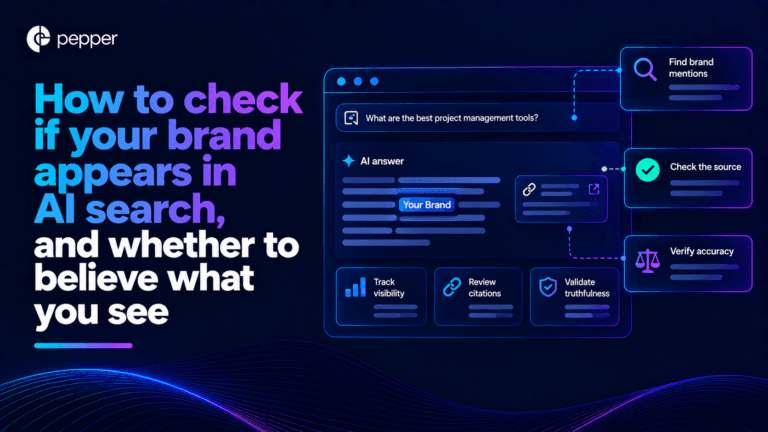
You can check if your brand appears in AI search in about twenty minutes, on two engines, without paying for anything. The method is simple and the result is noisier than most people admit. In one 2026 pilot, ChatGPT searched the web on only 42% of buying prompts, so on the rest there was no retrieval event at all. In another, rewording a question changed the answer more than 23% of the time. This article gives you the check, then gives you the four reasons it can lie, so you can tell a real absence from a bad sample.
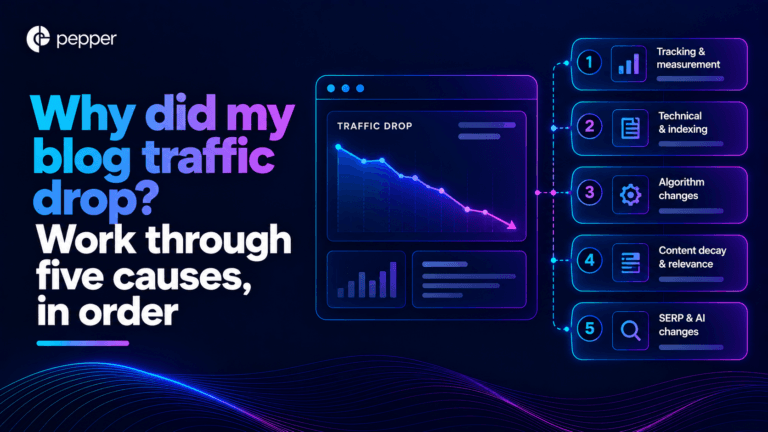
A blog traffic drop has five plausible causes and AI search is the most interesting one, which is exactly why people reach for it first. It is also the only one you cannot measure directly, so it should be diagnosed last, by elimination. The first check takes ten minutes and costs nothing: put clicks and impressions on the same chart. In one 2026 study of 53 brands, clicks held flat at around 400,000 while impressions more than doubled, so clickthrough halved without a single visitor being lost. Work through the other four before you conclude anything about AI.
Google publishes one eligibility rule for AI Mode, and in May 2026 it published what AI Mode users actually do. Both matter more than the fan-out arithmetic the category quotes.
Get your hands on the latest news!

Similar Posts
GEO / AI Search
17 mins read
How to check if your brand appears in AI search, and whether to believe what you see
GEO / AI Search
17 mins read
Why did my blog traffic drop? Work through five causes, in order
Artificial Intelligence
13 mins read