The short answer
Your rankings probably held. Your clicks probably did not. That gap is the whole problem, and it is why “improve your rankings” is now the wrong instruction on its own.
The work that moves Google and the work that gets you cited are mostly the same work. It is done in a different order and judged by a different number. Google’s own guidance is explicit that optimizing for generative AI search is still SEO. What changes is that a page can rank perfectly and never be quoted. Ranking rewards the best destination. Citation rewards the most quotable source.
So the sequence below is one sequence, not two. It just stops treating your own website as the only lever.
Key takeaways
- Fix what blocks retrieval first. Over 70% of chatbot errors trace to retrieval rather than reasoning. If an agent cannot fetch or parse the page, nothing downstream matters.
- Then make the page quotable rather than merely useful. A direct answer near the top, claims stated plainly, one idea per passage. This is the cheapest work with the fastest return.
- Then earn authority off your own domain. 84% of AI citations come from earned media. Another blog refresh will not fix an absence problem.
- Measure two numbers, not one. How often engines mention you, and how often they cite a page from your domain. The gap between them tells you which problem you have.
- Do not wait for one workstream to finish before starting the next. The overlaps are deliberate, and sequential working is the most common way a programme loses a quarter.
A note on where this comes from. We run organic for more than 250 enterprises and track more than 10 million prompts across every major engine. This is the order we actually work in, shaped by the client reviews we sit in weekly and the accounts we take over. It is our method rather than a published standard, and the charts say so where that applies.
What is AI search optimization, and is it different from SEO?
AI search optimization is the practice of making your pages retrievable, quotable and corroborated well enough that AI engines use them. Google states the position plainly in its official guidance on optimizing for generative AI features. “From Google Search’s perspective, optimizing for generative AI search is optimizing for the search experience, and thus still SEO.”
That is correct, and it is correct for Google. It does not mean the two are identical everywhere else, because a shopping assistant reading your page is not running Google’s ranking systems. The same guidance tells you to skip most of what gets sold as AI-specific work. “You don’t need to create new machine readable files, AI text files, markup, or Markdown to appear in Google Search.”
So treat this as one discipline with a wider surface. Most of the work is shared. A little of it is not.
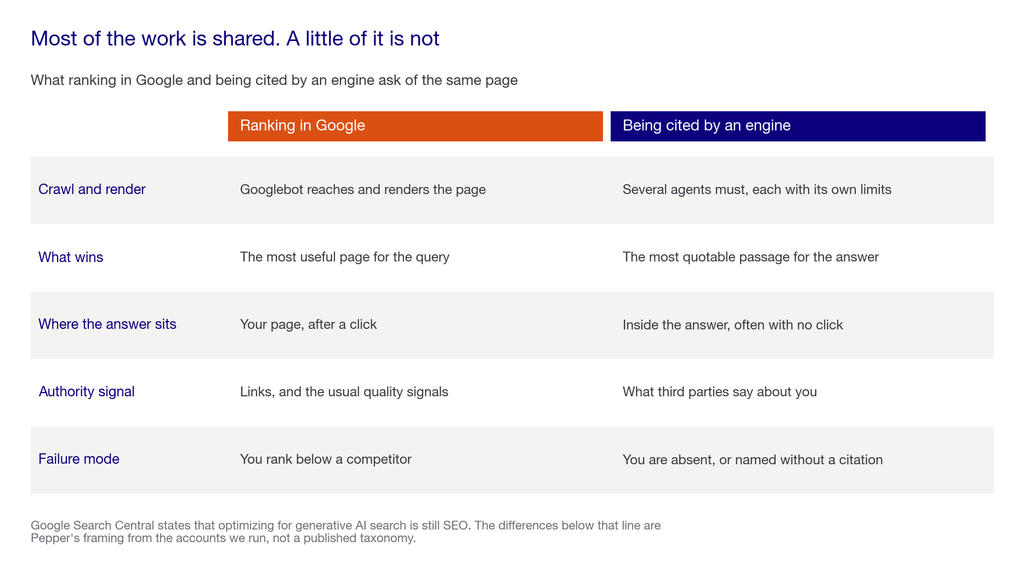
The row that matters most is the last one. In Google, failure looks like ranking below a competitor. In an AI answer, failure looks like being absent entirely, or being named while somebody else gets the citation. Those are different problems, and we have written separately about telling them apart.
Why the old advice stopped working
Three findings, all published in 2026, explain most of the change.
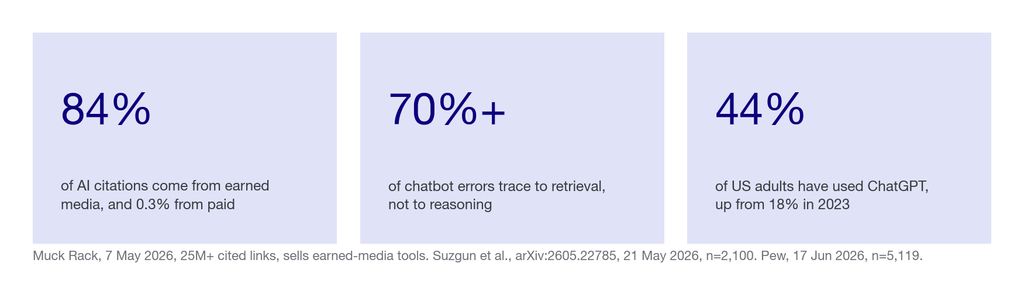
Muck Rack analysed more than 25 million cited links across 17 industries in May 2026. Earned media accounted for 84% of AI citations, against 0.3% for paid. Muck Rack sells earned-media software, so read it with that interest in mind, though the figure has held between 82% and 89% across three editions.
A Stanford-led evaluation of six chatbots published on 21 May 2026 tested 2,100 questions. It found retrieval failures, rather than reasoning failures, drive over 70% of all errors. When an engine gets you wrong or skips you, the usual cause is what it could fetch.
And Pew Research Center put ChatGPT at 44% of US adults in 2026, up from 18% in 2023, with 42% using chatbots to search. The behaviour is mainstream, which is why a flat ranking with falling clicks is now a common and expensive pattern.
Our point of view
We think most teams are working in the wrong order, and it costs them a quarter every time.
The instinct when clicks fall is to produce. More posts, more refreshes, more pages. What we see in accounts we take over is a content programme running at full speed on a site that renders its main content in JavaScript. Or a brand with genuinely good pages that no third party has ever written about. The production was not the constraint.
Our bias is explicit: fix what blocks, then make what you own quotable, then go and earn what you cannot make. That order is cheapest first and slowest last. You buy evidence early, and spend the expensive budget only once you know it is the right one.
Book a growth audit if you want us to run your prompt set and tell you which step you are actually stuck on.
Our methodology: how we weighted the work
We are not ranking products here, so there is no vendor scorecard. What we publish is how we weight the four workstreams when an account has all four open. That ordering is a judgement, and you should be able to argue with it.
| Workstream | Weight | Why it carries that weight |
|---|---|---|
| Retrievability and technical | 30 | It gates everything else. Earning coverage that points at a page an engine cannot render wastes the coverage, and this is usually the cheapest fix on the list. |
| On-page structure and quotability | 25 | The fastest return of the four, because you control the page and can ship a change this month rather than negotiate for it. |
| Content that answers the real question | 25 | Necessary and frequently over-invested in. Weighted equal to structure rather than above it, which is the opposite of how most programmes are staffed. |
| Earned authority and citations | 20 | The largest lever on citations and the slowest to move. Weighted lowest not because it matters least, but because starting here before the first three are done wastes it. |
Weights sum to 100. Retrievability and structure carry 55 between them, which is a judgement, and it is the judgement this page rests on.
The sequence, step by step
1. Make sure engines can fetch and read you
The cheapest work and the one that gates the rest.
- Confirm AI crawlers can reach you at all. Start with robots.txt for AI crawlers and our guide to crawlability for AI.
- Check your main content renders without JavaScript execution. A page that needs a browser to reveal its text is a page an engine may never read.
- Make your core entity facts identical everywhere: name, category, products, location, founding year. Contradictions across sources are what an engine cannot reconcile.
- Use schema markup to state plainly what each page is about.
Usually days of engineering. Movement shows in the prompt set within a month.
2. Make the page quotable as well as useful
A page can be the best resource on the internet and still never be quoted, because nothing in it is liftable.
- Put a direct answer to the heading’s question in the first two sentences under it.
- State claims plainly in a single sentence rather than implying them across three paragraphs.
- Keep one idea per passage, so a model can take a clean chunk without losing the meaning.
- Give the supporting detail a third party cannot: your own data, your own method, your own numbers.
- Our guide to structuring content for AI citation covers the mechanics.
Weeks of work, and the fastest return on this page.
3. Answer the question people actually ask
- Write against real commercial questions, not keyword variants of the same one.
- Cover the comparison and alternatives queries you have been avoiding, because those are the ones engines assemble answers from.
- Prune rather than refresh. Fewer, better pages beat a large library of thin ones on both surfaces.
4. Earn the authority you cannot manufacture
- Get into the sources engines already trust for your category: review platforms, analyst listings, industry roundups and genuine press.
- Treat this as a standing programme rather than a campaign, because it compounds and it cannot be compressed.
- How to get cited in LLMs and the LLM trust hierarchy cover which sources carry weight.
Months, and usually a budget. Start it early precisely because it is slow.
What moves when
Sequential working is the most expensive mistake here. Start the slow things early and let them overlap.
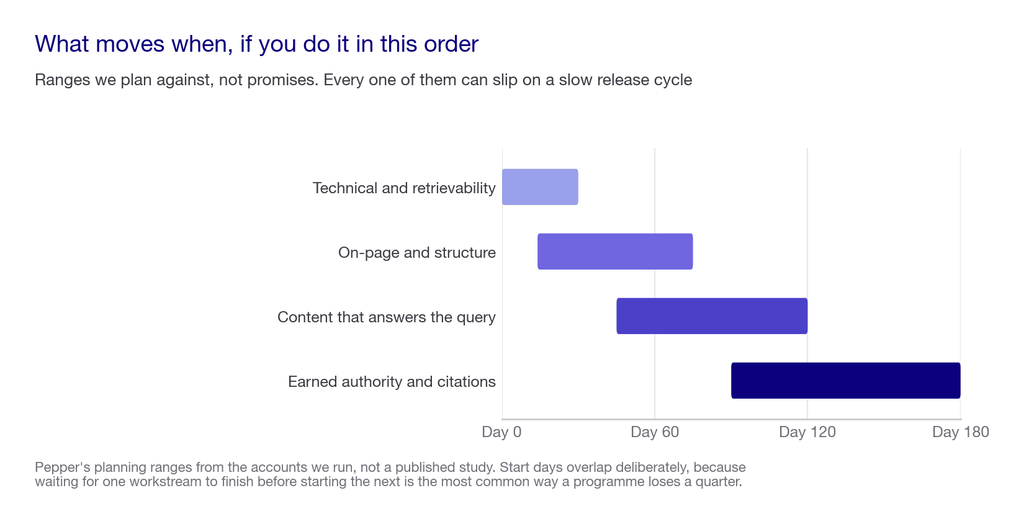
- Technical and retrievability: first 30 days. Cheapest, fastest, and it unblocks everything after it.
- On-page and structure: starts around day 14, showing movement to about day 75.
- Content: starts around day 45, compounding to about day 120.
- Earned authority: start by day 90 at the latest, and expect to be reading results at day 180.
These are ranges we plan against, and every one of them slips on a slow release cycle. If your engineering queue is six weeks deep, add six weeks to everything.
What this looks like when it works
Two Pepper accounts, on two different surfaces, each on its own scale.
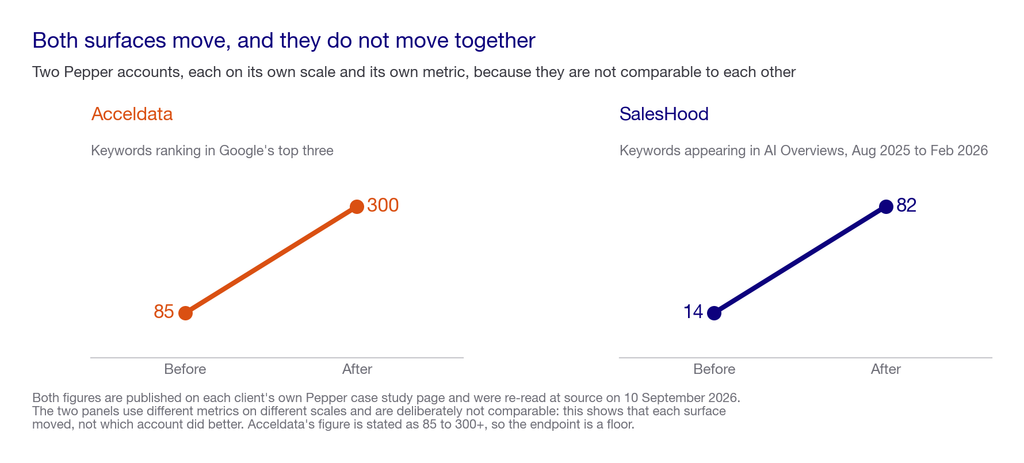
Acceldata went from 85 keywords in Google’s top three to more than 300, alongside 6X organic traffic and 260,000 impressions from a single hero guide. That is the classic surface behaving normally when the work is done properly.
SalesHood is the more interesting one for this article, because it shows the other surface moving. Keywords appearing in AI Overviews went from 14 in August 2025 to 82 in February 2026. Impressions grew from 200,000 to 417,000, and clicks rose 20% during a period of industry-wide decline.
The two panels are deliberately on separate scales and different metrics. They are not comparable to each other. Presenting them on a shared axis would imply one client did better, which the data does not support and we would not want to say about two customers.
What we would not bother doing
Some of the most-recommended tactics in this category are, on Google’s own account, unnecessary.
- Creating llms.txt or AI-specific files. Google’s guidance states you do not need new machine-readable files, AI text files, markup or Markdown to appear in Search.
- Chunking content into tiny fragments. The same guidance says there is no requirement to break content up for AI to understand it.
- Rewriting pages in a special voice for AI. Also named as unnecessary.
- Chasing a single AI visibility score. One composite number across engines that behave differently hides the gap you are trying to see. Our own help documentation is explicit that no universal good target exists for these metrics.
- Publishing more of what already is not working. Volume against a surface where most citations come from somebody else’s site.
The four steps at a glance
| Step | What it fixes | Typical effort | Time to first movement | Who usually does it |
|---|---|---|---|---|
| 1. Retrievability and technical | Engines cannot fetch, render or reconcile your pages | Days of engineering, no ongoing spend | Within 30 days | Your engineers, briefed by SEO |
| 2. On-page structure | You rank but nothing is quotable | Weeks per priority cluster | Around day 75 | Content and SEO together |
| 3. Content that answers the query | You are missing from the questions that matter | Ongoing, but fewer pages than you think | Around day 120 | Content, against a real question set |
| 4. Earned authority | Engines do not trust or know you | A retainer, or a lot of relationship work | Around day 180 | Digital PR, in-house or bought |
Read it top to bottom. The cost rises and the speed falls as you go down, which is the whole reason for the order.
What this costs, and who pays for what
There is no single price, but the shape is predictable enough to budget against.
- Step one is usually free in cash and expensive in queue position. It is engineering time you already pay for, and the real cost is getting it prioritised against the product roadmap.
- Step two is the best value on the page. Weeks of existing content and SEO time, no new tooling, and the fastest evidence that anything is working.
- Step three is the line item most teams over-fund. Weight it equal to structure rather than above it, and prune before you commission.
- Step four is the one that needs real budget. Either a digital PR retainer or a dedicated internal hire, and it is the only step you cannot compress by spending more in a hurry.
- Measurement tooling runs from free to roughly $300 a month, and whether you need a monitoring tool at all is worth answering before you buy one.
If budget only covers one of the four this year, fund step four and do the first three with the team you have. It is the only one that does not get cheaper by waiting.
Pepper, and how we run this
We are an agentic organic growth engine, which means three things working together rather than one product.
- An organic growth partner. A growth team is attached to your account, a senior strategist plus always-on agents, running this sequence alongside your people and accountable for the number.
- Pepper’s GEO platform. Genuinely self-serve. You log in, set up a workspace, define brand profile, competitors and personas, connect GA4 and Search Console, and manage themes and prompts. It tracks six engines, including ChatGPT, Perplexity, Gemini, Claude and Google AI Overviews, and reports Brand Visibility and Domain Prompt Presence side by side, which is how you see step four working before the traffic arrives.
- The Agent Atlas. Your team builds, versions and runs its own agents on a visual canvas, with quick runs for a single input and sheet runs for bulk. It is how steps one to three get done at the scale a real site needs.
Where it falls short. We do not publish pricing, so budget discovery is a conversation rather than a page. We are built for teams treating organic as a long-term function, so a one-off audit is not what we are for. Our depth sits in content, authority and AI search rather than large technical migrations. If step one turns out to be a replatform, bring in specialists for that part. And if your problem is purely that engineering has not shipped the fixes you already know about, no partner solves that for you.
How to choose what to do first
I will write this in the first person, because a sequence nobody will defend is worth nothing.
The honest starting point is that you probably cannot do all four workstreams at once, and the choice of what to start decides your next two quarters. So diagnose before you commit. Here is the scorecard I would use on the work itself, not on a vendor.
| Area | Weight | What tells you to start here |
|---|---|---|
| Is anything blocking retrieval | 30 | Rendering problems, blocked crawlers, contradictory entity facts. If any of these are true, everything else is on hold and this is not a judgement call. |
| Can you ship a page change this month | 25 | If yes, structure work is your fastest evidence. If your release cycle is quarterly, plan around that rather than pretending otherwise. |
| Do engines mention you at all | 25 | Absence across a prompt set points at earned authority. Being named without a citation points at your own pages. The two look identical on a traffic chart. |
| Do you have budget for earned media | 15 | Not whether you should do it, but whether you can. If you cannot fund it this year, weight the first three higher and be honest that the ceiling is lower. |
| Can anyone act on what you find | 5 | Low weight, high consequence. A diagnosis nobody has capacity to act on is a report, and you should fix the capacity first. |
Weights sum to 100. Retrieval carries the most because it is binary: it is either blocking you or it is not.
Before committing a quarter, run the free diagnostic. Write 20 to 30 real commercial prompts your buyers would type. Run them three times each across every engine you care about, and give any fix 90 days before judging it. Four worked examples for a mid-market B2B SaaS analytics company:
- “best data observability platform for enterprise”
- “how do I monitor data quality across Snowflake and Databricks”
- “Acceldata vs Monte Carlo vs Bigeye”
- “what should I look for in a data observability vendor”
Sort the answers. Absent everywhere points at step four. Named without a citation points at steps two and three. Wrong or inconsistent facts point at step one.
Red flags, each one something a vendor actually says:
- “We guarantee first page and AI citations.” Nobody can. Google’s own guidance warns to be wary of third-party tools promising ranking success or claiming to use internal Google metrics.
- “You need an llms.txt file.” Google says you do not, and the guidance is public.
- “Here is your AI visibility score.” One number across engines that behave differently hides the diagnosis.
- “We will publish 40 articles a month.” Volume aimed at the layer that is usually not your constraint.
- “Rankings do not matter any more.” An overcorrection. Rankings still matter, they are simply no longer sufficient.
- “We can start earned media next week and show results in a month.” The one workstream that genuinely cannot be compressed.
Five questions I would ask before signing anything, and what a good answer sounds like:
- “Which of the four steps are we stuck on, and what is your evidence?” A good answer cites a prompt-set tally. A weak one proposes an audit.
- “What would you fix first, and why that rather than the others?” A good answer names a blocking issue. A weak one starts with a content calendar.
- “How will you tell whether step two worked before traffic moves?” A good answer separates mentions from citations. A weak one waits for sessions.
- “What would you tell us to stop doing?” A good answer names something specific. A weak one adds without removing.
- “Show me a case where the number went down and what you did.” A good answer exists, because everyone has one.
It comes down to one principle: do the cheap thing that unblocks, before the expensive thing that compounds. The weaker sequence starts with production because it feels like progress. The stronger one starts with what an engine can reach, then what it can quote, then what other people say about you.
The note that costs us something. Very few firms are equally strong at technical work, content, digital PR and measurement, ours included. Ask everyone on your shortlist which of those four is their weakest, and ask us too.
What nobody should promise you
- A guaranteed position or citation. Engines are probabilistic and no third party controls their ranking systems.
- A single composite AI visibility score that means something. There is no universal good target for these metrics.
- Results in weeks from earned authority. It is the one workstream that does not compress.
- Conclusions from one run on one engine. Three runs on different days is the floor.
- Clean attribution from a citation to closed revenue. That measurement does not exist yet.
Frequently asked questions
How do I improve my organic search rankings?
Work in order. Fix anything blocking crawlers and rendering, make your pages quotable with direct answers near the top, cover the questions buyers actually ask, then earn third-party coverage. The first step is cheapest and gates everything after it.
Is AI search optimization different from SEO?
Google states that optimizing for generative AI search is still SEO. The work is largely shared. What differs is that ranking rewards the best destination while citation rewards the most quotable source, so a page can rank well and never be quoted.
How long does it take to improve organic rankings?
Technical fixes can show inside 30 days. Structure and on-page work typically move by day 75. Content compounds to around day 120. Earned authority takes until roughly day 180 and cannot be compressed by spending more.
Do I need an llms.txt file to rank in AI search?
No. Google’s guidance says you do not need new machine-readable files, AI text files, markup or Markdown to appear in Search. Treat vendors who insist otherwise with caution, because the guidance is public and explicit.
Why did my rankings stay flat while clicks fell?
Usually because answers are being assembled above the results, so users get what they need without clicking. Your position held and the click did not follow. That is a citability problem rather than a ranking problem.
What should I measure instead of rankings alone?
Track two numbers alongside the classic set. How often engines mention your brand, and how often they cite a page from your domain. The gap between them tells you whether you have an awareness problem or a citability problem.
Does publishing more content improve rankings in 2026?
Rarely, on its own. 84% of AI citations come from earned media rather than your own site, so volume aimed at your blog is usually aimed at the wrong layer. Fewer, better-structured pages outperform a large thin library.
Can I do this without buying any tools?
Yes, at least to diagnose. Write 20 to 30 commercial prompts, run them three times each across the engines your buyers use, and sort the answers. Tooling helps when you need to track the same set on a schedule.
Where to go next
For the wider operating picture, the AI search operating system covers how these workstreams connect and who owns them. Unsure which step you are stuck on? Why your competitor shows up in ChatGPT and you do not is the diagnostic version of this page.
For the definitions, what GEO is and AEO vs SEO cover the terminology. For measurement, what to track and what to ignore is the practical version.
If you would rather have this run for you, see where you show up and we will start with the diagnostic.
And the honest exit. If your engineering team has a backlog of known fixes it has not shipped, you do not need a new organic strategy this quarter. You need those fixes shipped. Buying a programme on top of an unshipped backlog is the most reliable way we know to spend a year and move nothing.
Sources and further reading
Research sources, all published in 2026 and checked at the original on 10 September 2026:
- Google Search Central, “Optimizing your website for generative AI features on Google Search”, announced 15 May 2026 and last updated 10 July 2026. All quoted phrases appear verbatim. Used for the position that generative AI optimisation is still SEO, for the llms.txt and chunking guidance, and for the warning about third-party tools.
- Muck Rack, “What Is AI Reading?”, published 7 May 2026. More than 25 million cited links across 17 industries and ChatGPT, Claude and Gemini. Used for the 84% earned-media and 0.3% paid figures. Muck Rack sells earned-media software and has a commercial interest in this finding.
- Suzgun et al., “Evaluating Commercial AI Chatbots as News Intermediaries”, arXiv:2605.22785, submitted 21 May 2026. Six chatbots on 2,100 questions derived from BBC News reporting. Used for the retrieval-error finding. The study is on news questions, so applying it to commercial pages is our inference.
- Pew Research Center, “Americans and AI 2026”, published 17 June 2026, 5,119 US adults. Used for ChatGPT at 44% and 42% using chatbots to search.
Client results, read at source on 10 September 2026:
- Acceldata case study: 6X organic traffic, top-three keywords from 85 to more than 300, 100,000 plus new organic users, 260,000 plus impressions from one hero guide.
- SalesHood case study: keywords in AI Overviews from 14 in August 2025 to 82 in February 2026, impressions from 200,000 to 417,000, clicks up 20%.
Removed from the previous version of this page, and why:
- The entire 2021 article, “How to Improve Website SEO: 6 Quick Tips”. At roughly 1,200 words it covered URL structure, meta tags, site speed, alt text, anchor text and page structure, and predates AI search entirely.
- The “Team Pepper” byline, replaced with a named author and reviewer.
- A conversion statistic attributed to a vendor blog with no publication date, which we could not verify to a 2026 primary source.
Latest Blogs
Most advice on this is inference dressed as fact. OpenAI documents exactly one thing clearly, which is access. Here is what is documented, what is inferred, and how to verify the rest for yourself.
Being named in an AI answer and having your page used as its source are different outcomes with different causes and different fixes. The gap between them is the most useful diagnostic in AI search, and most reporting collapses it into one number.
Every platform reports share of voice and almost none of them define it the same way. Here is the definition worth using, the three choices that change the number, and how to measure it yourself without buying anything.
Get your hands on the latest news!

Similar Posts

Digital Marketing
12 mins read
Does YouTube help AI visibility? What the citation data shows
Digital Marketing
15 mins read
What a modern SEO team looks like in 2026
Digital Marketing
5 mins read