
The short answer
A modern organic team still does five jobs: strategy, technical, content, off-page, and measurement. That has not changed since 2022. What changed is what each job now involves, and the fact that one of them has quietly grown a sixth responsibility nobody was assigned.
If you are hiring, aim for four things in this order. One person accountable for the number. One who can fix what blocks retrieval. One who can produce content built to be cited. And access to earned media. Everything else is a nice-to-have until those four exist.
Key takeaways
- The five functions survived. The work inside them did not. Link building became earned media. Content volume became citability. An annual technical audit became continuous retrievability.
- The market repriced this in about six months. SEO job ads asking for AI search skills went from 12.2% in December 2025 to 20.3% in June 2026.
- It is being hired senior. 28% of postings asking for AI search skills carry a leadership title, against 15% of standard SEO ads, and they pay a median $117,500 against $97,500.
- AI search is owned by nobody by default. It sits across content, technical, PR and brand, so unless one name is written down, it falls between four people who each assume somebody else has it.
- You probably need fewer people than you think, and more senior ones. Four accountable people beat eight who each own a fragment.
A note on where this comes from. We run organic for more than 250 enterprises and track more than 10 million prompts across every major engine. This is shaped by that, by the client reviews we sit in every week, and by hiring conversations with in-house leads at our events. What follows is the structure we see working, plus the hiring data we could verify. It is our read, not a survey of the industry.
What does a modern SEO team look like?
It looks like five functions and, in most companies we work with, between two and six people. Small teams double up. Large teams specialise. The functions do not change with headcount, only the number of people covering them.
- Strategy and ownership. Decides what the team works on this quarter and is accountable for the number moving. On a two-person team this is the same person as content.
- Technical. Makes sure engines and crawlers can reach, render and parse the site. Now a continuous function rather than an annual audit.
- Content. Produces pages built to answer questions directly and be lifted cleanly by an engine. Fewer pages, better structured.
- Off-page and earned media. Gets the brand mentioned and cited on sources engines already trust. This is the function that changed most.
- Measurement. Reports rankings and traffic, and now also brand mentions and citations per engine.
The sixth responsibility, AI search, is not a sixth person. It is a slice of the first four, which is exactly why it goes missing.
What is different about an organic team in 2026?
The job titles look similar. The work underneath them has moved, and the hiring market has repriced it faster than most teams have restructured.
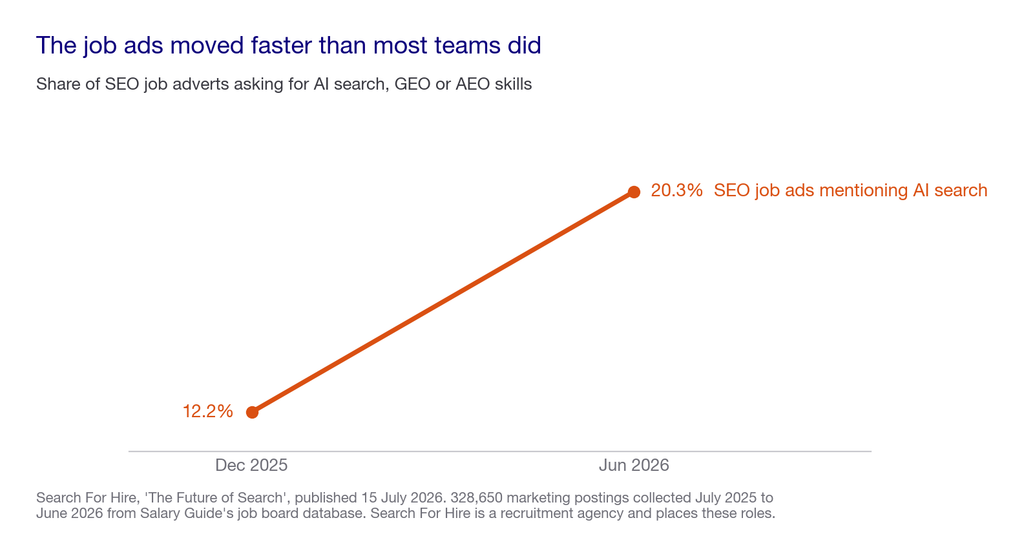
Search For Hire analysed 328,650 marketing job postings collected between July 2025 and June 2026. In December 2025, 12.2% of SEO job ads mentioned AI search, GEO or AEO skills. By June 2026 it was 20.3%. That is one in five, from one in eight, in six months.
Search For Hire is a recruitment agency that places these roles, so it has an interest in the trend looking healthy. The direction matches what we see in client teams. The dataset and window are also stated, which is more than most figures in this category offer.
Two things follow. The skill is now priced into the market, so you will pay for it. And it is being asked for at a level of seniority that suggests companies have stopped treating it as a task.
SEO team structure, then and now
This page, in its 2022 form, recommended hiring a link building specialist. That is the clearest single marker of how much has moved.
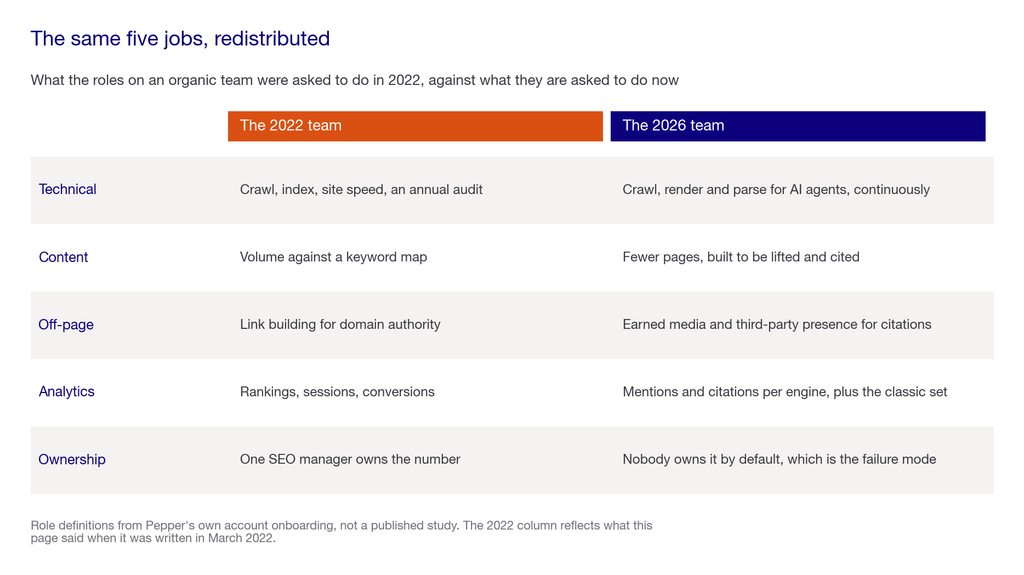
- Technical used to mean crawl, index, site speed and an annual audit. It now means making sure AI crawlers can fetch and parse you continuously. A page that needs JavaScript to render its text is a page an engine may never read, and crawlability for AI is now a standing item rather than a project.
- Content used to mean volume against a keyword map. It now means fewer pages, structured to be lifted and cited. The direct answer near the top matters more than the word count.
- Off-page used to mean link building for domain authority. It now means earned media and third-party presence, because that is where engines take their citations from. This is the largest change on the list and the one teams are least staffed for.
- Analytics used to mean rankings, sessions and conversions. It now means those plus mentions and citations per engine, and knowing what to track and what to ignore.
- Ownership used to be simple. One SEO manager owned the number. Now the work spans four functions and, unless somebody writes a name down, it is owned by nobody.
Our point of view
We think most teams are one role short, and it is not the role they think.
The instinct when AI search arrives is to hire a specialist, or to send the existing SEO to a course. What we see working is different: appoint an owner first, then buy the capability you are missing. In the accounts we take over, the constraint is almost never knowledge. Somebody usually knows what should happen. Nobody has the authority or the capacity to make it happen across four functions at once.
The second thing we would say plainly: if you have budget for one hire, do not spend it on a junior. A modern organic team is small and senior, because the work is now cross-functional and coordination is the bottleneck. Four accountable people will beat eight who each own a fragment.
Book a growth audit if you want a read on which of the five functions is actually your weakest before you write a job description.
Who owns AI search, and why it is being hired senior
Because it sits across content, technical, PR and brand, AI search is the responsibility that falls between chairs. Our colleague Dhriti has written the full argument in the AI search team ownership model, including the RACI and the handoffs that break. The short version: it needs one accountable name. That name usually has to be senior enough to direct work in functions they do not manage.
The hiring data says the market has reached the same conclusion.
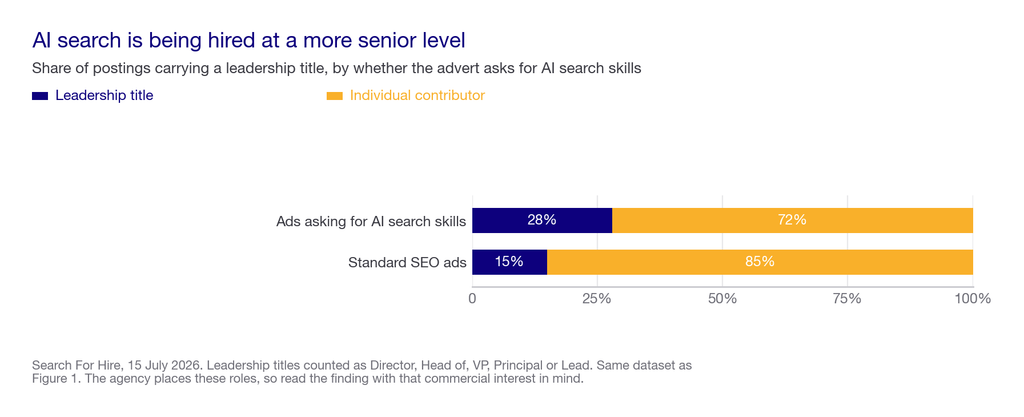
28% of postings asking for AI search skills carry a leadership title, against 15% of standard SEO postings. Those roles also carry a median advertised salary of $117,500 against $97,500, a premium of roughly 20.5% across 13,779 US postings with salaries listed.
Read that as a signal about scope rather than about the skill itself. Companies are not paying more for prompt-writing. They are paying for somebody who can hold four functions together, which is a management problem wearing a technical hat.
Our methodology: how we weighted the first hires
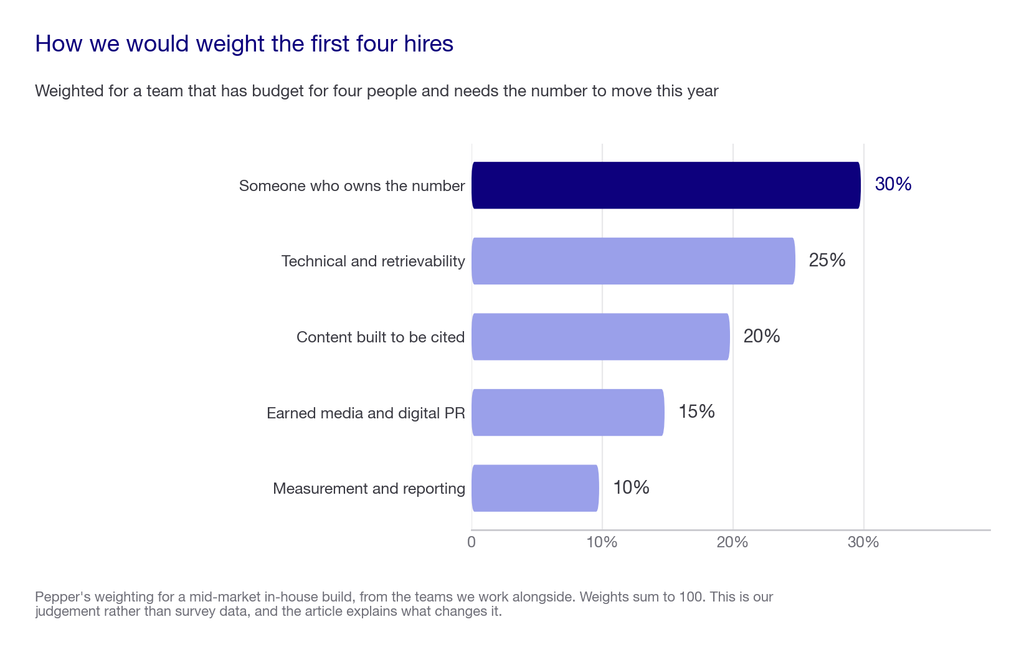
There is no vendor ranking on this page, so no vendor scorecard. What we publish instead is how we would weight the first four hires for a mid-market team. That is a judgement, and you should be able to argue with it.
| Hire | Weight | Why it carries that weight |
|---|---|---|
| Someone who owns the number | 30 | Without a single accountable name, work spans four functions and stalls in the gaps between them. This is the hire that makes the others productive rather than busy. |
| Technical and retrievability | 25 | It blocks everything else. There is no point earning coverage that points at pages an engine cannot render, so we fix the gate before we fix the funnel. |
| Content built to be cited | 20 | The fastest return of the three delivery functions, because you control the page and can ship a change this month rather than negotiate for it. |
| Earned media and digital PR | 15 | The largest lever on citations and the slowest to move, which is why we usually borrow it before we buy it. |
| Measurement and reporting | 10 | Necessary, not sufficient, and the easiest of the five to cover with tooling or a fractional resource in year one. |
Weights sum to 100. Ownership and technical carry 55 between them, which is the whole argument of this page: assign it, then unblock it, then produce.
What would change these weights. If you already have a strong technical function, move that 25 into content. Where your brand is genuinely unknown in the category, earned media rises and nothing else matters as much. If you are pre-product-market-fit, do not build this team yet.
The team at a glance
| Function | What it owns now | Hire order | Median US salary signal |
|---|---|---|---|
| Strategy and ownership | The number, the quarter’s priorities, cross-functional handoffs | First | $117,500 median for AI-search leadership postings |
| Technical | Crawlability, rendering, schema, entity consistency | Second | Standard SEO band, around $97,500 median |
| Content | Pages built to be lifted and cited, not volume | Third | Standard SEO band, varies widely by seniority |
| Off-page and earned media | Third-party presence on sources engines trust | Fourth, or borrowed | Usually a retainer rather than a salary |
| Measurement | Mentions and citations per engine, plus classic reporting | Tooling first, person later | Tooling from free to about $300 a month |
Salary figures are advertised US medians from the Search For Hire dataset and are a signal about scope, not a budget. Adjust for market, seniority and whether the role is remote.
How to build it, in order
- Name the owner before you write any other job description. One person, accountable for the number, senior enough to direct work in functions they do not manage. If you cannot fund this, fund a fractional version of it rather than skipping it.
- Fix retrieval next. Check that AI crawlers can reach and render the site, and that your core entity facts are consistent everywhere. Often days of engineering, and it gates everything downstream.
- Get content producing to a citable standard. Fewer pages, direct answers near the top, claims stated plainly rather than implied. One good editor plus briefs beats three writers without them.
- Buy or borrow earned media. Almost nobody’s first four hires should be a digital PR person, but almost every team needs the capability. A retainer or an agency is usually the right answer in year one.
- Add measurement last, and start with tooling. You can run a competent prompt-set diagnostic by hand long before you need a dedicated analyst.
The order matters more than the speed. Teams that hire content first and ownership last produce a lot of pages and no movement, which is the most common failure pattern we take over.
What this costs, and how long it takes
There is no single number, but the shape is predictable.
- A first accountable hire is the biggest line item, and the market signal is around $117,500 for AI-search leadership roles in the US against $97,500 for standard SEO postings.
- Technical work is usually existing engineering time rather than a new hire, measured in days for the first pass.
- Earned media is typically a retainer, and it is the slowest to show a return. Budget months.
- Tooling runs from free to roughly $300 a month, and whether you need a monitoring tool at all is worth answering before you buy one.
Expect to see technical movement inside a month, content movement in 60 to 90 days, and earned-media movement over quarters. Anyone promising faster is selling you something.
Pepper, and how we work alongside a team like this
We are an agentic organic growth engine, which is three things working together rather than a product you bolt on.
- An organic growth partner. A growth team is attached to your account, a senior strategist plus always-on agents, doing the work alongside your people and accountable for the number. For teams that cannot yet fund a senior owner, this is often the fastest way to get one without a twelve-week hiring process.
- Pepper’s GEO platform. Genuinely self-serve. Your team logs in, sets up a workspace, defines brand profile, competitors and personas, connects GA4 and Search Console, and manages themes and prompts. It tracks six engines, including ChatGPT, Perplexity, Gemini, Claude and Google AI Overviews, and reports Brand Visibility and Domain Prompt Presence side by side.
- The Agent Atlas. Your team builds, versions and runs its own agents on a visual canvas, with quick runs for a single input and sheet runs for bulk. In practice this is what lets a four-person team cover work that used to need eight.
The Acceldata case study is the clearest example we can point at. It records 6X organic traffic and top-three keywords rising from 85 to more than 300, plus 100,000 new organic users and 260,000 impressions from one hero guide.
Where it falls short: we do not publish pricing, so budget discovery is a conversation rather than a page. We are built for teams treating organic as a long-term function, so if you need a one-off audit, hire a contractor instead. Our depth sits in content, authority and AI search rather than large technical migrations. And if you already have a senior owner, a working technical practice and a content engine, you may simply not need us. We would rather write that sentence than have you discover it in month three.
How to choose what to hire first
I will write this in the first person, because a hiring order nobody will defend is worth nothing.
Start from what Google settled. Its official guidance on optimizing for generative AI features says it plainly. “From Google Search’s perspective, optimizing for generative AI search is optimizing for the search experience, and thus still SEO.” That matters for hiring, because it means you are not staffing a new discipline. You are staffing the same one with a wider surface, which argues for upskilling and seniority rather than a parallel AI team.
So my order is ownership, then unblocking, then production, then reach. Here is the scorecard I would score any candidate or partner against.
| Area | Weight | What a strong candidate demonstrates |
|---|---|---|
| Can hold four functions together | 30 | Evidence of directing work they did not personally do, across technical, content and PR. Ask for a specific programme they coordinated and what broke in it. |
| Diagnoses before prescribing | 25 | They ask what your prompt set shows before proposing a plan. A candidate who arrives with a strategy deck has not seen your data. |
| Technical fluency, not depth | 20 | They can tell whether a rendering problem is blocking retrieval and brief an engineer. They do not need to write the fix themselves. |
| Understands earned media | 15 | They know that most citations come from third parties and can describe how they would build that presence without owning a PR budget. |
| Says no to work | 10 | They can name something they would stop doing. Candidates who would do everything you listed have not prioritised anything. |
Weights sum to 100. Coordination carries the most, which is a judgement, and it is the judgement this page rests on.
Before you write the job description, run the diagnostic yourself. Write 20 to 30 real commercial prompts your buyers would type. Run them three times each across every engine you care about, and give any fix 90 days before you judge it. Four worked examples for a mid-market B2B SaaS analytics company:
- “best data observability platform for enterprise”
- “how do I monitor data quality across Snowflake and Databricks”
- “Acceldata vs Monte Carlo vs Bigeye”
- “what should I look for in a data observability vendor”
What comes back tells you which function to hire into. Absent everywhere means earned media. Named but never cited means content and structure. Inconsistent or wrong means technical.
Red flags, each one something a candidate or vendor actually says:
- “I can guarantee you’ll rank in ChatGPT.” Nobody can, and Google’s own guidance warns against third parties promising ranking success.
- “You need a dedicated GEO team.” Usually said by someone selling one. Most companies need one owner and existing people upskilled.
- “I’d start with a content calendar.” Before any diagnosis, this is a template.
- “We should publish more.” Volume against a surface where most citations come from somebody else’s site.
- “I’ll own the strategy, your team executes.” The split that creates the ownership gap this page is about.
- “Rankings are the wrong metric now.” Overcorrection. Classic rankings still matter; they are no longer sufficient.
Five questions I would ask every candidate, and what a good answer sounds like:
- “Walk me through a time you got a page cited by an engine.” A good answer describes the diagnosis and the specific change. A weak one describes publishing.
- “How would you tell whether our problem is visibility, citability or retrievability?” A good answer separates them and names the evidence for each. A weak one says “we’d audit”.
- “What would you stop doing in your first month?” A good answer names something concrete. A weak one adds work without removing any.
- “How do you get digital PR done without a PR budget?” A good answer is resourceful and specific. A weak one says it is not their remit.
- “What is the weakest part of your skill set for this role?” A good answer exists, and it is the strongest signal on the list.
It comes down to one principle: hire the coordinator before the specialists. The weaker sequence hires production capacity and hopes coordination emerges. The stronger sequence names an owner, lets them find the constraint, and hires against that. One optimises for output. The other optimises for the number moving.
The note that costs us something. If you can fund a strong senior owner in-house, you should, and you will need us less. Very few firms are equally good at technical work, content, digital PR and measurement, ours included. Ask whoever you shortlist which of those four is their weakest, and ask us too.
What nobody should promise you
- A guaranteed position or citation in an AI answer. Engines are probabilistic and no third party controls their ranking systems.
- A single composite AI visibility score that means something. Our own help documentation is explicit that there is no universal good target for these metrics.
- That one hire fixes it. AI search spans four functions. One person can own it; one person cannot do it.
- A benchmark headcount for your category. Team size follows the size of your commercial question set, not your industry.
- Clean attribution from a citation to closed revenue. That measurement does not exist yet.
Frequently asked questions
What does a modern SEO team look like?
Five functions: strategy and ownership, technical, content, off-page and earned media, and measurement. Most teams cover them with two to six people. The functions stay constant as headcount grows; only the degree of specialisation changes.
How many people do I need on an SEO team?
Fewer than most guides suggest, and more senior. Four accountable people generally outperform eight who each own a fragment. The work is cross-functional now, so coordination rather than production capacity is the usual bottleneck.
Who should own AI search internally?
One named person, senior enough to direct work in functions they do not manage. It spans content, technical, PR and brand, so without a single accountable name it falls between four people who each assume somebody else has it.
Do I need to hire a dedicated GEO or AEO specialist?
Usually not. Google’s own guidance treats generative AI optimisation as still being SEO. Upskilling an existing senior person is usually better value than a parallel hire, unless your commercial question set is large and spans several markets.
Is the link building specialist role gone?
The title largely is, and the function was absorbed into earned media. The goal shifted from acquiring links for domain authority to earning presence on the third-party sources that AI engines actually cite when answering.
What should I hire first with a limited budget?
Someone accountable for the number, every time. Without a single owner, the work spans four functions and stalls in the gaps between them. Fund a fractional or part-time version of that role before you fund a full-time junior specialist.
How much do AI search roles pay?
Advertised US medians run near $117,500 for postings asking for AI search skills, against $97,500 for standard SEO roles. That is a premium of roughly 20.5%, and it signals the scope of the role rather than a budget.
Should I build in-house or use an agency?
Build the owner in-house and borrow the capability you lack, usually earned media in year one. If you can fund a strong senior owner internally, do that, because you will need outside help less over time.
Where to go next
For the ownership question in full, including the RACI and where handoffs break, read who owns GEO internally. For the wider operating picture, the AI search operating system covers how the functions connect.
If you are weighing in-house against outside help, AEO agency or AEO tool is the more useful read. For the mechanics your team will actually run, start with how to get cited in LLMs and the Visibility, Citability and Retrievability framework.
If you would rather borrow the senior owner than hire one, see where you show up and we will run your prompt set first.
And the honest exit. If organic is not a committed function at your company, you do not need this team yet. Two people doing organic part-time alongside demand gen will not beat a competitor with one accountable owner. Hiring into an uncommitted programme wastes the hire more than the budget. Fix the commitment first, or keep the work with a partner until it exists.
Sources and further reading
Research sources, checked at the original on 9 September 2026:
- Search For Hire, “The Future of Search”, published 15 July 2026. 328,650 marketing job postings collected July 2025 to June 2026 from Salary Guide’s job board database. Used for the 12.2% to 20.3% shift, the 28% versus 15% leadership split, and the $117,500 versus $97,500 salary medians across 13,779 US postings with advertised salaries. Search For Hire is a recruitment agency that places these roles and has a commercial interest in this finding.
- Google Search Central, “Optimizing your website for generative AI features on Google Search”, announced 15 May 2026 and last updated 10 July 2026. The quoted phrase appears verbatim on that page. Used for the position that optimizing for generative AI search is still SEO, and for the warning about third parties promising ranking success.
Removed from the previous version of this page, and why:
- The entire 2022 article, “How to Build the Best SEO Team in 2022”. It recommended a link building specialist, described technical SEO as an annual audit, and predates AI search entirely.
- The “Team Pepper” byline, replaced with a named author and reviewer.
- An unsourced claim that “a study suggests that brands with an in-house SEO team tend to gain better outcomes”. No study was named and we could not identify one, so it is gone rather than re-sourced.
A note on the competing pages for this query. The strongest of them, updated in January 2026, argues that no AI-specific roles are needed because existing roles evolve. We agree on the substance and disagree on the implication. The roles do evolve, and that is exactly why somebody senior has to be accountable for the part spanning all of them.
Latest Blogs
Most advice on this is inference dressed as fact. OpenAI documents exactly one thing clearly, which is access. Here is what is documented, what is inferred, and how to verify the rest for yourself.
Being named in an AI answer and having your page used as its source are different outcomes with different causes and different fixes. The gap between them is the most useful diagnostic in AI search, and most reporting collapses it into one number.
Every platform reports share of voice and almost none of them define it the same way. Here is the definition worth using, the three choices that change the number, and how to measure it yourself without buying anything.
Get your hands on the latest news!

Similar Posts

Digital Marketing
12 mins read
Does YouTube help AI visibility? What the citation data shows

Digital Marketing
15 mins read
How to improve organic search rankings in 2026
Digital Marketing
5 mins read