Does YouTube help AI visibility? What the citation data shows

The short answer
Yes, and almost entirely on three surfaces.
Otterly analysed more than 100 million AI citation instances across six platforms over a 30-day window. YouTube citations concentrate heavily: Perplexity at 38.7 percent, Google AI Overviews at 36.6 percent and Google AI Mode at 19.6 percent. Those three take roughly 95 percent of all YouTube citations between them.
Everywhere else, video barely registers. ChatGPT at 4.4 percent. Copilot at 0.5 percent. Gemini at 0.2 percent.
So “does YouTube help AI visibility” is the wrong shape of question. The right one is which engines your buyers use.
Key takeaways
- YouTube is a Perplexity and Google play. If your buyers live in ChatGPT, video is a weak lever for citation specifically.
- Popularity does not earn citations. Views, likes and subscriber counts all correlate at roughly -0.03, which is statistically nothing.
- Description length is the strongest correlate measured, at 0.31. Hashtags in the description came second at 0.20.
- Long-form wins decisively. 94 percent of citations go to long-form video, and Shorts take just 5.7 percent.
- Timestamps drive repeat citation, and only on Google surfaces. 78 percent of timestamped videos get cited more than once.
Where this comes from. We run organic for more than 250 enterprises at Pepper and track over 10 million prompts across every major engine. We have run video programmes at enterprise scale, including one covered below. The study is not ours, and where it contradicted what we assumed about video, we changed the assumption.
What is YouTube AI visibility?
YouTube AI visibility is whether AI engines cite your videos when they answer a question, and whether your brand gets named in the process.
It is worth separating from two things it gets confused with.
- It is not YouTube search ranking. A video can rank well inside YouTube and never be cited by an AI engine, because the two systems judge completely different things.
- It is not video views. As the data below shows, views and citations have almost no measurable relationship at all.
- It is engine-specific. A video cited constantly on Perplexity may be invisible on Gemini, and that is not a quality problem.
The framework underneath this is the same one that governs written pages, which we set out in Visibility, Citability and Retrievability.
Does YouTube help AI visibility?
It depends almost entirely on the engine, and the spread is wide enough to change a budget.
Read the distribution as a routing decision rather than a score. Perplexity and Google’s two AI surfaces account for roughly 95 percent of YouTube citations. The three remaining platforms share about 5 percent between them.
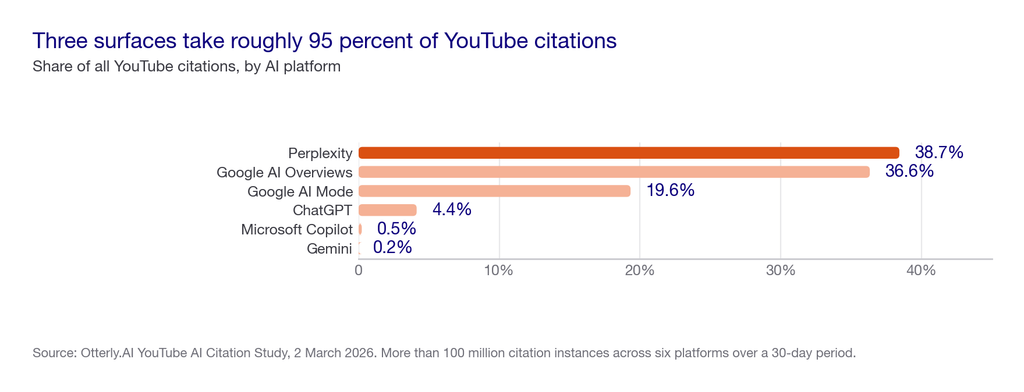
A second dataset agrees, by a completely different method. Ahrefs analysed 1.4 million ChatGPT prompts and found YouTube URLs were cited 0.51 percent of the time they were retrieved. That measures something different from Otterly’s share figure, using a different denominator entirely. Both point the same way: ChatGPT is not where video earns citations.
Two independent studies, two methods, one conclusion. That is about as solid as evidence gets in this field.
See where you show up. Pepper’s GEO platform tracks Brand Visibility, Domain Prompt Presence and Share of Voice across ChatGPT, Perplexity, Gemini, Claude and Google AI Overviews. Your team can log in, connect Search Console and GA4, manage the prompt set and run your own agents in the Agent Atlas. A growth team works the same account alongside you. Book a growth audit or see where you show up.
What that means engine by engine
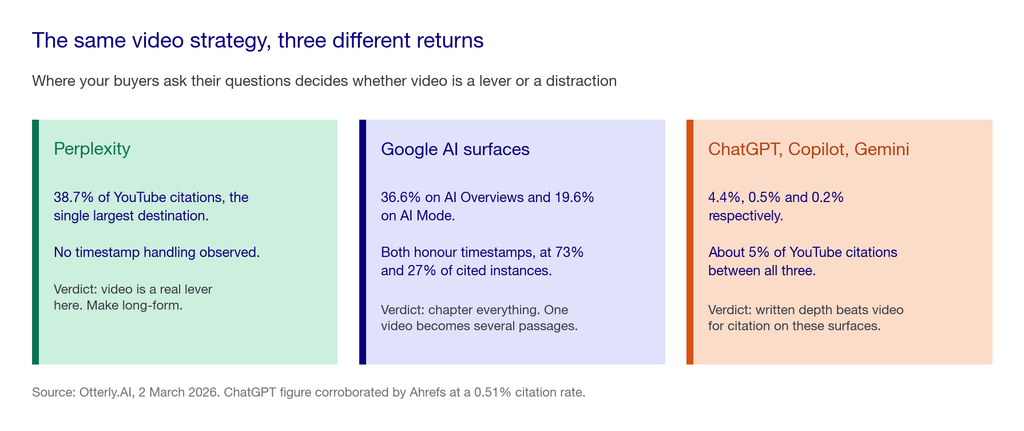
The same video strategy produces very different returns depending on where your buyers ask their questions.

The findings that invert conventional YouTube advice
This is the part worth reading twice, because it contradicts almost everything written about growing a channel.
The study measured correlation between video attributes and citation frequency. The results:
- Video views: -0.03. Statistically nothing.
- Video likes: -0.02. Nothing.
- Channel subscribers: -0.03. Nothing.
- Channel total views: -0.03. Nothing.
- Description length: 0.31. The strongest correlate in the study.
- Hashtags in description: 0.20. Second strongest.
- Video duration: 0.02. Close to nothing on its own.
Read the first four together. Every popularity signal a YouTube strategist optimises for shows near-zero relationship with whether an AI engine cites the video. A channel with a million subscribers has no measurable citation advantage over one with a thousand.
Then read the fifth. The single strongest correlate is how much text sits in the description, which is the part most channels treat as an afterthought.
That makes mechanical sense once you see it. An engine reads text. A video’s description is the largest body of machine-readable text attached to it, so a thin description gives a model almost nothing to work with. We made the same argument about pages in how to write content that AI engines actually cite.
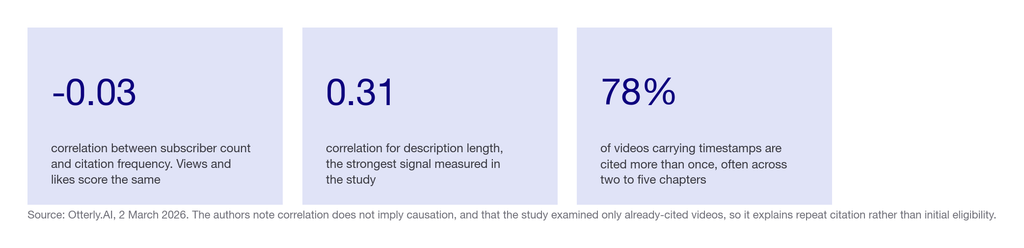
Read the caveat with the finding. The authors state plainly that correlation does not imply causation. They also note the study examined only already-cited videos, so it explains what makes a cited video get cited again rather than what gets a video cited in the first place. That is a real limit and it should temper how hard you push on any single number here.
Format and length
Two clear patterns, both actionable.
- Long-form dominates. 94 percent of citations go to long-form video. Shorts take 5.7 percent, and playlists, channels and livestreams share 0.3 percent between them.
- The sweet spot sits in the middle. The largest cluster of cited videos runs 10 to 20 minutes at 32.1 percent, followed by 5 to 10 minutes at 26.1 percent and over 20 minutes at 17.6 percent.
The practical reading is that a reference-style explainer of ten to twenty minutes is the shape that gets quoted. A thirty-second Short almost never is. The same depth-over-volume pattern shows up in written content, which we covered in topical authority for AI search.
Timestamps, and the Google-only effect
This is the most specific finding in the study, and it applies to exactly two surfaces.
When a YouTube citation carries a specific timestamp, it appears in Google AI Overviews 73 percent of the time and Google AI Mode 27 percent of the time. The authors observed no timestamped YouTube citations at all in ChatGPT, Gemini, Copilot or Perplexity.
The repeat effect is the interesting part. 78 percent of timestamped videos get cited more than once, often across two to five chapters of the same video. Around 31 percent of all cited videos carried timestamp signals.
So chaptering a video does two things on Google’s surfaces. It makes the video citable at the passage level rather than the whole-video level, and it gives one video several chances to be quoted rather than one.
That is the same mechanic we see on written pages, where engines score passages rather than whole documents. The structural side is in how to structure content for AI citation.
What this looked like at enterprise scale
Apollo 24/7 is the largest video programme we have published, and it sat inside a much broader organic engine rather than standing alone.
Alongside 400 doctor-authored blogs and 200 expert-authored articles, the programme produced more than 100 YouTube videos. Video reach grew 16x. The wider programme delivered 700 percent organic traffic growth over two years and a 177 percent increase in revenue attributed to organic search.
Where this evidence fits, and where it does not. This is a reach and audience result rather than an AI-citation measurement, and we would not present it as the latter. What it demonstrates is that clinician-authored video scales, and that video sat alongside written depth rather than replacing it. On the citation question specifically, the Otterly and Ahrefs studies are the evidence, not us.
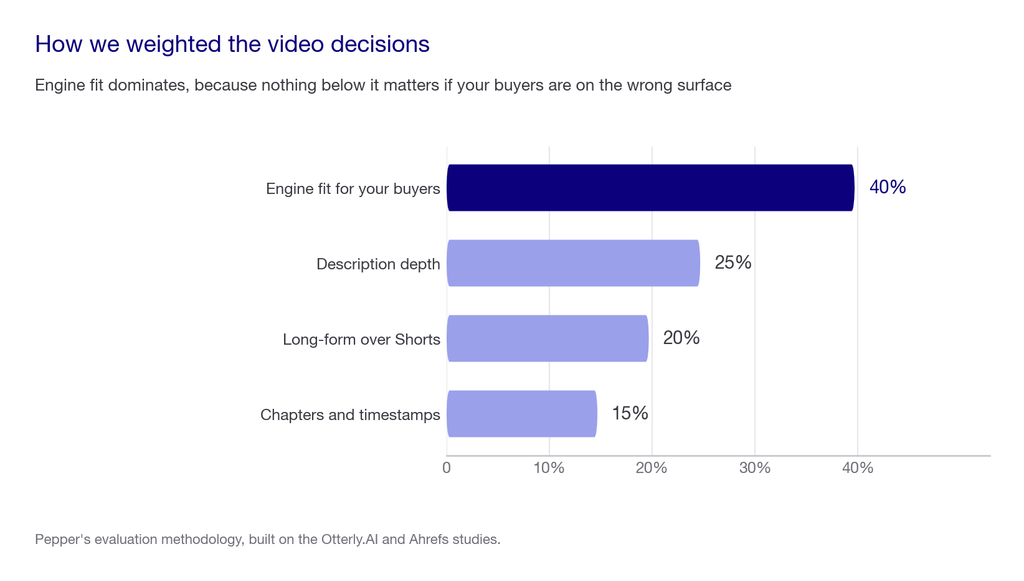
Our methodology: how we weighted the video decisions
| Decision | Weight | Why it carries this much |
|---|---|---|
| Engine fit for your buyers | 40% | Roughly 95% of YouTube citations land on three surfaces. If your buyers are elsewhere, nothing below changes that |
| Description depth | 25% | The strongest correlate measured, at 0.31, and the cheapest thing on this list to fix |
| Long-form over Shorts | 20% | 94% of citations go to long-form, and Shorts take 5.7% |
| Chapters and timestamps | 15% | 78% of timestamped videos are cited repeatedly, though only on Google surfaces |
YouTube for AI visibility at a glance
| Engine | Share of YouTube citations | Timestamps honoured | What video is worth here | Typical cost to compete | Where it falls short |
|---|---|---|---|---|---|
| Perplexity | 38.7% | No | The single biggest destination for video citations | Long-form production, the main line item | Smaller referral share overall, so weigh against your traffic mix |
| Google AI Overviews | 36.6% | Yes, 73% | High, and timestamps open up passage-level citation | Production, plus minutes per video for chapters | Competitive, since it is the surface everyone targets |
| Google AI Mode | 19.6% | Yes, 27% | Meaningful, and rising as the surface grows | Same production, no extra cost | Newer, so historical data is thin |
| ChatGPT | 4.4% | No | Low for citation specifically | Hard to justify on this alone | Corroborated by a second study at 0.51% citation rate |
| Microsoft Copilot | 0.5% | No | Close to nothing | Not worth a dedicated budget | In-tenant usage is invisible to every external tool |
| Gemini | 0.2% | No | Close to nothing | Not worth a dedicated budget | Surprising given Google owns YouTube, and worth watching |
The Gemini row is the one that catches people out. Google owns YouTube, and Gemini still cites it in 0.2 percent of cases, while Google’s AI Overviews cite it in 36.6 percent. Ownership does not imply preference, and the two Google surfaces behave completely differently.
How to choose whether video earns a place in your programme
Start from where your buyers ask questions, not from whether you like making video.
The scorecard
Score the opportunity out of 100 before you commission anything.
| Factor | Weight | How to score it honestly |
|---|---|---|
| Buyers use Perplexity or Google AI surfaces | 40% | You have checked, rather than assumed. Roughly 95% of YouTube citations land there |
| You can sustain long-form | 20% | Ten to twenty minutes of genuine substance, repeatedly. Shorts score zero here |
| Someone will write real descriptions | 20% | The strongest correlate measured, and the one most teams delegate to nobody |
| You will chapter every video | 10% | Only pays on Google surfaces, and it pays repeatedly there |
| You have something only you can show | 10% | A demonstration, a walkthrough, a practitioner doing the thing |
The live test, over 90 days
Fix 30 prompts your buyers would actually type, and run them across Google, ChatGPT and Perplexity. Real questions, such as “how do I set up data observability on Databricks”, “does YouTube help AI visibility”, “best sales enablement platform for mid-market” and “how to run a content audit”.
For each, record two things beyond the usual. Whether any video appears in the answer at all, and whose. That tells you whether video is even in play for your query set before you spend anything on producing it.
Rerun the identical set monthly for 90 days. Three readings is the shortest honest window. One is a snapshot, two could be noise, three shows direction. Keep the set fixed, because changing it resets the comparison.
If no video appears on any of your thirty prompts across three months, that is a genuine answer and it saves you a production budget. The free method for running this is in how to measure AI search visibility without expensive tools.
Weak approach versus strong approach
The weaker approach: commission a Shorts programme, chase subscriber growth, measure success on views, and expect AI citations to follow. Every metric in that sentence correlates at roughly zero with citation.
The stronger approach: check whether video appears on your query set at all. If it does, make long-form reference explainers of ten to twenty minutes, write descriptions as though they were the article, and chapter everything.
The difference is that the weak version optimises for the YouTube algorithm, which is a different system with different incentives. The strong version optimises for a model reading text attached to a video.
Red flags
- Video sold as a general AI visibility lever. It is a Perplexity and Google lever. On ChatGPT, Gemini and Copilot it does close to nothing for citations.
- Subscriber or view targets as the KPI. Both correlate at roughly -0.03 with citation frequency.
- A Shorts-first strategy for citations. Shorts take 5.7 percent of citations against 94 percent for long-form.
- Thin descriptions. The strongest measured correlate, and the cheapest thing on the list to fix.
- No chapters. Free, and it is what turns one video into several citable passages on Google surfaces.
- Guaranteed citations from video. Nobody controls generated output, and Google warns against providers guaranteeing rankings.
Five questions worth asking
- “Does video appear on our query set at all?” Thirty prompts answers this, and it gates everything else.
- “Which engines do our buyers actually use?” The spread here runs from 38.7 percent to 0.2 percent.
- “Who is writing the descriptions?” If the answer is nobody, you are skipping the strongest correlate.
- “Are we chaptering every video?” Free, and it drives repeat citation on Google surfaces.
- “What would you tell us not to make?” A good partner names Shorts for this particular objective.
Reduced to one principle: make long-form reference video with a real description, and only where your buyers’ engines cite video at all.
One closing note that costs us something. For a lot of B2B companies whose buyers live in ChatGPT, video is a weaker citation lever than written depth, and we would say so before quoting for a video programme. Every agency’s channel advice tends to match what it is set up to produce, ours included.
What does this cost?
| What you are buying | Typical 2026 cost | What it covers |
|---|---|---|
| Checking whether video appears at all | Free, an afternoon | Thirty prompts across three engines, recording video presence |
| Writing real descriptions | Internal, roughly an hour per video | The strongest correlate measured, at 0.31 |
| Chaptering and timestamps | Free, minutes per video | Repeat citation on Google surfaces |
| Long-form production | The main cost, and it scales with quality | Ten to twenty minutes of genuine substance |
| Subject matter expert time | The binding constraint, as with written content | Someone who can actually demonstrate the thing |
| Multi-engine tracking | Roughly $99 to $400 a month | Whether any of it is working, per engine |
| Platform plus a growth team | Custom | Pepper: tracking, plus the people and agents doing the work it points at |
The first row is free, and it decides whether the rest of the table applies to you at all.
What nobody should promise you
That YouTube lifts AI visibility across all engines. It concentrates on three surfaces and does close to nothing on three others.
That subscriber growth produces citations. Subscribers correlate at -0.03 with citation frequency.
A guaranteed citation from any video. Nobody controls generated output.
That these correlations are causes. The study authors say plainly that correlation does not imply causation, and that their data explains repeat citation rather than initial eligibility.
When video is not your answer
The answer that costs us the sale. If your buyers ask their questions in ChatGPT, and no video appears anywhere on your thirty-prompt test, you do not need a YouTube programme for AI visibility and we would tell you not to fund one.
Put the money into written depth instead. Video may still be worth making for demand generation, sales enablement or brand, and those are real reasons. They are simply not this reason, and conflating them is how video budgets get justified on the wrong evidence.
Frequently asked questions
Does YouTube help AI visibility?
On three surfaces, substantially. Perplexity takes 38.7 percent of YouTube citations, Google AI Overviews 36.6 percent and Google AI Mode 19.6 percent. On ChatGPT, Copilot and Gemini, which share about 5 percent between them, video does very little.
Do subscribers or views affect AI citations?
No, on the evidence available. Video views, likes, channel subscribers and channel total views all correlate at roughly -0.03 with citation frequency, which is statistically indistinguishable from no relationship at all.
What actually correlates with YouTube AI citations?
Description length was the strongest measured correlate at 0.31, with hashtags in the description second at 0.20. An engine reads text, and the description is the largest body of machine-readable text attached to a video.
Should I make Shorts or long-form video for AI search?
Long-form, decisively. It takes 94 percent of citations against 5.7 percent for Shorts, with playlists and livestreams sharing 0.3 percent. The largest cluster of cited videos runs 10 to 20 minutes, followed by 5 to 10 minutes.
Do timestamps and chapters help?
On Google surfaces, yes. Timestamped citations appear in Google AI Overviews 73 percent of the time and Google AI Mode 27 percent, with none observed in ChatGPT, Gemini, Copilot or Perplexity. 78 percent of timestamped videos are cited repeatedly.
Why does Gemini cite YouTube so rarely?
It is the most surprising finding in the data, given Google owns YouTube. Gemini accounts for 0.2 percent of YouTube citations while Google AI Overviews accounts for 36.6 percent, so ownership clearly does not imply preference.
Is video better than written content for AI visibility?
For most B2B companies, no. Written pages are cited across every engine, while video concentrates on three. Video earns its place when your buyers use those three surfaces and you have something worth demonstrating.
How do I know if video is worth it for my business?
Run thirty buyer questions across Google, ChatGPT and Perplexity and record whether any video appears in the answers. If none does across three monthly readings, video is not your citation lever.
Where to go next
Run thirty of your buyers’ real questions and record one thing: does any video appear in the answer at all.
That single check costs an afternoon and it tells you whether the rest of this article applies to your business or not.
Learn AI Search · Read the writing evidence · Book a growth audit
Sources and further reading
- Otterly.AI. YouTube AI Citation Study 2026, published 2 March 2026. More than 100 million AI citation instances over a 30-day period across ChatGPT, Google AI Overviews, Google AI Mode, Perplexity, Microsoft Copilot and Gemini. Share of YouTube citations: Perplexity 38.7 percent, Google AI Overviews 36.6 percent, Google AI Mode 19.6 percent, ChatGPT 4.4 percent, Copilot 0.5 percent, Gemini 0.2 percent. 94 percent of citations to long-form, Shorts 5.7 percent, other formats 0.3 percent. Length clusters: 10 to 20 minutes 32.1 percent, 5 to 10 minutes 26.1 percent, over 20 minutes 17.6 percent. Correlations: description length 0.31, hashtags 0.20, duration 0.02, title length 0.02, likes -0.02, views -0.03, subscribers -0.03. Timestamps appear in Google AI Overviews 73 percent and Google AI Mode 27 percent, with none observed elsewhere, and 78 percent of timestamped videos are cited repeatedly. The authors state that correlation does not imply causation, and that the study examined only already-cited videos, so it explains repeat citation rather than initial eligibility. Link
- Ahrefs. “Why ChatGPT cites one page over another”, a study of 1.4 million ChatGPT prompts. YouTube URLs were cited 0.51 percent of the time they were retrieved, against 88.46 percent for pages retrieved through search. A different denominator from the Otterly share figure, pointing the same way. Link
- Google Search Central. AI search optimisation guidance, 15 May 2026. Warns against providers guaranteeing rankings.
- Pepper. Apollo 24/7 case study. Figures as published on the page.
- Pepper. How to write content that AI engines actually cite and the top AI search engines.
- Deliberately excluded: circulating claims that YouTube holds a specific share of all Google AI answers, and that it holds a stated multiple over other video sources. Neither traces to a study with a published sample and method.
Latest Blogs
Most advice on this is inference dressed as fact. OpenAI documents exactly one thing clearly, which is access. Here is what is documented, what is inferred, and how to verify the rest for yourself.
Being named in an AI answer and having your page used as its source are different outcomes with different causes and different fixes. The gap between them is the most useful diagnostic in AI search, and most reporting collapses it into one number.
Every platform reports share of voice and almost none of them define it the same way. Here is the definition worth using, the three choices that change the number, and how to measure it yourself without buying anything.
Get your hands on the latest news!

Similar Posts

Digital Marketing
15 mins read
How to improve organic search rankings in 2026
Digital Marketing
15 mins read
What a modern SEO team looks like in 2026
Digital Marketing
5 mins read