Top AI search engines in 2026: the complete overview
The short answer
Every other overview of the top AI search engines is written for someone choosing a chatbot. This one is written for someone trying to be found inside one, which turns out to be a different question with a different answer. The engine that sends you the most traffic is not the engine most likely to cite you.
Key takeaways
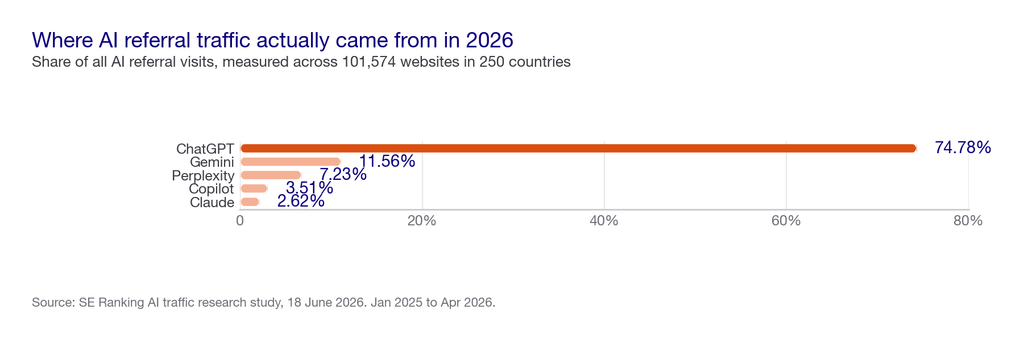
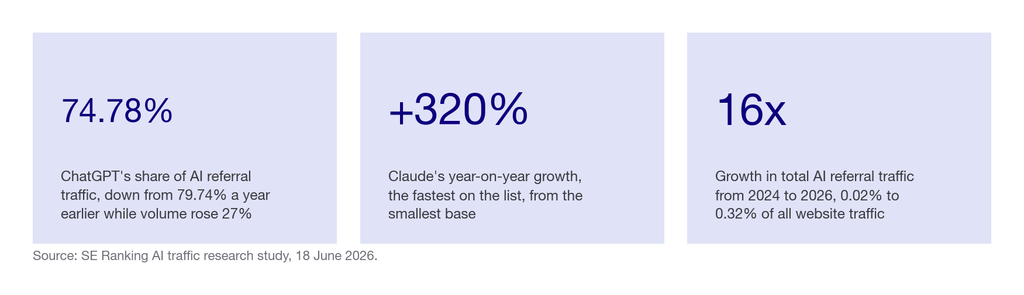
- ChatGPT still dominates referral traffic at 74.78 percent, but its share is falling. It held 79.74 percent a year earlier, even as absolute volume grew 27 percent.
- The fast movers are Claude, up 320 percent year on year, and Gemini, up 231 percent. Both from small bases, and both from engines that behave differently to ChatGPT.
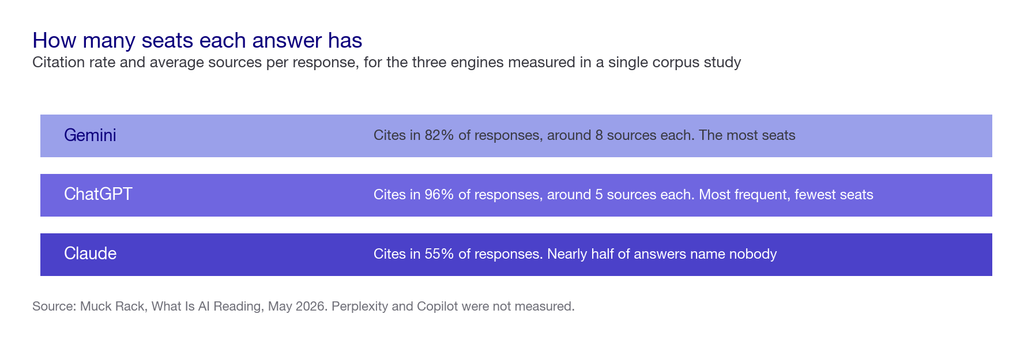
- Referral share and citation behaviour are not the same thing. Gemini carries a citation in 82 percent of responses and averages around eight of them. ChatGPT cites in 96 percent of responses but averages around five.
- Four engines carry 96 percent of measurable AI referral traffic: ChatGPT, Gemini, Perplexity and Claude.
- The practical takeaway is that a single AI visibility number across all five hides the only comparison worth making.
Where this comes from. We run organic and AI search for more than 250 enterprises at Pepper and track over 10 million prompts across every major engine, so the per-engine differences below are the ones we see in client accounts every week rather than a feature comparison assembled from marketing pages.
What is an AI search engine?
An AI search engine answers a question in natural language instead of returning a list of links, and cites some of the sources it used to build that answer.
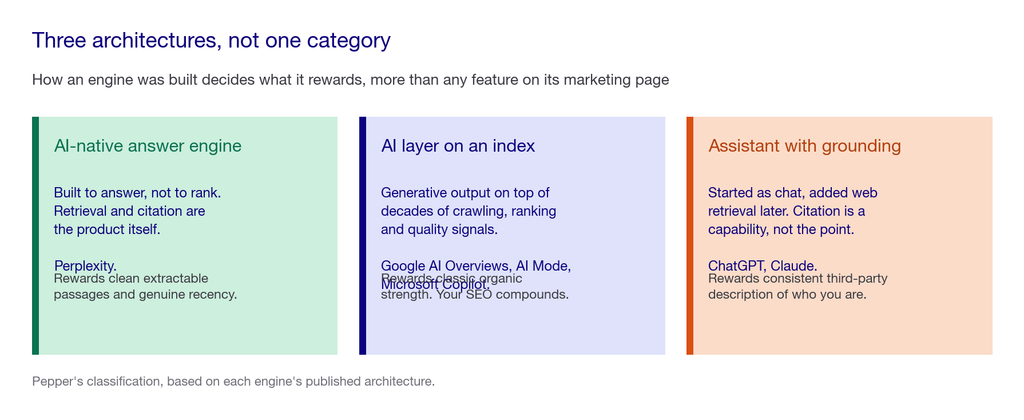
That definition covers three quite different architectures, and the difference matters more than any feature list.
AI-native answer engines were built to answer rather than to rank. Perplexity is the clearest example. Retrieval and citation are the product.
AI layers on an existing index sit generative output on top of decades of crawling. Google AI Overviews, Google AI Mode and Microsoft Copilot work this way. They inherit the index, the ranking systems and the quality signals underneath.
Conversational assistants with web grounding started as chat and added retrieval. ChatGPT and Claude are here. Retrieval is a capability rather than the whole product, which is why their citation habits are less consistent.
If you want the vocabulary itself untangled, we wrote AEO vs GEO vs AIO vs LLMO for exactly that.
See where you show up. Pepper’s GEO platform tracks Brand Visibility, Domain Prompt Presence and Share of Voice across ChatGPT, Perplexity, Gemini, Claude and Google AI Overviews. Your team can log in, connect Search Console and GA4, manage the prompt set and run your own agents in the Agent Atlas, with a growth team working the same account alongside you. Book a growth audit or see where you show up.
The top AI search engines at a glance
| Engine | Architecture | AI referral share, 2026 | YoY change | Citation habit | What it rewards |
|---|---|---|---|---|---|
| ChatGPT | Assistant with web grounding | 74.78% | Volume up 27%, share down from 79.74% | Cites in 96% of responses, around 5 sources | Being the consensus answer across many third-party sources |
| Gemini | AI layer on Google’s index | 11.56% | Up 231% | Cites in 82% of responses, around 8 sources | Classic organic strength, plus breadth of corroboration |
| Perplexity | AI-native answer engine | 7.23% | Slight decline | Cites heavily and visibly by design | Clean, extractable passages and recency |
| Copilot | AI layer on Bing’s index | 3.51% | Up 31% | Follows Bing indexing | Bing visibility, which most teams never check |
| Claude | Assistant with web grounding | 2.62% | Up 320% | Cites in 55% of responses, the lowest of the three measured | Depth and correctness over breadth |
Referral shares and growth rates come from SE Ranking’s June 2026 study of 101,574 websites across 250 countries, tracked from January 2025 to April 2026. Citation rates are from Muck Rack’s May 2026 analysis of more than 25 million cited links. The two studies measure different things, which is the point of putting them in the same table. Cost to appear in any of these is zero, since none of them sell placement.
Where this comparison falls short: these are two panel studies, not a census. SE Ranking sees websites running Google Analytics under its terms of service, and Muck Rack did not measure Perplexity or Copilot. Treat the numbers as well-sourced direction, not decimal-point truth.
The ranking everyone publishes, and the one that matters
Read the referral column on its own and you would conclude that ChatGPT is the whole game and the rest is rounding error. That conclusion is four percentage points wrong and getting wronger.
ChatGPT’s share of AI referral traffic dropped from 79.74 percent to 74.78 percent in a year. Its absolute volume rose 27 percent over the same period, so this is not decline. It is a market that stopped being a monopoly while nobody was looking. Claude grew 320 percent and Gemini 231 percent from much smaller bases, which is what redistribution looks like early.
Now read the citation column. Gemini carries a citation in 82 percent of its responses and averages around eight sources per answer. ChatGPT cites in 96 percent but averages around five. So Gemini, on roughly a seventh of ChatGPT’s referral traffic, offers meaningfully more citation slots per answer.
Put plainly: the engine sending you the least traffic today may be the one most willing to name you. Optimising only for the biggest referrer is optimising for the surface that gives out the fewest seats.
Engine by engine, from a visibility point of view
ChatGPT
The default. Three quarters of measurable AI referral traffic, and the engine most of your buyers open first.
It cites in 96 percent of responses, which sounds generous until you notice the average is around five sources. High frequency, low breadth. In practice that means ChatGPT tends to name whoever the wider web already agrees on, which rewards consistency of third-party description more than any on-page tactic.
What we do about it: work the sources that describe you, rather than only the pages you own. If four credible third parties describe your category position the same way, you become the easy answer. We wrote the mechanics up in LLM seeding.
Where it gets thin: ChatGPT’s answers move between runs. Ask the same question five times and the source set shifts. Anyone selling you a single ChatGPT ranking is selling you one dice roll.
Google Gemini, AI Overviews and AI Mode
Three surfaces, one underlying system. Google confirmed in May 2026 that AI Overviews and AI Mode run on core Search ranking and quality systems, with no separate AI index and no separate AI ranking algorithm.
That single sentence is the most useful fact on this page, because it means your organic work already compounds here. Content performing in organic search carries a higher baseline probability of appearing in AI features.
Gemini also cites more sources per answer than either engine measured alongside it, around eight, at an 82 percent citation rate. And AI Overviews now appear on 25.11 percent of queries across all industries, rising to 48.7 percent in healthcare and 25.8 percent in financials, according to Conductor’s 2026 benchmarks across 13,770 domains and 21.9 million searches.
What we do about it: treat it as SEO with an answer-shaped output layer. Our full approach is in how to get cited in AI Overviews.
Where it gets thin: an AI Overview can answer the question completely, and often does. Visibility on this surface is frequently a brand impression rather than a session, so measure it as citations and impressions instead of waiting for traffic that a satisfied searcher was never going to send. Judging AI Overview work by sessions alone will make good work look like failure.
Perplexity
The purest answer engine of the five, and the one whose behaviour is easiest to reason about. Citation is not an add-on, it is the interface.
Our own product documentation puts it simply: Perplexity heavily cites, AI Overviews heavily summarise, and ChatGPT mixes both. That difference should change what you publish for each.
What we do about it: clean, self-contained passages that answer one question without requiring the rest of the page, plus genuine recency. Perplexity is unusually responsive to fresh, well-structured material. See how to get your brand cited on Perplexity.
Where it gets thin: referral share slipped slightly year on year, so it is the one major engine on this list not growing its slice. It still punches far above that share for research-stage and comparison queries, which is where B2B buyers live, but do not budget for it as a traffic channel.
Microsoft Copilot
The engine most teams ignore, at 3.51 percent of AI referral traffic and 31 percent annual growth.
The honest read is that Copilot’s real footprint is larger than its public referral share suggests, because a lot of it happens inside Microsoft 365 tenants where no external measurement tool can see it. That is also why nobody can report it credibly, including us.
What we do about it: verify the site in Bing Webmaster Tools. Bing opened its AI Performance report to public preview in February 2026, showing cited URLs, triggering queries and citation share. It is free, and it is the only first-party window onto this surface. Note that sources disagree on whether that report reflects ChatGPT traffic or only Copilot, so read it as directional.
Where it gets thin: enterprise-internal usage is unmeasurable from outside. Any vendor quoting you a precise Copilot visibility figure is estimating.
Claude
The smallest referral share on the list at 2.62 percent, and the fastest growing at 320 percent.
It also has the most demanding citation behaviour of the three engines Muck Rack measured. Claude carries a citation in 55 percent of responses, against ChatGPT’s 96 and Gemini’s 82. Nearly half its answers name nobody at all.
What we do about it: the same thing that works everywhere, done more carefully. Low citation rates reward precision and correctness rather than volume. Claude is also increasingly where technical evaluators actually work, which matters more for a developer-tools company than its traffic share implies.
Where it gets thin: at 2.62 percent of referral traffic, Claude will not show up in your analytics in a way that justifies a dedicated programme. Track it, do not build for it separately.
Our methodology: how we weighted these engines
| Criterion | Weight | What that means here |
|---|---|---|
| Measured reach | 30% | Referral share from a named panel study with a published sample, not a vendor estimate |
| Citation behaviour | 30% | How often the engine names sources, and how many, from an independent corpus study |
| Direction of travel | 20% | Year-on-year change, because a 320% grower on a small base changes planning |
| What it actually rewards | 20% | Whether we can describe the optimisation work concretely from client accounts |
**What we could not verify and left out:** monthly active user counts for any engine, Perplexity and Copilot citation rates, and any figure describing Copilot usage inside enterprise tenants. Several published overviews quote all three. None that we checked traced to a primary source.
What this looks like on a real account
Two examples, because the per-engine picture changes depending on what you sell.
SalesHood is the multi-engine case. They were losing organic traffic and disappearing from AI answers against better-funded competitors. We ran seven workstreams, including GEO and AEO work tracked in Atlas across ChatGPT, Gemini and Claude, an SEO blog engine producing 20 new pieces and refreshing 8, and technical fixes resolving 10 issues including sitemap and schema. AI Overview visibility went from 14 keywords to 97. Blog impressions moved from 200,000 to 417,000, rich results grew 291 percent in five months, and clicks rose 20 percent while the wider category declined. Their CMO, Elay Cohen, described seeing a direct connection between the investment and closed deals originating from LLMs.
Acceldata is the depth case, and it explains why the Gemini and Perplexity columns matter. We built content deep enough to be worth citing rather than broad enough to fill a calendar. Organic traffic grew 6X, top-three keyword rankings went from 85 to more than 300, the site added over 100,000 new organic users at a 47 percent engagement rate, and a single hero guide produced more than 260,000 impressions on its own.
One hero guide outperforming a quarter of scheduled posts is the whole argument for the engines that cite eight sources rather than five. Depth gets cited. Volume gets ignored.
How to choose which engines to prioritise
Nobody has the budget to work all five properly, and you should not try. Here is the process we use to pick.
The scorecard
Score each engine out of 100 for your specific business, then work the top two.
| Factor | Weight | How to score it honestly |
|---|---|---|
| Buyer presence | 30% | Ask ten current customers which assistant they actually used while evaluating you. This beats every market-share chart, because it measures your buyers rather than the internet |
| Citation opportunity | 25% | Engines that cite more sources per answer offer more seats, so an eight-source engine is a better target than a five-source one at equal reach |
| Current gap | 20% | Run your prompt set and see where you are already absent. There is no return in optimising a surface where you are winning |
| Measurability | 15% | You can see Google and Bing through first-party tools for free, and everything else needs a platform or manual work |
| Category penetration | 10% | AI Overviews reach 48.7% of healthcare queries but 25.8% of financials, so the same engine is worth different amounts by industry |
The live test, over 90 days
Fix a set of 30 prompts phrased the way your buyers actually type them. Not keywords. Real questions, such as “what is the best sales enablement platform for a mid-market team”, “how does Acceldata compare to its competitors”, “which data observability tools support Databricks” and “is there a free way to track AI search visibility”.
Run all 30 across the engines you are considering. Log two things separately for each: whether your brand is named, and whether a page on your domain is cited. Then rerun the identical set monthly for 90 days.
Three readings is the minimum honest window. One is a snapshot, two could be noise, three shows direction. And the prompt set has to stay fixed, because changing it resets the comparison. If a partner cannot show you movement on a fixed set across that window, they are showing you a photograph and calling it a trend.
Weak approach versus strong approach
The weaker approach: pick the engine with the biggest market share, buy a tool that tracks it, watch a single blended visibility score, and report the number that moved.
The stronger approach: pick the two engines your buyers named, track named and cited as separate numbers on a fixed prompt set, and let the gap between those two numbers tell you what to fix. A brand that is named but never cited has an authority problem. A brand that is neither has a fundamentals problem. Those need different work, and a blended score cannot tell them apart.
Red flags when someone pitches you on this
- A single AI visibility score across all engines. It averages a 41-point spread in citation rate into one meaningless figure.
- Precise Copilot numbers. Enterprise-tenant usage is not externally measurable.
- Monthly active user counts presented as fact. We could not trace one to a primary source, and neither can they.
- “We optimise for ChatGPT.” It is the engine offering the fewest citation slots per answer, and the only one on this list whose share is shrinking.
- Rankings from a single run. Ask any engine the same question five times and the sources move.
Five questions worth asking
- “Which engines do you track, and which do you not?” Anyone claiming full coverage of Copilot is guessing.
- “Do you report named and cited as separate numbers?” If they are combined, you lose the diagnosis.
- “How many runs per prompt, and do you show the variance?” One run per prompt is noise presented as data.
- “Where did this market-share figure come from?” You want a sample size and a date, not a blog post citing a blog post.
- “Which of these engines would you tell us to ignore?” A good partner will name at least one. A weak one says all of them matter.
Reduced to one principle: pick engines by where your buyers actually are and how many seats each answer has, not by market share. Market share tells you where the crowd is. Citation behaviour tells you whether there is room for you.
One closing note that costs us something. No platform sees Copilot properly inside Microsoft tenants, ours included, and any provider who tells you otherwise is selling an estimate as a measurement.
What does it cost to work these engines?
Nothing to appear. None of the five sells placement, and none of them has an advertising product that guarantees a citation. What costs money is knowing where you stand.
| What you are paying for | Typical 2026 cost | What it covers |
|---|---|---|
| Google Search Console and Bing Webmaster Tools | Free | Google’s generative AI performance reports, live since June 2026, and Bing’s AI Performance report from February 2026 |
| Manual prompt tracking | Free, around two hours a month | 30 prompts across three engines, logged in a spreadsheet |
| Entry-level tracking platform | Around $99 a month | Typically one engine and a capped prompt set |
| Multi-engine tracking platform | Around $300 to $400 a month | Three or more engines, competitor share of voice, sentiment |
| Platform plus a team doing the work | Custom | Tracking, plus the content, technical and earned-authority work the tracking points at |
Platform prices reflect published 2026 rate cards from AI visibility vendors, checked in August 2026. They change often, so verify before you budget. The two free rows are genuinely free and most teams have not switched them on.
What nobody should promise you
A guaranteed citation or a fixed position in any of these engines. Nobody controls generated output, and Google explicitly warns against providers who guarantee rankings.
Precise Copilot visibility. The enterprise-tenant portion is not externally measurable by any tool.
Monthly active user figures for these engines presented as verified fact. Every version we checked traced to an estimate.
A single AI visibility score that means something on its own. There is no universal good number for these metrics. Trend on a fixed prompt set and distance from the category leader are what carry information.
When you should not do any of this
The answer that costs us the sale. If fewer than about twenty pages on your site are worth optimising, or your important pages are not indexed, you do not need per-engine tracking yet and we would tell you not to buy it. None of the five engines can help you, because there is nothing for them to retrieve.
Fix indexing, page titles and a clear description of what you sell. Those are free, they are prerequisites for every engine on this page, and buying per-engine tracking before they are done means paying to watch a problem you already know about.
Frequently asked questions
What are the top AI search engines in 2026?
By measured referral traffic, ChatGPT leads with 74.78 percent, followed by Gemini at 11.56 percent, Perplexity at 7.23 percent, Copilot at 3.51 percent and Claude at 2.62 percent, per SE Ranking’s June 2026 study of 101,574 websites.
Which AI search engine sends the most traffic?
ChatGPT, by a wide margin. Its share fell from 79.74 percent to 74.78 percent over the year even as absolute volume rose 27 percent, so the market is redistributing rather than shrinking around it.
Which AI search engine cites the most sources?
Of the three measured by Muck Rack in May 2026, Gemini averages around eight citations per response at an 82 percent citation rate. ChatGPT cites in 96 percent of responses but averages around five sources.
Is Perplexity better than ChatGPT for AI search visibility?
For research and comparison queries it often is, because citation is built into the interface rather than added to it. ChatGPT carries far more referral traffic, so most B2B brands need presence in both rather than a choice between them.
Do AI Overviews count as an AI search engine?
Yes, functionally. Google confirmed in May 2026 that AI Overviews and AI Mode run on core Search ranking systems with no separate AI index, so optimising for them is continuous with your existing SEO rather than separate from it.
How much of the market does Microsoft Copilot have?
It accounted for 3.51 percent of measured AI referral traffic in 2026 and grew 31 percent year on year. Its true footprint is likely larger, because usage inside Microsoft 365 tenants is not visible to any external measurement tool.
Should I optimise differently for each AI search engine?
Partly. The fundamentals are shared, so indexing, structure and authority serve every engine. What changes is emphasis: Perplexity rewards clean extractable passages and recency, Gemini rewards classic organic strength, and ChatGPT rewards consistent third-party description.
How do I track my brand across all these AI search engines?
Fix a prompt set of about 30 buyer questions, run it monthly across your priority engines, and log whether you are named and whether your domain is cited as two separate numbers. Search Console and Bing Webmaster Tools cover Google and Bing for free.
Where to go next
Ask ten customers which assistant they used while evaluating you. That single question will reorder this list for your business faster than any market-share chart, and it costs an afternoon.
Then run 30 prompts across the two engines they name, and see whether you are in the answer.
Book a growth audit · See the work in our case studies · Explore Pepper’s platform
Sources and further reading
- SE Ranking. AI traffic research study, published 18 June 2026. Aggregated anonymised data from 101,574 websites across 250 countries, tracked January 2025 to April 2026. Source of all referral-share and growth figures. Link
- Muck Rack. “What Is AI Reading?” May 2026. More than 25 million cited links across ChatGPT, Claude and Gemini, 17 industries. Source of all citation-rate figures. Perplexity and Copilot were not measured. Link
- Google Search Central. AI search optimisation guidance, 15 May 2026. Confirms AI Overviews and AI Mode run on core Search ranking systems with no separate AI index, and warns against guaranteed-ranking claims. Our reading of it is in AEO vs SEO.
- Conductor. 2026 AEO and GEO benchmarks. 13,770 domains and 21.9 million searches. Source of the AI Overview penetration figures by industry.
- Microsoft. Bing Webmaster Tools AI Performance report, public preview from 10 February 2026.
- Pepper. SalesHood case study and Acceldata case study. Metrics as published on those pages.
- Pepper. How Google AI Overviews work and Perplexity vs ChatGPT visibility, for the per-engine work described above.
- Deliberately excluded: monthly active user counts, Perplexity and Copilot citation rates, and enterprise-tenant Copilot usage estimates. None traced to a primary source.
Latest Blogs
Most advice on this is inference dressed as fact. OpenAI documents exactly one thing clearly, which is access. Here is what is documented, what is inferred, and how to verify the rest for yourself.
Being named in an AI answer and having your page used as its source are different outcomes with different causes and different fixes. The gap between them is the most useful diagnostic in AI search, and most reporting collapses it into one number.
Every platform reports share of voice and almost none of them define it the same way. Here is the definition worth using, the three choices that change the number, and how to measure it yourself without buying anything.
Get your hands on the latest news!

Similar Posts
GEO / AI Search
10 mins read
How to get cited by ChatGPT
GEO / AI Search
10 mins read
Mentioned vs cited: the difference that decides AI visibility
GEO / AI Search
13 mins read