The LLM trust hierarchy: what the evidence supports, and why the pyramid keeps moving

Key takeaways
- The same engine, given the same prompts on two reasoning settings, cited only 25.6% of the same domains. A fixed hierarchy cannot survive that.
- Which source types win is not a constant. Under deeper reasoning, user-generated content loses roughly half its citation share while official and academic sources gain.
- The durable finding is not a tier list. It is that about 85% of brand mentions in AI answers come from pages you do not own.
- Visibility is unstable run to run, so a brand that appears once has not won anything measurable.
- No engine publishes source weightings. Any figure that claims to be one is either an observed share relabelled, or invented.
A note on where this comes from. We run organic programmes for 250+ enterprises and track more than 10 million prompts across AI engines, and the question of which sources “count” comes up in nearly every client review. The judgements here come from that work. The evidence comes from named, dated 2026 research, and we have kept the two apart.
The short answer
There is a hierarchy. It is just not fixed, and nobody publishes its weights.
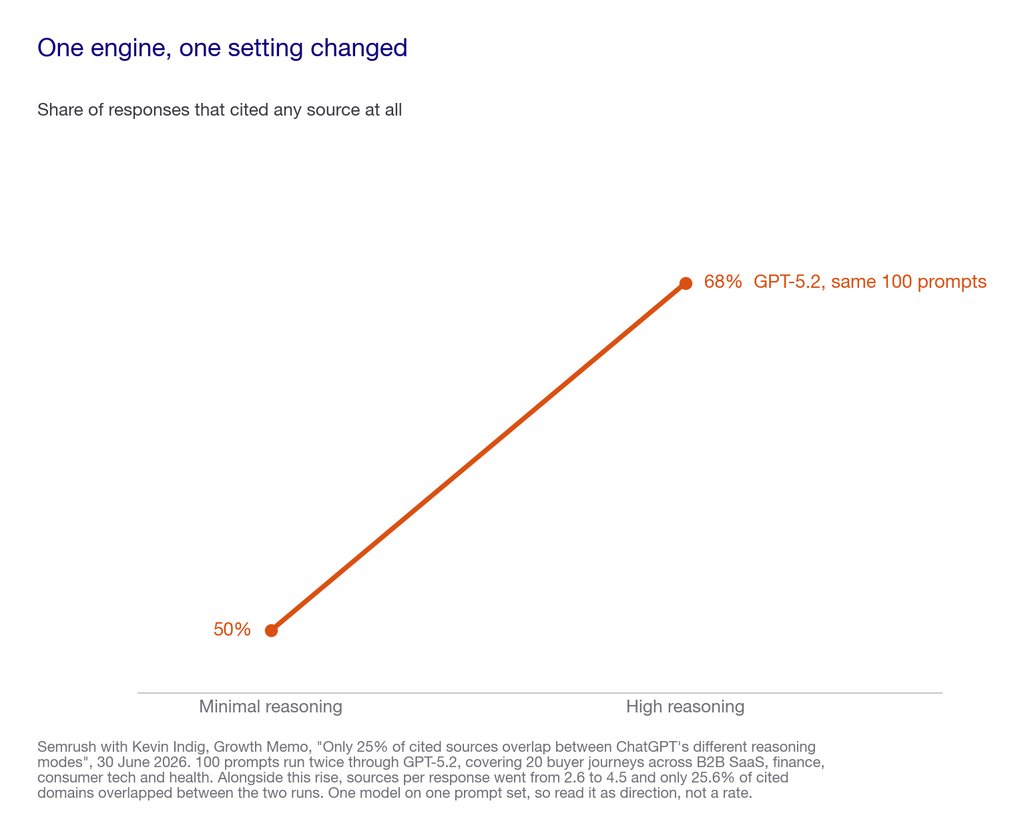
In June 2026, Semrush and Kevin Indig’s Growth Memo ran 100 prompts through GPT-5.2 twice: once on minimal reasoning, once on high reasoning. Same model, same prompts, one setting changed.
Only 25.6% of cited domains overlapped between the two runs.
That single number ends the argument for a stable pyramid. If three quarters of the cited domains change when one setting changes, then a tier list with weights to the decimal point is describing something that does not hold still long enough to be described.
If you would rather have someone map where your brand currently gets mentioned than work from a diagram, you can book a growth audit and we will run the prompt set with you.
What is the LLM trust hierarchy, and is it real?
The idea is reasonable. Models do not treat all sources alike, so there must be some ordering of what they draw on.
The evidence supports a weaker and more useful version of that claim: source types have different citation shares, those shares differ by engine, and they move with context. What the evidence does not support is a fixed pyramid with numbers attached.
The same Semrush study shows the movement directly. Going from minimal to high reasoning, the citation rate rose from 50% to 68%, sources per response nearly doubled from 2.6 to 4.5, and the model fired 4.6 times more internal sub-queries.
The composition moved too, and this is the part that matters for a tier list. In the study’s words, “Reddit and other user-generated content (UGC) sites lose roughly half their share of citations in Thinking mode compared to Instant mode, while government, academic, and official documentation sites gain ground.”
So community content is not a fixed tier three. It is tier two when the model is answering fast and something closer to tier four when it is reasoning carefully. You do not control which mode the user is in.
The weights nobody publishes
The previous version of this page carried a table assigning each engine a percentage: authoritative list mentions at 41% for ChatGPT, 49% for Gemini, 64% for Perplexity, and traditional directories at 68% for Claude.
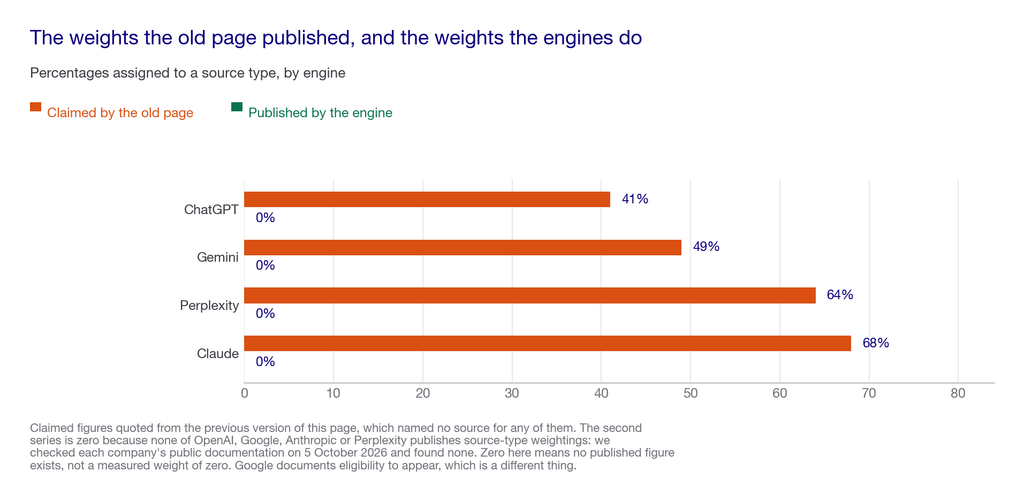
None of OpenAI, Google, Anthropic or Perplexity publishes how it weights source categories. We looked. Google documents eligibility, not selection, and states there are no additional requirements to appear in its AI features. The others publish nothing comparable at all.
What does exist is third-party measurement of observed citation shares. Those are useful and they are a different kind of claim. A share tells you what happened across a sample. A weight claims to describe the mechanism inside the model. Converting the first into the second, and adding a decimal place, is how a reasonable observation becomes a fabricated one.
This matters beyond one page. The same numbers appeared in our entity optimization, content structure and audit articles, and we have removed them from all three in the past fortnight.
What the tiers actually look like under scrutiny
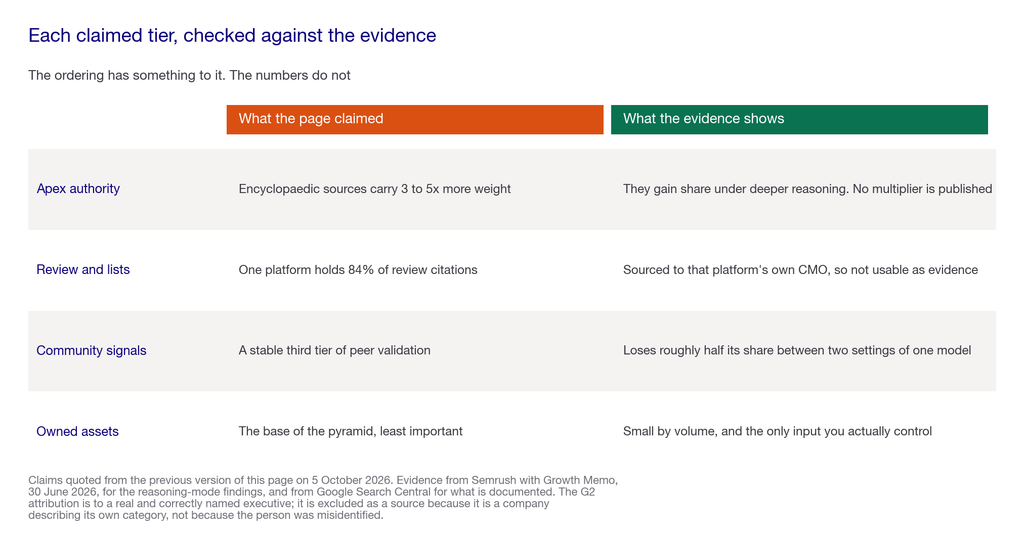
Apex authority. The claim that encyclopaedic and institutional sources sit permanently at the top is half right. They gain ground under deeper reasoning, which is real and documented. They do not hold a fixed multiplier, and the page’s “3 to 5x more weight” figure has no source.
Review and list ecosystems. Genuinely important in B2B, and the specific claim that one platform holds 84% of review citations came from that platform’s own chief marketing officer. She is a real person, correctly named, and that is still not a usable source for a claim about her own category.
Community signals. The most volatile tier of all, which is exactly why fixing it in a diagram misleads. Its share roughly halves between two settings of a single model.
Owned assets. The page put your own site at the base of the pyramid, which reads as least important. That is backwards in one specific sense: your own pages are the only input you control, and they are also what everything else gets written from.
The finding that survives all of it
Strip out the tiers and one durable fact remains.
AirOps analysed 21,311 brand mentions across ChatGPT, Claude and Perplexity and found that about 85% of brand mentions in AI search come from third-party sources. Their stability figures are the uncomfortable half: only around 30% of brands remained visible in back-to-back responses, and roughly 20% held presence across five consecutive runs.
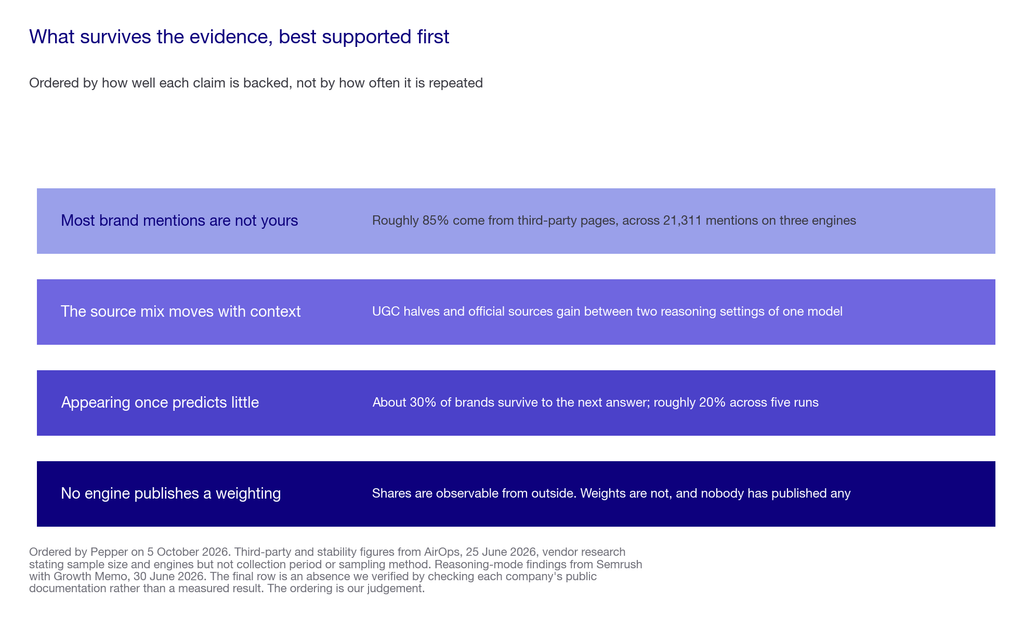
Read those two findings together and the strategy changes shape. If most of what an engine says about you comes from pages you do not own, and if appearing once does not predict appearing again, then the job is not climbing a pyramid. It is being present in enough third-party places, consistently enough, that the variance stops mattering.
That is a slower and less satisfying answer than a tier list. It is also the one the data supports.
Our methodology: how we graded each claim
We scored every claim on the previous version against three inputs. The weights decide what survived into the article above.
| Input | Weight | What it means |
|---|---|---|
| Traceable to a named, dated 2026 study | 50% | A published study with a stated sample size, not a vendor assertion |
| Independent of the party making the claim | 30% | Not sourced to a company describing its own category or product |
| Consistent with engine documentation | 20% | Does not contradict what Google or any engine actually publishes |
The per-engine weight table scored zero on the first input and zero on the third. The G2 share claim scored zero on the second. The reasoning-mode and third-party-mention findings scored on all three, which is why the article is built on them.
The trust hierarchy at a glance
| Official and academic | Review and list sites | Community and UGC | Your own pages | |
|---|---|---|---|---|
| Share of citations | Gains under deep reasoning | Significant in B2B | Large and highly volatile | Small, by definition |
| Stability across runs | Higher | Moderate | Lowest | Highest, you publish it |
| Can you influence it | Rarely and slowly | Yes, over quarters | Partly, and not directly | Fully |
| Published weighting | None exists | None exists | None exists | None exists |
| Typical cost to improve | Earned, not bought | Moderate, ongoing | Community effort, slow | Editorial, in-house |
Where it falls short as a comparison: the share row describes direction rather than magnitude, because the only precise figures available come from single studies on single samples. Treat the ordering as better supported than any number in it.
What this costs
Owned content is the cheapest to fix and the smallest share of the outcome. Do it anyway, because it is the input everything else quotes.
Third-party presence is the expensive half, and most of the cost is time rather than budget. Review profiles, documentation, analyst coverage and genuine community participation all compound slowly.
Measurement costs whatever prompt tracking costs you, and it matters more here than in most topics, because the instability is the finding.
Where Pepper fits
We are not a neutral recommender in this section, and you should read it knowing that.
Pepper works as an organic growth partner rather than a tool vendor. Pepper’s GEO platform runs prompt sets repeatedly and records where mentions come from, which is the only way to see the instability rather than guess at it. Agent Atlas handles the production side once you know which third-party surfaces matter in your category. Customers log in and run it themselves, and a growth team sits alongside for the judgement work.
The framework we run this on is visibility, citability and retrievability. A trust hierarchy is really a question about citability: whose passage gets used, not whose domain is most respected.
For a worked example in B2B SaaS, our SalesHood case study shows third-party presence built deliberately rather than hoped for.
Where it falls short. We cannot tell you a source’s weight, because no such published number exists and we will not invent one. We can show you where your mentions currently come from and how stable they are. Anyone offering you a tier multiplier is selling a diagram.
How to choose where to spend first
I will write this in the first person, because an ordering nobody will defend is not worth printing.
Start by finding out where your mentions already come from. I have watched a team commission a Wikipedia strategy on the strength of a pyramid diagram, when their actual mentions were coming almost entirely from two review sites and a documentation page they had forgotten they owned. The diagram was confident. It was also not about them.
So my order is: measure the current mention mix, fix the owned pages that everything else quotes, then invest in whichever third-party surface your own data says matters. Here is the scorecard I would apply to any proposed programme, on a 100 point scale.
| Area | Weight | What a programme worth funding demonstrates |
|---|---|---|
| The current mention mix has been measured | 30 | Someone has run the prompts and recorded which third-party sources named the brand. |
| Owned pages are accurate and readable | 25 | The pages other sources quote from are correct, current and present as text. |
| Investment follows your own data | 20 | The chosen surfaces come from the measurement, not from a generic tier diagram. |
| Stability is tracked alongside presence | 15 | Repeat runs are recorded, because appearing once predicts very little. |
| No claim rests on an unpublished weighting | 10 | Every number traces to a named, dated study with a stated sample size. |
Five questions I would ask before funding any of this, in this order.
- “Where do our mentions actually come from today?” A stronger answer is a list of domains from real runs. A weaker one is a pyramid graphic, which describes the category rather than you.
- “How many times was each prompt run?” If the answer is once, you are looking at noise. Around 30% of brands do not survive to the next answer.
- “Which of these weightings is published by the engine?” None of them are. The question is worth asking out loud, because it ends several sales conversations quickly.
- “Are our own pages correct?” They are what third parties quote from, so an error there propagates everywhere you do not control.
- “What would we stop doing?” If the plan adds four surfaces and drops nothing, nobody has prioritised anything.
Red flags, each one something a supplier actually says. A per-engine weighting table, when no engine publishes one. A citation multiplier for a source type, offered without a study. A tier diagram presented as mechanism rather than observation. A category claim sourced to a company in that category. And our own previous version of this page, which did all four.
Then run the test yourself before you buy anything. Write 25 real commercial questions your buyers would type, in full sentences rather than keywords. Run each of those 25 prompts three times across every engine you care about, because engines are probabilistic and one run is an anecdote. Record which third-party domains named you, which named a competitor, and whether the same ones recur. Give any change 90 days before judging it. Our full version of this method sits in how to do an AI search audit.
The recurrence column is the one people skip. A domain that names you in one run out of three is not a channel. A domain that names you in nine runs out of nine is, and it deserves more of your attention than anything on a pyramid.
And the answer that loses Pepper the sale: if you already know where your mentions come from and your owned pages are accurate, you do not need a trust hierarchy programme, and you do not need us to run one. Spend the budget on the two or three surfaces your own data already points at.
It comes down to one principle: measure where you are actually mentioned, fix what you control, and refuse every weighting nobody will publish, ours included. We printed four of those weightings on this page, which is the strongest argument we can make for the principle.
What nobody should promise you
Be sceptical of any of these.
- A per-engine source weighting. No AI company publishes one, so any figure is either a relabelled share or invented.
- A fixed tier multiplier. Source composition shifts with reasoning depth inside a single model.
- A category claim sourced to a company in that category. It may well be true, and it is not evidence.
- A single composite AI visibility score. It hides the instability, which is the most important thing to see.
- Guaranteed Wikipedia or encyclopaedic placement. Those sources are earned by third parties writing about you.
Frequently asked questions
Is there really an LLM trust hierarchy?
There is an ordering, but it is not fixed. Source composition shifts with context: running the same prompts through one model on two reasoning settings produced only 25.6% overlap in the domains it cited.
Do AI engines publish how they weight different sources?
No. None of OpenAI, Google, Anthropic or Perplexity publishes source-type weightings. Google documents eligibility rather than selection, and the others publish nothing comparable, so any percentage claiming to be a weight is unsourced.
What is the difference between a citation share and a weight?
A share describes what was observed across a sample of answers. A weight claims to describe the mechanism inside the model. Third-party studies can measure the first. Nobody outside the labs can measure the second.
Where do most brand mentions in AI answers come from?
Third-party pages. AirOps analysed 21,311 brand mentions across ChatGPT, Claude and Perplexity and found roughly 85% came from sources the brand does not own, which makes earned presence the larger half of the problem.
How stable is AI visibility between runs?
Not very. In the same AirOps analysis, only about 30% of brands remained visible in back-to-back responses and roughly 20% held presence across five consecutive runs, so a single appearance proves little.
Does user-generated content like Reddit always rank highly?
No, and this is the clearest evidence against a fixed pyramid. UGC sites lost roughly half their share of citations when the model moved from minimal to high reasoning, while official and academic sources gained ground.
Should I invest in review platforms for AI visibility?
Often yes in B2B, but decide from your own measurement rather than a diagram. Run your prompt set, record which third-party domains actually name you, and invest in the surfaces your own data points at.
What should I do with my own website in all this?
Keep it accurate, current and readable as text. It is a small share of citations by volume, and it is the source third parties quote from, so errors there propagate into places you cannot edit.
Where to go next
- How to do an AI search audit, for the full prompt-set method
- Entity optimization and LLM brand recognition, for the naming work underneath all of this
- How to get featured in Perplexity answers, for one engine in depth
- How to get cited in LLMs
- The GEO measurement stack
- How we rank and score GEO providers
Sources and further reading
- Semrush with Kevin Indig, Growth Memo, “Only 25% of cited sources overlap between ChatGPT’s different reasoning modes”, Margarita Loktionova, 30 June 2026. 100 prompts run twice through GPT-5.2 on minimal and high reasoning, covering 20 buyer journeys across B2B SaaS, finance, consumer tech and health, each across five funnel stages. Source of the 25.6% overlap, the citation rate shift and the UGC composition finding.
- AirOps, “How offsite brand mentions compound to drive AI citations over time”, 25 June 2026. 21,311 brand mentions analysed across ChatGPT, Claude and Perplexity. Source of the 85% third-party figure and the run-to-run stability figures. Vendor research: the sample size and engines are stated, the collection period and sampling method are not, and we have said so on the figure.
- Google Search Central, “AI features and your website”, last updated 10 December 2025. Cited for what Google does document, which is eligibility rather than source selection.
- Semrush with Kevin Indig, Growth Memo, “The ghost citations study”, 9 June 2026. 3,981 domain appearances across 115 prompts, 14 countries and four engines. Background on the difference between being cited and being named.
- Not used, and worth saying why: a claim that one review platform accounts for 84% of review citations across LLMs was attributed on the previous version to that platform’s own chief marketing officer. G2 announced her appointment in January 2026, so the attribution is to a real and correctly named person. It remains a company sourcing a claim about its own category, so we have not reproduced the figure.
Latest Blogs
Most advice on this is inference dressed as fact. OpenAI documents exactly one thing clearly, which is access. Here is what is documented, what is inferred, and how to verify the rest for yourself.
Being named in an AI answer and having your page used as its source are different outcomes with different causes and different fixes. The gap between them is the most useful diagnostic in AI search, and most reporting collapses it into one number.
Every platform reports share of voice and almost none of them define it the same way. Here is the definition worth using, the three choices that change the number, and how to measure it yourself without buying anything.
Get your hands on the latest news!

Similar Posts
GEO / AI Search
10 mins read
How to get cited by ChatGPT
GEO / AI Search
10 mins read
Mentioned vs cited: the difference that decides AI visibility
GEO / AI Search
13 mins read