Best AEO platform in 2026: seven rankings, seven number ones
The short answer
We read every ranking of the best AEO platform on page one of this search. There are seven published by companies that sell a platform in the category. All seven put their own product at number one. Not in the top three. First.
That is not a scandal. It is the structure of the category, and until this revision it was the structure of this page too, which ranked Pepper first out of seven. So the first useful thing we can give you is not another leaderboard. It is the shape of the bias, and a way to read past it.
The second useful thing is a definition. An AEO platform is not the same as an AI visibility tracker, though the words are used interchangeably across this SERP. A tracker tells you how often engines mention you. A platform is supposed to help you change it. On that test, most of the products marketed as platforms are trackers with a recommendations tab.
Key takeaways
- Seven of seven vendor-published rankings place their own product first. We checked each one on the publisher’s own site. Three disclose that they sell in the category, one partially, three do not disclose it at all.
- The rank a vendor gives itself and the rank its rivals give it are different numbers. Profound puts itself first and sits at a median of third across six rival lists. Conductor puts itself first and sits at eleventh.
- Pricing transparency is going backwards. Three of the eight platforms here publish no figure at any tier. Profound published a $99 Starter and a $399 Growth tier in August and, as of 17 September 2026, its pricing page shows a free trial and Enterprise custom pricing only.
- The category is consolidating. Sitecore acquired Scrunch on 3 June 2026, reported by Bloomberg at around $225 million. You are buying a roadmap, not a feature list, and Pepper weights that at 15 of 100 for exactly that reason.
- Eight of eight measure. Three of eight produce anything. None of them is accountable for the number moving, which is the gap Pepper’s agentic organic growth engine exists to close.
A note on where this comes from. We run organic for more than 250 enterprises and track more than 10 million prompts across every major engine. This read is shaped by that, by the platform evaluations we sit in during client reviews most weeks, and by the buyer conversations at the events we run. It is our opinion about a category we compete in, not a neutral directory.
Book a growth audit if what you actually need is to find out where you stand before you shortlist anything.
What is an AEO platform, really?
Answer engine optimization is the work of getting your brand named and cited in AI-generated answers. An AEO platform is software sold to support that work.
The category has not agreed on what that support includes, so the same label covers four genuinely different products.
- Monitors. They run a prompt set across engines on a schedule and report how often you appear. Otterly and Peec AI sit here.
- Monitors with diagnostics. They add which pages and domains are being cited, sentiment, competitor share, and an audit of whether your site is readable by the crawlers. Semrush, HubSpot and AthenaHQ sit here.
- Platforms with execution. They add agents or workflows that produce something: content, page changes, structured data. Profound, AirOps and Scrunch sit here.
- Suites. A platform absorbed into a larger marketing stack, where AEO is a module rather than the product. Scrunch is here now too, through Sitecore.
The distinction that matters to a buyer is the last one before the suite. Does the thing produce work, or does it produce a report about work you still have to do? Most of the products on this SERP are sold with verbs like “optimize” and “improve” attached to what is, in the tier you can afford, a measurement product.
That is not a criticism of measurement. You cannot improve what you are not tracking, and our guide to AI search metrics argues that the measurement layer is where most teams are still guessing. It is a criticism of the labelling. If the acronyms themselves are the sticking point, AEO vs GEO vs AIO vs LLMO untangles them.
The finding: seven rankings, seven number ones
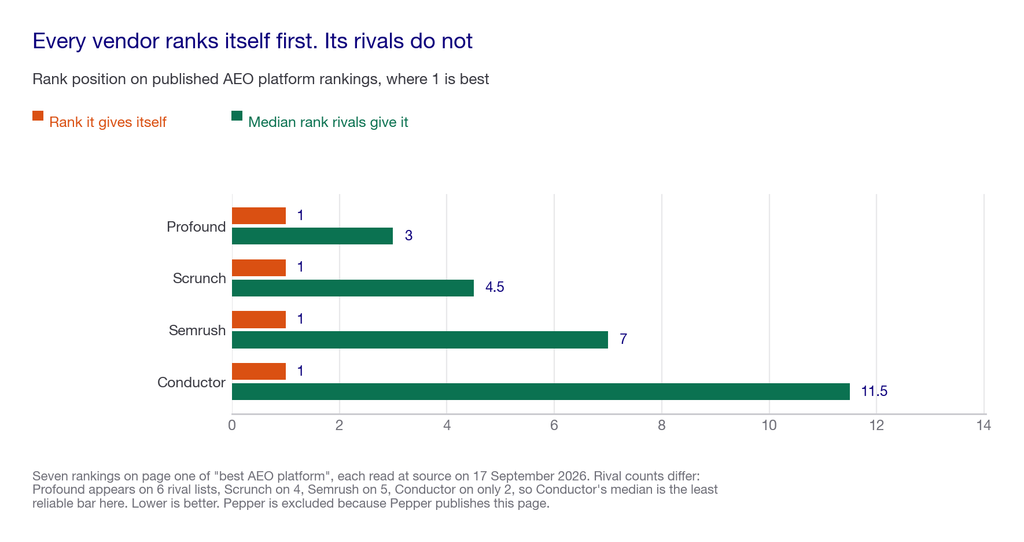
We checked every ranking of AEO platforms on page one of this search and recorded two things: where the publisher placed its own product, and whether the page discloses that the publisher sells in the category.
| Publisher of the ranking | Where it ranked itself | Out of | Discloses it is a vendor | Date checked at source |
|---|---|---|---|---|
| AI Rank Lab | 1 | 10 | No | 20 March 2026 |
| Scrunch | 1 | 7 | Yes, explicitly | 4 June 2026 |
| HubSpot | 1 | 10 | No | June 2026 |
| Semrush | 1 | 8 | Yes, explicitly | 8 July 2026 |
| Profound | 1 | 19 | No | 28 July 2026 |
| LLM Pulse | 1 | 11 | Partially | 30 August 2026 |
| Conductor | 1 | 10 | No | 10 September 2026 |
Seven lists. Seven first places. The two that disclose cleanly are Scrunch, which states “this guide is from Scrunch” and publishes a correction address, and Semrush, which says outright that it uses its own product internally.
The interesting part is not the self-placement. It is the gap. When you hold a vendor’s self-assigned rank against the median rank its rivals give it, the distance is the size of the marketing claim.
- Profound ranks itself first. Across six rival lists its median position is third.
- Scrunch ranks itself first. Across four rival lists its median position is between fourth and fifth.
- Semrush ranks itself first. Across five rival lists its median position is seventh.
- Conductor ranks itself first. It appears on only two rival lists, at ninth and fourteenth.
None of that makes any of these products bad. Profound landing at a median of third across six rivals who compete with it is a genuinely strong signal, and stronger than the first place it gives itself, because rivals have no incentive to be generous. That is the useful reading. A vendor’s own rank tells you nothing. A vendor’s rank on other vendors’ lists tells you something real.
Why we took Pepper out of the ranking
The version of this page you are replacing ranked Pepper first out of seven. We are not going to pretend that was different in kind from what the other six do.
So Pepper is out of the numbered list. It has its own section below, with the same “where it falls short” treatment we apply to everyone else. We think ranking ourselves against trackers was never an honest comparison anyway, because Pepper is sold with a growth team attached and a tracker is not. Comparing the two on a table of engine counts flatters us on some rows and misleads on all of them.
We would rather lose the ranking than win it on a table we built.
Our methodology: how we scored these platforms
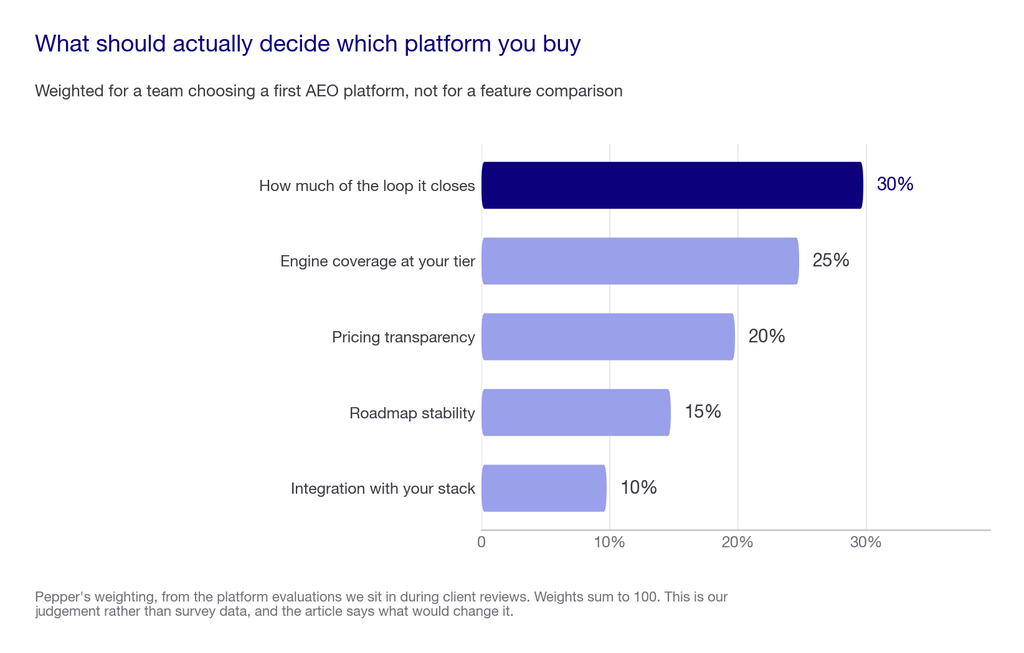
| Criterion | Weight | Why it carries that weight |
|---|---|---|
| How much of the loop it closes | 30 | A product that measures and stops leaves the expensive half of the job with you. This is the single biggest difference between two platforms at the same price. |
| Engine coverage at the tier you will buy | 25 | Demos are given on the enterprise tier. What matters is the coverage on the plan your budget actually reaches, which is often one engine. |
| Pricing transparency | 20 | A published ladder lets you size the decision without a sales cycle. It is also the clearest signal of how a company expects to sell to you. |
| Roadmap stability | 15 | The category is consolidating and the newest entrants are around eighteen months old. You are buying who owns the product in two years. |
| Integration with what you already run | 10 | A tool nobody opens is worth nothing. Connection to your analytics, your CMS and your content workflow decides whether it gets used. |
Weights sum to 100. Execution depth and engine coverage carry more than half, which is a judgement rather than a fact, and it is the judgement this page rests on. We publish our weightings the same way we publish [how we rank GEO agencies](https://www.pepper.inc/blog/geo-agency-ranking-methodology/), so you can argue with them precisely.
What would change these weights. If you already have a content team that can act on a report, execution depth drops and engine coverage rises. If you are a regulated enterprise, roadmap stability and security review outrank everything above them.
How much of the loop each platform closes
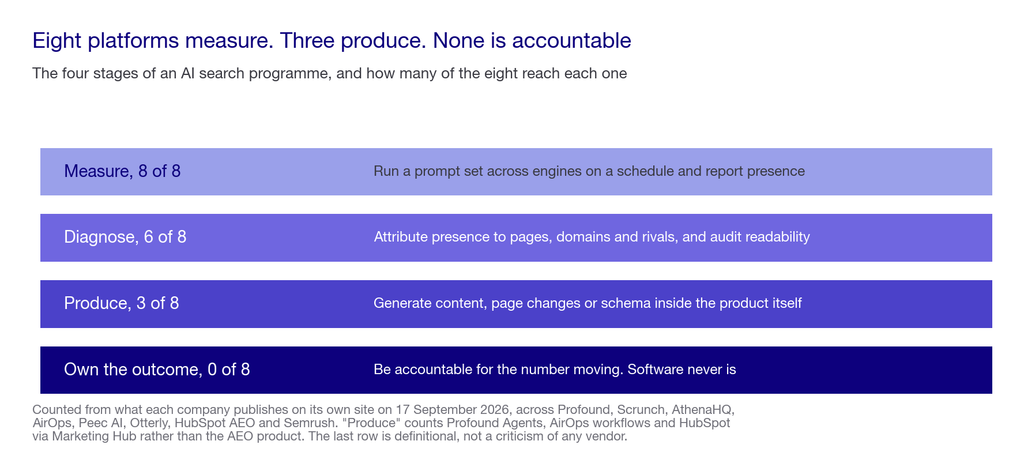
Every platform here does the first stage. The count falls off a cliff after the second.
- Measure. Run a prompt set across engines on a schedule and report presence. Eight of eight.
- Diagnose. Attribute presence to specific pages, domains and competitors, and audit whether your site is readable. Six of eight, on what each company publishes.
- Produce. Generate content, page changes or structured data inside the product. Three of eight: Profound through Agents, AirOps through workflows, HubSpot through Marketing Hub rather than the AEO product itself.
- Own the outcome. Be accountable for the number moving. None of eight, and that is definitional rather than a criticism. Software is not accountable for anything. Pepper is built to sit at this stage, which is why Pepper is not in the ranking above.
That last row is the whole argument of this page. The published research we find most useful here is Google’s own, which states that optimizing for generative AI search is still SEO. If that is true, then the constraint is not the dashboard. It is whether anyone does the SEO the dashboard is pointing at.
The best AEO platforms in 2026, ranked
Every price below was read on that company’s own pricing page on 17 September 2026.
1. Profound
The deepest enterprise product in the category, and the one rivals rank highest. It tracks up to nine answer engines, runs Agents that generate content rather than only recommending it, and carries the security posture an enterprise review will ask for.
- Engines: up to nine at Enterprise, including ChatGPT, Perplexity, Google AI Mode, Gemini, Copilot, Claude, DeepSeek, Google AI Overviews and Exa Search.
- Pricing: a free trial covering ChatGPT only, ten prompts run once, and Enterprise on custom pricing. The $99 Starter and $399 Growth tiers Profound published in August are no longer listed.
- Security: SSO, SAML and SOC 2 at Enterprise.
- Cost model: credits are consumed each time an Agent runs, so spend moves with usage rather than sitting flat.
Best for enterprises building a full AEO programme with people already in place to run it.
Where it falls short: you can no longer size this without a sales call, which is a real change from two months ago. The credit model makes the monthly number variable in a way a finance team will ask about. And the free trial covers one engine, so it will not tell you much about multi-engine coverage.
2. Scrunch, now part of Sitecore
Sitecore acquired Scrunch on 3 June 2026, at a figure Bloomberg reported at around $225 million. The product itself is one of the most complete in the category and one of the few publishing a full price ladder.
- Engines: six at every tier, including ChatGPT, Claude, Gemini, Perplexity, Google AI Mode and Overviews, and Meta. Coverage is not gated by tier, which is rarer than it should be.
- Pricing: Starter $300 a month, or $250 billed annually. Growth $500, or $417 annually. Enterprise custom. A 17% annual discount applies.
- What you get at Starter: 350 custom prompts, 1,000 industry prompts, three seats, three personas, five page audits.
- At Growth: 700 custom prompts, 2,500 industry prompts, five seats, ten page audits, strategy reviews.
Best for teams that want full engine coverage on a published price, and anyone already running Sitecore.
Where it falls short: the roadmap now belongs to a digital experience platform vendor, which usually means deeper integration with that suite and slower independent movement. If you are not a Sitecore customer, that trade is worth thinking about before a multi-year commitment.
3. AthenaHQ
The highest published model count at a published price, and a genuinely usable free tier. This is the one we point people at when they want to see the shape of the data before spending anything.
- Engines: five on the free tier, eleven on Starter, including ChatGPT, Perplexity, Google AI Overviews, AI Mode, Gemini, Claude, Copilot, Grok, DeepSeek, Meta AI and Mistral.
- Pricing: Essential free with a $25 credit. Starter $295 a month. Enterprise custom.
- At Enterprise: knowledge base support and discrepancy detection between what engines say and what your site says.
Best for teams who want the widest engine picture without an enterprise contract.
Where it falls short: it is measurement-led. There is no production layer, so everything it surfaces becomes work for somebody else, and that somebody is usually a content team that is already full.
4. AirOps
The closest thing in the category to a production system, built around workflows rather than dashboards. It has repositioned to “AI Search for Enterprise” and competes directly with Profound and with us.
- Tiers: Solo, Pro and Enterprise. Solo starts free.
- Engines: ChatGPT insights only on Solo. Seven or more answer engines from Pro up.
- Scale: 35,000 monthly tasks on Solo, 100,000 on Pro, custom at Enterprise, which also covers multiple regions, personas and languages.
- Pricing: no figure is published at any tier as of 17 September 2026.
Best for content teams that want the visibility data to end in produced work rather than a to-do list.
Where it falls short: no published price at any tier, which makes it hard to shortlist honestly. The free entry tier covers one engine, so it answers almost nothing about multi-engine performance.
5. Peec AI
Positioned as AI search analytics for marketing teams, and one of the cleaner reporting products. It is also the clearest example of the pricing problem on this SERP.
- Tiers: Starter, Pro, Advanced and Enterprise.
- Pricing: no figure at any tier. We checked the pricing page on 17 September 2026 and it names four tiers and prices none of them. At least one rival’s ranking quotes a monthly figure for Peec AI that we could not find on Peec AI’s own site.
- Engines: five, and as recorded on 3 September 2026 the engine list was not gated by tier. Tiers differed by number of projects and level of support.
Best for marketing teams who want a clean read on presence without a platform migration.
Where it falls short: the absence of any published price means every number you see quoted for Peec AI is somebody’s estimate, including the ones on competitor rankings. It is a tool rather than a service, so nothing here closes the loop.
6. Otterly
The genuine budget entry point, and the one where the headline price and the covered price are furthest apart.
- Pricing: Lite $29 a month for 15 prompts. Standard $189 for 100. Premium $489 for 400. Enterprise from $1,000. A 15% annual discount applies.
- Engines included: four. ChatGPT, Google AI Overviews, Perplexity and Microsoft Copilot.
- Engines that cost extra: Claude, Google AI Mode and Gemini are paid add-ons. On Lite they are $29, $9 and $9, so full coverage on the $29 plan is about $76.
- Seats: unlimited on every plan, which is unusually generous. Extra prompts are $99 per 100.
Best for a single brand testing whether any of this is worth a budget line.
Where it falls short: the $29 you see quoted everywhere, including on rival rankings, is not the price of the product most people need. Fifteen prompts is a sample, not a baseline.
7. HubSpot AEO
The easiest starting point if you are already a HubSpot customer, and the narrowest engine coverage on this list.
- Pricing: $50 a month, or $45 billed annually, for 25 prompts. Extra prompts are sold separately.
- Free tier: 25 prompts across ChatGPT, Perplexity and Gemini, with no card required.
- Engines: three. ChatGPT, Gemini and Perplexity.
- What it does: brand visibility scoring, sentiment, prompt tracking, competitor share of voice, citation analysis by page and domain, and prioritised recommendations.
Best for teams already on HubSpot who want AI visibility inside the system they use daily.
Where it falls short: three engines is the narrowest coverage here, and the content production it is often credited with lives in Marketing Hub Pro or Enterprise rather than in the AEO product. If you are not a HubSpot customer, the value of the integration is the part you do not get.
8. Semrush AI Visibility Toolkit
The natural add-on if your team already lives in Semrush, and a competent measurement and audit product rather than a platform.
- Pricing: $99 a month. An extra 50 prompts costs $60 a month.
- What is included: 25 custom prompts tracked daily, one domain for brand performance, AI competitor analysis, prompt research and a site audit for AI readiness.
- Engines: mentions from ChatGPT, Google AI, Gemini and Perplexity.
- Data: it draws on Semrush’s own AI search database rather than only your tracked prompts.
Best for SEO teams who want AI visibility in the same place as their existing rank data.
Where it falls short: it measures and audits. It does not produce, and it does not publish or change anything, so it inherits whatever content capacity you already have.
Pepper, in its own category
Every platform above hands you a number. Pepper is the only entry on this page accountable for moving it, and we think that is the most important sentence here. It is a different purchase rather than a better tier, which is exactly why Pepper is not in the ranking.
We are an agentic organic growth engine, and that means three things working together.
- An organic growth partner. A senior strategist and always-on agents are attached to your account. They do the work alongside your team and they are on the hook for the number. Not a dashboard you are left to interpret, and not an agency you hand the problem to. One team that owns the outcome.
- Pepper’s GEO platform. Genuinely self-serve and included rather than billed as a separate licence. You log in and set up a workspace, define your brand profile, competitors and personas, connect GA4 and Search Console, and manage your own themes, prompts and GEO analytics across six engines including ChatGPT, Perplexity, Gemini, Claude and Google AI Overviews.
- The Agent Atlas. Your team builds, versions and runs its own agents on a visual canvas. Quick runs handle a single input, sheet runs handle bulk, system agents ship ready to use and the ones you build are yours to edit. This is the stage no tracker on this page reaches.
The measurement is Pepper-native. Brand Visibility is how often engines mention you by name. Domain Prompt Presence is how often they cite a page from your domain. Share of Voice is your slice of category mentions. The gap between the first two is the diagnostic we care about most, because it separates an awareness problem from a citability problem and those two have completely different fixes.
For what the combination produces, the Acceldata case study records 6X organic traffic and top-three keywords rising from 85 to more than 300. For sector fit, most of this work runs through B2B SaaS teams.
Where it falls short: we do not publish pricing, so budget discovery is a conversation rather than a page, and on the transparency criterion this page weights at 20 we score worse than Scrunch, AthenaHQ, Otterly, HubSpot and Semrush. We are built for teams running organic as a long-term function, so a single-quarter visibility spike is not what we are for. Our depth sits in content, authority and AI search rather than large technical migrations. And if what you want is a visibility number this week, every tracker above is faster and cheaper than talking to us.
The eight platforms at a glance
| Platform | Published price | Engines at that price | Closes the loop | Best for |
|---|---|---|---|---|
| Profound | None. Free trial, then Enterprise custom | 1 on trial, up to 9 at Enterprise | Measure, diagnose, produce | Enterprise programmes with people in place |
| Scrunch (Sitecore) | $300/mo, $250 annual | 6 at every tier | Measure, diagnose, produce | Full coverage on a published price |
| AthenaHQ | Free tier, then $295/mo | 5 free, 11 on Starter | Measure, diagnose | Widest engine picture without a contract |
| AirOps | None at any tier | 1 on Solo, 7+ from Pro | Measure, diagnose, produce | Turning data into produced work |
| Peec AI | None at any tier | 5, not gated by tier | Measure | Clean reporting for marketing teams |
| Otterly | $29/mo, about $76 with full coverage | 4 included, 3 paid add-ons | Measure | Testing whether this needs a budget line |
| HubSpot AEO | $50/mo, $45 annual | 3 | Measure, diagnose | Teams already on HubSpot |
| Semrush AI Visibility | $99/mo | 4 | Measure, diagnose | SEO teams already in Semrush |
| Pepper | Not published | 6, included | Measure, diagnose, produce, own the outcome | Organic as a long-term function |
What these platforms cost, and where the published price stops
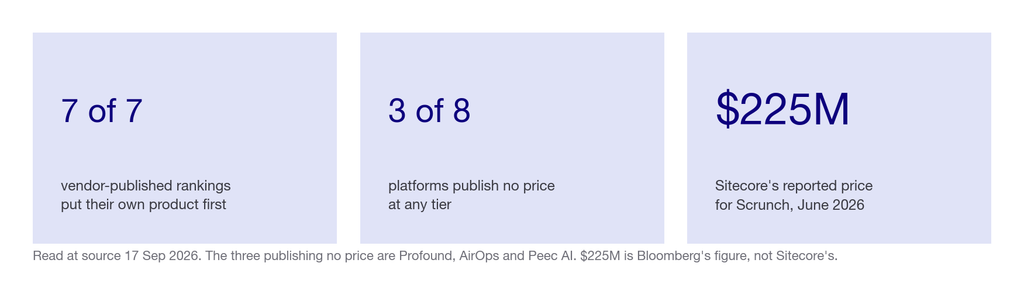
Three of the eight publish no figure at any tier: Profound, AirOps and Peec AI. That is not a small gap in the middle of the market. One of those three is the best-funded product in the category, and another is one of the two most execution-heavy.
The live example of the direction is Profound. In August it published a $99 Starter tier and a $399 Growth tier. On 17 September 2026 its pricing page shows a free trial and Enterprise custom pricing. Rankings published in June still quote the $99 figure, which is how a price that no longer exists keeps circulating.
The second pattern is the gap between the headline price and the covered price. Otterly’s $29 buys four engines out of seven; adding Claude, Google AI Mode and Gemini takes it to about $76. The Profound trial covers ChatGPT alone, and so does the free AirOps Solo tier. The entry tier is a sample in most of this category, and the demo is almost always given on the enterprise tier.
If pricing models rather than platform names are the question, whether to buy an AEO agency or an AEO tool is the decision underneath the shortlist. If you are moving off an incumbent rather than buying your first tool, what breaks when you switch off Profound covers the migration itself, and the data accuracy comparison scores fourteen tools on whether they publish enough to verify their own sampling.
How to choose an AEO platform
I will write this in the first person, because a recommendation nobody will defend is worth nothing.
Start by refusing the leaderboard, including this one. Seven vendor rankings put seven different products first, which means the ordering carries no information. What carries information is the fit between what a platform actually does and what your team is short of. If you have analysts and no writers, a monitor makes your problem worse by generating more work. If you have writers and no data, a monitor is exactly right. Pepper exists for the first case, and we will say so plainly rather than pretending to be the answer to both.
So my order is: decide which stage of the loop you are short of, then shortlist only products that reach it, then compare inside that shortlist. Here is the scorecard I would use, on a 100 point scale.
| Area | Weight | What a strong platform demonstrates |
|---|---|---|
| Closes the stage you are short of | 30 | It produces the thing you cannot produce today, rather than reporting on it. Ask for the output, not the dashboard. |
| Coverage on the tier you will buy | 25 | The engine list on your actual plan, in writing, with add-on prices named. Demos run on tiers most buyers never purchase. |
| Published, checkable pricing | 20 | A price ladder on the site, with what changes between tiers. If there is none, the sales cycle is the product experience. |
| Roadmap you can live with | 15 | A clear owner, a funding position or a parent company, and a public changelog. Eighteen month old products get acquired. |
| Fits the stack you already run | 10 | Real connections to your analytics, CMS and content workflow, not a CSV export described as an integration. |
Five questions I would ask every vendor on the call, in this order.
- “Which engines are included on the tier I can afford, and which are add-ons?” Get the add-on prices in writing. Otterly’s four included engines against three paid ones is the clearest example, but it is not the only one.
- “Show me something the product produced, not something it recommended.” A stronger vendor shows a page, a schema block or a draft. A weaker one shows a prioritised list and calls it action.
- “What is your sampling rate, and how often do you re-run a prompt?” Engines are probabilistic. One run is an anecdote. If they cannot answer this, the numbers in the dashboard are not stable enough to act on.
- “Who owns this company in two years?” Sitecore acquired Scrunch in June. It is a fair question now and nobody should be offended by it.
- “What happens to my prompt set and my data if I leave?” Portability decides how much a bad choice costs you. Prompt sets are rarely portable and baselines never are.
Red flags, each one something a vendor actually says. “We guarantee citations in ChatGPT”, which nobody can promise. “A single AI visibility score”, which compresses away the diagnosis you need. “Real-time tracking across every engine”, where the engine list turns out to be gated. “Our own ranking puts us first”, which is now true of seven publishers on this SERP and is therefore worthless as evidence.
Before you take any of it seriously, run the free diagnostic yourself. Write 25 real commercial questions your buyers would type. Run them three times each across every engine you care about, because one run tells you nothing. Then give any fix 90 days before you judge it. Four worked examples for a mid-market B2B SaaS analytics company:
- “best data observability platform for enterprise”
- “how do I monitor data quality across Snowflake and Databricks”
- “what should I look for in a data observability vendor”
- “who competes with Monte Carlo in data observability”
That exercise costs nothing and it will tell you whether you have an awareness problem or a citability problem, which decides the entire shortlist. Checking whether your brand appears in AI search walks through it properly.
And the answer that loses Pepper the sale: if you already have a content team with capacity and you only need to know where you stand, you do not need a platform at all this quarter. AthenaHQ’s free tier and HubSpot’s free tier will both tell you, for nothing. Buy software when the bottleneck is data. Buy a team when the bottleneck is doing the work.
It comes down to one principle: buy for the stage you are short of, not for the highest rank on somebody’s list. Every ranking on this SERP is published by a company with a product in it, ours included, and the only way to read them usefully is to stop reading them as rankings.
What nobody should promise you
- A guaranteed citation or position in an AI answer. Engines are probabilistic and nobody controls their ranking systems.
- A single number that captures AI visibility. The useful diagnosis lives in the gap between two numbers, not in one composite.
- A universal benchmark. Presence varies by category, by engine and by week.
- Results from one engine or one run. A prompt run once is an anecdote. Three runs across the engines you care about is the floor.
- Clean attribution from a citation to closed revenue. Nobody has this yet, including us. Anyone selling it is selling a model, not a measurement.
Frequently asked questions
What is the best AEO platform in 2026?
There is no single answer, and every ranking that gives you one was published by a vendor on its own list. Profound is the deepest enterprise product, Scrunch publishes the best coverage at a named price, and AthenaHQ has the widest engine list at a published tier.
What is the difference between an AEO platform and an AI visibility tracker?
A tracker reports how often engines mention you. A platform is supposed to help you change it. On our count, eight of eight products here measure and only three produce anything, so most of the category is trackers with a recommendations tab attached.
How much does an AEO platform cost?
Published entry prices run from $29 a month at Otterly to $295 at AthenaHQ, with Scrunch at $300 and Semrush at $99. Three of the eight platforms we checked publish no figure at any tier, so any number quoted for those is an estimate.
Which AEO platform covers the most engines?
AthenaHQ publishes eleven models on its $295 Starter tier, which is the highest engine count at a published price. Profound reaches up to nine at Enterprise, and Scrunch covers six at every tier including its cheapest one.
Can I try an AEO platform for free?
Yes, and you should before buying anything. AthenaHQ offers a free Essential tier with five models, HubSpot gives 25 free prompts across three engines, AirOps starts Solo free on ChatGPT only, and Profound offers a trial of ten prompts run once.
Why does every list rank a different platform first?
Because the lists are written by vendors. We checked seven rankings on page one of this search and all seven placed their own product at number one. Three disclose that they sell in the category, one does so partially, three do not.
Do I need an AEO platform if I already have SEO tools?
Not always. Google’s own guidance says optimizing for generative AI search is still SEO, so the underlying work overlaps heavily. If your team already acts on SEO data, buy measurement of AI presence rather than a second content system you will not use.
How long before an AEO platform shows results?
Give any change 90 days before judging it, and re-run your prompt set at least three times per engine to establish a baseline first. Engines are probabilistic, so a single before-and-after comparison will mislead you in both directions.
Where to go next
If you are moving off an incumbent rather than buying your first platform, the Profound alternatives switching guide covers what breaks in a migration. If the question is whether to buy software or buy help at all, AEO agency or AEO tool is the more useful read, and our ranked list of AEO agencies shows who is in that market.
To understand what you should be measuring once you have picked something, the Visibility, Citability and Retrievability framework is the model the rest of our work sits on.
Sources and further reading
Competitor pricing and product detail, each read on that company’s own site on 17 September 2026 and deliberately not hyperlinked, per our policy of not linking competitors:
- Profound pricing page. Free trial, ChatGPT only, ten prompts run once. Enterprise custom, up to nine answer engines, SSO, SAML and SOC 2, credits consumed per Agent run. The $99 Starter and $399 Growth tiers published in August are no longer listed.
- Scrunch pricing page. Starter $300 a month or $250 annual, Growth $500 or $417 annual, Enterprise custom, 17% annual discount, six engines at every tier, 350 custom and 1,000 industry prompts at Starter.
- AthenaHQ pricing page. Essential free with a $25 credit and five models. Starter $295 a month with eleven models. Enterprise custom with knowledge base and discrepancy detection.
- AirOps pricing page. Solo, Pro and Enterprise. Solo free, ChatGPT insights only, 35,000 monthly tasks. Pro, seven or more answer engines, 100,000 monthly tasks. No price published at any tier.
- Peec AI pricing page. Starter, Pro, Advanced and Enterprise. No price published at any tier. Engine parity across tiers recorded on 3 September 2026.
- Otterly pricing page. Lite $29 for 15 prompts, Standard $189 for 100, Premium $489 for 400, Enterprise from $1,000, 15% annual discount. Four engines included, Claude, Google AI Mode and Gemini as paid add-ons at $29, $9 and $9 on Lite. Unlimited seats.
- HubSpot AEO product page. $50 a month or $45 annual for 25 prompts, free tier of 25 prompts, three engines, monitoring and prioritised recommendations, production through Marketing Hub.
- Semrush AI Visibility Toolkit pricing. $99 a month, 25 custom prompts tracked daily, one domain for brand performance, 50 extra prompts for $60 a month, mentions from ChatGPT, Google AI, Gemini and Perplexity.
The seven rankings analysed in Figure 1 were read at source on 17 September 2026: AI Rank Lab (20 March 2026), Scrunch (4 June 2026), HubSpot (June 2026), Semrush (8 July 2026), Profound (28 July 2026), LLM Pulse (updated 30 August 2026) and Conductor (10 September 2026). Not hyperlinked, for the same reason.
Research and news sources, checked at the original on 17 September 2026:
- Sitecore, “Sitecore acquires Scrunch to help brands influence discovery and buying decisions in the AI-search era”, 3 June 2026. The acquisition itself. The approximately $225 million figure is Bloomberg’s reporting, not Sitecore’s announcement, and we attribute it that way.
- Google Search Central, “Optimizing your website for generative AI features on Google Search”, announced 15 May 2026, last updated 10 July 2026. The quoted position that optimizing for generative AI search is still SEO.
Further reading on Pepper, each checked live on 17 September 2026:
- Buying an AEO agency against buying an AEO tool, whether the answer is software, help, or both.
- Best AI search visibility tools, ranked by data accuracy, fourteen tools scored on whether they publish enough to verify their own sampling.
- The 2026 Profound switching guide, what actually breaks when you move.
- AEO metrics and the AI visibility score, what to hold a platform to once you have one.
A note on scope. This page ranks platforms on how much of the loop they close. It does not re-run the data accuracy scoring in our tools comparison, and it does not repeat the migration mechanics in the switching guide. Those are separate pages for separate questions.
Latest Blogs
There is no shortage of numbers answering this. But there is a severe shortage of numbers you can trace to a primary source, and the two sets do not overlap much. The short answer In short: large and growing, and yet nobody can give you a defensible growth rate. Only four figures come from primary […]
Indian AI users are ahead on capability, not just volume. Four times the global median on data analysis, second globally in AI skills penetration. That changes what adapting means for Indian brands.
The short answer An AI visibility check takes about fifteen minutes and gives you one of four answers. That is the whole exercise. Ask five questions your buyers ask, in three engines. Record two things each time: whether the answer named you, and whether it cited a page you own. Those two columns produce four […]
Get your hands on the latest news!