Best AI search visibility tools in 2026, compared on data reliability
Ask ChatGPT the same question twice and you can get two different answers. That is not a bug, and it is the single most important fact about this category of software.
It means a platform that asks your prompt once and reports the result is not measuring your visibility. It is sampling a distribution with a sample size of one, and reporting it as a fact. Two platforms can watch identical prompts on identical engines and disagree, and neither is lying.
So this compares fourteen platforms on the thing that actually decides whether a number is trustworthy: how many times each one asks. A note on what this is not, before you read further. We have not run an independent accuracy benchmark against these tools, and nobody else has published one either. What follows compares what each vendor publishes about sampling depth and response volume, which is verifiable, rather than accuracy, which is not.
The short answer
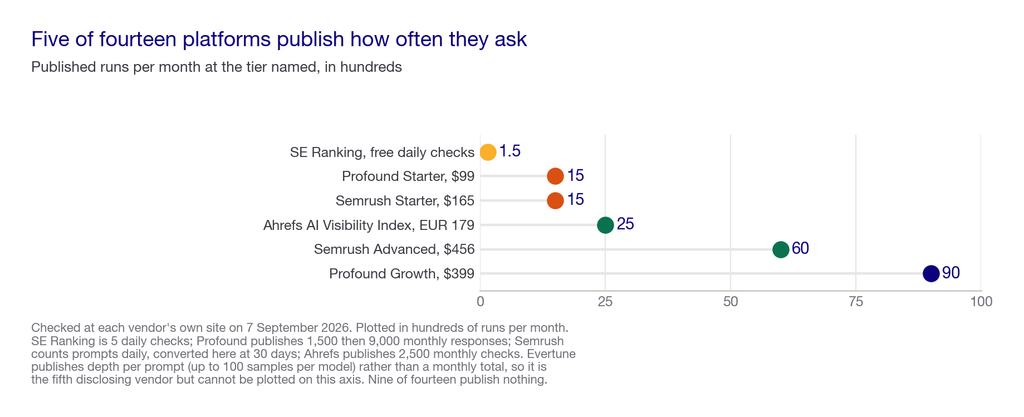
Evertune publishes the deepest sampling of anyone here, stating that it samples each prompt up to 100 times per model. Profound publishes the clearest volume figures, naming monthly responses at every tier rather than only prompt counts. Ahrefs and Semrush both publish daily check volumes, which is a meaningfully different unit from a monthly cap. SE Ranking publishes a small free daily allowance.
The other nine publish a prompt count and nothing about how often those prompts are asked. That is the gap worth knowing about before you compare prices. There are only two ways to close it: a vendor that publishes the figure, or a team you can ask. Pepper is the second kind, which is why it sits in its own category below.
Key takeaways
- Engines are probabilistic. The same prompt returns different answers on different runs, so a single run establishes nothing.
- Prompt count is not sample size. Tracking 100 prompts once a month is a hundred data points. Tracking 50 prompts daily is fifteen hundred.
- Only five of fourteen publish a volume figure. Evertune, Profound, Semrush, Ahrefs and SE Ranking. The rest publish prompt caps alone.
- Two platforms can disagree and both be right. If a vendor cannot explain their sampling, they cannot explain a discrepancy either.
- Reliability is not accuracy. Nobody has published an independent accuracy benchmark, ours included, so treat any accuracy ranking with suspicion.
A note on where this comes from. We run organic for more than 250 enterprises and track over 10 million prompts across every major engine. What follows is shaped by that, by the client reviews we sit in weekly, and by the discrepancies we have to explain when a client’s tool and ours disagree.
What is an AI visibility platform?
An AI visibility platform runs a defined set of prompts across AI engines on a schedule and reports what came back: whether your brand was mentioned, whether a page from your domain was cited, which competitors appeared instead, which URLs and domains fed the answer, and how sentiment reads.
Three metric names are worth fixing, because vendors use different words for the same things. Brand Visibility is how often engines mention your brand by name. Domain Prompt Presence is how often they cite a page from your domain. Share of Voice is your slice of all brand mentions in the category. The gap between the first two is the diagnostic worth reporting: engines that know you but cite somebody else to describe you have a citability problem, not an awareness one.
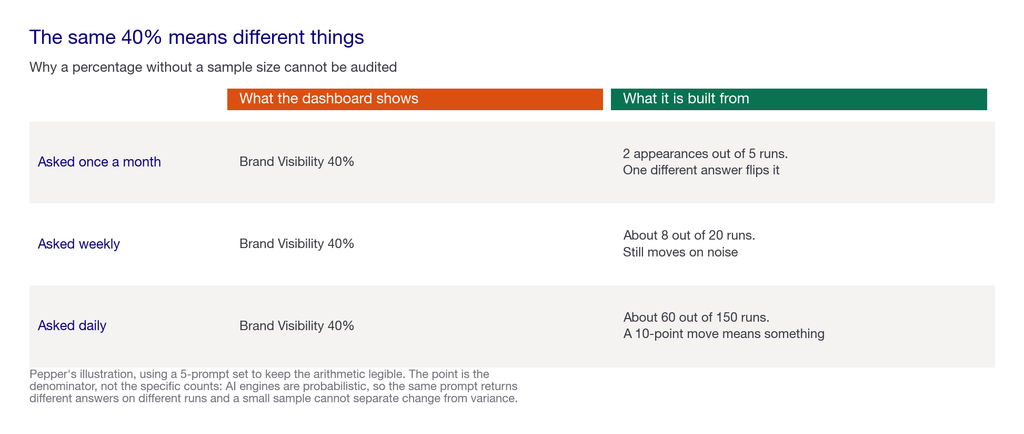
Every one of those metrics is a rate, not a count. “Brand Visibility of 40%” means you appeared in 40% of runs. Which immediately raises the question the category mostly avoids: forty percent of how many runs?
Our answer engine optimization guide covers the mechanics, and GEO vs SEO vs AEO covers where the vocabulary distinctions carry meaning.
Why does sampling depth decide everything?
Because a percentage computed from a small sample is unstable, and instability looks exactly like performance change.
Suppose a platform asks each of your prompts once a month. Your Brand Visibility moves from 30% to 40% between March and April. Did anything change? With that sample size, you cannot tell. Ordinary run-to-run variance produces swings that size, and you will spend a quarter chasing a movement nobody caused.
Now suppose it asks each prompt daily. The same 10-point move is built from roughly thirty times more observations, and it starts to mean something.
This is why response volume matters more than prompt count, and why the two most useful published numbers in this category are Profound’s monthly response figures and Evertune’s sampling depth. Both tell you the denominator. Almost nobody else does.
Evertune states it samples each prompt up to 100 times per model. Profound publishes 1,500 monthly responses on its $99 Starter tier and 9,000 on $399 Growth, alongside prompt counts of 50 and 100. Those two figures together are the most complete disclosure in the category.
If a vendor will not tell you the denominator, the percentage they report cannot be audited. That is not an accusation of bad faith. It is just a limit on what you can do with the number.
AI visibility platforms at a glance
| Platform | Entry pricing | Engines | Published volume or sampling |
|---|---|---|---|
| Pepper | Not published | 6 | Set per account with your growth team, and adjustable |
| Evertune | Not published | 7 | Up to 100 samples per prompt, per model |
| Profound | $99 Starter, $399 Growth | 1, then 3, up to 9 | 1,500 then 9,000 monthly responses |
| Semrush AI Visibility | $165 Starter (annual) | ChatGPT, Perplexity, Gemini, Google | 50 prompts daily, 200 on Advanced |
| Ahrefs Brand Radar | From €47, limited free | 7 | 83 daily prompts, 2,500 monthly checks |
| AthenaHQ | Free Essential, $295 Starter | 5 free, 10 on Starter | Credit-based, volume not stated |
| Trakkr | $100 Growth, $500 Scale | 8, all tiers | 50 prompts per brand, daily tracking |
| Scrunch | $300 Starter | 7, all tiers | Not published |
| Peec AI | Not published | 5, all tiers | Daily tracking, volume not stated |
| Otterly | $29 Lite | 4 included, 3 add-ons | Not published |
| AirOps | Free Solo | 1 free, 4 on Pro | Not published |
| Conductor | Not published | 6 | Not published |
| SE Ranking | Free trial, 5 daily checks | 5 | 5 free daily checks |
| HubSpot AI Search Grader | Free | 3 | One-time check |
Checked at each vendor’s own site or pricing page on 7 September 2026.
If you want your own prompt set run at a stated volume rather than an implied one, book a growth audit and we will show you the denominator alongside the number.
How we weighted this comparison
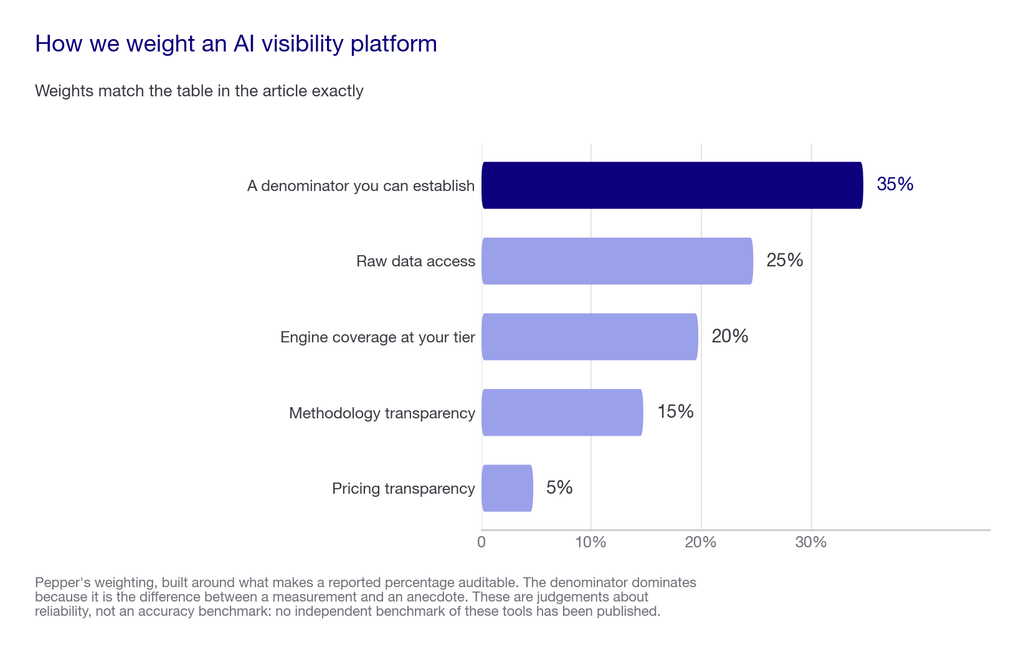
| Area | Weight | What decides the score |
|---|---|---|
| A denominator you can establish | 35 | Whether you can find out how many runs sit behind a percentage, either published on the pricing page or answered directly by a named team |
| Raw data access | 25 | Whether you can read the actual answer text and cited URLs, rather than a score computed from data you cannot see |
| Engine coverage at your tier | 20 | Which engines the purchasable tier returns, since coverage gaps look identical to absence |
| Methodology transparency | 15 | Whether the vendor can explain prompt selection and how a discrepancy with another tool would be investigated |
| Pricing transparency | 5 | Whether a buyer can size the purchase before a call |
The denominator carries the most weight because it is the difference between a measurement and an anecdote. Note what this criterion is and is not. It asks whether you can establish the sample size, not whether a vendor prints it on a pricing page. Self-serve tools have only one way to tell you, which is to publish. Where a team is attached to the account, you can simply ask, and change it. Pricing carries least, because it does not affect whether the data is trustworthy.
Our GEO agency ranking methodology explains how we build weightings like this one.
The platforms
1. Pepper sits in its own category per the disclosure, because it pairs the measurement layer with people who act on it.
- Pricing: Not published. Scope is set with the account rather than by tier
- Engines: 6, including ChatGPT, Perplexity, Gemini and Google AI Overviews
- Sampling and volume: Set per account with your growth team, and raised when a category proves volatile. A published tier cannot do that: if 1,500 monthly responses is not enough for your category, the tier is the tier
- Denominator: You are told it, and you can change it. That is the criterion this page weights highest
- What you log into: Workspace setup, brand profile, competitors and personas. GA4 and Search Console connected. Themes and prompts managed, GEO analytics read directly, and your own agents built and run in the Agent Atlas
- Metrics reported: Brand Visibility, Domain Prompt Presence and Share of Voice. The gap between the first two is the citability diagnostic
- When two tools disagree: A named person reruns the prompt set deeper and explains the gap. No dashboard does this
- Best for: Teams who need a number they can defend to a board, and the hands to act on it
- Where it falls short: We do not publish pricing, so you cannot size it before a call. A self-serve subscription with no people attached is not what we sell
2. Evertune publishes the deepest sampling statement of anyone here, which is the single most relevant disclosure on this page.
- Pricing: Not published. Demo request only
- Engines: 7 (ChatGPT, Claude, Perplexity, Gemini including AI Mode and AI Overviews, Copilot, DeepSeek, Meta AI)
- Sampling depth: Each prompt sampled up to 100 times per model. No other vendor states a figure this specific
- Positioning: “Own the AI customer journey”, building organic and paid strategy around measured gaps
- Best for: Brand perception work where the number has to survive statistical scrutiny
- Where it falls short: No published pricing. Sampling that deep suits periodic studies more than daily monitoring
3. Profound is the only self-serve vendor here that publishes a denominator, which makes its numbers auditable.
- Pricing: $99 Starter, $399 Growth, Enterprise quoted
- Engines: 1 on Starter, 3 on Growth, up to 9 on Enterprise
- Prompt allowance: 50 on Starter, 100 on Growth
- Response volume: 1,500 monthly on Starter, 9,000 on Growth. Naming responses alongside prompts is rare and genuinely useful
- Enterprise adds: SSO, SAML, SOC 2, dedicated Slack support
- Best for: Buyers who need a percentage with a knowable sample size behind it
- Where it falls short: Coverage is heavily tier-gated, so the entry tier measures one engine well rather than several adequately
4. Semrush counts daily rather than monthly, which makes its effective sample far larger than the headline suggests.
- Pricing: $165.17 Starter, $248.17 Pro+, $455.67 Advanced, monthly billed annually
- Engines: Google Search, ChatGPT, Perplexity, Gemini
- Prompt allowance: 50 daily on Starter, 100 on Pro+, 200 on Advanced
- Effective monthly sample: Roughly 1,500 runs on Starter, about thirty times a monthly cap of the same number
- Best for: High sampling volume without a specialist contract
- Where it falls short: One domain per plan, with additional domains charged separately
5. Ahrefs Brand Radar publishes both a daily prompt figure and a monthly check figure, which is unusually complete.
- Pricing: Custom prompts from €47. AI Visibility Index from €179. Limited daily checks free in paid Ahrefs plans
- Engines: 7 (AI Overviews, AI Mode, Gemini, Perplexity, ChatGPT, Copilot, Claude)
- Prompt allowance: 83 daily prompts on the Index plan
- Check volume: 2,500 monthly checks across all platforms
- Best for: Existing Ahrefs customers, who often already have limited access
- Where it falls short: An add-on to a broader SEO product, so it suits current customers better than new buyers
6. AthenaHQ leads on engine breadth at a published price, and says nothing about sampling.
- Pricing: Free Essential with $25 credit, $295 Starter, Enterprise quoted
- Engines: 5 free, 10 on Starter, more on request
- Sampling and volume: Not published. The model is credit-based and runs per prompt are not stated
- Best for: Buyers whose priority is breadth rather than statistical confidence
- Where it falls short: Without a stated run count, the denominator behind any reported percentage is unclear
7. Trakkr tracks daily across every model, and is the clearest fit for a portfolio.
- Pricing: $100 Growth, $500 Scale, Enterprise from $790. 17% annual discount
- Engines: All 8 at every tier. Its positioning: “no per-model fees, every model included”
- Prompt allowance: 50 per brand, tracked daily
- Brands: 1 on Growth, 10 on Scale, unlimited on Enterprise
- Sampling: Daily tracking stated, but runs per prompt are not published
- Where it falls short: 50 prompts per brand is a low ceiling for a broad category, and there is no free tier
8. Scrunch covers seven engines at both $300 Starter and $500 Growth with no tier-gating, plus GA4 integration for AI referral attribution. Where it falls short: no published sampling or response volume, and the highest entry price here.
9. Peec AI covers five engines at every tier with daily tracking and no gating, reporting 3,000+ brands and agencies as customers. Where it falls short: no published pricing at any tier and no stated run volume, so neither cost nor denominator can be established before a call.
10. Otterly has the cheapest paid entry at $29 for 15 prompts with unlimited team members. Where it falls short: three of its seven engines are paid add-ons, and no sampling figure is published.
11. AirOps offers the most generous free tier here, Solo covering 100 tracked prompts and pages on ChatGPT. Where it falls short: single-engine at the free tier and no published run volume, so a quiet result may be a coverage limit, a sampling limit, or a genuine finding, and you cannot tell which.
12. Conductor positions as “the only all-in-one enterprise AEO platform” across six engines, connecting presence to traffic and revenue. Where it falls short: no published pricing and no published sampling.
13. SE Ranking covers Google AI Overviews, AI Mode, ChatGPT, Gemini and Perplexity, with five free daily checks and a 14-day trial. The free daily allowance is a genuine sampling disclosure, if a small one. Where it falls short: toolkit pricing is not published on the product page.
14. HubSpot AI Search Grader is free, needs no account, and scores brand perception out of 100 across five dimensions using ChatGPT, Perplexity and Gemini. Where it falls short: it is explicitly a one-time check, so its sample size is one by design. Useful as a baseline, not as monitoring.
What these platforms cost
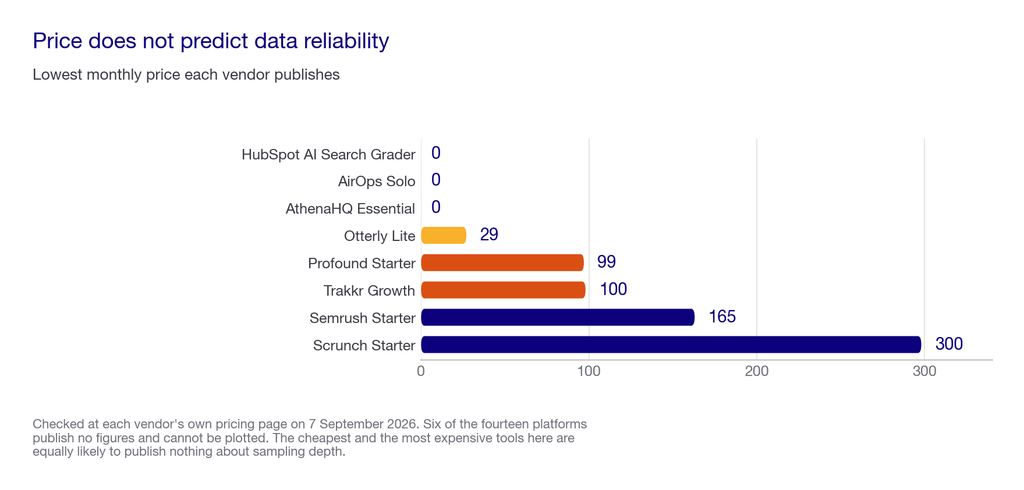
Entry pricing runs from free to $300, and it does not correlate with data reliability at all. The cheapest tools and the most expensive tools are equally likely to publish nothing about sampling.
Normalise three things before comparing. The counting period, since Semrush counts prompts daily and Profound counts them monthly. The brand count, since most plans cover one domain. Engine inclusion, since Otterly sells three of its seven engines separately.
Our engine coverage comparison works through the coverage side in detail, and best AI visibility platforms for enterprise applies procurement criteria to the same market.
The largest cost is on none of these pages. A platform surfacing two hundred opportunities a quarter creates two hundred pieces of work, and priced at a loaded hourly rate that lands several times above the subscription. Our cost breakdown of platforms against hiring models it.
What nobody should promise you
An accuracy ranking. Nobody has published an independent benchmark of these tools against ground truth, ours included. Any list claiming to rank by accuracy is ranking by something else and calling it accuracy.
A stable number from a small sample. If the vendor cannot tell you how many runs sit behind a percentage, the percentage cannot be audited.
Guaranteed citations. Google advises against providers guaranteeing rankings, because third parties cannot access internal ranking systems.
That two tools disagreeing means one is broken. Different prompt sets, different sampling depths and different engine mixes produce different numbers legitimately. Ask both to show their method.
How to evaluate an AI visibility platform
I would start with a question most buyers never ask, and it takes thirty seconds: how many times will you ask each of my prompts?
Google’s May 2026 guidance is the anchor for what you are buying into. Google states that AEO and GEO are part of SEO, and that AI Overviews and AI Mode run on core Search ranking systems with no separate AI index. That is correct for Google, and Google is one engine. ChatGPT and Perplexity retrieve and cite differently, and all of them are probabilistic. Hold both: the fundamentals carry over from work your SEO team already does, and the measurement layer is genuinely new precisely because rank tracking assumes a stable answer and these systems do not have one.
Score the decision before a demo.
| Area | Weight | What a strong vendor demonstrates |
|---|---|---|
| A denominator you can establish | 35 | Tells you runs per prompt or monthly responses without being pushed, whether from a published page or a named contact, and explains what confidence that buys |
| Raw data access | 25 | Shows actual answer text and cited URLs on the call, and confirms they export |
| Engine coverage at your tier | 20 | Reads the tier row aloud rather than the marketing page, and names which engines cost extra |
| Methodology transparency | 15 | Explains how prompts were selected and how they would investigate a discrepancy with another tool |
| Pricing transparency | 5 | Enough published to size the purchase before a sales conversation |
Those weights sum to 100. Score your own situation too: if nobody has hours to act on findings, a more reliable number changes nothing.
The live test, and run it before any demo. Take 30 real commercial prompts from your category, written the way a buyer would type them. Four worked examples: “which AI visibility platform is most accurate”, “how do we find out if ChatGPT recommends our product”, “best tool for tracking brand mentions across AI assistants”, “why do two AI visibility tools show different numbers”. Run each one yourself five times on the same engine, on the same day, and record how often the answer changes.
That single exercise is the most useful thing in this article. It shows you the variance in your own category, which tells you how much sampling you actually need. In stable categories a handful of runs is enough. In contested ones it is not.
Then hand the identical prompt list to each vendor and ask for five things back. Where do we appear and where do we not. Which competitors appear instead, consistently. Which sources influence those answers, sorted by frequency. Why are those sources winning. What would you change in the next 90 days, and who does it. Compare their output against your own runs, and ask any vendor whose numbers differ from yours to explain the gap.
The weak evaluation against the strong one. The weaker sequence compares feature grids and prices, picks the tool with the most engines per pound, and reports whatever it produces. It never establishes a denominator, so every subsequent movement is uninterpretable and the quarterly review becomes an argument about whether the number is real.
The stronger sequence measures variance in your own category first, decides how much sampling that requires, filters to vendors who publish enough volume to meet it, and only then compares price. It usually produces a shorter shortlist and a defensible board number.
Red flags, each one something you will genuinely hear. “Our data is the most accurate in the market”, offered with no benchmark and no method. “We track 200 prompts”, with no statement of how often. “Our AI visibility score is proprietary”, which means it cannot be audited. “We guarantee citations”, which Google’s guidance advises against. “The other tool is wrong”, offered instead of an explanation of methodological difference. “Real-time tracking”, which usually means daily. And the quiet one: a demo dashboard with percentages to one decimal place and no sample size anywhere on screen.
Five questions for the first call.
- How many times will you ask each prompt, and over what period? A good answer is a number. A weak one describes the prompt cap again.
- What sample size sits behind a percentage in this dashboard? A good answer shows it on screen. A weak one says the platform handles it.
- Can we export raw answer text and cited URLs? A good answer is yes with a format. A weak one explains why the score is more useful.
- If our other tool reports a different number, how would you investigate? A good answer describes comparing prompt sets and sampling. A weak one asserts they are more accurate.
- How did you select the prompts in this sample report? A good answer describes a method and admits which segments are thin.
It all comes down to one principle: never accept a percentage without a denominator. Everything else about these tools is a preference. That one is a requirement.
One closing note that costs us something. Very few providers are equally strong across measurement, execution, earned authority and attribution, ours included, and the good ones will tell you which of the four is their weakest. If all you need is a reliable number and you have the hands to act on it, buy the tool with the deepest published sampling and skip the rest of this market.
Frequently asked questions
What is an AI visibility platform?
Software that runs a set of prompts across AI engines on a schedule and reports whether your brand was mentioned, whether your pages were cited, which competitors appeared instead, and which sources fed the answer. It measures a system it does not change.
Which AI visibility tool has the most accurate data?
Nobody knows, because no independent accuracy benchmark has been published. What can be compared is sampling depth. Evertune publishes up to 100 samples per prompt per model, and Profound publishes monthly response volumes, which are the two clearest disclosures.
Why do two AI visibility tools show different numbers?
Because AI engines are probabilistic and return different answers on different runs. Different prompt sets, sampling depths and engine mixes produce different results legitimately. Ask both vendors to explain their method rather than assuming one is broken.
What is a good Brand Visibility score?
There is no universal benchmark, and be wary of anyone offering one. Compare against your own baseline over time and against named competitors in the same prompt set, using a sample size large enough that ordinary variance does not look like change.
How many times should a prompt be sampled?
Enough that ordinary run-to-run variance is smaller than the change you want to detect. Measure variance in your own category first by running the same prompt five times on one day. Contested categories need considerably more sampling than stable ones.
How much does an AI visibility platform cost?
From free to $300 monthly at entry, with mid tiers between $165 and $500 and enterprise quoted. Six of the fourteen platforms here publish no pricing, so budget for quoted pricing across part of any shortlist.
Are there free AI visibility tools?
Yes. AirOps Solo tracks 100 prompts on ChatGPT, AthenaHQ Essential covers five models with $25 of credit, and HubSpot’s AI Search Grader is a free one-time check. SE Ranking includes five free daily checks.
Can an AI visibility platform improve my visibility?
No. Every platform here measures. Improving visibility takes technical retrievability work, content and earned media, and Muck Rack found earned media drives 84% of AI citations across its dataset.
Where to go next
Measure your own variance first, because it decides how much sampling you need and it costs an afternoon. Take five commercial prompts, run each one five times on the same engine on the same day, and record how often the answer changes. That number tells you more about what to buy than any feature grid.
Then filter your shortlist to vendors who publish a volume figure, and ask the rest for one before you compare prices.
Our guide to tracking brand mentions in AI search covers the five methods and what each misses, and which platform covers the most AI engines covers the coverage side.
For the buy-versus-build question, is a GEO platform worth it without an agency covers the four conditions that decide whether you can act on findings, and GEO agency vs GEO tool covers what each model can and cannot do. Our SalesHood case study documents AI Overview keywords moving from 14 to 97 across five months.
The honest exit. If your category is small and stable, and five manual runs show the answer barely moves, you do not need a platform yet. Track it in a spreadsheet quarterly and revisit when the prompt set or the volatility grows.
Sources
Every vendor figure was checked at that company’s own website or pricing page on 7 September 2026, not taken from another roundup. Every study cited was published in 2026. No independent accuracy benchmark of these tools exists, so none is cited or implied.
- Evertune: “the marketing platform for brand discovery in AI search”, samples each prompt up to 100 times per model, seven engines, no published pricing.
- Profound pricing: $99 Starter, 50 prompts, 1,500 monthly responses, ChatGPT only; $399 Growth, 100 prompts, 9,000 responses, three engines; Enterprise up to nine with SSO, SAML and SOC 2.
- Semrush pricing: Starter $165.17 monthly billed annually, 50 prompts daily, one domain; Pro+ $248.17, 100 daily; Advanced $455.67, 200 daily.
- Ahrefs Brand Radar: seven engines, custom prompts from €47, AI Visibility Index from €179 with 83 daily prompts and 2,500 monthly checks.
- AthenaHQ pricing: free Essential, five models, $25 credit; $295 Starter, ten models; Enterprise quoted.
- Trakkr pricing: Growth $100 one brand, Scale $500 ten brands, Enterprise from $790. All eight models at every tier, daily tracking.
- Scrunch pricing: $300 Starter, $500 Growth, seven engines at every tier.
- Peec AI pricing: four tiers, no published figures, five engines at every tier, daily tracking.
- Otterly pricing: $29 Lite, four engines included, three sold as add-ons.
- AirOps pricing: free Solo tier, 100 tracked prompts, ChatGPT only.
- Conductor: “the only all-in-one enterprise AEO platform”, six engines, no published pricing.
- SE Ranking AI Search Toolkit: five engines, five free daily checks, 14-day trial.
- HubSpot AI Search Grader: free one-time check, no account, ChatGPT, Perplexity and Gemini.
- Zhang Kai, He Xinyue and Yao Jingang, From Citation Selection to Citation Absorption, arXiv, 28 April 2026. 602 controlled prompts, 21,143 search-layer citations, 18,151 fetched pages, across ChatGPT, Google AI Overview and Perplexity. Finds that high-influence pages are longer, more structured and richer in extractable evidence, and that citation counts alone inadequately measure effectiveness. Academic and independent of every vendor named here.
- Huang, Goyal, Saha and Chandrasekharan, Answer Bubbles: Information Exposure in AI-Mediated Search, arXiv, 17 March 2026. 11,000 real search queries across five systems. Finds that identical queries produce structurally different information realities across systems, and that Wikipedia and longer sources are disproportionately overrepresented. Academic and independent.
- Muck Rack, Earned media still drives 84% of AI citations, 7 May 2026. More than 25 million cited links across ChatGPT, Claude and Gemini, 17 industries. Muck Rack sells PR software, so read it as an interested party with a large dataset.
- Google Search Central, AI features and your website, 15 May 2026, including the guidance against providers guaranteeing rankings.
Latest Blogs
Most advice on this is inference dressed as fact. OpenAI documents exactly one thing clearly, which is access. Here is what is documented, what is inferred, and how to verify the rest for yourself.
Being named in an AI answer and having your page used as its source are different outcomes with different causes and different fixes. The gap between them is the most useful diagnostic in AI search, and most reporting collapses it into one number.
Every platform reports share of voice and almost none of them define it the same way. Here is the definition worth using, the three choices that change the number, and how to measure it yourself without buying anything.
Get your hands on the latest news!