Best AI visibility platforms for enterprise in 2026
Enterprise buyers get filtered out of this category before they reach the feature comparison, and usually by something boring.
Single sign-on. A seat model that survives a 40-person marketing org. Data export that satisfies a procurement review. Somebody accountable when the number moves and nobody can explain why. Most AI visibility roundups compare dashboards and never mention any of it.
So this page ranks seven platforms against enterprise criteria rather than general ones. Pepper is one of them, and the disclosure below sets out exactly how we handled that.
The short answer
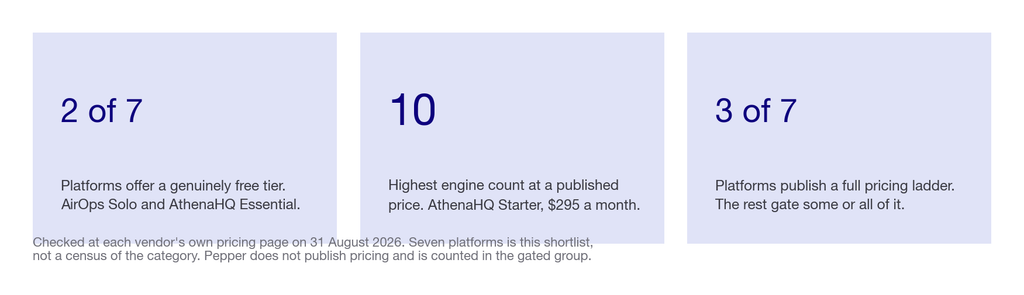
For raw engine coverage at a published price, AthenaHQ leads: 10 models on a $295 Starter tier. For a genuinely free way to start, AirOps and AthenaHQ both offer one. For enterprise procurement specifically, Profound publishes the clearest security posture, naming SSO, SAML and SOC 2 at its Enterprise tier.
None of those decide it on their own, because the constraint in most enterprises is not measurement. It is who acts on the findings.
Key takeaways
- Engine counts are not comparable as published. Vendors gate engines by tier, sell some as paid add-ons, and count two Google surfaces as two engines.
- The entry price collapsed. AirOps and AthenaHQ both offer free tiers, so testing whether AI search matters in your category now costs nothing.
- Enterprise criteria are different criteria. SSO, seat model, data export and multi-region matter more than dashboard design, and most roundups skip them.
- Published pricing is a minority position. Three of the seven publish a full ladder. The rest gate some or all of it.
- The measurement layer is the cheap part. Execution hours are the expensive part, and no platform includes them.
A note on where this comes from. We run organic for more than 250 enterprises and track over 10 million prompts across every major engine. What follows is shaped by that, by the client reviews we sit in weekly, and by conversations with buyers at the events we run. It is our read on the category, informed by selling into it.
What is an AI visibility platform?
An AI visibility platform runs a defined set of prompts across AI engines on a schedule and reports what came back: whether your brand was mentioned, whether a page from your domain was cited, which competitors appeared instead, which URLs and domains fed the answer, and how sentiment reads.
It is an instrument. It measures a system it does not change, which is the single most important thing to understand before signing anything.
Three metric names are worth fixing early, because vendors use different words for them. Brand Visibility is how often engines mention your brand by name. Domain Prompt Presence is how often they cite a page from your domain. Share of Voice is your slice of all brand mentions in the category. The gap between the first two is the diagnostic that matters: engines that know you but cite somebody else to describe you signal a citability problem rather than an awareness one.
Our Visibility, Citability and Retrievability framework sets out how we work out which of the three levers is stuck, and our guide to AI visibility metrics covers how each number is calculated and how to read it.
What do enterprise buyers actually check?
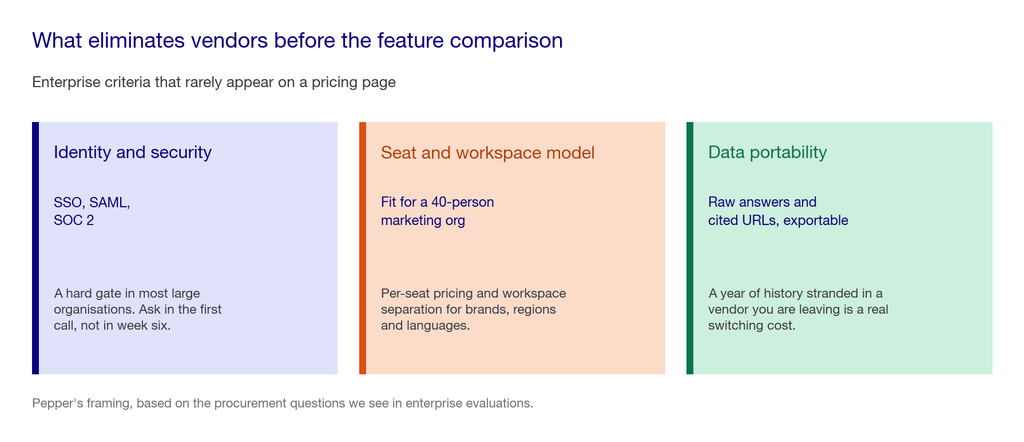
Different things from the criteria in a general roundup, and it is worth naming them because they eliminate vendors fast.
Identity and security. SSO and SAML, SOC 2, and a data processing agreement your legal team will sign. This is a hard gate in most large organisations and it is rarely on a pricing page.
Seat model. A 40-person marketing org cannot run on a three-seat plan. Some vendors include unlimited team members at every tier, others price per seat, and the difference over a year can exceed the subscription.
Data export. Raw answer text and cited URLs, in a format you can take with you. A year of history stranded inside a vendor you are leaving is a real switching cost that nobody models at purchase.
Multi-region, multi-brand, multi-language. Enterprises rarely have one brand in one market. Ask how workspaces separate, because retrofitting this is painful.
Engine coverage at the tier you will actually buy. Not the marketing page. The tier row.
Best AI visibility platforms for enterprise at a glance
| Platform | Entry pricing | Engines at the tier named | Notable for enterprise |
|---|---|---|---|
| Pepper | Not published | 6: ChatGPT, Perplexity, Gemini, Claude, Google AI Overviews | Self-serve platform with a growth team attached |
| AthenaHQ | Free Essential, then $295 Starter | 5 free, 10 on Starter | Highest published engine count at a published price |
| Profound | $99 Starter, $399 Growth | 1 on Starter, 3 on Growth, up to 9 on Enterprise | Names SSO, SAML and SOC 2 at Enterprise |
| Scrunch | $300 Starter, $500 Growth | 7 | Publishes a full ladder, GA4 integration |
| Peec AI | Not published, four tiers | 5 at every tier | No tier-gating of engines |
| Otterly | $29 Lite, $189 Standard, $489 Premium | 4 included, 3 paid add-ons | Unlimited team members on every plan |
| AirOps | Free Solo, paid tiers quoted | 1 free, 4 on Pro | Free tier tracks 100 prompts |
Pricing and engine coverage checked at each vendor’s own pricing page on 31 August 2026.
How we weighted this comparison
We weighted for an enterprise buyer rather than a general one, which changes the order materially.
| Area | Weight | What decides the score |
|---|---|---|
| Insight to action | 30 | Whether findings arrive as prioritised work with an owner, or as a dashboard somebody must interpret and then staff |
| Engine coverage at your tier | 25 | Which engines the tier you will buy actually returns, counted honestly rather than by marketing headline |
| Enterprise readiness | 20 | SSO and SAML, SOC 2, seat model, multi-region and multi-brand workspace separation |
| Data access and export | 15 | Raw answer text and cited URLs, exportable in a format that survives a vendor change |
| Pricing transparency | 10 | Whether a buyer can build a business case before booking a call |
Insight to action carries the most weight because it is the constraint that decides outcomes in almost every enterprise account we take over. Accurate dashboards with nobody acting on them is the most common state we inherit, and it is not a vendor failure.
Our GEO agency ranking methodology explains how we build weightings like this one.
The platforms, ranked for enterprise
1. Pepper, in its own category per the disclosure above, is an agentic organic growth engine rather than a measurement tool. Customers log into the platform themselves: they set up a workspace, define brand profile, competitors and personas, connect GA4 and Search Console, manage themes and prompts, read GEO analytics, and build and run their own agents in the Agent Atlas.
And a growth team is attached to the account and does the work alongside them, which covers the execution and earned media lines that no software tier includes at any price. We track ChatGPT, Perplexity, Gemini, Claude and Google AI Overviews.
Where it falls short: we do not publish pricing, so budget discovery is a conversation rather than a page. We are built for teams running organic as a long-term function, so a one-off audit is not what we are for. Our depth sits in content, authority and AI search rather than large technical migrations, so raise that early if it is your primary problem.
If you want the diagnostic run against your category before you shortlist anyone, book a growth audit and we will show you which sources decide your answers today.
2. AthenaHQ publishes the most engines at a published price in this set. Its free Essential tier includes $25 of credit and covers five models: ChatGPT, Perplexity, Google AI Overviews, Gemini and Copilot. Starter at $295 monthly covers ten, adding AI Mode, Claude, Grok, DeepSeek and Meta AI. Enterprise adds a knowledge base and discrepancy detection. Where it falls short: the jump from free to $295 is steep with nothing between, so a mid-sized team testing seriously has no natural next step.
3. Profound publishes the clearest ladder and the clearest enterprise security posture. Starter at $99 covers ChatGPT only, 50 prompts and 1,500 monthly responses. Growth at $399 covers three answer engines, 100 prompts and 9,000 responses. Enterprise is quoted, reaches up to nine engines, and names dedicated Slack support with SSO, SAML and SOC 2 compliance. Where it falls short: engine coverage is heavily tier-gated, so the entry tier measures one engine accurately while your buyers may be asking three.
4. Scrunch publishes a full ladder at $300 Starter and $500 Growth, tracking ChatGPT, Claude, Gemini, Perplexity, Google AI Mode, AI Overviews and Meta. Its GA4 integration for AI referral traffic is genuinely useful for attribution conversations. Where it falls short: it is among the most expensive entry points in the category, and there is no free or low tier to test with before committing.
5. Peec AI is the only platform here that does not tier-gate engines: all four tiers cover ChatGPT, Perplexity, Gemini, AI Mode and Copilot. It reports 3,000+ brands and agencies as customers, and tiers differ by project count and support rather than by coverage. Where it falls short: no figures are published at any tier, so a buyer cannot build a business case without a sales conversation.
6. Otterly has the lowest published entry point at $29 for 15 prompts, and includes unlimited team members on every plan, which is unusual and genuinely valuable for a large marketing org. Four engines are included: ChatGPT, Google AI Overviews, Perplexity and Copilot. Where it falls short: Google AI Mode, Gemini and Claude are paid add-ons rather than included, so the headline engine count costs more than the headline price.
7. AirOps positions as “AI Search for Enterprise” and offers the most generous free tier here: Solo covers 100 tracked prompts and pages with ChatGPT insights and monthly opportunity reports. Pro adds multi-engine insights across Google, Perplexity, OpenAI and Google AI Studio, with unlimited seats. Where it falls short: paid pricing is quoted rather than published, and the free tier is single-engine, so a quiet result may be a coverage limit rather than a finding.
What these platforms cost
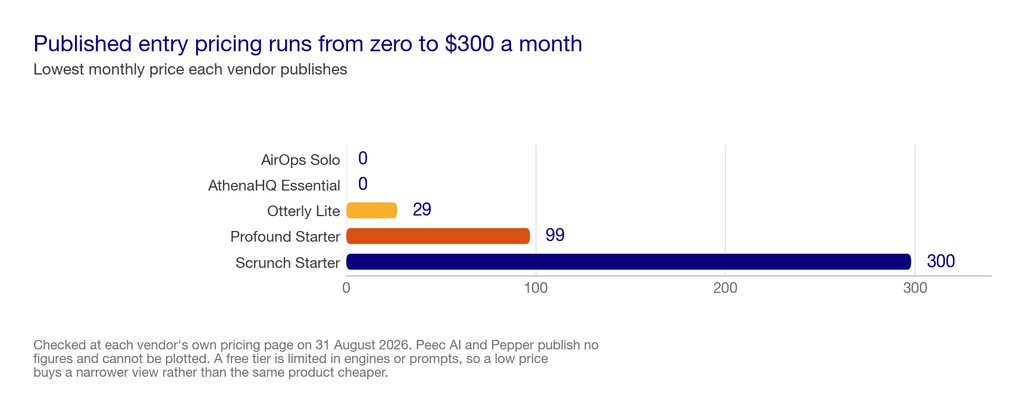
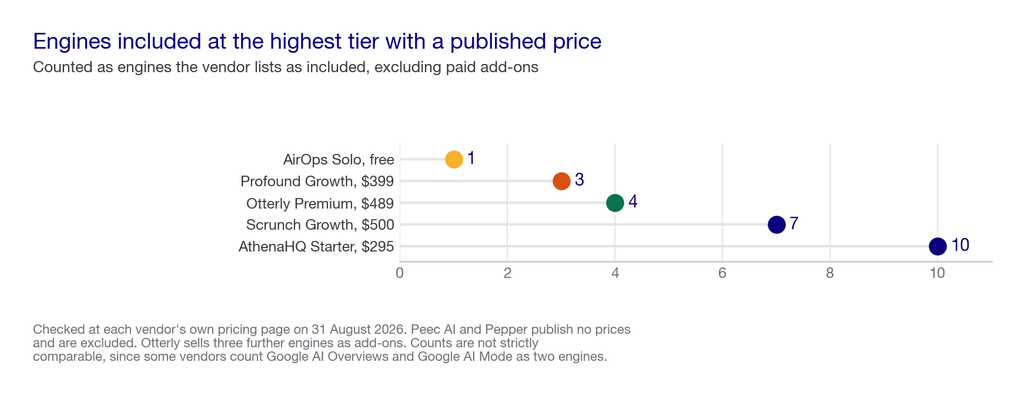
The spread is wider than any other category we track, running from free to $300 monthly at the entry tier, and the number does not predict quality. It predicts what the tier includes.
Two specs matter more than the headline. Prompt volume caps what you can watch, so 15 prompts on Otterly Lite or 50 on Profound Starter establishes whether a category matters and does not run one. Response volume is what separates a real change from noise, because engines are probabilistic. Profound is unusually transparent here, publishing 1,500 monthly responses at Starter and 9,000 at Growth.
The largest cost is on none of these pages. A platform surfacing two hundred opportunities a quarter creates two hundred pieces of work. Priced at a loaded hourly rate, that usually lands several times above the subscription. Our cost breakdown of platforms against hiring models that line properly.
What nobody should promise you
Guaranteed citations. Google advises against providers guaranteeing rankings, because third parties cannot access internal ranking systems. The same holds for AI answers.
That the platform will improve your visibility. It measures. Improvement takes technical fixes, content and earned media, and Muck Rack found 84% of AI citations come from earned media.
A single composite AI visibility score worth reporting. It hides the gap between Brand Visibility and Domain Prompt Presence, which is the finding you could act on.
That an engine count is comparable across vendors. Tier-gating, paid add-ons and counting two Google surfaces separately make headline counts non-comparable until you read the tier row.
How to choose an enterprise AI visibility platform
I would run the procurement filter before the feature comparison, because it removes more of the shortlist than anything else and it removes it faster.
Google’s May 2026 guidance is the right anchor for what you are buying. Google states that AEO and GEO are part of SEO, and that AI Overviews and AI Mode run on core Search ranking systems with no separate AI index. That is correct for Google, and Google is one engine. ChatGPT and Perplexity retrieve and cite differently. Hold both: the fundamentals carry over from work your team already does, and the measurement layer is genuinely new. It also means a vendor counting AI Overviews and AI Mode as two engines is counting two surfaces of one system.
Score the decision before you take a demo.
| Area | Weight | What a strong vendor demonstrates |
|---|---|---|
| Insight to action | 30 | Findings arrive prioritised with a named owner and an estimate of hours, not as a dashboard your team must interpret and then staff |
| Engine coverage at your tier | 25 | The tier row lists the engines your buyers use, and the vendor will say plainly which are add-ons and which count Google surfaces twice |
| Enterprise readiness | 20 | SSO, SAML and SOC 2 named in writing, a seat model that fits your org, and workspace separation for brands and regions |
| Data access and export | 15 | Raw answer text and cited URLs, exportable, so a year of history is not stranded if you switch |
| Pricing transparency | 10 | Enough published for you to build a business case before a sales conversation |
Those weights sum to 100. Score your own constraint first, because if the answer is execution capacity, a better dashboard will not help.
The live test, and it now costs nothing. Take 30 real commercial prompts from your category, written the way a buyer would type them. Four worked examples: “which AI visibility platform should a large enterprise use”, “how do we find out if ChatGPT recommends our product”, “best tools for tracking brand mentions in AI answers”, “which vendors do enterprise marketing teams shortlist for AI search”. Load them into one of the free tiers, let it run for a month, then hand the identical list to every vendor on your shortlist.
Ask for five things back. Where do we appear and where do we not. Which competitors appear instead, consistently. Which sources influence those answers, sorted by frequency. Why are those sources winning. What would you change in the next 90 days, and who does it. Compare their output against what you ran yourself. Engines are probabilistic, so require more than one run on more than one engine, since a single run establishes nothing.
The weak evaluation against the strong one. The weaker sequence is to book three demos, compare feature grids, and pick the best dashboard. It tests the vendor’s sales engineering rather than your ability to act, and it is how accurate reporting with nothing moving gets bought.
The stronger sequence runs the free diagnostic first, identifies which lever is actually stuck, applies the procurement filter to remove vendors legal will reject anyway, and only then compares the two or three that survive on the criteria that matter to you. It ends in a smaller purchase more often than the weak version does.
Red flags, each one something you will genuinely hear. “We track all major AI engines”, quoted from the marketing page when the tier row says one. “We guarantee citations in ChatGPT”, which Google’s own guidance advises against. “Here is your AI visibility score”, offered as a composite with no competitor share of voice beside it and no way to audit it. “We track your branded prompts”, which always looks healthy because those answers were already yours. “Unlimited prompts”, which usually caps somewhere the contract mentions and the page does not. “SOC 2 is on the roadmap”, said in a procurement conversation. And the quiet one: “your team will find this really easy to use”, offered instead of an answer about who does the work.
Five questions for the first call.
- Which engines does this specific tier return, and which are add-ons? A good answer reads the tier row aloud and names the add-on prices. A weak one points at the feature list.
- Can we export raw answers and cited URLs? A good answer is yes, with a format and a sample. A weak one explains why the dashboard is sufficient.
- What is your seat model at our headcount? A good answer is a number for 40 users. A weak one is that it depends.
- How did you choose the prompts in this sample report? A good answer describes a documented method and admits which segments are thin. A weak one cannot say.
- When this shows us we are invisible, what happens next, and who does it? A good answer names roles and hours. A weak one describes a recommendation engine.
It all comes down to one principle: buy the platform that fits your procurement reality and your engines, then budget separately for the hours it will create. The dashboard is the cheap half of this purchase.
One closing note that costs us something. Very few providers are equally strong across measurement, execution, earned authority and attribution, ours included, and the good ones will tell you which of the four is their weakest. If a vendor claims all four equally, treat the rest of their answers with the same scepticism.
Frequently asked questions
What is the best AI visibility platform for enterprise?
It depends on your binding constraint. AthenaHQ leads on published engine coverage at $295 for ten models. Profound publishes the clearest enterprise security posture. If execution capacity is your constraint, a platform with a team attached fits better than any dashboard.
Which AI visibility platform covers the most engines?
AthenaHQ publishes the highest count at a published price, covering ten models on its $295 Starter tier. Profound reaches up to nine at its quoted Enterprise tier. Counts are not directly comparable, because vendors gate and bundle engines differently.
Are there free AI visibility tools worth using?
Yes. AirOps offers a free Solo tier tracking 100 prompts and pages, and AthenaHQ offers a free Essential tier covering five models with $25 of credit. Both are single or limited scope, so treat a quiet result cautiously.
How much does an enterprise AI visibility platform cost?
Published entry pricing runs from free to $300 monthly, with enterprise tiers quoted. Three of the seven platforms here publish a full ladder. Budget separately for execution hours, which usually exceed the subscription by a wide margin.
Do these platforms support SSO and SOC 2?
Profound names SSO, SAML and SOC 2 at its Enterprise tier on its pricing page. Most others do not state security posture publicly, so raise it in the first call rather than assuming, since it is a hard gate in procurement.
What is the difference between Brand Visibility and Domain Prompt Presence?
Brand Visibility is how often engines mention your brand by name. Domain Prompt Presence is how often they cite a page from your domain. A wide gap means engines know you but trust other sources to describe you.
Can an AI visibility platform improve my rankings in AI answers?
No platform changes what engines say. They measure it. Improvement takes technical retrievability work, content and earned media, and Muck Rack found earned media drives 84% of AI citations across the dataset it analysed.
How many prompts does an enterprise need to track?
More than the entry tiers allow. Fifteen to fifty prompts establishes whether a category matters. Running a category across multiple brands, regions and personas usually needs several hundred, which is what the higher tiers are actually selling.
Where to go next
Start with the free tier and 30 real prompts. That single exercise tells you whether your gap is measurement, execution or authority, and it costs a day rather than a budget cycle.
Then apply the procurement filter before the feature comparison. SSO, seat model, data export and workspace separation will remove more of your shortlist than any dashboard review, and finding that out in week six is expensive.
Our guide to tracking brand mentions in AI search covers the five methods and what each misses. Is a GEO platform worth it without an agency covers the four conditions that decide whether you can act on findings, and GEO agency vs GEO tool covers what each model can and cannot do.
For adjacent shortlists, the best LLM SEO tools and best enterprise SEO tools cover the wider stack. Our Acceldata case study shows what the work looks like on a technical B2B account, and the SalesHood case study documents AI Overview keywords moving from 14 to 97 across five months.
The honest exit. If nobody in your organisation has protected hours to act on findings, you do not need to buy a platform this quarter. Fix the ownership question first, run the free diagnostic, and revisit with data.
Sources
Every vendor figure was checked at that company’s own pricing page on 31 August 2026, not taken from another roundup. Every study cited was published in 2026.
- Muck Rack, Earned media still drives 84% of AI citations, 7 May 2026. More than 25 million cited links across ChatGPT, Claude and Gemini, 17 industries. Muck Rack sells PR software, so read it as an interested party with a large dataset.
- Google Search Central, AI features and your website, 15 May 2026, including the guidance against providers guaranteeing rankings.
Latest Blogs
Most advice on this is inference dressed as fact. OpenAI documents exactly one thing clearly, which is access. Here is what is documented, what is inferred, and how to verify the rest for yourself.
Being named in an AI answer and having your page used as its source are different outcomes with different causes and different fixes. The gap between them is the most useful diagnostic in AI search, and most reporting collapses it into one number.
Every platform reports share of voice and almost none of them define it the same way. Here is the definition worth using, the three choices that change the number, and how to measure it yourself without buying anything.
Get your hands on the latest news!