LLM SEO tools in 2026: which ones work for AI Mode, ChatGPT and Perplexity
Here is the thing almost every roundup in this category gets wrong. They compare tools. You are not buying a tool, you are buying a tier, and coverage at the tier you can afford often looks nothing like the coverage on the marketing page.
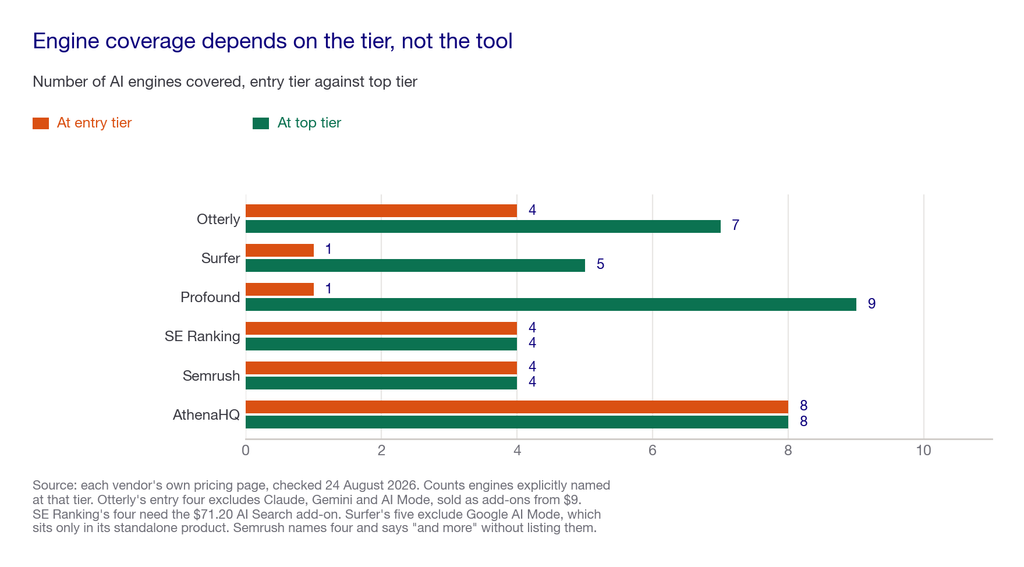
Two examples from checking every pricing page in this article on 24 August 2026. Surfer sells AI visibility tracking from its $99 Standard plan, and at that price it covers ChatGPT only. Profound’s $99 Starter also covers ChatGPT only, at 50 prompts a month. Both companies genuinely support five or more engines. Neither does it at the price most teams start with.
We have run organic for more than 250 enterprises across eight years and track over 10 million prompts across every major engine, so we buy and use these tools rather than only reviewing them.
Which engines actually matter
Before comparing tools, narrow the list of engines you care about, because coverage costs money and most teams over-buy.
ChatGPT is universally covered and usually the only engine at entry tier. Every tool here tracks it, so it should not drive your decision.
Perplexity is widely covered and worth having, because it cites transparently. Answers carry numbered inline citations, which makes it the easiest engine to audit by hand when you want to check what a tool is telling you.
Google AI Overviews is well covered. Given that it runs on core Search ranking systems, movement here tends to correlate with classic SEO work you are already doing.
Google AI Mode is the gap, and it is wider than it looks. This is the coverage question worth asking hardest. AthenaHQ includes AI Mode at its $295 Starter tier. SE Ranking names it explicitly in the AI Search add-on. Otterly sells it as a paid add-on running $9 to $149 a month depending on your plan. Surfer is the one to watch: its main plans do not include AI Mode at any tier, and it appears only in the standalone AI Search Analytics product at $158. Semrush names Google Search, ChatGPT, Perplexity and Gemini, then says “and more” without listing further engines. If AI Mode matters to your category, ask the vendor directly rather than reading the marketing page.
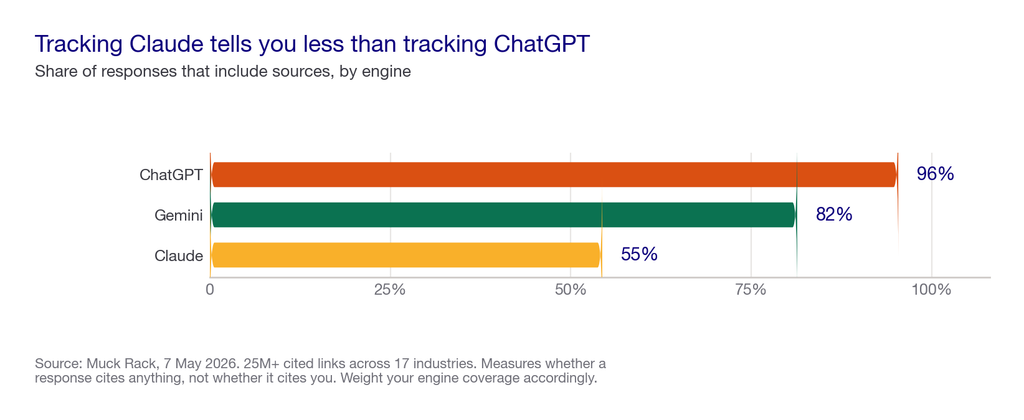
Claude and Copilot are situational. Claude cites far less often than the others, which changes what tracking it tells you. Muck Rack’s May 2026 analysis of more than 25 million cited links found ChatGPT includes sources in 96% of responses, Gemini in 82%, and Claude in just 55%.
What the tools actually cover, and what they cost
Every figure below was verified at the vendor’s own pricing page on 24 August 2026, the same day this was published.
| Tool | Entry AI price | Engines at that price | What to know |
|---|---|---|---|
| Otterly | $29/mo Lite | ChatGPT, AI Overviews, Perplexity, Copilot | Widest entry coverage, but only 15 prompts. Claude, Gemini and AI Mode are paid add-ons |
| Surfer | $99/mo Standard | ChatGPT only | Five engines at $182 Pro, though not AI Mode. AI Mode only in the standalone AI Search Analytics at $158 |
| Profound | $99/mo Starter | ChatGPT only | 50 prompts monthly at Starter. Three engines at $399 Growth, up to nine at Enterprise |
| SE Ranking | $103.20 + $71.20 add-on | AI Overviews, AI Mode, Perplexity, ChatGPT | AI Search is a separate add-on, not included. 200 daily prompts on Core |
| Semrush | $165.17/mo Starter | Google Search, ChatGPT, Perplexity, Gemini, plus unnamed others | 50 prompts daily, rising to 200 at Advanced. Classic SEO included in the same subscription |
| AthenaHQ | $295/mo Starter | ChatGPT, Perplexity, AI Overviews, AI Mode, Gemini, Claude, Copilot, Grok | Credit-based at 3,600 credits. Widest engine coverage at a published price. Free tier gives 300 credits |
| Ahrefs | $129 Lite, AI from $199 | Not named on the pricing page | Brand Radar included from Lite. Brand Radar AI is a separate product from $199, and specific engines are not named publicly |
What four-engine coverage actually costs
The headline price and the price for real coverage are different numbers, and the gap is where most budget surprises live.

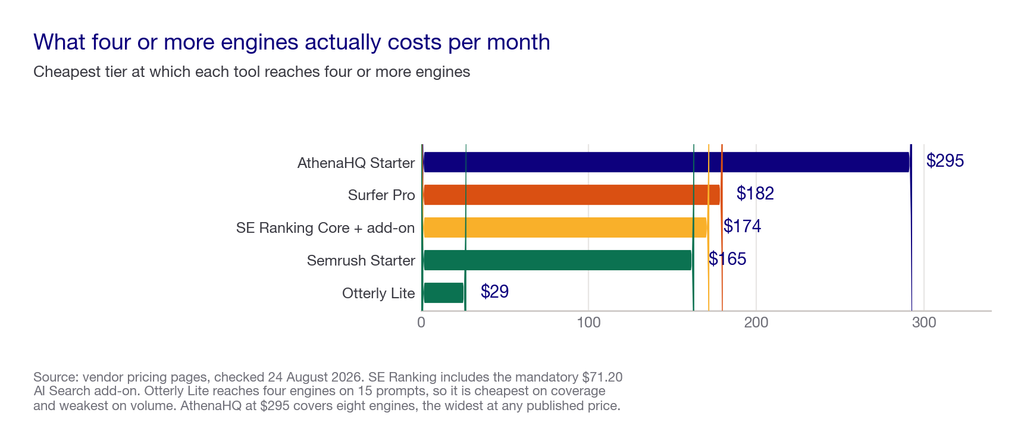
Otterly is cheapest at $29, and that buys 15 prompts, which is a demonstration rather than a measurement programme. Semrush reaches four named engines at $165.17 with 50 daily prompts, and classic SEO comes in the same subscription. SE Ranking lands at $174.40 once the mandatory add-on is included, with 200 daily prompts and AI Mode named. Surfer reaches five at $182, though not AI Mode. AthenaHQ is the outlier: $295 buys eight engines including AI Mode, Copilot and Grok.
Three traps recur, and all three are avoidable.

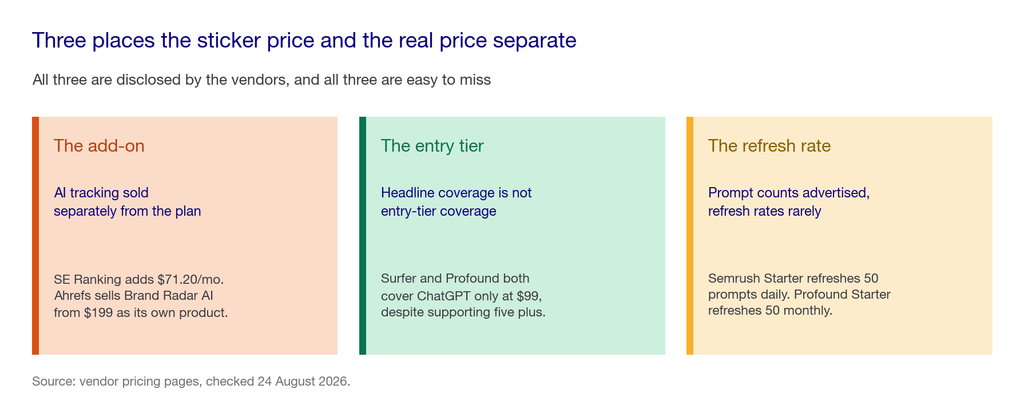
The add-on trap. SE Ranking’s AI Search tracking costs an additional $71.20 a month on top of the base plan. Ahrefs sells Brand Radar AI as a separate product from $199. Neither is hidden, and both are easy to miss when comparing headline prices.
The entry-tier trap. Surfer and Profound both cover ChatGPT only at $99. If you compare that against Otterly’s four engines at $29, the tools look mispriced. They are not, they are just priced differently by tier.
The refresh trap. Prompt counts are advertised, refresh rates usually are not. Semrush’s Starter tracks 50 prompts daily. Profound’s Starter tracks 50 monthly. Same advertised number, roughly thirty times the observations.
Which tool for which situation
Rather than a ranking, here is the routing we would actually use.
If you want the widest engine coverage on the smallest budget, Otterly at $29 is the honest answer, provided you accept 15 prompts. It suits a first look rather than an ongoing programme.
If you already pay for classic SEO tooling, check what your existing subscription includes before buying anything. Semrush bundles AI visibility into the same plan, and SE Ranking offers it as an add-on. Adding a second vendor to do what your first one already does is the most common waste we see.
If Google AI Mode is central to your category, verify at your tier explicitly. SE Ranking names it in the add-on, and Surfer covers it from $182. This is the coverage question most likely to catch you out.
If you want the widest engine coverage at a published price, AthenaHQ’s $295 Starter covers eight engines including AI Mode, Copilot and Grok, which is broader than anything else here that publishes a number. Profound reaches nine, though only at Enterprise on request.
If your bottleneck is authority rather than measurement, Ahrefs remains the strongest backlink dataset here, which matters more for AI visibility than it used to. Note that Ahrefs does not publicly name which engines Brand Radar AI covers, so ask before you assume.
Not sure which engines your buyers actually use? Book a growth audit and we will run your category’s prompt set across all five and show you where the answers are coming from.
What no tool can do for you
Every tool in this article measures. None of them change anything, and that distinction is worth being blunt about.
The most common failure we inherit is a team with excellent tooling, clean dashboards and no movement, because nobody had capacity to act on what the dashboard said. A tool surfacing two hundred opportunities nobody can action has added a backlog rather than a capability.
There is a second limit that matters more. Muck Rack’s May 2026 analysis of more than 25 million cited links found earned media accounted for 84% of AI citations, against 0.3% for paid and advertorial. So most of what decides your category’s answers is published by other people. A tool can show you which sources are winning. It cannot get you into them.
And no tool can guarantee a citation. Google explicitly advises against providers guaranteeing rankings, because third parties cannot access internal ranking systems. Nobody has that access for ChatGPT either.
Frequently asked questions
What are LLM SEO tools?
LLM SEO tools track how often AI engines mention your brand and cite your pages. They monitor citation frequency, source attribution, sentiment and competitor share of voice across ChatGPT, Perplexity, Google AI Overviews, AI Mode, Gemini and Claude.
Which LLM SEO tool covers Google AI Mode?
AthenaHQ includes it at $295 Starter, and SE Ranking names it in the AI Search add-on. Otterly sells it as an add-on from $9 monthly. Surfer’s main plans exclude it entirely, offering it only in a standalone product.
How much do LLM SEO tools cost?
Entry pricing runs from $29 monthly for Otterly to $295 for AthenaHQ. Reaching four or more engines typically costs $165 to $295. Watch add-on fees: SE Ranking charges $71.20 extra, Ahrefs sells Brand Radar AI separately from $199, and Otterly charges $9 to $439 per additional engine.
Do I need a separate tool for AI search?
Often not. Semrush includes AI visibility in its main subscription, and SE Ranking offers it as an add-on to an existing plan. Check what you already pay for before adding a second vendor for overlapping capability.
How many prompts should I track?
Enough to represent your category honestly, usually 50 to 200 for a mid-market business. Refresh rate matters as much as count: 50 prompts refreshed daily yields far more signal than 50 refreshed monthly.
Which AI engine should I prioritise?
Start with whichever your buyers actually use, then weight by citation behaviour. ChatGPT cites sources in 96% of responses and Claude in 55%, so tracking Claude tells you less about citation performance than the others.
Can these tools improve my AI visibility?
They measure it. Improving it takes technical retrievability work, content structure and earned media, since 84% of AI citations come from sources you do not own. Treat the tool as a diagnostic instrument rather than a treatment.
Is free LLM tracking available?
Partly. Bing’s AI Performance report provides first-party citation data at no cost, and several vendors offer free audits or trials. Sustained multi-engine tracking at any real prompt volume requires a paid plan.
Where to go next
Do the cheap thing first. Write down 20 to 30 real commercial questions from your category, then check which tools cover the engines your buyers use at a price you can defend for those prompt volumes. That exercise usually eliminates most of the shortlist before you book a single demo.
Then check what you already own. The most common overspend in this category is paying twice for overlapping coverage.
For the measurement theory, our guide to what actually matters in AI search measurement covers which numbers to report and which to ignore. For the discipline itself, what GEO is covers the mechanics, and the Visibility, Citability and Retrievability framework covers which lever a given piece of work moves.
To see the data before committing to tooling, see where you show up across ChatGPT, Perplexity, Gemini, Claude and AI Overviews. Customers run this themselves in the platform, with a growth team attached to do the work alongside them. Our SalesHood case study documents AI Overview keywords rising from 14 to 97 across five months.
One honest exit. If your category generates very few meaningful monthly prompts, or nobody can act on findings, buy nothing yet. Spend the money on earned media and revisit in two quarters.
Sources
All tool pricing, plan names, engine coverage and prompt limits were verified at each vendor’s own pricing page on 24 August 2026. This category reprices frequently, so re-check before quoting.
- Muck Rack, Earned media still drives 84% of AI citations, 7 May 2026. More than 25 million cited links across ChatGPT, Claude and Gemini, 17 industries. Muck Rack sells PR software, so read it as an interested party with a large dataset.
- Google Search Central, AI features and your website, 15 May 2026, including the advice against providers guaranteeing rankings.
Latest Blogs
Most advice on this is inference dressed as fact. OpenAI documents exactly one thing clearly, which is access. Here is what is documented, what is inferred, and how to verify the rest for yourself.
Being named in an AI answer and having your page used as its source are different outcomes with different causes and different fixes. The gap between them is the most useful diagnostic in AI search, and most reporting collapses it into one number.
Every platform reports share of voice and almost none of them define it the same way. Here is the definition worth using, the three choices that change the number, and how to measure it yourself without buying anything.
Get your hands on the latest news!

Similar Posts
Artificial Intelligence
11 mins read
What is anchor text, and does it still matter in 2026?
SEO
11 mins read
What is internal linking? Meaning, and what changed for AI search
SEO
15 mins read