What is answer engine optimization? The complete 2026 guide
Answer engine optimization is the practice of getting your brand named, and your pages cited, inside the answers that AI systems generate. Those systems include ChatGPT, Perplexity, Google AI Overviews and AI Mode, Gemini, Claude and Copilot. The work spans your website, your technical setup, and a large amount of the internet you do not own.
There is a simpler way to hold it. Search engines ranked documents and sent you traffic. Answer engines read a lot of documents, write one answer, and mention a handful of brands. You are no longer competing for a position on a page. You are competing to be in a sentence.
We have run organic for more than 250 enterprises across eight years, and we track over 10 million prompts across every major engine. Most of what follows comes from watching that shift happen inside real accounts, including the parts we got wrong before we understood the mechanism.
Key takeaways
- AEO, GEO, LLMO and AI SEO describe roughly the same practice. Wikipedia records that no consensus definition separating them existed in academic literature as of early 2026, and the terms are used interchangeably. Argue about the acronym at your peril.
- Google says this is still SEO. Its first official guidance, published 15 May 2026, confirms AI Overviews and AI Mode run on core Search ranking systems, with no separate AI index.
- Most citations are not yours to control directly. Muck Rack analysed more than 25 million cited links in May 2026 and found earned media accounted for 84% of AI citations, against 0.3% for paid and advertorial.
- Retrieval is the weak link, not reasoning. A Stanford-led evaluation in May 2026 found retrieval failures caused more than 70% of chatbot errors. Being findable beats being persuasive.
- Traffic is the wrong primary metric. Forrester found companies seeing 10% to 40% traffic declines as research moves into AI engines, which means a working programme can look like a failing one.
What answer engine optimization actually is
Start with what an answer engine does, because the name is doing a lot of work and most definitions skip the mechanism.
When someone asks ChatGPT or Perplexity for the best platform in your category, the engine does not go and rank a list of web pages for them. It expands the question into several searches. Then it pulls back passages from a set of sources, writes one answer from those passages, and credits some of the sources it used. Four separate things happen, and your brand can succeed or fail at each one independently.
Answer engine optimization is the work of making sure you are present at each stage. That means being known well enough to be named. It means being trusted enough that your own pages get pulled in as evidence. And it means being retrievable enough that you surface no matter how the question happens to be worded.
Here is where most teams go wrong. They treat this as one problem with one number attached, because that is how it gets sold. In practice it is three problems with three different owners. Being mentioned is usually a brand and PR problem. Being cited is usually a content and authority problem. Being retrievable is almost always a technical problem. A team that reports a single visibility figure to its leadership has averaged those three together and can no longer tell which one is broken.
Does the acronym matter?
Not really, and you should be suspicious of anyone who insists otherwise.
Answer engine optimization sits alongside generative engine optimization (GEO), large language model optimization (LLMO), artificial intelligence optimization (AIO) and plain AI SEO. Wikipedia’s entry notes that no consensus definition distinguishing these terms existed in academic literature as of early 2026. In practice they are used interchangeably. Forrester’s Nikhil Lai has argued the whole family is significantly, but not fundamentally, different from SEO.
Our position is that the mechanism matters and the label does not. If a vendor spends the first ten minutes of a call explaining why their acronym is the correct one, you have learned something useful about them, just not about the field. We break down the differences in AEO vs GEO vs AIO vs LLMO if you need to settle an internal argument. And AEO vs SEO helps if the argument is with a colleague who thinks none of this is new.
How is AEO different from SEO?
This is where the category tends to oversell, so it is worth being precise about what genuinely changed and what did not.
Google published its first official guidance on AI search on 15 May 2026, filed, tellingly, under SEO fundamentals rather than as a new discipline. It states that optimising for generative AI search is optimising for the search experience, and is therefore still SEO. It confirms that AI Overviews and AI Mode run on core Search ranking systems with no separate AI index. And it explicitly mythbusts several tactics the industry had been selling, including llms.txt files, content chunking, AI-specific rewrites and structured-data over-optimisation.
Read plainly, that is Google saying most of what you already do still applies. We think Google is right, and we also think that answer is incomplete, because Google is describing Google.
ChatGPT does not run on Google’s ranking systems. Neither does Perplexity, and neither does Claude. They retrieve differently from one another, they weight sources differently, and they disagree with each other constantly. A programme built entirely around Google’s guidance will be well optimised for one surface and blind on several others. Those others happen to include where a great deal of B2B research now takes place.
So the honest framing is this. The fundamentals carry over almost completely. What changes is the measurement, the source mix and the number of surfaces you have to think about.
| Traditional SEO | Answer engine optimization | |
|---|---|---|
| What competes | A page, for a position | A source, for inclusion in a sentence |
| Unit of success | A ranking | A mention, a citation, or influence on the answer |
| Where the answer forms | On your page, after a click | Inside the engine, often before any click |
| Main lever | Your own website | Third-party sources you do not own |
| How it moves | Gradually | In step changes, when a model version ships |
That last row catches people out. A site’s rankings tend to drift. Answer engine visibility can move sharply overnight because a model was updated and re-weighted its sources, with nothing having changed on your end at all. If your reporting cannot distinguish a model change from a performance change, you will spend a quarter chasing something you did not cause.
How answer engines decide what to cite
If you understand this section, most AEO tactics either justify themselves or collapse.
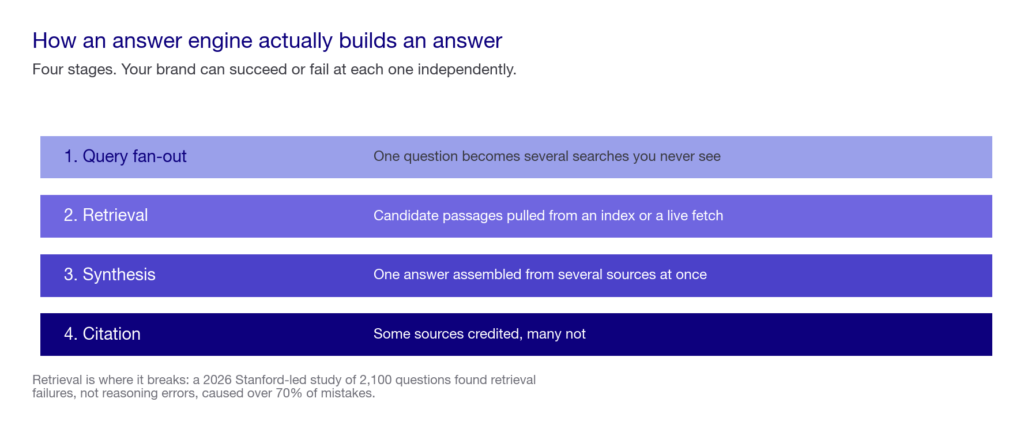
It starts by expanding your question. One prompt becomes several underlying searches, a behaviour usually called query fan-out. You never see those searches, which is why optimising for a single phrase makes less sense than it used to. You are trying to be present across a cluster of related questions you cannot observe directly.
Then it retrieves. The engine pulls candidate passages, either from an index it has already built or by fetching pages live. This stage deserves far more attention than it gets, because it is where things break. A Stanford-led evaluation of six commercial chatbots covered 2,100 factual questions in May 2026. It found that retrieval failures, rather than reasoning errors, accounted for more than 70% of all mistakes. When the models retrieved the right source, they usually produced the right answer.
Sit with that for a moment, because it reorders your priorities. The models reason competently over what they find. They are much worse at finding the right thing. So the boring technical work of being crawlable, renderable and unambiguous is not hygiene. It is the main event.
Next it synthesises. The engine writes one answer drawing on several sources at once. No single page “wins” the way a page wins a ranking, and this is why one-page-per-keyword thinking translates badly. Your claim might make the answer while your URL does not.
Finally it cites, or does not. And engines disagree about this more than almost anything else.
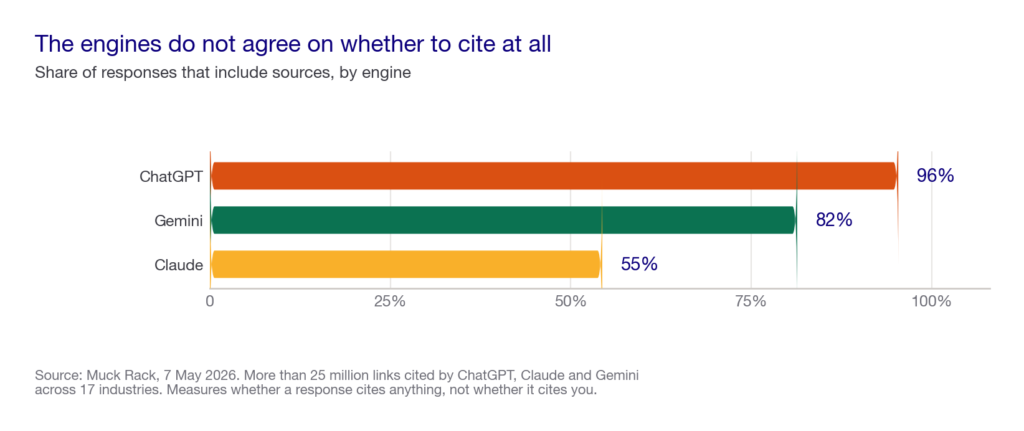
Muck Rack’s May 2026 analysis found ChatGPT includes sources in 96% of responses. Gemini manages 82%, and Claude barely half at 55%. A blended average would land near 78% and describe none of them. This is the clearest argument we have against single-number reporting, and it is why we track per engine and refuse to hand clients one composite score.
Where AI citations actually come from
Here is the finding that should redirect most AEO budgets, and the one most likely to be unpopular internally.
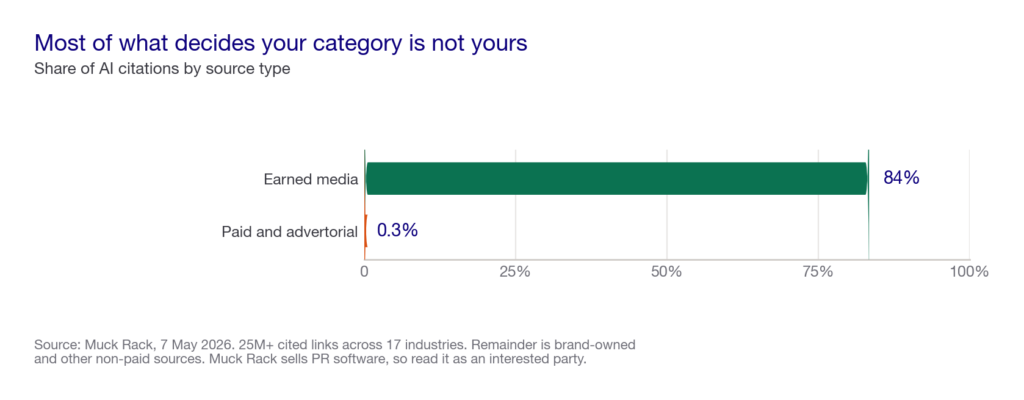
Muck Rack analysed more than 25 million links cited by ChatGPT, Claude and Gemini in May 2026, across 17 industries. Earned media accounted for 84% of AI citations. Paid and advertorial content accounted for 0.3%. That earned media figure has held between 82% and 89% across three editions of the study since July 2025, so it is a stable pattern rather than a one-off reading.
The uncomfortable implication is that most of what decides your category’s answers is published by other people. Review platforms, comparison sites, trade publications, community threads, expert commentary. You can influence all of it, but you cannot publish your way to it, and no content calendar will get you there on its own.
This is the single most common misallocation we inherit. A team is told AI search is a content problem, so they double their publishing cadence. Eighteen months later the brand is mentioned occasionally and cited almost never. The content was usually fine. It was just aimed at the small remainder rather than at the 84%.
None of which makes your own site irrelevant. It makes your site necessary and insufficient, which is a harder thing to plan around but a more accurate one.
Want to see which sources decide your category right now, rather than guessing? Book a growth audit. We will run your prompt set and show you the pages that keep winning the answers you want.
The three levers, and why you need to know which one you are pulling
Every account we run gets sorted into three levers before anyone does any work. The same symptom can have completely different causes. The full model is in our Visibility, Citability and Retrievability framework, but the short version matters here.
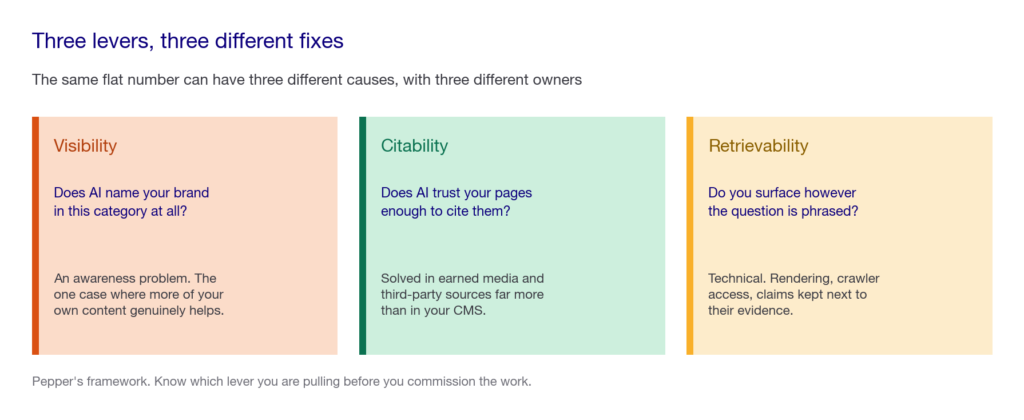
Visibility asks whether engines name your brand in your category at all. If they do not, you have an awareness problem, and this is the one case where publishing more of your own strong content genuinely helps. The engine needs enough signal to know you exist and what you do.
Citability asks whether engines trust your pages enough to use them as sources. A brand can be mentioned constantly and cited never, which sounds like a contradiction until you realise the engine is describing you using someone else’s page. That gap is the most useful diagnostic in this whole discipline, and closing it lives in earned media and third-party sources far more than in your CMS.
Retrievability asks whether you surface however the question is phrased. Winning one wording and vanishing on the next is winning by luck. Given that retrieval causes most engine errors, this lever is chronically underrated, and it is usually the cheapest to fix.
Knowing which lever you are pulling changes everything downstream: who owns the work, what you commission, and how long before you should expect movement. Teams that skip this step tend to spend a quarter on content when they had a rendering problem.
What actually works, in rough priority order
We have watched a lot of AEO tactics come and go over the past two years. What follows is what has survived contact with real accounts, ordered by what we would do first.
Fix retrievability before anything else. If an engine cannot reliably fetch and parse your pages, nothing else you do matters. Server-side render anything you want cited, because client-side rendering remains inconsistently handled. Check how you are treating AI crawlers, since blocking the wrong agent can remove you from an index entirely. OpenAI runs OAI-SearchBot, ChatGPT-User and GPTBot as three separate agents with three different jobs. Similarly, Perplexity runs PerplexityBot and Perplexity-User for scheduled indexing and live fetching. Blocking each one fails in a different way, and we have seen teams block the wrong one and lose visibility they spent a year building. Our guide to robots.txt for AI crawlers covers the specifics.
Then make your claims extractable. This is less about writing style than about physical proximity. Keep a claim and its evidence in the same block. A statistic three paragraphs from its source is much harder to lift cleanly. Write headings that stand alone as questions or statements rather than as clever labels. Answer each heading in the first two or three sentences underneath it, since models tend to extract from the top of a section rather than the middle. Our guide to structuring content for AI citation goes deeper on the formatting itself.
Clarify what you are. Engines need to resolve your entity before they can recommend you, and ambiguity loses to a competitor who is clearer. Describe your category the same way on your site, your profiles, your review listings and your press. If three sources describe you three different ways, the model has to pick, and it often picks a competitor instead.
Then go and earn authority, which is the part nobody enjoys budgeting for. This is where the 84% lives. Digital PR, review platforms, comparison sites, community presence, expert contribution. It is slower than publishing, it is harder to attribute, and it is the difference between being mentioned and being cited.
Find your Citation Core. These are the ten to twenty sources that decide your category, and most brands cannot name a single one of them. You find them by reading the actual citations in your own tracked answers rather than by guessing, and then you work on how those specific sources describe you. It is unglamorous and it is the highest-leverage thing on this list.
And measure per engine, over time. Never one blended score, never one run of one query.
How to measure answer engine optimization honestly
Three numbers do most of the work, and the relationship between the first two is where the insight lives.
Brand Visibility is how often engines name your brand across a defined prompt set. Domain Prompt Presence is how often they cite a page from your domain. Share of Voice is your slice of all brand mentions in the category. Pepper’s GEO platform separates the first two deliberately, because collapsing them destroys the diagnostic.
Read them as a pair. Healthy visibility with flat citation means engines know you and do not trust your pages, so the work is earned media and retrievability rather than publishing. Both low means start with visibility. The two converging means you are being used as a primary source, which is the strongest position available and worth protecting.
There is genuine first-party data now, which there was not a year ago. Bing’s AI Performance report entered public preview on 10 February 2026 and shows cited URLs, triggering queries and citation share. Read the scope carefully though. Microsoft is explicit that it covers Copilot, Bing AI summaries and select partner integrations, on a sampled basis, and that it counts citations rather than visits. It is useful, and it is not a window into ChatGPT.
The trap worth naming is traffic. Forrester’s 2026 Buyers’ Journey Survey covered 18,000 global business buyers. It reports companies seeing 10% to 40% traffic declines as research migrates into AI engines. If sessions are your headline metric, a working programme reads as a failing one. We have watched teams pause exactly the work that was starting to pay. Our guide to what actually matters in AI search measurement covers the full metric set.
What nobody should promise you
Anyone guaranteeing a citation or a position in an AI answer is either misunderstanding the systems or hoping you do. Nobody has access to the ranking systems, and Google explicitly advises against providers guaranteeing rankings for exactly that reason.
Be equally wary of a single AEO score. Composite numbers feel reassuring in a board deck and they hide the one finding you could have acted on, which is the gap between being mentioned and being cited. For the same reason, treat any universal benchmark as invented. There is no good number for these metrics, only your own trend and your distance from whoever leads your category.
And be sceptical of proof drawn from one engine or one run. Engines vary substantially and overlap little in the sources they cite, so a single flattering screenshot demonstrates that someone took a screenshot.
Finally, nobody honest will promise this quickly. Earned authority compounds slowly because it depends on other people publishing. Anyone offering a spike is describing paid media with a different name on it.
Frequently asked questions
What is answer engine optimization?
Answer engine optimization is the practice of structuring content and managing your wider online presence so AI systems name your brand and cite your pages in generated answers. It covers ChatGPT, Perplexity, Google AI Overviews, Gemini, Claude and Copilot.
Is AEO the same as SEO?
Largely, though not entirely. Google states that optimising for AI search is still SEO, and AI Overviews run on core Search ranking systems. However, other engines retrieve differently, and success is measured in mentions and citations rather than rankings and sessions.
What is the difference between AEO and GEO?
Very little in practice. Wikipedia records that no consensus definition separating AEO, GEO, LLMO and AIO existed in academic literature as of early 2026. The terms are used interchangeably, so focus on the mechanism rather than the acronym.
How do answer engines choose what to cite?
They expand your question into several searches, retrieve candidate passages, synthesise one answer from multiple sources, then credit some of them. Retrieval is the weakest stage, causing over 70% of errors in a 2026 Stanford-led evaluation of six chatbots.
Does AEO work if my content is already good?
Not on its own. Muck Rack found 84% of AI citations come from earned media rather than brand-owned pages. Strong content is necessary but insufficient, and most programmes underinvest badly in third-party authority.
How long does answer engine optimization take?
Expect two to three quarters for meaningful movement. Technical retrievability fixes land fastest, while earned authority compounds slowly because it depends on other people publishing about you.
Can I do AEO for free?
Partly. Bing’s AI Performance report gives first-party citation data at no cost, and branded search lift shows in Search Console. However, multi-engine prompt tracking at any real scale needs either a platform or a lot of analyst time.
Is llms.txt worth implementing?
Google’s May 2026 guidance explicitly mythbusts llms.txt, alongside content chunking and AI-specific rewrites. Treat it as unproven rather than essential, and spend the effort on retrievability and earned authority instead.
Where to go next
If you take one thing from this guide, make it the diagnostic rather than the tactics. Run 20 to 30 real commercial questions from your category across the engines your buyers use. Then write down where you appear, which competitors appear instead, and which sources are influencing those answers.
That exercise usually takes an afternoon and it tells you which lever you are working on. Most teams skip it, pick a tactic that sounds current, and spend a quarter discovering they had a different problem.
If you would rather see it on your own category without building the tracking yourself, see where you show up across ChatGPT, Perplexity, Gemini, Claude and AI Overviews. Customers run this themselves inside the platform, with a growth team attached to do the work alongside them. Our Acceldata case study documents what compounding looks like over time: 6X organic traffic growth and top-three keywords rising from 85 to more than 300.
And if your category generates very few meaningful monthly prompts, or nobody internally has the capacity to act on what you would find, you do not need a platform yet. Fix the capacity problem first and spend the money on earned media. We would rather say that now than sell you a subscription you will resent in six months.
Sources
Every study cited here was published in 2026.
- Wikipedia, Generative engine optimization, on terminology and the absence of a consensus academic definition as of early 2026.
- Google Search Central, AI features and your website, 15 May 2026.
- Suzgun et al., Evaluating Commercial AI Chatbots as News Intermediaries, arXiv, 21 May 2026. 2,100 factual questions across six chatbots. Tested on news rather than commercial queries, so read the mechanism rather than the exact rates.
- Muck Rack, Earned media still drives 84% of AI citations, 7 May 2026. More than 25 million cited links across 17 industries. Muck Rack sells PR software, so read it as an interested party with a large dataset.
- Forrester, 2026 Buyers’ Journey Survey, January 2026. 18,000 global business buyers. Forrester sells research subscriptions.
- Bing Webmaster Tools, Introducing AI Performance, public preview 10 February 2026.
Latest Blogs
The research pulls in two directions. Fan-out rewards covering many adjacent questions; absorption research finds longer pages get used. The resolution is that the passage competes, not the page.
Seven documented changes, not seven predictions. Google switched two rich results off, shipped two new AI reports, and added a channel to Analytics. Here is what actually moved and what it means.
Content chunking is the process of splitting a page into smaller pieces so a machine can retrieve one of them. Here is the part most articles get wrong: chunking is something engines do to your page, not something you do to it. You do not choose the chunk size.
Get your hands on the latest news!