What Pepper tracks: prompts, engines and citations
The short answer
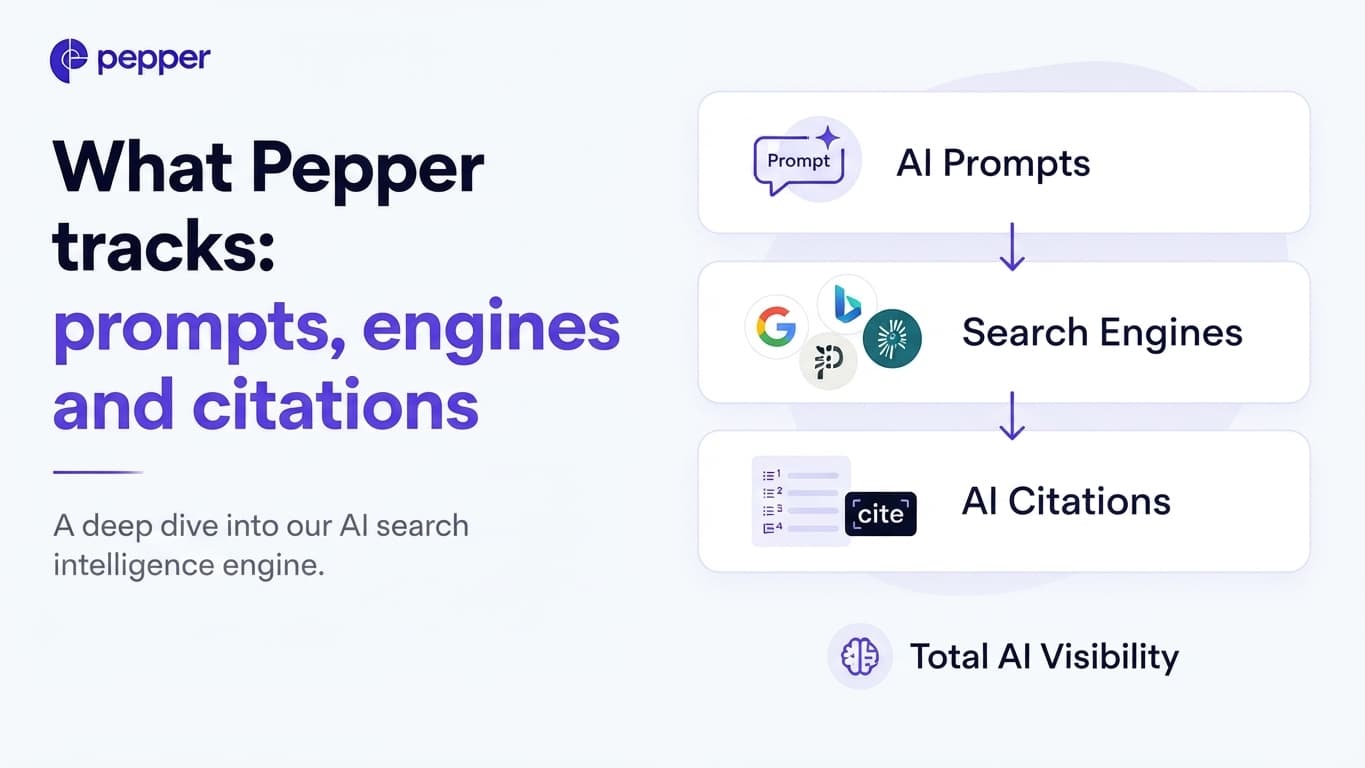
Pepper runs a curated set of prompts, the questions your buyers would actually ask, against the major AI engines every day. For each run it records what the engine answered, who it cited, and how that compares with your competitors.
Three things are tracked, and they map to three different questions.
- Prompts. A curated set, grouped into themes, that runs daily. Pepper pre-populates a starter set during workspace setup, generated from your personas, and your team adds, refines or removes them from there.
- Engines. Six of them: ChatGPT, Perplexity, Gemini, Copilot, Claude and Google AI Overviews.
- Citations. Which domains and which individual pages the engines cite, yours and everyone else’s, with the ability to drill from a domain to a page to the exact prompt and the exact answer.
The cadence is daily, and that matters more than it sounds. Each prompt is one daily run, so a month of tracking gives you roughly thirty observations per prompt rather than one. That is what makes a trend line readable rather than noise.
Pepper is an agentic organic growth engine, not an SEO agency. This page comes out of what we run: organic for more than 250 enterprises across eight years, more than 10 million tracked prompts, and the questions buyers put to us in client reviews. Customers log in and run the platform themselves, with a Pepper growth team attached. Book a growth audit and we will show you your own numbers.
Key takeaways
Key takeaways from Pepper’s own product documentation.
- Prompts run daily. Each prompt is one daily run, which is what makes the trend lines usable.
- Pepper covers six engines, including ChatGPT, Perplexity, Gemini and Google AI Overviews.
- Two headline metrics. Brand Visibility is the percentage of prompt runs that mentioned your brand by name. Domain Prompt Presence is the percentage that cited at least one page from your domain.
- Citations go down to the page. You can see which domains are cited, which pages from each, which prompts triggered them, and the exact answer.
- The same runs track your competitors, with the honest caveat that history does not backfill from before you add them.
- First data lands in minutes. Reliable trends need a few days, and weekly comparisons become useful around two weeks.
What is Pepper AI visibility tracking, and what does it record?
Pepper AI visibility tracking is the daily measurement of how AI engines answer the questions your buyers ask, and whether your brand and your pages appear in those answers.
The input layer is prompts and themes. A prompt is a single question. A theme is the topic cluster it belongs to. Together they are the input for every metric in the GEO section, which means the quality of your prompt set decides the quality of everything downstream.
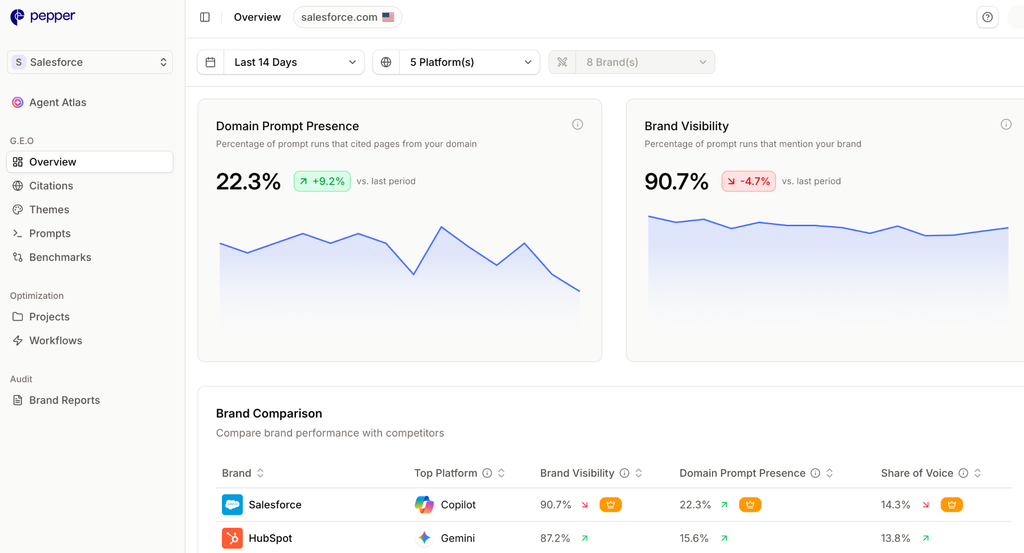
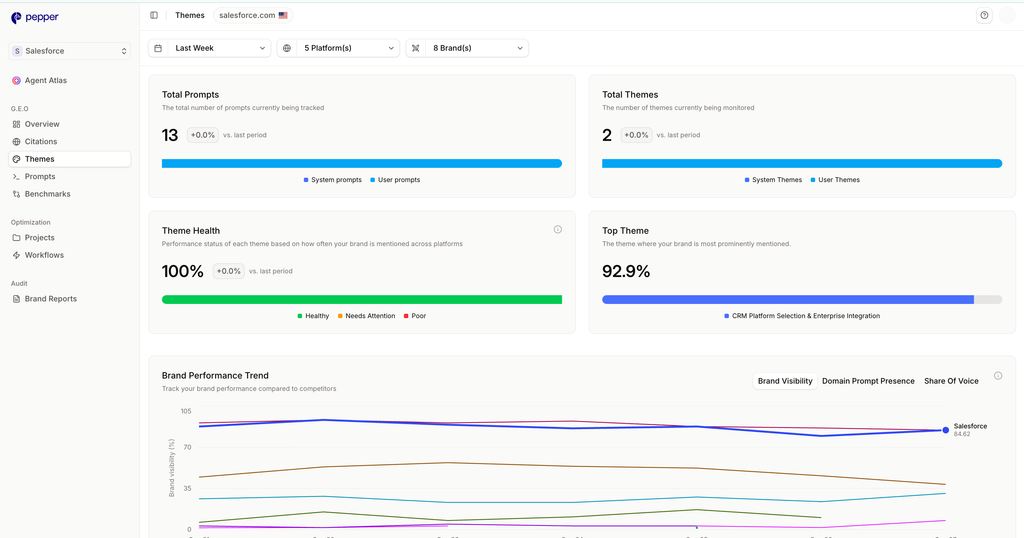
Figure 1: The two headline numbers, each with its own daily trend.
Where the prompts come from. Pepper pre-populates a starter set during workspace setup, generated from the personas you define. From there your team manages them in Settings, under Themes and Prompts. Each prompt carries a type: System, meaning Pepper provides and maintains it, or User, meaning your team added it. You can add one at a time or upload a CSV for a bulk seed, which is what most teams use when migrating from another tracker.
Where it falls short. Tracking measures what engines say. It does not measure what that is worth to you, and it cannot tell you why an answer changed. Both are separate pieces of work, and we would rather say so than let you buy tracking expecting either.
The two headline metrics, defined precisely
These two numbers sit at the top of the GEO Overview, and the distinction between them is the single most useful thing in the product.
- Brand Visibility is the percentage of prompt runs that mentioned your brand by name, with or without a citation.
- Domain Prompt Presence is the percentage of prompt runs that cited at least one page from your domain.
Each carries a period-over-period change and a daily trend sparkline across the range you select.
Why we report them separately. An engine can describe your product accurately and link a competitor’s comparison page instead of yours. Brand Visibility rises; Domain Prompt Presence does not. That gap is the diagnosis: you are in the conversation but you are not the source. The fix for that is different from the fix for not appearing at all, which is why we do not blend them into one score. Our framework for acting on the gap is Visibility, Citability and Retrievability, and the full metric set is in AI search visibility metrics and KPIs.
Which engines Pepper covers
Six engines: ChatGPT, Perplexity, Gemini, Copilot, Claude and Google AI Overviews.
Why multiple engines rather than one. Engines disagree with each other about the same question, and independent academic work across 11,000 real queries found identical queries produce structurally different results across systems. A reading from one engine tells you about that engine. It does not tell you about AI search, which is why we compared coverage across the market in which GEO platform covers the most AI engines.
On Google AI Overviews specifically, yes, it is covered, and it behaves differently from the assistants. Per-engine behaviour is worth knowing: Perplexity cites heavily, AI Overviews summarises heavily, and ChatGPT mixes the two. That is why a page can be cited often in one engine and rarely in another, and why we report per engine rather than blended.
How citations are tracked
This is the part that tells you what to do next, and it goes deeper than a count.
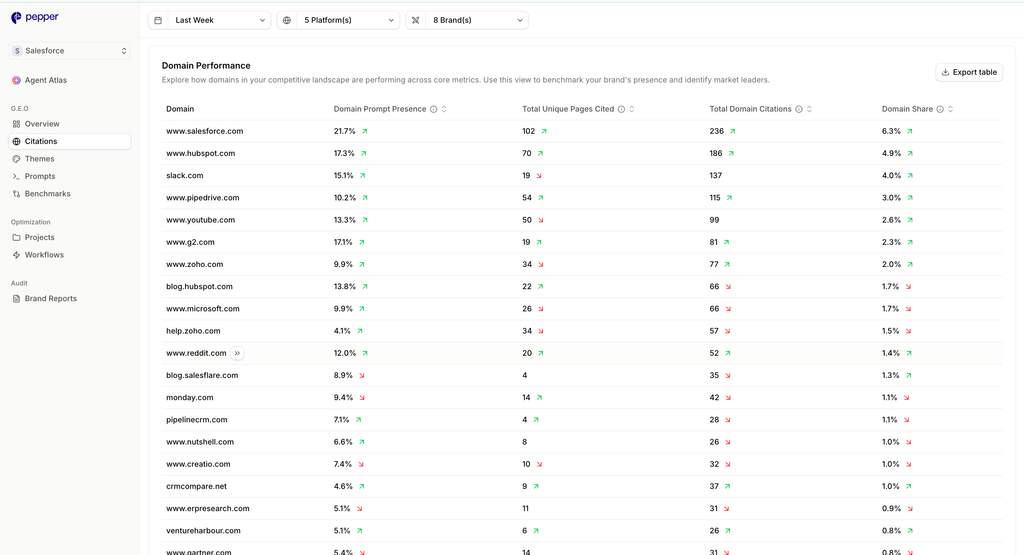
The Domain Overview Table shows which domains are cited most often, whether yours, a competitor’s or a third party’s. Four columns: the domain name, the total number of unique pages from it that appeared in AI responses, its mention rate against prompt runs, and its share of voice as a percentage of total citations.
Domain Performance Trends plots how citations from a domain change over your selected range, so you can see whether your authority is growing or eroding, and spot a competitor campaign as a sudden spike in their citations.
Page-level drill-downs are where it becomes actionable. Clicking a domain opens the Page Details Table, listing each individual page cited and how many different prompts triggered it. From there, a Prompts Drawer shows which prompts produced that citation, and the Prompt Run View shows the exact AI response and the context the page was cited in.
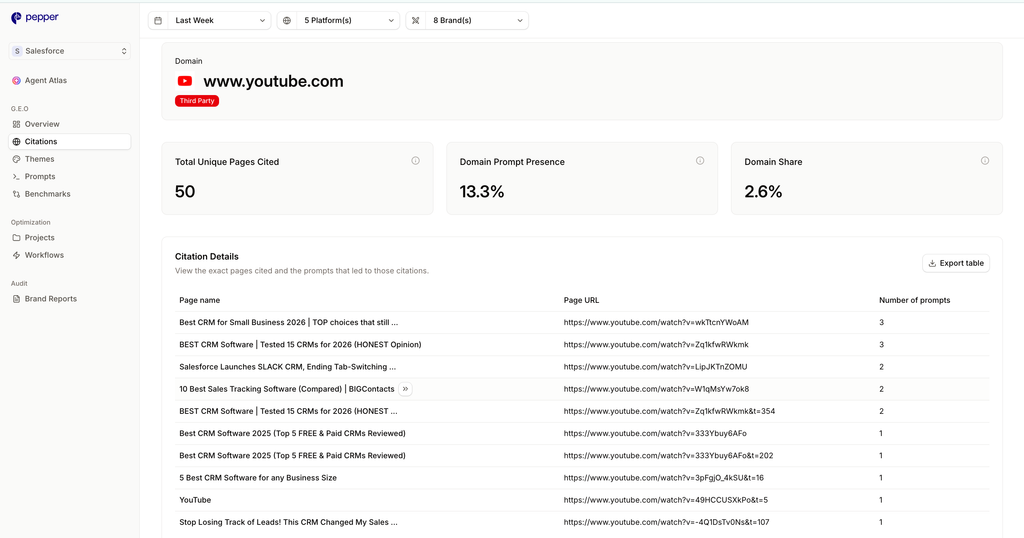
What that chain answers. Which of your pages is doing the most work in AI answers. Which competitor page dominates several prompts at once. And where the gap is, for example if competitors’ case studies are cited repeatedly and yours are not.
How often the data refreshes
Daily. Each prompt is one daily run, and that cadence is what everything else rests on.
- First results land within minutes of setup, in the GEO Overview.
- Reliable trend lines need a few days of daily data to build up.
- Weekly comparisons become useful around the two-week mark.
- Competitor history does not backfill. Add a competitor and Pepper starts tracking them on the next runs, so useful data arrives after a few days rather than immediately.
Why daily matters, in arithmetic. The same prompt does not return the same answer every time. On a daily cadence, a quarter of tracking gives you about ninety observations per prompt. On a monthly cadence it gives you three, and three observations cannot separate a real change from ordinary variance.
How to get the most out of what is tracked
Four habits, from the product documentation and from running this daily.
- Read it daily for thirty seconds. Headline metrics and the top of Brand Comparison are enough to know whether anything broke overnight.
- Read it weekly for five minutes. All sections. Note one competitor move and one platform shift to investigate next week.
- Review new prompts weekly in the first month. Prompts often turn out to be redundant or wrongly phrased only after a few runs, and catching that early keeps the metrics clean.
- Avoid near-duplicate prompts. Each prompt is one daily run, so near-duplicates inflate aggregate metrics without adding signal.
- Revisit your competitor set quarterly. Categories shift, and brands that mattered a year ago may not now.
One honest note on prompt sets. Every metric here is computed against the prompts you chose. Change the set and the numbers change, which means the figures are meaningful against your own history with the set held steady, and much less meaningful as a cross-industry benchmark. That is true of every tool in this category, ours included.
What tracking does not do
Being useful here means being clear about the boundary.
- It does not tell you why an answer changed. It tells you that it did, and gives you the exact response to read.
- Revenue is not attributed for you. Most AI answers resolve without a click, so the commercial link has to be modelled separately. Our approach is in the GEO ROI model.
- Competitor history does not backfill. Data starts from the day you add them.
- It does not do the work. Tracking tells you where you stand. Acting on it is what Agent Atlas is for, and the practices themselves are in our GEO best practices playbook.
What nobody should promise you
- A guaranteed citation in an AI answer. Nobody controls what a model outputs, and we will not promise it either.
- A single AI visibility score. We report Brand Visibility and Domain Prompt Presence separately, because the gap between them is the diagnosis.
- A cross-industry benchmark. Every figure depends on the prompt set you chose, so an industry average describes nobody in particular.
- Instant trends. First data lands in minutes, but reliable trend lines need days and weekly comparisons need around two weeks.
- That tracking alone moves anything. It is measurement. The movement comes from the content and authority work it points you at.
Frequently asked questions
Can Pepper track prompts across AI engines?
Yes. Pepper runs a curated set of prompts against the major AI engines every day, and records what each engine answered, who it cited and how that compares with your competitors. Prompts are grouped into themes and managed in workspace settings.
Does Pepper cover ChatGPT, Perplexity and Gemini?
Yes, all three, alongside Copilot, Claude and Google AI Overviews. We report results per engine rather than blended, because engines disagree with each other about the same question.
Engines and coverage
Does Pepper track visibility on Google AI Overviews?
Yes. AI Overviews is one of the six engines covered, and it behaves differently from the assistants: it summarises heavily where Perplexity cites heavily. That difference is why per-engine reporting matters.
Does Pepper support multiple AI engines?
Six of them. Tracking one engine tells you about that engine, not about AI search, because independent research has found identical queries produce structurally different results across different systems.
How often does Pepper refresh its AI visibility data?
Daily. Each prompt is one daily run. First results land within minutes of setup, reliable trend lines need a few days of data, and weekly comparisons become useful around the two-week mark.
Prompts and citations
Does Pepper show which prompts my brand appears in?
Yes. Brand Visibility is the percentage of prompt runs that mentioned your brand, and you can drill from a cited page into the Prompts Drawer to see which specific prompts triggered it, then into the exact AI response.
Can Pepper show me which pages get cited by AI?
Yes, down to the individual page. The Domain Overview Table shows cited domains, clicking one opens a Page Details Table listing each page and how many prompts it appeared in, and from there you can read the exact answer.
How does Pepper track brand visibility in AI search?
By running your prompt set daily against six engines and recording, for each run, whether your brand was named and whether a page from your domain was cited. Those become Brand Visibility and Domain Prompt Presence.
Can Pepper help me get cited in ChatGPT?
Tracking shows you whether you are cited and which sources are cited instead. Improving it is content and authority work, which a Pepper growth team does alongside you. Nobody can guarantee a citation, and we will not claim otherwise.
Sources
Product detail comes from Pepper’s own help centre and live product pages, checked 28 September 2026.
Pepper product documentation
- Pepper Help Centre, GEO Overview and Metrics explained. Source of the two headline definitions: Domain Prompt Presence as “the percentage of prompt runs that cited at least one page from your domain” and Brand Visibility as “the percentage of prompt runs that mentioned your brand by name, with or without a citation,” each with a daily trend sparkline.
- Pepper Help Centre, Citation Analysis. Source of the Domain Overview Table columns, Domain Performance Trends, the Page Details Table, the Prompts Drawer and the Prompt Run View.
- Pepper Help Centre, Manage Themes and Prompts. Source of the daily run cadence, the System and User prompt types, CSV bulk upload, and the guidance on avoiding near-duplicate prompts.
- Pepper Help Centre, Set up a workspace. Source of the persona-generated starter prompt set, first results landing within minutes, and trend lines needing a few days.
- Pepper, Agent Atlas product page, checked 28 September 2026. Source of the engine list: ChatGPT, Perplexity, Gemini, Copilot, Claude and Google AI Overviews.
Independent research
- Huang, Goyal, Saha and Chandrasekharan, Answer Bubbles: Information Exposure in AI-Mediated Search, arXiv, 17 March 2026. 11,000 real search queries across five systems. Finds identical queries produce structurally different information across systems, which is the evidence for tracking more than one engine.
On what this page is
This is Pepper’s own product documentation written as a guide, so read it as a first-party description rather than an independent review. Product capabilities change, so check the platform page for the current position before relying on any specific detail here.
Latest Blogs
Healthcare SEO advice has one dominant theme: this is YMYL, so build clinical authority. An analysis of 824,997 health citations shows that advice is correct and badly incomplete. Only 17.3 percent of citations go to authoritative medical sources. Three quarters go somewhere else entirely.
Three questions bring people here and only one of them has a clean answer. Profound no longer publishes prices. The $99 Starter and $399 Growth tiers that most comparison pages still quote, including one of ours, are gone from its pricing page, which now shows a free trial and a custom Enterprise tier. The trial is specified in detail and is genuinely useful: 50 prompts run daily for seven days across three engines, with unlimited seats. On reviews, the counts in circulation range from 140 to over 1,100, so we publish no rating at all.
On 3 August 2026 the IAB published the first industry standard for measuring AI visibility. It splits measurement into two tiers: Directional, which it says supports early signal detection but is unsuitable for budget decisions, and Decision-Grade, which requires rigour on query volume, sample size and reproducibility. We then checked what nine leading citation platforms publish about their own methods. Reproducibility is the requirement almost nobody meets, and our own earlier census of fourteen platforms found not one disclosing run-to-run variance.
Get your hands on the latest news!