GEO ROI: how to model and prove return on AI search investment
The short answer
You can model GEO ROI credibly. You cannot prove it the way a finance director means the word, and anyone selling you a multiplier is skipping that distinction. The published estimates of how AI search traffic converts against organic run from 13% worse to 23 times better. They disagree because they use different attribution models on the same behaviour. The only peer-reviewed study in the set covers 973 e-commerce sites. It found LLM traffic converting below almost every traditional channel, and it says openly that it measures last click only. So build the model from your own first-party data, write down every assumption, and report a range rather than a number.
Key takeaways
- The multipliers in circulation span about twenty-six fold. From 0.88x to 23x, on the one input a GEO business case rests on.
- The only peer-reviewed number points the other way. Kaiser and Schulze in Marketing Science (2026), across 973 e-commerce sites and 164 million purchases, found organic search converting 13% higher than organic LLM traffic, and affiliate 86% higher.
- That study names the reason everyone disagrees. It “credits only the last click before a purchase” and is “consistent with consumers starting their search on an LLM, then switching to a more familiar or convenient channel to actually buy.”
- So the spread is an attribution artefact, not a fact about reality. Last click undercounts AI. Assisted and first-touch models overcount it. Both numbers are computed from real data.
- No platform will do this for you. We audited 11 SEO platforms last week and none publishes organic-to-revenue attribution.
- Model the cost side from published prices and the return side from your own data. Cost is knowable: GEO retainers start at exactly $3,000 a month and mainstream software runs $29 to about $500.
- Pepper is an agentic organic growth engine and an organic growth partner. Agent Atlas gives your team the agents. Pepper’s GEO platform reports Brand Visibility, Domain Prompt Presence and Share of Voice. A growth team works alongside yours. Eight years, more than 250 enterprises, more than 10 million tracked prompts.
A note on where this comes from. My job is the sentence “traffic went down, pipeline did not”, and the harder version of it, which is being asked to put a number on a channel nobody can attribute cleanly. Pepper runs organic for more than 250 enterprises over eight years and tracks more than 10 million prompts across every major engine, so I sit in this conversation most weeks.
Disclosure: Pepper sells GEO services and published this guide, so we have an obvious interest in the answer being a large positive number. We have not supplied one. Every figure below was read at source on 17 September 2026 with its date stated, and where a claim has no method we say so rather than repeating it as a benchmark. Competitors are named but never linked.
What is GEO ROI, and why is it harder than SEO ROI?
GEO ROI is the return on money spent getting your brand cited and represented inside AI answers. Set that against what the programme costs to run. Same arithmetic as any channel: return minus cost, over cost.
The cost half is easy and we have already done it. The return half breaks for three reasons that do not apply to classic SEO.
- Most of the value never becomes a click. An engine can answer using your content, name you, and send nobody. That is the intended behaviour of the product.
- The click that does arrive is usually not the first touch. Buyers ask an assistant, then search the brand name, then arrive. Last-click analytics credits the brand search.
- There is no shared definition of the unit. Impressions, mentions, citations and referral sessions are four different things, counted four different ways by four different vendors.
So GEO ROI is not a measurement problem you can solve by buying better software. It is a modelling problem, and the quality of the model is entirely in how honestly you declare the assumptions.
If the vocabulary is new, our glossary of core AEO terms covers it, what GEO is sets out the scope, and what actually matters in AI search measurement covers which metrics to watch before you try to price them.
The number you cannot borrow
Here is every published estimate we could find of how AI search traffic converts relative to organic search, expressed on one axis.
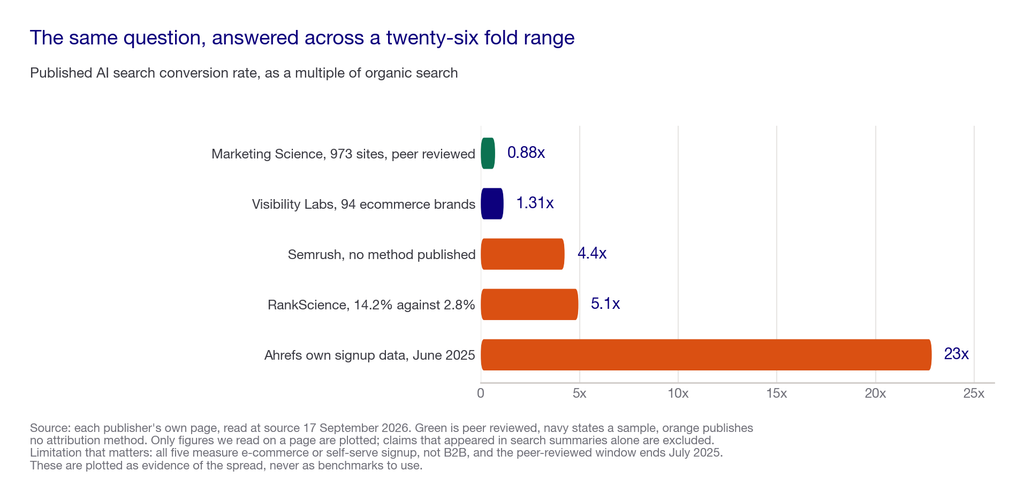
Twenty-six fold, on the single input that decides whether your business case clears the bar. Pick the bottom and GEO never pays back. Pick the top and it pays back in a quarter. Both numbers were produced from real traffic data.
The one at the bottom deserves far more attention than it gets. Maximilian Kaiser and Christian Schulze published in Marketing Science in 2026. They analysed 973 e-commerce sites with $20 billion in combined annual revenue, comparing more than 50,000 ChatGPT-referred purchases against 164 million purchases from traditional channels over twelve months. Their finding: organic LLM traffic “converts and earns per session below all traditional channels” except paid social. Organic search converted 13% higher than LLM traffic. Affiliate links converted 86% higher. LLM traffic was under 0.2% of visits.
That is the largest sample, the only peer review, and the least quoted figure in the category.
The ones at the top have no method attached. One widely shared September 2026 article stacks five claims in a single page: 23x, 4.4x, 31%, 14.2% against 2.8%, and a broad “6x to 27x” with no study named. Not one of the five describes how conversions were attributed. The headline 23x traces to one company’s own signup funnel and rests on June 2025 data.
Where this falls short: these studies measure different populations. Most are e-commerce, including the peer-reviewed one, and e-commerce conversion behaviour does not transfer to a B2B buying committee with a nine-month cycle. We have not found a comparable large-sample B2B study, and we are not going to substitute one from an adjacent vertical.
If you want to see what engines currently say about your brand before you model anything, book a growth audit and we will show you where you appear today.
Why they disagree, and why both are right
The Marketing Science authors answer this themselves, which is the most useful paragraph in the whole literature. Their data “credits only the last click before a purchase”. They say the study “measures the lower funnel” and cannot capture an upper-funnel discovery role. And they note the result is “consistent with consumers starting their search on an LLM, then switching to a more familiar or convenient channel to actually buy.”
Read that carefully. It does not say AI search is worthless. It says that under last click, the value lands on whatever channel the buyer used last. That is usually a branded search.
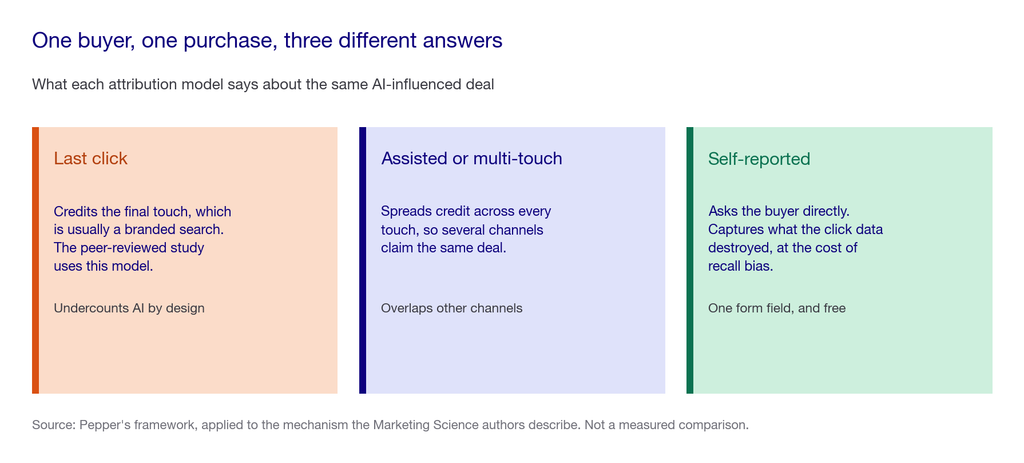
Same buyer. Same purchase. Three defensible models, three incompatible ROI figures. This is why the category’s numbers cannot be reconciled and why importing one into your model is the error, not choosing the wrong one.
The practical consequence: your GEO ROI figure is a statement about your attribution model before it is a statement about GEO. So the model has to declare it, and any number quoted without one should be treated as decoration.
How we built this model
Five rules, fixed before any arithmetic.
| Rule | Weight | What it means |
|---|---|---|
| Every input is first-party or published | 30 | It comes from your own systems, or from a company publishing about itself, never from a borrowed industry multiplier |
| The attribution model is declared | 25 | The model states which touch gets credit, because that choice sets the answer before any data is collected |
| Assumptions are visible and adjustable | 20 | Every assumed value sits in its own line a reader can change, rather than being baked into a total |
| Output is a range, not a number | 15 | Best, base and worst cases, because a point estimate on this data implies precision that does not exist |
| What cannot be measured is named | 10 | Uncited influence, zero-click brand exposure and upper-funnel effects are listed as unmeasured, never quietly set to zero |
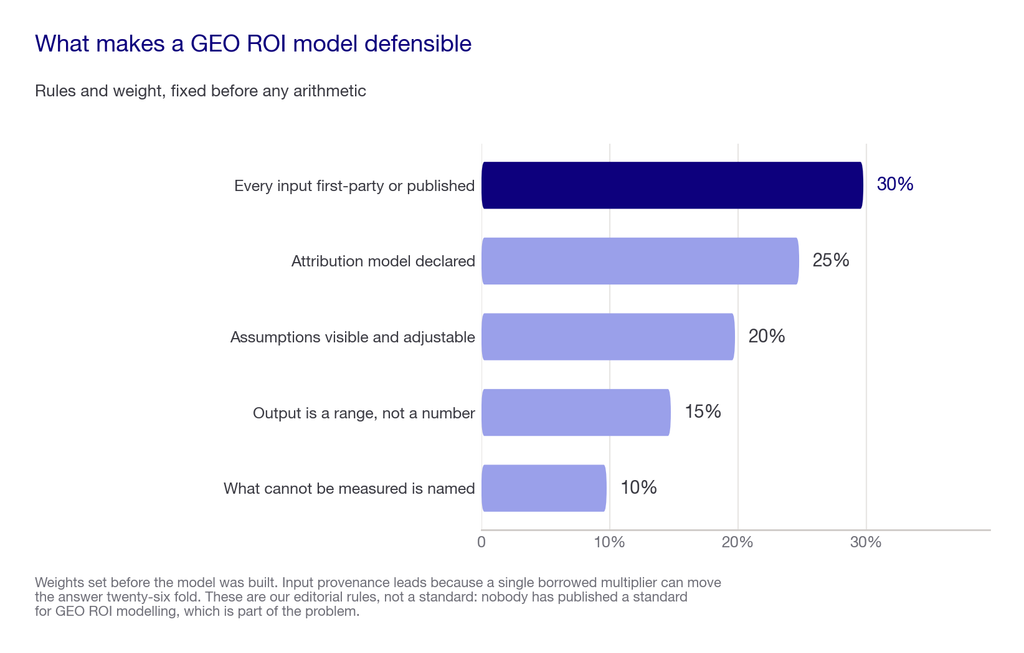
Where this falls short: these are our editorial rules, not a standard. Nobody has published a standard for GEO ROI modelling, which is part of the problem. Treat them as a defensible operating position rather than an authority.
The model, in five steps
Everything below uses either a published price or a number you already have. Nothing is imported.
1. Fix the cost side, because it is knowable
- Software: $29 to roughly $500 a month covers mainstream AI visibility tiers. One usage-based preset reaches $2,614.
- Retainer: the two agencies that publish a GEO-specific retainer both start at exactly $3,000 a month. Two more publish full-service figures at $10,000 a month minimum and $20,000 a month average.
- Your own time: the largest line and the one nobody publishes. Count the hours honestly or the model is fiction.
- Full detail in our published GEO price census.
2. Instrument the return side with free first-party data first
- Bing Webmaster Tools AI Performance, in public preview since 10 February 2026, gives you first-party citation data at no cost. Start here before buying anything.
- Server logs tell you which AI crawlers fetched what, and when. Free, and nobody looks at them.
- A self-reported source field on your forms, the plain “how did you hear about us” question, is the most underrated instrument in B2B. It captures the influence last click destroys, and it costs one form field.
- Your CRM, where the deal actually lives. No platform will connect organic to it for you: we audited 11 SEO platforms last week and none publishes organic-to-revenue attribution.
3. Declare the attribution model, in writing, before you compute
- Last click will understate AI. The peer-reviewed evidence says so explicitly.
- Assisted or multi-touch will show more, and will overlap with every other channel’s claim.
- Self-reported captures influence the click data cannot see, and carries recall bias.
- Our recommendation: run last click and self-reported side by side, and report both. The gap between them is the most informative number in the exercise, and it is yours rather than borrowed.
4. Compute break-even rather than forecasting return
Most business cases skip this step, and it is the one that survives scrutiny. Do not forecast a multiplier. Ask how much the programme must produce before it is worth running. Then judge whether that is plausible.
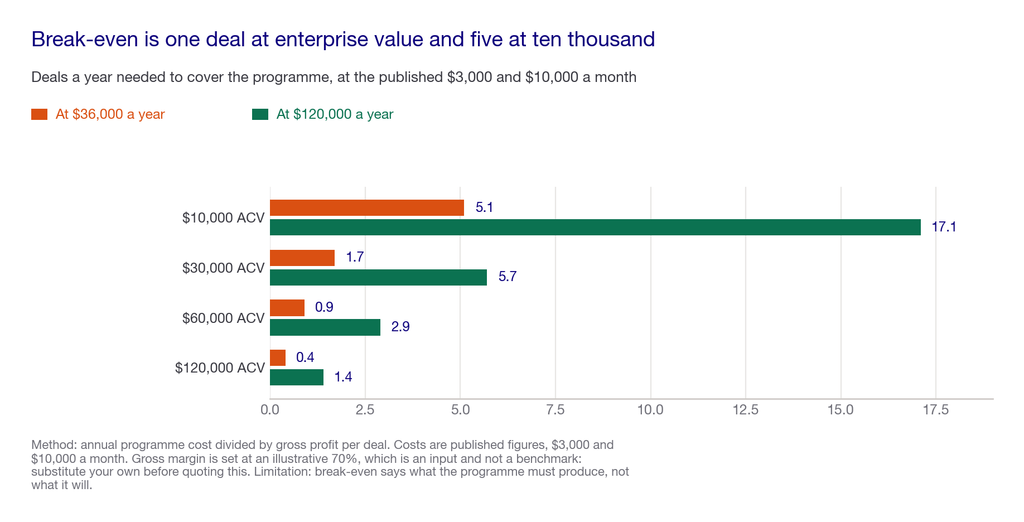
At the published $3,000 a month floor, a programme costs $36,000 a year. At $10,000 a month it costs $120,000. Divide by your gross profit per deal and you have the number of incremental deals the programme must produce.
| Your average contract value | Gross profit per deal at 70% | Deals needed at $36,000 a year | Deals needed at $120,000 a year |
|---|---|---|---|
| $10,000 | $7,000 | 5.1 | 17.1 |
| $30,000 | $21,000 | 1.7 | 5.7 |
| $60,000 | $42,000 | 0.9 | 2.9 |
| $120,000 | $84,000 | 0.4 | 1.4 |
**The 70% gross margin is an illustrative input, not a benchmark.** Substitute your own before showing this to anyone. The point of the table is the shape. At enterprise contract values a GEO programme at the published floor breaks even on roughly one deal a year. At a $10,000 contract value it needs five. That is a far more defensible sentence than any multiplier.
5. Report a range and name what you did not measure
- Worst case: last-click only, which the peer-reviewed data suggests understates the channel.
- Base case: last click plus self-reported source, deduplicated.
- Best case: including assisted touches, clearly flagged as overlapping other channels.
- Unmeasured, and listed as such: answers that named you and sent no click, brand exposure inside AI responses, and any upper-funnel effect. Never set these to zero silently. Zero is itself a claim.
GEO ROI at a glance
| What you are modelling | Where the number comes from | Cost to obtain | Where it falls short |
|---|---|---|---|
| Programme cost, software | Published vendor pricing, $29 to about $500 a month | The licence itself | Tiers are not equivalent, so compare prompt and response allowances |
| Programme cost, retainer | Published GEO retainers from $3,000 a month | The retainer | Only two agencies publish a GEO-specific figure |
| Programme cost, internal time | Your own timesheets | Free, and usually skipped | The biggest line and the least rigorous in most models |
| Citations and mentions | Bing AI Performance, free since February 2026 | Free | First-party to Bing, so partial engine coverage |
| Crawler activity | Your own server logs | Free | Tells you access, not influence |
| Referral conversions | Your analytics, last click | Free | Systematically undercounts AI, per peer-reviewed evidence |
| Influence the click misses | Self-reported source field on forms | One form field | Recall bias, and only captures people who convert |
| Deal outcome | Your CRM | Free, but needs a join built | No platform publishes this join, so you build it |
| Borrowed conversion multiplier | Vendor blogs | Free | Spans 0.88x to 23x. Do not use |
| Pepper, own row | Brand Visibility, Domain Prompt Presence, Share of Voice | Not published | We price by conversation, not by page |
## What this costs to run and to measure
Two separate budgets, and most models conflate them.
- The programme cost is the published side. GEO retainers start at exactly $3,000 a month, mainstream AI visibility software runs $29 to about $500, and one usage-based preset reaches $2,614. Two agencies publish full-service figures at $10,000 a month minimum and $20,000 a month average.
- The measurement cost is close to zero, and teams still skip it. Bing’s AI Performance report is free. Server logs are free. A self-reported source field is one line of a form. The only real expense is the analyst hours to build the CRM join, and no platform ships that join.
- The hidden cost is the argument. If your organisation has no agreed attribution model, expect the first GEO ROI review to become a debate about attribution rather than about GEO. Budget the meeting, not just the tooling.
How Pepper measures this
Pepper is an agentic organic growth engine and an organic growth partner, and on this topic the honest position is that we measure the part that is measurable and refuse to model the part that is not.
- Pepper’s GEO platform reports the visibility half properly. Brand Visibility for how often engines mention you, Domain Prompt Presence for how often they cite a page from your domain, and Share of Voice for your slice of the category. The gap between the first two is the citability diagnostic, and it is a leading indicator you can act on long before any revenue shows up. See the platform.
- Agent Atlas puts the workflows in your team’s hands. Agents are workflows. System agents stay fixed, user agents stay editable and versioned, and customers log in and build and run their own inside Atlas. The ROI relevance is direct: the join between organic and pipeline is unbought work, and work is what agents change.
- A growth team works alongside yours, including on the reporting join, because in most organisations the person who would build it does not exist.
- Proof rather than adjectives. Acceldata went from 85 to more than 300 top-three keywords with 6X organic traffic growth, and one hero guide carried over 260,000 impressions. That is an organic outcome on one account, not a GEO ROI benchmark, and we are not going to present it as one. More in our case studies.
Where Pepper falls short, and it matters on this page. Our platform does not attribute AI visibility to closed revenue, because nobody’s does. We can show you what engines say, which pages they cite and how that changes. Turning that into a revenue number still needs your CRM, your attribution model and a decision you own. Any vendor telling you otherwise, us included, would be overselling. We also publish no pricing, so the cost side of your model needs a conversation with us rather than a page.
How to choose what to model, and what to ask
I would not start by building a model. I would start by deciding which decision the number is for, because that sets how precise it needs to be.
- To get a programme funded: you need break-even, not forecast return. Step 4 above is the whole exercise.
- To decide whether to continue: you need a trend in leading indicators, not a revenue figure. Citation share on buyer-intent queries moves months before pipeline does.
- To allocate between channels: you need a consistent attribution model applied to all of them, and you almost certainly do not have one.
Here is the 100-point scorecard I would run over any GEO ROI model, including one we built for you.
| Area | Weight | What a defensible model demonstrates |
|---|---|---|
| Attribution model declared up front | 30 | It says which touch gets credit, on the first page, and shows what the answer becomes under a second model |
| Inputs traceable to a source | 25 | Every figure is first-party or published with a date, and no industry multiplier appears anywhere |
| Assumptions isolated and adjustable | 20 | Margins, close rates and cycle lengths sit in their own cells, so a sceptical CFO can change one and watch the answer move |
| Break-even before forecast | 15 | It states what the programme must produce to be worth running before it states what it might produce |
| Unmeasured effects named | 10 | Zero-click influence and upper-funnel exposure are listed as unmeasured rather than assumed to be zero |
**Then run the live test, on us as readily as on anyone else.** Take the 25 questions your buyers actually ask and track them across engines over 90 days. Record four things each month. Whether you were mentioned, whether a page of yours was cited, what your self-reported source field captured, and what last-click analytics recorded. For example: “which of these 25 questions did we appear in”, “which page got cited”, “how many new deals named AI search when asked”, “what did last click say about those same deals”.
Ask any provider bidding for the work to come back with five things. Which questions you appear in today. Which of your pages get cited. What they would change in 90 days. Which attribution model they propose and why. What their reporting will still not be able to tell you.
Five questions worth asking, and what a good answer sounds like.
- “Which attribution model does your ROI number use?” If there is no answer, the number is decoration. This is the single most diagnostic question in the category.
- “Where does that multiplier come from?” Ask for the sample, the period and the method. Most of the figures in circulation cannot supply all three.
- “What will this reporting never show me?” A good answer names zero-click influence immediately.
- “Who builds the CRM join, and what does it cost?” No platform ships it, so somebody is doing it by hand.
- “What would make you tell me to stop?” A provider with no stop condition is not measuring anything.
Red flags, each one seen in a real business case.
- A borrowed conversion multiplier, from anywhere. The published range is 0.88x to 23x.
- A single point estimate for ROI with no range and no sensitivity.
- Unmeasured effects set to zero without saying so, which quietly turns an unknown into a claim.
- A revenue figure with no attribution model named.
- Last-click numbers presented as the whole truth, when the peer-reviewed evidence says last click undercounts this channel.
- A guarantee of rankings or citations, which Google itself advises against, because no third party has access to the ranking systems.
- Any vendor claiming its platform attributes AI visibility to revenue. We checked eleven last week. None publishes it.
The weaker way to build this case, and it is the common one. Find a favourable multiplier. Apply it to your traffic. Produce a large number. Present it. Every step is quick. The whole thing collapses the first time a finance director asks where the multiplier came from.
The stronger sequence inverts it. Compute break-even from published costs and your own margins. Instrument the free first-party sources. Declare your attribution model. Report a range. Name what you did not measure. It produces a smaller number and it survives the meeting.
If I reduce this to one principle: model the cost precisely and the return honestly, because a defensible range beats an indefensible number every time you are challenged.
The honest closing note, and it costs us something. If your category is not yet being answered by AI engines, this whole exercise is premature and you do not need to model anything. Run the 25 questions first. If nothing comes back, you do not need a GEO programme yet, and we would tell you to check again next quarter rather than sell you one.
What nobody should promise you
Nobody should promise you a GEO ROI multiplier. The published estimates span twenty-six fold and disagree because they use different attribution models, so any single figure is a choice dressed as a measurement.
Nobody should promise that a platform attributes AI visibility to revenue. Of eleven SEO platforms we audited on 11 September 2026, none published that claim, including the vendor that owns the CRM.
Nobody should promise citations or rankings for a fee. Google advises against providers who guarantee rankings, because no external party has access to the ranking systems.
Where this stops working, including for us
If you are pre-product-market-fit or your deal count is in single digits, do not build a model. Trace the deals by hand, ask every customer how they found you, and spend the modelling time on the product.
If your organisation has no agreed attribution model for any channel, GEO is the wrong place to start that argument. Fix it centrally first. Otherwise you will produce a GEO number nobody trusts, because no channel number is trusted.
Where Pepper falls short: our platform measures visibility, not revenue attribution. The join to your CRM is still yours to own, and on a page about honest modelling that has to be said plainly rather than left implied.
Where to go next
Compute break-even this week. It takes twenty minutes, it needs only your contract value and a published price, and it will tell you whether the rest of this is worth doing.
Then instrument the free sources before you buy anything. For the adjacent decisions, our GEO cost benchmarks cover the cost side in detail, the metrics that move business outcomes cover which ones to watch, citation rate defines the core unit, and our warning on one-shot AI visibility scores covers what not to trust. To see where you stand across engines first, see where you show up.
Frequently asked questions
How do you calculate GEO ROI?
Take programme cost, which is knowable from published prices plus your own time. Set it against return measured with your own first-party data, under a declared attribution model. Report a range rather than a point estimate, and list what you could not measure.
What conversion rate should I assume for AI search traffic?
None. The published estimates run from 13% worse than organic search to 23 times better, and they disagree because of attribution model rather than reality. Measure your own or model break-even instead.
Does AI search traffic convert better than organic search?
The largest peer-reviewed study says no. Kaiser and Schulze in Marketing Science (2026) covered 973 e-commerce sites and 164 million purchases. They found organic search converting 13% higher than organic LLM traffic. They also state their data credits only the last click, which would undercount AI influence.
Why do vendors report such high AI conversion rates?
Mostly because of attribution model, and sometimes because no method is published at all. One widely shared article stacks five separate multipliers, from 31% to 23x, and describes the attribution method for none of them.
Can any platform prove GEO ROI for me?
No. We audited 11 SEO platforms on 11 September 2026 and none publishes organic-to-revenue attribution, including the vendor that owns the CRM. The join is work you or a partner has to build.
What is the cheapest way to start measuring GEO return?
Three free things. The AI Performance report in Bing Webmaster Tools, in public preview since February 2026. Your server logs, for AI crawler activity. And a “how did you hear about us” field on your forms, which captures the influence last click destroys.
How many deals does a GEO programme need to break even?
At the published $3,000 a month floor, the programme costs $36,000 a year. At a $30,000 contract value and 70% gross margin, that is under two incremental deals. At a $10,000 contract value it is about five. Substitute your own margin before quoting it.
Should I use last-click attribution for AI search?
Only alongside something else. Last click systematically undercounts this channel, on the peer-reviewed evidence. Run it next to a self-reported source field and report both, because the gap between them is the most informative figure you will produce.
Sources and further reading
- Maximilian Kaiser and Christian Schulze, “ChatGPT Referrals to E-Commerce Websites: How Do LLMs Compare Against Traditional Channels?”, Marketing Science, Vol. 45, No. 4 (2026). Sample: 973 e-commerce websites with $20 billion combined annual revenue, more than 50,000 ChatGPT-referred purchases against 164 million purchases from traditional channels, August 2024 to July 2025, from first-party Google Analytics records. Source of the finding that organic LLM traffic “converts and earns per session below all traditional channels” except paid social, of the 13% and 86% comparisons, and of the stated limitation that the data “credits only the last click before a purchase” and cannot capture an upper-funnel role. Limitations we are carrying forward: the measurement window ends July 2025, and the population is e-commerce, so it does not transfer to B2B. The publisher’s page returned a 403 on 17 September 2026 and the figures above were read from the study’s companion site the same day.
- Vendor and publisher conversion claims, read at source 17 September 2026 and shown in figure 1. Quoted only as evidence of the spread, never as benchmarks. None of them publishes an attribution method, and the most-shared figure rests on one company’s own signup data from June 2025. Named in the figure and not linked, per our policy on competitors.
- Microsoft, AI Performance in Bing Webmaster Tools, public preview announced 10 February 2026. The free first-party citation instrument recommended in step 2.
- Google Search Central, guide to optimizing for generative AI features, 15 May 2026. Source of the advice against providers who guarantee rankings. Applies to Google Search only.
- Pepper, our census of published GEO prices, for the cost figures used in step 1, and our audit of 11 SEO platforms, 11 September 2026, for the finding that none publishes organic-to-revenue attribution.
- Pepper, Acceldata case study. Source of the 85 to 300+ top-three keywords and 6X organic growth figures. One account, and an organic outcome rather than a GEO ROI benchmark.
What is not here, and why. No GEO ROI multiplier of our own, because producing one would require exactly the borrowed assumption this article argues against. No industry-average conversion rate, because the published set spans twenty-six fold and averaging incompatible attribution models would manufacture false precision. No B2B conversion benchmark, because we could not find a large-sample study and will not substitute e-commerce data for it. The break-even table uses an illustrative 70% gross margin, labelled as an input in three places, and no claim is made that it is typical. Pepper’s own case study figures are organic outcomes and are not presented as GEO returns.
Latest Blogs
Most 90-day AI plans are sequenced by how hard the work feels rather than by how long it takes to land. So they spend week one on an llms.txt file that Google states it does not use, and they schedule earned media for phase three, which guarantees no result inside the quarter. This plan inverts that. It orders the work by lead time, starts the slowest thing on day one, and cuts four tactics Google explicitly says are unnecessary.
We priced this category nine days ago. Today we went back to the same four pricing pages to check the numbers before publishing. Three of the four had changed, and two had stopped publishing prices altogether. That is the real answer to what AEO costs in 2026: not a number, but a meter that moves, measured in prompts and responses and engines that are billed separately. Here is how each pricing model works, what unit it charges you for, and which incentive that unit creates.
Ask what AI search traffic is worth and you will be handed a multiplier. The ones in circulation right now run from 13% worse than organic search to 23 times better, a spread of roughly twenty-six fold on the single input your whole business case depends on. They disagree because they are measuring the same behaviour under different attribution models. So this is not a guide to finding the right multiplier. It is a guide to building a model whose assumptions are visible, and to being honest about the half you cannot prove.
Get your hands on the latest news!

Similar Posts
Artificial Intelligence
16 mins read
How to improve your brand’s AI presence: a 90-day operating plan
Artificial Intelligence
16 mins read
What does AEO cost in 2026? Pricing models explained
Artificial Intelligence
15 mins read