What is AI visibility, and how do you actually improve it?
The short answer
AI search visibility is two numbers, not a feeling. The first is how often engines mention your brand when someone asks a question in your category. The second is how often they cite a page from your own domain as the source.
Most definitions stop at the first. That is why so much advice on this topic does not work. A brand can be mentioned constantly and cited never, and those are different problems with different fixes.
Entity optimization is the work that moves both. An engine will not name a company it cannot confidently resolve, and will not cite a page it cannot verify against other sources.
Key takeaways
- Measure two numbers, not one. Mentions and citations diverge, and the gap between them is the diagnosis.
- Entity optimization is a retrieval problem, not a branding one. A 2026 Stanford-led evaluation found retrieval failures, rather than reasoning failures, drive over 70% of chatbot errors.
- Most of the evidence is not on your website. 84% of AI citations come from earned media, so corroboration carries more weight than anything you can publish yourself.
- Consistency beats cleverness. The most common entity problem we find is a company describing itself four different ways across four properties.
- The audience roughly doubled in two years. ChatGPT reach among US adults went from 23% in 2024 to 44% in 2026.
A note on where this comes from. We run organic for more than 250 enterprises and track more than 10 million prompts across every major engine. What follows is the model we use on day one of an account, shaped by the client reviews we sit in weekly. It is our framework rather than a published standard, and the charts say so.
What is AI visibility?
AI visibility is the degree to which AI engines mention your brand and cite your pages when answering questions in your category. It is measured rather than sensed. It takes two numbers, because mentions and citations come apart.
In our own GEO analytics those are Brand Visibility and Domain Prompt Presence. The first is the share of prompt runs mentioning your brand by name. The second is the share citing at least one page from your domain. A third, Share of Voice, tells you your slice of all brand mentions in the category.
The gap between the first two is the useful part. High mentions with low citations means engines know you and trust somebody else’s account of you. Low on both means they cannot resolve you at all.
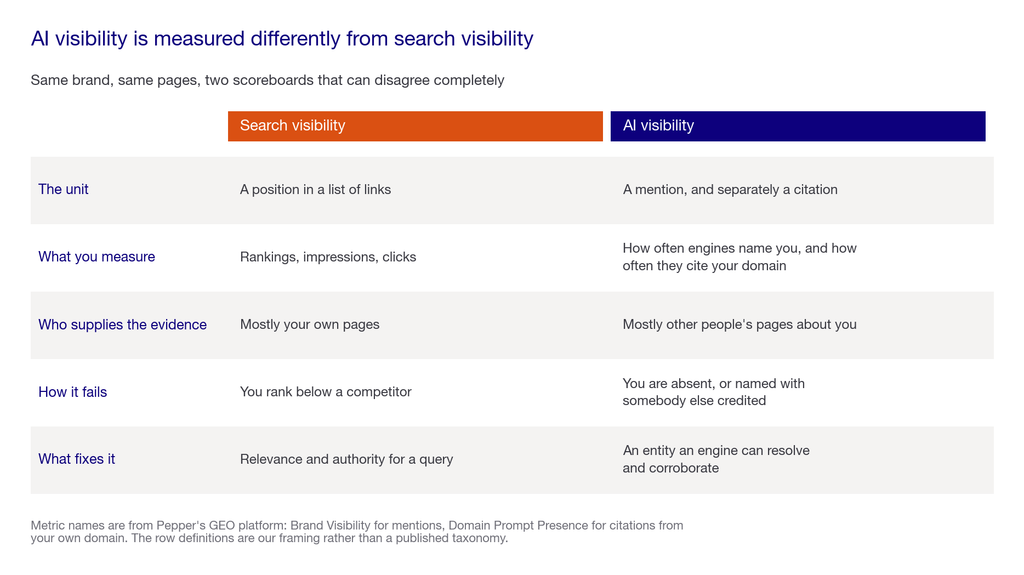
Note the third row, because it is the one that changes how you spend. In classic search, most of the evidence is on your own pages. In AI answers, most of it is on other people’s pages about you. That single difference is why a content calendar rarely fixes an AI visibility problem.
Why this matters now
Because the audience stopped being early adopters.
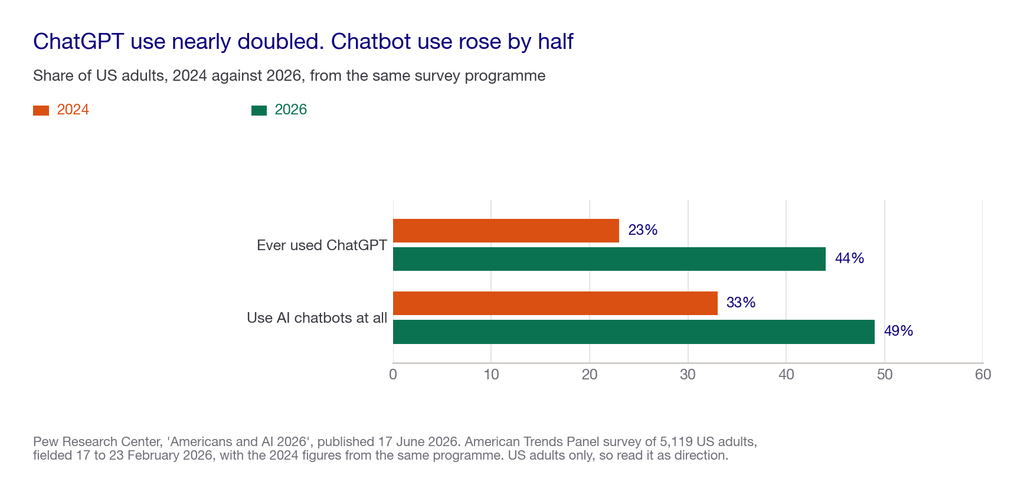
Pew Research Center’s 2026 survey of 5,119 US adults put ChatGPT reach at 44%, up from 23% in 2024. General chatbot use went from 33% to 49%. Separately, 60% said they read the AI summary above search results and 42% use chatbots to search for information.
Those are US figures, so treat them as direction rather than as your market. The direction is the point: being absent from an assembled answer now costs you introductions you used to get from a ranked link.
Our point of view
We think the category has turned entity optimization into a schema exercise, and that is why it underperforms.
Adding Organization markup is genuinely useful and takes an afternoon. It is also the smallest part of the job. The pattern we see most often in accounts we take over is a company with immaculate structured data that still cannot get named. Its own site says one thing, its LinkedIn says another, the analyst listing says a third. Nothing on the open web corroborates any of them.
An engine resolving an entity is doing something closer to cross-referencing than to reading. If the references disagree, it picks the source it trusts most, and that is usually not you.
So our bias is explicit. Fix consistency before you add markup, and earn corroboration before you optimise either. That order is the opposite of how most guides sequence it.
Book a growth audit if you want us to run your prompt set and show you which of the two numbers is actually stuck.
What is entity optimization?
Entity optimization is the work of making your company unambiguous to a machine assembling an answer from many sources at once. Not one page. Many sources, most of which you do not control.
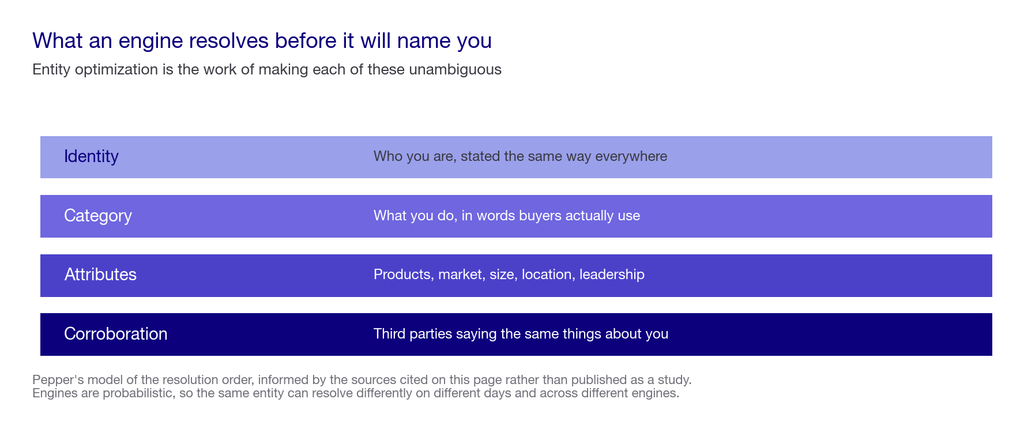
An engine works through four things, and a failure at any level stops the one below it from mattering.
- Identity. Who you are: the legal name, the trading name, the spelling, the disambiguation from similarly named companies.
- Category. What you do, described in the words buyers actually use rather than the words your positioning deck uses.
- Attributes. Products, market, size, location, leadership. The facts that let an engine decide you are relevant to a specific question.
- Corroboration. Whether independent sources say the same things. This is the layer that decides whether the other three are believed.
There is a technical reason this ordering matters rather than a stylistic one. A Stanford-led evaluation of six commercial chatbots published on 21 May 2026 tested 2,100 factual questions. It found retrieval failures, rather than reasoning failures, drive over 70% of all errors. When an engine gets a company wrong, the usual cause is what it could fetch and reconcile, not how it reasoned.
That reframes entity work. It is not brand polish. It is reducing the chance that a retrieval step returns something contradictory.
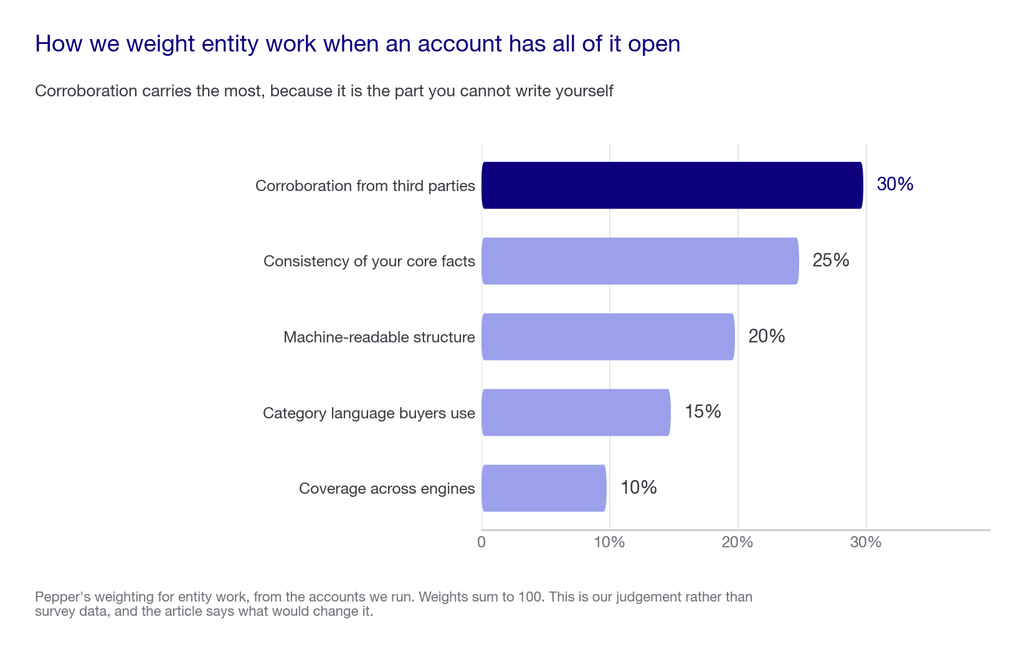
Our methodology: how we weight entity work
We are not ranking products here, so there is no vendor scorecard. What we publish is how we prioritise entity work when an account has all four layers open. That ordering is a judgement, and you should be able to argue with it.
| Element | Weight | Why it carries that weight |
|---|---|---|
| Corroboration from third parties | 30 | The layer you cannot write yourself, and the one engines lean on hardest. 84% of AI citations come from earned media, which makes this the largest lever and the slowest to move. |
| Consistency of your core facts | 25 | Cheap, fast, and the most common failure we find. Contradictions across your own properties are what make an engine distrust all of them. |
| Machine-readable structure | 20 | Schema and clean rendering. Genuinely necessary, routinely overweighted, and worth less than either of the two above. |
| Category language buyers use | 15 | Describing yourself in the words people search rather than the words you invented. Cheap to fix, and often overlooked entirely. |
| Coverage across engines | 10 | Checking more than one engine. Low weight because it changes what you know rather than what you do. |
Weights sum to 100. Corroboration and consistency carry 55 between them, which is a judgement rather than a fact, and it is the judgement this page rests on.
What would change these weights. If your core facts are already identical everywhere, move that 25 into corroboration. If you are a new company nobody has written about, corroboration rises further and nothing else matters as much. If you operate in several markets, coverage rises because a single-market reading will mislead you.
AI search visibility work at a glance
| Layer | What to fix | Typical effort | Time to show up | Cost |
|---|---|---|---|---|
| Identity | One name, one spelling, one description, everywhere you appear | Days, mostly coordination | Weeks | Internal time only |
| Category | Rewrite how you describe what you do, in buyer language | Days to a fortnight | Weeks | Internal time only |
| Attributes | Correct and complete facts on owned and third-party profiles | A fortnight, ongoing upkeep | Weeks to a month | Internal time only |
| Corroboration | Earned coverage and independent listings saying the same things | Months, continuous | Months | A retainer, or a dedicated hire |
Three of the four cost nothing but attention. The fourth costs real money and takes real time, which is why the first three should be finished before you commission it.
The four layers in detail
1. Identity
What it is: whether an engine can tell who you are without guessing.
- Use one company name consistently: the same legal or trading name, the same spelling, the same capitalisation, on your site, your profiles and your press.
- Disambiguate actively if your name collides with another company, a product, or a common word. Say what you are not, somewhere an engine can read it.
- Keep leadership names and titles current, because they are one of the strongest disambiguation signals available.
Where it falls short: identity work alone will not get you named. It removes a reason to be skipped rather than supplying a reason to be chosen.
2. Category
What it is: whether an engine can place you in the right answer.
- Describe what you do in the words buyers type, not the category you invented. If nobody searches your positioning phrase, it cannot retrieve you.
- Say the category plainly on the pages that matter, early, in a sentence rather than implied across a paragraph.
- Check what an engine currently thinks you do. Ask it directly, logged out, and see which category it puts you in.
Where it falls short: plain category language can feel like a downgrade to a brand team that has invested in a distinctive phrase. Use both, with the plain one doing the retrieval work.
3. Attributes
What it is: the facts that let an engine decide you fit a specific question.
- Make products, markets, company size, location and founding details correct and identical across every property you control.
- Use schema markup to state them machine-readably, and Organization schema specifically for the company-level facts.
- Make sure the pages carrying them can actually be fetched and rendered. Our guide to crawlability for AI covers what blocks this.
Where it falls short: structured data is a statement, not evidence. It tells an engine what you claim. It does not tell it whether anyone agrees.
4. Corroboration
What it is: whether independent sources say the same things about you. The layer that decides whether the first three are believed.
- Get into the sources engines already trust in your category: review platforms, analyst listings, industry roundups, genuine press.
- Make sure those third-party profiles carry the same facts as your own site. A stale listing is worse than no listing, because it is a contradiction.
- Treat this as a standing programme rather than a campaign. How to get cited in LLMs and the LLM trust hierarchy cover which sources carry weight.
Muck Rack’s May 2026 analysis of more than 25 million cited links across 17 industries found earned media accounts for 84% of AI citations against 0.3% for paid. Muck Rack sells earned-media software, so read it with that interest in mind, though the figure has held between 82% and 89% across three editions.
Where it falls short: it is slow, it cannot be bought directly, and it is the hardest of the four to attribute. You will move the other three and see nothing until this one starts working.
What this costs
There is no single figure, and most of the work is time rather than money.
- Identity, category and attributes cost internal coordination. Days to a fortnight each, no new spend, and the hardest part is getting four teams to agree on one description.
- Corroboration is the budget line. Either a digital PR retainer or a dedicated hire, and it takes months before it shows.
- Measurement runs from free to roughly $300 a month. You can check by hand first, and whether you need a monitoring tool at all is worth answering before you buy one.
If budget only covers one thing this year, fund corroboration and do the first three with the team you have. It is the only one that does not get cheaper by waiting.
Where Pepper fits, and where it does not
None of the four layers needs us. If you want them run and measured continuously, that is what we do.
We are an agentic organic growth engine, which is three things together. An organic growth partner, meaning a growth team attached to your account doing the corroboration work that you cannot write yourself. Pepper’s GEO platform, which is genuinely self-serve. You log in, set up a workspace, and define your brand profile, competitors and personas. You connect GA4 and Search Console, and manage your own themes and prompts across six engines. And the Agent Atlas, where your team builds, versions and runs its own agents, which is how a manual entity audit becomes something that runs on a schedule.
The platform reports Brand Visibility and Domain Prompt Presence side by side, so the gap this article is built around is visible without assembling it by hand.
Where it falls short: we do not publish pricing, so budget discovery is a conversation rather than a page. We are built for teams treating organic as a long-term function, so a one-off entity audit is not what we are for. Our depth sits in content, authority and AI search rather than large data-consistency programmes across many internal systems. And if your facts are already consistent and somebody is already writing about you, you may simply not need us.
How to choose what to fix first
I will write this in the first person, because a prioritisation nobody will defend is worth nothing.
Start from what Google settled. Its official guidance on optimizing for generative AI features says it plainly. “From Google Search’s perspective, optimizing for generative AI search is optimizing for the search experience, and thus still SEO.” The same page tells you to skip most of what gets sold as AI-specific work. “You don’t need to create new machine readable files, AI text files, markup, or Markdown to appear in Google Search.”
That matters here, because a lot of entity optimization advice is really file-format advice. Google says the files are unnecessary. The entity work that remains is consistency, category clarity and corroboration, which are older disciplines wearing a new name. Hold both ideas: Google is right for Google, and Google is one engine among several.
Here is the scorecard I would hold any entity programme to, ours included.
| Area | Weight | What a strong programme demonstrates |
|---|---|---|
| Diagnoses before prescribing | 30 | It runs your prompt set and tells you which of the two numbers is stuck before proposing work. A plan that arrives before a diagnosis is a template with your logo on it. |
| Fixes contradictions first | 25 | It audits what your own properties currently say about you and reconciles them, rather than starting with new markup on top of inconsistent facts. |
| Can earn corroboration | 25 | Real capability to get third parties writing about you, with named placements in your category. This is the lever that cannot be faked in a pitch deck. |
| Measures both numbers | 15 | It reports mentions and citations separately and can explain the gap. One composite score means it cannot. |
| Says when to stop | 5 | It will tell you a layer is good enough and not worth more spend. Rare, and the strongest signal on this list. |
Weights sum to 100. Diagnosis carries the most, which is a judgement, and it is the one I would argue hardest for.
Before committing a quarter, run the check yourself. Write 20 to 30 real commercial questions your buyers would type. Run them three times each across every engine you care about, and give any fix 90 days before judging it. Four worked examples for a mid-market B2B SaaS analytics company:
- “best data observability platform for enterprise”
- “how do I monitor data quality across Snowflake and Databricks”
- “what should I look for in a data observability vendor”
- “who competes with Monte Carlo in data observability”
Sort what comes back. Named and cited means you are fine on that question. Named without a citation points at attributes and corroboration. Absent entirely points at identity, category, or simply not being written about yet. Wrong facts point at contradictions across your properties.
Two approaches circulate here, and one is weaker. The weaker one runs: add Organization schema, publish an about page, add an FAQ block, wait. The stronger one runs: audit what your properties claim, reconcile them, state the category in buyer language, make the pages fetchable. Then go and earn coverage that repeats the same facts. Note where each begins. The weaker sequence starts with markup because it is fast and visible. The stronger one starts with the contradictions, because those are what make an engine distrust you.
Red flags, each one something a vendor actually says:
- “We will get your brand into the knowledge graph.” Nobody controls that, and Google’s own guidance warns against third parties promising ranking success.
- “You need an llms.txt file.” Google says you do not, in public, in writing.
- “Here is your AI visibility score.” One composite number hides the gap between mentions and citations, which is the whole diagnosis.
- “We will add schema across the site.” Useful, and not a strategy. Ask what it will be corroborated by.
- “Entity optimization is a one-off project.” Corroboration is continuous. A project ends; your competitors do not.
- “We track your brand name across every engine.” Branded prompts are the questions you already win.
Five questions I would ask before committing, and what a good answer sounds like:
- “Which of the two numbers is stuck, and what is your evidence?” A good answer cites a tally across runs. A weak one describes an audit it has not run yet.
- “What do our own properties currently say about us?” A good answer has already checked and found the contradictions. A weak one has not looked.
- “How will you get third parties to repeat our facts?” A good answer names publications and a method. A weak one says content marketing.
- “What will you not bother fixing?” A good answer names something. A weak one would fix everything.
- “How long before we see movement, and in which number first?” A good answer says consistency work shows in weeks and corroboration in months, and does not promise both at once.
It comes down to one principle: make your facts agree before you make them machine-readable. Structure applied to contradictory facts just publishes the contradiction in a format an engine reads faster.
The note that costs us something. Very few firms are equally strong at technical work, content, digital PR and measurement, ours included. Ask everyone on your shortlist which of those four is their weakest, and ask us too. If your entity problem is genuinely a data-consistency project across twelve systems, that is closer to an operations job than a marketing one. Neither we nor an agency is the right first call.
What nobody should promise you
- A guaranteed mention or citation in an AI answer. Engines are probabilistic and no third party controls their ranking systems.
- A single composite AI visibility score that means something. Our own help documentation is explicit that no universal good target exists for these metrics.
- Entity optimization completed in a sprint. Three of the four layers can be, and the one that matters most cannot.
- Conclusions from one run on one engine. Three runs across different days is the floor.
- Clean attribution from a citation to closed revenue. That measurement does not exist yet.
Frequently asked questions
What is AI visibility?
It is the degree to which AI engines mention your brand and cite your pages when answering questions in your category. It takes two measurements, because a brand can be mentioned often and cited almost never, and those are different problems.
What is entity optimization?
It is the work of making your company unambiguous to a machine assembling an answer from many sources. It covers your identity, your category, your attributes, and whether independent sources repeat the same facts about you.
Is AI visibility different from SEO?
Google states that optimizing for generative AI search is still SEO. The mechanics overlap heavily. What differs is that most of the evidence sits on other people’s pages, so corroboration matters more than it does for a ranked link.
How do I measure AI visibility?
Track two numbers: how often engines mention your brand, and how often they cite a page from your domain. Run a fixed set of commercial prompts across several engines, repeat them on different days, and watch the gap between the two.
Does schema markup improve AI visibility?
It helps, and it is routinely overrated. Structured data states what you claim about yourself. It does not corroborate that claim, and an engine weighing contradictory sources will generally trust independent ones over your own markup.
How long does entity optimization take to work?
Consistency and category fixes can show within a few weeks. Corroboration takes months and cannot be compressed by spending more in a hurry. Expect to move three of the four layers quickly, then wait on the fourth.
Do I need an llms.txt file?
No. Google’s guidance says explicitly that you do not need new machine-readable files, AI text files, markup or Markdown to appear in Search. Treat vendors who insist otherwise with caution, because the guidance is public.
What is the most common entity mistake?
Describing yourself differently in different places. We most often find a company whose site, profiles, listings and press each give a slightly different account, which is exactly what makes an engine distrust all of them.
Where to go next
For the framework this sits inside, read the Visibility, Citability and Retrievability levers. To check where you currently stand before doing any of this, check whether your brand appears in AI search takes about half an hour and costs nothing.
If a competitor is getting named and you are not, we have written up why that happens and how to tell which of three problems you have. For the terminology, what GEO is is the short version and AEO vs GEO vs AIO vs LLMO untangles the acronyms.
If you would rather we ran it, see where you show up across six engines and we will start with the diagnosis.
And the honest exit. If nobody has written about your company yet, you do not need entity optimization this quarter. You need somebody to write about you. Fix your own facts, which costs nothing but a week of coordination. Then spend the budget on earning coverage rather than optimising an entity nobody is looking for.
Sources and further reading
Research sources, all published in 2026 and checked at the original on 17 September 2026:
- Pew Research Center, “Americans and AI 2026”, published 17 June 2026. American Trends Panel survey of 5,119 US adults, fielded 17 to 23 February 2026. Used for ChatGPT at 44% against 23% in 2024, chatbot use at 49% against 33%, and the 60% and 42% figures. US adults only.
- Suzgun et al., “Evaluating Commercial AI Chatbots as News Intermediaries”, arXiv:2605.22785, submitted 21 May 2026. Six chatbots on 2,100 factual questions derived from BBC News reporting. Used for the finding that retrieval failures drive over 70% of errors. The study tested news questions, so applying it to company entities is our inference and is stated as such.
- Muck Rack, “What Is AI Reading?”, published 7 May 2026. More than 25 million cited links across 17 industries and ChatGPT, Claude and Gemini. Used for the 84% earned-media and 0.3% paid figures. Muck Rack sells earned-media software and has a commercial interest in this finding.
- Google Search Central, “Optimizing your website for generative AI features on Google Search”, announced 15 May 2026 and last updated 10 July 2026. Both quoted phrases appear verbatim.
A note on the competing pages for this query. The two we could read in full, published in August and September 2026, are well-structured and cite no dated research at all between them. A third, on Search Engine Land, returned an HTTP 403 to our check and is therefore not characterised here. The gap this piece aims at is evidence, not structure.
Latest Blogs
Most advice on this is inference dressed as fact. OpenAI documents exactly one thing clearly, which is access. Here is what is documented, what is inferred, and how to verify the rest for yourself.
Being named in an AI answer and having your page used as its source are different outcomes with different causes and different fixes. The gap between them is the most useful diagnostic in AI search, and most reporting collapses it into one number.
Every platform reports share of voice and almost none of them define it the same way. Here is the definition worth using, the three choices that change the number, and how to measure it yourself without buying anything.
Get your hands on the latest news!

Similar Posts
GEO / AI Search
10 mins read
How to get cited by ChatGPT
GEO / AI Search
10 mins read
Mentioned vs cited: the difference that decides AI visibility
GEO / AI Search
13 mins read