Organization Schema: Your Business’s Digital Name Tag
Remember how you wore a name tag on your first day of school? Organization Schema does something similar for your business—except this name tag is for robots and computers, not people.
What is Organization Schema? (The Simple Version)
Think of Organization Schema as a secret note you leave inside your website’s code. Visitors can’t see it, but search engines and AI systems can read it perfectly. This note tells them: “Hi! I’m ABC Company. Here’s my address. Here’s my phone number. Here’s my logo.”
It’s written in a special language called structured data that robots understand way better than regular website text. Just like how a nutrition label on a cereal box is easier to read than a paragraph describing the cereal, Organization Schema gives search engines your business info in a neat, organized format they can scan instantly.
How Does Organization Schema Work?
Here’s the simple version: You add a chunk of special code to your website’s homepage (usually). That code sits quietly in the background. When Google’s robots visit your site, they spot this code and think, “Aha! This is who these folks are!”
The code includes your business name, your logo, where you’re located, how to contact you, and links to your social media. Search engines take this information and file it away in their giant database called the Knowledge Graph. Now when someone searches for your business or something related to it, Google already knows exactly who you are and what you do.
Think of it like filling out a form at the doctor’s office. You could just tell the nurse your info, but writing it on the form makes it official and easy to find later.
Why Does Organization Schema Matter?
Here’s the big deal: Search engines and AI tools are getting smarter. They don’t just read words anymore—they understand entities (things, places, people, brands). When you use Organization Schema, you’re basically raising your hand and saying, “I’m a real entity! Recognize me!”
This helps Google show your logo in search results, helps ChatGPT and other AI tools understand your business when people ask about it, and makes your brand look more official and trustworthy. Without it, you’re just another website. With it, you’re a recognized brand in the eyes of robots everywhere.
Organization Schema at a Glance
| Feature | Details |
| What It Is | Structured data markup that describes your organization to search engines |
| Where It Goes | Usually your homepage and About page HTML code |
| Who Reads It | Search engines, AI systems, and LLMs—not human visitors |
| Key Information Included | Name, logo, address, phone, email, social profiles |
| Main Benefit | Helps your brand get recognized as an entity in Google’s Knowledge Graph |
Real-World Examples
Example 1: A local bakery adds Organization Schema to their homepage. Now when someone Googles “Main Street Bakery,” Google shows their logo, address, and phone number in a nice panel on the right side of search results.
Example 2: A software company includes their LinkedIn and Twitter profiles in their Organization Schema. When AI tools research the company, they can find and reference these official social accounts.
Example 3: A nonprofit adds Organization Schema with their official registered name and location. This helps Google distinguish them from similarly-named organizations and show the correct information when people search for them.
FAQs
Q1: What exactly is Organization Schema?
Organization Schema is a snippet of code you add to your website that tells search engines and AI systems your basic business information in a format they can easily understand and process.
Q2: Do visitors see Organization Schema on my website?
Nope! It lives in your HTML code behind the scenes. Regular visitors browsing your site won’t see it, but search engine robots will read it every time they scan your pages.
Q3: How hard is it to add Organization Schema to my site?
If you use WordPress or similar platforms, there are plugins that make it super easy. Otherwise, a web developer can add it in about 10 minutes. You basically fill in your business details and paste the code.
Q4: What happens if I don’t use Organization Schema?
Your website still works fine, but you’re missing a chance to formally introduce your brand to search engines and AI. You might not get those fancy search result features, and AI tools might have a harder time recognizing your business as an official entity.
Wrapping Up
Organization Schema sounds technical, but it’s really just a friendly introduction between your business and the robots that run the internet. Add it once, and you’re officially on the map.
Latest Blogs
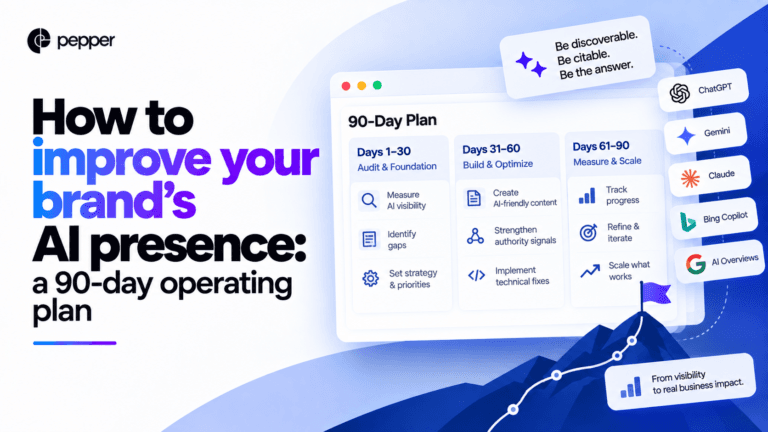
Most 90-day AI plans are sequenced by how hard the work feels rather than by how long it takes to land. So they spend week one on an llms.txt file that Google states it does not use, and they schedule earned media for phase three, which guarantees no result inside the quarter. This plan inverts that. It orders the work by lead time, starts the slowest thing on day one, and cuts four tactics Google explicitly says are unnecessary.
We priced this category nine days ago. Today we went back to the same four pricing pages to check the numbers before publishing. Three of the four had changed, and two had stopped publishing prices altogether. That is the real answer to what AEO costs in 2026: not a number, but a meter that moves, measured in prompts and responses and engines that are billed separately. Here is how each pricing model works, what unit it charges you for, and which incentive that unit creates.
Ask what AI search traffic is worth and you will be handed a multiplier. The ones in circulation right now run from 13% worse than organic search to 23 times better, a spread of roughly twenty-six fold on the single input your whole business case depends on. They disagree because they are measuring the same behaviour under different attribution models. So this is not a guide to finding the right multiplier. It is a guide to building a model whose assumptions are visible, and to being honest about the half you cannot prove.
Get your hands on the latest news!

Similar Posts
Artificial Intelligence
16 mins read
How to improve your brand’s AI presence: a 90-day operating plan
Artificial Intelligence
16 mins read
What does AEO cost in 2026? Pricing models explained
Artificial Intelligence
17 mins read