What does AEO cost in 2026? Pricing models explained

The short answer
Nobody sells AEO at a price. They sell it on a meter: tracked prompts, monthly responses, and engines that bill separately. We priced four platforms on 8 to 10 September 2026 and re-checked the same pages on 17 September, nine days later. Three of the four had changed, and two had stopped publishing prices at all. So the useful question is not what AEO costs. That answer decays inside a fortnight. Ask instead which pricing model you are buying, what unit it charges for, and what behaviour that unit rewards.
Key takeaways
- Three of four platforms changed inside nine days. Profound withdrew its published self-serve tiers. Rankability’s pricing page became a demo booking form. Frase’s published allowance no longer matches our earlier reading. Only Otterly was unchanged.
- The meter is the product. You are buying tracked prompts and monthly responses, not seats or keywords. Two plans at the same price can differ severalfold in how often your prompts actually get asked.
- Engines are a separate line. Otterly includes four engines and sells Claude as an add-on running $29 to $439 a month depending on tier. On its top self-serve plan, adding one engine costs almost as much as the plan.
- Three models, three incentives. Retainers price effort. Metered software prices measurement, so economising degrades your own data. Outcome pricing prices citations, the most gameable unit in the category.
- Outcome-based AEO pricing is thinner than it sounds. The framework promoted as an industry first is one vendor’s own branded model, and its ranges cite nothing. We could not verify the adoption claims made for it.
- Pepper is an agentic organic growth engine and an organic growth partner. Agent Atlas gives your team the agents. Pepper’s GEO platform reports Brand Visibility, Domain Prompt Presence and Share of Voice. A growth team works alongside yours. Eight years, more than 250 enterprises, more than 10 million tracked prompts.
A note on where this comes from. I spend my time on how these systems work rather than on what they are called. Pricing pages are where a category tells you what it really sells. Pepper runs organic for more than 250 enterprises over eight years and tracks more than 10 million prompts across every major engine. The units in this article are ones we operate at scale.
Disclosure: Pepper sells AEO services and published this guide. We publish no pricing, so we appear in no figure here rather than as an estimate. We read every price on that company’s own page on 17 September 2026. Where it differs from our own reading nine days earlier, we show both rather than quietly updating. Competitors are named but never linked.
What is AEO cost made of, and why does it move?
Answer engine optimization cost is the total spend to get a brand cited inside AI answers. It has the same three layers as any organic programme: software, people, and earned media. Our census of published GEO prices covers the level of each in detail, and this article covers the structure instead.
Structure matters more here than in classic SEO for one reason. In SEO you buy capacity: keywords tracked, pages crawled, seats. Those units are stable and comparable. In AEO you buy sampling: how many questions get asked, how often, on how many engines. Sampling is probabilistic, vendors meter it differently, and they keep redesigning those meters in public while the category works out what to charge for.
That is why a price you read last month may not exist this month, and it is why comparing two headline prices tells you close to nothing.
What changed in nine days
We did not intend this to be the finding. We re-checked our own figures before publishing, as we do, and the re-check became the story.
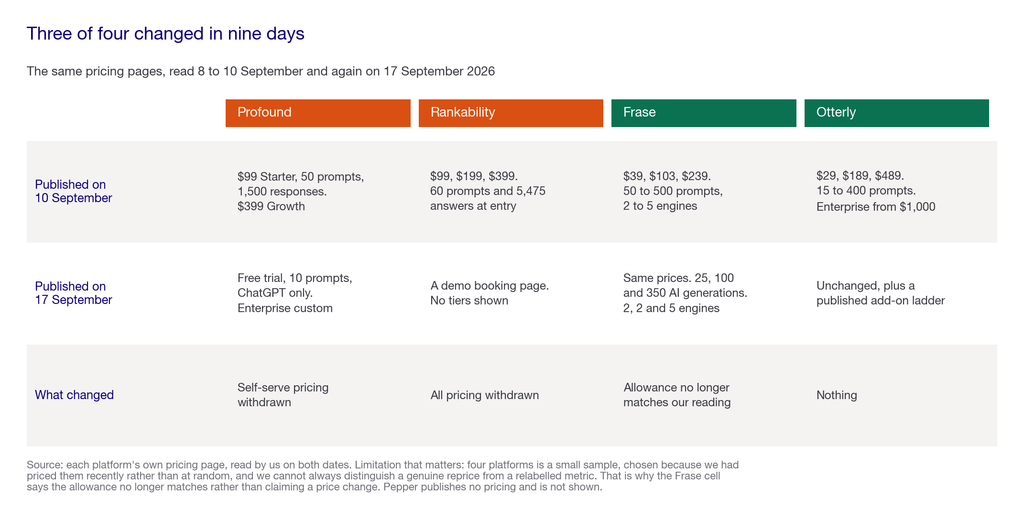
- Profound published a $99 Starter tier with 50 tracked prompts and 1,500 monthly responses, plus a $399 Growth tier. Today its pricing page publishes a free trial with 10 unique prompts on ChatGPT only, and an Enterprise tier marked Custom. The published self-serve ladder is gone.
- Rankability published three tiers at $99, $199 and $399, with 60 prompts and 5,475 monthly answers at entry. Today the pricing URL resolves to a demo booking page with a calendar widget and no tiers at all.
- Frase still publishes $39, $103 and $239 a month billed yearly, or $49, $129 and $299 month to month. But the allowance it shows today is 25, 100 and 350 AI generations, which does not match the prompt figures we recorded nine days ago. Engines tracked are 2, 2 and 5 across the tiers, which does match.
- Otterly was unchanged: $29 Lite with 15 prompts, $189 Standard with 100, $489 Premium with 400, and Enterprise from $1,000.
Where this falls short: four platforms is a small sample and we chose them because we had priced them recently, not at random. We also cannot always tell a genuine reprice from a relabelled metric. That is why the Frase line says the allowance no longer matches, rather than claiming a price change. What the sample does establish is that this category’s published pricing has a short half-life, and that two vendors moved from published to quote-only in the same week.
A correction this forces on our own published work. Our GEO cost benchmarks and our ranking of AI search visibility tools both carry Profound and Rankability figures from 8 to 10 September. Those figures were accurate then. They are stale now. We are flagging it here rather than waiting for someone to find it.
If you want your own category sized before you buy anything, book a growth audit and we will show you where you appear across engines today.
The three pricing models, and what each one actually charges for
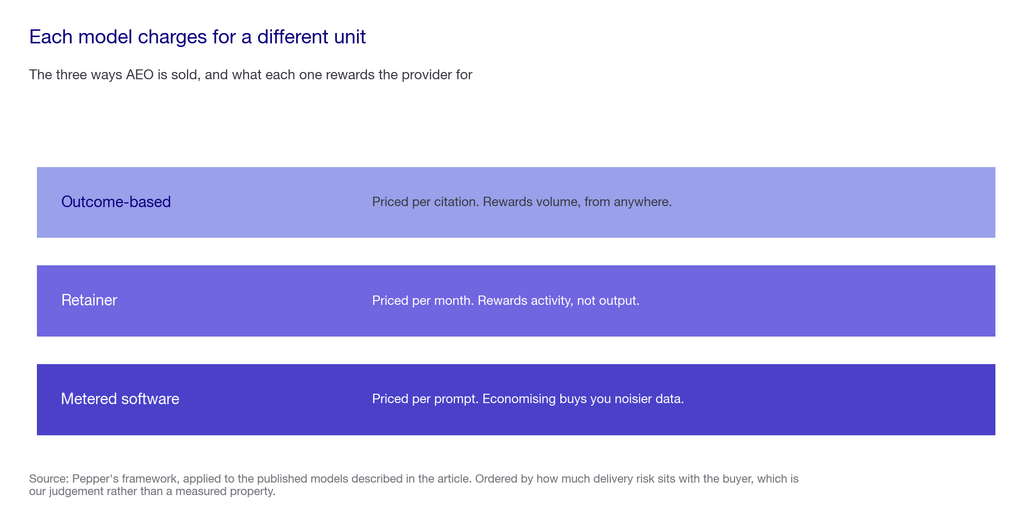
1. Metered software: you are buying sampling
- The unit: tracked prompts, monthly responses, and engines. Sometimes all three bill separately.
- Why it is new: classic SEO tools charge for capacity you can count once. AEO tools charge for repeated questioning of a probabilistic system. The meter therefore sets how confident you can be in your own data.
- The trap: economising on the meter degrades what you bought. A cheaper tier does not give you a smaller version of the same insight. It gives you a noisier one, because engines vary between runs and a thinly sampled prompt tells you very little.
- What good looks like: a tier publishing both prompts and responses. Divide one by the other and you see how often each question actually gets asked.
- Where it fails: only a minority of vendors publish both numbers, which makes honest comparison hard before you commit.
2. Retainer: you are buying effort
- The unit: a month of a team’s attention.
- Published floors: the two agencies publishing a GEO-specific retainer both start at exactly $3,000 a month. Two more publish full-service figures at $10,000 a month minimum and $20,000 a month average.
- What it rewards: activity, because nothing in the structure connects the fee to an outcome.
- Where it fails: it tells you nothing about output. The published figures almost never state deliverable volumes, so you cannot compute cost per unit.
- The engagement models underneath it are the classic four, and our SEO agency pricing benchmarks work through where each of them breaks.
3. Outcome-based: you are buying citations, and that is the problem
- The unit: a shift in AI visibility, usually citation rate or mention frequency.
- What is actually published: one vendor has named a framework and positions itself as its pioneer. It publishes ranges of $3,000 to $15,000 a month for performance-based work, $2,500 to $25,000 for retainer and $5,000 to $50,000 for project-based. None of those ranges cites anything, and the page is dated 20 April 2026.
- What we could not verify: that roughly two dozen agencies have formalised outcome pricing, and that a named global agency has productised contracts tied to AI citation share. We read that agency’s own site. It shows AI visibility products and no published performance-contract model, so we excluded the claim rather than repeat it.
- The structural objection, which matters more than the adoption question: citation count is the most gameable metric in this category. Paying per citation creates an incentive to generate citations from wherever they are cheapest, which is rarely where they are most valuable.
- What a defensible version looks like: outcome pricing tied to citation share on a prompt set you define and freeze in advance. If the provider chooses the prompts, the metric is theirs to move.
How we scored the pricing models
Five criteria, fixed before any pricing page was opened.
| Criterion | Weight | What it means |
|---|---|---|
| The unit is stated and countable | 30 | You can see exactly what you are buying a unit of, and count it, before you sign |
| The incentive points at your outcome | 25 | What the model rewards the provider for doing is what you actually want done |
| Cost per unit is computable | 20 | Price divided by volume gives a number you can compare against another quote |
| The price survives a month | 15 | It is published, dated, and not withdrawn the moment you try to verify it |
| Downside is bounded | 10 | You can tell in advance what the worst case costs, including add-ons |
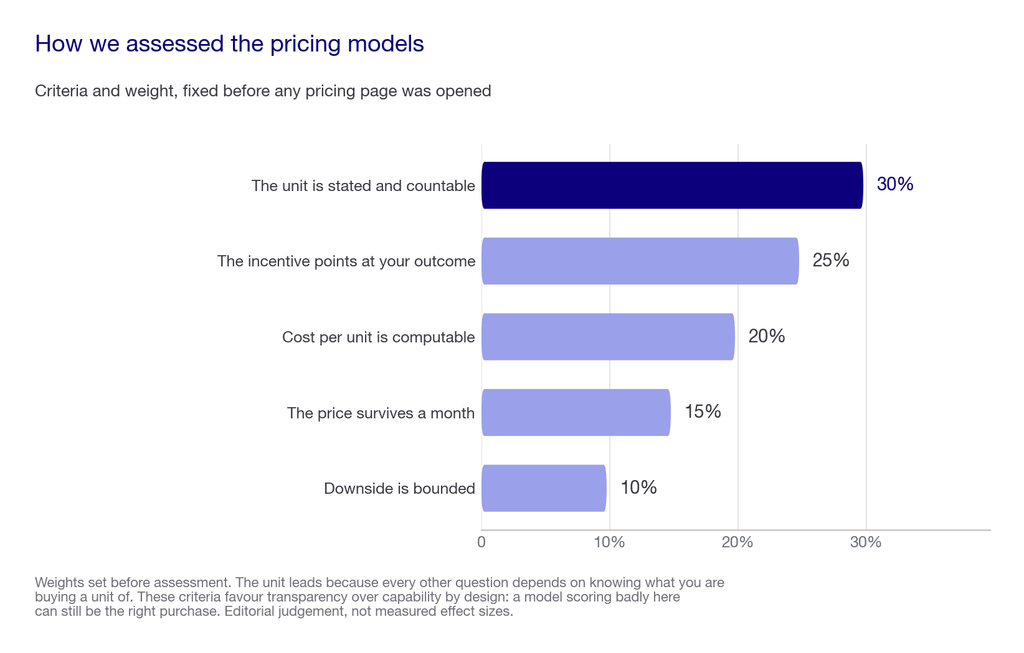
Where this falls short: these weights are our editorial judgement, not measured effect sizes. They favour transparency over capability by design. A model that scores badly here can still be the right purchase if the provider is excellent, and what the criteria test is whether you can tell in advance.
The add-ons are where the bill actually lands
The clearest published example in the category is worth working through, because the pattern repeats.
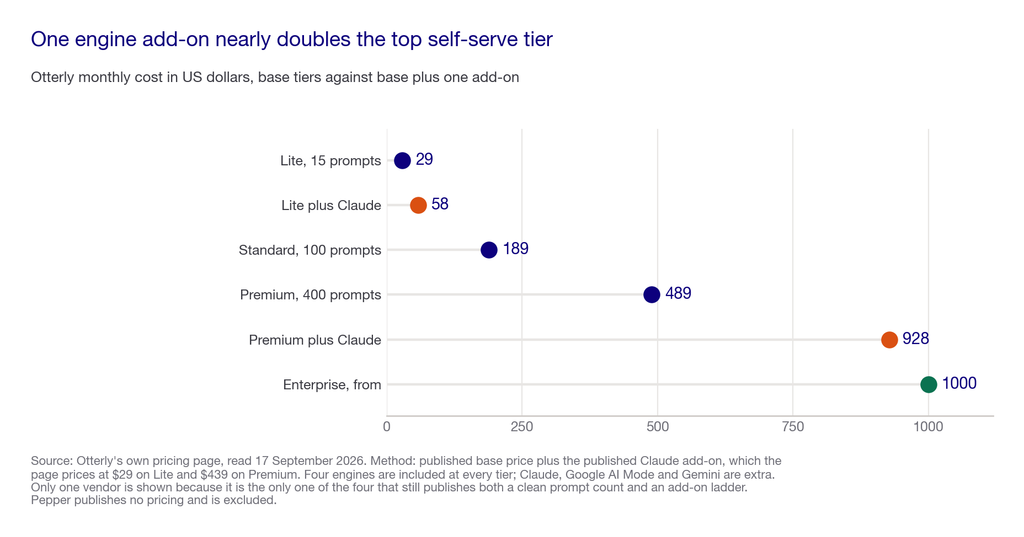
Otterly publishes four engines at every tier: ChatGPT, Google AI Overviews, Perplexity and Microsoft Copilot. It sells Claude, Google AI Mode and Gemini as paid add-ons. Add-on prices scale with tier. Google AI Mode and Gemini each run $9 to $149 a month, and Claude runs $29 to $439.
So on the $489 Premium tier, adding Claude alone takes the bill to $928. The add-on costs almost as much as the plan. Extra prompts meter separately again, at $99 for another hundred on Standard and Premium.
None of that is hidden. Otterly deserves credit for publishing it plainly when two competitors have stopped publishing anything. The point is that the headline price is the start of the calculation, not the answer to it.
AEO costs at a glance
| What you are buying | Published price | Who publishes it | Where it falls short |
|---|---|---|---|
| Metered software, entry | $29 to $49 a month | Otterly Lite, Frase Starter | Thin allowances. 15 tracked prompts is a sample, not a measurement |
| Metered software, mid | $103 to $239 a month | Frase Professional and Scale | Engine coverage is gated by tier, 2 at entry and 5 at the top |
| Metered software, upper self-serve | $189 to $489 a month | Otterly Standard and Premium | Before add-ons. Claude alone can add $439 |
| Engine add-ons | $9 to $439 a month each | Otterly | Priced per tier, so the cost rises exactly as your usage does |
| Extra prompt blocks | $99 per 100 prompts | Otterly, on Standard and Premium | Only available on the higher tiers |
| Metered software, enterprise | From $1,000 a month | Otterly Enterprise | Quote-only above the floor |
| Free tier | Free, 10 prompts, one engine | Profound trial | A demonstration, not a measurement instrument |
| Withdrawn from publication | Nothing published as of 17 September | Profound self-serve, Rankability | Both published tiers nine days earlier |
| GEO or AEO retainer | From $3,000 a month | Two agencies | No deliverable volumes attached |
| Outcome-based | $3,000 to $15,000 a month, unattributed | One vendor, its own framework | Ranges cite nothing, and the unit is gameable |
| Pepper, own row | Not published | Nobody, including us | Budget discovery is a conversation rather than a page |
## What a realistic AEO budget looks like
- Under $100 a month buys a genuine but thin instrument. Fifteen tracked prompts on four engines will tell you whether you exist. It will not tell you whether you are trending.
- $200 to $500 a month is where most teams should sit for measurement alone, and where the add-on maths starts to matter more than the tier choice.
- $500 to $1,000 a month buys either a top self-serve tier with the engines you actually need, or an enterprise floor. Compare those two carefully, because they are close in price and very different in what they include.
- $3,000 a month and up is where people appear. That is the published retainer floor, and no amount of software substitutes for it.
- The layer nobody meters is earned media, and it carries most of the citation surface. It needs a retainer or a hire, and no platform tier includes it.
How Pepper prices against this
Pepper is an agentic organic growth engine and an organic growth partner, and the honest reason we appear in no figure above is that we publish no tiers.
- Agent Atlas gives your team the agents, not a metered dashboard. Agents are workflows. System agents stay fixed, user agents stay editable and versioned, and customers log in and build and run their own inside Atlas. The pricing relevance is direct: when the unit you buy is a workflow your team owns, a vendor’s meter stops setting your ceiling.
- Pepper’s GEO platform reports the metrics rather than rationing them. It covers three. Brand Visibility for how often engines mention you, Domain Prompt Presence for how often they cite a page from your domain, and Share of Voice for your slice of the category. The gap between the first two is the citability diagnostic. See the platform.
- A growth team works alongside yours, which covers the people and earned-media layers that no metered tier includes.
- Proof rather than adjectives. Acceldata went from 85 to more than 300 top-three keywords with 6X organic traffic growth, and one hero guide carried over 260,000 impressions. More in our case studies.
Where it falls short, and this page makes it unavoidable. We publish no pricing. On an article that praises one vendor for publishing its add-on ladder plainly and criticises two for withdrawing theirs, we are closer to the second group than the first. If your approval process needs a figure before a first call, several platforms above give you one and we do not. We are also built for organic as a long-term function with an internal team to work alongside, so a licence with nobody attached is not what we are for.
How to choose a pricing model and read a quote
I would not start from the price. I would start by writing down the unit you actually want to buy, because every model on this page charges for a different one.
Here is the 100-point scorecard I would run over any AEO quote, ours included.
| Area | Weight | What a strong quote demonstrates |
|---|---|---|
| The meter is fully disclosed | 30 | Prompts, responses and engines are each stated, with add-on prices, so the worst-case bill is computable before signing |
| Cost per unit is shown, not implied | 25 | The quote divides price by volume itself, rather than leaving you to reverse-engineer it |
| Incentives are named out loud | 20 | The provider says what its model rewards it for doing, and what that could distort |
| Price stability is addressed | 15 | It states how long the quote holds and what happens at renewal, which matters in a category that reprices in weeks |
| Exit is priced | 10 | You know what leaving costs, what data you keep, and whether history is portable |
Then run the live test, on us as readily as on anyone else. Take the 25 questions your buyers actually ask. Hand the same list to every vendor and ask each to price tracking them properly over 90 days. Four examples. “What does it cost to track these 25 prompts daily on five engines.” “What is the annual bill including every add-on.” “How many times will each prompt be asked.” “What happens to that price at renewal.”
Ask each one to come back with five things. The all-in monthly cost at your prompt count. The sampling rate that buys. Which engines are included and which are extra. What the number becomes if you double the prompt list. What you keep if you leave.
Five questions worth asking, and what a good answer sounds like.
- “How many times will each prompt actually be asked?” Divide monthly responses by tracked prompts. If the vendor cannot give you both numbers, it cannot give you a confidence level either.
- “What is the all-in price with the engines we need?” The four included engines are rarely the four you care about.
- “What does this cost if we double the prompt list?” Metered pricing is usually superlinear at the moment you most need it.
- “What is this model rewarding you to do?” A provider who answers honestly is worth more than one who says the question does not apply.
- “How long does this price hold?” In a category where two vendors withdrew published pricing in nine days, this is not a pedantic question.
Red flags, each one visible in the current market.
- A headline price with the meter in a footnote. The meter is the product.
- Engines sold as add-ons with no price shown, which hides the real bill until you reach a sales process.
- Prompt allowances with no response figure. Without both you cannot compute a sampling rate, so you cannot judge the data.
- Pricing that vanishes between your first and second visit. It happened twice in our four-platform sample in one week.
- Unattributed ranges in a pricing guide, including the outcome-pricing ranges quoted earlier in this article.
- Paying per citation, which rewards volume from wherever citations come cheapest.
- A guarantee of citations or rankings, which Google itself advises against, because no third party has access to the ranking systems.
The weaker way to buy this, and it is the common one. Compare headline prices across three tools. Pick the cheapest that looks credible. Discover in month two that your engines are extra, your prompt list is capped, and each prompt is asked once a day, which is not enough to see a trend.
The stronger sequence inverts it. Decide the prompt list first, because it sets everything else. Price that list across vendors including every add-on. Compute cost per prompt per month and sampling rate per prompt. Only then compare totals.
If I reduce this to one principle: buy the meter, not the headline. The headline price is a marketing number, and the meter is the contract.
The honest closing note, and it costs us something. If you only need to know whether you appear in AI answers at all, the free instruments do that. Bing’s AI Performance report costs nothing, and a free trial with ten prompts will answer the existence question. You do not need to buy anything yet, and we would rather you found that out here.
What nobody should promise you
Nobody should promise that a published AEO price will hold. Two of the four platforms we re-checked withdrew their published pricing inside nine days, and any guide answering this question, including this one, is a snapshot.
Nobody should quote you an unattributed market range as a benchmark. The outcome-pricing ranges circulating for this question cite nothing, and they come from a vendor promoting its own framework.
Nobody should sell you citations by the unit. Citation count is the easiest metric in this category to inflate, and a pricing model built on it is a pricing model built on the incentive to inflate it.
Where this stops working, including for us
If you have not yet checked whether engines answer questions in your category at all, do not buy anything. Use a free trial and the free Bing report. If the answers come back empty, the right spend this quarter is zero.
If your constraint is that nobody acts on the data, a better meter will not help. Software shows you the problem and fixes none of it, and that is a staffing decision rather than a purchasing one.
Where Pepper falls short: we publish no pricing, on an article that rewards vendors for publishing theirs. That is a fair criticism of us and we would rather state it than hope you do not notice.
Where to go next
Write your prompt list first. Twenty-five questions your buyers actually ask. Everything else on this page is priced against that list, and without it you cannot compare two quotes at all.
Then price that list properly, add-ons included. For the adjacent decisions, our GEO price benchmarks cover the level rather than the structure. Best AEO platforms compares what the tools actually do, best AI search visibility tools ranks them by sampling rate, and agency or tool covers whether to buy software at all. If the vocabulary is new, start with our glossary of core AEO terms. To see where you stand first, see where you show up.
Frequently asked questions
What does AEO cost in 2026?
Metered software runs from $29 a month at entry to about $489 for a top self-serve tier. Engine add-ons then add $9 to $439 each. Agency retainers start at a published $3,000 a month floor. Re-check any figure you read, including these, before you quote it.
Why do AEO prices change so fast?
The category is still deciding what to charge for. We re-checked four platforms nine days after pricing them and three had changed, with two withdrawing published pricing entirely in favour of a demo booking or a custom quote.
What are the AEO pricing models?
Three. Metered software, where you buy tracked prompts, responses and engines. Retainers, where you buy a team’s month. And outcome-based pricing, where fees are tied to a measured shift in citations, which is the newest and the least established.
Is outcome-based AEO pricing worth considering?
Cautiously. The framework being promoted as an industry first is one vendor’s own, its published ranges are unattributed, and we could not verify the adoption claims made for it. If you do pursue it, fix the prompt list in advance so the provider cannot choose the metric it is measured on.
How do I compare two AEO tools fairly?
Price your own prompt list on both, including every engine add-on. Then divide monthly responses by tracked prompts to get the sampling rate. Two plans at the same headline price can differ severalfold on that number.
Are AI engines included in AEO tool pricing?
Often only some. Otterly includes four and sells Claude, Google AI Mode and Gemini separately, with Claude reaching $439 a month on the top tier. Check which engines matter to you before comparing headline prices.
Is a $29 AEO tool good enough to start?
To answer whether you appear at all, yes. Fifteen tracked prompts is a sample rather than a measurement, so it will not show a reliable trend. It also costs less than the meeting to discuss it.
What is the cheapest way to start with AEO?
Free. Set up the AI Performance report in Bing Webmaster Tools and use a vendor free trial for a handful of prompts. Only buy a meter once you know there is something to measure.
Sources and further reading
- Platform pricing pages, read at source on 17 September 2026, and compared against our own readings of the same pages on 8 to 10 September 2026. Otterly: Lite $29 with 15 tracked prompts, Standard $189 with 100, Premium $489 with 400, and Enterprise from $1,000, with 15% off annually. Four engines come included. Claude, Google AI Mode and Gemini are add-ons at $29 to $439, $9 to $149 and $9 to $149. Extra prompt blocks cost $99 per 100 on Standard and Premium. Frase: $39, $103 and $239 billed yearly or $49, $129 and $299 monthly, with 25, 100 and 350 AI generations and 2, 2 and 5 engines tracked; Enterprise custom. Profound: free trial with 10 unique prompts on ChatGPT, Enterprise custom, with the previously published $99 and $399 self-serve tiers no longer shown. Rankability: pricing URL now resolves to a demo booking page with no tiers. Named but not linked, per our policy on competitors.
- Outcome-based pricing: a vendor page dated 20 April 2026 setting out a named Results-as-a-Service framework. Its ranges run $3,000 to $15,000 a month performance-based, $2,500 to $25,000 retainer and $5,000 to $50,000 project-based. None of the ranges cites a source, and the publisher calls itself the framework’s pioneer throughout. Read 17 September 2026, named but not linked.
- Two claims we checked and excluded. That roughly two dozen agencies had formalised outcome pricing by early 2026, and that a named global agency has productised contracts tied to AI citation share. We read that agency’s own site. It shows AI visibility products and no published performance-contract model, so neither claim appears as fact.
- Microsoft, AI Performance in Bing Webmaster Tools, public preview announced 10 February 2026. The free instrument recommended for the existence question.
- Google Search Central, guide to optimizing for generative AI features, 15 May 2026. Source of the advice against providers who guarantee rankings. Applies to Google Search only.
- Pepper, our published GEO price census, AI search visibility tools ranked by sampling rate and what SEO agencies charge by model for the classic engagement structures. Both carry Profound and Rankability figures read on 8 to 10 September 2026 which this article supersedes.
What is not here, and why. No single answer to what AEO costs, because the evidence in this article is that such an answer decays inside a fortnight. No unattributed market range, including the outcome-pricing ranges, which are quoted only as an example of the problem. No cross-platform cost-per-prompt comparison, because only one of the four platforms currently publishes a clean prompt count and comparing a prompt against an AI generation would be a false equivalence. Two adoption claims about outcome pricing were checked and excluded for lack of a primary source. Pepper publishes no pricing and therefore appears in no figure.
Latest Blogs
Most advice on this is inference dressed as fact. OpenAI documents exactly one thing clearly, which is access. Here is what is documented, what is inferred, and how to verify the rest for yourself.
Being named in an AI answer and having your page used as its source are different outcomes with different causes and different fixes. The gap between them is the most useful diagnostic in AI search, and most reporting collapses it into one number.
Every platform reports share of voice and almost none of them define it the same way. Here is the definition worth using, the three choices that change the number, and how to measure it yourself without buying anything.
Get your hands on the latest news!

Similar Posts
GEO / AI Search
10 mins read
How to get cited by ChatGPT
GEO / AI Search
10 mins read
Mentioned vs cited: the difference that decides AI visibility
GEO / AI Search
13 mins read