SEO agency pricing in 2026: real benchmarks by model and scope
The short answer
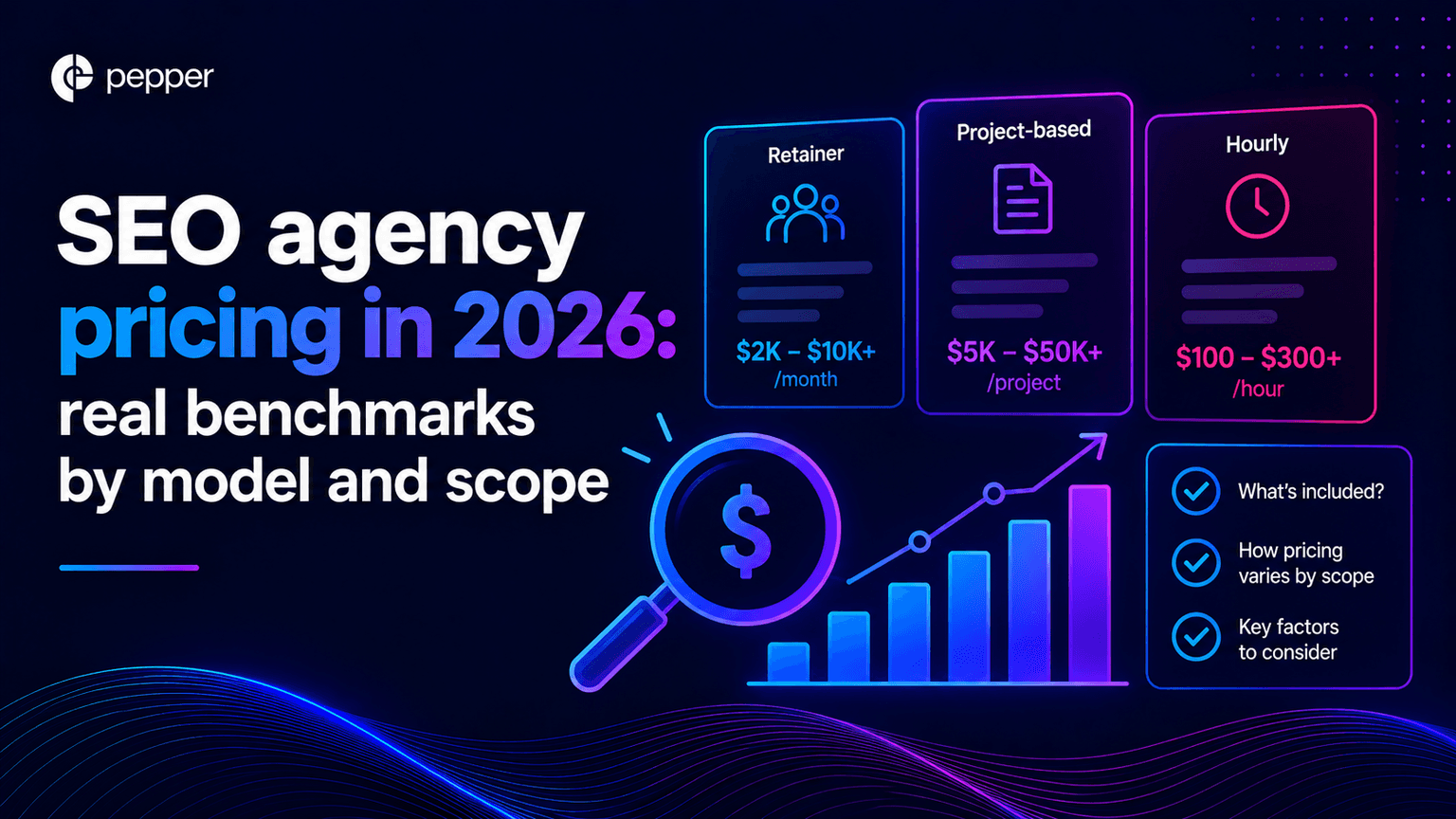
SEO agency pricing splits four ways: monthly retainer, project fee, hourly consulting, and the newer platform-plus-team hybrid. Verified published prices run from $29 a month for a self-serve tool to $9,200 for a top agency retainer tier. Most agencies publish nothing at all. That is the single most useful thing to know before you ask for a quote.
Key takeaways
- The average everyone quotes is stale. That monthly retainer figure comes from a provider survey published in 2023, not from anything measured this year.
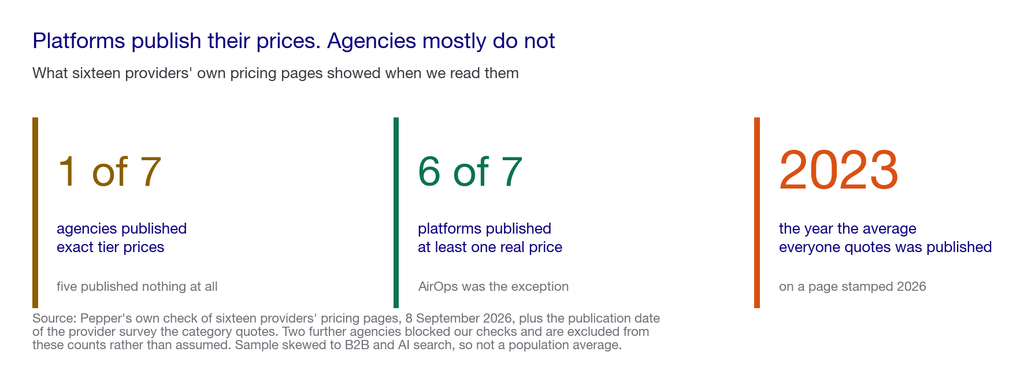
- Transparency tracks the model, not the price. Of the seven agencies whose pages we could actually read, one published exact tier prices and five published no numbers. Six of seven platforms published at least one real price.
- The one fully published agency ladder we verified runs $2,900 to $9,200 a month. It also charges a separate two-month setup fee of $5,900 to $12,200, which nobody quoting monthly averages mentions.
- Scope drives the number, not the model. Local, national and enterprise programmes differ by an order of magnitude. A quote without a defined scope is not a price.
- Ask what the fee buys in hours and deliverables, and who implements. A retainer where nobody ships changes to your site is a research subscription.
A note on where this comes from. I look at this through pipeline rather than traffic. Pricing is the conversation I sit in most often, on both sides of the table. Pepper runs organic for more than 250 enterprises and tracks over 10 million prompts across every major engine. That shapes this, along with the procurement conversations in client reviews each week and what buyers tell us they wish they had asked. Pepper sells in this category and does not publish pricing, so read this knowing we have a commercial interest and a limitation of our own.
Disclosure: we include Pepper in the comparison below and we published this guide. So we have placed ourselves in a separate category rather than ranking ourselves against providers we do not directly compete with. We apply the same scrutiny to ourselves as to everyone else, including a “where it falls short” line. We do not publish pricing, and we say that plainly rather than dressing it up. Every price here comes from that company’s own website as read on 8 September 2026, never from another roundup. Where a company publishes nothing, we say so rather than estimating. We also keep Pepper out of the price figure, because we sell with a growth team attached and are not a like-for-like line item.
What is included in SEO agency pricing, and what are you actually buying?
SEO agency pricing is the fee structure a provider uses to charge for organic search work. That covers strategy, technical fixes, content production, link acquisition, reporting, and increasingly visibility in AI answers. The fee usually buys a bundle of hours and deliverables rather than an outcome.
That distinction is the whole game. Two providers can quote the same $5,000 a month and mean entirely different things, because one is selling recommendations and the other is selling implementation.
So the useful question is never “what does SEO cost”. It is “what does this fee buy, in deliverables, and who does the work”. If the vocabulary here is new, our glossary of core AEO terms and the split between AEO and SEO cover the ground.
Why the benchmark everyone quotes is out of date
Search for SEO pricing and you will meet the same monthly average on page after page. Every one of those pages presents it as current. It is not.
That figure traces back to a survey of 439 service providers published in December 2023. The page hosting it carries a 2026 update stamp, which is what keeps it circulating as current. The fieldwork is three years old. The category has since absorbed AI search, agentic tooling and a wave of new platform pricing.
We are not linking that survey, because its publisher competes with us. We are not repeating its number either. A three-year-old average, presented without its date, is the kind of thing a buyer quotes in a negotiation and then cannot defend.
So we built the benchmark ourselves, from primary sources, on one day.
Our view: the model you pick decides what you can verify
Here is the pattern that matters, and it is not about price at all.
We checked sixteen providers. Platforms publish their prices. Agencies mostly do not. Of the seven agencies whose pricing pages we could actually load, exactly one published real tier prices, one published only a wide range, and five published nothing.
That is not a moral failing, and there are decent reasons for it. Scope genuinely varies, and a published number invites comparison on the one dimension a good agency likes least. It still has a consequence worth pricing in. With the retainer model you cannot benchmark before the conversation, so your first real number arrives from someone whose job is selling it to you.
The hybrid model puts a platform subscription underneath a team, and it is the one place here where you can check part of the cost in advance. That is the model we run, so treat this as an interested party pointing at their own shelf. The point stands anyway. You can check it yourself in ten minutes on the same pages we read.
If you want to see what your own category costs to compete in before you talk to anyone, book a growth audit and we will size it with you. Or read AEO agency or AEO tool first, which is the decision underneath this one.
How we built these benchmarks
We picked the sixteen providers before reading a single price, so nobody could tune the sample to a conclusion. Nine come from the agencies and platforms we already track, and seven from what the pricing SERP itself surfaces. We loaded every page by hand on 8 September 2026.
We recorded four outcomes per provider. The third and fourth stay separate on purpose, because a page that hides a price and a page that will not load are different facts.
| Criterion | Weight | What a provider has to demonstrate |
|---|---|---|
| Publishes an exact price | 35 | A specific figure attached to a named tier, on the provider’s own site, without a form or a call in the way |
| States what the fee buys | 25 | Deliverables or hours per tier, specific enough that two providers at the same price can be told apart |
| Discloses setup and add-on costs | 20 | Onboarding fees, minimum terms and paid extras are visible next to the headline number rather than surfacing in a contract |
| Names the implementation owner | 10 | The page says whether the provider ships changes or hands over recommendations for your team to build |
| Price is current and dated | 10 | Somebody maintains the page, and any benchmark it quotes carries its own publication date rather than a refresh stamp |
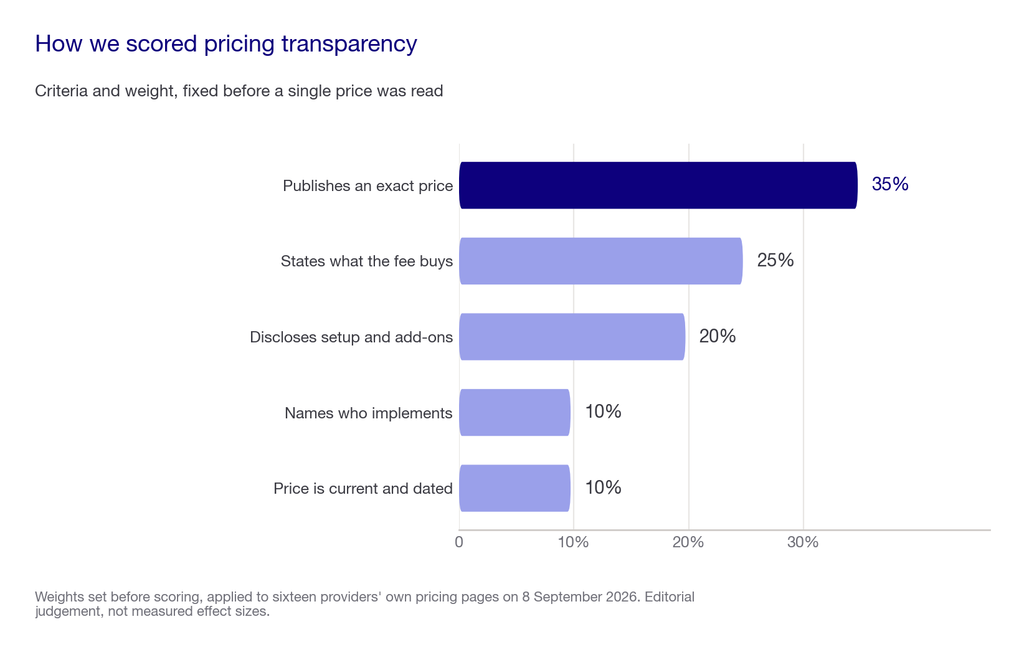
Where this falls short: sixteen providers is a sample, not a census, and it skews toward B2B and AI search rather than local service businesses. It tells you what transparency looks like in this corner of the market. It is not a population average, and we would not present it as one.
SEO agency pricing at a glance, by model
Named, never linked. Every figure read on the provider’s own site on 8 September 2026.
| Model | What the fee buys | Published monthly price | Who it suits | Where it falls short |
|---|---|---|---|---|
| Monthly retainer, published | A defined tier of deliverables, with the ladder visible before you talk to anyone | WebFX publishes Silver $2,900, Gold $6,150, Platinum $7,400, Diamond $9,200, Enterprise on request, plus a separate two-month initial investment of $5,900 to $12,200 | Buyers who need to benchmark and get budget approved before a sales call | Tiered deliverables can fit your site badly, and the setup fee roughly doubles month one and two |
| Monthly retainer, unpublished | A custom scope, quoted after discovery | Not published by Omniscient Digital, TripleDart, Graphite, Minuttia or Embarque. Thrive Agency publishes a range only, $500 to $10,000+, and consulting at $150 to $300 an hour | Complex or regulated programmes where scope genuinely cannot be templated | You cannot compare before you commit time to a sales process, and the first number you see is a negotiating position |
| Platform subscription | Software only. Tracking, analytics, sometimes agents. Nobody does the work | Otterly $29 to $489, Ahrefs $29 to $1,499, Profound $99 to $399, Semrush $117.33 to $455.67, Scrunch $250 to $500, AthenaHQ free then $295 | Teams with in-house capacity who need instrumentation, not people | Buys visibility into the problem and none of the execution, and the entry tiers meter prompts tightly |
| Hourly or project | A fixed scope, or a block of expert time | Thrive publishes $150 to $300 an hour for consulting. Most others quote on request | A one-off audit, a migration, or a second opinion on a strategy | No continuity, and organic work compounds, so a project ends exactly when the returns would start |
| Pepper, separate category | A platform your team runs, with a growth team attached doing the work alongside them | Not published | Teams running organic as a long-term function with people to work alongside | We do not publish pricing, so budget discovery is a conversation rather than a page |
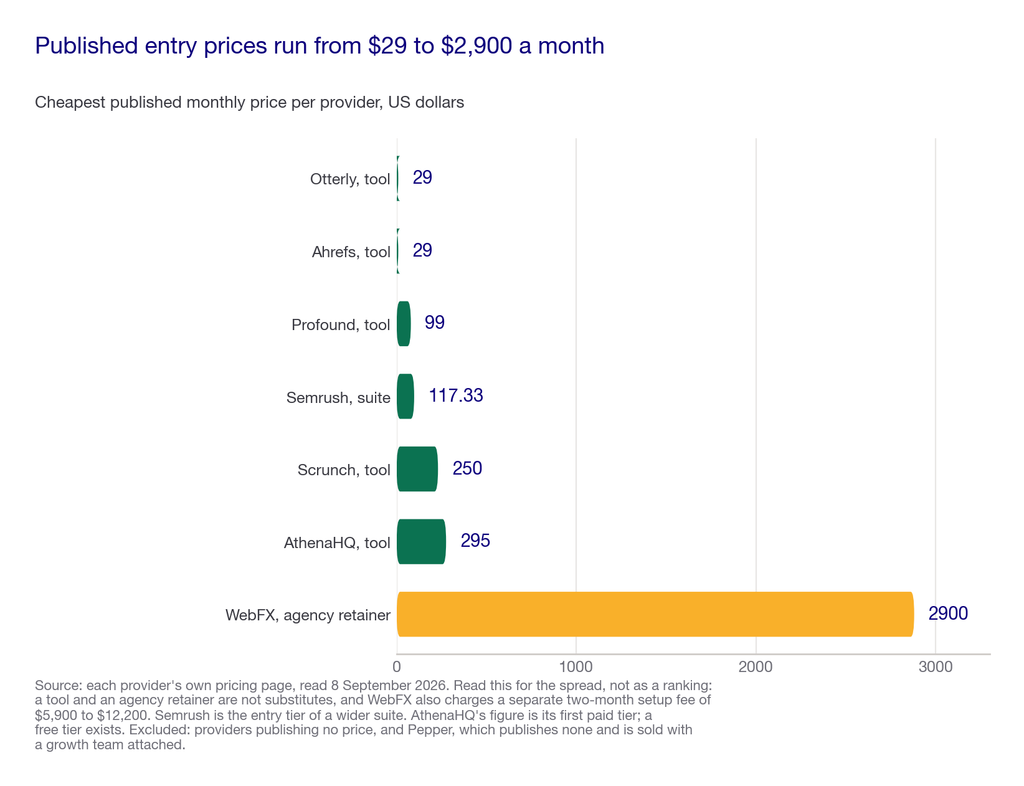
Read that figure for the spread, not for a ranking. A $29 tool and a $2,900 retainer do not compete for the same job. The chart puts them on one axis to show how far apart a published price sits once people join the software.
The four engagement models, and where each one fails
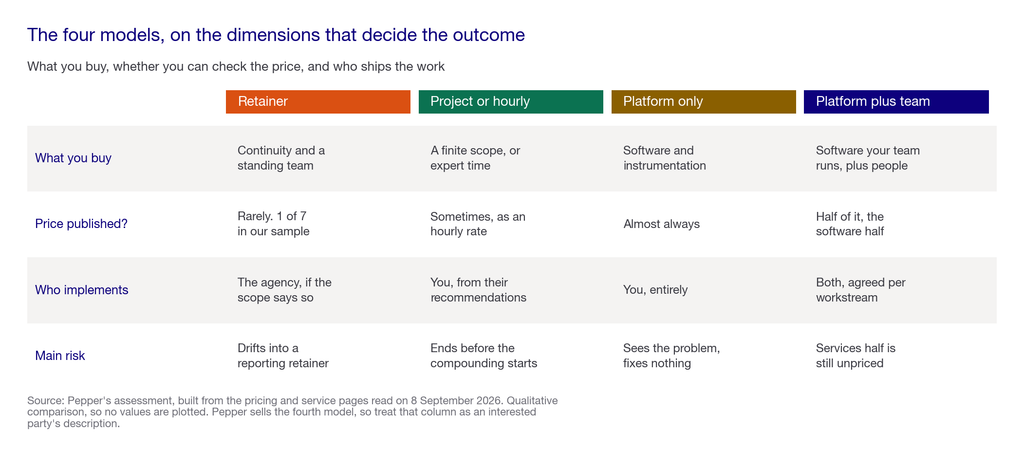
The monthly retainer is the default because organic work compounds and a project cannot. You buy continuity, and continuity is what produces results here. Where it falls short: it is also the model most likely to drift into a reporting relationship. The invoice arrives, a deck arrives, and nothing on the site changes for a quarter.
The project fee works when the scope really is finite: a migration, a technical audit, a schema rollout. Where it falls short: almost nothing in organic is finite. A project usually ends right where the compounding would have begun, so the next quarter starts from a standstill.
Hourly consulting is the honest way to buy judgement. At $150 to $300 an hour it is also the cheapest way to test whether someone knows what they are talking about. Where it falls short: you are buying advice, not delivery, so it only works if you have a team who can execute it.
The platform-plus-team hybrid is the newer shape, and the one where you can check part of the price up front, because the vendor publishes the software half. Where it falls short: you are still buying a services relationship for the larger half of the cost, so the transparency is partial. Ours is no exception.
What SEO agency pricing costs by scope
Scope moves the number more than the model does, so this is where a benchmark either helps you or misleads you.
Local and single-location. The lightest real programmes. The published agency ladder we verified starts at $2,900 a month, while the range Thrive publishes starts at $500. So the floor for something branded as SEO is low, and the floor for something with a team behind it is not.
National and mid-market. Most published retainer tiers sit here, roughly $3,000 to $9,000 a month in the one fully published ladder we could verify. Content volume and technical scope drive the step between tiers.
Enterprise and regulated. Quoted, essentially always. Nobody in our sample published an enterprise number, and every provider with an enterprise tier put it behind a conversation. At this level, expect someone to build the price from your scope rather than pick it off a menu, and expect industry context to move it.
The honest summary: the model tells you how a provider bills, the scope tells you what you pay, and only one of those usually reaches the website.
How to choose a pricing model and read a quote
I would not start by comparing prices. I would start by writing down what has to be true in twelve months for the spend to have been worth it, in pipeline terms. You can only judge a quote against an outcome you have defined. Most evaluations I sit in skip that step, and then every proposal looks reasonable.
The framing judgement first, anchored outside my own opinion. Google’s guidance says optimising for generative AI search “is optimizing for the search experience, and thus still SEO”. Google also advises against providers who guarantee rankings. I read that as two instructions to a buyer. Do not pay a premium for a separate AI methodology, and treat a guarantee as disqualifying rather than reassuring. Google is right for Google, and Google is one engine, so add cross-engine visibility to the scope rather than buying a second programme.
Here is the 100-point scorecard I would run over any proposal, ours included.
| Area | Weight | What a strong proposal should demonstrate |
|---|---|---|
| Deliverables per fee | 30 | The proposal breaks the fee into named deliverables with volumes and owners, so you can compare two proposals at the same price line by line rather than on tone |
| Implementation ownership | 25 | The proposal states plainly whether the provider ships changes to the site or hands recommendations to your team, and if the latter, whose time absorbs that |
| Total cost of the first year | 20 | The provider adds up setup fees, minimum terms, tooling, content production and any per-engine add-ons in writing, because the monthly figure is rarely the whole cost |
| Measurement and attribution | 15 | A named set of metrics agreed before signature, including how the provider measures AI visibility, and an honest statement of what nobody can attribute |
| Exit and portability | 10 | You keep the content, the data and the access on day one of leaving, and someone will say so in the contract rather than in the meeting |
Then run the live test, on us as readily as on anyone else. Give every shortlisted provider the same 25 questions from your own category. Ask them to price the work of winning those questions, not to describe their process. For example: “best SEO agency for B2B SaaS”, “how much should we budget for SEO”, “alternatives to our largest competitor”, “which vendors do you recommend for enterprise AI search”.
Ask them to come back with five things. Where does my brand appear today. Which competitors appear instead. Which sources are influencing those answers. Why are those sources winning. What exactly would you change in the next 90 days, and what would it cost. A provider who returns named sources and a costed plan beats one who returns a capabilities deck. And one who cannot admit that engine answers vary run to run does not understand what they are selling.
The weaker way to buy this, and what most procurement processes do: collect three proposals, compare monthly fees in a spreadsheet, check the case studies, negotiate ten percent off the cheapest, sign. Every step feels prudent. None of it tests whether the fee buys implementation or only advice. That is the variable deciding whether anything changes.
The stronger sequence: define the pipeline outcome, then the scope, then ask everyone to price that same scope. Compare total first-year cost rather than monthly fee, check who implements, and only then negotiate. It matters because in organic the failure mode is almost never paying too much. It is paying a fair price for a relationship where nobody was ever going to ship anything.
Red flags, each one something I have heard in a real procurement call. “We guarantee first-page rankings” should end the meeting, and Google advises against exactly that. A monthly fee with no deliverable counts, so scope shrinks quietly while the invoice stays flat. A setup fee that appears only in the contract. A proposal where the reporting is the deliverable. A claim that AI search is included, with no named engines and no measurement method. Any refusal to say who implements. A minimum term longer than the time it would take to see whether the work is landing. And a benchmark quoted at you with no date on it, which is where this article started.
Five questions I would ask, and what a good answer sounds like.
- “What does this fee buy in deliverables and hours, per month?” A good answer is a list with volumes. A bad one is a description of a methodology.
- “Who ships the changes to my site, you or us?” If it is us, the real cost includes our engineering time, and a good provider raises that unprompted.
- “What is the total first-year cost, including setup and tools?” Ask for it in writing. The one published ladder we verified adds a two-month setup fee of $5,900 to $12,200 on top of the monthly.
- “Which of these 25 questions would you not take on, and why?” Anyone who takes on all of them is selling hours rather than judgement.
- “What happens to the content and data if we leave in month seven?” The answer should be immediate and boring. Hesitation is the finding.
If I reduce this to one principle: compare what the fee buys, never what the fee is. Two identical numbers here routinely buy completely different amounts of work, and the difference is almost always implementation.
The honest closing note, and it costs us something. Very few providers are equally strong across technical execution, content, earned authority and measurement, ourselves included. The good ones will tell you which is their weakest. Ask. And if a published price is what you need most to get budget approved, one of the providers above publishes a full ladder and we do not, which is a real reason to choose them over us.
What nobody should promise you
Nobody should promise a ranking or an AI citation for a fee. Google advises against providers who guarantee rankings, because no third party has access to the ranking systems.
Nobody should quote you a category average as though it were a price. Averages here blend wildly different scopes, and the most-quoted one is three years old.
Nobody should promise clean attribution from an organic citation to closed revenue, or results inside a quarter on a compounding channel. We will not, and I would rather lose the deal than pretend we have solved attribution. What we do instead is measure citation rate and Brand Visibility against Domain Prompt Presence, then say plainly which part of the pipeline we cannot see.
Where this stops working, including for us
If you need a published price to get internal approval, the retainer model will frustrate you. The honest answer is to shortlist providers who publish, or buy a platform subscription first and add people later.
If your programme is small enough that one person holds all of it, you do not need an agency retainer yet. You do not need a growth engine with a team attached either, which is what we sell. Buy tooling, buy a few hours of consulting, and revisit when the work outgrows one head.
Where Pepper falls short: we do not publish pricing, so budget discovery is a conversation rather than a page. That is a genuine disadvantage against the one provider in our own sample that publishes a full ladder. We are built for teams running organic as a long-term function, with an internal team to work alongside. Atlas plus a growth team is what we sell, so a one-off audit or a pure self-serve licence is not what we are for. If organic is not a commitment for the next several quarters, we will say so and turn the work down.
Where to go next
Write down the pipeline outcome first, then the scope, then ask three providers to price the same scope. That sequence costs nothing and it removes most of the risk in this purchase.
Then compare total first-year cost rather than monthly fee. Want the scope sized against your own category before you brief anyone? See where you show up across the engines your buyers use. For a shortlist, read our best AEO platforms and best AEO agencies roundups. Our case studies show what the work produced, including Acceldata going from 85 to more than 300 top-three keywords with 6X organic growth.
Frequently asked questions
How much does an SEO agency cost per month?
Published tiers we verified run from $2,900 to $9,200 a month for a full-service retainer, and platform subscriptions start at $29. Most agencies publish nothing, so any single average you meet blends very different scopes.
Why do most SEO agencies hide their pricing?
Scope genuinely varies, and a published number invites comparison on price alone. The consequence is that you cannot benchmark before the sales conversation. Your first real number comes from someone whose job is selling it.
Is the average SEO retainer figure I keep seeing accurate?
Treat it carefully. The most widely quoted figure comes from a provider survey published in 2023, on a page carrying a later update stamp. Its fieldwork predates AI search entirely, so it describes a different market.
What is a fair SEO pricing model for a small business?
Usually hourly consulting or a platform subscription rather than a full retainer. Published consulting rates run $150 to $300 an hour and tooling starts under $50 a month. That buys instrumentation and judgement without committing to a programme.
What should an SEO retainer include?
Named deliverables with monthly volumes, a stated implementation owner, agreed metrics, and any setup or add-on costs up front. If the retainer produces only reports and recommendations, you are buying research rather than delivery.
Does SEO pricing include AI search visibility in 2026?
Providers claim it increasingly and specify it rarely. Ask which engines they cover, how they measure visibility, and whether the output is a composite score or actual prompts and cited URLs. That difference decides whether you can act on it.
Are SEO setup fees normal?
They are common, and pricing guides rarely mention them. The one fully published ladder we verified charges a separate two-month initial investment of $5,900 to $12,200. That materially changes first-year cost against the monthly figure.
Should I buy an SEO platform or an agency?
Buy a platform if you have in-house capacity and need instrumentation. Buy people if the constraint is execution. The hybrid, a platform your team runs with a team attached, exists because most companies have some of both.
Sources and further reading
- Provider pricing and service pages, each read on the company’s own website on 8 September 2026. Publishing exact tier prices: WebFX. Publishing a range only: Thrive Agency. Publishing no prices: Omniscient Digital, and no pricing page found for TripleDart, Graphite, Minuttia or Embarque. Platform prices: Otterly, Ahrefs, Profound, Semrush, Scrunch, AthenaHQ, with AirOps publishing none at any paid tier. Not linked, per our policy of naming competitors without passing them authority.
- Google Search Central, guide to optimizing for generative AI features, and the announcement post, 15 May 2026. Source of the “still SEO” framing and of Google’s advice against guaranteed rankings. Applies to Google Search only.
- Pepper, Acceldata case study. Source of the 6X organic growth and 85 to more than 300 top-three keywords figures, verified on the page. One account, not a benchmark.
- Pepper, the agency-or-tool decision that sits underneath this one, and how we rank providers generally, which sets out the weighting approach reused here.
- Pepper’s own transparency check, 8 September 2026. Sixteen providers, chosen before any prices were read. Method: load each provider’s pricing page directly and record whether it publishes an exact tier price, a range only, or nothing, keeping unreachable pages separate from silent ones. Limitation: a sample skewed toward B2B and AI search, not a population average.
What we could not verify. Two agencies’ pricing pages returned a server error and blocked our checks, Intero Digital and Inoriseo. We left both out of every count in this article rather than assume either way. A third-party roundup lists Inoriseo as publishing four tiers, and we have not repeated those figures, because we could not read them at source.
The claim we refused. We did not repeat the widely circulated average monthly retainer. Its underlying survey predates this article by three years, and our house rule is that a cited study has to carry a current-year publication date. We describe its age and method instead of its number, and we do not link it, because its publisher competes with us.
Latest Blogs
Most advice on this is inference dressed as fact. OpenAI documents exactly one thing clearly, which is access. Here is what is documented, what is inferred, and how to verify the rest for yourself.
Being named in an AI answer and having your page used as its source are different outcomes with different causes and different fixes. The gap between them is the most useful diagnostic in AI search, and most reporting collapses it into one number.
Every platform reports share of voice and almost none of them define it the same way. Here is the definition worth using, the three choices that change the number, and how to measure it yourself without buying anything.
Get your hands on the latest news!

Similar Posts
GEO / AI Search
10 mins read
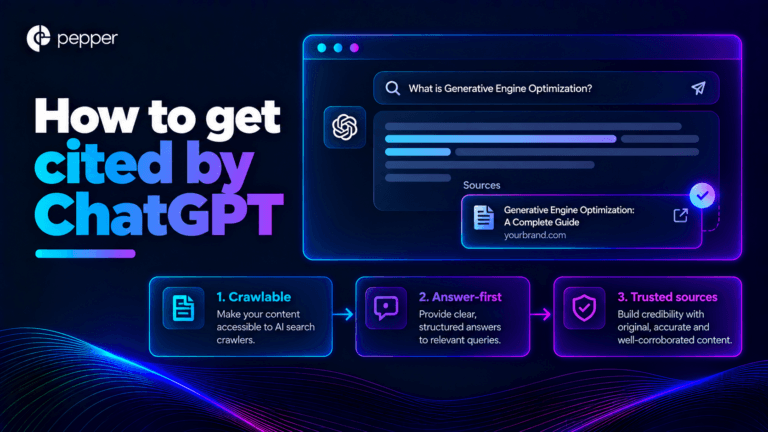
How to get cited by ChatGPT
GEO / AI Search
10 mins read
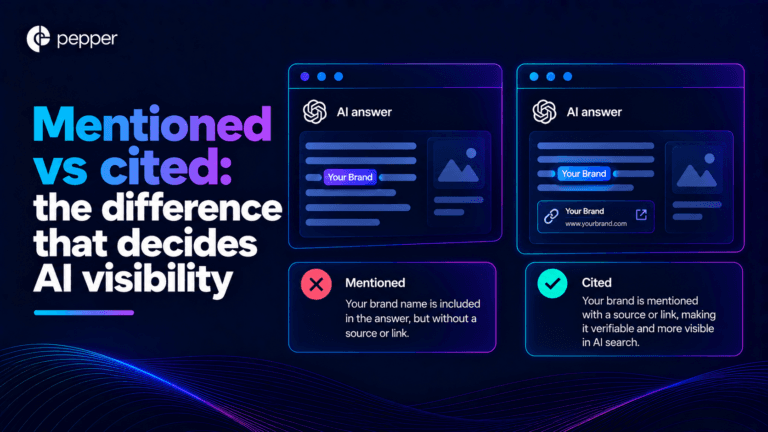
Mentioned vs cited: the difference that decides AI visibility
GEO / AI Search
13 mins read