Generative engine optimization services: what you get, what you pay, what to ask
The short answer
Generative engine optimization services cover six kinds of work: technical retrievability, on-page answer structure, entity and schema, content, earned authority, and measurement. The label is not standardised. Two proposals at the same price routinely buy different halves of that list, so get the deliverables named in writing before you compare a single number.
Key takeaways
- The evidence points at the two ends of the list. Retrieval failures drive over 70% of chatbot errors, and 84% of AI citations point at earned media. So technical retrievability and earned authority carry most of the load. The middle of a typical proposal carries least.
- Three line items that appear on GEO proposals are things Google says are unnecessary: an llms.txt file, pre-chunked content, and AI-specific rewrites of pages you already have.
- Some measurement you are quoted for is free. Microsoft publishes your Copilot citation data in Bing Webmaster Tools at no cost, so ask what a paid report adds on top.
- Almost nobody publishes a scope. One provider in our check publishes both a GEO price and a named deliverable list, which is the exception in this category.
- The cost nobody quotes is your own team’s time. Unless the contract says otherwise, implementation lands on your developers and writers, and that line is usually missing.
A note on where this comes from. I spend my time on why some content gets cited and some does not. So I read these proposals for what they will produce, not for what they cost. Pepper runs organic for more than 250 enterprises and tracks over 10 million prompts across every major engine. That shapes this, along with the scopes we are asked to review against competitors and the questions buyers tell us they wish they had asked earlier. Pepper sells GEO services, so read this knowing we have a commercial interest in the answer.
Disclosure: we sell in this category and we published this guide. So we have put Pepper in its own row rather than ranking ourselves against providers we do not directly compete with. We apply the same scrutiny to ourselves, including a “where it falls short” line. Provider deliverables and prices come from that company’s own website as read on 8 September 2026, never from another roundup. Where a provider publishes nothing, we say so rather than estimating. Pepper is excluded from the deliverable figure, because that figure ranks nothing and we would rather not be the illustration in our own article.
What are generative engine optimization services?
Generative engine optimization services are paid work to make a brand appear, and be cited, in answers produced by generative engines rather than in a list of links. In practice that means a bundle of technical, editorial and public-relations work, plus the measurement to tell whether any of it landed.
The definition is easy. The scope is the problem.
“GEO services” is not a standardised term. It can describe a one-off audit, or a full programme covering technical fixes, content, digital PR, prompt monitoring and reporting. If the vocabulary is new, start with what GEO is and the boundaries between AEO, GEO, AIO and LLMO.
The six things a GEO engagement actually delivers
Here is the inventory. Every proposal we are asked to review draws from these six groups, and the useful question is which ones a given provider is actually staffing.
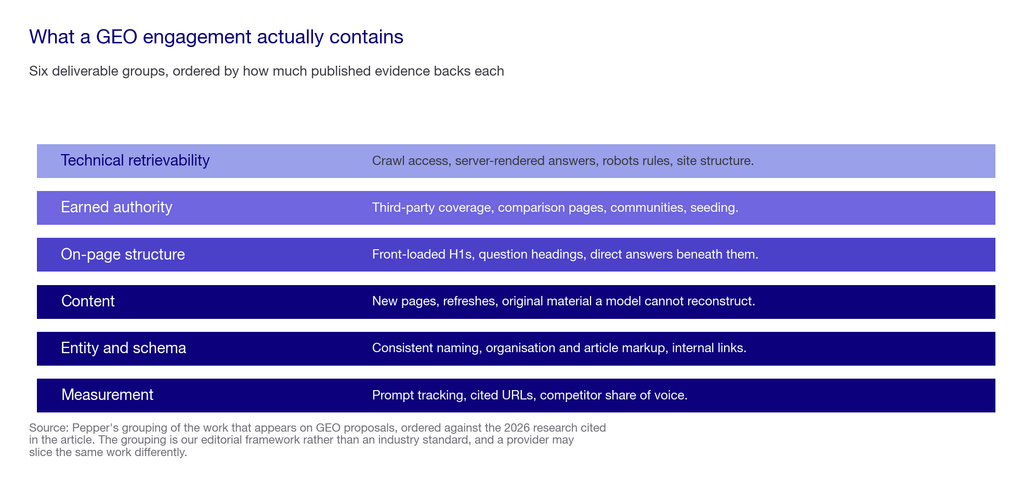
Technical retrievability. Crawl access for AI agents, server-rendered answers, clean robots rules, site structure a machine can follow. This is the plumbing, and it is covered properly in crawlability for AI.
On-page answer structure. Front-loaded H1s, question-shaped headings, direct answers beneath them, FAQ blocks that earn their place. The practical version is in how to structure content for AI citation.
Entity and schema. Consistent naming, organisation and article markup, internal links whose anchors describe the destination. Our view on what markup still earns its place sits in schema markup.
Content. New pages, refreshes, and original material a model cannot reconstruct from someone else’s page.
Earned authority. Third-party coverage, comparison pages, communities, and the seeding work behind getting mentioned and cited in LLMs.
Measurement. Prompt tracking, cited-URL reporting, competitor share of voice, and the honest statement of what cannot be attributed.
Where this falls short: the grouping is ours, not an industry standard, so a provider may slice the same work differently. Ask them to map their proposal onto these six and watch which ones come back thin.
Which deliverables are load-bearing, and which are decoration
This is the part no pricing guide answers, and the published evidence is unusually clear about it.
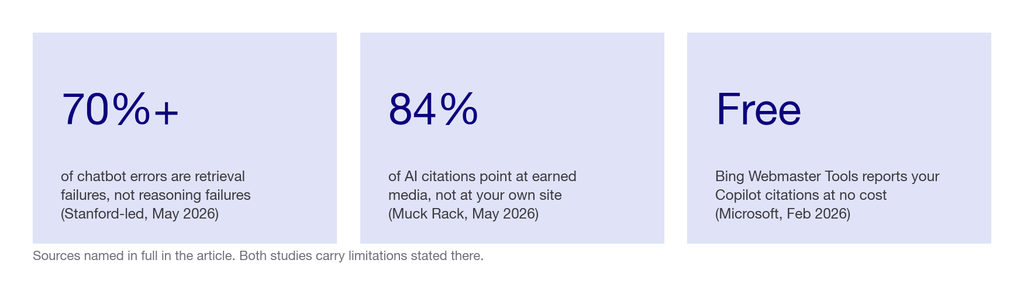
A Stanford-led evaluation published in May 2026 found that “retrieval, not reasoning, failures drive over 70% of all errors” in commercial chatbots. When the models found the right source they usually read it correctly. So the first group on that list, technical retrievability, removes the most common failure in the whole system.
Muck Rack’s May 2026 analysis of more than 25 million cited links puts earned media at 84% of AI citations. That is the fifth group, and it is where most of the citation opportunity actually sits.
Notice what that does to the middle of a typical proposal. On-page structure and schema are necessary, and they are not where the leverage is. That is the argument we make at length in Visibility, Citability and Retrievability. A proposal weighted almost entirely toward on-page rewrites is optimising the least load-bearing group.
That is also the shape of most GEO proposals we review. On-page work is the easiest to scope, price and show in a report. Book a growth audit if you want your own proposal read against these six groups before you sign it.
Three line items Google says you do not need
Now the part that should save you money, and it comes from Google rather than from us.
In May 2026 Google published consolidated guidance on optimising for generative AI in Search, and it retired several things that still appear as billable GEO deliverables.
Its wording, verbatim.
- On machine-readable files, including llms.txt: “You don’t need to create new machine readable files, AI text files, markup, or Markdown to appear in Google Search.”
- On chunking: “There’s no requirement to break your content into tiny pieces for AI to better understand it.”
- On rewriting for machines: “You don’t need to write in a specific way just for generative AI search.”
- On markup: “Structured data isn’t required for generative AI search, and there’s no special schema.org markup you need to add.”
If a proposal bills separately for any of those four as an AI-specific deliverable, ask what it buys beyond what Google says is unnecessary.
Then hold the other half of the thought, because a literal reading goes too far. Google is describing Google. Schema still earns its place for rich results and entity clarity, and other engines publish no equivalent guidance at all, so we keep schema on client sites. We just stopped selling it as an AI citation lever.
Where it falls short: this is documentation, not a ranking commitment. It tells you what is unnecessary for Google. It does not promise what works anywhere else.
What you can already get for nothing
Ask what a paid measurement line adds on top of the free baseline, because there is one now.
Microsoft shipped AI Performance in Bing Webmaster Tools as a public preview in February 2026. It reports which of your URLs get cited in AI answers and which queries triggered them, across Copilot, Bing AI summaries and select partner integrations. It costs nothing.
That does not cover ChatGPT, Perplexity or Google, so it is a baseline rather than a solution. It does mean a provider quoting for citation reporting should say precisely what theirs adds. More engines, a stable prompt set, competitor share of voice, or run-to-run variance. If the answer is a nicer chart, do not pay for it.
How we scored the deliverables
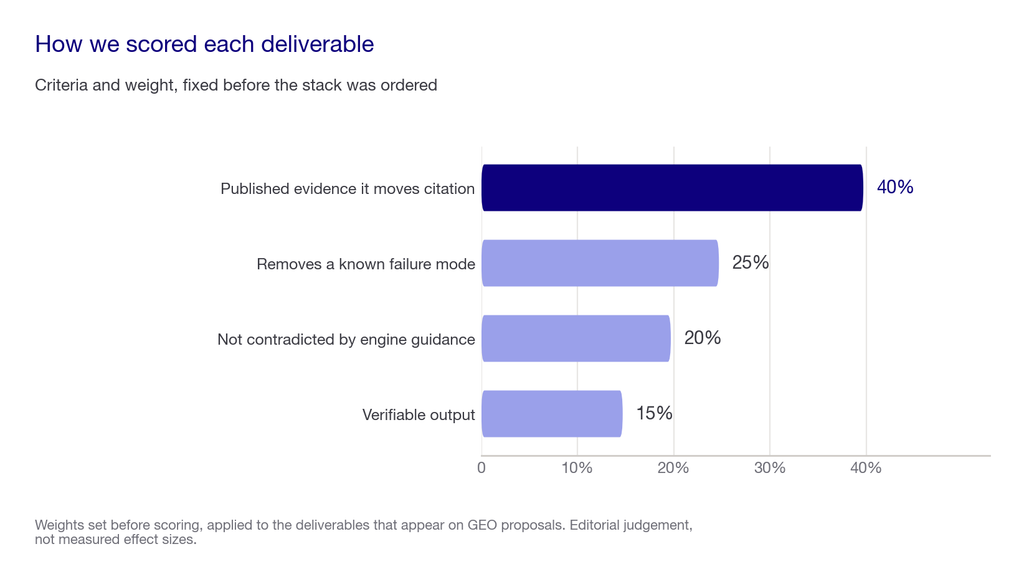
Four criteria, weighted before we ordered the stack. This is also the test I would apply to any line item on a proposal.
| Criterion | Weight | What a deliverable has to demonstrate |
|---|---|---|
| Published evidence that it moves citation | 40 | A 2026 primary source connects this work to being retrieved or cited, rather than a vendor asserting a best practice |
| Removes a known failure mode | 25 | It fixes something that demonstrably stops a page being found or used, instead of improving something already working |
| Not contradicted by engine guidance | 20 | No engine has publicly stated the work is unnecessary, and where one has, the proposal explains why it is still worth doing |
| Verifiable output | 15 | You can tell it was done by looking at something other than the provider’s own report |
GEO services at a glance, by scope
Named, never linked. Read on each provider’s own site on 8 September 2026.
| Scope | What you should get | Published price | Where it falls short |
|---|---|---|---|
| One-off audit | A findings document across the six groups, with prioritised fixes and no implementation | Rarely published. Consulting rates in the wider market run $150 to $300 an hour | Ends at the report. Organic work compounds, so an audit with nobody to implement it ages fast |
| Monitoring only | Prompt tracking, cited URLs, competitor share of voice. Software, no people | Published and cheap. Platform tiers run from free to roughly $500 a month | Sees the problem and fixes none of it, and the entry tiers meter prompts tightly |
| Retainer, published scope | Named deliverables across most of the six groups, with volumes and an implementation owner | WebFX publishes GEO from $3,000 a month, with named deliverables including LLM monitoring, competitor benchmarking and performance tracking | Tiered scopes fit unusual sites badly, and any retainer can drift into reporting |
| Retainer, unpublished scope | Whatever the discovery call produces | Not published by most providers in the category | You cannot compare scopes before committing to a sales process |
| Pepper, separate row | All six groups, with the platform your team runs and a growth team attached doing the work alongside them | Not published | We do not publish pricing, so budget discovery is a conversation rather than a page |
**On what you pay:** the ranges circulating for this category come from providers’ own blogs rather than primary research, so treat them as orientation. The one figure we verified at source is WebFX’s published GEO starting price of $3,000 a month, read on its own page on 8 September 2026.
What you pay, and where the real cost hides
Three costs, and proposals reliably name only the first.
The fee. Published GEO prices are scarce. The verified example above starts at $3,000 a month, and monitoring software runs from free to a few hundred. Beyond that, most of this category quotes after a call.
Your own team’s time. This is the line that goes missing. Unless the contract says the provider ships changes to your site, your developers and writers absorb the implementation. A proposal full of technical fixes can quietly cost more internally than externally.
The earned-media half. If 84% of citations come from third parties, then coverage, original research and digital PR are not an optional upsell. They are most of the opportunity, and they are the slowest and most expensive part of the list.
The honest summary: the fee tells you what the provider costs, not what the programme costs. Add your own time and the earned-media budget before you compare two numbers.
What a good first 90 days looks like
Sequence matters more than volume here, because the groups depend on each other. Fixing retrievability after commissioning twenty articles wastes the articles.
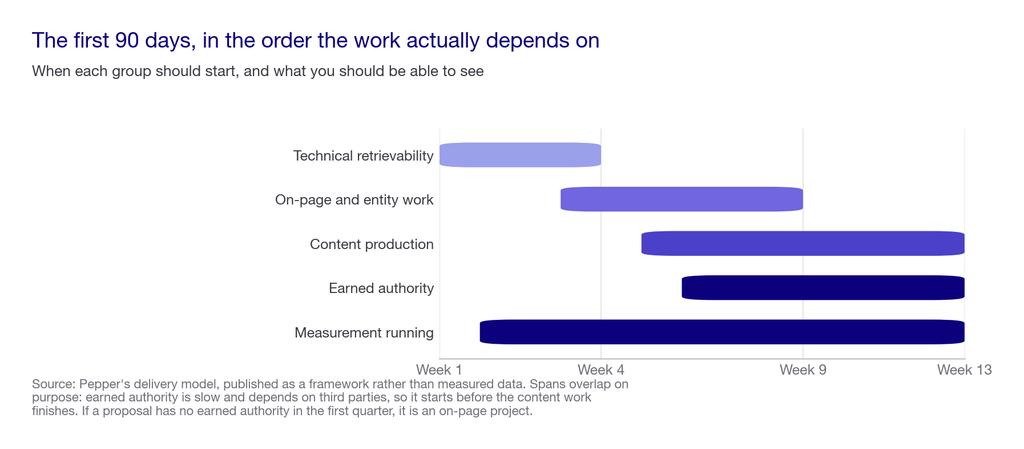
Ask any provider to lay their plan out on this shape. If earned authority does not appear anywhere in the first quarter, the proposal is an on-page project wearing a GEO label.
What to ask before you sign
I would not open with price. I would ask the provider to map their proposal onto the six groups above and say which ones they are staffing. In most proposals I read, two of the six are missing entirely and nobody mentions it.
The framing judgement first, anchored outside our own opinion. Google’s guidance states that optimising for generative AI search “is optimizing for the search experience, and thus still SEO”, and Google advises against providers who guarantee rankings. I read that as a warning against paying a premium for a separate AI methodology. Hold the other half too: Google is one engine, it publishes documentation, and the others publish nothing comparable, so cross-engine coverage still has to be in the scope.
Here is the 100-point scorecard I would run over any GEO proposal, ours included.
| Area | Weight | What a strong proposal should demonstrate |
|---|---|---|
| Coverage of the six groups | 30 | The proposal maps onto all six and states plainly which ones it is not doing, rather than leaving the gaps for you to discover in month three |
| Implementation ownership | 25 | It says who ships each change, and if the answer is your team, it estimates that time honestly instead of leaving it off the page |
| Earned authority in the plan | 20 | Third-party coverage and original material appear in the first quarter with named targets, because that is where most citation opportunity sits |
| Measurement beyond the free baseline | 15 | It names engines, prompts and cited URLs, and can say what it adds over the free Bing citation report |
| No billing for retired tactics | 10 | Nothing is billed as an AI-specific deliverable that Google has publicly said is unnecessary, unless the proposal argues the case for another engine |
Then run the live test, on us as readily as on anyone else. Give every shortlisted provider the same 25 questions from your category and ask them to show you, live, where you appear today. For example: “best generative engine optimization services for B2B”, “who are the leading vendors in our category”, “what should we budget for AI search”, “alternatives to our biggest competitor”.
Ask them to come back with five things. Where does my brand appear today. Which competitors appear instead. Which sources are influencing those answers. Why are those sources winning. What exactly would you change in the next 90 days. A provider who answers with named third-party sources and a sequenced plan is worth more than one who answers with a deck. And one who cannot say that answers vary run to run does not understand the medium.
The weaker proposal, and it is the majority: a prompt list, a set of on-page rewrites, FAQ blocks added to existing posts, schema, a monthly dashboard. Every item is real work. The sequence has no theory of why a third party would start citing you.
The stronger sequence: fix retrievability, then answer structure, then entity clarity, then content, then earned authority, then instrument all of it. It matters because the groups are dependent. Structure cannot rescue a page an engine never reaches, and content cannot manufacture the third-party citations that make up most of the opportunity.
Red flags, each one something we have seen on a real proposal. An llms.txt file as a billed deliverable. “AI-optimised rewrites” of pages that already rank. Schema sold explicitly as a citation lever. A single AI visibility score as the headline metric, with no prompts or cited URLs behind it. Branded-prompt-only tracking, which always looks good. A guarantee of citations, which Google itself advises against, because no third party has access to the ranking systems. Earned media missing from a twelve-month plan. And no line anywhere for your own team’s implementation time.
Five questions I would ask, and what a good answer sounds like.
- “Which of the six groups are you not doing?” A good provider names two immediately. Anyone claiming all six at a small retainer is spreading thin.
- “Who ships the technical fixes?” If it is us, ask for an estimate of our engineering hours, and treat a refusal as the answer.
- “What does your reporting add over the free Bing citation data?” They should know that report exists. If they do not, they are not close enough to the measurement.
- “Show me a citation you earned for a client, and the work behind it.” Not a ranking, a citation, and the earned-media path to it.
- “What would you refuse to bill me for?” The best answer names one of the retired tactics above, unprompted.
If I reduce this to one principle: buy the two ends of the list. Retrievability removes the failure and earned authority creates the preference, and the middle is necessary work that no proposal should be mostly made of.
The honest closing note, and it costs us something. Very few providers are equally strong across technical execution, content, earned authority and measurement, ourselves included, and the good ones will tell you which is their weakest. Ask, and treat a straight answer as a positive signal.
What nobody should promise you
Nobody should promise a citation or a position in an AI answer. Google advises against exactly that kind of guarantee, because no external party has access to the ranking systems.
Nobody should promise a single composite visibility score as the measurement, or a universal benchmark for a good citation rate. There is no such benchmark, and your own trend against the category leader is the only useful comparison. That is the argument in what actually matters in AI search measurement.
Nobody should promise results from one engine on one run, or clean attribution from a citation to closed revenue. We will not, and I would rather lose the deal than pretend otherwise. What we do is report Brand Visibility against Domain Prompt Presence and track citation rate as a trend. Then we say plainly which part of the pipeline we cannot see.
Where this stops working, including for us
If your brand is barely mentioned in your category, a GEO retainer is the wrong first purchase. Build presence and earned coverage first, because there is nothing yet for an engine to cite.
Say you have fewer than roughly thirty commercial questions worth tracking, or nobody to act on findings inside a fortnight. Then you do not need a GEO service yet, and you do not need us. Buy the free Bing report, track a handful of prompts by hand, and revisit in two quarters.
Where Pepper falls short: we do not publish pricing, so budget discovery is a conversation rather than a page. We are built for teams running organic as a long-term function, with an internal team to work alongside. What we sell is Atlas plus a growth team, so a one-off audit or a pure self-serve licence is not what we are for. Our engine coverage is deliberately narrower than the widest claim here: six engines, including ChatGPT, Perplexity, Gemini and Google AI Overviews, run at the response volume needed to trust a reading.
Where to go next
Ask your shortlist to map their proposal onto the six groups this week, and set up the free Bing report while you wait. Both cost nothing and together they tell you most of what you need.
Then compare scopes rather than fees. Want your own category read first? See where you show up across the engines your buyers use. For a shortlist, use our best AEO platforms and best AEO agencies roundups. Our case studies show the work, including Acceldata going from 85 to more than 300 top-three keywords with 6X organic growth.
Frequently asked questions
What do generative engine optimization services include?
Six groups of work: technical retrievability, on-page answer structure, entity and schema, content, earned authority, and measurement. The term is not standardised, so ask any provider to name which groups they are staffing and which they are not.
How are GEO services different from SEO?
The work overlaps heavily, and Google states that optimising for generative AI search is still SEO. The difference is emphasis. GEO weights earned authority and cross-engine measurement more, because citations come mostly from third parties.
What should I not pay for in a GEO proposal?
Anything Google has said is unnecessary and billed as AI-specific: an llms.txt file, pre-chunked content, AI-only rewrites of existing pages, and special schema sold as a citation lever. Schema still has other uses, so judge the reason given.
Can I measure AI citations for free?
Partly. Microsoft’s AI Performance report in Bing Webmaster Tools is free and shows cited URLs and triggering queries across Copilot and Bing AI summaries. It does not cover ChatGPT, Perplexity or Google, so it is a baseline.
How long before GEO services show results?
Expect technical and structural changes to land inside the first quarter and earned authority to take longer, because it depends on third parties. Anyone promising citations on a fixed date is describing something they do not control.
Who implements the changes, the provider or my team?
It varies, and this is the most expensive detail to leave unclear. Get it in writing per workstream. A proposal full of technical fixes can cost more in your engineering hours than in the fee.
Do GEO services cover every AI engine?
Rarely, and coverage claims are hard to compare. Vendors count engines differently, sell some as paid add-ons and publish floors like “7+”, so ask which engines are included at your tier in writing.
Is a one-off GEO audit worth buying?
Only if you have a team who will implement it. An audit produces a prioritised list, and organic work compounds, so a list nobody acts on loses value quickly. Buy consulting hours if you need judgement rather than delivery.
Sources and further reading
- Suzgun, Shen, Bianchi, Spangher, Icard, Ho, Jurafsky and Zou, “Evaluating Commercial AI Chatbots as News Intermediaries”, arXiv:2605.22785, submitted 21 May 2026. Source of the finding that retrieval, not reasoning, failures drive over 70% of all errors. Limitation: news questions put to commercial chatbots, not a marketing stack.
- Muck Rack, “Earned media still drives 84% of AI citations”, What is AI reading? May 2026 edition, published 7 May 2026. Sample: more than 25 million cited links across ChatGPT, Claude and Gemini in 17 industries. Journalism is reported as a subset of earned media, not a separate slice.
- Google Search Central, guide to optimizing for generative AI features, and the announcement post, 15 May 2026. Every Google quotation here appears on one of those two pages. Applies to Google Search only.
- Microsoft, AI Performance in Bing Webmaster Tools, public preview announced 10 February 2026. The free citation baseline referenced throughout, covering Copilot, Bing AI summaries and select partner integrations.
- Pepper, Acceldata case study. Source of the 6X organic growth and 85 to more than 300 top-three keywords figures, verified on the page. One account, not a benchmark.
- Provider deliverables and prices read at source on 8 September 2026. WebFX publishes a GEO starting price and a named deliverable list. Most providers in this category publish neither. Not linked, per our policy of naming competitors without passing them authority.
What is not here. No industry-wide figure for what GEO services cost, because we found no primary research measuring it. The ranges circulating in this category trace to providers’ own blogs, and we would rather name the one price we verified than average a set of unsourced claims. The deliverable grouping in figure 1 is our editorial framework, and the figure says so rather than implying it was measured.
Latest Blogs
Most advice on this is inference dressed as fact. OpenAI documents exactly one thing clearly, which is access. Here is what is documented, what is inferred, and how to verify the rest for yourself.
Being named in an AI answer and having your page used as its source are different outcomes with different causes and different fixes. The gap between them is the most useful diagnostic in AI search, and most reporting collapses it into one number.
Every platform reports share of voice and almost none of them define it the same way. Here is the definition worth using, the three choices that change the number, and how to measure it yourself without buying anything.
Get your hands on the latest news!

Similar Posts
GEO / AI Search
10 mins read
How to get cited by ChatGPT
GEO / AI Search
10 mins read
Mentioned vs cited: the difference that decides AI visibility
GEO / AI Search
13 mins read