Best AEO agencies in 2026: the ten that more than one list agrees on
The short answer
You probably have three tabs open. If they are the roundups ranking for this search, they recommend fifty-three different agencies between them and agree on almost none.
We counted. Five published rankings of the best AEO agencies, including the version of this page we are replacing. Sixty-nine recommendations. Fifty-three distinct companies. Twelve are named by two lists or more, ten of them by lists that do not own them, and not one appears on all five.
That is the useful fact, because it tells you what a shortlist built from a single roundup is worth. It is one person’s reading of a category that has existed for about two years, and the next roundup will hand you a different ten names with equal confidence.
So this page does something narrower and more checkable. It uses corroboration across independent lists as the inclusion rule, then scores the ten that clear it on what an engagement actually contains. That is a visibility filter rather than a quality filter, and the difference matters, so we say what it does not measure.
Key takeaways
- Five lists, 69 recommendations, 53 different agencies. Forty-one of the fifty-three are named by exactly one list. The category has no consensus at all.
- Only two of the ten publish a price. Omniscient Digital publishes a $10,000 a month starting point. NoGood publishes an average retainer above $20,000 a month. The other eight publish nothing, which is the category norm rather than an exception.
- Corroboration measures marketing reach, not quality. Several agencies we rate are named by only one list, and we name them in their own section rather than quietly dropping them.
- One list is already stale. Two rankings recommend Scrunch’s peer Scalerrs at the domain scalerrs.com, which is now parked for sale. The agency is live at scalerrs.co. Nobody updated the link.
- An agency is not the only shape of this purchase. Pepper’s agentic organic growth engine pairs a growth team with a self-serve platform, and for some readers a tool plus an internal owner is genuinely the cheaper answer.
A note on where this comes from. We run organic for more than 250 enterprises and track more than 10 million prompts across every major engine. This read is shaped by that, by the agency bake-offs we sit in during client reviews most weeks, and by the buyer conversations at the events we run. It is our opinion about a category we compete in, not a neutral directory.
Book a growth audit if you would rather establish what your problem actually is before you brief anyone.
What is an AEO agency, and what does one actually deliver?
Answer engine optimization is the work of getting your brand named and cited in AI-generated answers. An AEO agency sells that work as a service, usually on a monthly retainer.
What is inside that retainer varies more than the label suggests. Across the ten agencies here, the work falls into four groups.
- Measurement. Tracking where you appear across ChatGPT, Perplexity, Gemini, Google AI Overviews and Copilot, and which prompts you lose.
- Content and entity work. Producing or rewriting pages so engines can read, attribute and quote them, plus schema and internal structure.
- Earned media and citation building. Getting your brand into the third-party sources engines actually cite: Reddit, YouTube, review sites, industry listicles, press.
- Technical readability. Making sure crawlers can reach and parse the pages in the first place.
The third group is the one that separates the category, and it is also the one most often priced separately or left out of scope entirely. Engines cite sources they trust, and most of those sources are not your website.
If the underlying question is whether to hire anyone at all, AEO agency or AEO tool is the more useful read. If the acronyms are the sticking point, AEO vs GEO vs AIO vs LLMO untangles them.
What five published rankings actually agree on
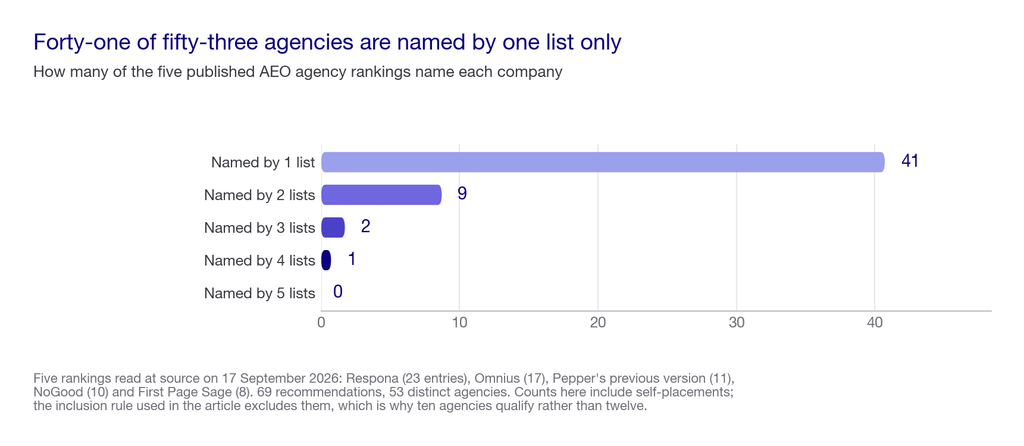
We read five rankings of AEO agencies and recorded every name in each.
| Ranking | Published by | Entries | Date read at source |
|---|---|---|---|
| 23 Best Answer Engine Optimization Agencies | Respona | 23 | 9 July 2026 |
| 16 Best Answer Engine Optimization Agencies | Omnius | 17 | 18 August 2026 |
| The Best Answer Engine Optimization Agencies | NoGood | 10 | 29 August 2026 |
| The Top Answer Engine Optimization Companies | First Page Sage | 8 | 10 August 2026 |
| 11 Best AEO Agencies in 2026 | Pepper, the page this replaces | 11 | 26 June 2026 |
Sixty-nine recommendations. Fifty-three distinct agencies. **Forty-one of those fifty-three are named by exactly one list.**
Four of the five lists put their own publisher at number one, which is worth knowing but is not the interesting part here. The interesting part is the disagreement. Respona’s twenty-three names and First Page Sage’s eight share exactly one company between them. Omnius and NoGood, both credible B2B specialists publishing within two weeks of each other, share two.
Our own page was no better. Seven of the eleven agencies it recommended appear on none of the other four lists.
So we changed the inclusion rule rather than the ranking. An agency is on this page if at least two lists that do not own it name it. Self-placements count for nothing. That rule is reproducible: you can run it yourself against the same five lists and get the same ten companies.
What that rule does not measure. It does not measure the quality of the work, client outcomes, or whether an agency is right for you. It measures whether more than one independent observer thought the company belonged in the category. That is a weak signal on its own, which is why it is a filter here rather than the ranking.
Our methodology: how we scored the ten
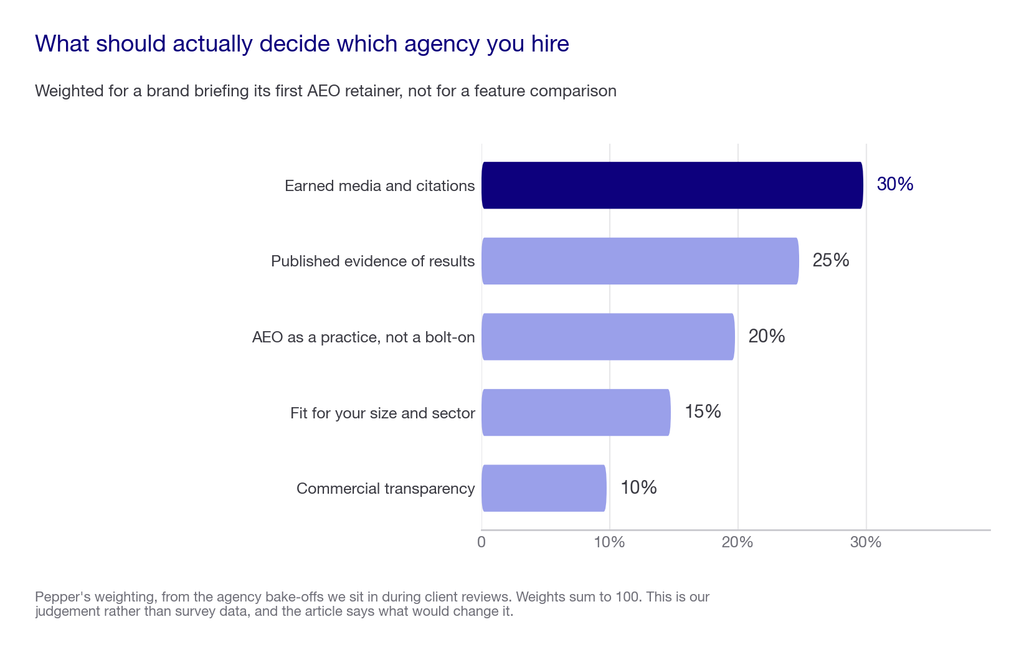
| Criterion | Weight | Why it carries that weight |
|---|---|---|
| Earned media and citation capability | 30 | Engines cite third-party sources far more than brand sites, so an agency without this is optimising the half of the problem you can already see. |
| Published evidence of results | 25 | Named clients with numbers attached, not a logo wall. A logo proves a contract existed, not that the work moved anything. |
| AEO specificity rather than a bolt-on | 20 | Whether AI search is a practice with its own method and measurement, or last year’s SEO retainer with a new line on the invoice. |
| Fit for your buyer size | 15 | An agency built for seed-stage SaaS and one built for a regulated enterprise are not substitutes at any price. |
| Commercial transparency | 10 | A published price or a stated range shortens the sales cycle and signals how the firm expects to sell to you. |
Weights sum to 100. Earned media and published evidence carry more than half, which is a judgement rather than a fact, and it is the judgement this page rests on. We publish our weightings the same way we publish [how we rank GEO agencies](https://www.pepper.inc/blog/geo-agency-ranking-methodology/), so you can argue with them precisely.
What would change these weights. If your site is genuinely unreadable to crawlers, technical readability jumps ahead of earned media and stays there until it is fixed. If you are in a regulated sector, commercial transparency and security posture matter more than anything above them.
Three kinds of agency are on this list, and they are not substitutes
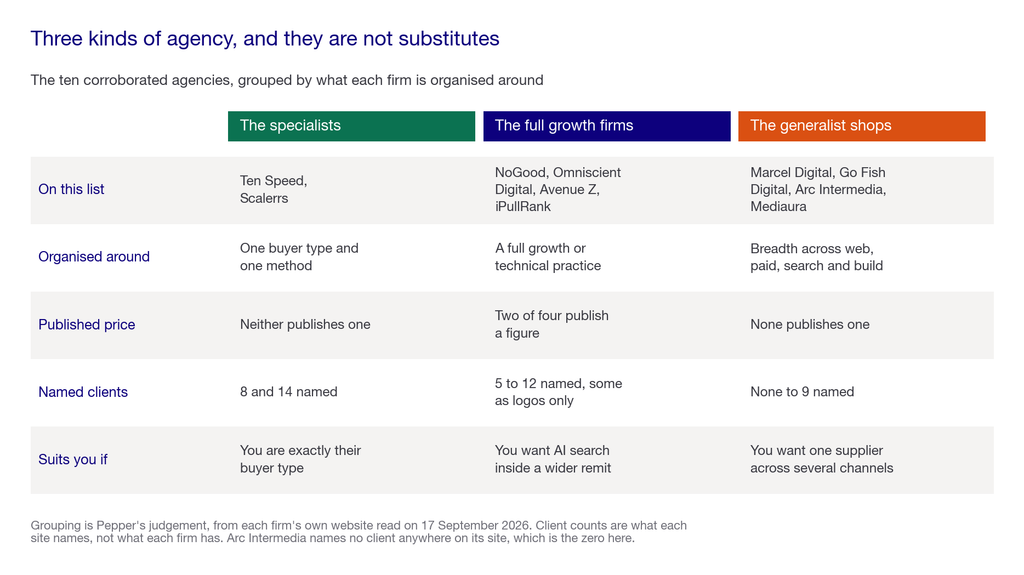
The corroboration filter produced ten companies that do not do the same job. Three shapes come out of it, and mixing them up is the most common shortlisting error we see.
- The specialists. Ten Speed and Scalerrs are organised around one buyer type and one method. They go deeper and refuse more work.
- The full growth firms. NoGood, Omniscient Digital, Avenue Z and iPullRank sell AI search inside a larger growth or technical practice, usually at a higher floor.
- The generalist digital shops. Marcel Digital, Arc Intermedia, Mediaura and Go Fish Digital carry AEO alongside web, paid and development work, often for regional or vertical clients.
Comparing a specialist’s proposal against a generalist’s on price is the error. You are comparing depth in one lane against breadth across several, and the cheaper number usually belongs to whichever one is not organised around your actual gap.
The best AEO agencies in 2026, ranked
Every claim below was read on that agency’s own website on 17 September 2026. The corroboration count is the number of independent lists naming it, out of four possible.
1. Omniscient Digital
The only agency named by four independent lists, and one of two here that publishes a price.
- Corroborated by: 4 of 4 independent lists. The strongest consensus in the category.
- Pricing: publishes “Full-service engagements start at $10,000 a month.”
- Services: GEO described as appearing in AI search and LLM outputs, plus SEO strategy, programmatic SEO, technical SEO, content production, digital PR, link building and conversion rate optimisation.
- Named clients: Jasper, Order.co, Smartling, 360Learning, Eppo by Datadog, TikTok Shop, Sortly, RightCapital and others.
- Earned media: digital PR and link building are named services rather than add-ons.
Best for mid-market and growth-stage B2B software companies with a $10,000 a month floor and a real content programme to run.
Where it falls short: the ten thousand dollar minimum rules out smaller teams entirely, and GEO sits inside a broad service list rather than being the practice the firm is organised around.
2. NoGood
The most visible brand in the category, and the only other agency here that publishes a commercial figure.
- Corroborated by: 2 of 4 independent lists, plus its own.
- Pricing: publishes that engagements are monthly retainers and that “Our average retainer is above $20,000/month.” That is an average rather than a floor, which is a meaningful difference when you are budgeting.
- Services: answer engine optimization named for ChatGPT, Gemini, Perplexity and AI Overviews, alongside earned media and digital PR described as building the citation infrastructure models rely on.
- Named clients: Nike, TikTok, MongoDB, Intuit, Anthropic, AWS, Oura, L’Oreal, Johnson and Johnson.
- Published results: a SteelSeries case study citing 75% on agentic commerce and AI search, though the metric behind the number is not defined on the page.
Best for consumer and enterprise brands with a five-figure monthly budget who want AI search inside a full growth function.
Where it falls short: above twenty thousand a month on average is a serious commitment, and the headline results we could find do not define the metric they improved. Ask for that definition before the second call.
3. iPullRank
The deepest technical bench on this list, and the one doing the most public thinking about how models select sources.
- Corroborated by: 2 of 4 independent lists.
- Pricing: none published.
- Services: generative engine optimization, content engineering, and what the firm calls relevance engineering, described as understanding how AI models identify and select information.
- Named clients: Target, Under Armour, Adidas, American Express, CVS Pharmacy, Nordstrom, MLB, Grainger, Coindesk.
- Published work: the Rank Report newsletter and an AI search readiness assessment, plus case studies citing $2.4 billion incremental revenue in financial services and 130% traffic recovery in automotive.
Best for large enterprises with complex technical estates and an internal team that can absorb genuinely technical recommendations.
Where it falls short: no published pricing, and the client logos are mostly presented without attributed case detail. The largest published figures are not attributed to a named client, so they are hard to check.
4. Avenue Z
The PR-led answer to AI search, which matters more than it sounds given where citations actually come from.
- Corroborated by: 2 of 4 independent lists.
- Pricing: none published.
- Services: AI search optimization positioned explicitly as winning AI search through PR, plus AEO for PR and ecommerce, agentic commerce and AI ad development.
- Named clients: Dave, Olipop, Better, Prometeo, Kind Patches, with logos for Verizon, Adobe, Bank of America and Williams-Sonoma.
- Proprietary: AIVx reports and an AEO readiness quiz. No software platform is described.
Best for consumer and fintech brands whose gap is third-party coverage rather than their own site.
Where it falls short: the firm describes itself as the number one AI search agency for brand visibility, which is a self-assessment rather than a finding. No published pricing, and no proprietary measurement product to inspect.
5. Go Fish Digital
The one agency here that has built and named its own tooling, which makes the measurement layer inspectable.
- Corroborated by: 2 of 4 independent lists.
- Pricing: none published.
- Services: generative engine optimization across ChatGPT, Google AI Mode, Claude and Perplexity, plus SEO, digital PR and paid media.
- Proprietary tool: Barracuda, which the firm describes as monitoring ChatGPT visibility, customising content for audiences and engines, and page-level SEO research.
- Named clients: HP, Uber, Lowe’s, LegalZoom, plus case studies for MoneyGeek, Joybird and SimpleTexting.
- Published research: a GEO whitepaper on how brands are handling Google’s changing results.
Best for brands that want an agency with its own measurement rather than a reseller of somebody else’s dashboard.
Where it falls short: no published pricing, and the proprietary tool is not available to inspect independently, so its sampling and engine coverage cannot be verified from outside.
6. Marcel Digital
The most corroborated mid-market agency here, and a Chicago shop with a long operating history rather than a 2024 rebrand.
- Corroborated by: 3 of 4 independent lists, second only to Omniscient Digital.
- Pricing: none published.
- Services: answer engine optimization named across Google AI Overviews, Gemini, ChatGPT, Perplexity and Microsoft Copilot, plus LLM ad services and Umbraco development work.
- Named clients: Mozilla, Johns Hopkins, Medius, SEKO, Perkspot, with testimonials from Absolute Software and Worldpoint.
- Based: Chicago, Illinois. Team size not published.
Best for mid-market brands, particularly in healthcare and education, who want a generalist digital agency with a genuine AEO practice attached.
Where it falls short: AEO sits alongside web development and paid media rather than being the centre of the firm, and no pricing, team size or contract terms are published anywhere on the site.
7. Ten Speed
The most focused B2B SaaS specialist on this list, run by operators who built the function in house before selling it.
- Corroborated by: 2 lists, one independent and one our own previous version.
- Pricing: none published.
- Services: answer engine optimization and LLM optimisation, AEO refreshes, technical SEO, site migrations and consolidations, content strategy and production, social and digital PR.
- Named clients: Bitly, TechSmith, Moveworks, Salesloft, DataRobot, Press Ganey, Rasa, Spot AI.
- Background: founded by operators who built the content engine at Sprout Social.
Best for high-ACV B2B and B2B SaaS companies that want pipeline-oriented organic rather than traffic.
Where it falls short: deliberately narrow. If you are not B2B software this is the wrong shop, and with a small senior team capacity is finite, so timing matters more than it does with larger firms.
8. Scalerrs
The clearest example on this page of why you should check a link before you trust a list.
- Corroborated by: 2 of 4 independent lists.
- Pricing: none published.
- Services: AEO for ChatGPT, Perplexity, Claude and Google AI Overviews, delivered explicitly by placing brands in the sources engines cite: Reddit, YouTube, Wikipedia, third-party listicles and conventional SEO.
- Named clients: Marq, Qwilr, Pabau, Korona POS, TuxCare, Qrvey, Lyssna and others, with a claim of more than eighty SaaS companies.
- A warning about the listings: two published rankings point at scalerrs.com, which is now parked for sale. The live site is scalerrs.co.
Best for B2B SaaS companies whose gap is presence in the third-party sources engines quote.
Where it falls short: no published pricing, and the off-site placement model needs scrutiny. Ask specifically how listings and Reddit presence are obtained, because the methods in that part of the category vary from genuinely editorial to something you would not want attached to your brand.
9. Arc Intermedia
A long-established Pennsylvania agency that has added AI search to a broad digital practice.
- Corroborated by: 2 of 4 independent lists.
- Pricing: none published.
- Services: AI and organic visibility services, GEO and AEO, SEO, plus custom GPT and business AI agent development.
- Industries named: ecommerce, sports, healthcare, consumer goods, pharma and biotech, associations, financial services and B2B.
- Based: King of Prussia, Pennsylvania.
Best for mid-market brands in those verticals wanting one agency across search, paid and AI build work.
Where it falls short: no client is named anywhere on the site. The firm cites more than $600 million in client revenues with no attributed case studies behind it, which is the weakest published evidence of any agency on this page.
10. Mediaura
The most vertical-specific entry here, with twenty-two years of operating history behind a newer AEO line.
- Corroborated by: 2 of 4 independent lists.
- Pricing: none published.
- Services: SEO and AEO listed together, plus AI consulting. Neither is described in detail.
- Named clients: University of Alabama Online, Marco’s Pizza, BrightSpring Health Services, The Meadows, NV5 Geospatial, DreamLife Recovery.
- Based: Jeffersonville, Indiana. Stated expertise in healthcare and multi-location brands.
Best for healthcare and multi-location regional brands who want a long-standing partner rather than a specialist.
Where it falls short: AEO is a line item rather than a described practice, with no method, measurement approach or engine coverage published. For an AI-search-specific brief you will be taking a good deal on trust.
Agencies we rate that did not clear the filter
The corroboration rule is honest but blunt, and it drops companies that are genuinely good. The version of this page we are replacing recommended eleven agencies. Seven of them appear on none of the four independent lists we checked.
- Animalz, the thought leadership benchmark in B2B content, named by no other list here.
- Graphite, with Masterclass, Notion and BetterUp published as clients.
- Foundation, distribution-first content with Canva, Bitly and Procore named.
- GrowthX, Gushwork, Embarque and Roketto, each covering a different budget band.
None of that is a judgement on their work. It is a statement about how often other people writing roundups named them, which is a marketing outcome rather than a delivery outcome. We have kept them here by name so the change to this page is visible rather than silent. For B2B and enterprise specifically, our ranked comparison of AEO agencies for B2B scores a different set on enterprise readiness, and our GEO agency comparison covers the agencies working on generative engines specifically.
Pepper, in its own category
Every agency above sells you people. Pepper sells a growth team and a platform together, which is a different purchase rather than a better one, and that is why it is not in the ranking.
We are an agentic organic growth engine, and that means three things working together.
- An organic growth partner. A senior strategist and always-on agents are attached to your account. They do the work alongside your team and they are on the hook for the number. Not a dashboard you are left to interpret, and not an agency you hand the problem to. One team that owns the outcome.
- Pepper’s GEO platform. Genuinely self-serve and included rather than billed as a separate licence. You log in and set up a workspace, define your brand profile, competitors and personas, connect GA4 and Search Console, and manage your own themes, prompts and GEO analytics across six engines including ChatGPT, Perplexity, Gemini, Claude and Google AI Overviews.
- The Agent Atlas. Your team builds, versions and runs its own agents on a visual canvas. Quick runs handle a single input, sheet runs handle bulk, system agents ship ready to use and the ones you build are yours to edit. No agency on this page gives you tooling you keep.
The measurement is Pepper-native. Brand Visibility is how often engines mention you by name. Domain Prompt Presence is how often they cite a page from your domain. Share of Voice is your slice of category mentions. The gap between the first two is the diagnostic we care about most, because it separates an awareness problem from a citability problem and those two have completely different fixes.
For what the combination produces, the Acceldata case study records 6X organic traffic and top-three keywords rising from 85 to more than 300, and the SalesHood case study covers the same work in B2B software. Most of this runs through B2B SaaS and BFSI teams.
Where it falls short: we do not publish pricing, so on the commercial transparency criterion this page weights at 10 we score below Omniscient Digital and NoGood, and budget discovery is a conversation rather than a page. We are built for teams running organic as a long-term function, so a one-off audit or a single-quarter spike is not what we are for. Our depth sits in content, authority and AI search rather than large technical migrations, so raise that early if it is your main problem. And if your gap is purely third-party coverage in one vertical, a specialist PR-led shop above will get there faster than we will.
The ten agencies at a glance
| Agency | Independent lists | Published price | Named clients | Earned media in scope | Best for |
|---|---|---|---|---|---|
| Omniscient Digital | 4 of 4 | From $10,000/mo | 12 named | Yes, digital PR and links | Mid-market B2B software |
| Marcel Digital | 3 of 4 | Not published | 8 named | Not described | Mid-market healthcare and education |
| NoGood | 2 of 4 | Average above $20,000/mo | 10 named | Yes, named as citation infrastructure | Consumer and enterprise brands |
| iPullRank | 2 of 4 | Not published | 9 logos | Not described | Large technical enterprises |
| Avenue Z | 2 of 4 | Not published | 5 plus logos | Yes, PR-led by design | Consumer and fintech |
| Go Fish Digital | 2 of 4 | Not published | 7 named | Yes, digital PR | Brands wanting owned tooling |
| Ten Speed | 2 total | Not published | 8 named | Yes, digital PR | High-ACV B2B SaaS |
| Scalerrs | 2 of 4 | Not published | 14 named | Yes, off-site placement | B2B SaaS needing third-party presence |
| Arc Intermedia | 2 of 4 | Not published | None named | Not described | Multi-vertical mid-market |
| Mediaura | 2 of 4 | Not published | 9 named | Not described | Healthcare and multi-location |
| Pepper | Not applicable | Not published | Case studies published | Yes, core to the model | Organic as a long-term function |
What an AEO agency costs in 2026
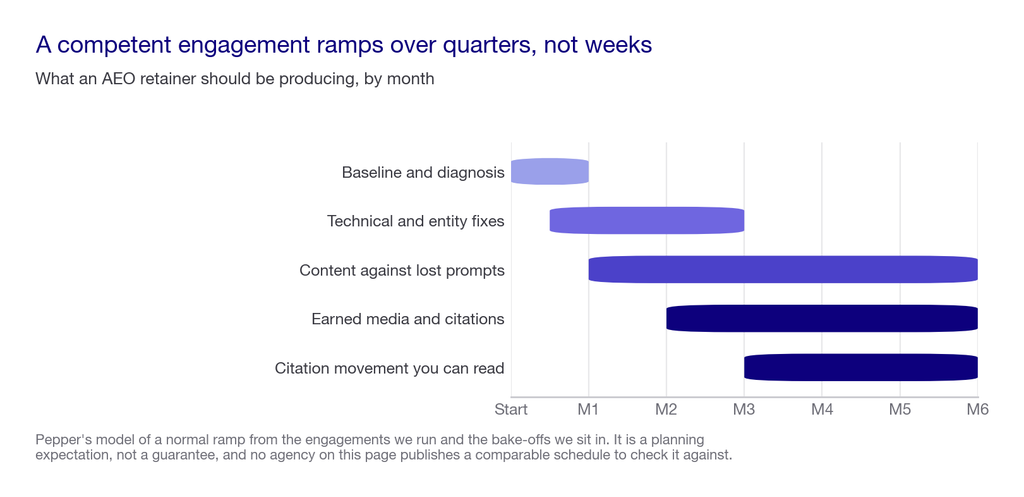
Two of the ten publish a figure. Omniscient Digital starts full-service engagements at $10,000 a month. NoGood publishes an average retainer above $20,000 a month. The other eight publish nothing at all, so every number you see quoted for them, including on competitor roundups, is somebody’s estimate.
We are not going to add to that. The previous version of this page carried price bands for agencies that publish none, and a monthly figure for Pepper that we do not publish either. Both have been removed rather than updated.
What we can tell you is the shape of the spend, from the bake-offs we sit in.
- The retainer is not the whole cost. Earned media and digital PR are frequently quoted separately, and they are the largest single lever on citations. Get them in scope with a figure, or out of scope and stated.
- The cheapest tier is rarely the product. A productised low-cost retainer usually buys content volume with no measurement layer and no off-site work, which is the half that moves AI citations.
- Contract length is the negotiable term nobody negotiates. Ask for a ninety-day break clause. A firm confident in its ramp will discuss it.
- Your own team is a line item. Every agency here hands work back to you. If nobody internally owns acting on it, the retainer buys reports.
For a proper treatment of how these deals are structured, our disclosure audit of what agencies publish counts what this category discloses about price, security and contract terms, which is the honest answer to why a benchmark table is so hard to build.
How to choose an AEO agency
I will write this in the first person, because a recommendation nobody will defend is worth nothing.
Start by throwing away the ranking, including this one. The corroboration filter tells you who is visible, not who is good, and the scorecard below is my judgement rather than a measurement. What decides this purchase is the match between what the agency is organised around and what your programme is missing. If your site is unreadable to crawlers, a brilliant PR-led shop will waste six months. If your pages are immaculate and nobody cites you, more content will not help.
So my order is: diagnose the gap first, shortlist only agencies organised around that gap, then compare inside the shortlist. Here is the scorecard I would use, on a 100 point scale.
| Area | Weight | What a strong agency demonstrates |
|---|---|---|
| Earned media capability | 30 | Named placements they secured, with the outlet and the date. Not a list of publications they can pitch, which anyone can write. |
| Evidence you can check | 25 | A named client, a defined metric and a number, published where you can read it without a sales call. |
| AEO as a practice | 20 | Their own method and measurement, described in their own words, distinct from the SEO retainer they sold in 2024. |
| Fit for your size and sector | 15 | Clients at your scale and in your regulatory environment, because the constraints do not transfer between them. |
| Commercial clarity | 10 | A published price or a stated range, a break clause, and what happens to your content and data if you leave. |
Five questions I would ask every agency on the call, in this order.
- “Show me a citation you earned for a client, with the source and the date.” A stronger agency has one ready. A weaker one describes a process. This single question separates the category faster than anything else.
- “Is earned media in this retainer, and at what figure?” If it is out of scope, the price you are comparing is not comparable to one that includes it.
- “What do you measure, and how often do you re-run it?” Engines are probabilistic, so a single monthly run is an anecdote. Ask for the sampling approach in writing.
- “Who is actually doing the work, and what else are they on?” Senior names sell the engagement. Ask which of them is on your account weekly.
- “What is the break clause?” Ninety days is reasonable. Twelve months with no exit is a financing arrangement, not a partnership.
Red flags, each one something an agency actually says. “We guarantee citations in ChatGPT”, which nobody can promise. “AI readiness” with no measurement attached, which is a workshop sold as a programme. “Our own ranking puts us first”, which is true of four of the five lists on this page. Logos with no numbers. And an annual lock-in with no pilot, offered before anyone has looked at your site.
Before you brief a single agency, run the free diagnostic yourself. Write 25 real commercial questions your buyers would type. Run them three times each across every engine you care about, because one run tells you nothing. Then give any fix 90 days before you judge it. Four worked examples for a mid-market B2B SaaS analytics company:
- “best data observability platform for enterprise”
- “how do I monitor data quality across Snowflake and Databricks”
- “what should I look for in a data observability vendor”
- “who competes with Monte Carlo in data observability”
That exercise costs nothing and tells you whether engines do not know you, know you but cite someone else, or cannot read your site. Those three have completely different fixes and completely different suppliers. Checking whether your brand appears in AI search walks through it properly.
And the answer that loses Pepper the sale: if you have a capable content team and a technical owner, and your only gap is knowing where you stand, you do not need an agency this quarter. Buy a tracker, give the diagnosis to the team you already have, and revisit in two quarters. We would rather tell you that than sell you a retainer you will resent.
It comes down to one principle: hire for the gap you have diagnosed, not for the name that appeared on the most lists. Every ranking in this category is somebody’s opinion published for reach, ours included, and the only defensible shortlist is the one you built from your own diagnostic.
What nobody should promise you
- A guaranteed citation or position in an AI answer. Engines are probabilistic and nobody controls their ranking systems.
- A single number that captures AI visibility. The useful diagnosis lives in the gap between two numbers, not in one composite.
- Results in thirty days. Earned media and entity work compound over quarters. Anyone promising a month is describing a spike.
- A universal benchmark. Presence varies by category, by engine and by week.
- Clean attribution from a citation to closed revenue. Nobody has this yet, including us. Anyone selling it is selling a model, not a measurement.
Frequently asked questions
What are the best AEO agencies in 2026?
Ten agencies are named by two or more independent rankings: Omniscient Digital, Marcel Digital, NoGood, iPullRank, Avenue Z, Go Fish Digital, Ten Speed, Scalerrs, Arc Intermedia and Mediaura. Omniscient Digital has the widest corroboration, appearing on four of four.
How much does an AEO agency cost in 2026?
Only two of the ten publish anything. Omniscient Digital starts full-service engagements at $10,000 a month, and NoGood publishes an average retainer above $20,000 a month. The other eight publish no figure, so quoted numbers for them are estimates.
What is the difference between an AEO agency and a GEO agency?
In practice, very little. The acronyms describe the same work on the same engines, and most firms use them interchangeably. Judge the method and the measurement rather than the label, because the label changes faster than the capability does.
Should I hire an AEO agency or buy an AEO tool?
It depends on which half you are missing. Buy a tool when you have people who can act on data. Hire an agency when the work itself is the bottleneck. If you have neither, a tool alone will produce reports nobody uses.
How long before an AEO agency delivers results?
Give any engagement 90 days before judging it, and establish a baseline first by running your prompt set at least three times per engine. Earned media and entity work compound over quarters, so a one-month read will mislead you in both directions.
What should an AEO agency deliver every month?
Measurement across the engines you care about, content or page work tied to specific prompts you lose, off-site citation building, and a written read of what changed and why. If earned media is absent, ask whether it is out of scope or simply not done.
Why do published AEO agency rankings disagree so much?
Because the category is about two years old and most rankings are published by agencies in it. Across five lists we counted 53 different agencies, 41 of them named by exactly one list, and four of the five put their own publisher first.
Can I start with a pilot instead of a long contract?
Usually yes, and you should ask. A 90-day pilot with a defined baseline and a break clause is reasonable, and a firm confident in its ramp will discuss it. An annual lock-in offered before anyone has audited your site is the red flag.
Where to go next
If you are choosing between hiring anyone and buying software, the agency against tool decision sits underneath this page. If you are B2B or enterprise specifically, our ranked comparison of AEO agencies for B2B scores a different set against enterprise readiness.
If you have decided on software rather than people, the best AEO platforms compared covers eight products on how much of the work they actually do. And to understand what you should be measuring either way, the Visibility, Citability and Retrievability framework is the model the rest of our work sits on.
Sources and further reading
Agency claims, each read on that company’s own website on 17 September 2026 and deliberately not hyperlinked, per our policy of not linking competitors:
- Omniscient Digital. “Full-service engagements start at $10,000 a month.” GEO, programmatic SEO, technical SEO, content production, digital PR, link building, CRO. Clients named include Jasper, Order.co, Smartling, 360Learning, Eppo by Datadog and TikTok Shop.
- NoGood. “Our average retainer is above $20,000/month.” AEO named for ChatGPT, Gemini, Perplexity and AI Overviews, plus earned media and digital PR. Named clients run to Nike, TikTok, MongoDB, Intuit, Anthropic and AWS. SteelSeries case study cites 75% without defining the metric.
- iPullRank. No pricing published. GEO, content engineering and relevance engineering. Enterprise logos including Target, Adidas, American Express and CVS. Case study figures of $2.4 billion and 130% are not attributed to named clients.
- Avenue Z. No pricing published. AI search optimization positioned as winning AI search through PR. Named clients are Dave, Olipop, Better and Prometeo. Describes itself as the number one AI search agency for brand visibility, which is a self-assessment.
- Go Fish Digital. No pricing published. GEO across ChatGPT, Google AI Mode, Claude and Perplexity. Proprietary tool named Barracuda. HP, Uber, Lowe’s and LegalZoom are named as clients.
- Marcel Digital. No pricing published. AEO named across AI Overviews, Gemini, ChatGPT, Perplexity and Copilot. Mozilla and Johns Hopkins are named as clients. Based in Chicago. Team size not published.
- Ten Speed. No pricing published, at tenspeed.io. AEO and LLM optimisation, AEO refreshes, technical SEO, migrations, content, social and digital PR. Named clients run to Bitly, TechSmith, Moveworks, Salesloft and DataRobot.
- Scalerrs. No pricing published. AEO delivered through Reddit, YouTube, Wikipedia, third-party listicles and SEO. More than eighty SaaS clients claimed, with fourteen named. The live site is scalerrs.co. The scalerrs.com domain returns a GoDaddy parked listing offering the domain for sale, and two published rankings still point there.
- Arc Intermedia. No pricing published. AI and organic visibility, GEO and AEO, custom GPT and AI agent development. Based in King of Prussia, Pennsylvania. No client is named anywhere on the site. Cites more than $600 million in client revenues without attribution.
- Mediaura. No pricing published. SEO and AEO listed together with AI consulting, neither described in detail. Named clients are University of Alabama Online, Marco’s Pizza and BrightSpring Health Services. Based in Jeffersonville, Indiana, with twenty-two years claimed.
The five rankings counted in Figure 1, each read at source on 17 September 2026 and not hyperlinked for the same reason: Respona, 23 entries, Payman Taei, 9 July 2026. Omnius, 17 entries, Matija Golubovic, 18 August 2026. First Page Sage, 8 entries, FPS Staff, 10 August 2026, with a published five-criterion weighting. NoGood, 10 entries, Julia Olivas, 29 August 2026. Pepper, 11 entries, 26 June 2026, the page this replaces.
Research sources, checked at the original on 17 September 2026:
- Google Search Central, “Optimizing your website for generative AI features on Google Search”, announced 15 May 2026, last updated 10 July 2026. The position that optimizing for generative AI search is still SEO, which is why an AEO retainer should be able to say what changed in delivery.
Further reading on Pepper, each checked live on 17 September 2026:
- AEO agencies for B2B and enterprise, ranked, a different set scored on enterprise readiness, plus the disclosure audit.
- Best generative engine optimization agencies, the GEO-specific comparison.
- Best AEO platforms compared, if the answer is software rather than people.
- AEO metrics and the AI visibility score, what to hold any supplier to.
A note on scope and on corrections. This page ranks by cross-list corroboration and scores on what an engagement contains. It does not repeat the enterprise-readiness scoring or the disclosure audit in our B2B comparison, and it does not cover generative engines specifically, which the GEO page does. Two things from the previous version have been removed rather than updated: Pepper’s position at number one, and the published price bands for agencies that publish none, including a monthly figure for Pepper that we do not publish.
Latest Blogs
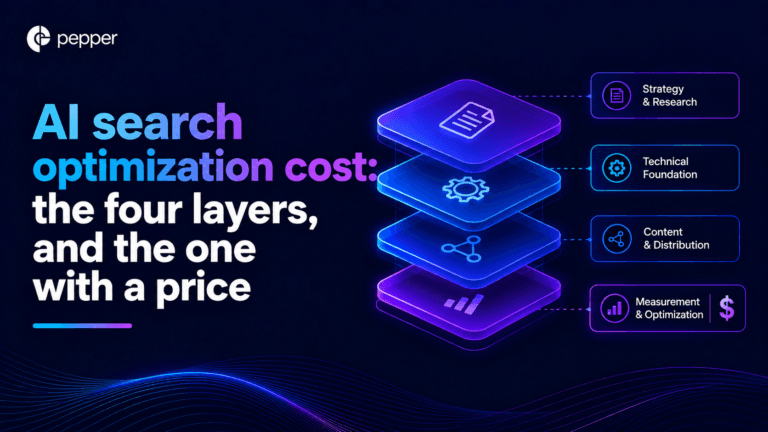
AI search optimization has four cost layers and only one of them has a price you can look up. Software is published, comparable and the cheapest. Agency retainers are published by exactly two firms. Earned media, which drives most AI citations, is priced by almost nobody. And the fourth layer, doing it with your own people, turns out to have no market rate at all. A study of 3,900 SEO job listings found that just 6.3% of senior roles mention AI search, and published salary figures for the same job title differ by 76% between sources.
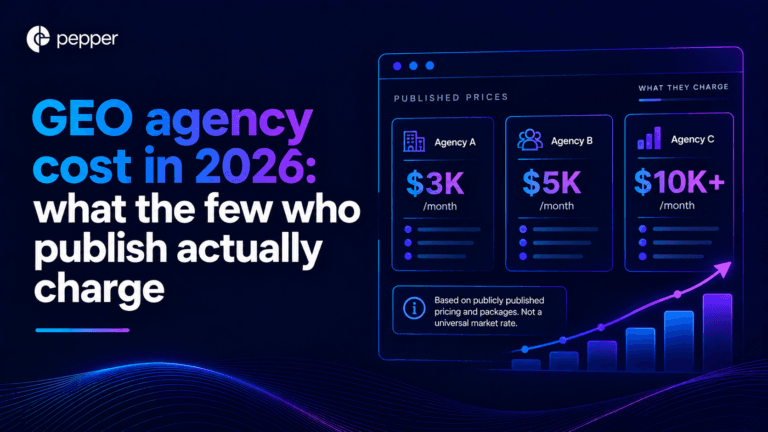
We re-read every published GEO agency price on 25 September 2026, fifteen days after our own benchmark first recorded them. All four held, which is worth knowing on its own because the software side of this market has been withdrawing prices all quarter. The more useful finding came from the one agency that publishes volumes alongside price. Ten blog articles at $3,000 a month and forty at $8,000 works out at $300 and $200 an article. That is a content production contract with a GEO label, and the citation evidence says content you own accounts for a small minority of AI citations.
Our own benchmark of 30 published prices already answers what GEO costs. This answers the different question, which is what you should budget and where it should go. Two numbers decide it. A study of more than 25 million cited links found earned media drives 84% of AI citations while paid and advertorial content drives 0.3%. And the Gartner CMO survey of 401 CMOs puts marketing at 7.8% of revenue with SEO the largest single line inside owned and earned digital. Put those together and the answer is that GEO is not a new budget line at all. It is a reallocation, and most teams are making it in the wrong direction.
Get your hands on the latest news!

Similar Posts
GEO / AI Search
16 mins read
AI search optimization cost: the four layers, and the one with a price
GEO / AI Search
16 mins read
GEO agency cost in 2026: what the few who publish actually charge
GEO / AI Search
16 mins read