How to improve your brand’s AI presence: a 90-day operating plan
The short answer
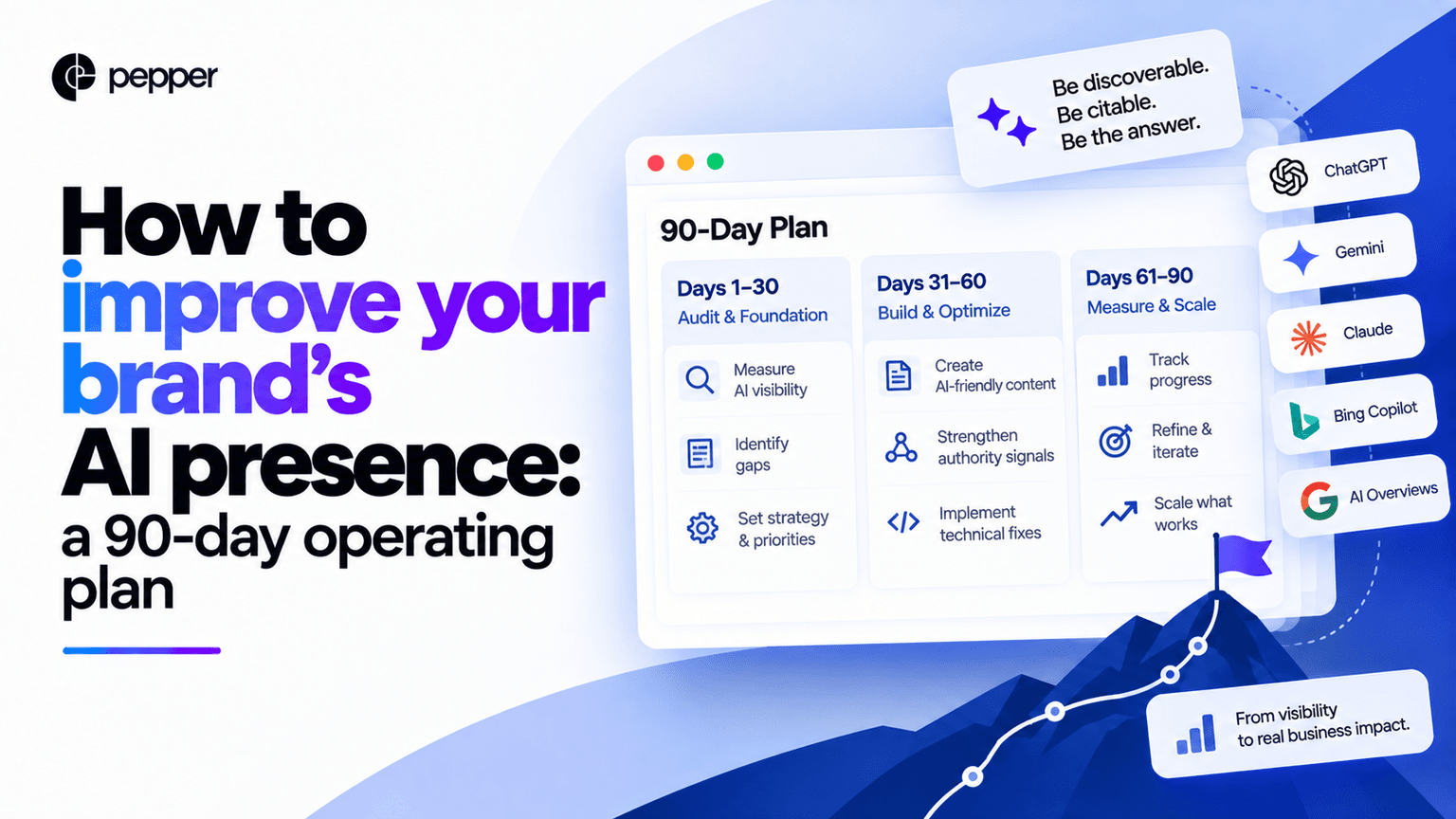
Sequence the work by lead time, not by effort. Earned third-party coverage carries most of the citations and takes about a quarter to land. So it starts on day one, even though it reports last. The free measurement instruments cost nothing and take an afternoon, so they also start on day one, because without a baseline nothing after week one is interpretable. Four commonly recommended tactics can be cut outright. Google states plainly that it does not use them.
Key takeaways
- Order by lead time, not by effort. A 90-day plan that starts its slowest work in month three has already failed, whatever it does in months one and two.
- Google says four popular tactics do nothing. On llms.txt files: “Google Search itself doesn’t use them” and “Doing so will neither harm nor help your site’s visibility.” On chunking: “There’s no requirement to break your content into tiny pieces.” On rewriting: “You don’t need to write in a specific way just for generative AI search.” On schema: “there’s no special schema.org markup you need.”
- Two free first-party measurement reports now exist. Google names its own Search Console generative AI performance report, and Bing’s AI Performance report has been in public preview since February 2026. Set both up in week one.
- Earned media is 84% of AI citations on the largest published analysis, and it is the one thing in this plan you cannot accelerate.
- This plan schedules a framework we have already published. Our visibility, citability and retrievability framework sets out the stages. This article sets out when to do them, and in what order.
- Pepper is an agentic organic growth engine and an organic growth partner. Agent Atlas gives your team the agents. Pepper’s GEO platform reports Brand Visibility, Domain Prompt Presence and Share of Voice. A growth team works alongside yours. Eight years, more than 250 enterprises, more than 10 million tracked prompts.
A note on where this comes from. I spend my time on how programmes actually run inside organisations rather than on the ideal version. The failure mode I see most often is a sensible plan sequenced in the wrong order. Pepper runs organic for more than 250 enterprises over eight years and tracks more than 10 million prompts across every major engine. The lead times below are ones we have watched play out repeatedly.
Disclosure: Pepper sells AI search services and published this plan. Most of what it recommends for the first thirty days costs nothing and needs no vendor. Every external source was read at source on 17 September 2026 with its date stated. Where this plan disagrees with something Pepper has already published, we say so rather than quietly diverging. Competitors are named but never linked.
What is AI presence, and what actually moves it?
AI presence is how often and how accurately engines mention and cite your brand when someone asks a question in your category. It has three stages, and we have already published the framework: can engines see you, do they trust you enough to quote you, and can they technically use your content. That is visibility, citability and retrievability, and this article assumes it rather than re-explaining it.
What this article adds is the missing dimension in almost every plan of this kind: time.
The three stages are not equally fast. Fixing crawler access is a day of engineering. Publishing a reviewed answer is a week. Earning a citation in a publication your buyers read is a quarter, and no amount of budget compresses it much. A plan treating those as interchangeable phases produces technical work in month one and content in month two. Then nothing measurable at the end, because the slow thing never started.
What to cut before you start
The fastest way to free up ninety days is to stop doing work that does nothing. Google publishes explicit guidance on this, last updated 10 July 2026, and it is more direct than most people expect.
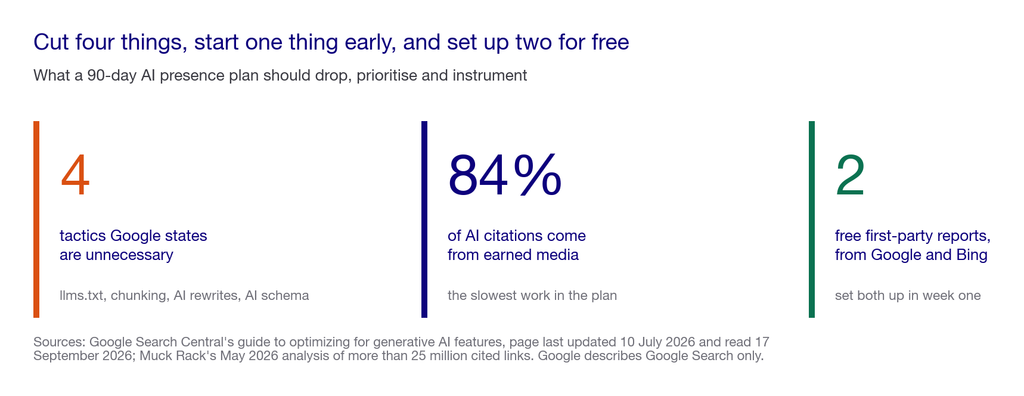
Four things Google states you do not need:
- llms.txt files. “Google Search itself doesn’t use them,” and “Doing so will neither harm nor help your site’s visibility.”
- Chunking your content into small blocks. “There’s no requirement to break your content into tiny pieces.”
- Rewriting in a special style for AI. “You don’t need to write in a specific way just for generative AI search.”
- Special structured data for AI. “Structured data isn’t required for generative AI search, and there’s no special schema.org markup you need.”
Google also states the underlying position: “the best practices for SEO continue to be relevant because our generative AI features on Google Search are rooted in our core Search ranking and quality systems.”
A disagreement with our own published work, which we would rather flag than bury. Our own AI search framework, published 15 June 2026, lists llms.txt under retrievability. Google’s guidance, updated a month later, says Search does not use those files. We are not withdrawing the framework, whose three stages we still stand behind and build this plan on. On that single item the newer primary source wins, and we have flagged the page for revision.
Where this falls short: Google describes Google. ChatGPT, Claude and Perplexity publish nothing equivalent, so “Google does not use llms.txt” is not “no engine uses llms.txt”. What it does mean is that the largest AI surface has told you it is not a factor there. That is enough to move it off a ninety-day critical path.
If you want to see what engines say about your brand before you plan anything, book a growth audit and we will show you today’s answers.
How we built this plan
Five criteria, fixed before the calendar was drawn.
| Criterion | Weight | What it means |
|---|---|---|
| Lead time to result | 30 | How long between doing the work and observing any effect. The longest lead times go first, whatever else competes |
| Everything downstream depends on it | 25 | Prerequisites come first, because doing them late invalidates the work that assumed them |
| Free or near-free | 20 | Zero-cost work is scheduled early, because it needs no approval and de-risks the spend that follows |
| Supported by a primary source | 15 | The activity is something an engine operator or a large published study says matters, not something the category repeats |
| Produces a baseline you can be judged against | 10 | It creates a measurement you can point at in ninety days, rather than a deliverable nobody can score |
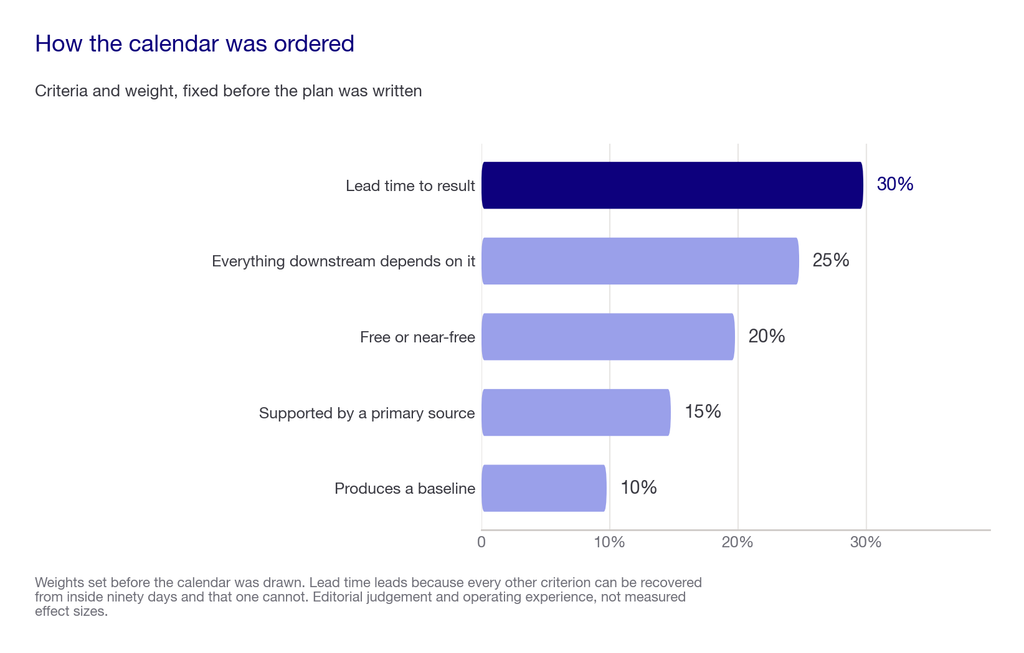
Why lead time leads. Every other criterion can be recovered from. If you skip a free task in week one you can do it in week three. If you skip a quarter-long task in week one, ninety days is not long enough to recover, and the plan ends with nothing to show.
Where this falls short: these weights are our editorial judgement, not measured effect sizes. Lead times vary enormously by category. A brand with existing press relationships will see earned media land faster than one starting cold. Treat the sequence as the argument and the dates as an illustration.
Lead time against impact
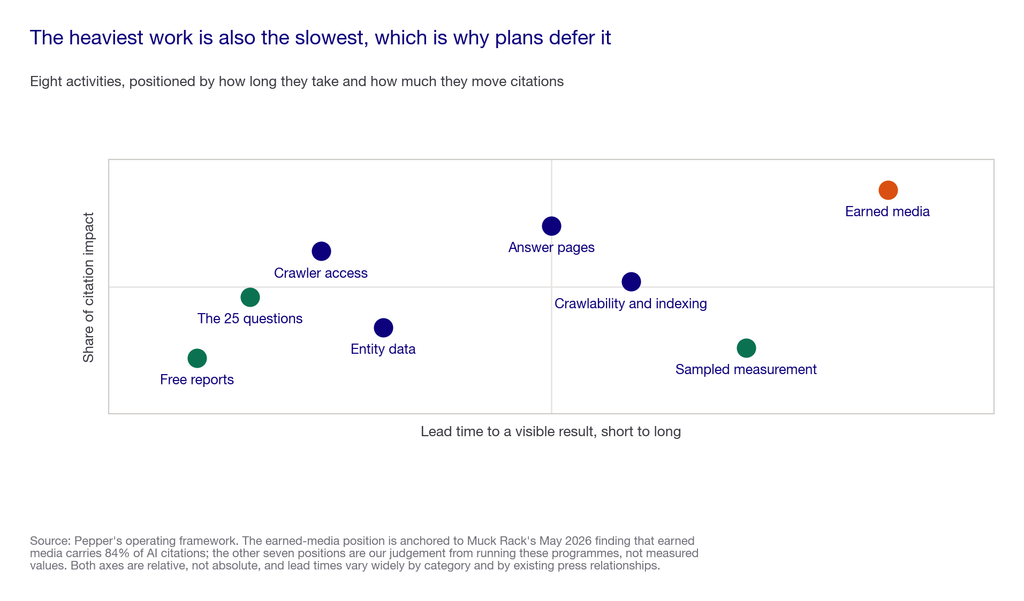
The top right of that chart is the whole argument. Earned media is both the slowest and the heaviest. That combination is exactly what gets it scheduled last by plans built around effort. The bottom left, the free instruments, costs nothing and takes an afternoon. Plenty of programmes still run a full quarter without it.
The 90-day plan
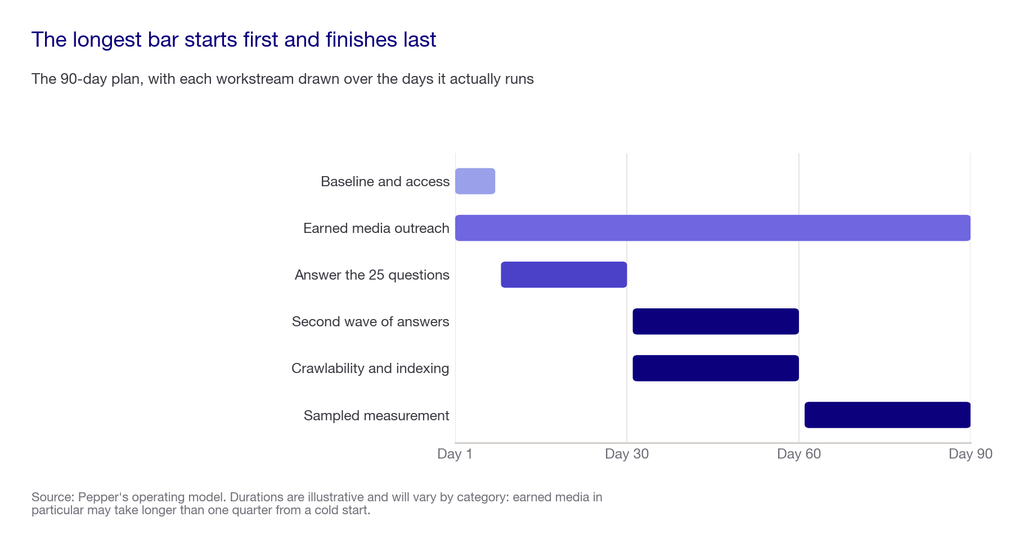
Days 1 to 7: baseline, access, and the slow thing
Everything in this week is either free or a prerequisite, and one item is neither but must start anyway.
- Set up both free performance reports. Google names its own Search Console generative AI performance report in its guidance. Bing’s has been in public preview since 10 February 2026. Between them you get first-party citation data at no cost, dated from before you changed anything.
- Write the 25 questions. The things your buyers actually ask, taken from your contact centre and sales calls rather than a keyword tool. Everything later is measured against this list, which makes it the most consequential artefact of the quarter.
- Check crawler access. Confirm in your own server logs which AI crawlers reach you and which are blocked. This is a day of work and it invalidates everything downstream if it is wrong.
- Publish your regulated identifiers and entity data. Registered name, registration numbers, the authoritative third-party profiles that describe you. These are the facts an engine can verify independently.
- Start earned media on day one. Brief the two or three publications your buyers actually read. This will not report until month three, which is precisely why it cannot start in month three.
Days 8 to 30: answer the 25 questions properly
- Write one self-contained answer per question. A sentence or short paragraph answering correctly and completely, on the page where it belongs. Engines extract answers. If your only complete answer is spread across four paragraphs, the engine composes its own.
- Put the qualifying condition inside the claim sentence, not in a block below it. A paraphrase keeps the sentence and drops the footer.
- Do not rewrite everything in an AI style. Google is explicit that you do not need to, and a site-wide rewrite is the most expensive way to comply with advice nobody gave.
- Add expert attribution. Named authors with real credentials, because citability depends on the source looking like one.
- Measure nothing yet. Thirty days is too early, and reading noise as signal at this stage is how good programmes get cancelled.
Days 31 to 60: fix the technical work that actually exists
- Crawlability and site structure. Google names “clear technical website structure and crawlability” among the things that do help. This is ordinary technical SEO and it is the part of retrievability that survives scrutiny.
- Indexing and eligibility. If a page is not indexed it cannot be retrieved, which is unglamorous and is where a surprising share of problems live.
- Standard structured data, for the reasons it always existed. Not a special AI schema, which Google says does not exist. Just the ordinary markup that helps any system parse a page.
- Second wave of answers, covering the questions the first pass revealed you had no good page for.
- First read of the baseline. Not a verdict. Just check the instruments are collecting and the prompt list still reflects what buyers ask.
Days 61 to 90: measure, decide, and be willing to stop
- Run the 25 questions across engines properly. Multiple samples, because engines vary between runs and one sample is not a measurement.
- Record four things per question: whether you were mentioned, whether a page of yours was cited, which page, and what the competing citations were. Our definition of citation rate covers the unit itself.
- Compare against the week-one baseline, which is why week one mattered.
- Write down what you cannot attribute. Zero-click mentions, brand exposure inside answers, and anything earned media influenced indirectly. Naming these as unmeasured is more honest than assigning them zero.
- Apply the stop test. If ninety days produced no movement in mentions or citations on your own 25 questions, the right decision may be to stop. A plan without a stop condition is not a plan.
The plan at a glance
| Phase | What you do | Lead time | Cost | Where it falls short |
|---|---|---|---|---|
| Day 1 | Two free AI performance reports | Immediate | Free | Each is first-party to one engine, so coverage is partial |
| Day 1 | Write the 25 buyer questions | Immediate | Free | Only as good as the sales input behind it |
| Week 1 | Crawler access check in server logs | Days | Free, an engineer’s day | Tells you about access, not influence |
| Week 1 | Entity data and identifiers | Days | Low | Fixes identity, does nothing for claim accuracy |
| Day 1 to 90 | Earned media outreach | A quarter or more | A retainer or a hire, the biggest line | The least controllable item, and 84% of the citation surface |
| Days 8 to 30 | One reviewed answer per question | Weeks | Writing and review time | Needs the real questions, not keyword proxies |
| Days 31 to 60 | Crawlability, indexing, standard schema | Weeks | Engineering time | Ordinary SEO, which is the point |
| Days 61 to 90 | Sampled measurement and the stop test | Immediate once running | Free, or software from $29 a month | Single samples mislead, so sample repeatedly |
| Cut entirely | llms.txt, chunking, AI-style rewrites, special AI schema | Not applicable | Saves weeks | Google describes Google; other engines publish nothing |
| Pepper, own row | Agents, platform and a growth team | Varies | Not published | We publish no pricing, so budget is a conversation |
What the ninety days costs
- Days 1 to 30 can cost nothing but time. Both reports are free, the question list is free, the log check is an engineer’s day, and the entity work is small. If a provider wants a fee for this phase, ask what they add.
- Measurement software is optional and cheap when you want it. Mainstream AI visibility tiers run from $29 to about $500 a month. The meters move, though: we re-checked four platforms this month and three had changed inside nine days.
- Earned media is the real budget line, it is the largest, and no platform tier includes it. It needs a retainer or a hire.
- Engineering time is the hidden cost. The days 31 to 60 work is ordinary technical SEO, which means it competes with everything else in your release process.
- Our GEO price benchmarks cover the published figures in detail.
How Pepper runs this
Pepper is an agentic organic growth engine and an organic growth partner, and the honest summary is that most of the first month above does not need us.
- Agent Atlas puts the repeatable parts in your team’s hands. Agents are workflows. System agents stay fixed, user agents stay editable and versioned, and customers log in and build and run their own inside Atlas. In a ninety-day plan the throughput constraint is usually the second wave of answers. That is what agents change.
- Pepper’s GEO platform is the measurement layer for days 61 to 90. Brand Visibility for how often engines mention you, Domain Prompt Presence for how often they cite a page from your domain, and Share of Voice for your slice of the category. The gap between the first two is the citability diagnostic. See the platform.
- A growth team works alongside yours on the earned-media layer, which is the slow, heavy work this plan starts on day one and the part no software does.
- Proof rather than adjectives. Acceldata went from 85 to more than 300 top-three keywords with 6X organic traffic growth, and one hero guide carried over 260,000 impressions. That is an organic outcome on one account rather than a ninety-day AI presence benchmark. More in our case studies.
Where Pepper falls short. Ninety days is short for the work that matters most here. We can compress the content and measurement phases considerably. We cannot compress earned media much at all, and any agency promising a transformed citation profile in a quarter is selling the one thing nobody controls. We also publish no pricing, so the budget conversation happens on a call rather than on a page.
How to choose what to do first
I would not start from this calendar. I would find out which of the three stages you actually fail first. A plan that fixes the wrong stage produces nothing, whatever its sequence.
Here is the 100-point scorecard I would run over any ninety-day AI presence plan, ours included.
| Area | Weight | What a strong plan demonstrates |
|---|---|---|
| Slowest work starts first | 30 | Earned media and anything with a quarter-long lead time begins in week one, not in phase three |
| Baseline captured before changes | 25 | Both free reports are running and dated before anything is edited, so the result is interpretable |
| Retired tactics are absent | 20 | No llms.txt, no chunking mandate, no AI-specific rewrite, no special AI schema, because the primary source says they do nothing |
| Measured on your own question list | 15 | Success is defined against 25 buyer questions you wrote, not against a vendor’s index or a generic visibility score |
| A stop condition exists | 10 | The plan states what result would justify stopping, which is the difference between a plan and a budget |
Then run the live test, on us as readily as on anyone else.Give any provider your 25 questions and ask what they would do in 90 days, week by week, with a cost against each phase. For example: “what happens in week one”, “when does earned media start”, “what will you have measured by day ninety”, “what would make you tell us to stop”.
Ask each one to come back with five things. Where you appear today. Which pages get cited. What starts in week one. What is deliberately excluded and why. What the ninety-day report will and will not be able to show.
Five questions worth asking, and what a good answer sounds like.
- “When does earned media start?” The only good answer is week one. Anything later cannot land inside the quarter.
- “What are you not doing, and why?” A provider who names llms.txt and special AI schema as deliberate exclusions has read the primary source.
- “What is the baseline, and when is it captured?” If it is captured after the work begins, the result is uninterpretable.
- “Which 25 questions are we being measured on?” If the provider chooses them, the metric is theirs to move.
- “What would make you recommend stopping?” A plan without a stop condition is a subscription.
Red flags, each one seen in a real ninety-day plan.
- An llms.txt file in week one, which Google states it does not use.
- Earned media in phase three, which guarantees no citation result inside the quarter.
- A site-wide rewrite for AI, when Google says you do not need to write in a special way at all.
- No baseline, so the end-of-quarter report has nothing to compare against.
- Success measured on the vendor’s own visibility score rather than on your question list.
- Weekly reporting on citation counts from day one, which reports noise as progress.
- A guarantee of citations or rankings. Google’s own wording: “Be wary of third-party tools that promise ranking success or claim to use ‘internal’ Google metrics. No third-party tool has access to our internal ranking or AI systems.”
The weaker way to run this, and it is the common one. Start with the technical checklist because it feels concrete. Publish content in month two. Add PR in month three if budget allows. Then report at day ninety on crawl fixes and page counts, because the citation numbers have not moved. The thing that moves them started three weeks ago.
The stronger sequence inverts it. Capture the baseline and start the slow work in week one. Do the content in month one and two. Do the genuine technical work in month two. Measure in month three against a baseline that exists, on questions you chose.
If I reduce this to one principle: start the slowest thing first. In a fixed ninety days, sequence beats effort, and nothing you do in month three can compensate for what you did not start in week one.
The honest closing note, and it costs us something. If your category is barely being answered by engines yet, do not run this plan. Spend an afternoon on the two free reports and the 25 questions, see what comes back, and if the answers are empty then re-check next quarter. You do not need a programme and you do not need us.
What nobody should promise you
Nobody should promise a transformed citation profile in ninety days. The activity carrying most citations takes about a quarter to land on its own. A single quarter is therefore the minimum honest horizon, not the delivery window.
Nobody should sell you an llms.txt implementation as an AI visibility service. Google’s own words are that it does not use them and that adding one “will neither harm nor help your site’s visibility.”
Nobody should promise rankings or citations for a fee, and Google says so directly: no third-party tool has access to its internal ranking or AI systems.
Where this stops working, including for us
If engines are not answering questions in your category yet, this plan is premature. The two free reports and an afternoon will tell you, and the right spend may be zero this quarter.
If your constraint is that nothing ships, sequencing will not save you. A ninety-day plan assumes you can publish and deploy inside ninety days. In plenty of organisations that assumption is the actual problem.
Where Pepper falls short: the highest-impact item in this plan is the one nobody can accelerate, ours included. We can make the other four phases much faster and we cannot make a publication cite you sooner than it will.
Where to go next
Do the week-one list this week. Two free reports, 25 questions, a log check. It costs an afternoon and it determines whether the rest of the quarter is worth planning.
Then read the framework this plan schedules: our three-stage AI search model explains what each stage is for. For the adjacent decisions, what GEO actually costs covers the published prices, and agency or tool covers whether to buy help at all. If the vocabulary is new, start with our glossary of core AEO terms. To see where you stand first, see where you show up.
Frequently asked questions
How do you improve a brand’s AI presence?
Sequence by lead time. Start earned media and your measurement baseline in week one. Publish self-contained answers to 25 real buyer questions in month one, do ordinary technical SEO in month two, and measure in month three against that baseline.
Can you improve AI presence in 90 days?
Partly. Content, technical and measurement work all fit comfortably. Earned media carries most of the citations and takes about a quarter on its own. Ninety days is therefore the minimum honest horizon rather than the delivery window.
Do I need an llms.txt file?
Not for Google. Its guidance states “Google Search itself doesn’t use them” and that adding one “will neither harm nor help your site’s visibility.” Other engines publish nothing equivalent, so treat it as optional rather than as a priority.
Should I rewrite my content for AI?
Google says no: “You don’t need to write in a specific way just for generative AI search.” What helps is a complete, self-contained answer to the question on the page where it belongs, which is ordinary good writing.
What should I measure in the first 90 days?
Whether you are mentioned, whether a page of yours is cited, which page, and what the competing citations are, across your own 25 questions. Capture it in week one before changing anything. Sample repeatedly, because engines vary between runs.
Is there a free way to track AI presence?
Two. Google names its own Search Console generative AI performance report, and Bing’s AI Performance report has been in public preview since February 2026. Both are first-party and both are free.
What is the most important thing in an AI presence plan?
Starting earned media in week one. It is both the slowest item and the heaviest, carrying 84% of citations on the largest published analysis. Every other element can be recovered if it slips by a few weeks, and that one cannot be recovered at all inside a quarter.
How much does a 90-day AI presence programme cost?
The first month can cost nothing but time. Measurement software is $29 to about $500 a month if you want it. Earned media is the real budget line and no software tier includes it.
Sources and further reading
- Google Search Central, guide to optimizing for generative AI features, page last updated 10 July 2026 and read at source 17 September 2026. Source of all four “not necessary” quotations, of the statement that SEO best practices remain relevant because generative features are rooted in core ranking systems, of the warning about third-party tools promising ranking success, and of the reference to Search Console’s generative AI performance report. Limitation carried throughout: Google describes Google Search only.
- Microsoft, AI Performance in Bing Webmaster Tools, public preview announced 10 February 2026. The second free first-party instrument in the week-one list.
- Muck Rack, “Earned media still drives 84% of AI citations”, What is AI reading? May 2026 edition, published 7 May 2026. Sample: more than 25 million cited links across ChatGPT, Claude and Gemini in 17 industries. Source of the earned-media share that sets this plan’s sequence. Not specific to any one industry or to B2B.
- Pepper, the AI search framework: visibility, citability, retrievability, published 15 June 2026. The framework this plan schedules. Noted disagreement: that page lists llms.txt under retrievability, and Google’s guidance updated 10 July 2026 states Search does not use those files. On that single item the newer primary source wins, and the page is flagged for revision.
- Pepper, our census of published GEO prices, for the cost figures in the budget section. Our companion piece on AEO pricing models, which found three of four platform pricing pages changed inside nine days this month, is not yet published and is therefore named here rather than linked.
- Pepper, Acceldata case study. Source of the 85 to 300+ top-three keywords and 6X organic growth figures. One account, an organic outcome, and not a ninety-day AI presence benchmark.
What is not here, and why. No promised citation uplift, because the activity carrying most citations has a lead time longer than the plan. No llms.txt, chunking, AI-rewrite or special-schema step, because the primary source says they are unnecessary and including them would cost the reader weeks. No measured effect sizes for the sequence, because we have none and found none published: the lead times are our operating experience and the ordering is an argument, not a study. No claim that Google’s position covers other engines, which publish nothing comparable. Where this plan contradicts a Pepper page, the contradiction is stated rather than resolved silently.
Latest Blogs
Most 90-day AI plans are sequenced by how hard the work feels rather than by how long it takes to land. So they spend week one on an llms.txt file that Google states it does not use, and they schedule earned media for phase three, which guarantees no result inside the quarter. This plan inverts that. It orders the work by lead time, starts the slowest thing on day one, and cuts four tactics Google explicitly says are unnecessary.
We priced this category nine days ago. Today we went back to the same four pricing pages to check the numbers before publishing. Three of the four had changed, and two had stopped publishing prices altogether. That is the real answer to what AEO costs in 2026: not a number, but a meter that moves, measured in prompts and responses and engines that are billed separately. Here is how each pricing model works, what unit it charges you for, and which incentive that unit creates.
Ask what AI search traffic is worth and you will be handed a multiplier. The ones in circulation right now run from 13% worse than organic search to 23 times better, a spread of roughly twenty-six fold on the single input your whole business case depends on. They disagree because they are measuring the same behaviour under different attribution models. So this is not a guide to finding the right multiplier. It is a guide to building a model whose assumptions are visible, and to being honest about the half you cannot prove.
Get your hands on the latest news!

Similar Posts
Artificial Intelligence
16 mins read
What does AEO cost in 2026? Pricing models explained
Artificial Intelligence
17 mins read
GEO ROI: how to model and prove return on AI search investment
Artificial Intelligence
15 mins read