Should you trust a single AI visibility score?
The short answer
Use an AI visibility score to notice something, never to decide something.
The problem is not that composite scores are dishonest. It is that they average away the one distinction that tells you what to do next. Two brands can hold the same score while having opposite problems, and the score cannot tell them apart.
- Being mentioned and being cited are different failures. An engine can describe your product accurately while linking a competitor’s comparison page. Brand Visibility rises, Domain Prompt Presence does not, and a blended score drifts gently upward while the actual problem goes unnamed.
- Engines disagree with each other. A number averaged across five engines hides which one you are losing.
- Most scores do not publish their components or their denominator. If a vendor will not say how many times a prompt was sampled, the percentage underneath the score cannot be audited.
So the useful question is not “is this score good or bad.” It is “what is this score made of, and what does it move on.” Below are the four questions we would ask any vendor, and the small number of jobs a composite genuinely does well.
Pepper sits in this market, so treat this as an interested view. We are an agentic organic growth engine, not an SEO agency. This page comes out of what we run: organic for more than 250 enterprises across eight years, more than 10 million tracked prompts, and the questions buyers put to us in client reviews. Customers log in and run the platform themselves, with a Pepper growth team attached to the account. We do not sell a one-shot AI visibility score, and we say why below. Book a growth audit and you will get the components instead.
Key takeaways
Key takeaways from the measurement questions buyers put to us most often.
- A composite hides the diagnostic. Mentions up and citations flat is a different problem from both being flat, and a blended number moves similarly in both cases.
- Two brands, same score, opposite problems. That is the whole argument against deciding on one.
- Ask for the denominator. A percentage built on three observations per prompt and one built on ninety look identical on a dashboard.
- Engine-level detail is where the action is. You fix a Perplexity problem differently from an AI Overviews problem.
- Scores are good at one thing: noticing a change worth investigating. That is a real job and worth having.
- Google warns against guarantees for the same underlying reason: nobody outside the system can see what drives the output.
What is an AI visibility score, and what goes into one?
An AI visibility score is a single figure, usually out of 100, that a platform calculates by blending several underlying measurements of how often and how favourably AI engines refer to your brand.
The inputs vary by vendor and are frequently unpublished. Where they are published, a score typically blends some combination of these.
- Mention rate, how often engines name your brand at all across a tracked prompt set. Pepper calls this Brand Visibility.
- Citation rate, how often an engine links a page from your own domain. Pepper calls this Domain Prompt Presence.
- Share of voice, your slice of all brand mentions in the category.
- Sentiment or favourability, how positively you are described.
- Position or prominence, whether you appear first in an answer or in a trailing list.
Each of those is a legitimate measurement. The question is what happens when you add them together. We set all fourteen measurements out, and how we weight them, in AI search visibility metrics and KPIs.
The two brands problem
This is the clearest way to see what a composite costs you.
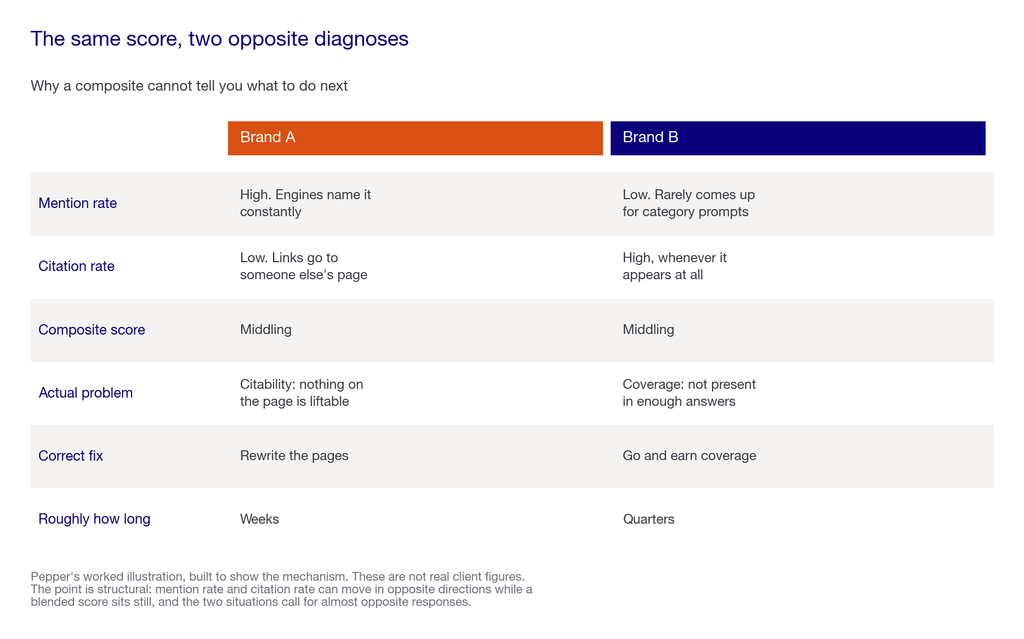
Brand A is mentioned constantly and cited never. Engines know the company, describe it accurately, and link somewhere else when a reader asks for detail. The problem is citability: the pages exist but nothing on them is liftable, or a third party explains the product better than the company does. The fix is structural and editorial, and it is comparatively fast.
Brand B is cited whenever it appears, but it rarely appears. When an engine reaches for a source, it reaches for Brand B’s documentation. It just does not come up for most category prompts. The problem is coverage and authority. The fix is slower and mostly happens off your own site, and it is the slower half of the GEO ROI model.
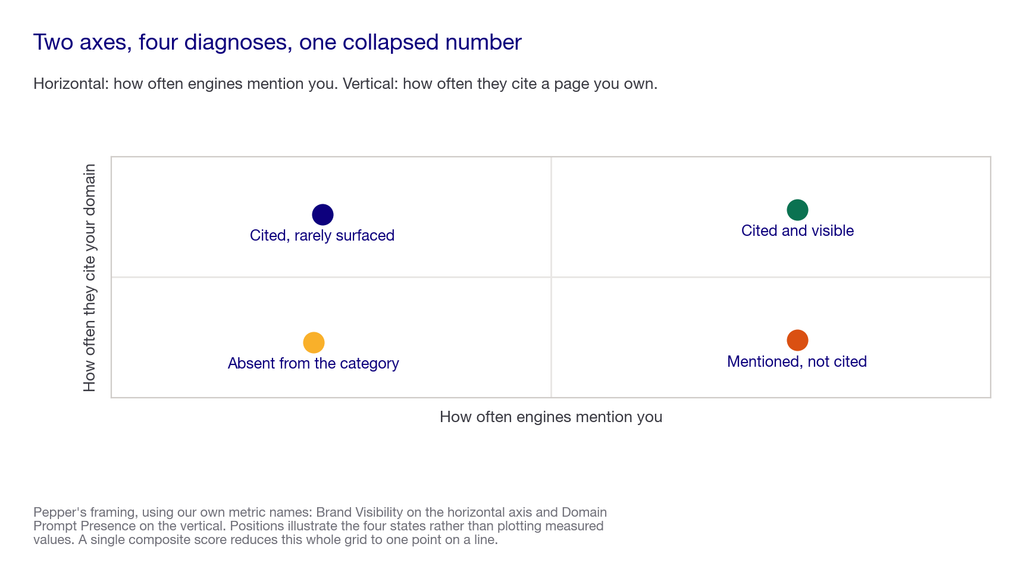
Both can hold the same composite score. Both will see that score move by a similar amount if it drifts. And the correct response to each is almost opposite: Brand A should rewrite, Brand B should go and earn coverage. The gap between mention rate and citation rate is the whole diagnosis, and averaging them destroys it. Our framework for acting on that gap is Visibility, Citability and Retrievability.
Composite versus components at a glance
Neither is useless. They answer different questions, and the mistake is using one for the other’s job.
| A single composite score | The component metrics | |
|---|---|---|
| Best question it answers | Has anything changed? | What changed, and what do I do? |
| Who it suits | A board slide, a weekly glance | Whoever has to act this month |
| Diagnostic value | Low. Opposite problems look alike | High. Mention and citation split cleanly |
| Engine-level detail | Usually averaged away | Preserved, which is where the fix lives |
| Sensitivity to sampling | Hidden. You cannot see the denominator | Visible, if the vendor publishes it |
| Comparability across vendors | Poor. Every vendor weights differently | Reasonable, if definitions are stated |
| What it costs you | Nothing extra: every platform ships one | Nothing extra either, but it costs reading time and a person who knows the difference |
| Where it falls short | Cannot tell you what to do next | Takes longer to read, and needs someone who understands the difference |
How to evaluate an AI visibility score before you trust it
Most of the risk in a composite disappears if a vendor answers four questions. But before you ask them, decide what you actually need the number for, because that changes which answers matter.
Step one: decide what the score is for
There are only two honest jobs. Noticing, where one number triggers a weekly look. And reporting upward, where a board wants direction rather than diagnosis. If you are trying to use it for a third job, deciding what to fix, stop now and read the components instead.
Step two: score the vendor on a 100-point scale
| Criterion | Weight | What earns full marks |
|---|---|---|
| Components and weights published | 30 | Both stated, and stable across releases |
| Sampling depth published | 25 | A stated number of runs per prompt |
| Engine-level breakout | 20 | Every engine visible separately, not averaged |
| Raw answers and cited URLs | 15 | Exportable, not screenshots |
| Weighting stability | 10 | They will tell you when it changes |
Total 100. The first two carry more than half, because a score whose recipe and denominator are both secret cannot be checked against anything, including its own value last quarter.
Step three: ask the four questions, in this order
- “What are the components, and how are they weighted?” If the weighting is proprietary, the number is not comparable with anything, including its own value last quarter if the weighting changed.
- “How many times was each prompt sampled to produce this?” This is the denominator. A percentage built on three runs per prompt and one built on ninety look the same on screen and mean very different things.
- “Can I see the score broken out by engine?” An average across five engines hides the one you are losing, and the fixes differ by engine. We go through the engine-by-engine differences in how to optimize for ChatGPT and Perplexity.
- “Can I get the raw answers and cited URLs behind it?” Without these you cannot tell whether a citation was your page or a third party’s, which is the distinction that decides your next move.
- “What happens to my historical scores if you change the weighting?” Most vendors will change it eventually. The good answer is that history is recalculated or clearly annotated. The bad answer is silence, which means your trend line quietly stops meaning one thing and starts meaning another.
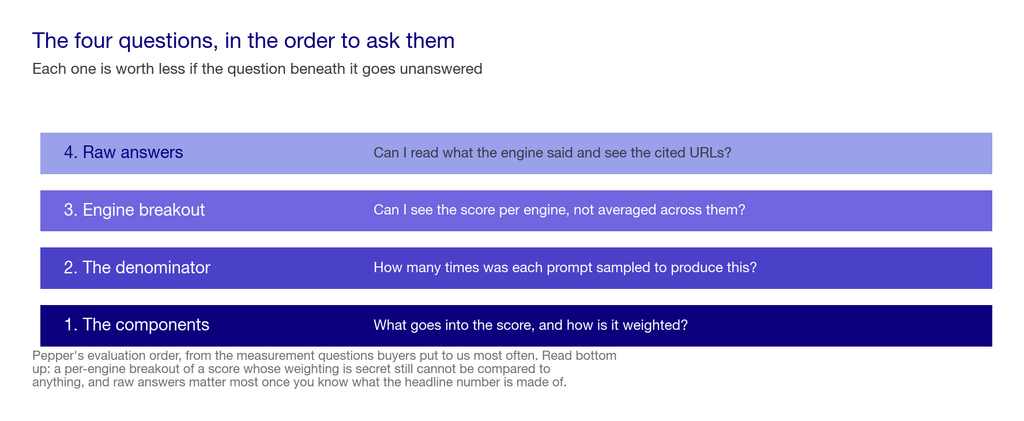
A vendor that answers all four has earned the benefit of the doubt. One that answers none is asking you to trust an output with no visible inputs, which is the definition of a number you cannot act on.
Step four: run a 90-day reality check
Before you build reporting on any score, test it against your own eyes. Take your 25 most valuable prompts and run them yourself in ChatGPT and Perplexity, monthly, across 90 days. Record whether you were mentioned, and whether the citation was your page.
Ninety days matters here rather than two weeks, because you are testing whether the score tracks reality over a period long enough for real movement. Then compare your log to what the platform reported over the same window. A stronger tool matches your manual reading closely and explains the gaps. A weaker one reports a confident percentage you cannot reproduce. If you cannot reconcile the two, the problem is usually sampling depth rather than dishonesty, and the fix is asking for the denominator.
Step five: watch for these red flags
- A proprietary weighting that the vendor will not describe even in outline.
- No published sampling figure, or a vendor that withdrew one it used to publish.
- A score presented without engine breakout, which hides the engine you are losing.
- A target score written into a contract. If the weighting changes, the target changes meaning.
- A score that only ever goes up. Real measurement is noisy, and a perfectly smooth line usually means heavy smoothing.
Step six: decide whether you need the score at all
And here is the answer that loses us the sale. If you are tracking fewer than about twenty prompts and one person reads the output, you do not need a composite and you may not need a platform. Read the two component numbers directly, watch the gap between them, and spend the difference on the pages and coverage the engines are already reaching for.
It comes down to one principle: buy the number you can act on, not the number that fits on a slide. If you need both, take the components and compute your own headline figure, because at least then you know the recipe.
Why sampling depth decides whether any score is readable
This is the part that gets skipped, and it matters more than the weighting.
The same prompt does not return the same answer every time. Run “best project management software for small teams” five times and you will get overlapping but different brand sets. That variance is the noise floor, and your score sits on top of it.
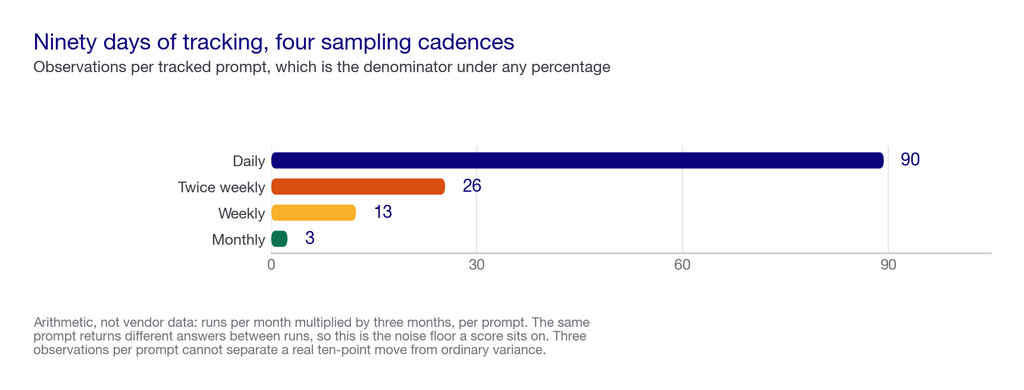
- On a monthly cadence, a quarter of work gives you three observations per prompt. A score built on that will move visibly on noise alone.
- On a daily cadence, the same quarter gives you about ninety. Now a ten-point move is more likely to be real than random.
- The headline prompt count does not tell you this. Fifty prompts sampled daily produce far more evidence than 350 sampled monthly.
- Very few vendors publish the figure at all, and at least one that used to publish it has since withdrawn the disclosure.
We work through which platforms publish what, and the arithmetic behind it, in top AI visibility platforms.
When a single score is actually the right tool
We are not arguing that composites should not exist. They do a small number of jobs better than a table of components does.
- Noticing. A weekly glance at one number is a reasonable trigger to go and look at five. Nobody reads fourteen metrics every Monday, and our guide to reading an SEO report makes the same point about traditional dashboards.
- Trend shape over long periods. Across two or three quarters, a composite smooths the engine-level noise and shows direction.
- Communicating upward. A board does not want the components. Give them the score, and keep the diagnosis for the people doing the work. Which side of that line each team sits on is covered in the AI search team ownership model.
- Comparing yourself against yourself. Within one vendor and one unchanged weighting, the number is internally consistent even if it is not comparable to anyone else’s. What the agents behind that tracking actually do sits in Agent Atlas.
The rule we would apply. A score can start a conversation. It should never end one, and it should never appear in a contract as the measure of success. If a proposal sets a target score as the deliverable, ask what happens if the weighting changes mid-contract, because that is a real question with an uncomfortable answer.
What nobody should promise you
- A single number that tells you what to do. Two brands with opposite problems can hold the same score, and no amount of weighting fixes that.
- A score you can compare across vendors. Every vendor weights differently and most do not publish the weights.
- A guaranteed score improvement. Google’s own guidance warns against providers who guarantee rankings, because outsiders cannot see what drives the output. The same logic applies to any composite built on those outputs.
- A percentage without a denominator. If nobody will tell you how many times a prompt was sampled, the percentage is a number rather than a measurement.
- That we sell you one. We do not offer a one-shot AI visibility score, and we would rather explain why than ship a number we could not defend.
Frequently asked questions
Should I trust a single AI visibility score?
Use it to notice a change, not to decide on one. A composite averages away the difference between being mentioned and being cited, which is the distinction that tells you whether to rewrite your pages or go and earn coverage.
What is a good AI visibility score?
There is no answer that holds across vendors, because each one weights its components differently and most do not publish the weights. A score is only meaningful against your own history, with the weighting unchanged.
What the number is made of
What goes into an AI visibility score?
Typically some blend of mention rate, citation rate, share of voice, sentiment and answer position. The exact components and their weights vary by vendor and are often unpublished, which is the first thing to ask about.
Why do two platforms give me different scores?
Because they measure different prompt sets, sample at different depths, cover different engines and weight the components differently. Two scores disagreeing is expected, and it is not evidence that either is wrong.
What is the denominator, and why does it matter?
It is how many times each prompt was run to produce the percentage. Three observations per prompt and ninety look identical on a dashboard, but only one of them can distinguish a real change from ordinary answer-to-answer variance.
Using it well
What should I report to my board instead?
Report the score for direction, then two components underneath it: how often engines mention you, and how often they cite a page from your domain. The gap between those two is the finding worth a slide.
Can a score be used as a contract target?
We would not agree to one. If the vendor changes the weighting, the target changes meaning mid-contract. Set targets on named components with stated definitions instead.
Does Pepper publish a single visibility score?
No. We report Brand Visibility, Domain Prompt Presence and Share of Voice separately, because the gap between the first two is the diagnosis. We would rather hand you three numbers you can act on than one you cannot.
Sources
Google documentation was read directly on 22 September 2026. Where a claim rests on our own judgement or our own product, we say so rather than dressing it as research.
Google documentation
- Google Search Central, Do you need an SEO?, checked 22 September 2026. States “No one can guarantee a #1 ranking on Google. Beware of SEOs that claim to guarantee rankings, allege a ‘special relationship’ with Google, or advertise a ‘priority submit’ to Google.”
- Google Search Central, AI features and your website, 15 May 2026. Places AEO and GEO inside SEO, and advises against providers guaranteeing rankings.
Our own published work
- Pepper, our fourteen AI search measurements. Sets out fourteen measurements and our weighting, and states the position this page expands on: composite scores hide the diagnostic.
- Pepper, Top AI visibility platforms. Records which platforms publish sampling depth and which do not, including one vendor that withdrew its published response volumes during 2026.
On what this page is
This is an argument, not a study. We have not run a controlled experiment comparing composite scores against component metrics, and we are not aware of one. The two-brands illustration is a worked example built to show the mechanism, not a case study with real client numbers behind it. We also sell in this category and do not offer a composite score, so read the argument with that interest in view and check it against your own data.
Latest Blogs
Most advice on this is inference dressed as fact. OpenAI documents exactly one thing clearly, which is access. Here is what is documented, what is inferred, and how to verify the rest for yourself.
Being named in an AI answer and having your page used as its source are different outcomes with different causes and different fixes. The gap between them is the most useful diagnostic in AI search, and most reporting collapses it into one number.
Every platform reports share of voice and almost none of them define it the same way. Here is the definition worth using, the three choices that change the number, and how to measure it yourself without buying anything.
Get your hands on the latest news!
