The short answer
Brand visibility in AI is the share of a defined prompt set where an AI engine names your brand at all.
That is the whole definition, and every word of it is load-bearing.
- A defined prompt set. Not “AI search” in general. A specific, written-down list of questions you chose. Change the list and the number changes.
- An AI engine names your brand. Your brand appears by name, anywhere in the answer. It needs no link, no recommendation and no positive description.
- Share, not count. State it against the prompts you ran, so it survives a change in how many you track.
It deliberately leaves out whether the engine linked to you. That is a separate measurement, and keeping the two apart is the entire reason the definition is worth learning.
The one number that matters more than either. The gap between how often you are named and how often a page of yours is cited. A brand that engines name constantly but never cite has a different problem, and a different fix, from one they cite reliably but rarely surface at all.
We run this work daily. Pepper is an agentic organic growth engine, not an SEO agency. This page comes out of what we run: organic for more than 250 enterprises across eight years, more than 10 million tracked prompts, and the questions buyers put to us in client reviews. Customers log in and run the platform themselves, with a Pepper growth team attached. Book a growth audit and we will measure both numbers for your category.
Key takeaways
Key takeaways from the measurement questions buyers put to us most often.
- It is a mention rate, not a reputation score. An answer that describes you badly still counts as visibility.
- It is not citation. Citation is whether a page from your domain was linked. The two move independently.
- The gap between them is the diagnosis. High mentions with low citations means engines describe you using somebody else’s pages.
- It depends entirely on your prompt set. The number is meaningful against your own history with the set unchanged, and against very little else.
- Sampling depth decides whether a change is real. The same prompt returns different answers between runs.
- Measure per engine. A blended figure hides the engine you are losing, which is the one you can act on.
What is brand visibility in AI, and what is it not?
Four adjacent things get called brand visibility, and conflating them is why so many reports are unreadable.
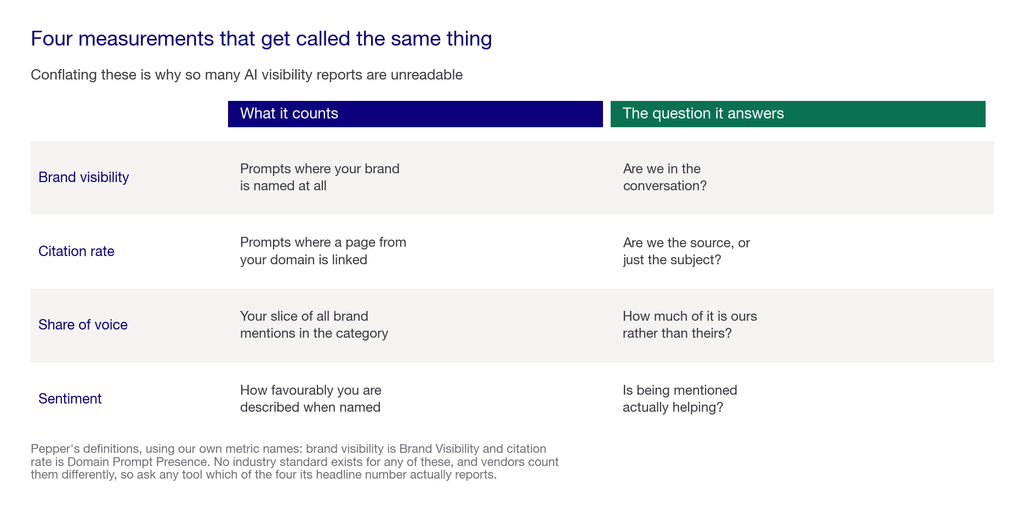
Brand visibility, or mention rate. How often engines name you across your prompt set. Pepper calls this Brand Visibility. It answers: are we in the conversation at all?
Citation rate, or domain presence. How often an engine links a page from your own domain. Pepper calls this Domain Prompt Presence. It answers: are we the source, or just the subject?
Share of voice. Your slice of all brand mentions in the category. It answers: how much of the conversation is ours rather than a competitor’s?
Sentiment. How favourably you are described when named. It answers: is being mentioned actually helping?
Where it falls short as a single metric. On its own, brand visibility tells you almost nothing actionable. It rises when a competitor’s comparison page starts naming you. It rises when a review site writes about your category. Neither of those is something you did, and neither tells you what to do next. It is a starting number, not a finishing one.
Why mention and citation come apart
This is the mechanism underneath the whole field, and it is worth understanding rather than memorising.
An AI engine composes an answer from sources it retrieved. It can learn that your product exists from a review site, a comparison article or a community thread, describe it accurately, and cite that third-party source rather than you. You are visible. You are not cited.
That is not a malfunction. Independent academic work across 11,000 real queries found Wikipedia and longer third-party sources cited far more often than their share of the web would suggest. Engines reaching for third-party sources is normal behaviour, not a failure of your site.
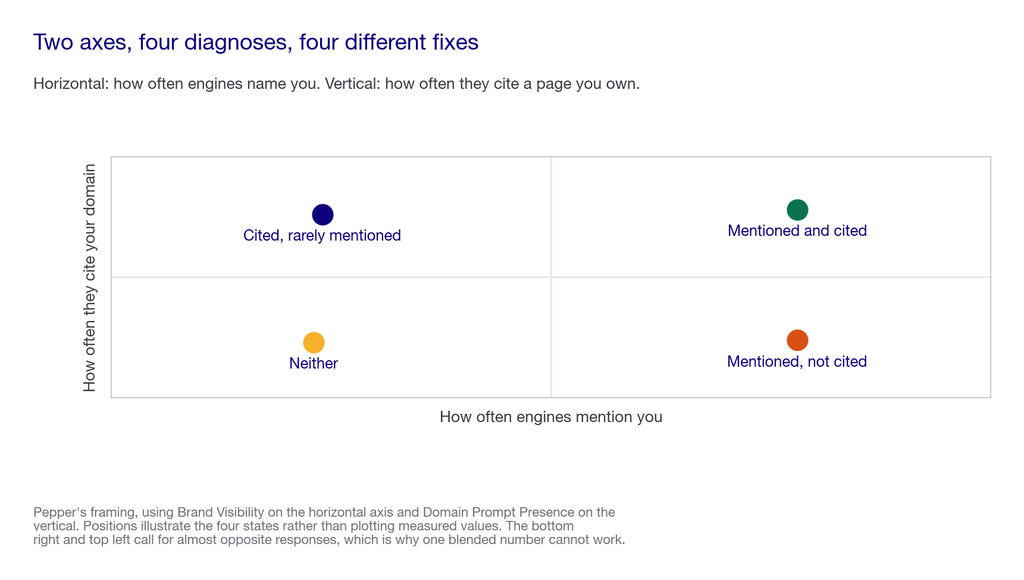
The four states, and what each one means.
- Mentioned and cited. The healthy state. Engines know you and reach for your pages.
- Mentioned, not cited. Engines know you and reach for somebody else’s pages. A citability problem: your pages exist but nothing on them is liftable, or a third party explains you better than you do. The fix is structural and comparatively fast.
- Cited, rarely mentioned. When you do appear, your pages are the source, but you do not come up often. A coverage problem. The fix is slower and mostly happens off your own site.
- Neither. You are not in the category conversation. Start with whether engines can fetch your pages at all.
How brand visibility in AI is measured
There is no industry-standard method, so the honest version is to state yours. Here is the one we use and would recommend.
- Define the prompt set. Forty to eighty category questions, written the way a buyer who does not know you would ask them. Freeze it and date it.
- Choose the engines. Measure each separately. Pepper tracks ChatGPT, Perplexity, Gemini, Claude and Google AI Overviews.
- Run each prompt repeatedly. This is the sampling depth, and it decides whether a change you see is real.
- Count a mention. Your brand appears anywhere in the answer text, whatever the link or tone.
- Express as a share. Prompts where you were named, over prompts run, per engine.
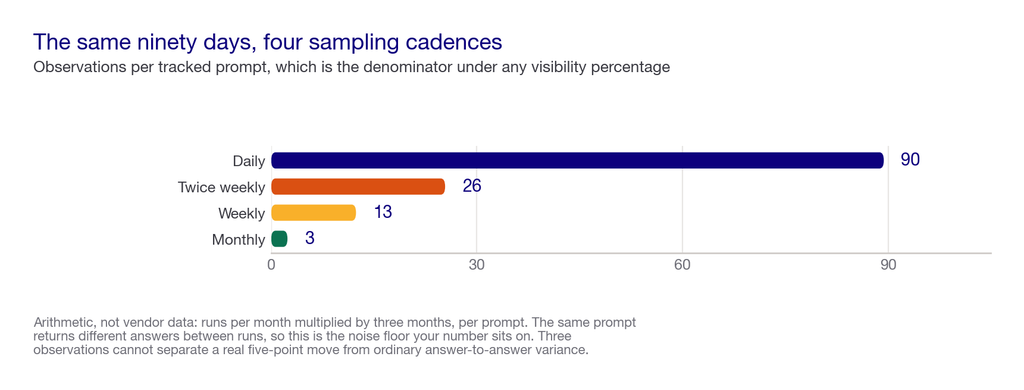
The denominator is the part nobody asks about. The same prompt does not return the same answer every time. On a monthly cadence, a quarter of tracking gives you three observations per prompt, and a five-point move on three observations is noise. On a daily cadence the same quarter gives you about ninety. We go through which platforms publish this figure in top AI visibility platforms, and the methods for tracking it in how to track brand mentions in AI search.
What a good brand visibility number looks like
There is no benchmark, and anyone offering one across industries is describing their own prompt set rather than yours.
What is meaningful is comparison in three specific directions.
- Against your own history, with the prompt set and definition unchanged. This is the only clean comparison available.
- Against named competitors on the same prompt set, run at the same time on the same engines. Relative position is more robust than absolute share.
- Against your citation rate, which is the gap that tells you what to do.
Where it falls short. None of those comparisons tells you about pipeline. A competitor can be named more often than you and sell less. Treat brand visibility as a diagnostic of presence, not as a proxy for commercial performance, and pair it with the GEO ROI model when you need the money question answered.
How to improve it, in dependency order
Three stages, and they have to happen in this order because each one gates the next.
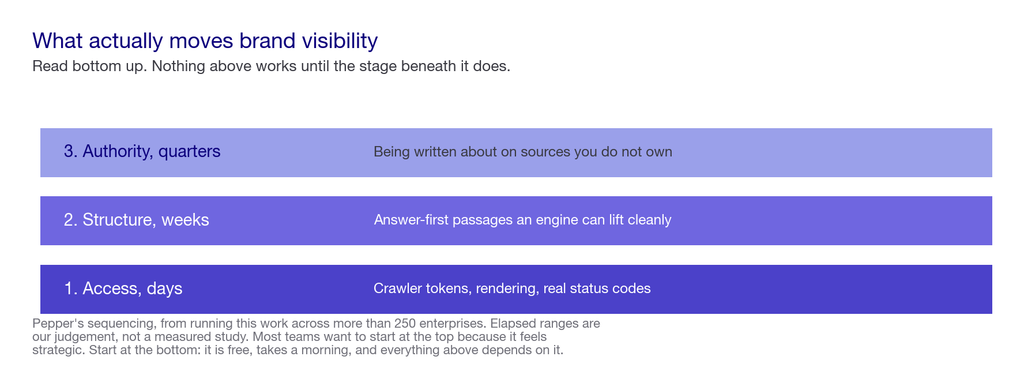
- Access. An engine has to be able to fetch your pages. Crawler tokens, rendering and real status codes. Days of work, and nothing else counts until it is done.
- Structure. Answer-first paragraphs under question-shaped headings, in self-contained blocks an engine can lift. Weeks of editorial work, and the fastest visible change.
- Authority. Being written about on sources you do not own. Quarters, and where most citations actually come from.
The full practice set sits in our GEO best practices playbook, and the eleven tactics we would run first are in how to improve brand visibility in AI search engines.
One honest note on sequencing. Most teams want to start at authority because it feels strategic. Start at access because it is free, takes a morning, and a page an engine cannot fetch scores zero on everything above it.
What nobody should promise you
- A brand visibility benchmark for your industry. Every figure depends on a chosen prompt set, so an industry average describes nobody in particular.
- A guaranteed increase. Nobody controls what a model outputs, and Google’s own guidance warns against providers who guarantee rankings for the same underlying reason.
- A single score combining visibility and citation. Blending them destroys the gap that tells you what to fix.
- That visibility equals revenue. It measures presence in answers. Model the commercial link separately, and honestly.
- A number without a denominator. If nobody will say how many times each prompt was sampled, you have a figure rather than a measurement.
Frequently asked questions
What is brand visibility in AI?
The share of a defined prompt set where an AI engine names your brand at all. It does not require a link or a positive description, and it is measured per engine against a prompt set you wrote down in advance.
Is brand visibility the same as being cited?
No, and keeping them separate is the point. Visibility is whether you were named. Citation asks whether an engine linked a page from your domain. An engine can describe you accurately and still cite a competitor’s page.
Measuring it
How is brand visibility in AI calculated?
Prompts where your brand was named, divided by prompts run, per engine. The inputs that decide whether the answer means anything are the prompt set you chose and how many times each prompt was sampled.
What is a good brand visibility score?
There is no cross-industry answer, because the figure depends entirely on your prompt set. It is meaningful against your own history with that set unchanged, against competitors measured on the same set, and against your own citation rate.
Why does my number move when nothing changed?
Because the same prompt returns different answers between runs. That variance is the noise floor. On a monthly sampling cadence a quarter gives you three observations per prompt, which cannot distinguish a real move from ordinary drift.
Improving it
What is the fastest way to improve brand visibility in AI?
Check access first. Confirm the right crawlers can fetch and render your pages, because a page an engine cannot read scores zero on everything else. It takes a morning and it is the only free step.
Why is my competitor mentioned more than me?
Usually because third-party sources that describe them are being retrieved and ones describing you are not. In most categories the majority of citations go to review sites, trade publications and community threads rather than to brand sites.
Should I track visibility or citation rate?
Both, separately, plus the gap between them. Visibility alone rises for reasons you did not cause, and citation alone hides whether you are in the conversation. The gap is the number that tells you what to do next.
Sources
Google documentation and academic sources were read directly. Where a definition is ours, we say so rather than presenting it as a standard.
Independent research
- Huang, Goyal, Saha and Chandrasekharan, Answer Bubbles: Information Exposure in AI-Mediated Search, arXiv, 17 March 2026. 11,000 real search queries across five systems. Finds Wikipedia and longer third-party sources cited far more often than their share of the web would suggest. Academic and independent.
- Zhang Kai, He Xinyue and Yao Jingang, From Citation Selection to Citation Absorption, arXiv, 28 April 2026. 602 set prompts, 21,143 search-layer citations across ChatGPT, Google AI Overview and Perplexity. Finds absorbed pages are longer, more structured and richer in extractable evidence.
Google documentation
- Google Search Central, AI features and your website, 15 May 2026. Places AEO and GEO inside SEO, and advises against providers guaranteeing rankings.
- Google Search Central, Do you need an SEO?, checked 24 September 2026. States “No one can guarantee a #1 ranking on Google.”
Our own definitions
- Pepper, AI search visibility metrics and KPIs. The fourteen measurements this page draws from, with our weighting.
- Pepper, Visibility, Citability and Retrievability. The framework for acting on the gap between mention and citation.
On what this page is
Brand Visibility and Domain Prompt Presence are our product’s metric names, and the definition above is ours rather than an industry standard. No such standard exists: vendors count mentions, first mentions and weighted position differently, and most do not publish their method. We have stated ours so you can disagree with it or hold another vendor to the same clarity.
Latest Blogs
Yes, and it will not show up in your pipeline report. Those two statements are not in tension, they are the same fact stated twice. A survey of more than 1,000 B2B software buyers found 82% had sourced software recommendations from an AI chatbot in the last two years, and about half said AI mattered most when they were narrowing and comparing options. That is precisely the stage that produces no click. Meanwhile the conversion multiples circulating for AI traffic run from 22% better than organic to five times better, and the only peer-reviewed study says worse. Here is how to tell which is true for you.
Agent Atlas is the chat-first layer of Pepper’s platform: you ask in plain language, it reasons across your connected sources, and it runs the work. Here is exactly what it does, and what V1 does not.
The short answer The fork is who the buyer is, and it changes everything about what you should be buying. Both are legitimate, and the wording problem underneath them is one we traced in AEO, GEO, AIO and LLMO explained. They are not swaps, and a list that ranks them together is comparing an Indian […]
Get your hands on the latest news!