How to improve brand visibility in AI search engines: 11 strategies
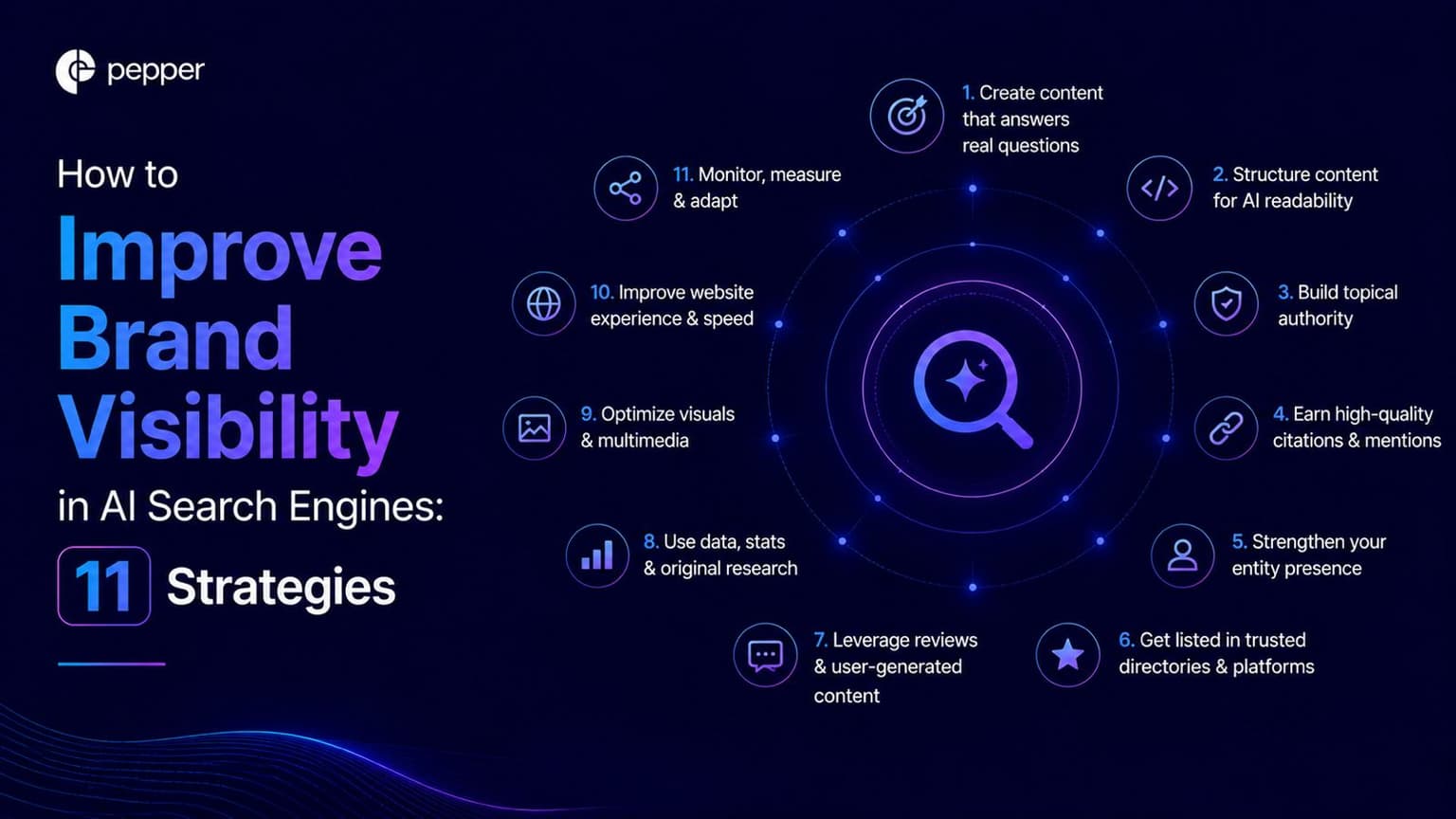
Most lists like this one are sorted by what sounds impressive. This one is sorted by what to do first, which is a different order and a more useful one.
The reason ordering matters so much here is that these strategies are not independent. Three of them unblock the rest. Tackle the other eight first and you will spend a quarter moving nothing. So work down the list rather than picking the tactics you like.
We have run organic for more than 250 enterprises across eight years and track over 10 million prompts across every major engine. Where the evidence for a strategy is strong, we cite it. Where it is thin, we say so plainly rather than dressing it up.
First, the three that unblock everything else
1. Fix retrievability before anything else
If an engine cannot fetch and parse your pages, nothing further on this list matters to you.
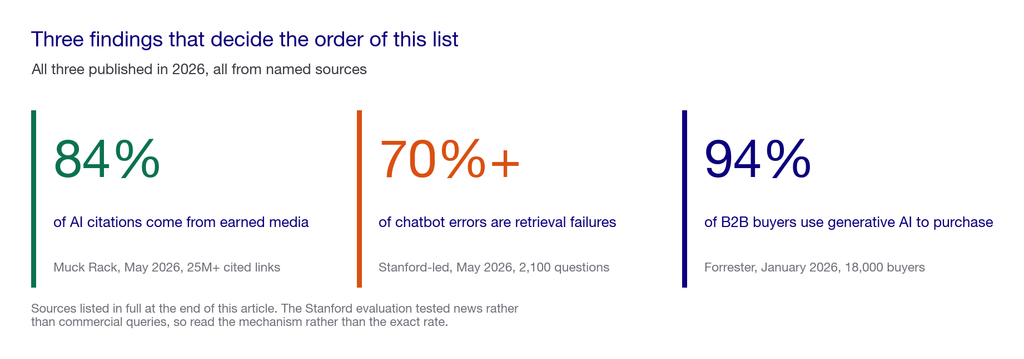
The evidence here is unusually direct. A Stanford-led evaluation of six commercial chatbots, covering 2,100 factual questions in May 2026, found that retrieval failures rather than reasoning errors caused more than 70% of all mistakes. When the models retrieved the right source, they usually produced the right answer. The models are reasonably good at reasoning. They are much worse at finding.
Practically that means server-side rendering anything you want cited, because client-side rendering remains inconsistently handled across engines. It also means checking your crawler access rather than assuming it.
2. Audit your AI crawler access specifically
This is the most common self-inflicted wound we find, and it usually takes a one-line fix.
OpenAI runs OAI-SearchBot, ChatGPT-User and GPTBot as three distinct agents with three different jobs. Perplexity runs PerplexityBot and Perplexity-User for scheduled indexing and live fetching respectively. Blocking each one fails differently, and blocking the wrong one can drop you from an index entirely.
A robots.txt decision somebody made two years ago, then left the company, is a genuinely common cause of invisibility. Check it before you commission anything else. Our guide to robots.txt for AI crawlers covers the specific agents.
3. Make your entity unambiguous
Engines need to resolve what your company actually is before they can recommend you for anything.
If your site describes you one way, your review profiles another, and your press coverage a third, the model has to choose. It often picks a competitor who is clearer. Describe your category identically across your website, your social profiles, your listings and your press. This costs almost nothing, and teams routinely skip it.
Then, the four that earn citations
4. Invest in earned media, not more publishing
This is the strategy most likely to be underfunded and most likely to matter.
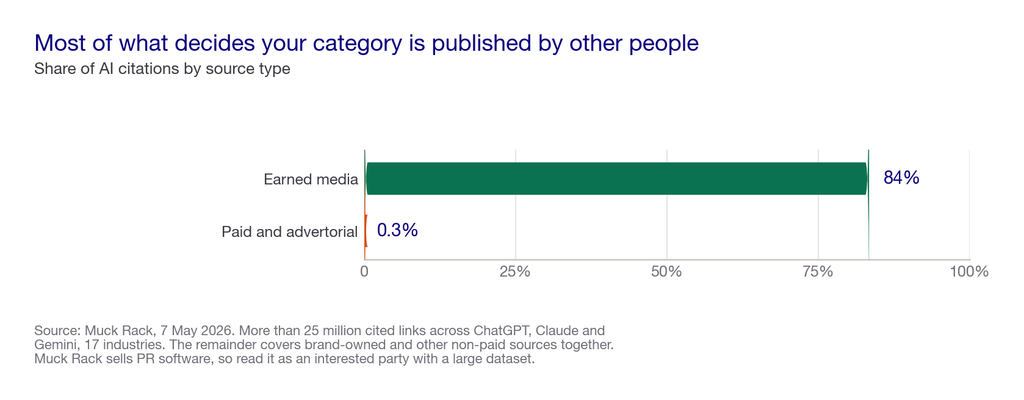
Muck Rack analysed more than 25 million cited links across ChatGPT, Claude and Gemini in May 2026, spanning 17 industries. Earned media accounted for 84% of AI citations. Paid and advertorial content accounted for 0.3%. That pattern has held between 82% and 89% across three editions since July 2025.
Read that against how your budget is actually split. If most of what decides your category’s answers is published by other people, and most of your spend goes to your own blog, the shape is wrong regardless of content quality.
5. Find and work your Citation Core
Your Citation Core is the ten to twenty sources that decide your category. Most brands cannot name a single one.
You find them by reading the actual citations in your own tracked answers, rather than guessing. Then you work on how those sources describe you, which usually means outreach and relationships rather than publishing. It is unglamorous and it is the highest-leverage item on this list.
6. Get into comparison and alternatives content
Buyers in a shortlist phase search comparatively, and engines answer those queries by drawing on comparison sites, roundups and alternatives pages.
If your category has a “best X” ecosystem and you are absent from it, you are absent from a large share of commercial answers. Getting in takes outreach, plus having something specific enough to warrant a mention.
7. Show up where the conversation happens
Community platforms carry weight in AI answers because they contain real language about real problems. Reddit, industry forums, Q&A sites, expert communities.
The honest caveat is that this works only when participation is genuine. Readers spot astroturfing, it damages the brand, and Google’s own guidance mythbusts inauthentic mentions as a tactic.
Then, the four that shape how you are described
8. Write so a claim can be lifted cleanly
Structure matters more here than style, and the mechanics are specific.
Keep a claim and its supporting evidence in the same block. A statistic three paragraphs from its source is much harder to extract. Answer each heading in the first two or three sentences beneath it, since models tend to extract from the top of a section. Write headings that stand alone as questions or statements rather than as clever labels. Our guide to structuring content for AI citation covers this in detail.
9. Publish things that cannot be reconstructed elsewhere
Original research, proprietary benchmarks, genuinely specific case data. If the same information exists on forty other sites, an engine has no reason to reach for yours.
This runs slower than commodity content, and it compounds, because a cited statistic keeps earning citations.
10. Keep your factual footprint current
Engines will happily describe you using two-year-old information.
Pricing changes, repositioning and product renames all take time to propagate. Stale third-party profiles are often the culprit. Audit what engines actually say about you quarterly, and after every launch or pricing change. This is the strategy with the shortest half-life on the list.
11. Measure per engine, and separate mention from citation
Measurement changes behaviour, because without it you cannot tell which of the previous ten strategies to prioritise.
Track Brand Visibility, meaning how often engines name your brand, and Domain Prompt Presence, meaning how often they cite a page from your domain, separately. The gap between them is the most useful diagnostic available. Healthy mentions with flat citations means the engine knows you but trusts somebody else’s page. That sends you back to strategies four through seven, not to more publishing.
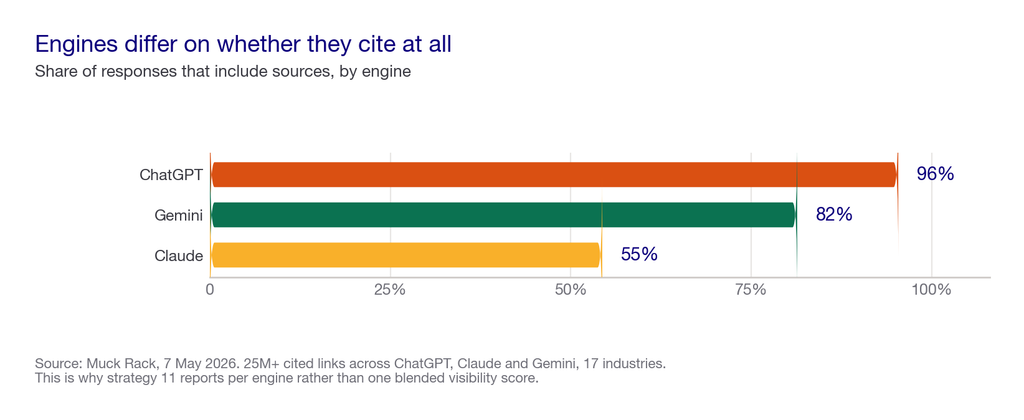
Report per engine rather than blended. Muck Rack’s data shows citation rates ranging from 96% for ChatGPT to 55% for Claude, so an average describes none of them.
Where the evidence is thin, and we should say so
Four things commonly appear on lists like this one that we would not spend much on.
llms.txt. Google’s official AI search guidance, published 15 May 2026, explicitly mythbusts llms.txt, alongside content chunking, AI-specific rewrites and structured-data over-optimisation. It costs almost nothing, so implement it if you like, but do not treat it as foundational.
Rewriting existing good content into AI-optimised formats. Also on Google’s mythbusted list. Improving genuinely weak pages pays off. Reformatting pages that already work is expensive theatre.
Schema everywhere. Structured data helps machines resolve what things are. However, Google specifically calls out over-optimising it as unhelpful. We have watched teams spend a quarter on schema while a rendering problem sat untouched.
Chasing sentiment scores. Sentiment classifiers read B2B language bluntly, scoring measured description as neutral. Neutral and accurate is usually the right outcome, not a problem to fix.
How to sequence this over 90 days
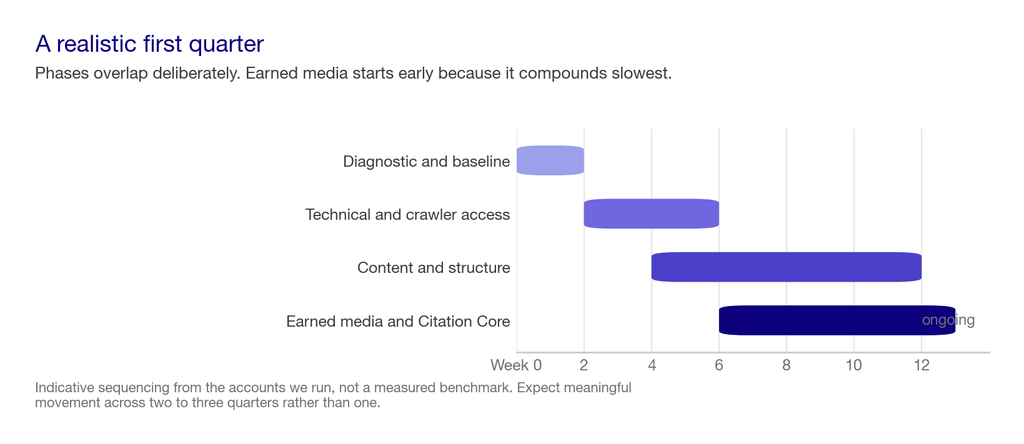
Weeks one and two are diagnostic. Run 20 to 30 real commercial prompts across the engines your buyers use, record where you appear and which sources are winning, and audit crawler access and rendering. You are building a baseline and finding the blockers.
Weeks two to six are technical. Fix rendering, crawler access and entity consistency. These land fastest and unblock everything after them.
Weeks four to twelve are content and structure. Improve the pages that matter rather than all of them, and build the original assets that earn citations later.
Weeks six onward are earned media, and this continues indefinitely. Start it early precisely because it compounds slowest. Waiting until the technical work finishes costs you a quarter.
Expect meaningful movement in two to three quarters rather than one. Anyone promising faster on earned authority is describing paid media.
Want the diagnostic run for you before you start? Book a growth audit and we will show you which sources are deciding your category’s answers today.
What nobody should promise you
A guaranteed citation or position in an AI answer. Nobody controls the ranking systems, and Google advises against providers who claim otherwise.
A single visibility score worth reporting. Composite numbers hide the gap between being mentioned and being cited, which is the one finding you could act on.
A benchmark for what good looks like. There is no universal good number. What matters is your trend and your distance from the category leader.
Fast results from earned media. It depends on other people publishing, which nobody controls.
Frequently asked questions
How do I improve brand visibility in AI search engines?
Start with retrievability, crawler access and entity clarity, since those block everything else. Then invest in earned media, which accounts for 84% of AI citations. Structure content so claims can be extracted cleanly, and measure mentions and citations separately.
Why is my brand mentioned but never cited in AI answers?
That gap means engines know who you are but trust somebody else’s pages as sources. It is a citability problem rather than an awareness one, so the fix is earned media and third-party sources rather than publishing more of your own content.
How long does it take to improve AI search visibility?
Technical fixes can show within weeks. Content structure work takes a quarter or so. Earned authority takes two to three quarters because it depends on other publishers, and no agency controls that timeline.
Does llms.txt improve brand visibility?
Google’s May 2026 guidance explicitly mythbusts llms.txt, along with content chunking and AI-specific rewrites. It costs little to implement, so it is not worth arguing about, but treat it as unproven rather than a priority.
Which AI engines should I optimise for?
Whichever your buyers use, weighted by citation behaviour. ChatGPT includes sources in 96% of responses, Gemini in 82% and Claude in 55%, so tracking Claude tells you less about citation performance than the others do.
Do reviews affect AI search visibility?
They contribute, because review platforms are third-party sources engines draw on and they carry current, specific language about your product. Make sure review content is crawlable HTML rather than rendered only in JavaScript widgets.
Is Reddit worth investing in for AI visibility?
Community platforms carry real weight because they contain authentic language about real problems. However, this only works with genuine participation. Google’s guidance specifically mythbusts inauthentic mentions, and astroturfing damages the brand when discovered.
Should I create original research for AI visibility?
Yes, if you can sustain it. Information that exists on forty other sites gives an engine no reason to choose yours. Original data compounds, because a cited statistic keeps being cited long after publication.
Where to go next
Do the diagnostic before the tactics. Run 20 to 30 real commercial questions from your category, record where you appear, which competitors appear instead, and which sources are influencing those answers.
That exercise tells you which of the eleven strategies you actually need. Most teams skip it, pick the tactics that sound current, and discover a quarter later that they had a rendering problem.
For the underlying model, the Visibility, Citability and Retrievability framework covers which lever each strategy moves. For measurement, what actually matters in AI search measurement covers the metric set. And what GEO is covers the discipline itself.
To see where you stand, see where you show up across ChatGPT, Perplexity, Gemini, Claude and AI Overviews. Customers run this themselves in the platform, with a growth team attached to do the work alongside them. Our SalesHood case study documents what this looks like in practice, with AI Overview keywords rising from 14 to 97 across five months.
One honest exit. If your category produces very few meaningful monthly prompts, none of this is urgent yet. Spend the effort on earned media directly and revisit in two quarters.
Sources
Every study cited here was published in 2026.
- Suzgun et al., Evaluating Commercial AI Chatbots as News Intermediaries, arXiv, 21 May 2026. 2,100 factual questions across six chatbots, February 2026. Tested on news rather than commercial queries, so read the mechanism rather than the exact rates.
- Muck Rack, Earned media still drives 84% of AI citations, 7 May 2026. More than 25 million cited links across ChatGPT, Claude and Gemini, 17 industries. Muck Rack sells PR software, so read it as an interested party with a large dataset.
- Forrester, 2026 Buyers’ Journey Survey, January 2026. 18,000 global business buyers. Forrester sells research subscriptions.
- Google Search Central, AI features and your website, 15 May 2026, including the mythbusting of llms.txt, content chunking, AI-specific rewrites, inauthentic mentions and structured-data over-optimisation.
- OpenAI crawler documentation and Perplexity bot documentation.
Latest Blogs
Most advice on this is inference dressed as fact. OpenAI documents exactly one thing clearly, which is access. Here is what is documented, what is inferred, and how to verify the rest for yourself.
Being named in an AI answer and having your page used as its source are different outcomes with different causes and different fixes. The gap between them is the most useful diagnostic in AI search, and most reporting collapses it into one number.
Every platform reports share of voice and almost none of them define it the same way. Here is the definition worth using, the three choices that change the number, and how to measure it yourself without buying anything.
Get your hands on the latest news!