Earned authority: why third-party sources decide whether AI cites you

The short answer
Third-party sources decide most of it, and two findings about them point in opposite directions.
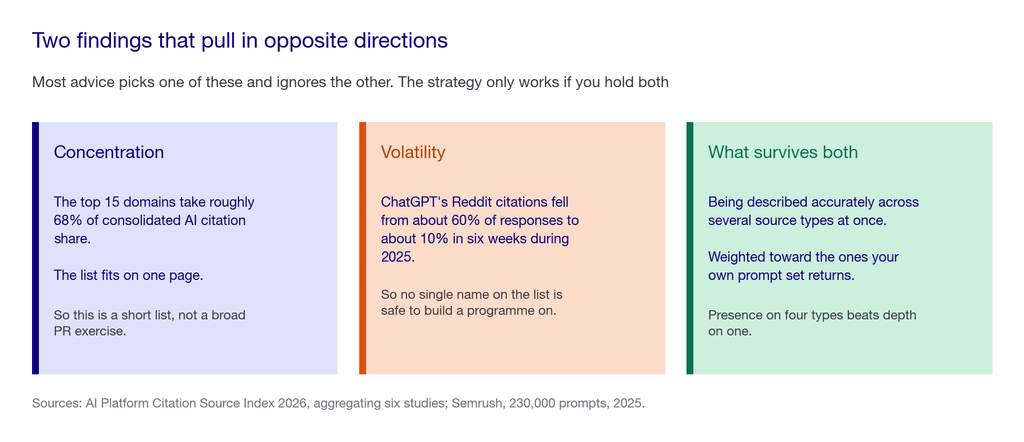
The first is concentration. An index aggregating six citation studies found the top 15 domains take roughly 68 percent of consolidated AI citation share. So earned authority is a short list rather than a broad PR exercise.
The second is volatility. That list reshuffles fast. ChatGPT’s Reddit citations fell from roughly 60 percent of responses to about 10 percent in six weeks during 2025, measured across 230,000 prompts.
Put those together and you get the strategy. Work the short list, and never bet the programme on one name in it.
Key takeaways
- Authority is earned off your domain now. The old model was links pointing at your site. The current one is other people describing you accurately.
- The list is short. Fifteen domains, roughly 68 percent of citations. You can write them down on one page.
- The list moves within months, not years. A 50-point swing in six weeks happened on the largest engine.
- Source type depends on query type. Journalism is about 27 percent of citations overall, and roughly 49 percent on time-sensitive queries.
- Engines disagree with each other. ChatGPT leans on Wikipedia and Forbes, Claude on the New York Times and the Atlantic, Gemini on YouTube and Google properties.
Where this comes from. We run organic for more than 250 enterprises at Pepper and track over 10 million prompts across every major engine. We watch this source mix shift on live accounts. That is why the volatility half of this article gets as much space as the concentration half.
What is earned authority?
Earned authority is the standing you hold on properties you do not own, built from what other people publish about you rather than what you publish about yourself.
Three things separate it from the authority SEO used to chase.
- It attaches to your name, not your domain. The old signal was links pointing at your site. The current one is descriptions of you sitting on other people’s sites, often with no link at all.
- You influence it, you do not control it. Every lever here runs through somebody else’s editorial decision. That is why it moves slowly and cannot be bought outright.
- It is spread, not stacked. One strong placement is worth less than accurate descriptions across several source types, for reasons the volatility data below makes obvious.
How important are third-party sources for AI visibility?
They are most of the game, and the evidence is unusually consistent on this point.
Muck Rack analysed more than 25 million cited links across ChatGPT, Claude and Gemini. 84 percent of AI citations came from earned media. Paid and advertorial content accounted for 0.3 percent. We set that against paid channels in organic versus paid in AI search.
A separate 2026 analysis of roughly 410,000 brand mentions across 240 brands found the same pattern from the brand side. Repeatedly visible brands drew 70 to 80 percent of their mention footprint from third parties. Rarely visible brands were owned-heavy, at 30 to 40 percent.
So two datasets, one measuring citations and one measuring mentions, agree. The material that gets you quoted mostly sits on domains you do not control.
That is a genuine change from how authority used to work. It once accrued to your domain through links. It now accrues to your name, spread across properties you influence but do not own. We covered the measurement side in brand visibility in AI search.
See where you show up. Pepper’s GEO platform tracks Brand Visibility, Domain Prompt Presence and Share of Voice across ChatGPT, Perplexity, Gemini, Claude and Google AI Overviews. Your team can log in, connect Search Console and GA4, manage the prompt set and run your own agents in the Agent Atlas. A growth team works the same account alongside you. Book a growth audit or see where you show up.
Two forces, pulling against each other
Most advice on this subject picks one of these and ignores the other. Both are true at once. The strategy only makes sense when you hold both.
Concentration tells you where to work. Volatility tells you not to over-commit to any one name on it. A programme built on a single platform sits one product decision away from zero.
What the volatility actually looked like
This is the part worth dwelling on, because it is the reason single-source strategies fail.
Semrush tracked 230,000 prompts across ChatGPT search, Google AI Mode and Perplexity over thirteen weeks, covering more than 100 million citations. Within that window, ChatGPT’s source mix changed sharply.
- Reddit went from appearing in roughly 60 percent of ChatGPT responses to about 10 percent.
- Wikipedia went from roughly 55 percent to under 20 percent.
Six weeks, and the two largest sources on the largest engine both collapsed. A team that had spent a quarter building a Reddit-first programme watched most of its value evaporate without warning.
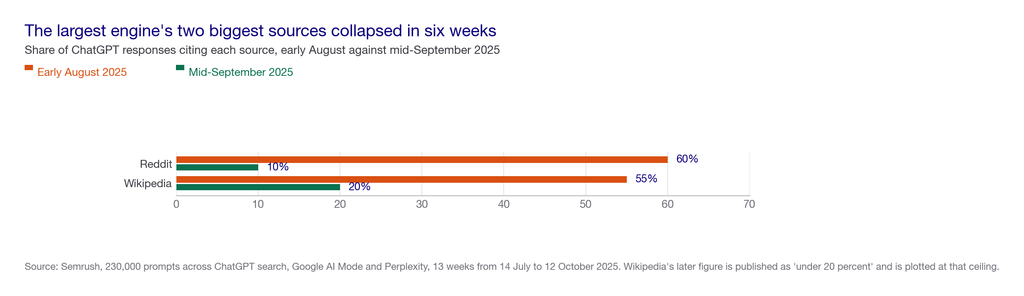
On the date of this data, stated plainly. That window ran from 14 July to 12 October 2025, outside the 2026-only rule we apply to research here. We are using it deliberately and narrowly. We do not claim Reddit sits at 10 percent today, or at 60 percent, because we do not know. We use it as dated evidence that the mix moves this fast. That is a structural fact about the category rather than a current reading. The index aggregating it agrees, noting that citation patterns are volatile within single months rather than years.
That reasoning matters more than the numbers. A current-state ranking of sources has a shelf life measured in weeks. A strategy built to survive reshuffling does not.
Which sources, and for which questions
The short list is real, and it is not evenly useful.
Across the aggregated studies, the most-cited properties are Reddit, Wikipedia, YouTube, LinkedIn and Forbes. User-generated platforms outrank most institutional journalism on raw volume.
But volume is not the whole picture, and this next split is the useful one.
- Journalism is about 27 percent of citations overall. On time-sensitive queries it rises to roughly 49 percent.
- User-generated content dominates evergreen and recommendation queries. Reddit, YouTube, LinkedIn and Quora do the heavy lifting there.
- Review platforms appear on recommendation queries specifically. G2 and Capterra in B2B, Yelp in local.
So the right source type depends on the question your buyer asks. A brand whose queries are mostly “best X for Y” needs review platforms and community presence. A brand whose queries are news-adjacent needs journalism.
Engines also disagree with each other, which is the second reason not to over-commit. ChatGPT leans toward Wikipedia and Forbes. Claude leans toward the New York Times and the Atlantic. Gemini leans toward YouTube and Google properties. One earned-media plan cannot be optimal for all three.
On these figures’ provenance. These come from an index aggregating six studies spanning August 2024 to April 2026: Profound, Semrush, Ahrefs, Search Engine Land, Muck Rack and Visual Capitalist. The underlying shares sit on different denominators. So we have used the ordering and the category splits rather than treating any single percentage as precise. The authors revise the rankings quarterly.
Where authority accrues, and how much of it you control
The uncomfortable part of earned authority is that the highest-value positions answer to you least.
The quadrant below is our read rather than a measurement. It is worth drawing anyway, because it explains why most programmes stall.
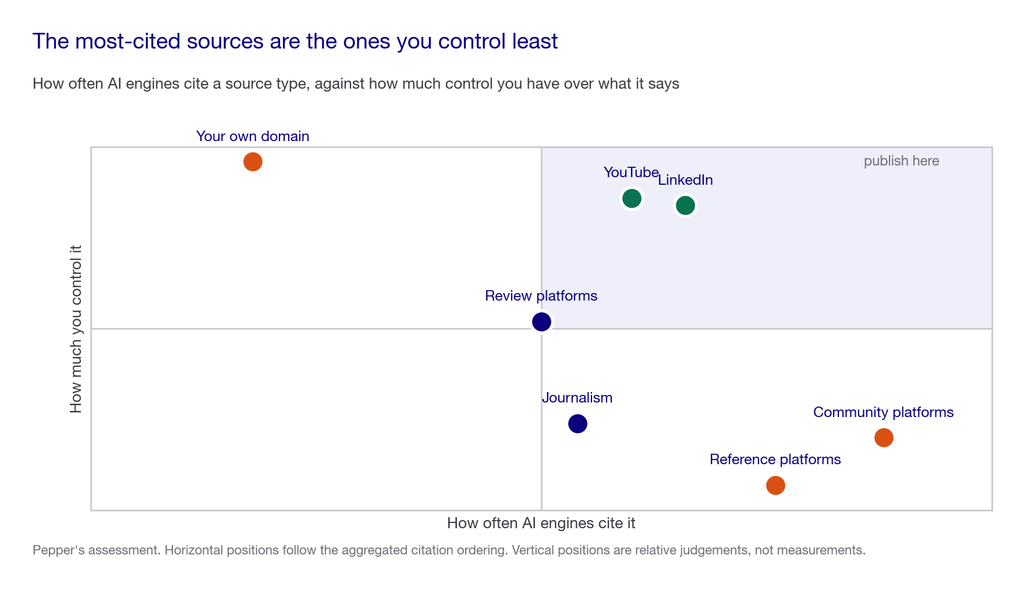
Read it as three zones rather than four.
- Top left is where teams default. Your own domain, total control, and the smallest share of the citation pool. Comfortable and fast, which is exactly why programmes stall here.
- Bottom right is where the citations are. Community and reference platforms earn the most and answer to you the least. You influence these by being worth citing, rather than by publishing harder.
- Top right is the underused zone. YouTube and LinkedIn get cited meaningfully and you publish on them directly. For most teams this is the largest unclaimed gap on the chart.
What actually earns it
Five things, and none of them is a press release blast.
- Be describable in one sentence. An engine that cannot place you in a category will not name you in it. This precedes everything and costs nothing. Use one buyer-language description on every property you control.
- Read the source lists on answers you are missing from. Run your prompt set and note which sources appear instead of you. Build the target list from that. It beats any media database, because it comes from what engines already trust in your category.
- Get onto the review platforms your category uses. G2 and Capterra for B2B software. They appear on exactly the recommendation queries buyers ask before building a shortlist.
- Be genuinely useful in communities, rather than promotional. This is slow and it cannot be outsourced convincingly. The Reddit collapse is a reminder not to make it your only channel. E-E-A-T for AI search covers how engines judge the difference.
- Give journalists something worth citing. Original data, a named expert, a dated observation. Journalism is 27 percent of citations overall and about half on time-sensitive queries. It is the one source type you influence with substance rather than presence, and what AI engines actually cite explains what makes material quotable.
The sequencing matters. Most programmes we inherit have published heavily on their own domain and done almost none of the second item.
What this looked like on a real account
A sales enablement account is our clearest published example of this working alongside on-site effort.
Seven workstreams ran together. A strategic audit mapped competitor performance. An SEO blog engine produced 20 new pieces and refreshed 8. GEO and AEO tracking ran in Atlas across ChatGPT, Gemini and Claude, alongside technical SEO on 10 issues, competitive intelligence, EEAT work and monthly reporting.
AI Overview visibility went from 14 keywords to 97. Blog impressions rose from 200,000 to 417,000, and clicks rose 20 percent against an industry-wide decline. Their CMO, Elay Cohen, could point to a direct connection between the investment and lead flow from LLMs that closed.
Where this evidence fits. One account, published on our own case study page, and not a controlled study. It shows the number moving under a combined programme. It does not isolate the earned-authority workstream from the other six. We would not claim otherwise.
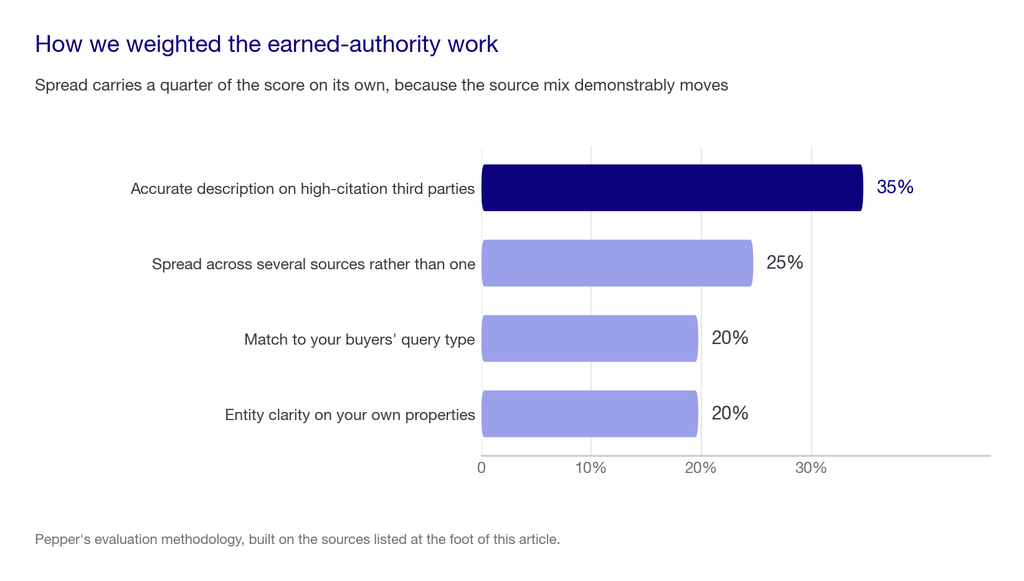
Our methodology: how we weighted the earned-authority work
| Lever | Weight | Why it carries this much |
|---|---|---|
| Accurate description on high-citation third parties | 35% | Where 84% of the citation signal originates, and the short list is genuinely short |
| Spread across several sources rather than one | 25% | A 50-point swing in six weeks is the argument, and it happened on the largest engine |
| Match to your buyers’ query type | 20% | Journalism runs at 27% overall and about 49% on time-sensitive queries |
| Entity clarity on your own properties | 20% | Free, fast, and everything above it degrades without it |
Source types at a glance
| Source type | Where it matters most | Roughly how much of the citation pool | How much you control it | Typical cost | Where it falls short |
|---|---|---|---|---|---|
| Community platforms | Evergreen and recommendation queries | Among the largest, led by Reddit | Very little | Time, and it resists outsourcing | Demonstrably volatile, as the 2025 swing showed |
| Reference platforms | Definitional and category queries | Large, led by Wikipedia | Very little, and rightly so | Indirect, via notability | You cannot edit your way in credibly |
| Video platforms | Perplexity and Google surfaces | Roughly 19% of AI Overview citations | High, you publish it | Production, the main line item | Concentrated on three engines, as the YouTube data shows |
| Professional networks | B2B queries | Top five across platforms | High | Consistent posting and profiles | Thin on transactional questions |
| Review platforms | Recommendation and shortlist queries | Category-specific, not published cleanly | Moderate, you can prompt reviews | Time, plus sometimes listing fees | Buying reviews is detectable and damaging |
| Journalism | Time-sensitive queries | About 27% overall, about 49% time-sensitive | Low, and it depends on substance | The slowest, and the hardest to fake | Needs something genuinely new to say |
| Your own domain | Converting a mention into a citation | Small share of the pool | Total | Your existing content budget | Cannot carry the programme alone |
How to choose where to spend
The short list is short enough that the question is order, not discovery.
The scorecard
Score your earned-authority position out of 100.
| Factor | Weight | How to score it honestly |
|---|---|---|
| Presence on the sources your queries actually return | 30% | Someone has read the source lists on your top thirty prompts and written the names down |
| Spread across at least four source types | 25% | You would survive one platform’s share collapsing, as ChatGPT’s largest source did in 2025 |
| Match between source type and query type | 20% | Review platforms if buyers ask for recommendations, journalism if your queries are news-adjacent |
| Accuracy of how those sources describe you | 15% | You have read what they say, and it is correct and current |
| Entity clarity on your own properties | 10% | One description, in buyer language, identical everywhere you control |
The live test, over 90 days
Fix 30 prompts in your buyers’ words. Real questions, such as “best sales enablement platform for mid-market”, “which data observability tool works with Databricks”, “how important are third-party sources for AI visibility” and “who are the leading GEO agencies”.
Run them across Google, ChatGPT and Perplexity. Record the usual two columns, named and cited, plus the one that matters here: every source the answer used instead of you.
Rerun the identical set monthly for 90 days. Three readings is the shortest honest window. One is a snapshot, two could be noise, three shows direction. Keep the set fixed, because changing it resets the comparison.
Then do the thing almost nobody does. Compare month one’s source list against month three’s. The churn between them is your own local reading of the volatility described above. It tells you how heavily to concentrate.
Weak approach versus strong approach
The weaker approach: pick the single most-cited platform, build a programme around it, and report presence on it as the KPI. That is the strategy the 2025 data destroyed in six weeks.
The stronger approach: work the short list across at least four source types, weighted toward the ones your own prompt set returns. Then re-read that list quarterly.
The weak version optimises for a ranking. The strong version optimises for surviving that ranking changing, which on this evidence it will.
Red flags
- A plan built on one platform. ChatGPT’s largest source fell roughly 50 points in six weeks.
- A current-state source ranking presented as durable. The people who compile these revise them quarterly and say so.
- Paid placement sold as authority. Paid and advertorial content is 0.3 percent of AI citations.
- Buying reviews. Detectable and damaging. It poisons exactly the source type recommendation queries depend on.
- Press release volume as the metric. Journalism cites substance, not distribution.
- A plan entirely on your own domain. That is the profile of the rarely-visible group in the brand-mention data.
Five questions worth asking
- “Which sources appear instead of us, on our top thirty prompts?” If nobody has looked, there is no target list.
- “How many source types are we present on?” One is fragile, whatever the current rankings say.
- “Do our buyers ask recommendation questions or time-sensitive ones?” That decides review platforms versus journalism.
- “What do those sources currently say about us?” Being described wrongly is worse than being absent.
- “When did we last re-read the source list?” Quarterly is the cadence the data supports.
Reduced to one principle: work the short list, and never let it be one name long.
One closing note that costs us something. Earned third-party work is slow, it reports badly month to month, and a content calendar is far easier to sell and to show progress against, ours included. A partner proposing only on-site publishing is proposing the comfortable half of the job.
What does earned authority cost?
| What you are buying | Typical 2026 cost | What it covers |
|---|---|---|
| Reading your own source lists | Free, an afternoon | Thirty prompts, three engines, recording who appears instead of you |
| Entity description consistency | Internal, roughly a day | One buyer-language sentence on every property you control |
| Review platform presence | Time, plus listing fees in some categories | The queries buyers ask before building a shortlist |
| Community participation | Sustained internal time | Slow, and it resists outsourcing convincingly |
| Original data or named expertise | The real cost, and the real return | The only thing that reliably earns journalism |
| Multi-engine tracking | Roughly $99 to $400 a month | Whether any of it is working, per engine |
| Platform plus a growth team | Custom | Pepper: tracking, plus the people and agents doing the work it points at |
The first row is free, and it is the one that tells you which of the rows below apply to you.
What nobody should promise you
A guaranteed placement on any specific high-citation source. Nobody controls generated output, and Google warns against providers guaranteeing rankings.
That a current source ranking will hold. The people compiling these revise them quarterly because the patterns move within months.
That paid placement builds authority with AI engines. Paid and advertorial content is 0.3 percent of citations.
That you can build this on your own domain. The brands that get cited are the ones other people write about.
When this is not your problem yet
The answer that costs us the sale. If engines cannot reach your pages, or your site does not plainly say what you sell, earned authority work is premature and we would tell you not to buy it.
Fix indexing and your own description first. Both are free, and both are covered in the free AI visibility audit. Earned coverage pointing at a site engines cannot read means paying other people to describe a business the machines cannot verify.
Frequently asked questions
How important are third-party sources for AI visibility?
They carry most of the weight. Muck Rack found 84 percent of AI citations come from earned media, against 0.3 percent from paid. Brand-side data agrees. Repeatedly visible brands draw 70 to 80 percent of their mention footprint from third parties.
Which sources do AI engines cite most?
Across aggregated studies the leaders are Reddit, Wikipedia, YouTube, LinkedIn and Forbes. The top 15 domains take roughly 68 percent of consolidated citation share. The exact ordering shifts, so treat any current ranking as perishable.
Do backlinks still matter for AI search?
Less than they did, and less than mentions. Between half and 60 percent of third-party mentions around highly visible brands carry no hyperlink at all. So backlink tools miss a large share of the signal.
How fast does the source mix change?
Fast enough to break a strategy. ChatGPT’s Reddit citations fell from roughly 60 percent of responses to about 10 percent in six weeks during 2025. The people who track this revise their rankings quarterly.
Should I focus on Reddit for AI visibility?
Not exclusively, and that is the lesson of the 2025 swing. Community platforms earn real citation volume. A programme resting on one of them sits a single product decision away from nothing.
Does journalism still matter for AI citations?
Yes, and it depends on your query type. Journalism is roughly 27 percent of citations overall, rising to about 49 percent on time-sensitive queries. It matters most when your buyers ask news-adjacent questions.
Do different AI engines cite different sources?
They do, noticeably. ChatGPT leans toward Wikipedia and Forbes. Claude leans toward the New York Times and the Atlantic, and Gemini toward YouTube and Google properties. One earned-media plan cannot suit all of them.
Can I pay to get cited by AI engines?
Not effectively. Paid and advertorial content accounted for 0.3 percent of citations in a study of more than 25 million cited links. This is a channel you earn rather than buy.
Where to go next
Run thirty of your buyers’ questions and write down every source the answers use instead of you.
That list is your earned-authority plan. It costs an afternoon, and it comes from what engines already trust in your category. It beats any media database you could licence.
Learn AI Search · Measure brand visibility · Book a growth audit
Sources and further reading
- AI Platform Citation Source Index 2026. An aggregation of six independent citation studies spanning August 2024 to April 2026: Profound (680 million citations across ChatGPT, AI Overviews and Perplexity), Semrush, Ahrefs, Search Engine Land, Muck Rack and Visual Capitalist. Source of the top-15-domains figure at roughly 68 percent of consolidated citation share, the leading properties of Reddit, Wikipedia, YouTube, LinkedIn and Forbes, the journalism split at about 27 percent overall against 49 percent on time-sensitive queries, and the per-engine leanings. The authors state that citation patterns are volatile within single months rather than years, and that they revise the rankings quarterly. Underlying shares sit on different denominators, so we have used the ordering and category splits rather than any single percentage. Link
- Semrush. Most-cited domains analysis, 230,000 prompts across ChatGPT search, Google AI Mode and Perplexity, thirteen weeks from 14 July to 12 October 2025, covering more than 100 million citations. Source of the ChatGPT shift, with Reddit falling from roughly 60 percent of responses to about 10 percent and Wikipedia from roughly 55 percent to under 20 percent. The authors note their conclusions are correlational and that the data does not explain why the shifts happened. Used here as dated evidence of volatility rather than as a current reading, for the reason stated in the body. Link
- Muck Rack. “What Is AI Reading?” May 2026. More than 25 million cited links across ChatGPT, Claude and Gemini, 17 industries. Source of the 84 percent earned media and 0.3 percent paid figures. Link
- BrandMentions. Brand mentions and AI visibility analysis, published 21 September 2026. Approximately 410,000 public brand mentions across 240 brands in six sectors, 90 days to 17 July 2026. Source of the 70 to 80 percent third-party composition figure and the finding that 50 to 60 percent of those mentions carry no link. The authors state correlation is the ceiling of what the data supports. Link
- Google Search Central. AI search optimisation guidance, 15 May 2026. Warns against providers guaranteeing rankings.
- Pepper. SalesHood case study. Figures and quote as published on the page.
- Pepper. Brand visibility in AI search for measuring the outcome, and LLM seeding for the outreach mechanics.
- Deliberately excluded: any single current figure for a named domain’s share of AI citations. The underlying studies use different denominators and the mix moves within months, so a precise current-state number would be false confidence.
Latest Blogs
Most advice on this is inference dressed as fact. OpenAI documents exactly one thing clearly, which is access. Here is what is documented, what is inferred, and how to verify the rest for yourself.
Being named in an AI answer and having your page used as its source are different outcomes with different causes and different fixes. The gap between them is the most useful diagnostic in AI search, and most reporting collapses it into one number.
Every platform reports share of voice and almost none of them define it the same way. Here is the definition worth using, the three choices that change the number, and how to measure it yourself without buying anything.
Get your hands on the latest news!
