Brand visibility in AI search: what it is and how to increase it

The short answer
Most teams try to increase brand visibility by getting mentioned more. The evidence says volume is close to the wrong target.
An analysis of roughly 410,000 public brand mentions across 240 brands, published in September 2026, found raw mention count to be a weak and noisy signal. One thing separated the brands appearing repeatedly in AI answers from those that rarely did: where the mentions sat.
For repeatedly visible brands, 70 to 80 percent of the mention footprint came from third-party sources. For rarely visible brands, owned properties dominated, leaving third-party sources at 30 to 40 percent.
And the mentions doing the work mostly carry no link. Roughly 50 to 60 percent of third-party mentions around higher-visibility brands were text only.
Key takeaways
- Composition beats volume. A thousand mentions on your own properties move less than a hundred on sources engines already trust.
- Unlinked mentions count. Between half and 60 percent of the useful ones carry no hyperlink, which means no SEO tool is measuring them.
- Being named and being cited are different metrics with different fixes. Pepper tracks them separately, as Brand Visibility and Domain Prompt Presence, for exactly that reason.
- 84 percent of AI citations come from earned media, against 0.3 percent from paid, so this is not a channel you can buy into.
- The fastest diagnostic is free. Thirty prompts, three engines, two columns, one afternoon.
Where this comes from. We run organic for more than 250 enterprises at Pepper and track over 10 million prompts across every major engine. Brand Visibility is one of the three numbers our platform reports, so we watch it move on real accounts weekly. That work shapes the view here. So do the client reviews we sit in, and the conversations we have with operators at the events we run.
What is brand visibility in AI search?
Brand visibility is how often AI engines mention your brand by name when answering questions in your category.
It is one of three numbers worth tracking, and the most common mistake in this field is collapsing them into one score.
Work up the stack. Being named is the entry condition. Being cited is the capture. Share of voice is the competitive read, and it can fall while your own numbers rise, if rivals rose faster.
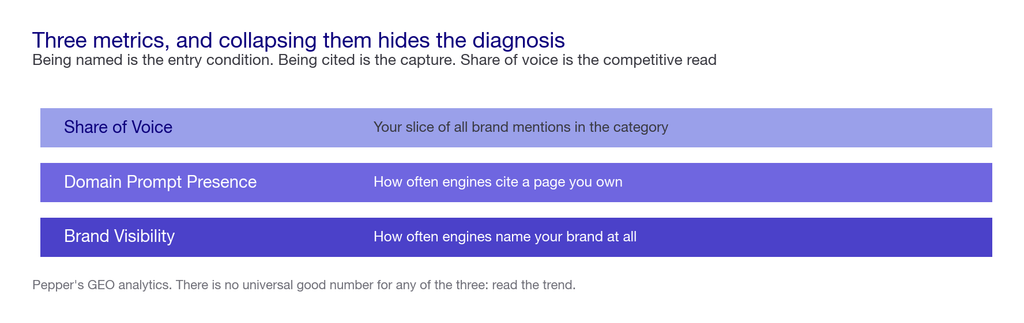
The distinction matters because the fixes differ completely.
- Named but not cited means engines know you and quote somebody else. That is a citability problem, and rewriting your own pages usually fixes it.
- Cited but rarely named is rarer. It usually means one strong asset is carrying you, while the brand itself has no independent standing. Topical authority is the fix.
- Neither means engines have no confident picture of you at all, which is the problem this article is about.
See where you show up. Pepper’s GEO platform tracks Brand Visibility, Domain Prompt Presence and Share of Voice across ChatGPT, Perplexity, Gemini, Claude and Google AI Overviews. Your team can log in, connect Search Console and GA4, manage the prompt set and run your own agents in the Agent Atlas. A growth team works the same account alongside you. Book a growth audit or see where you show up.
Why mention volume is the wrong target
This is the finding that should redirect most brand visibility budgets.
BrandMentions analysed approximately 410,000 public brand mentions connected to 240 brands across six sectors. Those covered B2B SaaS, ecommerce technology, fintech, travel, consumer software and professional services. The window ran 90 days, from 19 April to 17 July 2026, monitoring Google AI Overviews, Perplexity and ChatGPT browsing-style answers. It was published on 21 September 2026.
Their conclusion on volume is blunt. Raw mention count amounted to a weak, noisy signal. Several brands with large public footprints never appeared consistently in AI answers.
What did separate the two groups was composition.
- Repeatedly visible brands: roughly 70 to 80 percent of their mention footprint came from third-party sources.
- Rarely visible brands: owned-heavy profiles, with third-party sources at only 30 to 40 percent.
That gap is the actionable finding. You cannot publish your way to brand visibility on your own domain. The brands engines name are the ones other people write about.
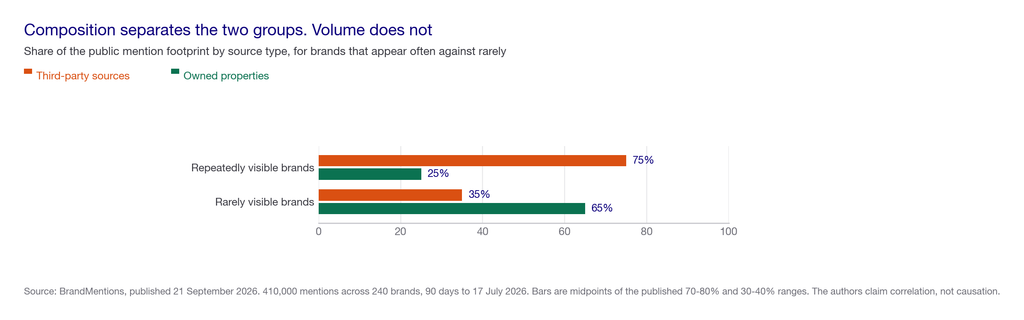
Read the caveat with it. The authors state plainly that correlation is the ceiling of what this data supports. They claim no causal proof. Neither do we.
This lines up with the citation evidence from a different direction. Muck Rack analysed more than 25 million cited links. 84 percent of AI citations come from earned media, against 0.3 percent from paid and advertorial content.
The part no SEO tool is measuring
Here is the detail that makes this hard to manage with existing tooling.
Of the third-party mentions around higher-visibility brands, roughly 50 to 60 percent were text only, carrying no outbound link at all.
Think about what that means operationally. Your backlink tool cannot see them. Your SEO reporting does not count them. A significant share of what appears to drive brand visibility sits outside the entire measurement stack most teams already own.
That is why the diagnostic further down uses prompts rather than link data. You have to ask the engines, because the signal does not appear in a crawl. The free method is in how to measure AI search visibility without expensive tools.
A note on a study we deliberately did not use. A widely cited Ahrefs analysis of 75,000 brands found unlinked web mentions correlate with AI Overview mentions at 0.664, against 0.218 for backlinks. It is a striking figure, and it points the same way as everything above. It also dates from May 2025, which puts it outside the 2026-only rule we apply here. So we left it out rather than lean on it.
How do I improve my brand visibility in AI search?
Five moves, in the order that compounds.
Work them in sequence. Each one makes the next cheaper, and skipping to the fourth is the most common expensive mistake.
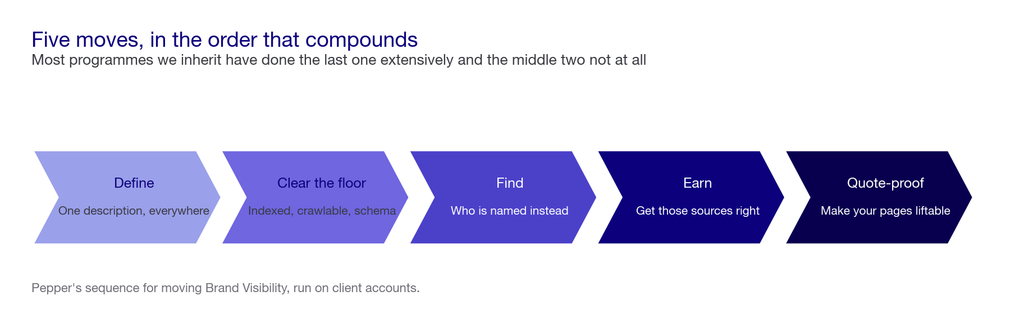
- Fix what you are, first. An engine that cannot confidently place you in a category will not name you in it. Use one description, in buyer language, identical across every property you control.
- Get the entry conditions right. Pages indexed, crawlers unblocked, Organization schema correct once. This is a floor, not a lever, and we covered it in the free AI visibility audit.
- Find who is being named instead of you. Run your prompt set and read the source lists. Those sources are your target list, and it is a better one than any media list you could buy.
- Get those sources to describe you accurately. Directories, analyst notes, journalism, comparison pages you do not own, review platforms. Slow and unglamorous, and it is where 84 percent of the citation signal starts. The mechanics are in LLM seeding.
- Then make your own pages worth quoting. Once you are named, citability becomes the constraint. That is a writing problem, and the evidence behind it is in our analysis of 1.4 million ChatGPT prompts.
Most programmes we inherit have done the fifth thing extensively and the third and fourth not at all.
What this looked like on a real account
SalesHood is our clearest published example of brand visibility moving on an AI surface specifically.
Seven workstreams ran together. A strategic audit mapped competitor performance. An SEO blog engine produced 20 new pieces and refreshed 8. GEO and AEO tracking ran in Atlas across ChatGPT, Gemini and Claude, alongside technical SEO on 10 issues, competitive intelligence, EEAT work and monthly reporting.
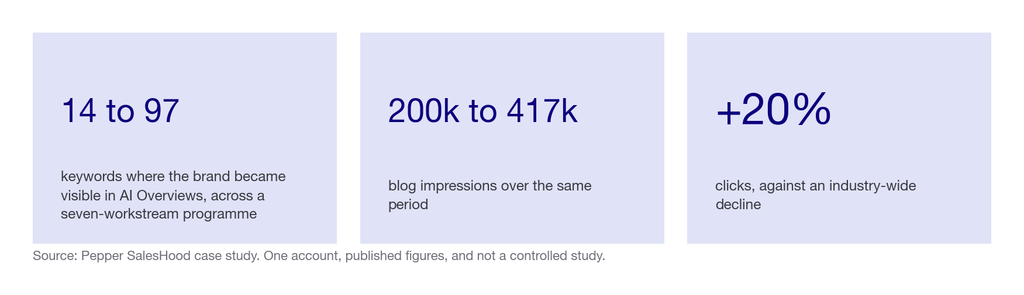
The results, as published:
- AI Overview visibility went from 14 keywords to 97.
- Blog impressions rose from 200,000 to 417,000.
- Rich results grew 291 percent in five months.
- Clicks rose 20 percent against an industry-wide decline.
Their CMO, Elay Cohen, described the outcome in business terms rather than metrics. He could point to a direct connection between the investment and lead flow from LLMs that closed.
Where this evidence fits. One account, published on our own case study page, and not a controlled study. It shows the number moving under a combined programme. It does not isolate which of the seven workstreams moved it, and we would not claim otherwise.
Our methodology: how we weighted the levers
| Lever | Weight | Why it carries this much |
|---|---|---|
| Third-party mention composition | 40% | The clearest separator in the 2026 data, at 70-80% against 30-40%, and where 84% of citations originate |
| Entity clarity and consistency | 25% | An engine that cannot categorise you confidently will not name you, and this is the cheapest thing to fix |
| Retrievability of your own pages | 20% | Converts being named into being cited, which is the second metric |
| Technical floor | 15% | A gate rather than a lever. Nothing above it counts until it passes |
Brand visibility in AI search engines, at a glance
| Metric | What it measures | What a low number means | How to move it | Typical cost | Where it falls short |
|---|---|---|---|---|---|
| Brand Visibility | How often engines name you | Engines have no confident picture of you | Third-party mentions, entity clarity | The largest line item, and the slowest | Being named does not mean being quoted |
| Domain Prompt Presence | How often engines cite your pages | You are known but not quotable | Answer-led structure, non-composable specifics | Roughly a day of editing per page | Can rise while competitors rise faster |
| Share of Voice | Your slice of category mentions | Rivals are outpacing you | Both of the above, sustained | Whole-programme cost | Falls even when your own numbers improve |
| A single blended score | Nothing useful | Unknowable | Not applicable | Roughly $99 to $400 a month | Hides which of the three is broken, which is the diagnosis |
The last row is deliberate. A composite visibility score cannot tell an awareness problem from a citability one, and those need completely different budgets.
How to choose where to start
The diagnostic decides this, and it costs an afternoon.
The scorecard
Score your situation out of 100.
| Area | Weight | How to score it honestly |
|---|---|---|
| Third-party mention composition | 35% | Credible independent sources describe you, unpaid, and you can name three without checking |
| Entity clarity | 25% | Your homepage, about page and category pages say the same thing, in buyer language |
| Named-versus-cited tracked separately | 20% | You report two numbers per engine rather than one blended score, so you can tell an awareness problem from a citability one |
| Retrievability of key pages | 15% | Headings are questions, answers come first, tables are text |
| Technical floor verified | 5% | Someone has confirmed the pages are indexed, the crawlers are unblocked and Organization schema is correct |
The live test, over 90 days
Fix 30 prompts in your buyers’ words. Real questions, such as “best sales enablement platform for mid-market”, “which data observability tool works with Databricks”, “how do I improve brand visibility in AI search engines” and “who are the leading GEO agencies”.
Run them across Google, ChatGPT and Perplexity. Log three columns rather than two: whether you were named, whether a page on your domain was cited, and which sources appeared instead.
Rerun the identical set monthly for 90 days. Three readings is the shortest honest window. One is a snapshot, two could be noise, three shows direction. Keep the set fixed, because changing it resets the comparison.
The third column turns this from a report into a plan. It is your earned-media target list, built from what the engines already trust rather than from a media database.
Weak approach versus strong approach
The weaker approach: commission more content on your own blog, add a press release cadence and buy sponsored placements, then measure mentions in aggregate. Owned-heavy footprints describe the rarely-visible group, and paid content is 0.3 percent of citations.
The stronger approach: read the source lists on the answers you are missing from, then work those specific sources until they describe you accurately.
The weak version increases mention volume, which the evidence calls a noisy signal. The strong version changes mention composition, which is what actually separated the two groups.
Red flags
- Mention volume as the headline KPI. Raw count was explicitly described as weak and noisy in the 2026 data.
- A single blended visibility score. It cannot distinguish an awareness problem from a citability one.
- Paid placements sold as brand visibility. Paid and advertorial content is 0.3 percent of AI citations.
- A plan that is entirely on your own domain. That is the profile of the rarely-visible group.
- Backlink reporting as the measure. Between half and 60 percent of the useful mentions carry no link at all.
- Guaranteed mentions or citations. Nobody controls generated output, and Google warns against providers guaranteeing rankings.
Five questions worth asking
- “What proportion of our mention footprint is third-party?” This is the number the 2026 data separates on.
- “Which sources are named instead of us, on our top queries?” If nobody has looked, there is no target list.
- “Are we tracking named and cited separately?” One score loses the diagnosis.
- “How much of this plan sits off our own domain?” If none, it addresses the minority of the signal.
- “What would you tell us to stop publishing?” A good partner reallocates rather than adds.
Reduced to one principle: change where you are mentioned, not how often.
One closing note that costs us something. Earned third-party work is slow, it reports badly month to month, and it is genuinely harder to sell than a content calendar, ours included. A partner whose brand visibility plan is entirely pages on your own site is proposing the comfortable half of the job.
What does this cost?
| What you are buying | Typical 2026 cost | What it covers |
|---|---|---|
| The thirty-prompt diagnostic | Free, an afternoon | Named, cited and competing sources, per engine |
| Search Console and Bing Webmaster Tools | Free | Your own first-party data on two surfaces |
| Entity and description consistency | Internal, roughly a day | One buyer-language sentence everywhere |
| Organization schema, done once | A few hours of developer time | The technical floor, not a lever |
| Third-party mention work | The largest line item, and the slowest | Directories, analysts, journalism, comparison pages, review platforms |
| Retrievability pass on key pages | Roughly a day of editing per page | Turning named into cited |
| Multi-engine tracking | Roughly $99 to $400 a month | Brand Visibility and Domain Prompt Presence, tracked separately |
| Platform plus a growth team | Custom | Pepper: tracking, plus the people and agents doing the work it points at |
The first two rows are free, and they tell you whether the expensive rows are relevant to you at all.
What nobody should promise you
A guaranteed mention or citation in any engine. Nobody controls generated output.
That more mentions produce more visibility. Raw mention count was a weak and noisy signal in the largest 2026 analysis available.
That paid placement builds brand visibility with AI engines. Paid and advertorial content accounts for 0.3 percent of AI citations.
A single score that tells you what to fix. It cannot separate an awareness problem from a citability one, and those need different work.
When this is not your problem yet
The answer that costs us the sale. If your pages are not indexed, or your site does not plainly state what you sell, you do not need a brand visibility programme yet and we would tell you not to buy one.
Fix indexing and your plain description first. Both are free. Brand visibility work layered on a site engines cannot read means paying to amplify a problem you already have. The diagnostic above shows you that in an afternoon rather than a quarter.
Frequently asked questions
How do I improve my brand visibility in AI search engines?
Change where you are mentioned rather than how often. In 2026 data, repeatedly visible brands drew 70 to 80 percent of their mention footprint from third-party sources. Rarely visible brands were owned-heavy, at 30 to 40 percent.
What is brand visibility in AI search?
How often AI engines name your brand when answering questions in your category. It is distinct from whether they cite a page on your domain, which is a separate metric with a separate fix, and collapsing the two hides the diagnosis.
Do unlinked brand mentions matter for AI search?
The evidence suggests they matter a great deal. Roughly 50 to 60 percent of third-party mentions around higher-visibility brands carried no outbound link. So backlink tools miss a large share of the relevant signal.
Does mention volume drive AI visibility?
Not reliably. An analysis of roughly 410,000 mentions across 240 brands called raw mention count a weak, noisy signal. It also noted several brands with large public footprints that never appeared consistently in AI answers.
Can I pay for brand visibility in AI search?
Not effectively. Paid and advertorial content accounted for 0.3 percent of AI citations in a study of more than 25 million cited links, against 84 percent for earned media.
What is the difference between being named and being cited?
Being named means an engine mentions your brand in its answer. Being cited means it links a page on your domain as a source. Named without cited points to a citability problem in your own content, which rewriting usually fixes.
How long does brand visibility work take?
Plan on three monthly readings of a fixed prompt set before judging direction, so roughly 90 days. The third-party half is slower, because it depends on other people publishing, which you do not control.
How do I measure brand visibility across engines?
Track two numbers separately per engine: whether you are named, and whether your domain is cited. Run thirty fixed prompts monthly by hand for free, or automate it from roughly $99 to $400 a month.
Where to go next
Run thirty of your buyers’ real questions and record three columns: named, cited, and who appeared instead.
That third column is the whole plan. It is a target list built from what the engines already trust, and it costs an afternoon to assemble.
Learn AI Search · Explore Pepper’s platform · Book a growth audit
Sources and further reading
- BrandMentions. Brand mentions and AI visibility analysis, published 21 September 2026. Approximately 410,000 public brand mentions connected to 240 brands across B2B SaaS, ecommerce technology, fintech, travel, consumer software and professional services. Ninety-day window from 19 April to 17 July 2026, monitoring Google AI Overviews, Perplexity and ChatGPT browsing-style answers, with sources spanning news, blogs, Reddit, review sites, video and public social posts. Found raw mention count to be a weak, noisy signal. Repeatedly visible brands drew roughly 70 to 80 percent of their mention footprint from third-party sources, against 30 to 40 percent for rarely visible brands. Roughly 50 to 60 percent of third-party mentions around higher-visibility brands were text only, with no outbound link. The authors state that correlation is the ceiling of what the data supports and claim no causal proof. Link
- Muck Rack. “What Is AI Reading?” May 2026. More than 25 million cited links across ChatGPT, Claude and Gemini, 17 industries. Source of the 84 percent earned media and 0.3 percent paid figures. Link
- Google Search Central. AI search optimisation guidance, 15 May 2026. Confirms AI Overviews and AI Mode run on core Search ranking and quality systems with no separate AI index, and warns against providers guaranteeing rankings.
- Pepper. SalesHood case study. Figures and quote as published on the page.
- Pepper. The free AI visibility audit for the technical floor, and how to write content that AI engines actually cite for turning named into cited.
- Deliberately excluded on recency grounds: an Ahrefs correlation study of 75,000 brands finding unlinked web mentions at 0.664 against backlinks at 0.218. It points the same way as the argument here, and it was published in May 2025, outside the 2026-only rule we apply to research in this field.
- Deliberately excluded on sourcing grounds: a citation-rate figure of 53.1 percent when a brand is mentioned against 10.6 percent when it is not, attributed to Seer Interactive across 541,213 LLM responses. We found it reported second-hand rather than at the source.
Latest Blogs
Most advice on this is inference dressed as fact. OpenAI documents exactly one thing clearly, which is access. Here is what is documented, what is inferred, and how to verify the rest for yourself.
Being named in an AI answer and having your page used as its source are different outcomes with different causes and different fixes. The gap between them is the most useful diagnostic in AI search, and most reporting collapses it into one number.
Every platform reports share of voice and almost none of them define it the same way. Here is the definition worth using, the three choices that change the number, and how to measure it yourself without buying anything.
Get your hands on the latest news!

Similar Posts
Artificial Intelligence
11 mins read
What is anchor text, and does it still matter in 2026?
SEO
11 mins read
What is internal linking? Meaning, and what changed for AI search
SEO
15 mins read