GEO agency vs GEO tool: which gives better value?
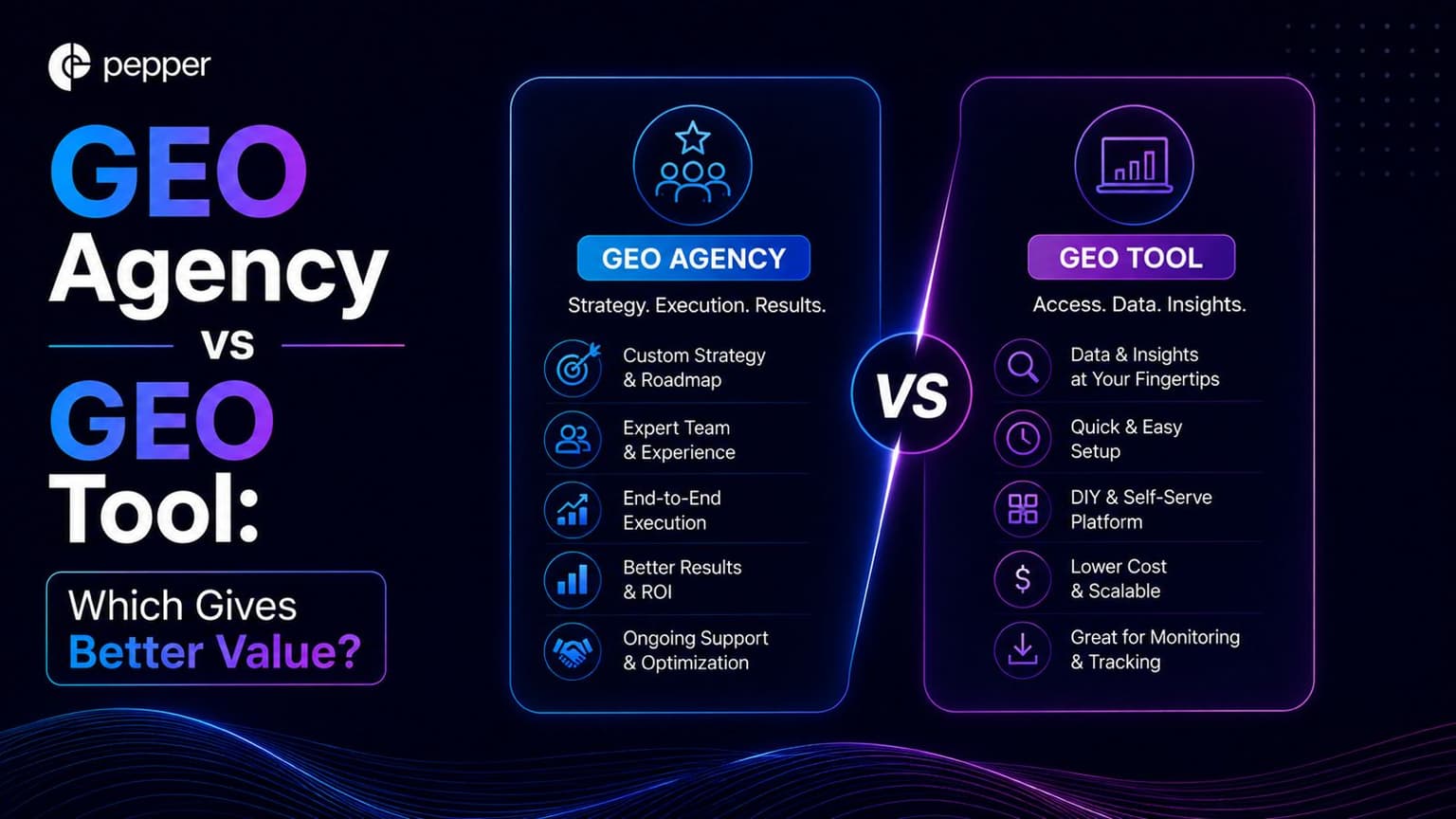
The value question has a different answer than it did six months ago, and the reason is that the floor fell out of tool pricing.
AirOps now offers a free tier that tracks 100 prompts and pages on ChatGPT. Profound charges $99 a month for 50 prompts on ChatGPT. Both figures are published, both were checked on 31 August 2026, and the comparison is not flattering to the paid tier at the entry level.
So “which gives better value” is no longer mostly about software price. Pepper sells the combined model, so read that with appropriate scepticism, but the arithmetic below is from published pages you can check yourself.
If you want the capability comparison rather than the value one, GEO agency vs GEO tool covers what each model can and cannot do. This page is about what you get per pound spent.
The short answer
At the entry level, a tool gives better value than an agency, because the entry level now costs nothing and answers a real question: does AI search matter in our category at all.
Past that point the comparison inverts, because the tool’s cost is not its price. It is the internal hours needed to act on what it surfaces, and those hours are what an agency is actually selling you.
Key takeaways
- The entry price is now zero. AirOps offers a free tier with 100 tracked prompts on ChatGPT, which is twice the prompt volume of Profound’s $99 Starter.
- Cost per prompt rises as you move up, not down. Profound’s $99 tier works out at $1.98 per prompt tracked. The $399 tier is $3.99. You are buying engines and response volume, not prompt count.
- Neither model can price an outcome. Any cost-per-citation figure is invented, because nobody controls AI ranking systems.
- The largest line is execution hours, and it appears on no pricing page.
- Some readers should spend nothing. Start on a free tier for a quarter and buy against what it shows you.
A note on where this comes from. We run organic for more than 250 enterprises and track over 10 million prompts across every major engine. What follows is shaped by that, by client reviews we sit in weekly, and by conversations with buyers at the events we run. It is our read on the economics rather than a neutral survey.
What is value in a GEO agency vs GEO tool decision?
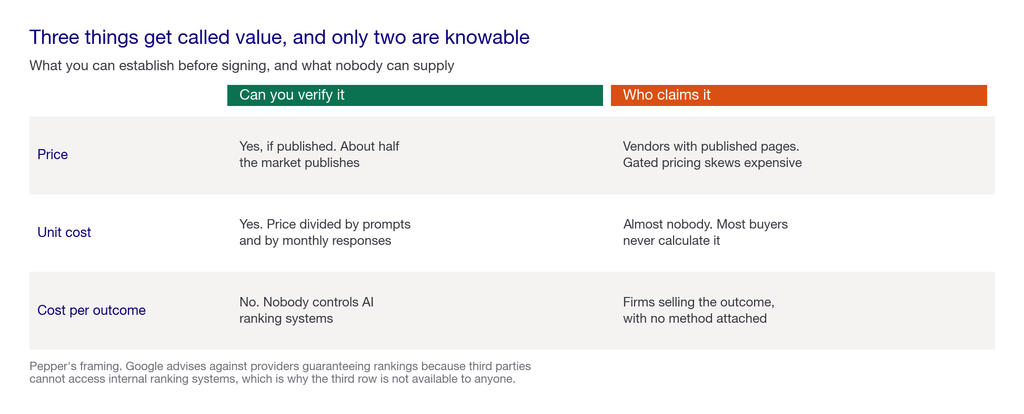
Three different things get called value in this category, and vendors switch between them mid-sentence.
Price is what you pay monthly. It is published by roughly half the market and gated by the rest.
Unit cost is price divided by something useful: prompts tracked, engines covered, responses returned. This is where published pricing gets genuinely comparable, and it is the number most buyers never calculate.
Cost per outcome is what everyone wants and nobody can supply. You will see claims like a managed programme delivering “a lower effective cost-per-outcome”, published by firms selling managed programmes with no study attached. Treat any cost-per-citation figure as marketing until someone shows you the method.
We can compare the first two honestly. The third is not available to anyone, and a vendor offering it is telling you something about their standards rather than their results.
What the published tiers actually buy
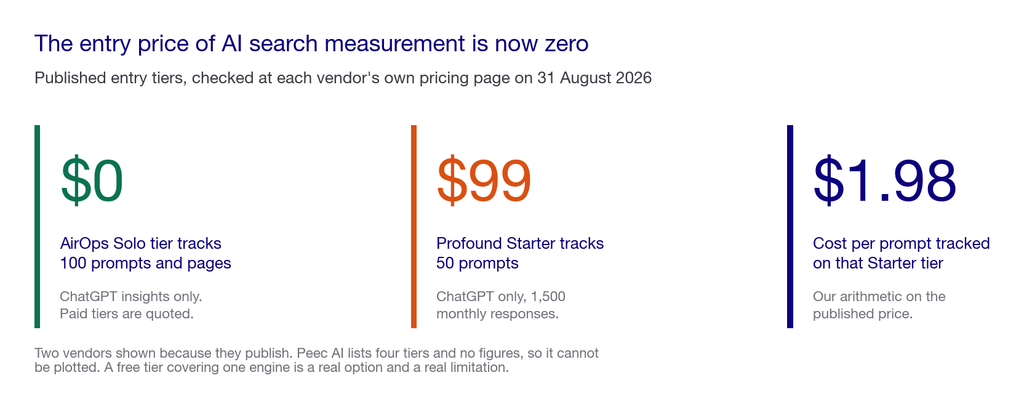
AirOps positions as “AI Search for Enterprise” and its free Solo tier covers 100 tracked prompts and pages, ChatGPT insights only, with monthly opportunity reports. Its paid tiers are quoted rather than published.
Profound publishes a full ladder: $99 Starter with 50 prompts tracked, 1,500 monthly responses and ChatGPT tracking only; $399 Growth with 100 prompts, 9,000 monthly responses and three answer engines; and a quoted Enterprise tier reaching up to nine.
Peec AI lists four tiers, Starter through Enterprise, publishes no figures for any of them, and covers five engines at every tier including AI Mode and Copilot. It reports 3,000+ brands and agencies as customers.
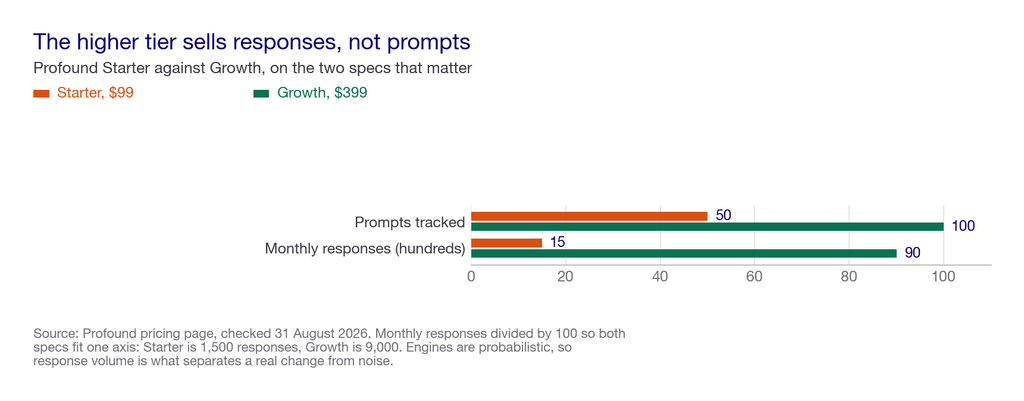
That second chart is the one worth sitting with. Moving from Starter to Growth doubles your prompt count and multiplies monthly responses by six. Since engines are probabilistic, response volume is what lets you distinguish a real change from noise, and it is the spec most buyers never look at.
Cost per prompt goes the wrong way
Divide price by prompts tracked and something counterintuitive appears.
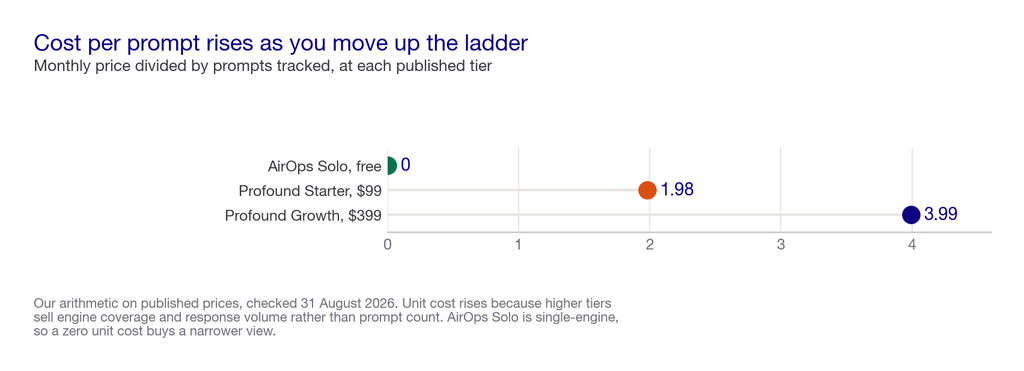
Most software gets cheaper per unit as you scale. This does not, because prompt count is not the thing the higher tier is selling. Engine coverage and response volume are.
That matters for how you justify the spend. A business case built on “more prompts for the money” will not survive contact with the pricing page. A business case built on “we need Perplexity and Gemini coverage, and enough responses to tell signal from noise” will.
Our roundup of the best LLM SEO tools records which vendors publish and which gate, and the cost breakdown of platforms against hiring models the execution hours neither figure includes.
GEO agency vs GEO tool value at a glance
| GEO tool | GEO agency | Platform with a team | |
|---|---|---|---|
| Published cost | Free to $399 monthly at entry tiers | Retainer, rarely published | Retainer, rarely published |
| Cost you can verify before a call | Yes, if the vendor publishes | Almost never | Almost never |
| Cheapest way to test | Free tier, one quarter | No cheap version exists | No cheap version exists |
| What the money buys | Measurement | Execution hours | Both |
| Covers earned media | No | The good ones do | Yes |
| Unit cost at entry | $0 to $1.98 per prompt tracked | Not computable | Not computable |
| Where it falls short | Value collapses if nobody acts | No trial, no published floor | Price is a conversation |
How we weighted value
Value here is scored on what a buyer can establish before signing, which rules out the thing everyone wants most.
| Area | Weight | What decides the score |
|---|---|---|
| Execution hours covered | 40 | Whether the price includes the hours the findings create, or assumes your team absorbs them free |
| Unit cost at your tier | 25 | Price divided by prompts and by monthly responses at the tier you will actually buy |
| Engine coverage at that tier | 20 | Whether the tier row, not the marketing page, lists the engines your buyers use |
| Earned media included | 10 | Whether the capability is present at all, since no software tier provides it at any price |
| Exit cost | 5 | Whether raw answers and cited URLs export, so a year of history is not stranded |
Execution hours carry the most weight because they are the largest line and the one no pricing page shows. Exit cost carries the least, though it is the one people regret ignoring.
Our GEO agency ranking methodology sets out how we build weightings like this.
Where does each model fall short on value?
The tool falls short on conversion. At entry level the value is unbeatable, because it is free or nearly so and it answers a genuine question. Where it falls short: the moment it surfaces work, the value depends entirely on whether anyone does the work. A free tier with nobody acting on it has produced a more precise description of the problem and nothing else.
The agency falls short on transparency and on the floor. It sells the execution hours that are the real cost, which is genuine value when your constraint is hands. Where it falls short: retainers are almost never published, so you cannot compare before a call, and there is no cheap version. You cannot buy a quarter of an agency to test whether the category matters.
The combined model falls short on discoverability of price. Pepper’s customers log into the platform themselves: workspace setup, brand profile, competitors and personas, GA4 and Search Console connected, themes and prompts managed, GEO analytics read directly, and their own agents built and run in the Agent Atlas.
And a growth team is attached to the account doing the work alongside them, which covers the execution line that breaks the tool-only maths.
Where the combined model falls short: we do not publish pricing, so budget discovery is a conversation rather than a page. We are built for teams running organic as a long-term function, so if you want a one-off audit, a free tier is better value. Our depth sits in content, authority and AI search rather than large technical migrations.
If you want the unit economics modelled against your actual prompt volume, book a growth audit and we will run the numbers with you.
The line that decides value, and it is on no pricing page
A tool that surfaces two hundred opportunities a quarter needs somebody to write, fix or pitch two hundred times.
Price that. Actions per month, times hours per action, times a loaded hourly rate. For most teams the result is several multiples of the subscription, and it is the number that decides whether the tool was good value or an expensive way to document a decline.
This is also the honest answer to why agencies cost what they cost. You are not paying for a dashboard. You are paying for the hours that the dashboard creates, and whether that is better value than doing it yourself depends on your loaded rate and your spare capacity, not on the vendor’s pitch.
Earned media is where that gap bites hardest. Muck Rack analysed more than 25 million cited links across ChatGPT, Claude and Gemini in May 2026, spanning 17 industries, and found earned media accounted for 84% of AI citations against 0.3% for paid and advertorial. No tier of any tool pitches a publication. That capability is only available with people attached, which is a real point in the agency column.
How to evaluate value between an agency and a tool
I would build the comparison around unit cost and capacity, because those are the two things you can actually establish before signing anything.
Google’s May 2026 guidance is the anchor for what nobody can sell you. Google states that AEO and GEO are part of SEO, that AI Overviews and AI Mode run on core Search ranking systems with no separate AI index, and it advises against providers guaranteeing rankings because third parties cannot access internal ranking systems. That is correct for Google, and Google is one engine, so ChatGPT and Perplexity retrieve differently. Hold both, and note what follows: nobody can price a citation, so any value comparison that ends in a cost-per-outcome figure is fabricated.
Score value on what is knowable.
| Area | Weight | What a strong answer demonstrates |
|---|---|---|
| Execution hours covered | 40 | The proposal names who does the work and how many hours, priced at a loaded rate rather than assumed free |
| Unit cost at your volume | 25 | Price divided by prompts and by monthly responses at the tier you will actually buy, not the headline figure |
| Engine coverage at that tier | 20 | The tier row lists the engines your buyers use, verified on the pricing page rather than the marketing page |
| Earned media included | 10 | A named owner and target list, since that capability is unavailable at any software tier |
| Exit cost | 5 | Raw answers and cited URLs are exportable, so a year of history is not stranded if you switch |
Those weights sum to 100. Score the free tier too, because it is a real option and it often wins the first quarter.
The live test, and it now costs nothing. Take 30 real commercial prompts from your category, written the way a buyer would type them. Four worked examples: “which platform gives the best value for AI search tracking”, “how do we find out if ChatGPT recommends our product”, “is a GEO agency worth it for a mid-market B2B company”, “best free tool for tracking brand mentions in AI answers”. Load them into a free tier, run them across the engines it covers, and let it run for a month.
Then answer five questions. Where do we appear and where do we not. Which competitors appear instead, consistently. Which sources influence those answers, sorted by frequency. How many of those sources could we plausibly reach this quarter. What would change in the next 90 days, and who does it. Engines are probabilistic, so a single run establishes nothing and response volume is what buys you confidence.
That exercise costs a day and it converts a value question into an arithmetic one.
The weak business case against the strong one. The weaker version compares a subscription to a retainer, picks the smaller number, and calls it value. It ignores that the two purchases buy different things, which is like comparing the price of a thermometer to the price of a doctor.
The stronger version prices four lines: software at the tier you will buy, execution hours at a loaded rate, earned media as its own budget, and the cost of a quarter spent not acting. The fourth line is the one that usually flips the conclusion, and it is the one nobody writes down.
Red flags, each one something you will genuinely hear. “Lower effective cost-per-outcome”, published by a firm selling the outcome with no method shown. “The tool pays for itself in saved time”, with no estimate of the hours it creates. “We guarantee citations”, which Google’s own guidance advises against. “72% of target queries win featured snippets in 90 days”, a figure circulating on AEO vendor pages with no study behind it, and which describes a Google SERP feature rather than an AI answer. “Full engine coverage”, quoted from a marketing page when the tier row says one engine. “Unlimited prompts”, which usually caps somewhere the contract mentions and the page does not. And “our AI visibility score went up”, offered with no competitor share of voice beside it.
Five questions that establish value before you sign.
- What is the cost per prompt and per monthly response at our tier? A good answer is two numbers computed on the call. A weak one repeats the headline price.
- Which engines does this specific tier cover? A good answer reads the tier row aloud. A weak one points at the feature list.
- What hours does this create for us, and who absorbs them? A good answer estimates actions per month. A weak one says the tool saves time.
- What does the free or cheapest option not tell us? A good answer is specific about engines and response volume. A weak one dismisses free tiers.
- Can we export raw answers and cited URLs? A good answer is yes with a format. A weak one explains why the dashboard is enough.
It all comes down to one principle: compare unit costs, then price the hours, and never accept a cost per outcome from anyone. Value in this category is knowable up to the point where it becomes a claim about results, and that is exactly where the honest comparison stops.
One closing note that costs us something. If you have not yet established that AI search matters in your category, the best value available is a free tier and a quarter of patience, and we would tell you that on a call. Very few providers are equally strong across measurement, execution, earned authority and attribution, ours included, and the good ones will say which of the four is their weakest.
What nobody should promise you
A cost per citation. Nobody controls AI ranking systems, so nobody can price their output. Google advises against guarantees for exactly this reason.
That the subscription is the total cost. The execution hours are larger for most teams and appear on no pricing page.
That a higher tier is better value per prompt. Published pricing shows unit cost rising with the tier. Higher tiers sell engines and response volume.
That a free tier is a toy. A free tier with 100 tracked prompts answers the only question that matters in the first quarter, which is whether any of this applies to you.
Frequently asked questions
Which gives better value, a GEO agency or a GEO tool?
At entry level the tool wins outright, since AirOps offers a free tier with 100 tracked prompts. Beyond that the answer depends on whether you have hours to act on findings, because those hours are what an agency actually sells.
How much does a GEO tool cost per prompt?
Profound’s $99 Starter tracks 50 prompts, which is $1.98 per prompt monthly. The $399 Growth tier tracks 100 prompts at $3.99 each. Unit cost rises with the tier because higher tiers sell engine coverage and response volume.
Is there a free GEO tool worth using?
AirOps offers a free Solo tier covering 100 tracked prompts and pages with ChatGPT insights and monthly opportunity reports. It is single-engine, so treat a quiet result as possibly a coverage limit rather than a finding.
Can anyone tell me the cost per AI citation?
No, and be wary of anyone who does. Google advises against providers guaranteeing rankings because third parties cannot access ranking systems. Any cost-per-citation figure is an estimate presented as arithmetic.
Why is a GEO agency more expensive than a tool?
Because it sells different goods. The tool sells measurement. The agency sells the execution hours that measurement creates, plus earned media, which no software tier provides at any price.
What is the biggest hidden cost of a GEO tool?
Internal execution hours. A platform surfacing two hundred opportunities a quarter creates two hundred pieces of work, and pricing those at a loaded rate usually produces a figure several times the subscription.
Should I start with a free tier?
For most teams, yes. Run 30 real commercial prompts for a quarter, see whether your buyers’ questions surface you at all, and buy against what it shows rather than against a projection.
Do agency retainers get published?
Rarely, ours included. Roughly half the tool market publishes pricing and almost none of the service market does, so budget for quoted pricing across most of a shortlist and treat a missing price as information.
Where to go next
Do the arithmetic before the demos. Take the tier you would actually buy, divide by prompts and by monthly responses, and write both numbers down. Then estimate actions per month and price the hours. That page is your value comparison, and it takes an afternoon.
Then start free. Our guide to tracking brand mentions in AI search covers the five methods and what each one misses, and is a GEO platform worth it without an agency covers the four conditions that decide whether you can act on what you find.
For the wider landscape, AI SEO agencies covers which firms rebuilt their model, and the Visibility, Citability and Retrievability framework explains which lever is stuck. Our SalesHood case study documents AI Overview keywords moving from 14 to 97 across five months.
The honest exit. If you have not established that AI search matters in your category, do not buy anything. Take the free tier, load 30 prompts, and revisit in a quarter with data instead of a projection.
Sources
Vendor pricing was checked at each company’s own pricing page on 31 August 2026. Every study cited was published in 2026.
- Muck Rack, Earned media still drives 84% of AI citations, 7 May 2026. More than 25 million cited links across ChatGPT, Claude and Gemini, 17 industries. Muck Rack sells PR software, so read it as an interested party with a large dataset.
- Google Search Central, AI features and your website, 15 May 2026, including the guidance against providers guaranteeing rankings.
Unit costs in Figure 3 are our arithmetic on published prices, not vendor-supplied figures.
Latest Blogs
Most advice on this is inference dressed as fact. OpenAI documents exactly one thing clearly, which is access. Here is what is documented, what is inferred, and how to verify the rest for yourself.
Being named in an AI answer and having your page used as its source are different outcomes with different causes and different fixes. The gap between them is the most useful diagnostic in AI search, and most reporting collapses it into one number.
Every platform reports share of voice and almost none of them define it the same way. Here is the definition worth using, the three choices that change the number, and how to measure it yourself without buying anything.
Get your hands on the latest news!