Best AI SEO agencies in 2026: what they do differently
Almost every SEO agency now describes itself as an AI SEO agency. However, far fewer changed what they actually do. That distinction is worth about a year of your time.
The tell is not vocabulary. Instead, it is whether the firm can describe a mechanism. A rebranded agency talks about optimising for AI. A rebuilt one talks about query fan-out, passage retrieval, and why a specific competitor wins a specific answer. So you can hear the difference inside ten minutes, and this guide is mostly about how to listen for it.
Disclosure: Pepper is included on this list and published the guide, so we have placed ourselves in a separate category rather than ranking ourselves against agencies we do not directly compete with. We have also applied the same scrutiny to ourselves as to everyone else. Every competitor description is based on that company’s own website as of 25 August 2026, rather than another roundup or secondary source. Where a company does not publish pricing, we have said so rather than estimating it.
What genuinely changed, and what did not
Start with what carries over, because agencies selling you a rebuild are overstating.
Crawlability, content quality, entity clarity and authority all still matter, across every engine. Google’s AI search guidance, published 15 May 2026, states that optimising for AI search is still SEO. It also confirms AI Overviews and AI Mode run on core Search ranking systems, with no separate AI index.
Three things did change, and they are what a genuine AI SEO agency is built around.
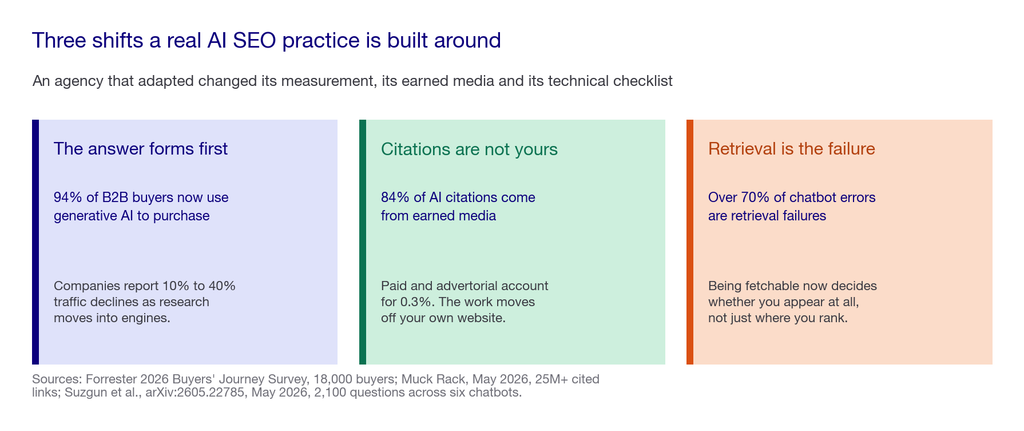
The answer forms before the click. Forrester’s 2026 Buyers’ Journey Survey covered 18,000 global business buyers. It found generative AI use in the purchase process rose from 89% in 2025 to 94% in 2026. Meanwhile companies reported 10% to 40% traffic declines as research moved into engines.
Most citations are not yours. Muck Rack’s analysis covered more than 25 million cited links across ChatGPT, Claude and Gemini in May 2026. Earned media accounted for 84% of AI citations, against 0.3% for paid and advertorial. So the centre of gravity moves off your website.
Retrieval is the failure point. A Stanford-led evaluation covered 2,100 factual questions across six chatbots in May 2026. It found retrieval failures, rather than reasoning errors, caused more than 70% of all mistakes. Therefore being fetchable now decides whether you appear at all.
An agency that genuinely adapted changed three things in response: its measurement, its earned-media capability and its technical checklist. One that did not changed its homepage.
The agencies
1. Pepper
Pepper is an agentic organic growth engine, and we sit apart from this list because we are not structured like an agency. The product is two things working together.
Customers get a genuinely self-serve platform. They log in, set up a workspace, and define brand profile, competitors and personas. Then they connect GA4 and Search Console, manage themes and prompts, read GEO analytics, and build and run their own agents in the Agent Atlas. And a growth team is attached to the account, doing the work alongside them. Agents give you scale, experts give you judgement, and one team owns the number.
On measurement we separate two numbers across five engines. Brand Visibility is how often engines name your brand. Domain Prompt Presence is how often they cite a page from your domain. The gap between them tells you whether you have an awareness problem or a citability problem, and those need completely different work.
We have run organic for more than 250 enterprises across eight years, and we track over 10 million prompts. That matters here, because AI search rewards exactly what long-running content and authority programmes build.
Where we fit and where we do not. We are built for organisations running organic as a long-term function, with a team we work alongside. That is who we do our best work for. We do not publish pricing, so budget conversations happen with a person rather than a page. And our depth sits in content, authority and AI search rather than large technical migrations. So if a migration is your immediate problem, one of the technical specialists below is the better first call.
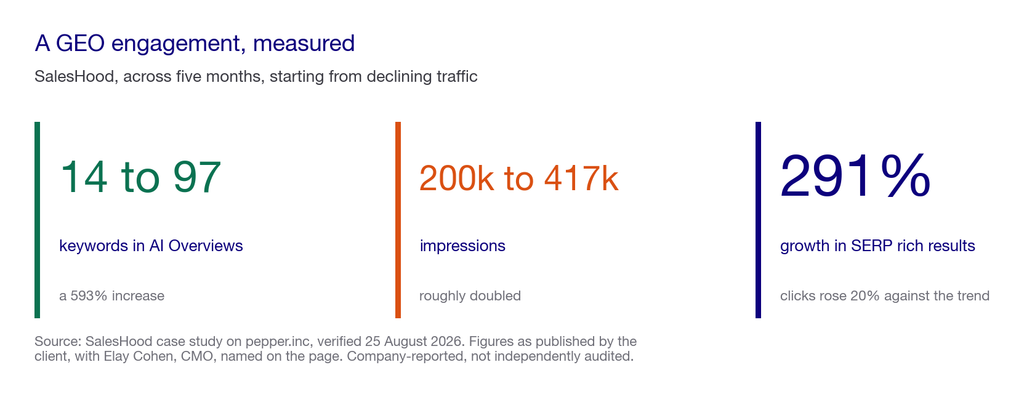
What it looks like in practice. SalesHood came to us with declining traffic and no GEO capability. Elay Cohen, their CMO, put it plainly: “Traffic was declining, we realized the world of GEO and AEO was happening without us.” Then, across five months, keywords appearing in AI Overviews rose from 14 to 97. Impressions doubled from 200,000 to 417,000, and SERP rich results grew 291%. Clicks rose 20% while the industry-wide direction was down.
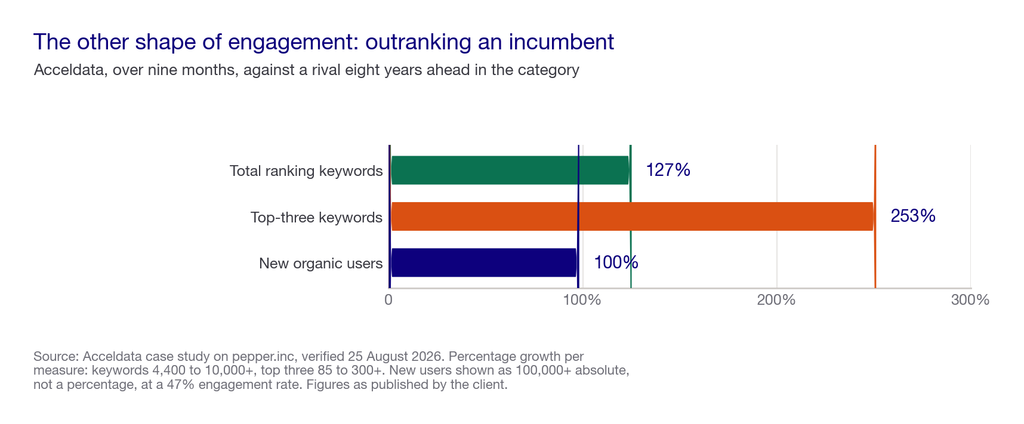
For a different shape of problem, Acceldata was competing against a rival with an eight-year head start in data observability. Over nine months, ranking keywords went from 4,400 to more than 10,000. Top-three keywords rose from 85 to more than 300. Meanwhile organic traffic grew 6X, bringing over 100,000 new users at a 47% engagement rate.
2. iPullRank
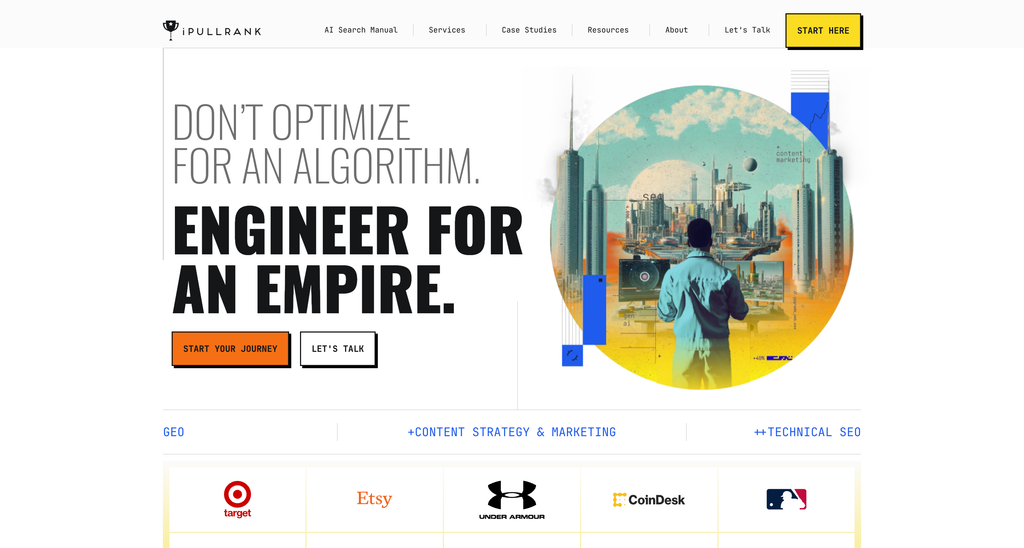
iPullRank describes itself as a “pioneering enterprise and mid-market AI search agency”, with the line “we don’t optimize for blue links. We make your brand the answer.” Services span Relevance Engineering, GEO, AI search strategy, content strategy, technical SEO and content engineering. Clients include Target, Google, American Express, Adidas, Nordstrom and the Wall Street Journal.
They are the clearest example here of a firm that rebuilt rather than rebranded. Their public material discusses query fan-out, passage retrieval, embeddings and synthesis. Almost nobody else matches that mechanical specificity. They also publish results including $2.4 billion in incremental revenue for a financial services client, and 130% traffic recovery for an automotive publisher. As with every vendor here, those figures are company-reported.
They suit enterprises that want to understand why something happens, not just that it did. Where they fall short: no published pricing. Furthermore, the depth suits organisations with internal capacity to act on sophisticated recommendations. So if you need hands more than analysis, press hard on execution.
3. Optimist
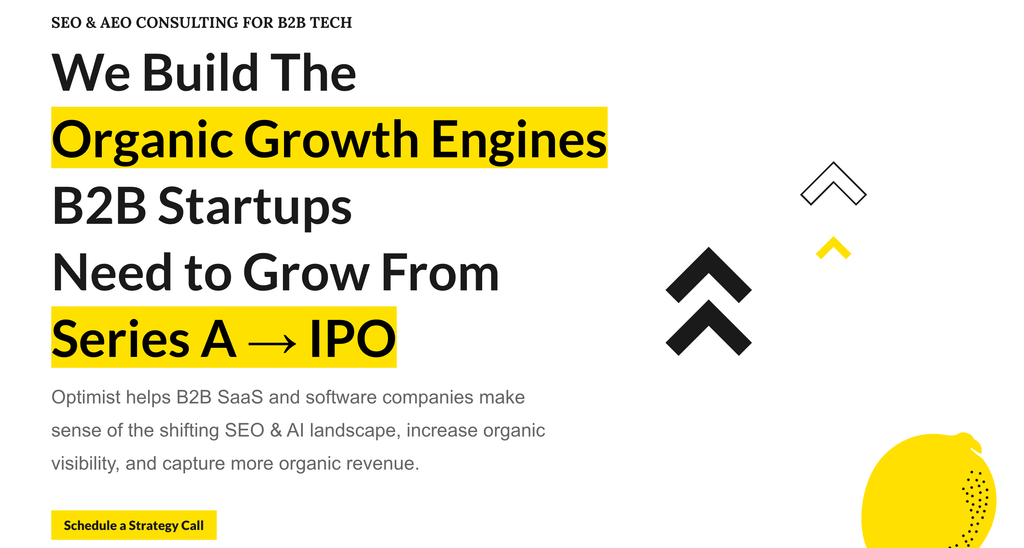
Optimist calls itself “the 10x organic growth agency: SEO, AEO, and content for B2B SaaS”, built around taking companies from Series A to IPO. Services include full-service SEO, AEO, GEO, AI visibility and schema optimisation, content production and organic pipeline generation. Clients include Semrush, Superhuman, SendBird and ContentStack.
They publish the clearest pricing in this comparison, which is rare enough to reward. A roadmap engagement is $7,500 one-time. Advisory starts at $3,000 a month, and full service at $4,000. Published case studies include figures such as 14X leads and a 2,961% organic traffic increase, company-reported as usual.
They suit growth-stage B2B SaaS wanting pipeline framing rather than traffic reporting. Where they fall short: the focus is squarely B2B SaaS, so manufacturers and services businesses sit outside the sweet spot. In addition, those published figures are floors rather than ranges.
4. Siege Media
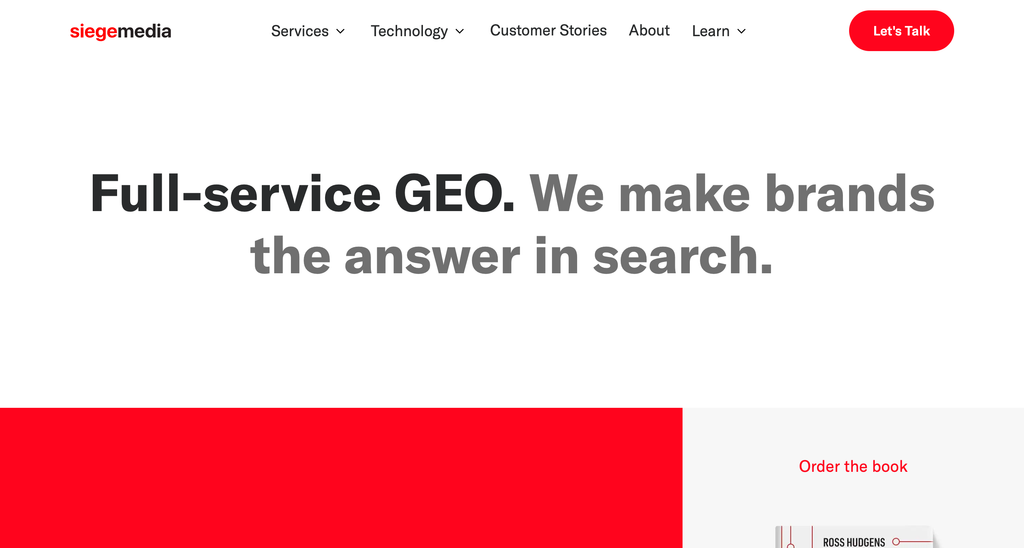
Siege Media now positions as a “full-service GEO agency for brands”, with the promise “we make brands the answer in search”. Scope runs from content strategy through production and design into digital PR, Reddit marketing, affiliate partnerships and research reports. Clients include Instacart, Zendesk, Zapier, Airbnb, HubSpot and Zoom.
The Reddit and research-report capability matters more than it used to, because those are exactly the earned sources engines lean on. Given that 84% of citations come from earned media, an agency with real digital PR muscle holds a structural advantage over one with only a content team.
They suit content-led programmes needing real volume, plus the earned media that wins citations. Where they fall short: the centre of gravity is content and PR rather than deep technical SEO. So a complex migration may need a second partner. No published pricing.
5. Onely
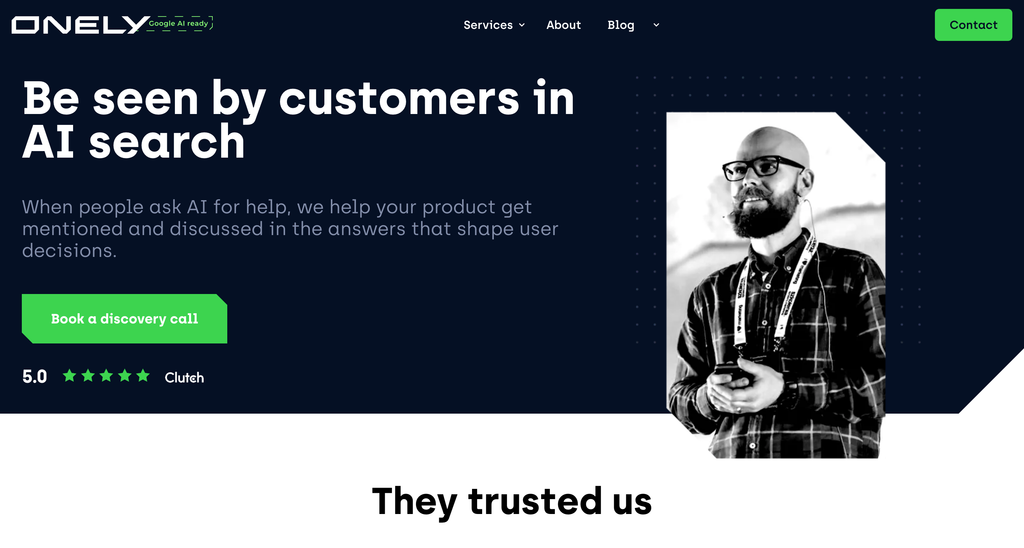
Onely leads with “we deliver organic growth through practical innovation”, and Generative Engine Optimization is now their first listed service. The technical reputation is the substance though, with JavaScript SEO, Core Web Vitals, information architecture and traffic drop recovery all named. Clients include eBay, Oracle, Atlassian, Ikea and Miele.
Given that retrieval failures cause most AI answer errors, a firm whose core competence is making complex sites machine-readable is well positioned for AI search, whether or not it rebrands.
They suit organisations with a genuinely technical problem. A JavaScript-heavy application, a migration that went wrong, or an unexplained traffic drop. Where they fall short: they promise “measurable improvements in AI visibility and business outcomes within weeks”. That is faster than we would claim for anything involving earned authority, so ask precisely what gets measured in that window. No published pricing.
6. Seer Interactive
Seer Interactive blends “expert consulting with data-qualified recommendations” across SEO, paid media, analytics, creative, CRO, GEO and AI consulting. They lead on proprietary data, citing SeerSignals and 8.2 billion rows of SERP data, and report 97% client retention with an NPS of 71.
They suit data-heavy programmes in SaaS, healthcare, banking and higher education, where analytical rigour matters as much as output. Where they fall short: GEO appears as a listed service without much public explanation of method, which reads thin next to iPullRank. The consulting-led model also means confirming who implements. No published pricing.
How to tell rebuilt from rebranded
Four questions separate them reliably, and none require you to know the technology.
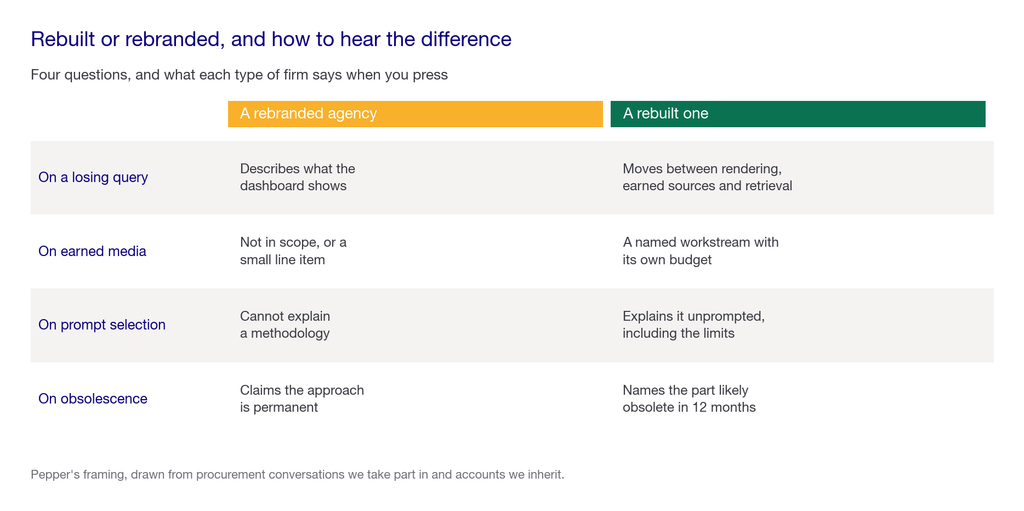
“Take one query where a competitor beats us and explain why.” A rebuilt agency moves between layers. How the competitor’s page renders, what earned sources reinforce it, why the engine trusts it. A rebranded one describes what the dashboard shows.
“What proportion of this scope is earned media?” Given the 84% figure, an all-on-site proposal is structurally mismatched to the outcome. There may be good reasons in your case, so make them say what they are.
“How do you select prompts?” If they cannot explain a methodology, the visibility number they report is whatever the prompt list flatters. This single question filters more proposals than any other.
“Which part of your methodology will be obsolete in 12 months?” The field is moving fast. A thoughtful answer beats a confident one, and anyone claiming permanence has not been paying attention.
What nobody should promise you
Guaranteed citations or rankings. Google explicitly advises against providers guaranteeing rankings, because third parties cannot access internal ranking systems, and nobody has that access for ChatGPT either.
A single AI visibility score. Composite numbers hide the gap between being mentioned and being cited.
Results in one quarter on earned authority. It depends on other people publishing, which no agency controls.
That AI search replaces SEO. Google’s own position is that this is still SEO. Anyone telling you your existing work is now irrelevant is selling a rebuild you probably do not need.
Frequently asked questions
What does an AI SEO agency do differently?
A genuine one changes three things. First, measurement moves from rankings to mentions and citations across engines. Second, earned media gets real budget, because 84% of AI citations come from third-party sources. Third, the technical checklist adds AI crawler access and rendering.
Is an AI SEO agency different from an SEO agency?
Increasingly less than the marketing implies. Google states AI search optimisation is still SEO. So the genuine differences are measurement, source mix and multi-engine coverage, rather than a separate discipline needing a separate vendor.
How much do AI SEO agencies cost?
Few publish pricing. Optimist lists $3,000 monthly for advisory and $4,000 for full service, plus a $7,500 roadmap. Most others, Pepper included, quote after a conversation, because scope varies enormously with site size and market count.
How do I know if an agency actually understands AI search?
Ask them to take one query where a competitor beats you and explain why. A firm that has done the work moves between rendering, earned sources and retrieval. A firm that has rebranded describes what a dashboard shows.
Should I hire a specialist AI SEO agency or a full-service one?
It depends which of three capabilities you lack. Technical retrievability, content and structure, or earned authority. Most engagements fail on the third, so weight earned-media capability heavily unless your problem is clearly technical.
How long before an AI SEO engagement shows results?
Technical fixes can show within weeks. Content structure takes a quarter. Earned authority takes two to three quarters because it depends on other publishers. SalesHood’s AI Overview keywords rose from 14 to 97 across five months, which is a realistic shape.
Do AI SEO agencies work for B2B?
Particularly well, because B2B buyers research in AI tools before contacting vendors. Forrester found 94% of B2B buyers used generative AI during purchases in 2026, with 47% building the internal business case before speaking to anyone.
What is the biggest red flag when hiring an AI SEO agency?
Guaranteed citations. Nobody has access to the ranking systems. After that, watch for proposals with no earned-media component and vendors who cannot explain how they select the prompts they report on.
Where to go next
Before you brief anyone, run the diagnostic yourself. Take 20 to 30 real commercial questions from your category and run them across the engines your buyers use. Then record where you appear, which competitors appear instead, and which sources win those answers.
That exercise tells you which capability you are actually short of, and it makes every agency conversation sharper. Most teams skip it, then buy the capability that was pitched best rather than the one they needed.
Our 7-point AI search audit is the checklist we run on every new account, and the Visibility, Citability and Retrievability framework covers which lever your findings point to.
To see where you stand today, book a growth audit and we will run your category’s prompt set against the sources currently winning those answers. Customers run this themselves inside the platform, with a growth team attached. Our Acceldata case study documents 6X organic traffic growth over nine months, and the SalesHood case study documents the GEO recovery described above.
Sources
Agency descriptions were taken from each company’s own website on 25 August 2026, not from competing roundups. Every study cited was published in 2026. Agency results figures, including ours, are company-reported and not independently audited.
- Google Search Central, AI features and your website, 15 May 2026.
- Muck Rack, Earned media still drives 84% of AI citations, 7 May 2026. More than 25 million cited links, 17 industries. Muck Rack sells PR software.
- Forrester, 2026 Buyers’ Journey Survey, January 2026. 18,000 global business buyers.
- Suzgun et al., Evaluating Commercial AI Chatbots as News Intermediaries, arXiv, 21 May 2026. 2,100 questions across six chatbots.
- Pepper case studies: SalesHood and Acceldata, verified 25 August 2026.
Latest Blogs
Most advice on this is inference dressed as fact. OpenAI documents exactly one thing clearly, which is access. Here is what is documented, what is inferred, and how to verify the rest for yourself.
Being named in an AI answer and having your page used as its source are different outcomes with different causes and different fixes. The gap between them is the most useful diagnostic in AI search, and most reporting collapses it into one number.
Every platform reports share of voice and almost none of them define it the same way. Here is the definition worth using, the three choices that change the number, and how to measure it yourself without buying anything.
Get your hands on the latest news!