What is a SERP? A complete guide to search engine results pages in 2026
The short answer
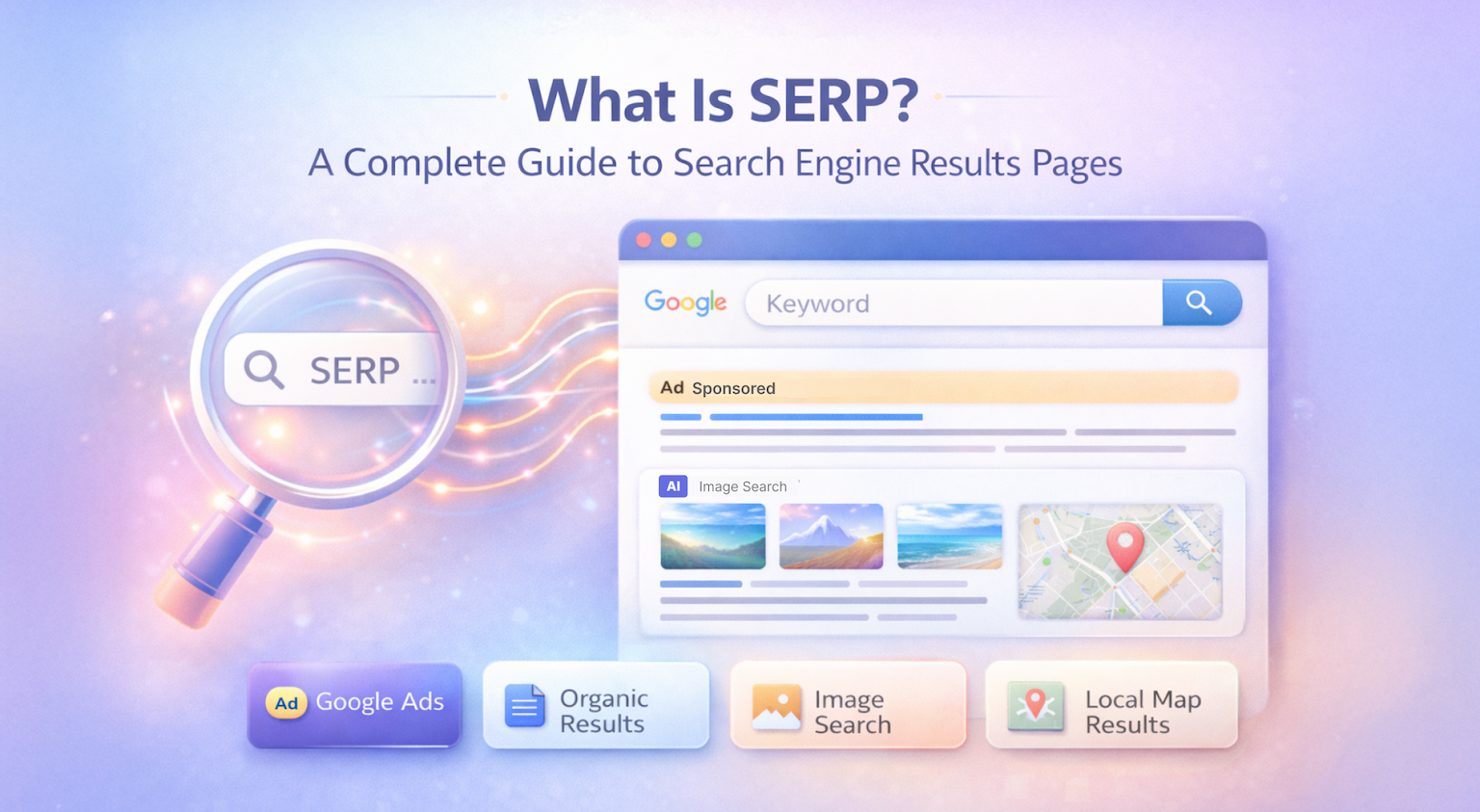
A SERP, or search engine results page, is the page you get back after a search. That definition has not changed. What sits on the page has changed almost completely.
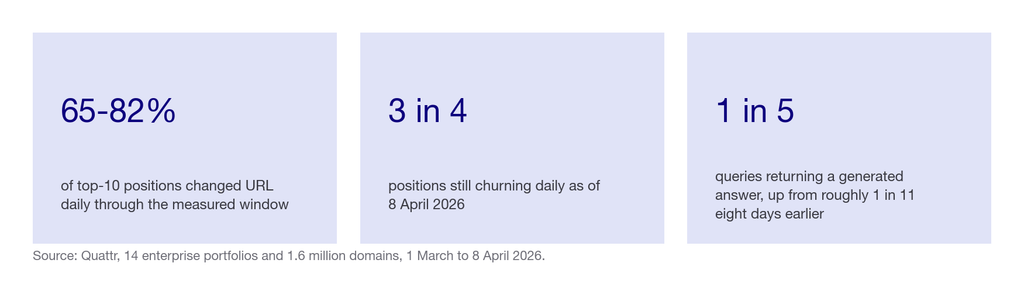
The most useful way to understand a SERP in 2026 is that it is not a ranking you hold. It is a page that re-renders. One study covered 14 enterprise portfolios and 1.6 million domains between 1 March and 8 April 2026. At the end of that window, three out of four top-10 positions were still changing URLs daily.
Key takeaways
- A SERP is assembled rather than retrieved. Google composes it from many blocks. Organic links are one of them.
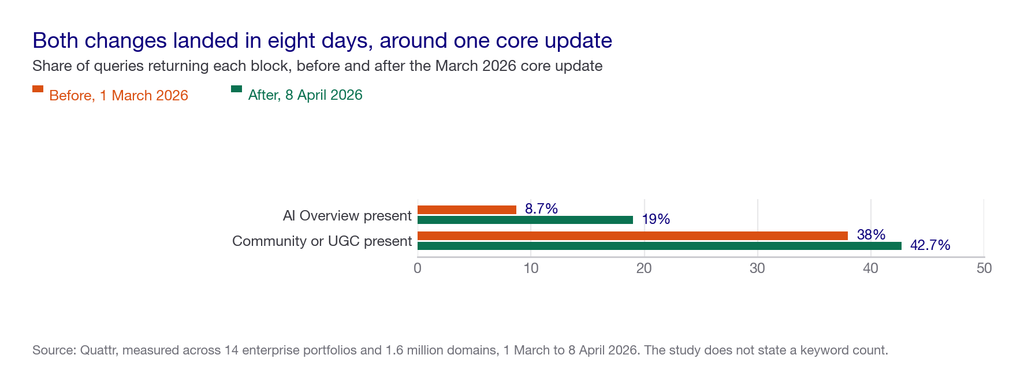
- AI Overview share moved fast. It jumped from 8.7 percent to 19.0 percent of queries in eight days, around the March 2026 core update.
- Community content now competes on four queries in ten. UGC prevalence rose from 38.0 percent to 42.7 percent in the same window.
- Position is not possession. URL churn in the top ten ran at 65 to 82 percent through that period.
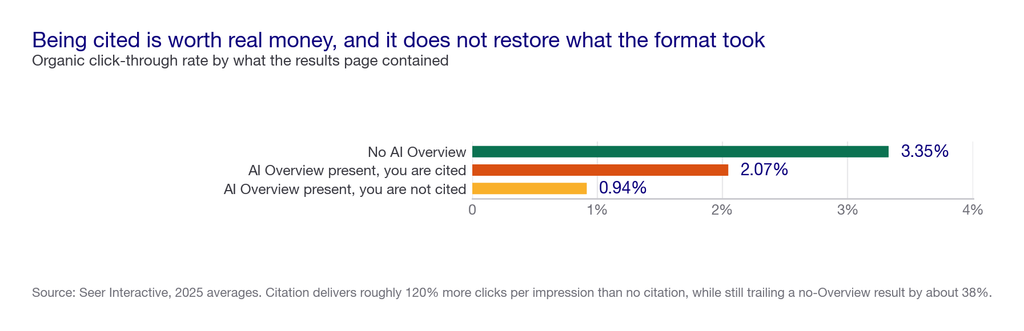
- Being cited beats being ranked. With an AI Overview present, cited pages earned about 2.07 percent click-through. Uncited pages earned 0.94 percent.
Where this comes from. We run organic for more than 250 enterprises at Pepper and track over 10 million prompts across every major engine. We watch page composition shift weekly on live accounts. That work shapes the view here, along with the client reviews we sit in and the conversations we have at the events we run.
What is a SERP?
A SERP is the page a search engine returns for a query. In 2026 it reads better as a set of competing blocks than as a list.
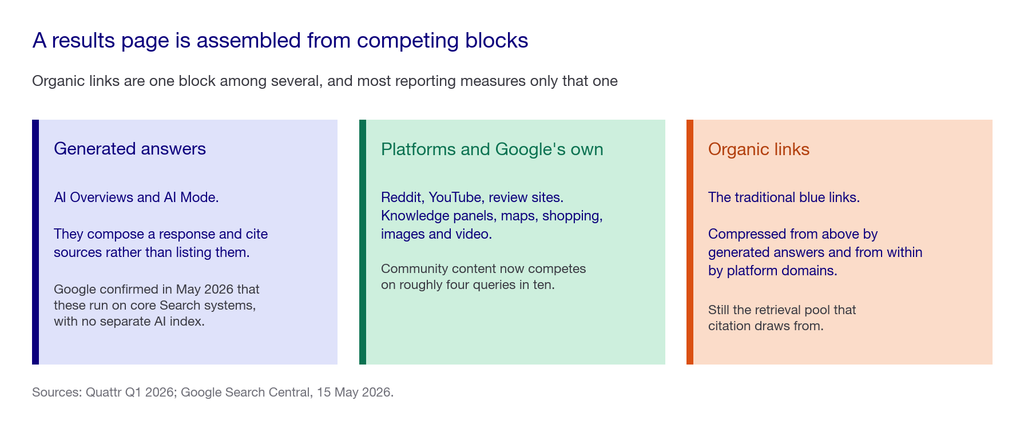
Five kinds of block now share the page, and organic links are only one.
- Generated answers. AI Overviews and AI Mode compose a response and cite sources rather than listing them. Google confirmed in May 2026 that these run on core Search ranking and quality systems, with no separate AI index.
- Owned Google surfaces. Knowledge panels, maps, shopping units, images, videos and Google’s own properties. Video is more winnable than most teams assume, per the YouTube citation data.
- Community and platform content. Reddit, YouTube, LinkedIn and review sites. These now appear on a large share of queries.
- Paid placements. Ads at the top, and sometimes through the page. They are worth little for AI citation, as organic versus paid sets out.
- Organic results. The traditional blue links. This is the only block most SEO reporting measures.
So “ranking first” describes your position within one block. That block may sit below several others on the page.
See where you show up. Pepper’s GEO platform tracks Brand Visibility, Domain Prompt Presence and Share of Voice across ChatGPT, Perplexity, Gemini, Claude and Google AI Overviews. Your team can log in, connect Search Console and GA4, manage the prompt set and run your own agents in the Agent Atlas. A growth team works the same account alongside you. Book a growth audit or see where you show up.
How fast the page is changing
The clearest picture we found comes from a study of the March 2026 core update. The speed is the story.
Quattr measured across 14 enterprise portfolios and 1.6 million domains, from 1 March to 8 April 2026. The update landed between 24 and 31 March. Two composition changes stand out.
- AI Overview query share went from 8.7 percent to 19.0 percent in eight days. That is close to one query in five. The authors describe it as a new structural baseline rather than a test.
- UGC prevalence rose from 38.0 percent to 42.7 percent. So four queries in ten now have a platform domain competing for page-one positions.
Read those together and the organic block is compressed from both directions at once. Generated answers take space above it. Community platforms take positions within it.
On how this squares with other measurements. A separate aggregation of seven datasets put prevalence much higher. Near 88 percent for healthcare, and around 25 percent across all industries in Q1 2026. These are differently built rather than contradictory. Different keyword samples, different vertical mixes, different definitions of a triggering query. We covered that disagreement in which industries GEO actually works for. Treat the direction as reliable and any single percentage as approximate.
What it costs when a generated answer appears
This is the part that turns page composition into a business problem.
Seer Interactive’s 2025 averages remain the cleanest like-for-like comparison we have found. They break click-through down by what the page contained.
- No AI Overview: 3.35 percent organic click-through.
- AI Overview present, and you are cited: 2.07 percent.
- AI Overview present, and you are not cited: 0.94 percent.
Two readings matter. Being cited earns roughly 120 percent more clicks per impression than not being cited, so citation is worth real money. A cited result still trails a page with no AI Overview by around 38 percent, so citation does not restore what the format took.
Ahrefs reached a compatible conclusion from a different angle. It compared 150,000 keywords carrying AI Overviews against 150,000 informational controls. The top-ranking page earns 58 percent fewer clicks when an AI Overview is present.
The conclusion is uncomfortable but simple. On queries with a generated answer, the question is no longer whether you rank. It is whether you are quoted.
Position is not possession
The third finding from that March window changes how you should read a rank tracker.
URL churn in the top ten ran at 80 to 82 percent before the update. It fell to 65 percent, then rose again to 75 percent. On 8 April, three in four top-10 positions were still changing URLs daily.
A rank of four is not a holding. It is a reading taken at one moment, on a page assembled for that moment.
That has two practical effects. Daily rank movement is mostly noise, so it should not drive decisions. A monthly average across a fixed query set tells you far more than any single-day position. That is why every measurement method we publish uses a fixed set over three readings.
Our methodology: how we weight SERP work
| Factor | Weight | Why it carries this much |
|---|---|---|
| Citation in generated answers | 35% | On AI Overview queries, cited pages earn roughly 120% more clicks than uncited ones |
| Presence in the blocks that sit above organic | 25% | Knowledge panels, video and community results now occupy space organic used to own |
| Classic organic ranking | 25% | Still the retrieval pool for citation, and still the largest single block on many queries |
| Stability of the query set you measure | 15% | With 65 to 82% daily URL churn, an unstable measurement set produces unreadable data |
SERP blocks at a glance
| Block | What it is | How you influence it | Typical cost | Where it falls short |
|---|---|---|---|---|
| AI Overview | A generated answer with citations | Be quotable, and rank well enough to be retrieved | Content depth, the main line item | Nobody controls generated output |
| Featured snippet | One lifted answer above organic | Answer-first structure, clean markup | Editing time, low | Volatile, and can vanish overnight |
| People Also Ask | Expandable related questions | Question-shaped headings on your pages | Low, structural | Weak click value on its own |
| Knowledge panel | Entity summary, usually right-hand side | Entity consistency and third-party corroboration | Slow, largely earned | Not directly editable by you |
| Community and UGC | Reddit, YouTube, review sites | Genuine participation, not posting | Sustained time, resists outsourcing | Volatile, as platform citation shares have shown |
| Local pack | Map plus three listings | Listings, proximity, reviews | Low, largely internal | Irrelevant to non-local queries |
| Paid | Ads above and within results | Bidding | Ongoing media spend | Roughly 0.3% of AI citations come from paid content |
| Organic | The traditional blue links | Everything classic SEO does | Your existing budget | One block among several, and compressed from both sides |
How to evaluate your position on a modern SERP
A rank report cannot answer this. Reading the page can, and the free measurement method covers how.
The scorecard
Score your position out of 100 on the queries that matter to you.
| Factor | Weight | How to score it honestly |
|---|---|---|
| You know which blocks appear on your queries | 30% | Someone has looked at the actual pages, rather than reading a rank export |
| You are cited when a generated answer appears | 25% | Tracked separately from ranking, because they move independently |
| You appear in at least one non-organic block | 20% | Video, community, knowledge panel or local, wherever your queries return them |
| Your measurement set is fixed | 15% | The same queries every month, given churn of 65 to 82 percent |
| You read monthly, not daily | 10% | Daily movement on this page is mostly noise |
The live test, over 90 days
Fix 30 prompts in your buyers’ words and hold them steady. Real questions, such as “what is a SERP”, “best project management tool for a small agency”, “how long does knee replacement recovery take” and “is generative engine optimization worth it”.
For each, record what the page contained. Whether a generated answer appeared, whether it cited you, which other blocks were present, and where your organic result sat.
Rerun the identical set monthly for 90 days. Three readings is the shortest honest window. One is a snapshot, two could be noise, three shows direction. Keep the set fixed, because changing it resets the comparison.
The column worth watching is block composition rather than position. When a generated answer starts appearing where it previously did not, your traffic moves before your rankings do. That is the pattern we unpack in rankings held and traffic fell.
Weak approach versus strong approach
The weaker approach: track average position daily, report it monthly, then treat any fall as a ranking problem to fix with more content.
The stronger approach: record what the page contained alongside where you sat on it. Then treat a composition change as a different problem from a ranking change.
The weak version cannot tell a lost position from a changed page. Those need opposite responses. With three in four positions churning daily, it also generates constant false alarms.
Red flags
- Rank reporting with no page context. Position four means one thing with a generated answer above it, and another without.
- Daily rank alerts. With 65 to 82 percent churn, these mostly report noise.
- Guaranteed first position. Nobody controls generated output, and Google warns against providers guaranteeing rankings.
- Pixel-share statistics with no stated device. Above-the-fold claims rest on viewport assumptions that are rarely published.
- Treating citation and ranking as one number. They move independently and need separate work.
- Ignoring community results. Platform domains now compete on roughly four queries in ten.
Five questions worth asking
- “What blocks actually appear on our top queries?” If nobody has looked at the pages, the plan rests on an export.
- “Are we cited when a generated answer appears?” A separate number from ranking.
- “Which non-organic block could we realistically win?” Video, community and local are all winnable, and all ignored.
- “Is our measurement set fixed?” Churn makes an unstable set unreadable.
- “What changed on the page, rather than in our position?” The better first question after a traffic fall.
Reduced to one principle: read the page, not the position.
One closing note that costs us something. Most of what we have described is measurable for free, by reading thirty pages once a month. Agencies would rather sell a dashboard than teach you to read a results page, ours included. Do the manual version first, and buy tooling when it stops fitting in an afternoon.
What does this cost?
| What you are buying | Typical 2026 cost | What it covers |
|---|---|---|
| Reading thirty results pages by hand | Free, about two hours a month | Block composition, citation and position, per query |
| Google Search Console | Free | Your own first-party impressions and clicks |
| Answer-first restructuring | Roughly a day of editing per page | Being quotable when a generated answer appears |
| Winning a non-organic block | Varies by block | Video production, community time, or listings work |
| Rank and SERP feature tracking | Roughly $99 to $400 a month | Automated composition tracking at scale |
| Platform plus a growth team | Custom | Pepper: tracking, plus the people and agents doing the work |
The first row is free and it is the one that tells you which of the rows below you need.
What nobody should promise you
A guaranteed first position. Nobody controls generated output, and Google warns against providers guaranteeing rankings.
A stable ranking. Between 65 and 82 percent of top-10 URLs changed daily through the measured window.
That ranking first restores your old click-through. A cited result with an AI Overview present still underperforms a page with no AI Overview by roughly 38 percent.
A precise figure for how much of the page organic owns. Pixel-share claims depend on device and viewport assumptions that are rarely stated.
When rank tracking is still enough
The answer that costs us the sale. If your queries return no generated answer, no community results and no rich blocks, you do not need SERP composition tracking and we would tell you not to buy it.
That is a real situation, particularly on narrow technical and local queries. Check it rather than assuming it. Run your thirty queries once and note what the pages contained. If the answer is ten blue links, a rank tracker is still an adequate instrument. Recheck in six months, because AI Overview share doubled in eight days on the last core update.
Frequently asked questions
What is a SERP?
A search engine results page, meaning the page returned after a search. In 2026 it reads best as a set of competing blocks rather than a list. Generated answers, community content, Google’s own surfaces, ads and organic links all share the space.
What does SERP stand for?
Search Engine Results Page. The term predates almost everything that now appears on one, which is why the definition sounds simpler than the thing it describes. A 2026 results page mixes generated answers, platform content, ads and organic links.
What are SERP features?
Any block that is not a standard organic link. AI Overviews, featured snippets, People Also Ask, knowledge panels, local packs, image and video carousels, and shopping units are the common ones.
How often do SERPs change?
Constantly. Measurement across 1.6 million domains found 65 to 82 percent of top-10 positions changing URLs daily through March and early April 2026. A single-day position is a reading rather than a holding.
Do AI Overviews reduce clicks?
Yes, substantially. Organic click-through was 3.35 percent with no AI Overview, 2.07 percent when one appeared and cited you, and 0.94 percent when one appeared and did not. Being cited roughly doubles your clicks without restoring the original rate.
Is it better to rank first or be cited?
On queries with a generated answer, citation matters more. Cited pages earned roughly 120 percent more clicks per impression than uncited ones. A cited result still trails a page with no AI Overview at all.
How much of the SERP is organic now?
No trustworthy single figure exists. Pixel-share measurements depend on device and viewport assumptions that are rarely published. What is measurable is that AI Overview share more than doubled in eight days, and community content now appears on roughly four queries in ten.
How do I track SERP features for my queries?
Fix thirty queries and record what each page contained, monthly. Generated answer present or not, whether you were cited, which other blocks appeared, and your organic position. That is free, and it beats a rank export.
Where to go next
Open the actual results pages for your ten most valuable queries and write down what is on them.
Most teams have never done this. It usually explains a traffic pattern that a rank report made look mysterious.
Learn AI Search · Why clicks fall when rankings hold · Book a growth audit
Sources and further reading
- Quattr. Q1 2026 organic search shifts, measured across 14 enterprise portfolios and 1.6 million domains from 1 March to 8 April 2026, covering the core update between 24 and 31 March. AI Overview query share rose from 8.7 percent to 19.0 percent in eight days, described by the authors as a new structural baseline. UGC prevalence rose from 38.0 percent to 42.7 percent. Top-10 URL churn ran at 80 to 82 percent, fell to 65 percent, then returned to 75 percent. The study does not state a keyword count, and publishes no click-through or page real-estate data. Link
- Seer Interactive. Organic click-through by AI Overview state, 2025 averages: 3.35 percent with no AI Overview, 2.07 percent when present and citing, 0.94 percent when present and not citing. Being cited delivers roughly 120 percent more clicks per impression than not being cited, while still trailing a no-Overview result by about 38 percent.
- Ahrefs. Comparison of 150,000 keywords with AI Overviews against 150,000 informational controls, finding the top-ranking page earns 58 percent fewer clicks when an AI Overview is present.
- AI Overview prevalence by industry, Q1 2026 benchmarks, aggregating seven measurement datasets. Quoted here to show that prevalence figures disagree by sample and vertical mix rather than to establish a single number. Link
- Google Search Central. AI search optimisation guidance, 15 May 2026. Confirms AI Overviews and AI Mode run on core Search ranking and quality systems with no separate AI index, and warns against providers guaranteeing rankings.
- Pepper. Rankings held and traffic fell for the diagnostic when position holds and clicks do not, and how to write content that AI engines actually cite for the citation half.
- Deliberately excluded: the claim that SERP features occupy 60 to 80 percent of above-the-fold space on commercial queries, and that roughly 68 percent of US searches end without a click. Neither traces to a published method we could open, and pixel-share claims depend on device and viewport assumptions that are rarely stated.
Latest Blogs
Most advice on this is inference dressed as fact. OpenAI documents exactly one thing clearly, which is access. Here is what is documented, what is inferred, and how to verify the rest for yourself.
Being named in an AI answer and having your page used as its source are different outcomes with different causes and different fixes. The gap between them is the most useful diagnostic in AI search, and most reporting collapses it into one number.
Every platform reports share of voice and almost none of them define it the same way. Here is the definition worth using, the three choices that change the number, and how to measure it yourself without buying anything.
Get your hands on the latest news!

Similar Posts
Content Creation
7 mins read
What Is Skyscraper Content, And How Can You Use It?

Content
14 mins read