The enterprise SEO audit framework: 47 checks for sites at scale
Most audit checklists are written for a 200-page site and then handed to someone running 800,000 URLs. The checks are not wrong. They are just aimed at problems that stop mattering at scale, and silent about the ones that start.
At enterprise scale the question stops being “is this page optimised” and becomes “can Google fetch, render and index this template at all, and is it spending its crawl on the URLs that earn money.” Those are different questions with different evidence.
Pepper runs organic for more than 250 enterprises, and this is the framework our growth teams work through on a new account. Forty-seven checks, six categories, sequenced so the ones that unblock everything else come first.
The short answer
Run the audit in sequence, not in parallel. Crawl and indexation first, because a page that cannot be fetched cannot be fixed by anything downstream. Rendering second. Architecture and templates third. Structured data and AI retrievability last, because they only pay off once the first three are clean.
Google names the exact thresholds where this becomes necessary, and they are more specific than most people expect.
The framework below is the one Pepper’s growth teams work through on a new enterprise account, which is why it is sequenced rather than listed.
Key takeaways
- Google publishes the trigger conditions. Sites above 1 million pages changing weekly, sites above 10,000 pages changing daily, or any site with a large share of URLs sitting in “Discovered, currently not indexed.”
- Two popular fixes are named by Google as ineffective. Using
noindexto save crawl budget, and using robots.txt to temporarily reallocate it. - Audit templates, not pages. At scale, one template flaw is a hundred thousand URL flaws, and page-level auditing will never find it.
- You need four data sources. A full crawl alone cannot tell you what Google actually fetched. Server logs can.
- Sequence matters more than completeness. Structured data on a page that never gets rendered is wasted work.
A note on where this comes from. We run organic for more than 250 enterprises and track over 10 million prompts across every major engine. What follows is shaped by that, by the client reviews we sit in weekly, and by the accounts we inherit and have to diagnose from scratch. It is the framework we actually use, not a generic checklist.
What is an enterprise SEO audit?
An enterprise SEO audit is a diagnostic of a large website’s ability to be crawled, rendered, indexed and cited, run at template level rather than page level, using crawl data, server logs, Search Console and URL mapping together.
The distinction from a standard audit is not thoroughness. It is unit of analysis. On a 200-page site you audit pages. On a 500,000-URL site you audit templates, because pages are generated from a few dozen patterns and a single flawed pattern produces tens of thousands of identical failures. Fixing them one at a time is not an option, and finding them one at a time is not either.
Google states which sites need this. Its crawl budget guidance names three conditions: large sites of 1 million or more unique pages with content changing about weekly, medium or larger sites of 10,000 or more unique pages with very rapidly changing daily content, and sites with a large portion of total URLs classified by Search Console as “Discovered, currently not indexed.”
That third condition is the one most teams overlook, and it applies at any size. If Search Console knows about your URLs and has chosen not to fetch them, you have a crawl budget problem regardless of your page count.
Our enterprise SEO guide covers what else changes above 10,000 pages, and the technical SEO agency guide covers when to bring in outside help.
The audit at a glance
| Category | Checks | What it catches | Typical remediation cost |
|---|---|---|---|
| Crawl and indexation | 10 | Crawl waste, discovery failures, budget spent on parameters and pagination | Low, mostly configuration |
| Rendering and JavaScript | 7 | Content that exists for users and not for crawlers | High, engineering sprints |
| Architecture and internal linking | 8 | Orphaned templates, depth problems, link equity trapped in navigation | Medium, often a template change |
| Templates and duplication at scale | 7 | One flaw multiplied across a hundred thousand URLs | Medium to high |
| Structured data and entities | 6 | Machine-readable meaning, brand disambiguation | Low to medium |
| AI retrievability | 9 | Whether AI crawlers can fetch and cite what Google can | Low, mostly access configuration |
Forty-seven checks. Costs are indicative bands from engagements we run rather than quoted prices, and they vary enormously with your engineering capacity.
If you want this framework run against your site rather than done from memory, book a growth audit and we will work through it with your team.
How we weighted the categories
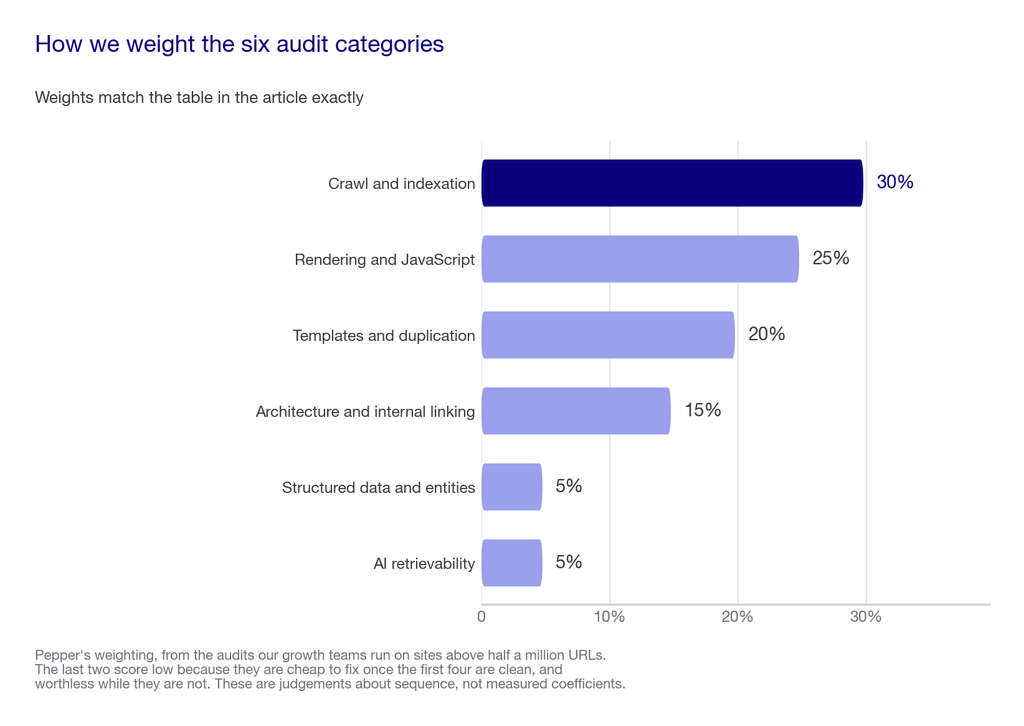
| Area | Weight | What decides the score |
|---|---|---|
| Crawl and indexation | 30 | Whether Google is fetching the URLs that earn revenue, or spending its budget on parameters, pagination and dead templates |
| Rendering and JavaScript | 25 | Whether the content that matters exists in what a crawler receives, not only in what a browser assembles |
| Templates and duplication | 20 | Whether one pattern flaw is silently multiplied across tens of thousands of URLs |
| Architecture and internal linking | 15 | Whether important templates are reachable at sensible depth and actually linked from somewhere |
| Structured data and entities | 5 | Whether meaning is machine-readable and the brand is unambiguous |
| AI retrievability | 5 | Whether AI crawlers can fetch what Google can, which is mostly an access question |
Crawl and rendering carry more than half the weight because they gate everything else. Structured data and AI retrievability carry least, not because they are unimportant, but because they are cheap to fix once the first four are clean and worthless while they are not.
Our GEO agency ranking methodology explains how we build weightings like this one.
Why does sequence matter more than completeness?
Because the checks are dependent, and running them in the wrong order wastes the expensive ones.
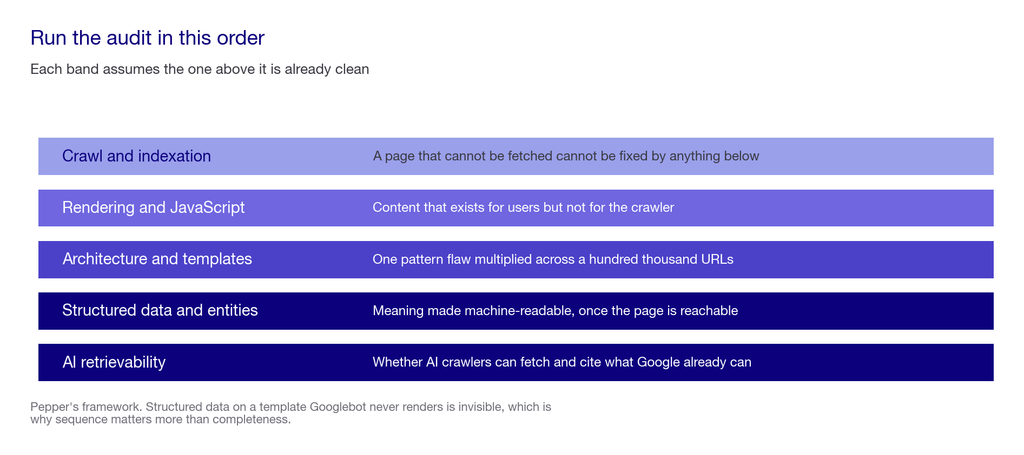
Structured data on a template Googlebot never renders is invisible. Internal linking improvements to a section excluded in robots.txt change nothing. Content depth on a URL sitting in “Discovered, currently not indexed” is a page nobody will read.
So the sequence is the framework. A complete audit delivered in the wrong order produces a 60-item backlog where items 40 through 60 depend on items 1 through 10 and nobody noticed.
The four data sources, and why one is not enough
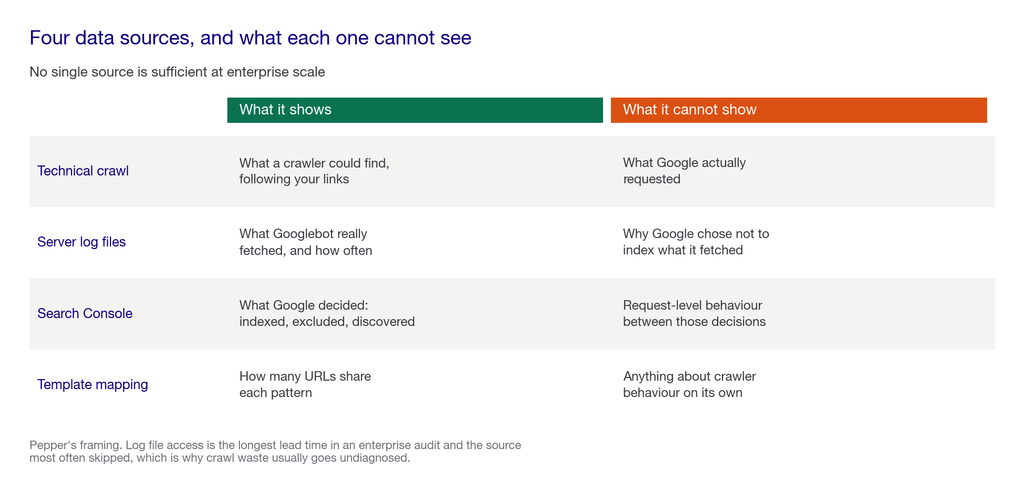
A full technical crawl tells you what a crawler could find, following your links and directives. It cannot tell you what Google actually did.
Server log files tell you what Googlebot actually requested, how often, and what it received. This is the only source that shows real crawl behaviour, and it is the one most audits skip because access is a fight with the infrastructure team. Get it anyway.
Search Console tells you what Google decided after fetching: indexed, excluded, discovered and not crawled, crawled and not indexed. The Page Indexing report is where crawl budget problems surface first.
Template and URL mapping tells you which patterns generate which URLs, so a finding on one page can be scoped to the ninety thousand that share its template.
Run any one alone and you will misdiagnose. A crawl showing clean internal linking means nothing if logs show Googlebot spending 60% of its requests on faceted parameters.
The 47 checks
Crawl and indexation, 10 checks
- Robots.txt directives audited line by line, including whether any rule blocks a template that should be indexed.
- Segment XML sitemaps by template, so you can read index coverage per pattern rather than in aggregate.
- Sitemap freshness and accuracy, with no 3xx, 4xx or noindex URLs submitted.
- “Discovered, currently not indexed” volume and trend in Search Console, which Google names as a crawl budget trigger.
- “Crawled, currently not indexed” volume, which is a quality or duplication signal rather than a budget one.
- Log file analysis of Googlebot request distribution by template, to find where the budget is actually going.
- Review parameter and faceted URL handling, the most common source of crawl waste at scale.
- Review pagination handling, including whether deep pages remain reachable and worth reaching.
- Check server response health, since Google ties crawl capacity to latency stability and the absence of 5xx errors.
- HTTP 304 support and caching behaviour, which Google explicitly recommends for crawl efficiency.
Where this falls short: crawl data tells you about access, not about whether the page deserves to rank. A perfectly crawlable thin template is still a thin template.
Rendering and JavaScript, 7 checks
- Compare rendered against raw HTML on every major template, to find content that appears only after JavaScript executes.
- Flag client-side rendered primary content, especially on product detail and category templates.
- Find internal links injected by JavaScript, which a crawler may never discover as links.
- Test rendering timeouts on heavy templates, where content exists but arrives too late.
- Find blocked resources in robots.txt that the renderer needs to assemble the page.
- Check canonical and meta directives injected client-side, which prove unreliable and frequently contradict the server response.
- Compare rendering across device types, since mobile rendering is the one that counts.
Where this falls short: rendering checks are expensive to remediate and often collide with a product roadmap. Expect these to be the slowest fixes in the backlog.
Architecture and internal linking, 8 checks
- Measure click depth by template, from the homepage and from category entry points.
- Find orphaned URLs and orphaned templates, which represent different problems at different scales.
- Map internal link distribution to find templates that receive almost no internal links.
- Separate navigation from contextual links, since sitewide navigation distributes differently from in-content links.
- Check breadcrumb implementation and consistency across templates.
- Hub and cluster integrity, whether pillar pages actually link down and cluster pages link back.
- Cross-linking between revenue templates, which is usually the largest missed opportunity at scale.
- Find redirect chains and loops, particularly those a past migration introduced.
Where this falls short: internal linking findings are easy to produce and hard to prioritise. Without revenue mapping you will optimise linking to pages nobody buys from.
Templates and duplication at scale, 7 checks
- Template inventory, an explicit list of every pattern generating URLs, with counts.
- Detect near-duplicates across templates, not only exact duplicates.
- Verify canonical logic per template against actual rendered output rather than stated intent.
- Find thin or empty-state templates, such as zero-result category pages that still generate URLs.
- Check title and meta description patterns for uniqueness at pattern level.
- Verify internationalisation and hreflang, where implemented, as reciprocal and complete.
- Set programmatic page quality thresholds defining when a generated page should never publish at all.
Where this falls short: template auditing needs engineering cooperation to change anything, so findings here often sit longest in the backlog.
Structured data and entities, 6 checks
- Confirm schema is present, valid, and matches visible content on each major template.
- Check Organization and brand entity markup stays consistent across the site.
- Populate Product, Article or Service schema as appropriate, with every required property filled.
- FAQ and HowTo schema where genuinely applicable, not applied decoratively.
- Check entity consistency off-site, so every source describes the brand the same way.
- Add author and reviewer markup to content where expertise counts as a ranking consideration.
Where this falls short: structured data is frequently oversold as a ranking lever. It makes meaning machine-readable. It does not make a weak page strong.
AI retrievability, 9 checks
- Check AI crawler access in robots.txt per agent rather than assuming it.
- Test whether AI crawlers can render your primary templates, a stricter bar than Googlebot passing.
- Use server-side rendering for content you want cited, since retrieval failures cause a documented share of AI answer errors.
- Test content extractability: whether an engine can lift the key claim cleanly as a standalone passage.
- Check factual density and specificity on pages targeting commercial questions.
- Check freshness signals and visible dates, which affect selection for time-sensitive answers.
- Build citation-worthy assets: original data, methodology statements and definitions other sources can reference.
- Brand Visibility against Domain Prompt Presence, the gap between engines mentioning you and engines citing your pages.
- Off-site source coverage, which publications and communities feed answers in your category.
Where this falls short: the last three are not fixed on your own site. Muck Rack found 84% of AI citations come from earned media, so an audit that ends at your domain boundary has scoped out most of the work. Our Visibility, Citability and Retrievability framework covers which lever is actually stuck.
What an enterprise SEO audit costs
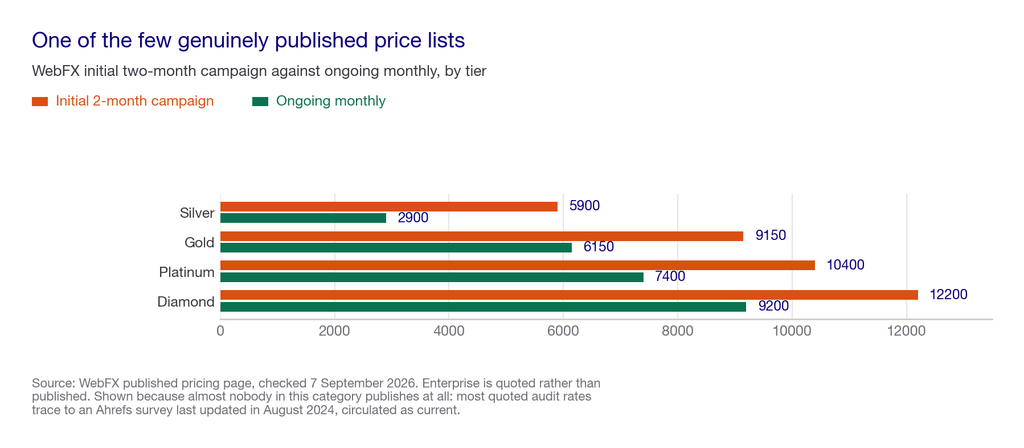
Published figures in this category are unreliable, and it is worth knowing why before you benchmark against them. Most cost guides quote hourly and project rates attributed to an “Ahrefs 2026 survey.” That survey exists, and it was last updated in August 2024. Its figures are being circulated two years out of date.
What is verifiable: WebFX publishes its pricing, with an initial two-month campaign from $5,900 to $12,200 across four tiers, ongoing monthly optimisation from $2,900 to $9,200, and enterprise quoted. That is one of very few genuinely published price lists in the category.
The honest guidance is that an enterprise audit’s cost is driven by three things, none of which appear in a price range: how many templates you have, whether log file access is available, and whether anyone will act on the output. The third dominates. Our cost breakdown of platforms against hiring models the execution side properly, and SEO audit agencies covers what to pay and what a real audit includes.
What nobody should promise you
That noindex saves crawl budget. Google states plainly that it will still request the page, then drop it when it sees the directive. The crawl is already spent.
That robots.txt reallocates crawl budget. Google says it will not reallocate unless you are already hitting capacity limits.
Guaranteed rankings after remediation. Google advises against providers guaranteeing rankings, because third parties cannot access internal ranking systems.
A finished audit as the deliverable. An audit is a diagnosis. If nobody has engineering time to act on it, you have bought a document.
How to evaluate an enterprise SEO audit before you commission it
I would judge the proposal on its evidence sources before anything else, because that single question separates a real diagnostic from a crawl export with commentary.
Google’s guidance is the anchor and it is more specific than most proposals acknowledge. Crawl budget management matters for sites above 1 million pages changing weekly, sites above 10,000 pages changing daily, and any site with a large share of URLs in “Discovered, currently not indexed.” Google also states what crawl capacity depends on, namely crawl health and its own resource availability, and what crawl demand depends on, namely perceived inventory, popularity and staleness. A proposal that never mentions logs or Search Console coverage states is not measuring any of that.
Score the proposal before you sign it.
| Area | Weight | What a strong proposal demonstrates |
|---|---|---|
| Evidence sources | 30 | Crawl, server logs, Search Console and template mapping all named, with log access raised as a prerequisite rather than an optional extra |
| Template-level analysis | 25 | Findings scoped to patterns and URL counts, not a list of individual page issues |
| Prioritisation by revenue | 20 | Findings ranked by the templates that earn money, with an explicit estimate of remediation effort |
| Remediation support | 15 | Named help implementing, or at minimum developer-ready tickets rather than a PDF |
| AI retrievability included | 10 | AI crawler access and extractability checked, since Google states AEO and GEO are part of SEO |
Those weights sum to 100. Score your own readiness too, because an audit landing on a team with no engineering time produces a backlog rather than a result.
The live test, before you commission anything. Give every shortlisted provider the same brief and the same three URLs: your highest-revenue template, your largest-volume template, and one URL currently sitting in “Discovered, currently not indexed.” Ask four questions in writing. “What is the rendered versus raw HTML difference on these.” “Which templates do these URLs belong to and how many URLs share them.” “What would you need from our infrastructure team in week one.” “What would change in the next 90 days, and who does it.”
A provider who asks for log file access in reply is running a real audit. A provider who returns a crawl summary in an hour is selling a tool export.
Add the AI half to the same brief, because Google treats it as the same discipline. Give them 30 real commercial questions from your category, written the way a buyer would type them. Four worked examples: “which enterprise SEO platform handles a million URLs”, “how do we stop Google crawling our faceted navigation”, “best technical SEO audit for a large ecommerce site”, “why are our product pages discovered but not indexed”. Ask which of those your templates currently answer, which competitors appear instead, and what would change in the next 90 days.
The weak audit against the strong one. The weaker version runs a crawler, exports the issues tab, sorts by count, and delivers a spreadsheet of several thousand rows. It is page-level, undifferentiated by template, unprioritised by revenue, and it is why so many audits are never implemented.
The stronger version starts from logs and Search Console coverage states, maps findings to templates with URL counts, ranks by the revenue those templates carry, estimates engineering effort for each, and sequences the output so dependencies resolve in order. It produces fewer findings and more change.
Red flags, each one something you will genuinely hear. “We can start without log file access”, which means crawl behaviour will be inferred rather than measured. “Here are 4,200 issues”, offered as thoroughness rather than as a prioritisation failure. “We’ll noindex the thin pages to save crawl budget”, which Google explicitly says does not work. “We’ll block it in robots.txt to redirect crawl budget”, also named by Google as ineffective. “Guaranteed rankings within six months.” “Core Web Vitals is the priority”, on a site where 40% of URLs are not indexed at all. And the quiet one: an audit scope that ends at your domain boundary, with no off-site or earned media component.
Five questions for the first call.
- Which four data sources will you use, and what do you need from us to get them? A good answer names logs first and treats access as a prerequisite. A weak one says a crawl is sufficient.
- Will findings be scoped to templates with URL counts? A good answer describes template mapping. A weak one promises a comprehensive page list.
- How will you prioritise? A good answer is by revenue and effort. A weak one is by issue severity from a tool’s default scoring.
- What does remediation support look like? A good answer is developer-ready tickets or hands-on help. A weak one is a document and a call.
- Does the scope include AI crawler access and extractability? A good answer treats it as part of technical SEO. A weak one calls it a separate engagement.
It all comes down to one principle: audit templates, not pages, and prioritise by revenue rather than by issue count. An audit that produces twelve sequenced findings someone will actually ship beats one that produces four thousand nobody will.
One closing note that costs us something. Very few providers are equally strong across measurement, execution, earned authority and attribution, ours included, and the good ones will tell you which of the four is their weakest. Our depth sits in content, authority and AI search rather than large technical migrations, so if a platform replatform is your primary problem, say so early and we will tell you whether we are the right fit.
How we run this framework
The 47 checks above are what our growth teams work through on a new enterprise account, which is why they are sequenced rather than listed. We wrote them down because the sequence is the part that gets lost when an audit is handed over as a document.
Customers log into the platform themselves: they set up a workspace, define brand profile, competitors and personas, connect GA4 and Search Console, manage themes and prompts, read GEO analytics, and build and run their own agents in the Agent Atlas. We track six engines, including ChatGPT, Perplexity, Gemini and Google AI Overviews.
And a growth team is attached to the account and works through the framework alongside them. That is the deliberate difference: the audit is not a document we hand over, it is the first phase of work we then do with you, which is why the remediation column in the table above is a real number rather than somebody else’s problem.
Where it falls short: we do not publish pricing, so budget discovery is a conversation rather than a page. We are built for teams running organic as a long-term function, so if a standalone audit document is all you want, commission one from a specialist and use this framework to brief them.
Frequently asked questions
What is an enterprise SEO audit?
A diagnostic of a large site’s ability to be crawled, rendered, indexed and cited, run at template level rather than page level. It uses a full crawl, server logs, Search Console and template mapping together, because no single source shows what Google actually did.
When does a site need crawl budget managed?
Google names three conditions: sites above 1 million pages with content changing about weekly, sites above 10,000 pages changing daily, and any site with a large share of URLs classified as “Discovered, currently not indexed” in Search Console.
Does noindex save crawl budget?
No. Google states it will still request the page and then drop it when it sees the directive, so the crawl is already spent. Google also says robots.txt does not reallocate crawl budget unless you are already at capacity.
How long does an enterprise SEO audit take?
Typically three to six weeks for a site above half a million URLs, with most of the variance coming from how long log file access takes to arrange. Remediation runs far longer and depends entirely on engineering capacity.
What data do I need to provide?
Server log files, Search Console access, analytics, and ideally a list of templates with URL counts. Log access is the one that most often delays a start, so raise it with infrastructure in week one rather than week three.
How much does an enterprise SEO audit cost?
Published figures are unreliable, because most quoted rates trace to a survey last updated in August 2024. WebFX publishes an initial two-month campaign from $5,900 to $12,200. Cost is driven by template count, log availability and remediation scope.
Should the audit include AI search?
Yes. Google states that AEO and GEO are part of SEO, and AI crawler access is a technical check like any other. An audit that stops at Googlebot is missing part of the same discipline.
What is the most common finding at scale?
Crawl budget spent on parameter and faceted URLs while revenue templates sit under-crawled. It is invisible in a standard crawl and obvious in server logs, which is why log access matters so much.
Where to go next
Pull your Search Console Page Indexing report and check one number first: the share of URLs in “Discovered, currently not indexed.” Google names that as a crawl budget trigger at any site size, and it takes two minutes.
Then request log file access before anything else, because it is the longest lead time in the whole process and the only source that shows what Googlebot actually did.
Our enterprise SEO guide covers what else changes above 10,000 pages, and SEO audit agencies covers what a real audit includes and what to pay. For the AI half, our AI search audit template is the seven-point checklist we run on every new client.
If you need help choosing a provider, technical SEO agency and enterprise SEO agency cover the selection criteria. Our Acceldata case study shows the work on a technical B2B account.
The honest exit. If your site is under about 10,000 URLs and your content does not change daily, you probably do not need an enterprise audit. Run a standard technical audit, fix what it finds, and revisit when scale or Search Console tells you otherwise.
Sources
Every claim about Google’s guidance is quoted from Google’s own documentation, checked on 7 September 2026. Pricing was checked at the vendor’s own page.
- Google Search Central, Large site owner’s guide to managing your crawl budget, checked 7 September 2026. Names the three trigger conditions, the determinants of crawl capacity and crawl demand, and states that
noindexdoes not save crawl budget and that robots.txt does not reallocate it. - Google Search Central, AI features and your website, 15 May 2026. States that AEO and GEO are part of SEO, that AI Overviews and AI Mode use core Search ranking systems with no separate index, and advises against providers guaranteeing rankings.
- Zhang Kai, He Xinyue and Yao Jingang, From Citation Selection to Citation Absorption, arXiv, 28 April 2026. 602 controlled prompts, 21,143 search-layer citations, 18,151 fetched pages, across ChatGPT, Google AI Overview and Perplexity. Finds that high-influence pages are longer, more structured and richer in extractable evidence, and that citation counts alone inadequately measure effectiveness. Academic and independent of every vendor named here.
- Huang, Goyal, Saha and Chandrasekharan, Answer Bubbles: Information Exposure in AI-Mediated Search, arXiv, 17 March 2026. 11,000 real search queries across five systems. Finds that identical queries produce structurally different information realities across systems, and that Wikipedia and longer sources are disproportionately overrepresented. Academic and independent.
- Muck Rack, Earned media still drives 84% of AI citations, 7 May 2026. More than 25 million cited links across ChatGPT, Claude and Gemini, 17 industries. Muck Rack sells PR software, so read it as an interested party with a large dataset.
- Suzgun et al., Evaluating Commercial AI Chatbots as News Intermediaries, arXiv, 21 May 2026. 2,100 questions across six commercial chatbots, on retrieval failure as a cause of answer errors. Tested on news rather than commercial queries.
- WebFX SEO pricing, checked 7 September 2026. Initial two-month campaign $5,900 to $12,200 across four tiers; ongoing monthly $2,900 to $9,200; enterprise quoted.
- Ahrefs, SEO pricing survey, 439 service providers, last updated 15 August 2024. Cited here only to note that its figures are widely circulated as current 2026 rates, which they are not.
The 47 checks and the category weightings are Pepper’s own framework, based on the audits our growth teams run. They are a working method rather than an industry standard.
Latest Blogs
Most advice on this is inference dressed as fact. OpenAI documents exactly one thing clearly, which is access. Here is what is documented, what is inferred, and how to verify the rest for yourself.
Being named in an AI answer and having your page used as its source are different outcomes with different causes and different fixes. The gap between them is the most useful diagnostic in AI search, and most reporting collapses it into one number.
Every platform reports share of voice and almost none of them define it the same way. Here is the definition worth using, the three choices that change the number, and how to measure it yourself without buying anything.
Get your hands on the latest news!