Technical SEO is the easiest specialism to fake and the most expensive to get wrong. A content programme that underperforms costs you time. A migration that goes wrong costs you a year, and sometimes a job.
That asymmetry should shape how you buy it. You are not looking for the agency with the best deck. You are looking for the one that can tell you why a specific competitor beats you on a specific query, and then actually ship the fix.
Disclosure: Pepper is included on this list and published the guide, so we have placed ourselves in a separate category rather than ranking ourselves against agencies we do not directly compete with. We have also applied the same scrutiny to ourselves as to everyone else, including a “where it falls short” section. Every competitor description is based on that company’s own website as of 18 August 2026, rather than another roundup or secondary source. Where a company does not publish pricing, we have said so rather than estimating it.
Key takeaways
- Ask for a redacted sample audit before anything else. It tells you more in ten minutes than a capabilities call tells you in an hour.
- Check the roundups you are reading. One firm appearing on several “best technical SEO agency” lists has been acquired and no longer leads with technical SEO on its own site.
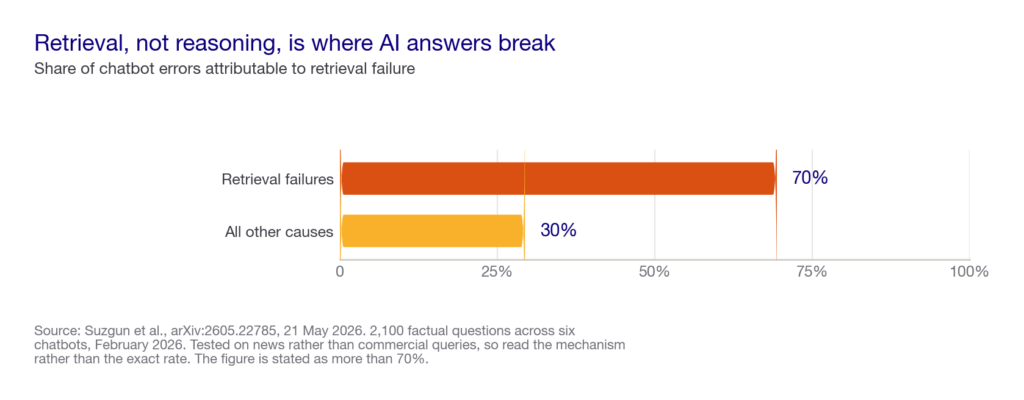
- Technical work now decides AI visibility too. A Stanford-led study in May 2026 found retrieval failures caused over 70% of chatbot errors, which makes crawlability and rendering an AI search issue rather than just a Google one.
- Nobody publishes pricing in this category. Of the firms here, none publish a rate card, so budget discovery is always a conversation.
- The bottleneck is usually implementation. Most technical audits fail not because they were wrong but because nobody owned shipping them.
What a technical SEO agency actually does
Technical SEO is the work of making sure search systems can find, fetch, understand and trust your pages. It sits underneath content and authority, and when it is broken nothing above it performs.
In practice an engagement covers a familiar list. Crawl efficiency, indexation control, rendering, site architecture and internal linking. Then structured data, page performance, international configuration and migrations. On large sites it also covers log file analysis. That is the only way to know what crawlers actually did, rather than what you hoped.
What has changed is who is crawling. It is no longer just Googlebot. OpenAI runs OAI-SearchBot, ChatGPT-User and GPTBot as three distinct agents with different jobs. Similarly, Perplexity runs PerplexityBot and Perplexity-User for scheduled indexing and live fetching. Blocking each one fails differently. A robots.txt decision made two years ago by someone who has since left is a genuinely common cause of AI invisibility.
That shift matters more than it sounds. A Stanford-led evaluation of six commercial chatbots covered 2,100 factual questions in May 2026. It found retrieval failures, rather than reasoning errors, caused more than 70% of all mistakes. When the models retrieved the right source, they usually got the answer right. Which means the boring technical work of being fetchable and parseable is no longer just an SEO hygiene task. It is the main determinant of whether you appear in AI answers at all.
We have run organic for more than 250 enterprises across eight years. In the accounts we take over, flat AI visibility despite good content is usually a technical problem wearing a content problem’s clothes.
The evaluation framework
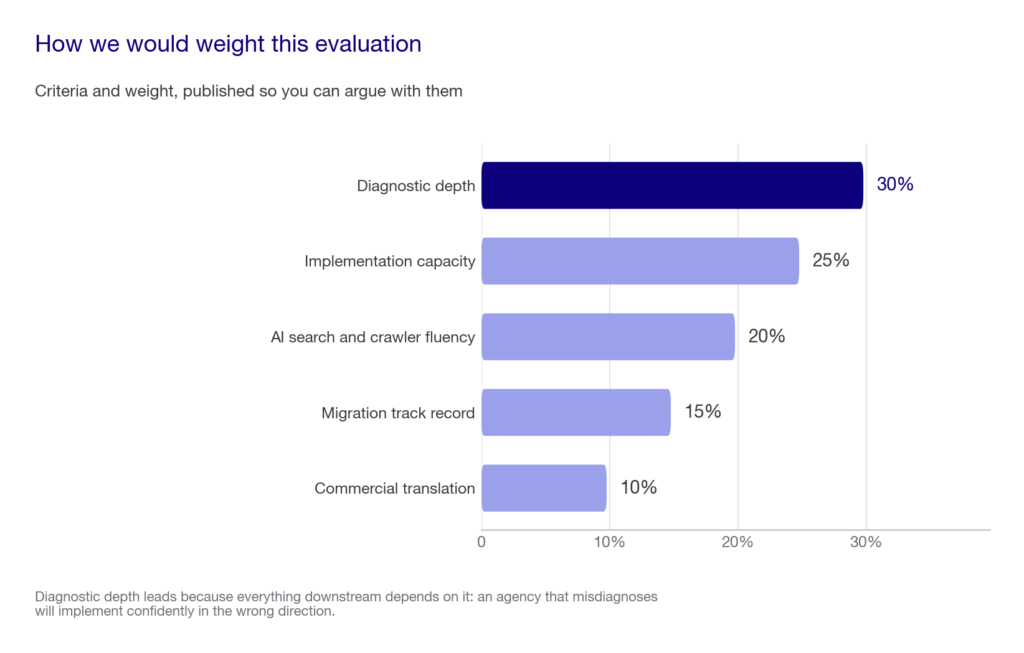
Here is how we would actually assess a technical SEO agency if we were buying one, weighted by what changes outcomes rather than what is easy to check.
| Area | Weight | What a strong agency demonstrates |
|---|---|---|
| Diagnostic depth | 30% | Works from log files and rendering tests rather than a crawler export, and can explain why an issue matters commercially rather than listing it by severity colour |
| Implementation capacity | 25% | Writes tickets your engineers can action, sits in sprint ceremonies, and can name who does the work rather than handing over a PDF |
| AI search and crawler fluency | 20% | Can discuss the distinct AI crawler agents, rendering implications for citation, and how retrievability differs from ranking |
| Migration track record | 15% | Has run migrations at your scale and will describe one that went badly and what they learned |
| Commercial translation | 10% | Connects technical fixes to traffic, pipeline or revenue rather than to a crawl score |
Diagnostic depth carries the most weight because everything downstream depends on it. An agency that misdiagnoses will implement confidently in the wrong direction, which is worse than doing nothing. Implementation capacity comes second because, in our experience, this is where most technical engagements actually die.
Ask for a redacted sample audit
Do this before the capabilities call, not after. Any serious agency will have one they can share with client details removed, and the ones that hesitate are telling you something.
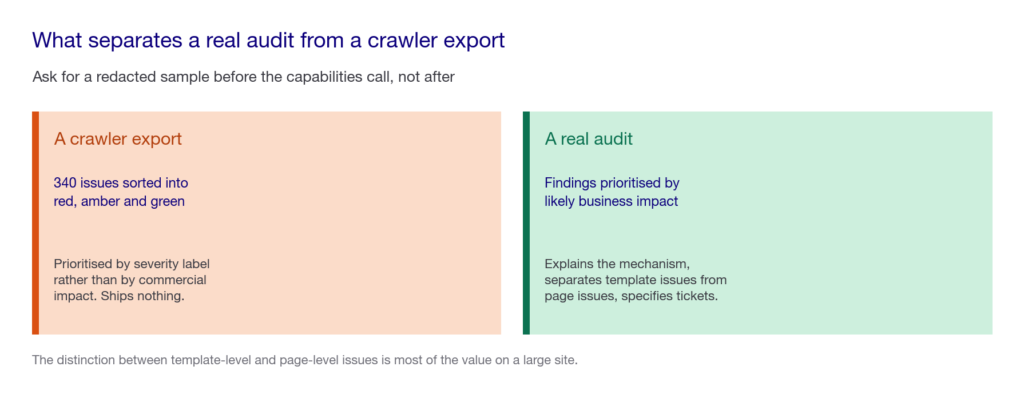
Read it and check one thing first. Are findings prioritised by likely commercial impact, or just listed by severity label? A list of 340 issues sorted into red, amber and green is a crawler export with a logo on it. Then look at whether each recommendation explains the mechanism. Your engineers need to understand why, not just what. Look for whether the fixes are specified concretely enough to become tickets. Finally, check whether it separates template-level issues from one-off page issues. On a large site that distinction is most of the value.
Then run the live test
Give them a real problem rather than a hypothetical one. Pick a query where a competitor consistently beats you, and ask them to explain why.
A strong answer will move between layers. It will cover how the competitor’s page renders, and whether the content survives without JavaScript. It will look at internal linking, and how much authority actually flows to that page. It will consider what third-party sources reinforce that competitor’s position. And it will end with what they would change, in what order, and what they would expect to see move.
A weak answer stays on one layer, usually the one visible in whatever tool they opened.
Then extend it to AI search. The same diagnostic applies. Ask them to run 20 to 30 real commercial questions from your category. Then have them show you five things: where you appear, which competitors appear instead, which sources influence those answers, why those sources win, and what they would change in 90 days. That conversation separates firms that have done this work from firms that have read about it. Usually within ten minutes.
A serious partner will also volunteer, unprompted, that AI answers are probabilistic. They vary between engines and between runs. So a single flattering screenshot proves nothing.
The weak playbook and the strong one
The weaker model is recognisable. Run a crawler, export the errors, format them into a deck, present the deck, hand the implementation problem back to you. It generates activity and very little change.
The stronger model looks different in sequence and in ownership. It starts with log files and rendering tests, to establish what is actually happening. It separates template problems from page problems. Fixing a template fixes thousands of pages at once. It prioritises by commercial impact rather than by error count. It writes tickets in your engineers’ language, then sits with them while they land. And it measures the result in traffic and pipeline rather than in a reduced error total.
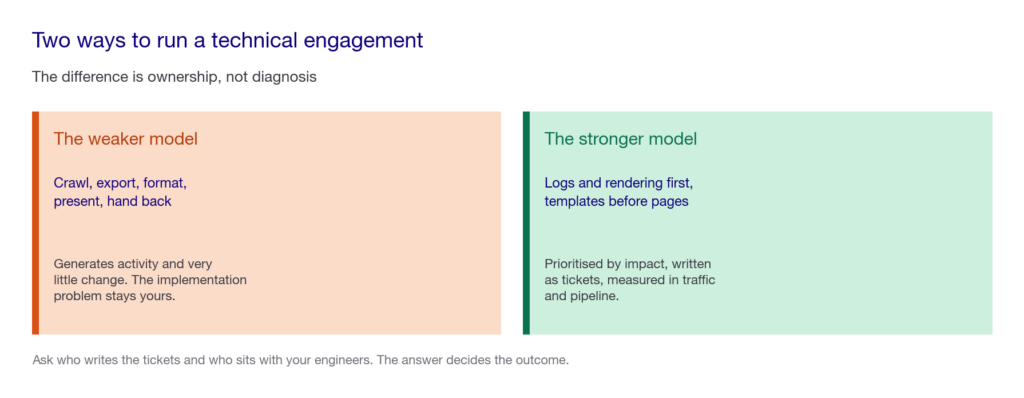
The difference is ownership. One model tells you what is wrong. The other one fixes it.
Red flags
An agency guaranteeing rankings should end the meeting. Google’s own guidance advises against providers who do, because third parties cannot access internal ranking systems. The same reasoning applies to anyone guaranteeing AI citations.
Beyond that, be cautious of a proposal that is entirely deliverables with no named owner for implementation. Be cautious of an audit priced as a fixed one-off with no path to shipping anything. Be cautious of anyone who cannot discuss AI crawler agents specifically. Or who treats rendering as a solved problem. Be cautious if every case study comes from a site an order of magnitude smaller than yours. Failure modes genuinely differ at scale. And be cautious of a firm that has never had a migration go wrong. That usually means they have not run many.
One of those is survivable. Three together is a pattern.
The five questions I would actually ask
- “Walk me through your last migration, including what went wrong.” Everyone has had one go sideways. The signal is whether they can describe it precisely, and what they changed afterwards.
- “Take one query where a competitor beats us and explain why.” This separates people who understand retrieval and authority from people reading a dashboard aloud.
- “Who writes the tickets, and who sits with our engineers?” Named roles and real capacity. If the answer is about strategy, implementation is still your problem.
- “How do you handle AI crawler access?” They should distinguish the OpenAI and Perplexity agents, and explain what blocking each one costs you.
- “What would you not bother fixing on our site?” A good technical partner prioritises ruthlessly. Anyone who wants to fix everything has not thought about cost.
If I reduced the whole decision to one principle: hire the firm that can explain the mechanism, not the one with the longest issue list.
Vetted options
Every description below came from that company’s own website on 18 August 2026, not from another roundup. That matters here more than usual, because this category has moved.
| Firm | Best for | AI search capability | Pricing |
|---|---|---|---|
| Pepper (own category) | Organic run as one function, platform plus growth team | Core to the product, five engines tracked | Not published |
| Ayima | Blue-chip enterprises, migrations, consultancy-style engagements | Explicit. AI Search Visibility, ChatGPT Optimization, Ayima AI co-pilot | Not published |
| Onely | JavaScript-heavy sites, traffic drop recovery, Core Web Vitals | GEO is their first listed service | Not published |
| iPullRank | Large sites needing deep structural audits | Leading. Relevance Engineering, query fan-out, passage retrieval | Not published |
| Seer Interactive | Data-heavy programmes in regulated sectors | GEO and AI consulting listed | Not published |
| Builtvisible | Brand and organic strategy, now under Brave Bison | Not stated on the site | Not published |
1. Pepper
We are an agentic organic growth engine, and it is worth being clear that a pure technical audit is not our centre of gravity. Our depth sits in content, authority and AI search visibility, run as one function over time rather than as a project.
The product is genuinely two things at once. Customers log in and run it themselves. They set up a workspace, define brand profile, competitors and personas, and connect GA4 and Search Console. Then they manage themes and prompts, read GEO analytics, and build and run their own agents in the Agent Atlas. And a growth team is attached to the account doing the work alongside them. On measurement we track Brand Visibility, Domain Prompt Presence and Share of Voice across five engines. The gap between the first two tells you whether your problem is awareness or citability.
We suit organisations that want organic run as a continuous function. Where we fall short: we do not publish pricing, so budget discovery is a conversation rather than a page. And if what you need is a deep technical audit of a JavaScript-heavy application and nothing else, one of the specialists below is a better fit than we are. We would tell you that on a sales call too.
2. Ayima
Ayima describes itself as “the expert-led ‘no fluff’ technical SEO consultancy”, delivering results “in even the most challenging of industries and corporate environments”. They say they operate “more like a management consultancy than a marketing agency”. Services span enterprise SEO, competitive SEO, site migrations and SEO for AI. Clients include British Airways, Wells Fargo, Macy’s, Verizon and QVC.
They have moved further into AI search than most technical specialists. Stated capability covers AI Search Visibility, ChatGPT Optimization and Knowledge Graph work, plus Ayima AI, a co-pilot built for technical SEO teams.
They suit large blue-chip organisations, particularly where a migration or a complex corporate environment is the problem. Where they fall short: the consultancy framing means you should confirm early who implements, since consultancy-style engagements can leave delivery with your team. No published pricing.
3. Onely
Onely leads with “we deliver organic growth through practical innovation”, and Generative Engine Optimization now sits as their first listed service. Their technical reputation is the substance though. JavaScript SEO, Core Web Vitals, information architecture and traffic drop recovery are all named explicitly. Clients include eBay, Oracle, Atlassian, Ikea and Miele.
They suit organisations with a genuinely technical problem. A JavaScript-heavy application that renders badly, a migration that went wrong, or a traffic drop nobody can explain.
Where they fall short: they promise “measurable improvements in AI visibility and business outcomes within weeks”, which is a faster claim than we would make for anything involving earned authority. Ask precisely what is being measured in that window. No published pricing.
4. iPullRank
iPullRank calls itself a “pioneering enterprise and mid-market AI search agency”, with the line “we don’t optimize for blue links. We make your brand the answer.” Services span Relevance Engineering, GEO, AI search strategy, content strategy, technical SEO and content engineering. Clients include Target, American Express, Adidas and CVS Pharmacy.
Their public material discusses query fan-out, passage retrieval, embeddings and synthesis. Almost nobody else in this category matches that specificity. If you want someone who can explain why something happens rather than just that it happened, they are a strong fit.
Where they fall short: that same depth suits organisations with the internal capacity to act on sophisticated recommendations. If you need hands rather than analysis, press hard on execution capacity. No published pricing.
5. Seer Interactive
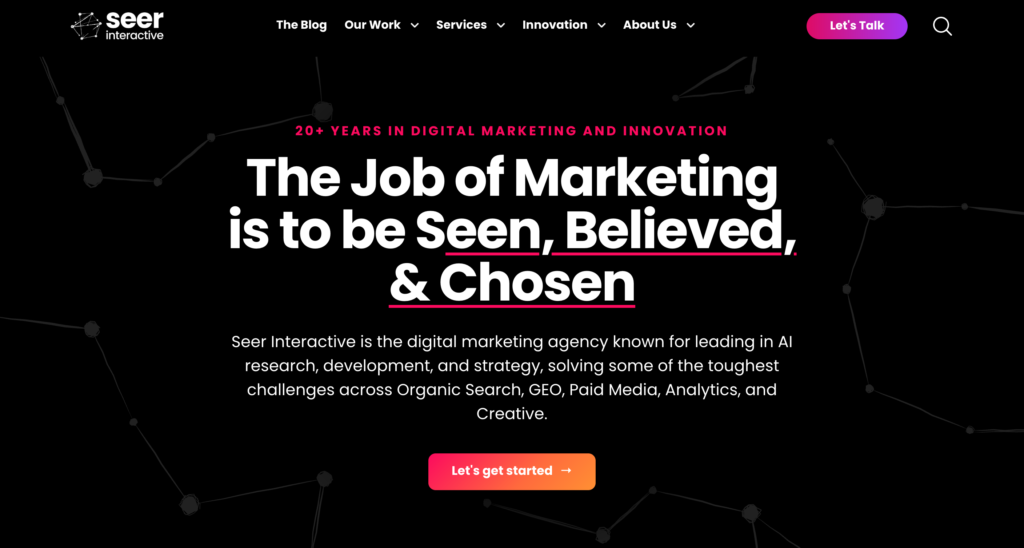
Seer Interactive blends “expert consulting with data-qualified recommendations” across SEO, paid media, analytics, creative, CRO, GEO and AI consulting. They lead on proprietary data, citing SeerSignals and 8.2 billion rows of SERP data. They also report 97% client retention and an NPS of 71.
They suit data-heavy programmes, particularly in SaaS, healthcare, banking and higher education. Analytical rigour matters as much as output there.
Where they fall short: technical SEO is one service among many rather than the centre of the offer. GEO also appears as a listed service without much public explanation of method. The consulting-led model also means confirming who implements. No published pricing.
6. Builtvisible
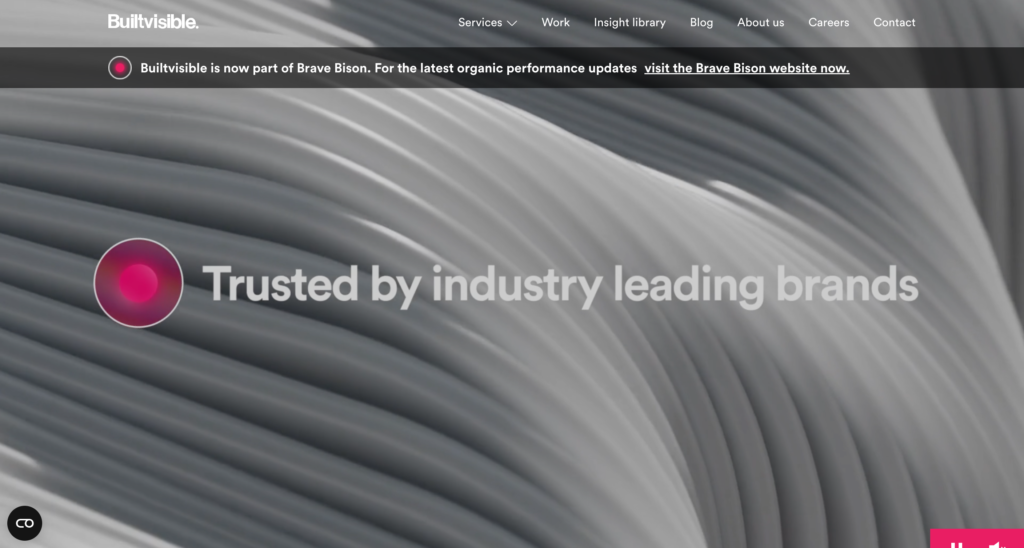
Builtvisible describes itself as delivering “brand and business growth through search-based customer journeys”, operating “at the intersection of brand and performance marketing”. Three services are listed: strategy and planning, campaigns and brand activation, and consultancy and transformation. They are also now part of Brave Bison.
There is no explicit technical SEO discussion on the homepage, and no stated AI search, GEO or AEO capability. Case studies reference GLL, Icelandair and Towergate.
They suit brand-led organic strategy work. Where they fall short: if you arrived here from a roundup describing them as a technical SEO specialist, verify current scope directly, because the positioning has moved. No published pricing.
What this costs, and what actually drives the number
Nobody here publishes a rate card. So treat any figure quoted elsewhere as someone’s estimate rather than a price.
What we can tell you is what moves the number. Site size and technical debt come first. A 200,000-page site with a decade of accumulated redirects is a different job from a clean 15,000-page site. Whether a migration is in scope comes second, and it is the largest variable. Migrations carry both the most work and the most risk. Then whether implementation is included or handed back to you, which can double or halve the engagement. And finally whether AI search measurement is bundled or sold separately.
The cost nobody quotes is your own engineering time. Every recommendation-led engagement assumes someone internal ships the work. An audit surfacing 200 fixes nobody can action adds a backlog, not a capability. We have inherited plenty of accounts in exactly that state.
Pepper does not publish pricing either, so we are not going to pretend otherwise. What we will say is that the ratio matters more than the total. If you are spending more on being told what to fix than on fixing it, the shape of the engagement is wrong.
What nobody should promise you
Guaranteed rankings or guaranteed AI citations. Nobody has access to the ranking systems, and Google says so about its own.
A migration with no risk. Migrations move rankings, and the honest promise is a plan that limits the downside and a rollback path, not an assurance that nothing will move.
Results in weeks. Technical fixes can land quickly, but the measurement window on a large site is quarters, particularly where indexation has to catch up.
A single score that captures technical health. Crawl scores and site health percentages are directional at best, and optimising for them is how teams end up fixing 300 trivial issues while the rendering problem sits untouched.
That an audit alone will fix your visibility. Most of what decides your category’s AI answers is published on domains you do not own, and no technical work reaches it.
Frequently asked questions
What does a technical SEO agency do?
A technical SEO agency makes sure search systems can find, fetch, understand and trust your pages. Work spans crawl efficiency, indexation, rendering, site architecture, structured data, performance, international setup and migrations, plus log file analysis on larger sites.
How much does a technical SEO agency cost?
None of the firms compared here publish pricing, so budget discovery is always a conversation. The largest variables are site size, existing technical debt, whether a migration is in scope, and whether implementation is included or handed back to your team.
How do I evaluate a technical SEO agency?
Ask for a redacted sample audit before the capabilities call, then give them a real query where a competitor beats you and ask them to explain why. A strong answer moves between rendering, internal linking and third-party authority rather than staying on one layer.
Do technical SEO agencies handle AI search?
Increasingly, though depth varies. Ayima, Onely and iPullRank all name AI search or GEO capability explicitly. Ask specifically whether they can discuss the distinct OpenAI and Perplexity crawler agents, since that reveals real fluency quickly.
Is technical SEO still important with AI search?
More than before. A 2026 Stanford-led evaluation found retrieval failures caused over 70% of chatbot errors, meaning being fetchable and parseable determines whether you appear in AI answers at all. Technical work is now upstream of AI visibility.
How long does technical SEO take to show results?
Individual fixes can show within weeks, but a full programme on a large site takes two to three quarters, because indexation lags and approval cycles are slow. Migrations have their own timeline and usually dip before they recover.
Should I hire a specialist or a full-service agency?
Hire a specialist if your problem is genuinely technical, such as a JavaScript rendering issue or a migration. Choose full-service if technical is one of several gaps, since coordinating three vendors carries its own cost.
What is the most common technical SEO mistake at scale?
Fixing pages instead of templates. On a large site most pages are generated, so the leverage is in the template. Teams that work URL by URL burn quarters achieving what one template change would have delivered.
Where to go next
Before you brief anyone, do one thing yourself: check what crawlers are actually doing on your site. Pull your log files and look at where crawl attention goes. If a meaningful share is landing on faceted URLs, deep pagination or redirect chains, you have found your first conversation topic, and you will be able to tell immediately which agencies understand it.
Then check your AI crawler access, because it is the fastest-moving part of this discipline and the easiest to get wrong. Our guide to robots.txt for AI crawlers covers the specific agents, and can AI search bots crawl your website is the check we run first on every new account.
If your site is large, our enterprise SEO guide covers the governance and template questions that decide whether technical work ever ships. And if you want to see where your pages currently stand in AI answers, see where you show up across ChatGPT, Perplexity, Gemini, Claude and AI Overviews. Customers run this themselves in the platform, with a growth team attached. Our Acceldata case study documents 6X organic traffic growth and top-three keywords rising from 85 to more than 300.
One honest exit. If your technical foundation is sound and your problem is that engines mention you but never cite your pages, a technical SEO agency will not fix it. That is a citability problem and it lives in earned media. Hiring the wrong specialism for it costs you two quarters. We would rather point that out now.
Sources
Agency descriptions were taken from each company’s own website on 18 August 2026, not from competing roundups. Every study cited was published in 2026.
- Suzgun et al., Evaluating Commercial AI Chatbots as News Intermediaries, arXiv, 21 May 2026. 2,100 factual questions across six chatbots, February 2026. Tested on news rather than commercial queries, so read the mechanism rather than the exact rates.
- Google Search Central, AI features and your website, 15 May 2026, including the advice against providers guaranteeing rankings.
- OpenAI crawler documentation and Perplexity bot documentation.
Latest Blogs
The research pulls in two directions. Fan-out rewards covering many adjacent questions; absorption research finds longer pages get used. The resolution is that the passage competes, not the page.
Seven documented changes, not seven predictions. Google switched two rich results off, shipped two new AI reports, and added a channel to Analytics. Here is what actually moved and what it means.
Content chunking is the process of splitting a page into smaller pieces so a machine can retrieve one of them. Here is the part most articles get wrong: chunking is something engines do to your page, not something you do to it. You do not choose the chunk size.
Get your hands on the latest news!

Similar Posts
SEO
11 mins read
What is internal linking? Meaning, and what changed for AI search
SEO
15 mins read
Primary and secondary keywords in 2026: what they were always for, and what changes now
Content Creation
11 mins read