Enterprise SEO in 2026: the complete guide for sites over 10,000 pages
Enterprise SEO is what organic search becomes when the constraint stops being knowledge and starts being coordination. Past roughly 10,000 pages, several things change at once. You cannot inspect your own site by hand. You cannot fix pages individually. And you almost certainly cannot ship a change without three other teams agreeing to it.
That last part is the one most guides skip, and it is the one that decides whether a programme works. We have run organic for more than 250 enterprises across eight years, and the pattern is consistent: large organisations are rarely short of good SEO ideas. They are short of a path from a good idea to a shipped change.
This guide is written for that reality. It covers what genuinely differs at scale, what breaks first, how AI search changes the picture, and how to structure a programme that survives contact with a real organisation.
Key takeaways
- Scale changes the unit of work. You stop optimising pages and start optimising templates, because a single template flaw multiplies across thousands of URLs.
- Crawl becomes an economy. Google allocates finite attention. On a large site, wasted crawl is the difference between fresh pages and pages that never get seen.
- Governance decides throughput. The technical backlog is rarely the bottleneck. Approval cycles are.
- AI search is now part of the brief. Forrester’s 2026 survey of 18,000 buyers found generative AI use in purchasing rose from 89% to 94%. It also reports companies seeing 10% to 40% traffic declines.
- Most citations come from outside your site. Muck Rack’s May 2026 analysis of over 25 million cited links found 84% of AI citations came from earned media, which no amount of on-site work reaches.
What makes SEO “enterprise”
The honest threshold is not a page count, though 10,000 is a reasonable marker. It is the point at which three things become true at the same time.
The first is that you can no longer hold the site in your head. Somewhere past a few thousand URLs, nobody knows what all the pages are, which ones matter, or which ones should not exist. Discovery becomes a data problem rather than a browsing exercise.
The second is that changes stop being individual. On a small site you fix a title tag. On a large one you change a template, and eleven thousand title tags change with it. Several hundred of those you did not think about. The upside is leverage. The downside is that mistakes scale just as efficiently as improvements.
The third is that you have stakeholders. Legal has an opinion on claims. Brand has an opinion on language. Engineering owns the release cycle and has its own roadmap. Regional teams have their own sites and their own priorities. None of these people report to whoever owns SEO, and all of them can stop a change.
Once all three are true, you are doing enterprise SEO, whether your site has 8,000 pages or 800,000. The tactics from a 50-page site do not simply scale up, because the failure modes are different in kind rather than in degree.
Crawl is an economy, and you are probably wasting it
This is the first thing that genuinely changes at scale. Most teams underestimate it, because it is invisible in every standard report.
Search engines allocate a finite amount of attention to your site. On a small site that limit never binds, so nobody thinks about it. On a large site it binds constantly, and every URL a crawler spends time on is a URL it did not spend on something that mattered.
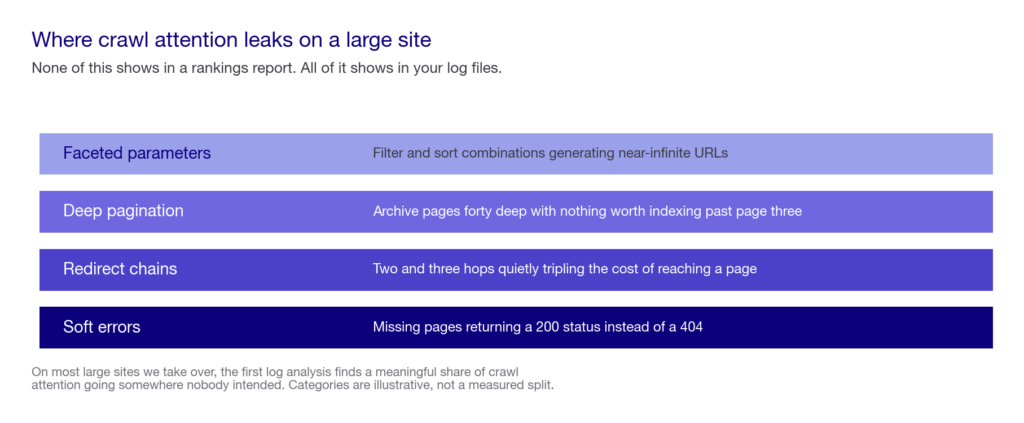
The waste is rarely where people look for it. It accumulates in a few predictable places. Faceted navigation generating near-infinite parameter combinations. Paginated archives forty pages deep with nothing worth indexing past page three. Staging or filter URLs that leaked into the sitemap. Soft 404s returning a 200 status. And redirect chains that quietly triple the cost of reaching a page. None of that shows up in a rankings report. All of it shows up in your log files.
Log file analysis is the least glamorous work in enterprise SEO, and one of the highest-yield. It tells you what crawlers actually did, rather than what your sitemap suggested. On most large sites we take over, the first log analysis finds a meaningful share of crawl attention going somewhere nobody intended.
The fix combines four things. Block what should never be crawled. Consolidate what duplicates. Flatten redirect chains. And make sure internal linking reflects what you actually consider important. That last one matters more than people expect, because internal links are the strongest signal you fully control about which of your own pages deserve attention.
Our guide to crawl budget for AI bots covers how this changes when the crawler is not Googlebot, which it increasingly is not.
Think in templates, not pages
The second shift is conceptual, and it reframes almost everything else.
On a large site, most pages are not written individually. They are generated by a template with variable content poured into it. Product pages, location pages, category pages, documentation, job listings. That means the highest-leverage SEO work is not editing pages. It is editing the thing that produces them.
Get a template right and every page it generates improves at once. Get it wrong and you have shipped the same mistake several thousand times, which is a genuinely unpleasant thing to explain in a Monday meeting.
The practical discipline is to audit by template rather than by URL. Pull a representative sample from each template, diagnose it as a class, and fix the class. A large site often has only a dozen or so templates behind thousands of pages, which makes an intimidating problem tractable.
Two template-level failures are worth naming because they show up constantly. The first is thin variation. A template produces thousands of pages differing by one variable and saying nothing distinct, which is how large sites end up competing with themselves. The second is missing evidence. The template has nowhere to put the specific proof that would make a page worth citing, so everything it generates is structurally generic.
That second one has become much more expensive since AI search arrived, for reasons we will come to.
Governance is the real timeline
Here is the part that does not appear in most enterprise SEO guides, and the part that decides whether yours works.
The bottleneck in a large organisation is almost never the audit. It is everything between the audit and production. A recommendation has to be understood by someone who did not attend the meeting. Then it is prioritised against roadmap items with louder sponsors, and scoped by engineering. Legal reviews it if it touches claims. Brand approves it if it touches language. Finally it is scheduled into a release train that may run fortnightly.
We have seen excellent audits sit untouched for eleven months. Not because anybody disagreed with them, but because nobody owned the path.
So the design question for an enterprise programme is not “what should we fix”. It is “what can we actually ship, through which door, and who signs it off”. A few structural answers work reliably.
Give SEO a named owner with an actual mandate, not a dotted line into three teams. Ambiguous ownership produces polite inaction. Our breakdown of who owns AI search internally covers the reporting-line question in more detail, and it applies equally to classic SEO at scale.
Get SEO into the definition of done for engineering work, rather than raising issues after release. Catching a template regression in review is cheap. Catching it after it has propagated across every page that template generates is not.
And pre-agree the small stuff. A standing approval for a defined class of low-risk changes, such as metadata patterns or internal linking rules, removes an enormous amount of friction. If every change needs its own approval conversation, you will ship a fraction of what you plan.
What AI search changed for large sites
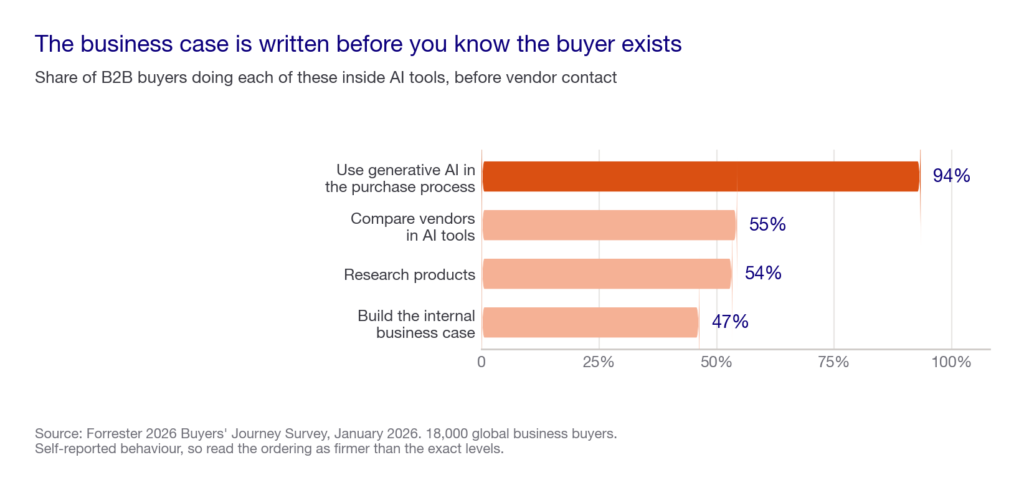
Everything above still applies. What changed is that buyers now research inside AI answers before they ever reach you. Forrester’s 2026 Buyers’ Journey Survey covered 18,000 global business buyers. It found generative AI use in the purchase process rose from 89% in 2025 to 94% in 2026. Twice as many buyers named AI as their most meaningful research source than named any other. Specifically, 55% compare vendors inside AI tools, 54% research products there, and 47% build the internal business case before contacting a vendor at all.
The same research reports companies seeing 10% to 40% traffic declines as research shifts into engines. For an enterprise team, that creates a genuinely dangerous reporting situation. Sessions fall, the programme looks like it is failing, and the natural response is to cut exactly the work that was starting to matter.
There is a second change, and for large sites it is the sharper one. Muck Rack’s May 2026 analysis of more than 25 million cited links across ChatGPT, Claude and Gemini found 84% of AI citations came from earned media, with paid and advertorial at 0.3%. Which means most of what decides your category’s answers is published on domains you do not control.
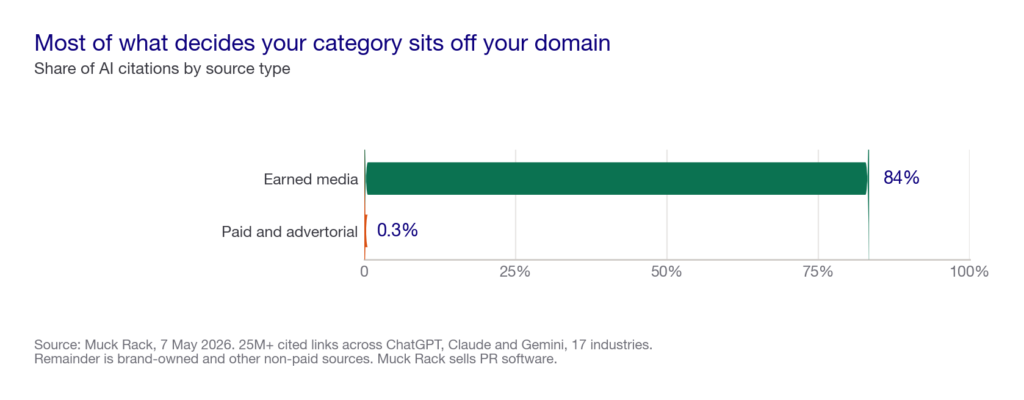
Large organisations tend to be structurally bad at this, and it is worth being blunt about why. On-site work has a clear owner and a clear process. Earned authority sits between SEO, PR, communications and product marketing, so it frequently belongs to nobody. The teams that do it well have usually made someone explicitly responsible for how third parties describe the company.
The technical half is also different now
The good news for enterprise teams is that a lot of AI search readiness is technical work you already know how to do.
A Stanford-led evaluation of six commercial chatbots, published May 2026 and covering 2,100 factual questions, found that retrieval failures rather than reasoning errors caused more than 70% of all mistakes. When the models retrieved the right source, they usually got the answer right. Which means being findable and parseable matters more than being eloquent.
Practically, that means server-side rendering anything you want cited, since client-side rendering is still handled inconsistently across engines. It means keeping a claim and its evidence in the same block, so a statistic three paragraphs from its source can still be lifted cleanly. And it means being deliberate about crawler access. OpenAI runs OAI-SearchBot, ChatGPT-User and GPTBot as separate agents with separate jobs. Likewise, Perplexity runs PerplexityBot and Perplexity-User for scheduled indexing and live fetching. Blocking each fails differently, and on a large site a robots.txt decision made two years ago by someone who has since left is a genuinely common cause of invisibility.
Google’s official AI search guidance, published 15 May 2026, is worth reading in full and worth reading carefully. It confirms that AI Overviews and AI Mode run on core Search ranking systems with no separate AI index, and it explicitly mythbusts llms.txt, content chunking, AI-specific rewrites and structured-data over-optimisation. Google is right about Google. It is also only describing Google. ChatGPT, Perplexity and Claude retrieve differently, so a programme built solely around that guidance ends up blind on several surfaces.
What to measure when the numbers stop agreeing
Enterprise reporting has always had a tension between what is measurable and what matters. AI search made it worse, and the honest answer is to report on more than one layer.
Keep the classic layer, because it still works. Rankings on priority terms, organic sessions, conversions, revenue where you can attribute it. It is imperfect and it is not going away.
Add a visibility layer, because the classic one now systematically undercounts. Track three things. Brand Visibility is how often engines name your brand across a defined prompt set. Domain Prompt Presence is how often they cite a page from your domain. Share of Voice is your slice of category mentions. The gap between the first two is the single most useful diagnostic available at enterprise scale, because it separates an awareness problem from a citability problem, and those have completely different owners.
Add a technical health layer, because at scale it is a leading indicator. Crawl distribution across templates, index coverage against the pages you actually care about, rendering success, and Core Web Vitals by template rather than sitewide averages that hide everything.
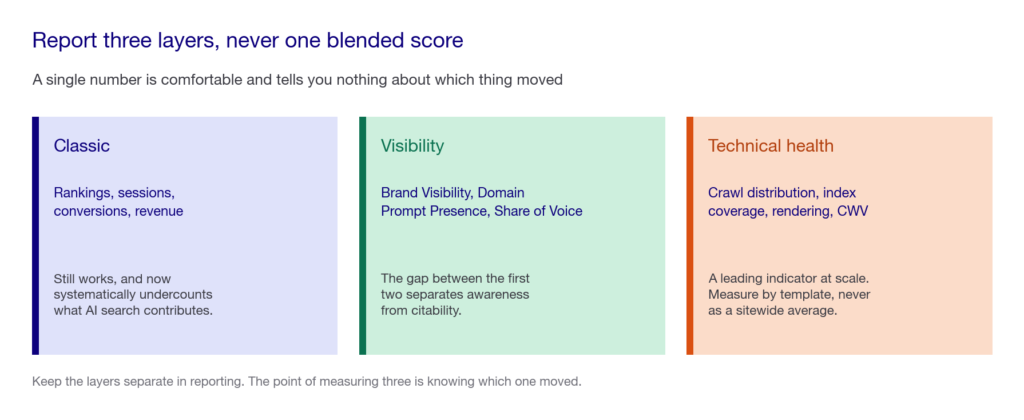
Then keep them separate in your reporting. A blended score is comfortable and useless. The whole point of measuring three layers is to know which one moved.
If you want the full metric set and how to read each one, our guide to what actually matters in AI search measurement covers it in depth.
Seeing this on your own domain is usually more persuasive than reading about it. Book a growth audit and we will run your category’s prompt set and show you where your pages sit against the sources currently winning those answers.
How to sequence an enterprise programme
The order matters more than the list, because doing these in the wrong sequence wastes quarters.
Start with discovery and access. Log files, crawl data, index coverage, template inventory, and the political map of who can approve what. You are building a picture of both the site and the organisation, and the second one is usually less documented than the first.
Then fix the foundation. Crawl waste, redirect chains, rendering, template-level errors, internal linking that reflects actual priorities. This work is unglamorous and it makes everything after it more effective, because there is no point earning attention for pages an engine cannot process.
Then work the templates. Improve the classes that generate the most valuable pages, add the structural slots for evidence and specificity, and kill the thin variation that has you competing with yourself.
Then build authority off-site, which will take longest and needs starting earliest for exactly that reason. This is the 84%, and it is the part large organisations consistently start too late because it does not feel like SEO.
And measure across all three layers throughout, so you can tell a model update from a performance change, and a citability problem from an awareness one.
Expect two to three quarters before the picture genuinely shifts. Anyone promising materially faster on a site this size is describing paid media or has not worked at this scale.
What nobody should promise you
Nobody can guarantee rankings, and Google says so plainly about its own systems, on the grounds that third parties do not have access to them. The same applies to AI citations, where nobody has that access either.
Be equally sceptical of a single composite score covering both classic and AI visibility. It will move gently upward while hiding the one thing you needed to know.
Nobody should promise results in a quarter on a site of this size, given that approval cycles alone can consume most of one. And nobody should promise that a technical audit alone will fix your visibility, because most of what decides your category’s answers is not on your site.
Finally, treat any universal benchmark as fiction. There is no correct crawl ratio, no right number of indexed pages, no target visibility score. There is your trend, and your distance from the leader in your category.
Frequently asked questions
What is enterprise SEO?
Enterprise SEO is organic search for large, complex sites, usually over 10,000 pages, where changes happen at template level and multiple stakeholders must approve them. The distinguishing feature is scale and coordination rather than a different set of tactics.
How is enterprise SEO different from regular SEO?
The tactics overlap heavily, but the constraints differ. You optimise templates rather than pages, crawl budget becomes a real limit, and the bottleneck shifts from knowing what to fix to getting changes approved and shipped.
How many pages makes a site “enterprise”?
Around 10,000 pages is a common marker. However, the real threshold is when you can no longer inspect the site by hand, changes happen at template level, and multiple teams must sign off. Some 8,000-page sites qualify and some 50,000-page sites do not.
What is crawl budget and does it matter?
Crawl budget is the finite attention search engines give your site. On small sites it never binds. On large sites, wasted crawl on faceted URLs, deep pagination and redirect chains directly reduces how quickly your important pages get discovered and refreshed.
Do enterprise sites need to worry about AI search?
Yes. Forrester found 94% of B2B buyers now use generative AI during purchases, and companies reporting 10% to 40% traffic declines as research moves into engines. Enterprise sites also tend to have technical debt that blocks AI crawlers specifically.
How long does enterprise SEO take to show results?
Expect two to three quarters for meaningful movement. Technical fixes can land faster, but approval cycles are slow and authority compounds gradually. Any agency promising material results in one quarter has not worked at this scale.
Should enterprise SEO be in-house or agency?
Most successful programmes are hybrid. In-house teams carry product context and organisational access that agencies cannot replicate quickly, while agencies bring surge capacity and specialist skills like digital PR that are hard to recruit.
What is the biggest cause of enterprise SEO failure?
Governance, not tactics. Excellent audits routinely sit unimplemented because nobody owned the path from recommendation to production. Fix ownership and approval routes before commissioning more analysis.
Where to go next
If you are inheriting a large site, resist the urge to start with a full audit. Start by finding out what crawlers are actually doing and who can approve a change, because those two facts determine what is realistically achievable in your first two quarters.
If you already have a programme and the numbers have gone flat, run the visibility diagnostic before you change anything else. Compare how often engines mention your brand against how often they cite your domain. If mentions are healthy and citations are not, no amount of on-site work will fix it, and the answer sits in earned media instead.
Our enterprise playbook for AI search covers the full sequence for large B2B organisations, and can AI search bots crawl your website is the technical check we run first on every enterprise account.
To see where your pages stand in the answers your buyers are reading, see where you show up across ChatGPT, Perplexity, Gemini, Claude and AI Overviews. Customers run this themselves in the platform, with a growth team attached to do the work alongside them. Our Acceldata case study documents 6X organic traffic growth and top-three keywords rising from 85 to more than 300.
One honest note to close on. If your organisation cannot currently ship a template change inside a quarter, more SEO analysis is not your bottleneck and buying more of it will not help. Fix the path to production first. We would rather tell you that than sell you an audit that joins the queue.
Sources
Every study cited here was published in 2026.
- Forrester, 2026 Buyers’ Journey Survey, January 2026. 18,000 global business buyers. Forrester sells research subscriptions.
- Muck Rack, Earned media still drives 84% of AI citations, 7 May 2026. More than 25 million cited links across 17 industries. Muck Rack sells PR software.
- Suzgun et al., Evaluating Commercial AI Chatbots as News Intermediaries, arXiv, 21 May 2026. 2,100 factual questions across six chatbots, February 2026.
- Google Search Central, AI features and your website, 15 May 2026.
- OpenAI crawler documentation and Perplexity bot documentation.
Latest Blogs
The research pulls in two directions. Fan-out rewards covering many adjacent questions; absorption research finds longer pages get used. The resolution is that the passage competes, not the page.
Seven documented changes, not seven predictions. Google switched two rich results off, shipped two new AI reports, and added a channel to Analytics. Here is what actually moved and what it means.
Content chunking is the process of splitting a page into smaller pieces so a machine can retrieve one of them. Here is the part most articles get wrong: chunking is something engines do to your page, not something you do to it. You do not choose the chunk size.
Get your hands on the latest news!

Similar Posts
SEO
11 mins read
What is internal linking? Meaning, and what changed for AI search
SEO
15 mins read
Primary and secondary keywords in 2026: what they were always for, and what changes now
Content Creation
11 mins read